

Lettere di molte valorose donne,
nelle quali chiaramente appare non esser ne di eloquentia ne di dottrina alli huomini inferiori.
- Venice: Gabriel Giolito de' Ferrari, 1548-49
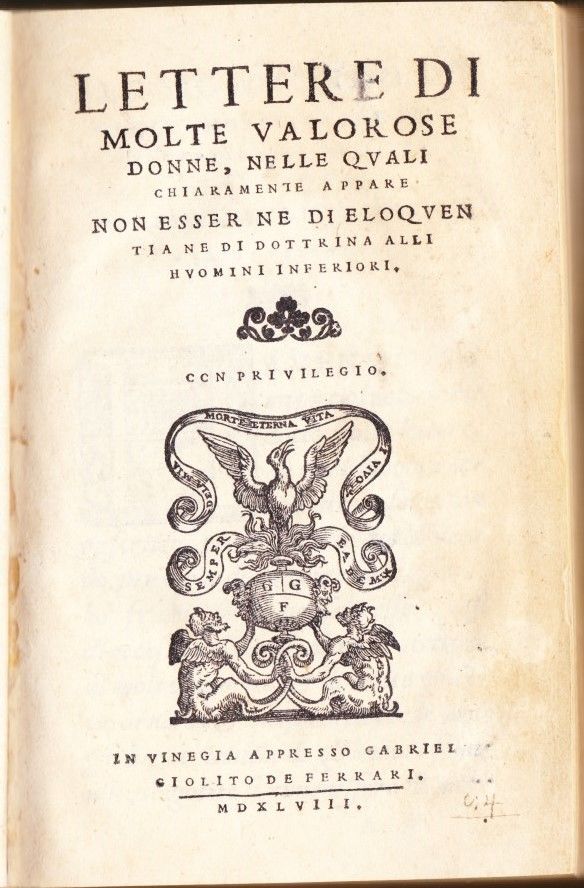
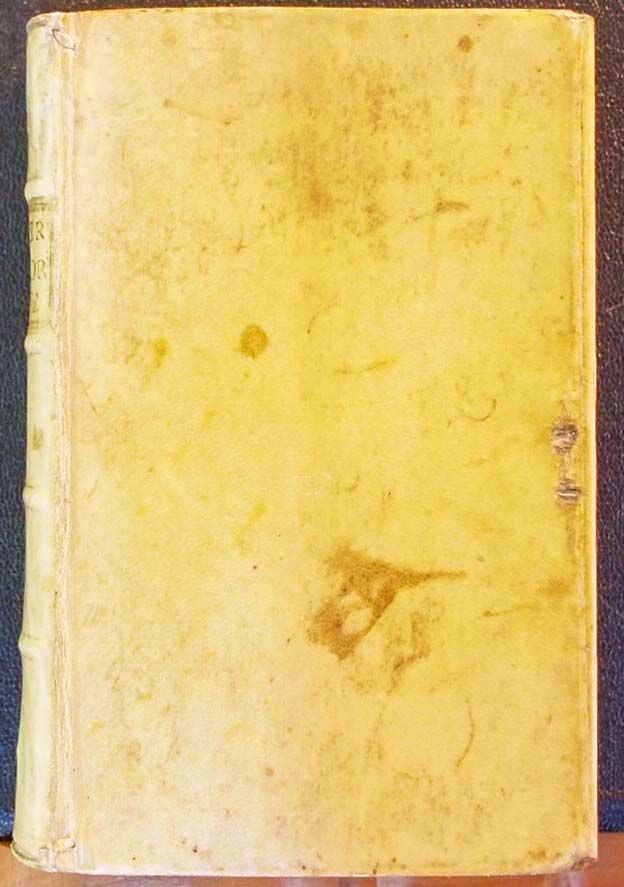
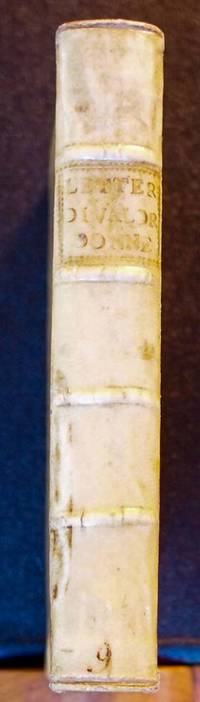
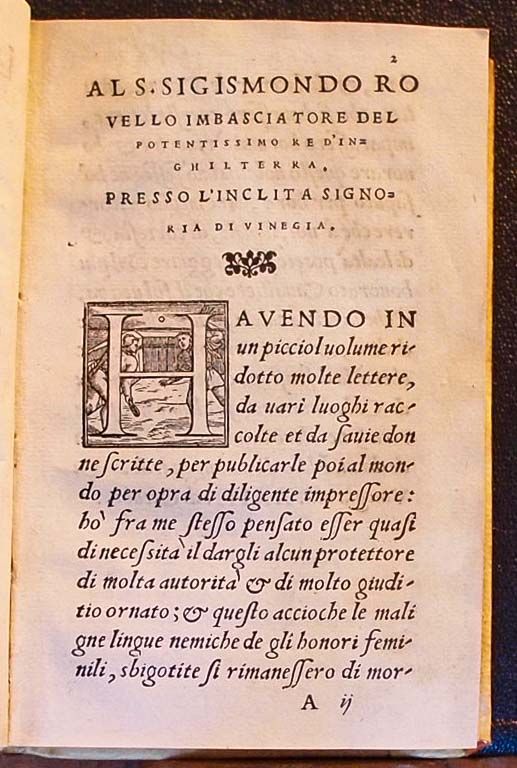
Venice: Gabriel Giolito de' Ferrari, 1548-49. First edition. Very Good. Octavo (17cm); 161 [3] leaves (including final blank). Printer's device on title page and on verso of last leaf. Woodcut initial H on f.2 populated with racquetball players, and woodcut initial D on f.3 by the figure of a woman petting a boar. Italic and Roman type. Slight yellowing, light water stain to some lower outer corners. A very good copy in c.1750 polished vellum, gilt-stamped title on spine. C16 pen traces. Occasional scattered foxing.
References: Adams, L-562; Bongi I, 213-214; BM Italian, 376; Melzi II, 115; Grendler, 14. See also, Meredith K. Ray, "Writing Gender in Womens Letter Collections of the Italian Renaissance" (Toronto, 2009); Serena Pezzini, "Dissimulazione e paradosso in Ortensio Lando," in "Italianistica" 31:1 (2002) pp. 67-83; Natalina Bellucci, "Lettere di molte valorose donne...e di alcune pettegolette, ovvero: di un libro di lettere di Ortensio Lando," in Quondam, ed., "Le carte messaggere: rhetorica e modelli di communicazione epistolare..."(Rome, 1981) pp. 255-76.
Lettere di molte valorose donne is a collection of model letters written by women to other women, demonstrating (in the context of the "querelle des femmes") that women are in no way inferior to men in eloquence and education. Topics range widely, embracing the commonplaces but with the addition of issues such as marriage, childbirth, the struggle for education, and the attractiveness of men, or lack thereof. The text seems to provide an intimate glimpse into a female network in which advice and comfort are shared.
Authorship of Lettere di molte valorose donne puzzles scholars to this day. Published by the powerful Venetian house of Gabriel Giolito de' Ferrari, there is no attribution on the title page or in the front matter. Lando is only mentioned in the gratulatory verses at the end of the book, where his famous peers, Dolce, Aretino, Sansovino, and Pestalossa, celebrate him for the "copious sweat and considerable personal expenses" that he put into compiling the book. Succumbing to historical bias, nineteenth-century scholarship denied the authorship of the letters from the women who wrote them, insisting that Lando wrote the entire text. Recent research restores the texts to their female writers, and takes the view that Lando, in collaboration with his great friend and sometime patron, Lucrezia Gonzaga, may have done some heavy editing.
The eccentric, peripatetic humanist Ortensio Lando was never comfortable with the noble courtesies of his Renaissance world. During his lifetime (ca. 1510-ca. 1559), he was in the top tier of Italian public intellectuals, but unlike his still-famous peers (Dolce, Sansovino, Bembo) he refused to buckle down. He attached himself to Rabelais's circle in Lyon while he worked in Gryphius's print shop there. He was especially close with Étienne Dolet there, the champion of free speech later hanged for heresy. He rambled on to Erasmus's Basel, and then to Germany, and returning to Italy he drifted through various Italian university towns (from Lucca, to Pisa, to Trent). He spent about ten years in Venice, and died, probably in Naples, in the late 1550s. Sometimes he published under his own name, but he frequently used pseudonyms or indeed no name. Despite this unsettled existence, he liked to call himself "Tranquillo."
References: Adams, L-562; Bongi I, 213-214; BM Italian, 376; Melzi II, 115; Grendler, 14. See also, Meredith K. Ray, "Writing Gender in Womens Letter Collections of the Italian Renaissance" (Toronto, 2009); Serena Pezzini, "Dissimulazione e paradosso in Ortensio Lando," in "Italianistica" 31:1 (2002) pp. 67-83; Natalina Bellucci, "Lettere di molte valorose donne...e di alcune pettegolette, ovvero: di un libro di lettere di Ortensio Lando," in Quondam, ed., "Le carte messaggere: rhetorica e modelli di communicazione epistolare..."(Rome, 1981) pp. 255-76.
Lettere di molte valorose donne is a collection of model letters written by women to other women, demonstrating (in the context of the "querelle des femmes") that women are in no way inferior to men in eloquence and education. Topics range widely, embracing the commonplaces but with the addition of issues such as marriage, childbirth, the struggle for education, and the attractiveness of men, or lack thereof. The text seems to provide an intimate glimpse into a female network in which advice and comfort are shared.
Authorship of Lettere di molte valorose donne puzzles scholars to this day. Published by the powerful Venetian house of Gabriel Giolito de' Ferrari, there is no attribution on the title page or in the front matter. Lando is only mentioned in the gratulatory verses at the end of the book, where his famous peers, Dolce, Aretino, Sansovino, and Pestalossa, celebrate him for the "copious sweat and considerable personal expenses" that he put into compiling the book. Succumbing to historical bias, nineteenth-century scholarship denied the authorship of the letters from the women who wrote them, insisting that Lando wrote the entire text. Recent research restores the texts to their female writers, and takes the view that Lando, in collaboration with his great friend and sometime patron, Lucrezia Gonzaga, may have done some heavy editing.
The eccentric, peripatetic humanist Ortensio Lando was never comfortable with the noble courtesies of his Renaissance world. During his lifetime (ca. 1510-ca. 1559), he was in the top tier of Italian public intellectuals, but unlike his still-famous peers (Dolce, Sansovino, Bembo) he refused to buckle down. He attached himself to Rabelais's circle in Lyon while he worked in Gryphius's print shop there. He was especially close with Étienne Dolet there, the champion of free speech later hanged for heresy. He rambled on to Erasmus's Basel, and then to Germany, and returning to Italy he drifted through various Italian university towns (from Lucca, to Pisa, to Trent). He spent about ten years in Venice, and died, probably in Naples, in the late 1550s. Sometimes he published under his own name, but he frequently used pseudonyms or indeed no name. Despite this unsettled existence, he liked to call himself "Tranquillo."
Details
Title
Lettere di molte valorose donne,
Author
Lando, Ortensio; Lucrezia Gonzaga; eds.
Condition
Very Good
Publisher
Gabriel Giolito de' Ferrari: Venice
Date
1548-49
Edition
First edition