

The Liberator. Vol. XVII. No. 40
- Boston , 1848
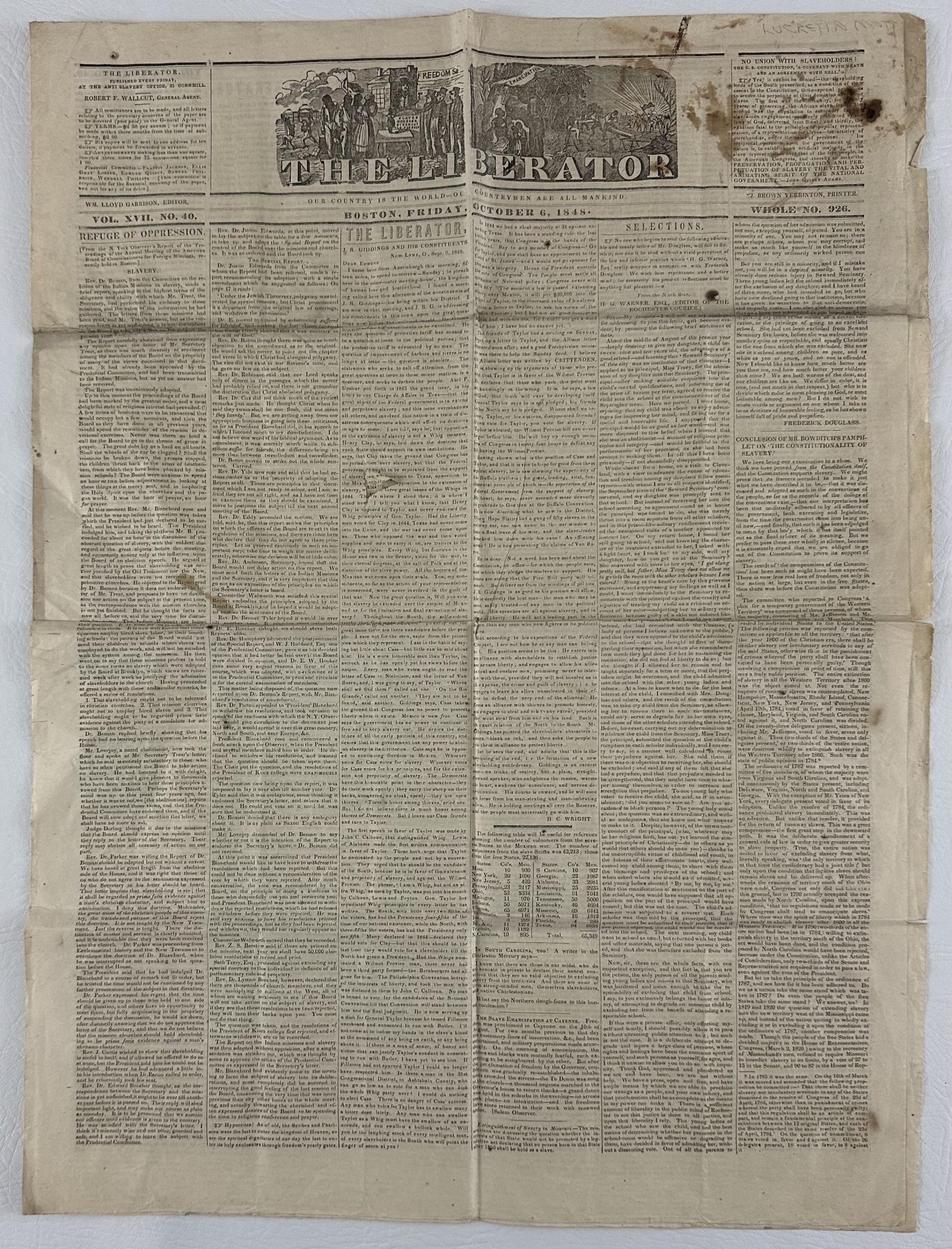
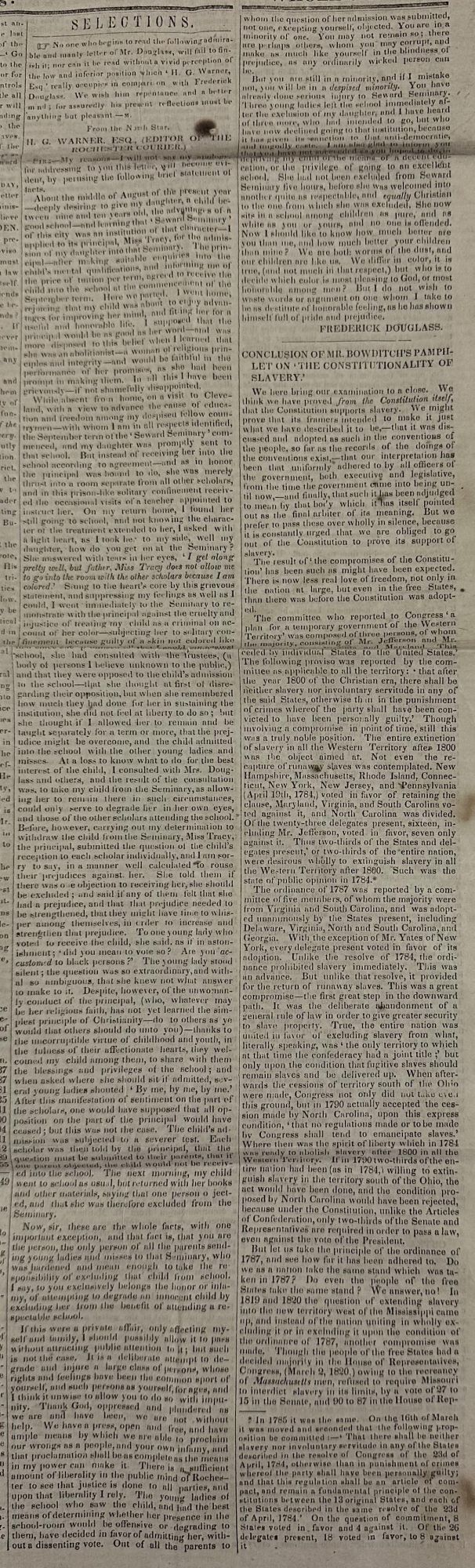
Boston, 1848. [4]pp. (paginated [157]-160), printed in six columns on a single folded folio sheet of newsprint. Old folds, minor wear and light scuffing to edges, small closed tear in third column of first leaf, minor staining. Small pencil notation in top margin reading, "Lucretia Mott." Overall about very good. A particularly notable issue of the official newspaper of the American Anti-Slavery Society (AASS), famously edited by firebrand abolitionist William Lloyd Garrison, containing the full text of a gloriously scathing letter by Frederick Douglass. The unabashedly seething letter, addressed by Douglass to Horatio G. Warner, the editor of the Rochester Courier, is printed in the fifth and sixth columns of the front page. The letter was originally published by Douglass in the September 22, 1848 issue of his own newspaper, The North Star. This is the second appearance of the letter, which was also subsequently printed in two other periodicals later in the month. The letter is here introduced with an editor's note which should be shared in full, and sets up Douglass's wicked takedown of Warner: "No one who begins to read the following admirable and manly letter of Mr. Douglass will fail to finish it; nor can it be read without a vivid perception of the low and inferior position which 'H.G. Warner, Esq.' really occupies in comparison with Frederick Douglass. We wish him repentance and a better mind; for assuredly his present reflections must be anything but pleasant."
Douglass's letter excoriates Warner for being the ONE person who refused to let Douglass's daughter, Rosetta attend the Seward Seminary in Rochester. He provides detailed background information on how he went about securing a place for his daughter in the school, and how she was most horribly betrayed by the prejudice and racism she found there. First, Rosetta was physically segregated from her classmates; Douglass quotes her assessment of her first day to him: "I get along pretty well, but father, Miss Tracy does not allow me to go into the room with the other scholars because I am colored." Then, the trustees of the school refused to seat her, which the principal successfully fought. Then, Rosetta was subjected to a vote by her classmates, and if a single student objected, Rosetta would be removed from the school. The kindness of children prevailed and "they welcomed my child among them, to share with them the blessings and privileges of the school; and when asked where she should sit if admitted, several young ladies shouted 'By me, by me, by me.'" Finally, the same "test" was submitted to the white parents of the student body; again, if just ONE parent objected, Rosetta was out. ONE parent objected -- Horatio G. Warner. Like Garrison writes in his editor's note, Douglass's subsequent lambasting of Warner really should be read in full, but the following provides plenty of flavor, as Douglass unloads with both barrels:
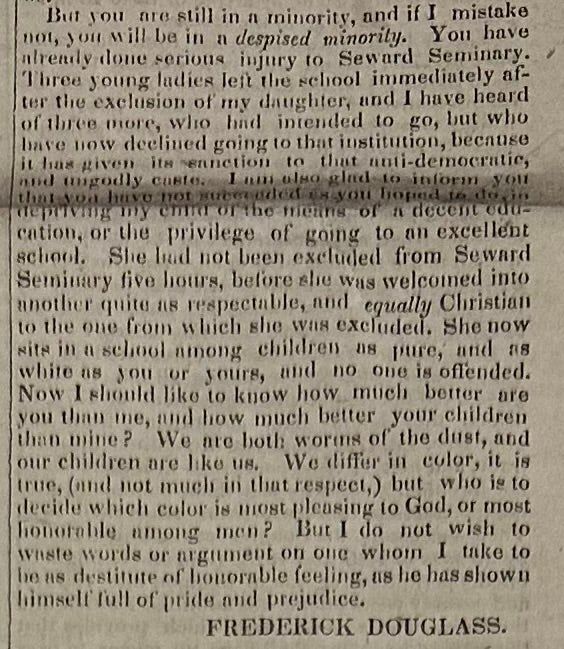
"Now, sir, these are the whole facts, with one important exception, and that fact is, that you are the person, the only person of all the parents sending young ladies and misses to that Seminary, who was hardened and mean enough to take the responsibility of excluding that child from school. I say, to you exclusively belongs the honor or infamy, of attempting to degrade an innocent child by excluding her from the benefit of attending a respectable school. If this were a private affair, only affecting myself and family, I should possibly allow it to pass without attracting public attention to it; but such is not the case. It is a deliberate attempt to degrade and injure a large class of persons, whose rights and feelings have been the common sport of yourself, and such persons as yourself, for ages, and I think it unwise to allow you to do so with impunity. Thank God, oppressed and plundered as we are, and have been, we are not without help. We have a press, open and free, and have ample means by which we are able to proclaim our wrongs as a people, and your own infamy, and that proclamation shall be as complete as the means in my power can make it.... Out of all the parents to whom the question of her admission was submitted, not one, except yourself, objected. You are in a minority of one. You may not remain so; there are perhaps others, whom you may corrupt, and make as much like yourself in the blindness of prejudice, as any ordinarily wicked person can be. But you are still in a minority, and if I mistake not, you will be in a despised minority. You have already done serious injury to Seward Seminary. Three young ladies left the school immediately after the exclusion of my daughter, and I have heard of three more, who had intended to go, but who have now declined going to that institution, because it has given its sanction to that anti-democratic, and ungodly caste. I am also glad to inform you that you have not succeeded as you hoped to do, in depriving my child of the means of a decent education, or the privilege of going to an excellent school. She had not been excluded from Seward Seminary five hours, before she was gladly welcomed into another quite as respectable, and equally christian to the one from which she was excluded. She now sits in a school among children as pure, and as white as you or yours, and no one is offended. Now I should like to know how much better are you than me, and how much better your children than mine? We are both worms of the dust, and our children are like us. We differ in color, it is true, (and not much in that respect,) but who is to decide which color is most pleasing to God, or most honorable among men? But I do not wish to waste words or argument on one whom I take to be as destitute of honorable feeling, as he has shown himself full of pride and prejudice."
The present issue also reports on the peaceful emancipation of Cayenne, legislation on gradual emancipation in Missouri, the imminent presidential election between Zachary Taylor, Lewis Cass, and Martin Van Buren, and prints dispatches from other newspapers on slavery, politics, the African slave trade, colonization in Liberia, and more. In addition to the Douglass letter, the issue prints letters from Lucretia Mott (likely the motivation for a previous reader's notation of her name at the top) and "Edward Search," the pseudonym for William Henry Ashurst, the Liberator correspondent reporting from Europe on various radical causes. In addition, this issue advertises lectures, conventions, the 15th Annual Anti-Slavery Bazaar, and more, along with standard 19th-century products and services. The title in the masthead of the newspaper is printed in the midst of an elaborate engraved vignette featuring a slave market on the left and an idealized utopian society of industrious freed slaves on the right. The tagline below reads, "Our Country Is the World -- Our Countrymen Are All Mankind." A message Horatio Warner hadn't learned yet. Hopefully after Douglass's letter, the message was clear.
Douglass's letter excoriates Warner for being the ONE person who refused to let Douglass's daughter, Rosetta attend the Seward Seminary in Rochester. He provides detailed background information on how he went about securing a place for his daughter in the school, and how she was most horribly betrayed by the prejudice and racism she found there. First, Rosetta was physically segregated from her classmates; Douglass quotes her assessment of her first day to him: "I get along pretty well, but father, Miss Tracy does not allow me to go into the room with the other scholars because I am colored." Then, the trustees of the school refused to seat her, which the principal successfully fought. Then, Rosetta was subjected to a vote by her classmates, and if a single student objected, Rosetta would be removed from the school. The kindness of children prevailed and "they welcomed my child among them, to share with them the blessings and privileges of the school; and when asked where she should sit if admitted, several young ladies shouted 'By me, by me, by me.'" Finally, the same "test" was submitted to the white parents of the student body; again, if just ONE parent objected, Rosetta was out. ONE parent objected -- Horatio G. Warner. Like Garrison writes in his editor's note, Douglass's subsequent lambasting of Warner really should be read in full, but the following provides plenty of flavor, as Douglass unloads with both barrels:
"Now, sir, these are the whole facts, with one important exception, and that fact is, that you are the person, the only person of all the parents sending young ladies and misses to that Seminary, who was hardened and mean enough to take the responsibility of excluding that child from school. I say, to you exclusively belongs the honor or infamy, of attempting to degrade an innocent child by excluding her from the benefit of attending a respectable school. If this were a private affair, only affecting myself and family, I should possibly allow it to pass without attracting public attention to it; but such is not the case. It is a deliberate attempt to degrade and injure a large class of persons, whose rights and feelings have been the common sport of yourself, and such persons as yourself, for ages, and I think it unwise to allow you to do so with impunity. Thank God, oppressed and plundered as we are, and have been, we are not without help. We have a press, open and free, and have ample means by which we are able to proclaim our wrongs as a people, and your own infamy, and that proclamation shall be as complete as the means in my power can make it.... Out of all the parents to whom the question of her admission was submitted, not one, except yourself, objected. You are in a minority of one. You may not remain so; there are perhaps others, whom you may corrupt, and make as much like yourself in the blindness of prejudice, as any ordinarily wicked person can be. But you are still in a minority, and if I mistake not, you will be in a despised minority. You have already done serious injury to Seward Seminary. Three young ladies left the school immediately after the exclusion of my daughter, and I have heard of three more, who had intended to go, but who have now declined going to that institution, because it has given its sanction to that anti-democratic, and ungodly caste. I am also glad to inform you that you have not succeeded as you hoped to do, in depriving my child of the means of a decent education, or the privilege of going to an excellent school. She had not been excluded from Seward Seminary five hours, before she was gladly welcomed into another quite as respectable, and equally christian to the one from which she was excluded. She now sits in a school among children as pure, and as white as you or yours, and no one is offended. Now I should like to know how much better are you than me, and how much better your children than mine? We are both worms of the dust, and our children are like us. We differ in color, it is true, (and not much in that respect,) but who is to decide which color is most pleasing to God, or most honorable among men? But I do not wish to waste words or argument on one whom I take to be as destitute of honorable feeling, as he has shown himself full of pride and prejudice."
The present issue also reports on the peaceful emancipation of Cayenne, legislation on gradual emancipation in Missouri, the imminent presidential election between Zachary Taylor, Lewis Cass, and Martin Van Buren, and prints dispatches from other newspapers on slavery, politics, the African slave trade, colonization in Liberia, and more. In addition to the Douglass letter, the issue prints letters from Lucretia Mott (likely the motivation for a previous reader's notation of her name at the top) and "Edward Search," the pseudonym for William Henry Ashurst, the Liberator correspondent reporting from Europe on various radical causes. In addition, this issue advertises lectures, conventions, the 15th Annual Anti-Slavery Bazaar, and more, along with standard 19th-century products and services. The title in the masthead of the newspaper is printed in the midst of an elaborate engraved vignette featuring a slave market on the left and an idealized utopian society of industrious freed slaves on the right. The tagline below reads, "Our Country Is the World -- Our Countrymen Are All Mankind." A message Horatio Warner hadn't learned yet. Hopefully after Douglass's letter, the message was clear.
Details
Title
The Liberator. Vol. XVII. No. 40
Author
[African Americana]: [Douglass, Frederick]: Garrison, William Lloyd, ed.
Condition
Unknown
Publisher
Boston
Date
1848