

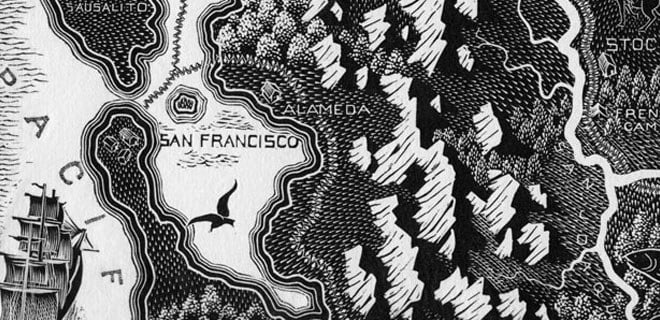
Now in its 57th year, the California International Antiquarian Book Fair is one of the world’s premier events for rare and antiquarian books and ephemera.
This year, the Fair returns to San Francisco, taking place February 27—March 1, 2026, at Pier 27 on The Embarcadero. (Tickets are available here...)
The California Book Fair brings together fine and rare printed materials from more than 100 booksellers across the globe. Attendees can explore a vast array of books, maps, ephemera, drawings, manuscripts, autographs and more, with curated collections available for purchase across two floors of exhibition space.
Below are some of the highlights dealers will be bringing to the 57th California Book Fair.
The Fight for the Chicano Nation: Chilili Defends Right to the Land [with related handbill]
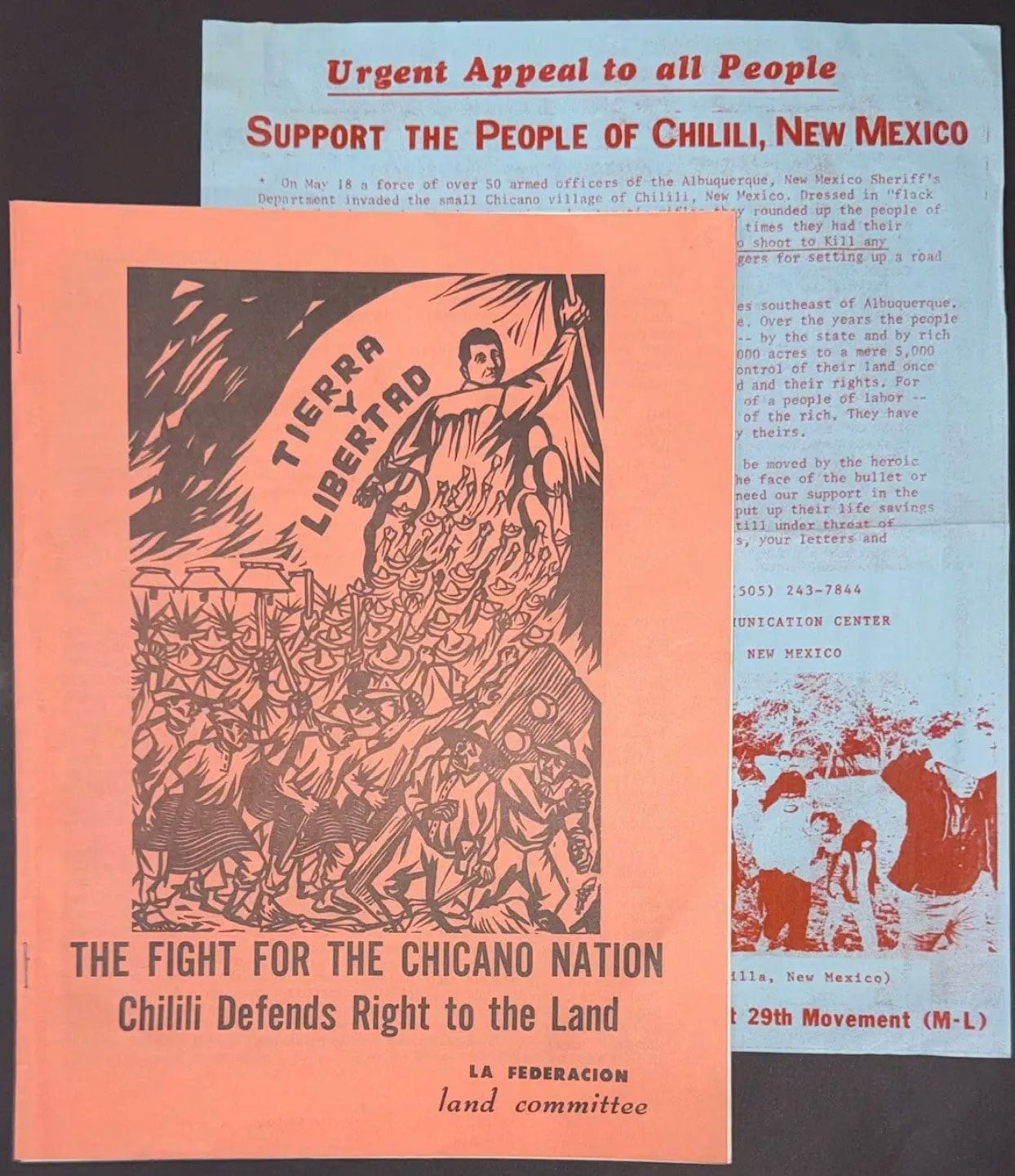
Tijeras, NM: El Comite Para Reformar y Preservar las Tierras de la Merced de Chilili, [1977]. Staplebound pamphlet, five pages each in English and Spanish, minor handling wear; laid in is a folded handbill from the August 29th Movement on the same issue. Not found in OCLC as of January 2026.
States that on Sept. 1, 1976, more than 30 armed Chicano villagers showed up to block an Anglo developer's construction of a road that they feared would destroy their community. States that it "would have opened up the area for more development, more tourists, more rich people moving in and eventually leading to the destruction of the traditional way of life of the Chicano people of Chilili and the destruction of the village itself."
Offered by Bolerium Books, booth 216.
Nash, John.
Non-Cooperative Games [in Annals of Mathematics, Vol. 54, No. 2, pp. 286-295].

Princeton: Princeton University, July-November 1951. 250 by 175mm (93⁄4 by 7 inches). Black cloth boards; 608 pp. Vol. 54. Nos. 1, 2 & 3 bound together with original wrappers intact. Inoffensive number stamp to page 1 and library stamp to edges of text block. Near fine but for light bumping to corners.
First edition of the complete journal volume containing the work that introduced the “Nash equilibrium” into economics and game theory, whose impact “is comparable to that of the discovery of the DNA double helix in the biological sciences.” (Journal of Economic Literature). This publication of John Nash’s (1928-2015) doctoral thesis had an enormous impact. As a graduate student at Princeton Nash concentrated on game theory and the idea of rivalry with the possibility of mutual gain. His idea that non-cooperative games have an equilibrium point became known as the “Nash equilibrium”, a founding concept in analyzing economic behavior and the one for which he won the Nobel Prize in 1994. Sylvia Nasar’s award-winning biography, A Beautiful Mind, as well as the 2002 Best Picture of the same title, chronicled Nash’s devastating struggle with schizophrenia, which caused his long exile from elite mathematics.
Offered by Mark Funke, Bookseller, booth 145.
Leaves of Grass by Walt Whitman
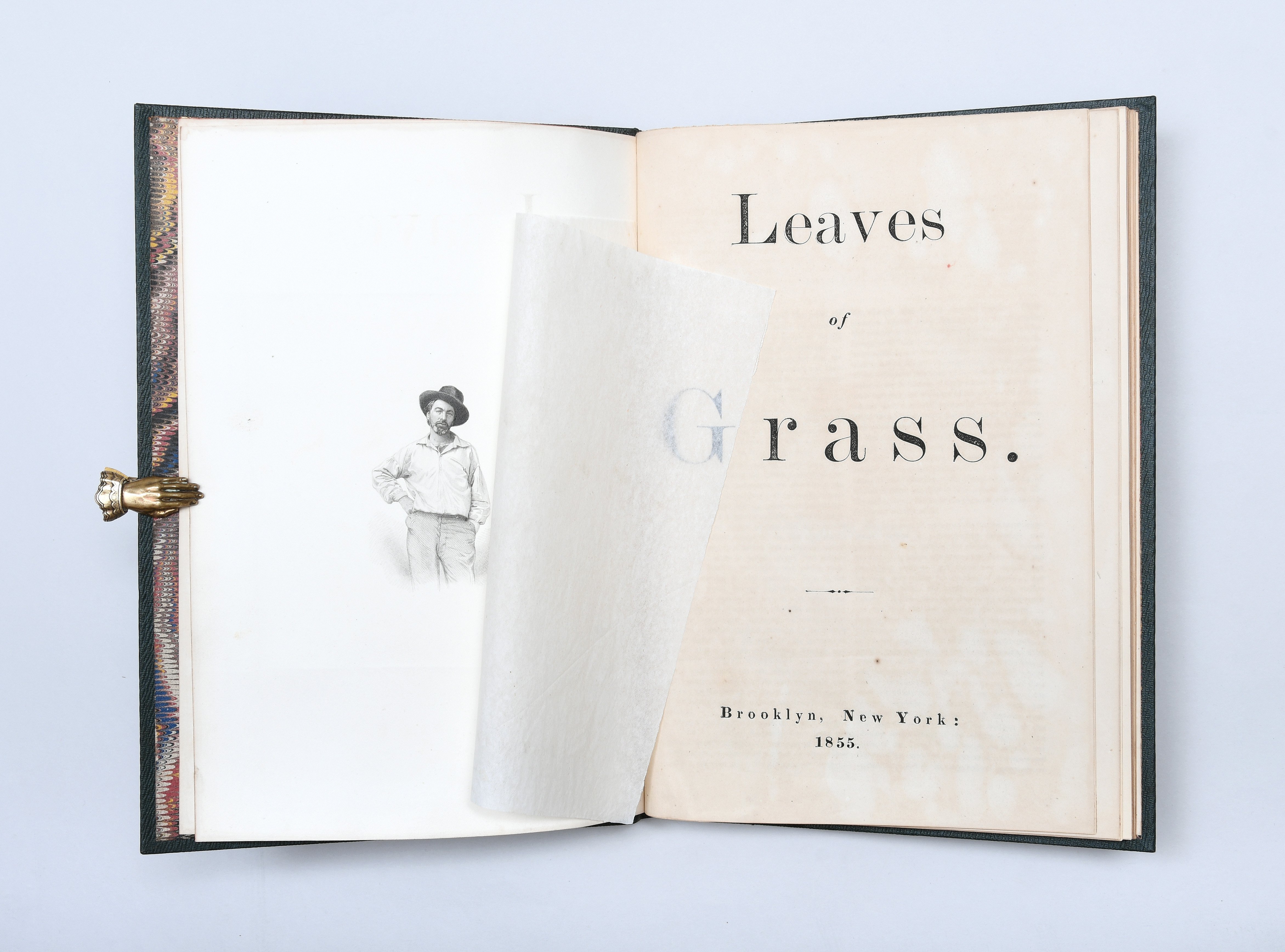
First edition, first state binding. The first edition of Leaves of Grass was self-published by Whitman. His money ran tight as production continued, and the bindings became progressively less elaborate. Only 337 copies were bound in the initial and most elaborate binding with gilt border, marbled endpapers, and gilt edges, as here. This book, more than any other perhaps, is said to have defined America to itself. “He was and is the poet and prophet of democracy, and the intoxication of his immense affirmative, the fervor of his 'barbaric yawp,' are so powerful that the echo of his crude yet rhythmic song rings forever in the American air”.
Offered by Peter Harrington, booth 128.
LANDACRE, Paul (1893-1963).
The Gold Fields
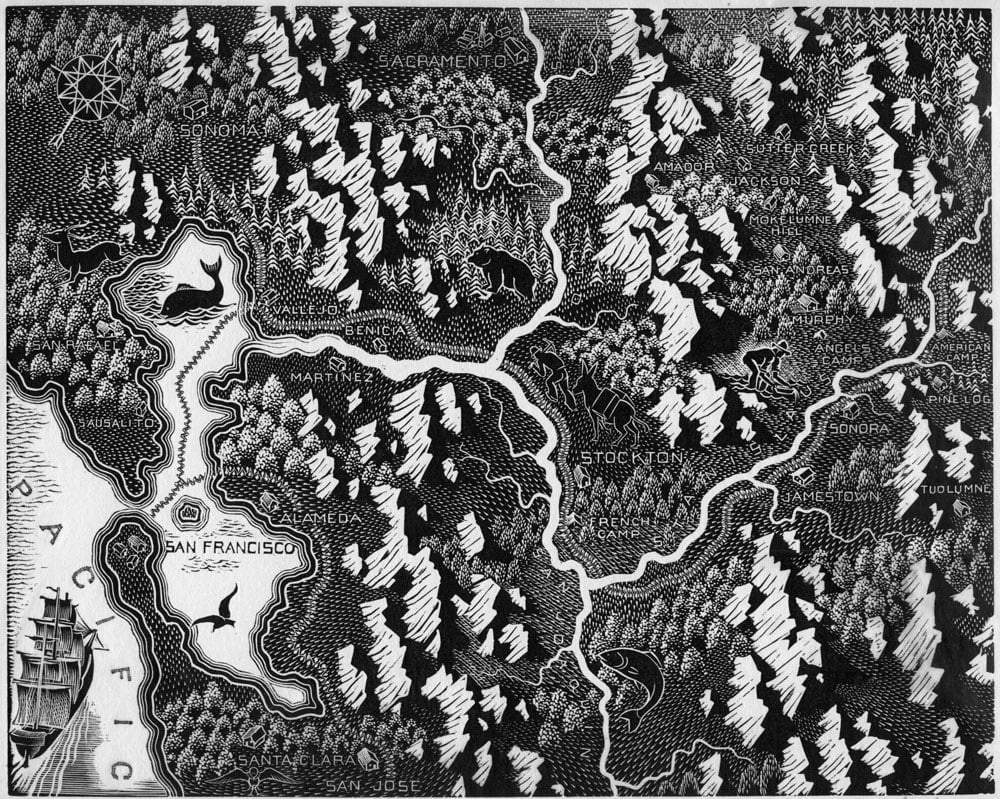
[Los Angeles, CA: Paul Landacre, 1933]. Wood Engraving. 7 15/16 x 9 15/16 inches. Printed on sheet that measures 9 1/16 x 11 15/16 inches. Hinge-mounted on stiff board 16 x 20 inches that has a hinge mounted top board with a display window and a hinge-mounted plastic protective
sheet. The sheet printed by Paul Landacre has both an Origins of Art rubber stamp, a red kestrel rubber stamp, and a pencilled annotation “ForML” in Landacre’s hand. Some soiling and the outer corners of the stiff boards, the boards are bumped at the corners, not affecting the print. Fine.
UNSIGNED PROOF outside the edition of 30. “‘The Gold Fields’ was printed in a signed, titled and numbered edition of 30, although only 22 such impressions are recorded. Jake Wien notes that in the months following Paul Landacre’s death the Origins of Art rubber stamp was placed on the verso of prints “found in Landacre’s studio.” Here, the Origins of Art rubber stamp is in the margin of the recto of this print, as is the red kestrel (or petrel) stamp. Both are described by Wien as a “form of estate stamp.” Neither of these stamps “in no way detracts from the beauty or value of a Landacre print.” Personal correspondence from Jake Wien.
The most interesting aspect of this particular print is the pencil notation in the lower right margin, “ForML.” Wien writes that Landacre “annotated many different prints this way as a kind of life insurance of Margaret [Gertrude McCreery Landacre (1891-1963)]. But, as you know, Margaret died first. Prints so annotated ‘For ML’ are generally superb impressions.”
Offered by John Howell for Books, booth 146.
Five Jack London Items
In April 2004, Sotheby's New York auctioned The Maurice F. Neville Collection. As a result, significant Jack London items spent two decades in a private collection in Sydney, Australia. Five of these are returning to San Francisco for the 57th California International Rare Book Fair.
From the original manuscript of his genre-defining novel The Game, to the Hampton’s Magazine setting copy of his south sea story Mauki, to his impassioned reporting on England’s poor in the advance copy (with corrections in his hand) of People of the Abyss, the five items represent examples from across his oeuvre.
London scholarship has grown considerably over the past few decades, and London is now held as one of the great American writers of the late nineteenth/early twentieth century. The forthcoming 30-volume Oxford University Press Collected Works of Jack London is sure to cement London’s place in the canon of English language literature. Archives Fine Books (Stand 251) is pleased to present:

The Game [Original Autograph Manuscript, Signed] offered with A.L.S. to Richard Watson Gilder, editor of the "Century Magazine".
The Game [Presentation Copy]. New York: Macmillan, 1905. First Edition, second printing. [PRESENTATION copy, INSCRIBED to one of the book's illustrators, Henry Hutt]
Typescript of the South Sea story, "Mauki". [Setting Copy] "Hampton's Magazine" 1908.
The People of the Abyss [Proof Copy, Inscribed and with corrections in London's hand] New York: Macmillan, April 1903.
The Iron Heel [Presentation Copy] London: Everett, 1908. Inscribed to "Comrade Sweet, ...Yours for the Revolution, Jack London".
[Naturalism] [Prize fighting] [Masculinity] [Indentured Labor practices] [South Pacific] [Black birding] [ [Social Justice] [Socialism] [Futurism] [Dystopia] [Working Class]
Offered by Archives Fine Books, booth 251.
THE FIRST FEMINIST WORK OF THE NEW WORLD
Cruz, Juana Inés de la. Fama, y obras pósthumas del fénix de México. Madrid: Manuel Ruiz de Murga, 1700.
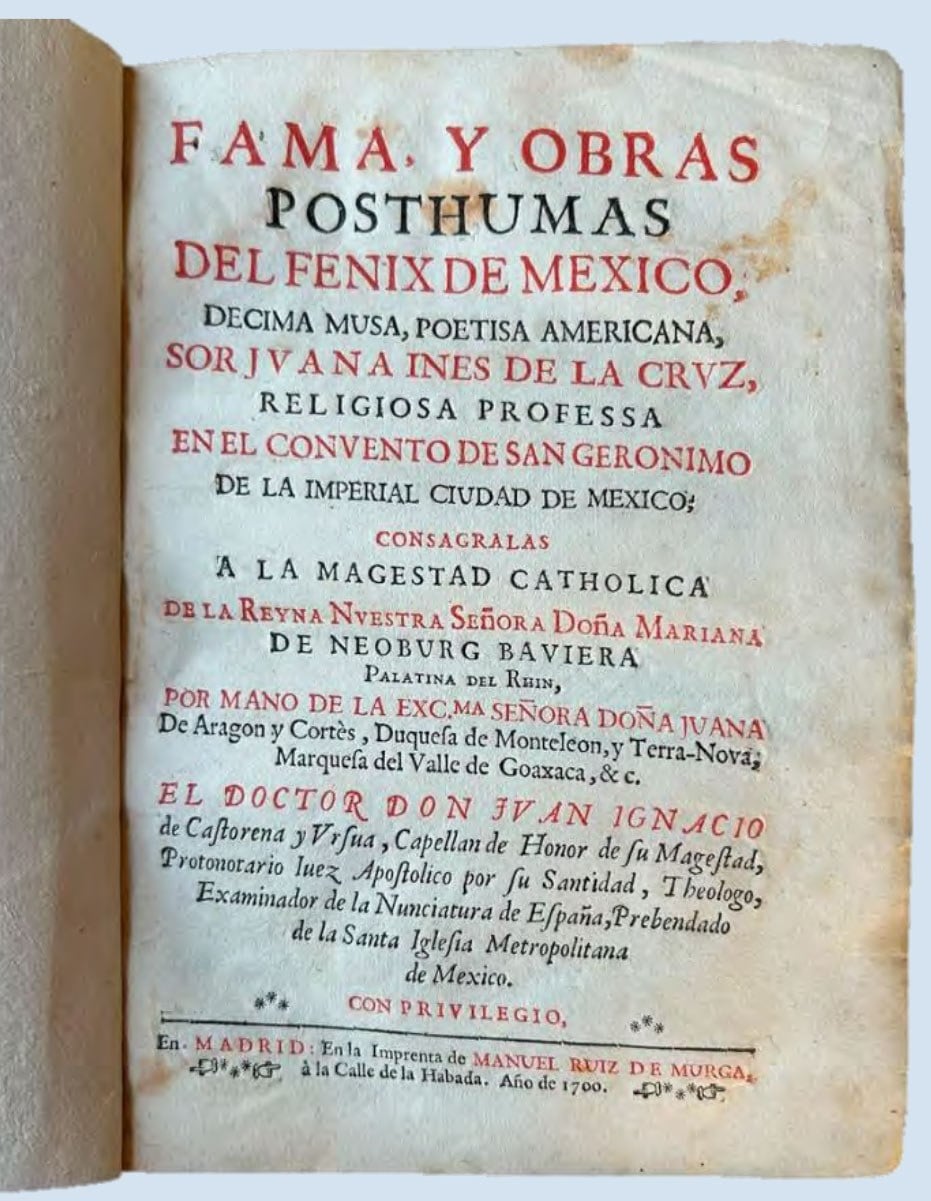
4to (205 x 143 mm). Title page in red and black, engraved portrait provided in old facsimile. Contemporary vellum. First edition of Fama, one of the most important writings of Sor Juana Inés de la Cruz, and considered the FIRST FEMINIST WORK OF THE NEW WORLD.
Published posthumously, it is generally known as the third volume of Sor Juana's works; however, each volume was published separately, and only later in the 18th century were they compiled together.
Sor Juana Inés de la Cruz (Juana Inés de Asbaje y Ramírez) was born in San Miguel de Nepantla in 1651 (Mexico). She was reputedly a child prodigy who learned to read and write at the age of 3. From an early age, she was noted by the wife of the Viceroy of Mexico, Leonor Carreto, at court, where she stood out for her intelligence and wit. She rose to fame for her originality of thought and composition skills, earning her the title of "The Phoenix of Mexico" and recognition as one of the most influential figures in Novo-Hispanic society.
Offered by Libreria de Antano, booth 132.
MOLZA, Francesco Maria (1489–1544) – VARCHI, Benedetto (1503–1565) – DOLCE, Lodovico (1508–1568).
Terzerime del Molza, del Varchi, del Dolce et d'altri.

[Venice]: Curzio Troiano Navò & fratelli, 1539. 8vo (142 × 85 mm), [80] ff. (A-K8), printer’s device to the title. Later vellum, spine with title gilt, yellow edges; small defect to the title touching the device; small burning in D2 affecting a few letters; somewhat spotted, some leaves lightly browned at the end.
Rare first edition of one of the earliest printed works to contain openly homoerotic poetry.
It is an exemplary testimony to Bernesque verse and marks a moment when male homosexuality found expression in Italian poetry. The genre takes its name from Francesco Berni (1497–1535), a Tuscan writer who developed a taste for playful, popular, and often irreverent poetry during his years in Florence, before moving into the more refined ecclesiastical and literary circles of Rome. Although Bernesque poetry covers a wide variety of subjects, it is consistently marked by a licentious, ironic, and often overtly erotic tone: from salads to taverns, hard-boiled eggs to ricotta, fennel to locks and keys; every mundane object becomes a pretext for sexual innuendo. Starting with Burchiello, and later with Berni and his imitators, poets composed—and printers circulated—verses that, through double meanings and metaphorical language often drawn from foods or household items (cardoons, eels, peaches, needles), carried unmistakable references to homoerotic relationships, using playful ambiguity to elude censorship and contemporary moral restraints.
The book is divided into 29 chapters, among the most notable pieces in the volume is a long and fran poem by Ludovico Dolce: "d’un ragazzo" (about a Boy), which fits perfectly within this bold poetic tradition.
Offered by Erasmushaus AG, booth 110
Franklin, Benjamin. Political, Miscellaneous, and Philosophical Pieces.

Engraved portrait frontispiece, 3 engraved plates (1 folding), folding table. xi, [1], 565, [1], [8]pp. 8vo. London: J. Johnson, 1779. First edition. Contemporary tree calf, rebacked, red morocco lettering piece. Minor foxing. Howes F330; Sabin 25565; ESTC T58635; Ford 342; Adams, American Controversy 79- 38b; Reese, Revolutionary Hundred 56.
"First edition of a noted selection of Franklin's essays published in London during the American Revolution, edited by his close friend Benjamin Vaughan. This is the 'only edition of Franklin's writings (other than his scientific), which was printed during his life time; [and] was done with Franklin's knowledge and consent and contains an 'errata' made by him for it' (Ford). Franklin was serving as American ambassador in Paris at the time these essays were published in the enemy capital. Many of the pieces published here relate to the Revolution, including the transcript of Franklin's famous appearance before Parliament in 1766 in which he argued successfully for the repeal of the Stamp Act. Also present here is the culmination of his sagacious Poor Richard advice, his The Way to Wealth. And although the compilation is predominantly political or social essays, the collected work also includes his paper on the effectiveness of lightning rods" (Reese, Revolutionary Hundred)
Offered by James Cummins Bookseller, booth 117.
HOMER. THE WHOLE WORKS OF HOMER; PRINCE OF POETTS, IN HIS ILIADS, AND ODYSSES.
(Oxford: Shakespeare Head Press, 1930-31) 292 x 203 mm. (11 1/2 x 8"). Five volumes. Translated from the Greek by George Chapman. No. 3 OF 10 COPIES PRINTED ON VELLUM, from a total edition of 460.
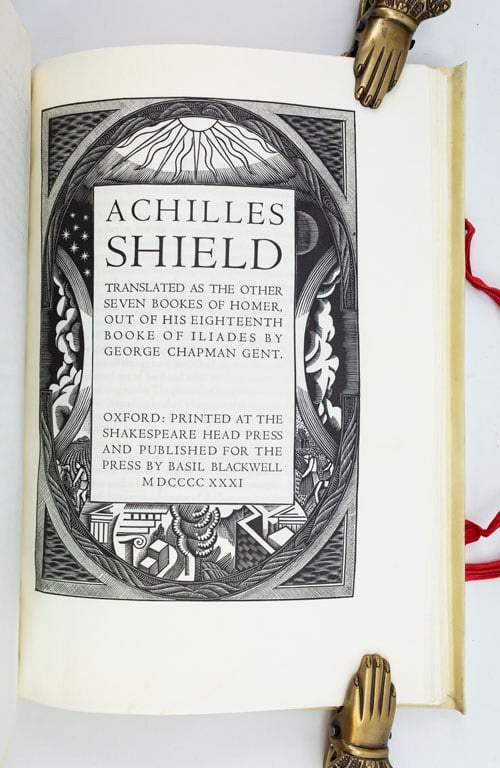
Publisher's limp vellum, yapp edges, red silk ties. IN THE ORIGINAL (just slightly worn) MOROCCO-BACKED SOLANDER BOXES with title label on spine. With 52 wood engravings by John Farleigh, comprised of two frontispieces, woodcut-framed title pages to volumes I and V, and 48 full-page cuts. Ransom, p. 17; Franklin, p. 236; Horne, p. 185. Lacking one tie, half a dozen leaves with naturally occurring variations of color and grain in the vellum, but A LOVELY SET, quite clean, fresh, and bright inside and out.
This is the glorious vellum printing of a major modern fine press edition of Homer, with illustrations by one of the most popular woodcut artists of the period. It is one of the most beautiful modern books we have ever offered for sale. The text here is Chapman's Homer, which Day calls "the greatest verse translation of the Renaissance" and perhaps "the greatest English translation of Homer." George Chapman (1559/60-1634) made his name as a poet and playwright before turning to translating classical literature. His was the first English translation of Homer to be done directly from the Greek, and it remained the standard translation until Pope's 18th century version. Chapman enjoyed a renewed popularity among 19th century poets: Keats composed a much-quoted sonnet, "On First Looking into Chapman's Homer," which begins "Much have I travell'd in the realms of gold"; and Swinburne said, "No praise can be too warm or high for the power, the freshness, the indefatigable strength and inextinguishable fire which animate this exalted work." Wood engraver, painter, illustrator, writer, and teacher John Farleigh (1900-65) had a style perfectly suited to an edition of Homer. In "A History of British Wood Engraving," Albert Garrett writes that "in terms of modern engraving, John Farleigh understood the purity of Greek engraving and largely formed his style upon the few known examples. Like the Greek engraver, he also understood the human form and could express it." He was one of the major engravers of the new British School, which focused on broadening the medium's range of expression and techniques. The creamy vellum comprising the text here provides the perfect medium for displaying these woodcuts to best advantage. Given its strictly limited print run of 10, this special edition is, not surprisingly, seen only rarely in the market. We were able to trace just three copies sold at auction: one in 1967, the present copy in 1971, and a third copy sold both in 2009 and 2019.
Offered by Phillip J. Pirages Fine Books & Manuscripts, booth 109.
PTOLEMY, Claudius The Compost of Ptolomeus, Prince of Astronomie. Very necessary and profitable for all such as desire the knowledge of the famous art of astronomie.

London, By M. P[arsons] for Henry Gosson, and are [to be sold by Edward Wright, 1638[?]
4to. 72 unnumbered leaves. A-I . Black letter some Roman. Large astronomical woodcut of ‘K. Ptholomeus’ and an astronomer (just chipped at fore-edge) on title, woodcut and typographical headpieces, small floriated initials, sixty three woodcuts in the text, including a figure of the heavens, the 12 signs of the zodiac, a world map, physiognomoligcal portraits, a large woodcut of a dragon in landscape on verso of last, chiromantic hands, and stars etc, monogram ‘H. R.’ with shelf mark on fly. Light general age browning, heavier in places, title slightly dusty, light waterstaining on first few leaves, occasional mark or stain. A good copy in English calf circa 1800, covers bordered with a single gilt rule, spine gilt ruled, title gilt lettered, a.e.r. a little rubbed.
Exceptionally rare edition of this popular astronomical text, very charmingly illustrated with numerous woodcuts, the last of the early editions, the only edition printed in the seventeenth century. The rather rudimentary map is marked i.a. with Mexico, New England, the West indies, Peru, the Straits of Magelan, Brasil and Virginia. Below the two southmost capes is a the land mass described as the ‘South Continent’. The work was originally translated from the French ‘Compost et kalendrier des bergiers’, and appeared in two forms throughout the C16th; one as ‘The Kalender of Shepards’ and the other with the title ‘The Compost of Ptholomeus’. Although they are often described as containing nothing from Ptolemy, other than the falsification of authorial attribution, the work does have a general articulation of some of the astrological matters set forth in Ptolemy’s Quadripartitum. The influence of astronomy over individuals is discussed, and this version has a chapter on palmistry added at the end. “In the ‘Kalendar of Shepherds’, the putative source of the astrological and health information is initially an unnamed, ancient shepherd. … the authentication for the information in the text was a natural and pastoral figure of wisdom, the void of book learning. In the prologue, it is also stated that ‘this boke was made for them that be no Clerkes to brynge them to great understandynge’ thus identifying itself as a text for a non-elite readership yet at the same time offering access to the very traditional classical learning skills and intimating a connection between the occult knowledge and active reading. .. In Notary’s 1506 edition, Ptolemy is merely cited in the table of contents in relation to the twelve signs of the zodiac but not mentioned in the text. In Pynson’s 1518 edition, Ptolemy is referenced both textually and visually, again in relation to the zodiac, but as a very minor reference in the text. .. Beginning in the 1530s, the strand of the multi-text breaks off; the text is condensed, new images are added, others are eliminated, and the title is changed to the ‘Compost of Ptolomeus, Prince of Astronomy’ .. These editions, initially published by Robert Wyer, make a significant modification: the name of the Ptolemy is increasingly inserted into the verbal text, shifting the authentication from the ancient shepherd to Ptolemy. .. The Catholic feast day calendar is eliminated, along with much of the Christian moralising and, generally, a narrower focus on the astrological components. Neither the woodblock image of the shepherd nor that of the scholar carries over once the text is renamed ‘The compost of Ptolomeus;’ instead, the symbolic function previously vested in the figure of the scholar shepherd is now conflated into the single figure of Claudius Ptolomy, ‘Prince of Astronomeye’. ..In his editions of the Compost, Wyer not only strengthened the association of the verbal and visual text with Ptolemy, but also incorporated specifically geographical information; Wyer appends a ‘Rutter’, a navigational chart of the distances between various port cities, consequently increasing the function of the text as a source of geographic information.. For English readers in the early print era the images of and attribution to Ptolemy thus narrate and mediate an encounter with emerging geographical thought. The textual and visual attribution to Ptolemy created a kind of aura for the text that mystified the diffuse authorship of the work, and that subsumed the fascination with the occult and Catholic ritual into a pseudo-scientific discourse.” Keith D. Lilley ‘Mapping Medieval Geographies: Geographical Encounters in the Latin West’.
Unsurprisingly all editions of this ephemeral and popular work it are exceptionally rare; ESTC records no more than two copies of any of the five earlier editions of this text, and records this, the only seventeenth century edition, in three copies only, two at the BL and one at Birmingham University library. No copies recorded in the US.
Offered by Sokol Books, booth 219.
THE KEYSTONE OF DEMOCRACY
Magna Carta and Statutes of the Realm, in Latin and Anglo-Norman French. Illuminated manuscript on vellum. [England, possibly York, c.1300-1310].

A very early manuscript of Edward I’s re-confirmation of the Magna Carta in 1300, possibly a unique copy in this format. The present manuscript is a fine and early example of the collections of enrolled Statutes that had begun to be produced by the beginning of the 14th century. With 25 illuminated initials.
The Magna Carta is the most renowned and influential legal document of the English-speaking world. By agreeing to the terms of the Charter at Runnymede on 15 June 1215 King John bound himself and all subsequent rulers of his kingdom to the rule of law. In a modified form it was reissued in the name of his son and successor, Henry III in 1216 and 1217, and in 1225 the King once again confirmed the Charter and the accompanying Forest Charter, and this fourth issue was final and definitive: it became a permanent legislative enactment guaranteeing the rights and liberties of all freemen of the kingdom. In Edward I’s 1297 confirmation was the Magna Carta officially enrolled by Chancery and copied into the first Statute Roll. Thanks to the interpretation of Sir Edward Coke (1552-1634), Attorney General to Elizabeth I and Chief Justice of James I of England, the Charter had widespread and continuing influence, especially inspirational to the charters for the American colonies. The colonies used it to justify revolution against British policies, with the Massachusetts Assembly invoking it in declaring the 1765 Stamp Act null and void, and on the eve of revolution adopting a new seal showing a militia man with a sword in one hand and Magna Carta in the other. Specific provisions of the Magna Carta are echoed in the Declaration of Independence and serves as a keystone of the Constitution and Bill of Rights.
Offered by Rootenberg Rare Books & Manuscripts, booth 209.
Eric Sweet
XIV Olympiad, London 1948.
Original manuscript.
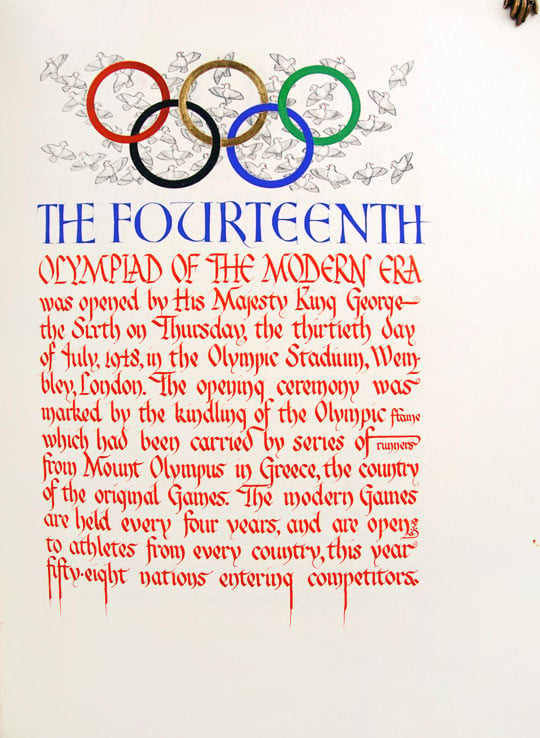
20pp. A remarkable calligraphic ode to the first iteration of the Olympic Games to take place after the Second World War. After the title page almost entirely in gilt, the manuscript begins, appropriately, with the Olympic rings against a background of doves. A subsequent epigraph conveys the spirit of the Games in the postwar era: "The most important thing in the Olympic Games is not winning, but taking part. The essential in Life is not conquering but fighting well." Then Sweet records the winning competitors in their respective sports, with names and specific
events in black, national affiliations in red, and details in gray. The sporting categories are themselves written in blue and with a gilt initial, and the "A" in Athletics receives special treatment, with a background of cross-hatched blue and linear details extending the length of the page.
Notable athletes of 1948 were Dutch sprinter Fanny Blankers-Koen, the seventeen-year-old American decathlete Bob Mathias, and Finnish gymnast Veikko Huhtanen. The conclusion supplies the winners of the final gold medal count, as well as a nod to the past, present, and future of the Games with a clever combination of the flags of Greece, England, and Finland (Helsinki would host the 1952 Olympics). Bound in full brown morocco with cover design an angular riff on the five Olympic rings, rendered both in gilt and in blind. Spine in six compartments with gilt titling. Mild rubs to corners, else near fine in original dropback box.
Offered by Philip Salmon & Company Rare Books, booth 151.
Smith, Joseph [Ex-libris Don Maguire] [Southwest] [Trading].
The Book of Mormon [printed in the Deseret Alphabet].

New York: Published for the Deseret University by Russell Bros., 1869. First edition. xi, 443p. Octavo [23 cm] Black cloth over boards with title and image of the Salt Lake Temple gilt stamped on the spine and triple blind ruled borders on the covers. Cloth boards a bit dampstained. Several ripples in cloth of rear board. Spine ends chipped and frayed. Splits in cloth along the front joint (the longest split, at the foot of the spine, measures 1 and 1/2"). Underlying boards exposed occasionally along the edges. Front hinge just a little soft, but text block still very strong. Rear free endpaper absent. 1 cm dark stain on top edge of the text block that has bled into the top margins of pp. 335-388 (most of the staining is very minor). Else, the pages are remarkably clean and bright. Good.
With the bookplate of the notorious Catholic adventurer and Southwestern trader Don Maguire on the front pastedown. Dominic "Don" Maguire (1852-1933), of Irish descent, was an early Ogden, Utah settler. His narratives of his three notable trading expeditions through Utah, Nevada, California, Arizona, and Mexico during the years 1876-1879 are original and striking contributions to the literature of the American West. Maguire is the subject of "Gila Monsters and Red-Eyed Rattlesnakes: Don Maguire's Arizona Trading Expeditions, 1876-1879" by Gary Topping (Salt Lake City: University of Utah Press, 1997).
"Utah history can hardly boast a more colorful character than Don Maguire, a trader, traveler, miner, archaeologist, poet and public figure who was one of the original members of Saint Joseph Parish in Ogden and lived in that city for more than six decades. Unfortunately, separating fact from fiction in telling the story of his life is no small problem, for most biographical information comes from his own pen, and he was known to stretch the truth. But even if only part of his narrative is true, he ranks with some of the legendary figures in Western history." - Gary Topping
The print run for the Deseret Alphabet Book of Mormon is usually cited as five-hundred, making this one of the rarest Book of Mormons.
The Deseret Alphabet was introduced in 1854 and was created by Parley P. Pratt, Heber C. Kimball, and George D. Watt. Made up of thirty-eight characters (apparently it was partially based on Pitman shorthand) to correlate with basic sounds in the English language, the Deseret Alphabet was intended to be used to help simplify the principles of the English language. The Deseret News announced in its issue of January 19, 1854, "The Board [of Regents] have held frequent sittings this winter, with the sanguine hope of simplifying the English Language, and especially its orthography. After many fruitless attempts to render the common alphabet of the day subservient to their purpose, they found it expedient to invent an entirely new and original set of characters."
Although only a written language, Brigham Young had high hopes for the new language, firmly believing it would unite the many foreign converts that were streaming into Utah from Europe. The creation of the language was one of the more unusual ideas of Brigham Young, and was never fully embraced by the Mormons. The Deseret Alphabet was abandoned shortly after Young's death.
A historically important book with an interesting provenance.
Offered by Ken Sanders Rare Books, booth 137.
FIRST RESEARCH NOTEBOOKS OF ONE OF THE DECIPHERERS OF DNA
CRICK, FRANCIS. Measuring the Viscosity of Water at High Temperature. Three volumes of manuscript laboratory notebooks for graduate research, March 9th, 1938 - August 12, 1939. London, University College London, 1938-1939.
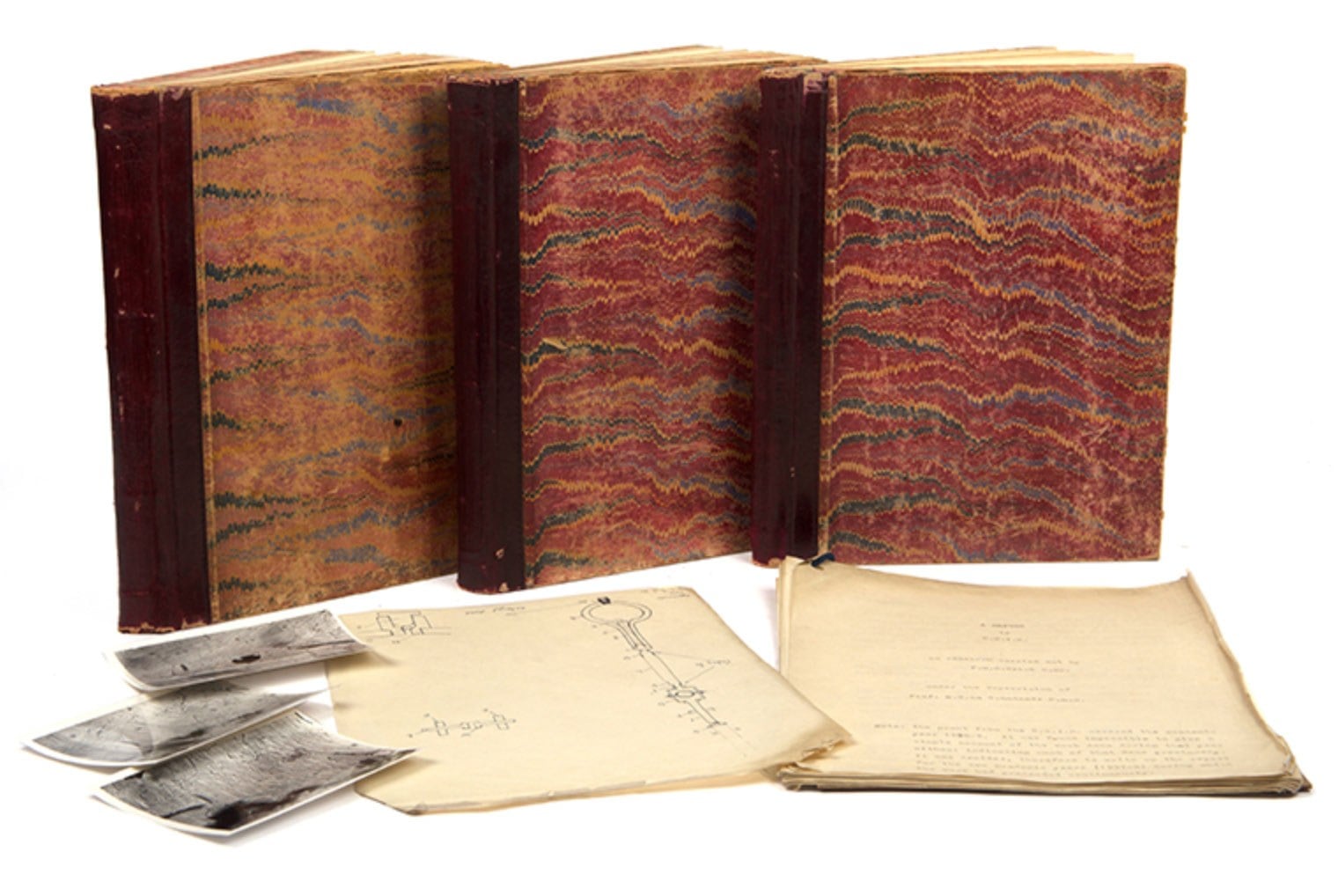
The substantial manuscript laboratory notebooks of Francis Crick, produced during his first PhD attempt at University College London in 1938 and 1939. Laboratory notebooks by leading scientific figures are extremely rare on the market and it is unlikely that anything similar by Crick will emerge, as his papers are at the Wellcome Institute (likewise, his colleague James Watson’s archive is held by Cold Spring Harbour Laboratory). This set was apparently abandoned by Crick when his studies were interrupted at the outbreak of the Second World War, as it was in the possession of Leonard Walden, Chief Laboratory Assistant, who is mentioned repeatedly in the text. An exceptional and historically significant set of documents from the beginning of one of the great scientific careers.
3 purpose-made notebooks with Crick’s dated ownership inscriptions on the front endpapers of volumes I and II, manuscript in ink and pencil primarily on the rectos, volume 1 containing approximately 188 pages of manuscript on 146 leaves, volume II with approximately 199 pages of manuscript on 146 leaves, and volume III with approximately 64 pages of manuscript on 103 leaves. 4to; quarter burgundy skiver, marbled boards, ink stamps of H.K. Lewis & Co. stationer of Gower Street, bindings a little rubbed with wear at the extremities, particularly volume III which has loss from the head of the spine with loosening of the lower board, very good condition. Together with a 28-page report for the Department of Scientific and Industrial research, typescript, rectos only, with manuscript additions and corrections, the final leaf being a page of manuscript technical drawings, bound with cotton string and card cover labelled in a separate hand ‘Crick’s work for PhD’. And with two sets of 10 monochrome photographs (11 x 8.5 cm) with manuscript labels on the backs, in glassine envelopes with matching labels (”G3/C1-C10” and “G3/SC1-SC10”). And a small collection of newspaper clippings in a plain envelope.
Offered by Shapero Rare Books, booth 226.
García Márquez, Gabriel
Cien años de soledad (Inscribed twice to a friend)

Buenos Aires: Editorial Sudamericana, 1967. First edition, inscribed twice on the dedication page by Gabriel García Márquez to his close friend Antonio España. First, García Márquez continues the printed dedication: "...y Antonio España, con un cojonudo abrazo de su hermano, Gabo - 1967" (“and for Antonio España, with a big fucking hug from his brother, Gabo - 1967”). Then, nearly a decade later, García Márquez writes: "Por medio de esta nota certifico que este ejemplar es el primero que autografié apenas salido de las prensas; y que el abrazo sigue firme, Gabriel - México, Febrero 18, 1976" ("I hereby certify that this is the first copy of this book that I autographed, as soon as it came off the presses; and the hug remains firm, Gabriel - Mexico, February 18, 1976").
Paperback (125 x 190 mm.), in publisher's printed wrappers with front wrapper professionally secured. Some fading to covers, spine crinkling, and a few scratches to back cover. Toning to first and last few leaves, and marginal toning throughout, due to paper quality. Ink staining to a few leaves, mostly at margins. A Very Good copy with two inscriptions to a close friend and an exceptional provenance that ties this copy to two pivotal moments in modern Latin American history.
García Márquez inscribed this copy to Antonio España, his friend in Mexico City, upon the book's publication in 1967, apparently the very first copy of the book he inscribed. According to García Márquez's son, Rodrigo García, his father used the nickname "Gabo" in these early inscriptions to his close friends, as seen in the first inscription. García Márquez inscribed this copy a second time in 1976; Rodrigo notes that his father's later inscriptions use his full first name "Gabriel" and a black felt-tip pen, also as seen here. This copy remained with España until about 1982, when he decided to move to Nicaragua following the Sandinista victory over Somoza. To facilitate the move, España contacted Danilo Bartulin and María José Ortiz Aguilar, a couple living in Mexico who had political connections and were mutual friends with García Márquez. Bartulin, who had been the personal physician of Salvador Allende (and can be seen in photographs with him on the day of the coup), became close friends and collaborators with García Márquez after being exiled from Chile in 1973. Before departing Mexico for Nicaragua, España visited Bartulin and his wife and gifted them this copy, inscribed by their mutual friend. The book has remained with the couple until now and is accompanied by letters of provenance from both Rodrigo García and María José Ortiz Aguilar.
Cien años de soledad, first published in English as One Hundred Years of Solitude in 1970, was García Márquez's second novel and is generally considered his greatest work – though El amor en los tiempos del cólera / Love in the Time of Cholera (1985) and El general en su laberinto / The General in His Labyrinth (1989) offer serious competition. One of the finest novels of the twentieth century, Cien años de soledad established García Márquez's international reputation and achieved incredible popularity, lifting the author from poverty as it eventually sold over thirty million copies. It was also a major factor in García Márquez being awarded the 1982 Nobel Prize in Literature and the 1972 Neustadt International Prize for Literature.
The novel has been praised worldwide since its publication: a contemporary New York Times review lauded the story as “so filled with humor, rich detail and startling distortion that it brings to mind the best of Faulkner and Gunter Grass. It is a South American Genesis, an earthy piece of enchantment, more, as the narrator says of Macondo, ‘an intricate stew of truth and mirages.'" The impact of Cien años de soledad on Latin American literature, in particular, cannot be overstated. Carlos Fuentes, García Márquez's friend and contemporary, called the book "...more than a novel, it is a libro de familia for the Latin American literary tradition, an eternal ship on which Gabriel García Márquez will remain forever alive among us." Very Good.
Offered by Whitmore Rare Books, booth 113.

Learn more about the 57th California International Antiquarian Book Fair here...