

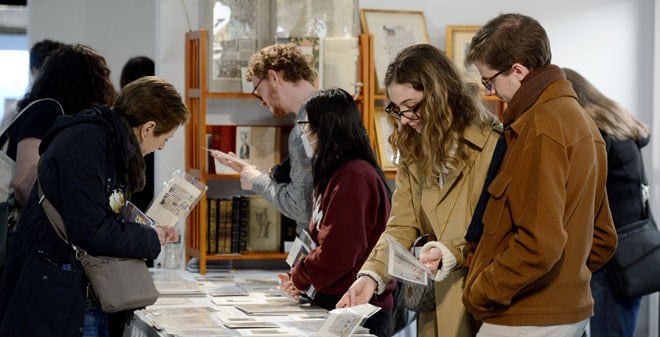
The world's finest antiquarian book fair returns to the Park Avenue Armory in New York City from April 30-May 3, 2026. Over 170 exhibitors from across the globe.
The 66th edition of the Fair will offer an impressive range of collectibles across various disciplines. You'll find a selection of these items below. (This page is being updated daily, so check back to preview more items from the Fair!)
A JOHN WILKES BOOTH PROMPT BOOK, OWNED, MARKED UP, & SIGNED
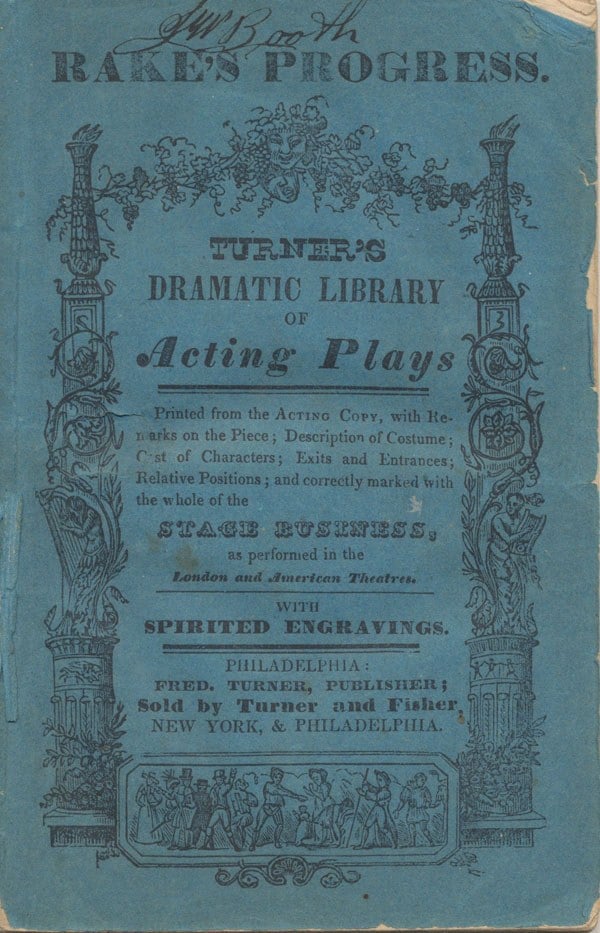
(“J. W. Booth”)on the front wrapper. William Leman Rede. RAKE’S PROGRESS. A MELO-DRAMA IN THREE ACTS.
Philadelphia & New York: Turner & Fisher, (no date, circa 1860). 59pp.; printed wrappers. Wilkes appeared twice in this play, both at the Richmond Theater, Richmond, Va: 8 January and 31 March 1860. Not listed for any part: But marking his part as an understudy.
Offered by Abraham Lincoln Book Shop, booth D9.
Merian, Maria Sibylla.
Over de Voortteling en Wonderbaerlyke Veranderingen der Surinaamsche Insecten...
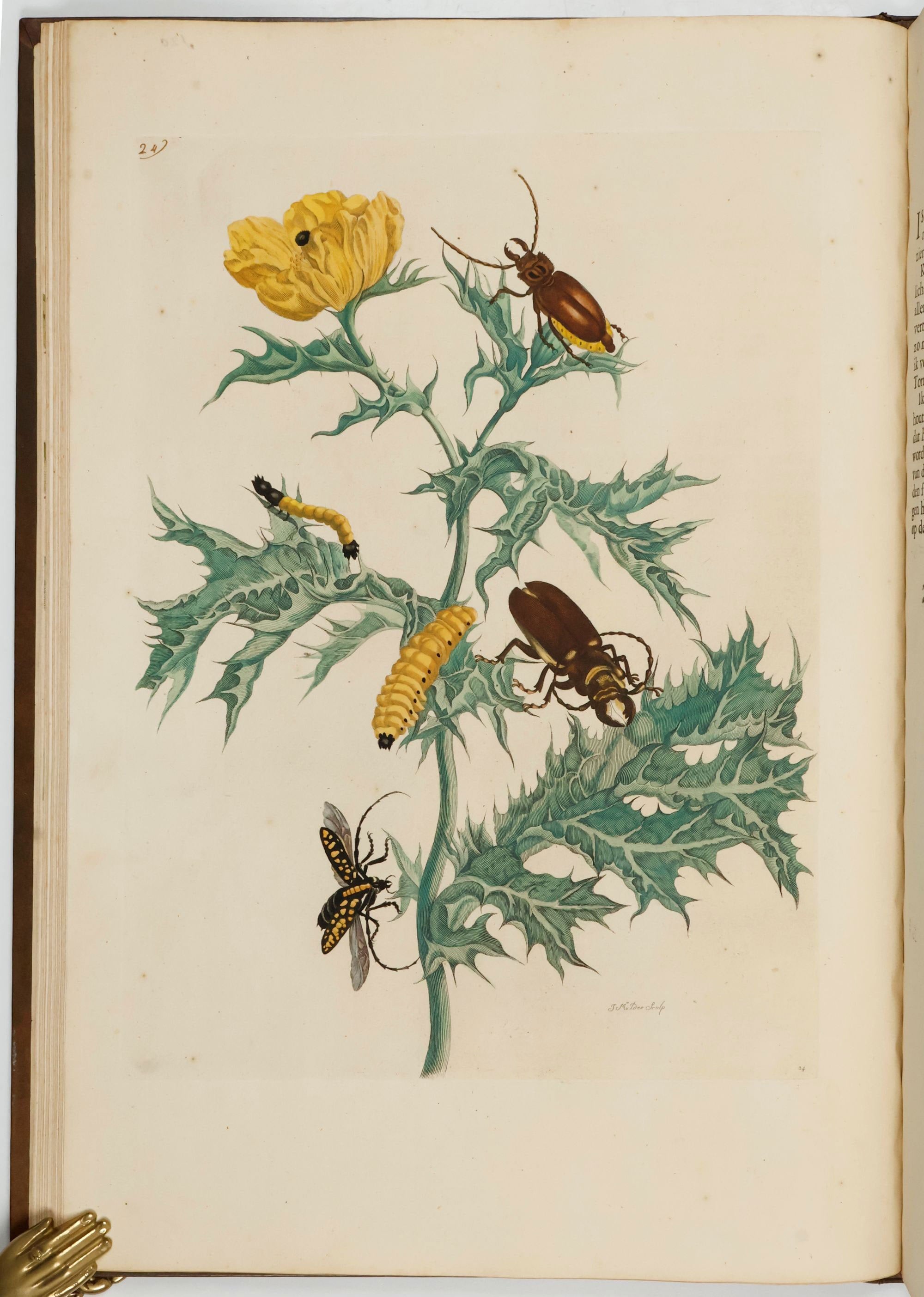
Large folio (50.3 x 34.7 cm). Originally hand-coloured engraved frontispiece; title page with engraved, hand-coloured vignette. [vi], 51 pp.; 72 hand
-coloured plates. 18th-century style Dutch mottled calf. Spine with five raised, gilt-rolled bands; compartments rich gilt with floral borders and floral vignettes; boards with decorative gilt-rolled lines, large, square gilt floral corner pieces, and large gilt embossed arabesque in the center of both panels. Gilt dentelles.
Third Dutch edition of a work first published in 1705 (with only 60 plates), and then reissued in 1719, with twelve additional plates, and again in 1730 (this edition), with 72 plates too. The work was written and illustrated by the great early 18th-century naturalist, early entomologist, and artist Maria Sibylla Merian (1647-1717), daughter of the famous Swiss-born Frankfurter printer and publisher Matthäus Merian. She was the first to document the life stages of the Surinamese toad (Pipa pipa), here figured, which carries its eggs on its back" (NHM site). Merian "had started to collect insects as an adolescent. At age 13, she raised silkworms. In 1679, Merian published the first volume of a two-volume series on caterpillars; the second volume followed in 1683. Each volume contained 50 plates that she engraved and etched.
The magnificent plates are remarkably clean and beautifully coloured. Impression and colouring both strong and accurate. The binding is extremely well done, with a convincing 18th-century Dutch look. A fine copy.
Offered by Antiquariaat de Roo, booth D21.
Babe Ruth
How to Play Baseball
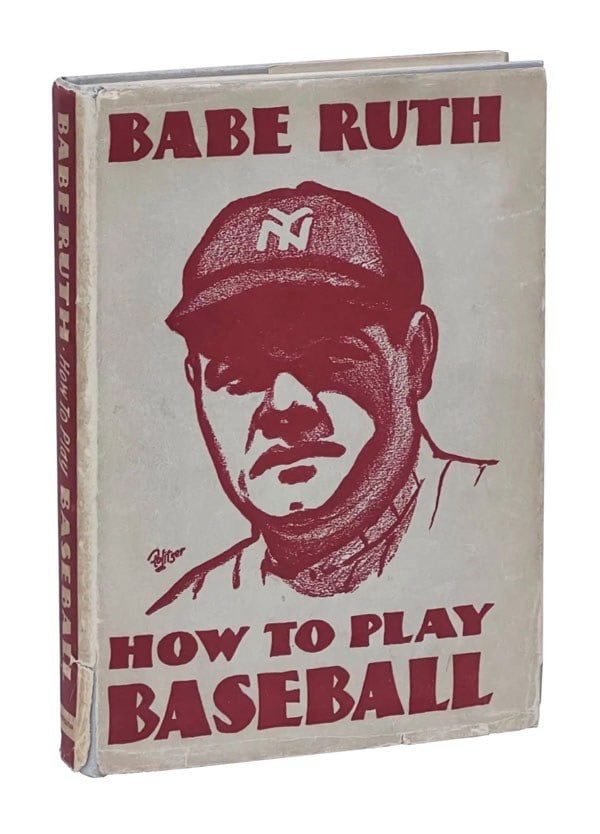
New York: Cosmopolitan Book Corporation, 1931. First edition, first printing. Publisher's light blue cloth, lettered in darker blue with an illustration of Babe Ruth to the front cover; original dust jacket with matching illustration to the front panel, lettered in dark red. Near fine book with light rubbing to front board and a hint of fading to spine; near fine price-clipped dust jacket with a few small nicks and creases to edges and corners, some toning to spine, and a bit of wear to lower spine. Overall, a handsome and sturdy copy.
How to Play Baseball is a book on baseball fundamentals by the legendary player Babe Ruth. Each chapter covers a different element of the game, such as "The Batting Stance," "How to Throw a Curveball," and "Blocking the Plate." The book also includes over thirty full-page photos of Ruth instructing young players. Ruth was a big advocate for children playing baseball, famously saying, "I won't be happy until we have every boy in America between the ages of six and sixteen wearing a glove and swinging a bat."
Ruth played in the MLB from 1914 to 1935 and revolutionized the game with his incredible home run hitting ability. Many consider him to be the greatest baseball player of all time.
Offered by B&B Rare Books, booth B6.
The complete literary universe of Thomas Pynchon.

Sixty-eight volumes spanning every novel, the majority of his short stories, and a full run of scholarly materials, from his first commercial publication in 1960 to his most recent novel in 2025, including proofs and advance copies bearing the bookplate of his own editor. The most comprehensive single collection of America's most elusive and consequential postmodern novelist, assembled in one place.
Offered by Biblioctopus, booth C20.
Poe, Edgar Allan (James A. Harrison Editor)
The Complete Works of Edgar Allan Poe (In Scarce Original Wooden Box)
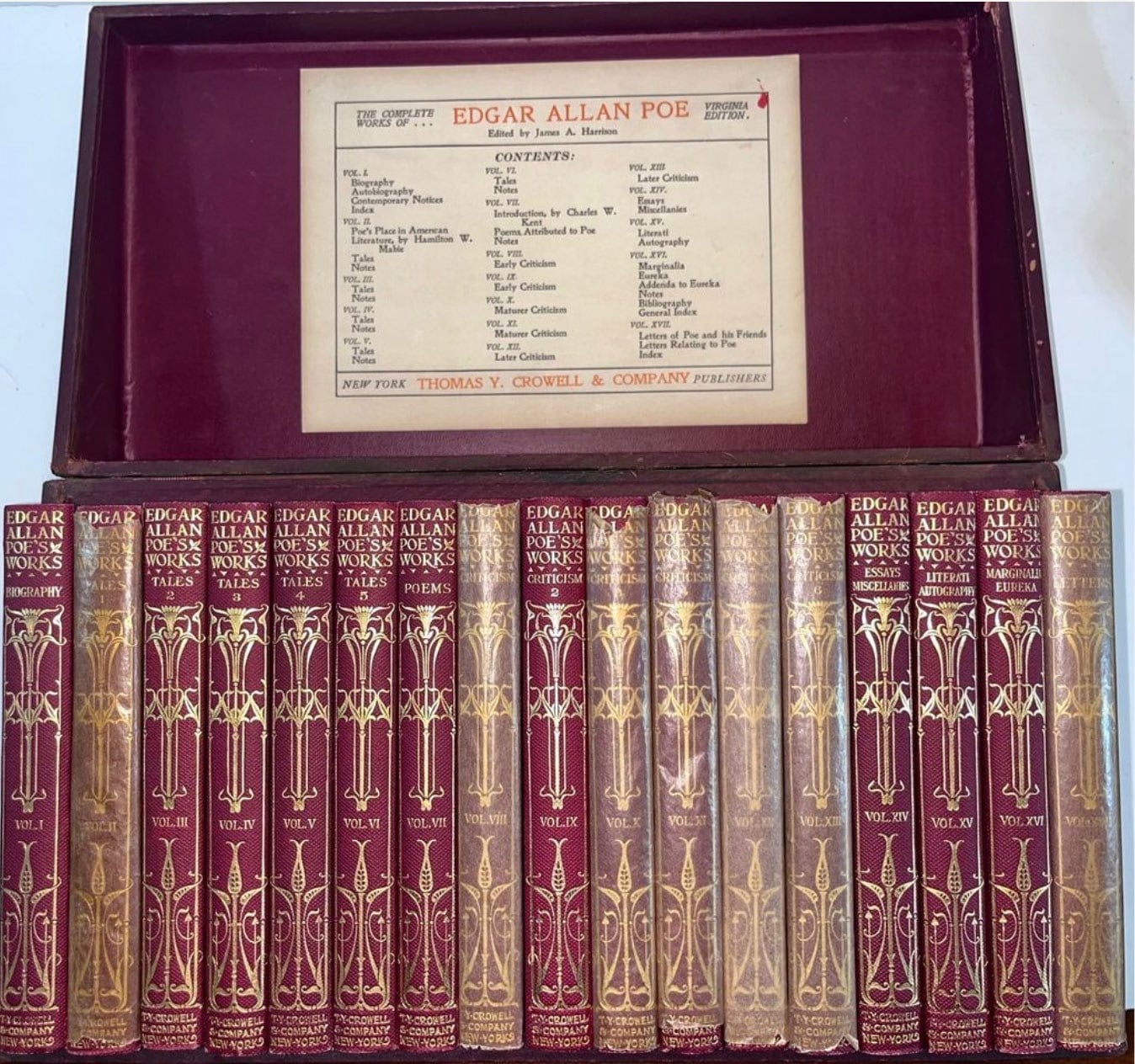
New York: Thomas Y. Crowell, 1902. Publisher's Cloth. Very Fine. Seventeen Volumes, 12mo. A simply gorgeous copy of the comprehensive "Virginia Edition" of Poe's works including a biography, criticisms, notes, letters, etc... Bound in publisher's original red cloth with lettering and decoration in gilt on front board and spine. Top edge gilt. Each volume has a tissue-guarded frontis illustration of either a scene from a poem or tale, a portrait of the author or one of his homes, etc... The plates are also protected with the original loosely inserted blank before the tissue guard that captured any off-setting to the tissue or page following. Seven of the volumes comes in its original glassine wrapper. Each volume appears to be rarely, if ever, unopened, let alone read. Square, tight and clean throughout with no discernible wear. No toning or foxing to pages.
Remarkably well-preserved, seemingly as new as when they were first published, and quite scarce as such. Scarcer still is the original wood box that houses the volumes. The original printed paper label, describing each volume, is affixed to the underside of the lid. The box has some spots here and there and a faint cup ring on the top of the lid but most handsome and quite sound. A stunning collectable set, one that rarely comes to market in such high-grade condition.
Offered by Brenner's Books - Rare & Collectable, booth D23.
Connie Converse (Original acetate recording)

New York: National Recording Studios, Inc., [1960]. An extremely scarce original acetate disc of the only known studio recordings of Connie Converse, an unusual American singer-songwriter who had no recordings issued before her mysterious disappearance in August 1974.
Her whereabouts since then are unknown.
In the early 21st century home recordings of Converse's work began to circulate online and gain a cult following, and in 2009 a small label issued a CD of home recordings, How Sad How Lovely, that brought her work to a larger audience and in time established her reputation as a major (albeit previously completely unsung) folk artist of the 1950s and '60s. As she had no commercial output during her known lifetime, though, fans of her work have been unable to own a piece of it until now.
LP record contains eleven songs, including a vocal overdub of "Down This Road" that is superior to the one on the Musicks online release, which was sourced from a tape dub. Very Good. Some scratches and rubbing to Side 1, a few skips and pops to Side Two's "Two by Two" (titled "One by One" on the Musicks release, a better and perhaps unique version) and "Two Tall Mountains."
This acetate was a gift by Converse to Susan Reed, an accomplished folksinger who appeared with Burl Ives on radio and TV in her youth, had a role in the 1948 film Glamour Girl, and ran into trouble with the notorious anti-communist HUAC in the late 1950s. She and Converse shared leftwing political leanings and recorded demos at home together. Reed also was one of the only well-known musicians to evince interest in Converse's work, performing it at Kaufmann Concert Hall in New York City in 1961.
Converse's biographer, Howard Fishman, mentions this 1960 studio session, but is unsure if it was recorded with an eye towards getting a recording contract or just a way of documenting Converse's songs for her and her friends' own edification. Regardless, it represents an important
part of the mercurial, fascinating singer-songwriter's slim oeuvre. As the music review site Pitchfork put it, "There was something uncommon and vulnerable, something deceptive and futuristic about Connie Converse’s songs... [She] wrote unbearably lonely songs, with protagonists who find their alienation to be almost sweet... They are stories of dreamers and travelers and men who will break your heart.”.
Offered by Burnside Rare Books, booth A5.
[Pierre Balmain] Josephine Baker.
Two Original Costume Designs for Josephine Baker.
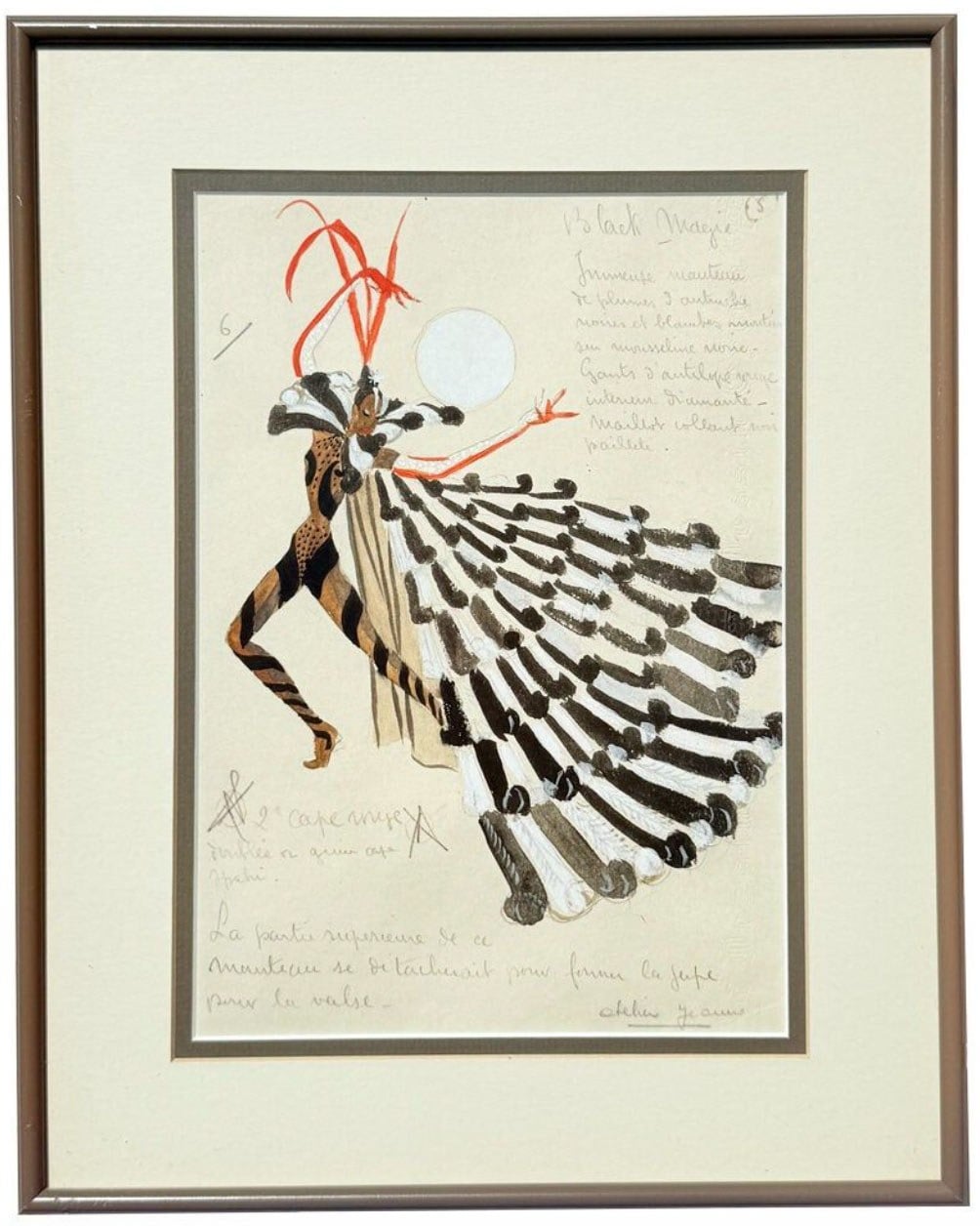
Paris, France: [Pierre Balman], ca. 1950. Two original costume designs in water color, gouache, and graphite on paper (26.5x19cm), archivally tipped to window mats and framed (37x29cm). Small pinholes obscured by frame, else a Near Fine set. Costume designs "Black Magie 1" and "Black Magie 5" for Josephine Baker's post-World War II performances, including her 1951 world tour. Though unsigned, these were both produced in the first decade of the Parisian fashion house of Pierre Balmain (1914-1982).
The first costume, captioned in pencil as "Revee" (concept) features a floor-length gown of gold lame and tulle fabric with a diamond corsage. The Balmain website features photos of Pierre Balmain fitting Baker in this very dress, noting that "Josephine Baker had a new gravitas after the war ended. And, of course, after her wartime heroism, she was loved by the French public even more than before the war. She returned to all the
big clubs in Paris—and, as we can see from the house archives, this is when the new young star of Post-War Parisian Couture, Pierre Balmain, began dressing her for her performances."
The second costume is even more involved, accompanied with the pencil annotations "Immense manteau de plum es d'autriche noires et blanches remontees sur mousseline noire. Gants d'antilope rouge interieure diamente-maillot collant noir" (Enormous cape of black and white ostrich features on black muslin. Red antelope gloves with diamond undersides, black skint ight leotard - our translation). The cape, according to the notes, would be fashioned into the skirt for the waltz portion of the performance. An image of Baker in this costume exists from her 1960s Olympia Theatre show in Paris and is described again in detail in a review of her 1973 performance at Carnegie Hall, where she refers to the head dress of flamingo feathers, as tall as herself, as her "Eiffel Tower."
Born in St. Louis, Missouri, in 1906, Baker began her career as a street dancer before making her way to New York at the start of the Roaring Twenties and the Harlem Renaissance, finding a place in the chorus line of the Broadway revue "Shuffle Along." Her big break, however, only came when Baker arrived in Paris in 1925 as a member of La Revue Negre. In 1927 she broke her contract to perform at the nightclub the Folies Bergeres, where her defining performance, wearing nothing but a short skirt made of fake bananas and a beaded necklace, was a sensation, establishing her as one of the leading entertainers of her generation.
In 1937 Baker married French businessman Jean Lion, renouncing her U.S. citizenship. During World War II she served as a pivotal member of the Resistance, using her celebrity and connections to work counterintelligence for Jacques Abtey. For her efforts she was awarded the Resistance Medal, the Croix de Guerre, and was named a Chevalier de la Legion d'Honneur.
As these fabulous and ambitious designs indicate, Josephine Baker was still, twenty-five years after her triumph at the Folies Bergères, at the height of her popularity, and she courageously kicked off her world tour "Black Magic in January, 1951, at Miami's Copa City Club, insisting that this segregated venue be integrated for her performance. The NAACP subsequently named her Outstanding Woman of the Year and in Harlem
May 20th was named Josephine Baker Day. However, an ill-fated run-in with the powerful columnist Walter Winchell at the Stork Club in October, 1951, put a premature end to the tour. She did return again to the American stage in her 1973 performance at Carnegie Hall, age 67, featuring once again the black leotard and flamingo head dress first conceived of here.
Offered by Capitol Hill Books, booth C9.
A highlight of our catalog for the fair this year is a wild and wonderful 1940s archive of photographs, negatives and written material pertaining to the Lost and Found Department of the New York City Subway.
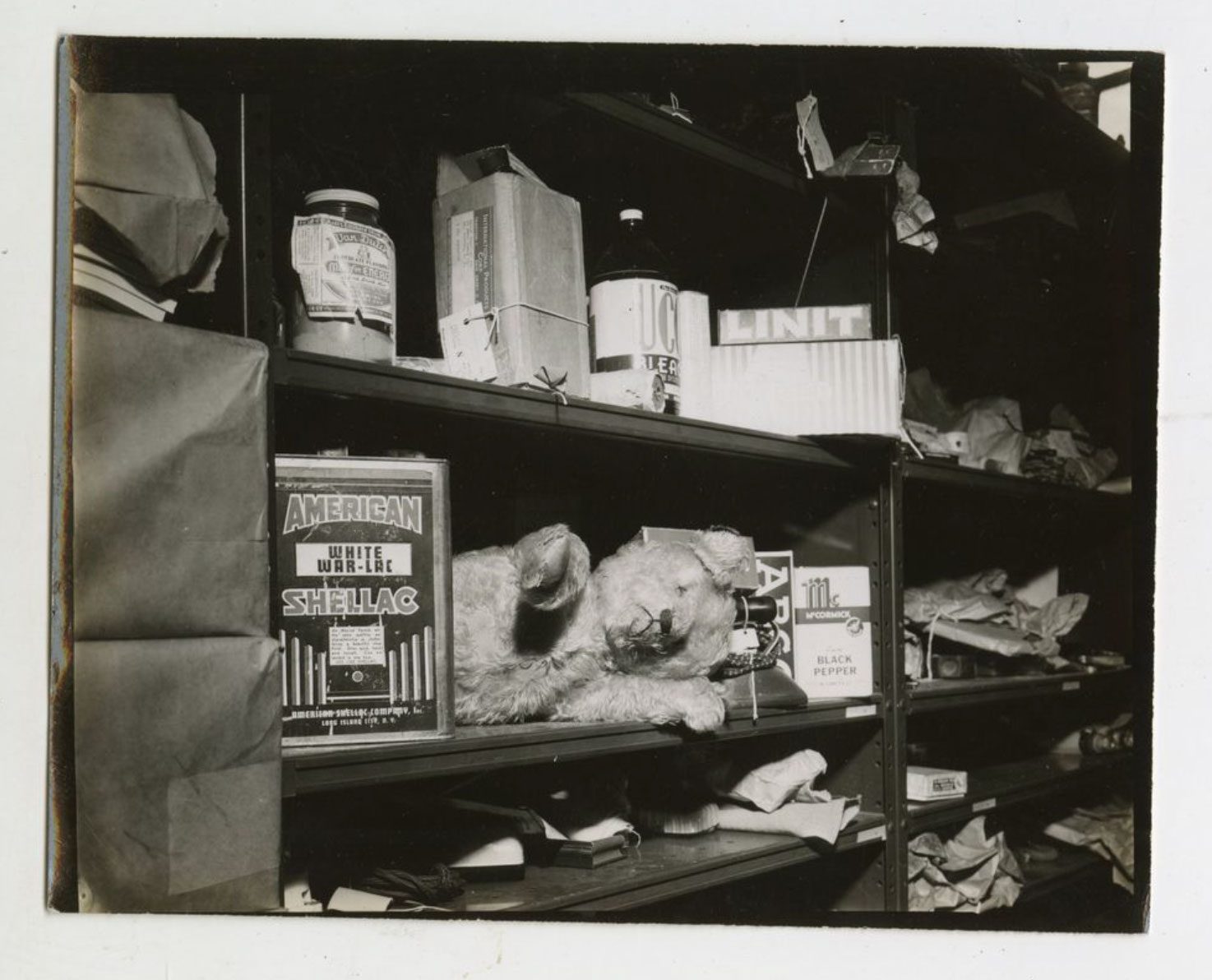
The collection includes photographs documenting stray watches, rings, purses, crutches, musical instruments, weapons, teddy bears, hats, brassieres, and much more. The written material includes a story about a man who tried on every pair of false teeth in search of his own, before walking a way with none, and a letter from the Lost Property Clerk filled with bits of wisdom acquired on the job such as, “It is surprising how few
people know how to describe an umbrella."
Offered by Daniel Oliver Gallery, booth A13.
A Shaker Manuscript Given by the Lord to The Shakers at Watervliet, New York (Wisdom’s Valley) and Transcribed at New Lebanon, New York (Holy Mount) in 1843.
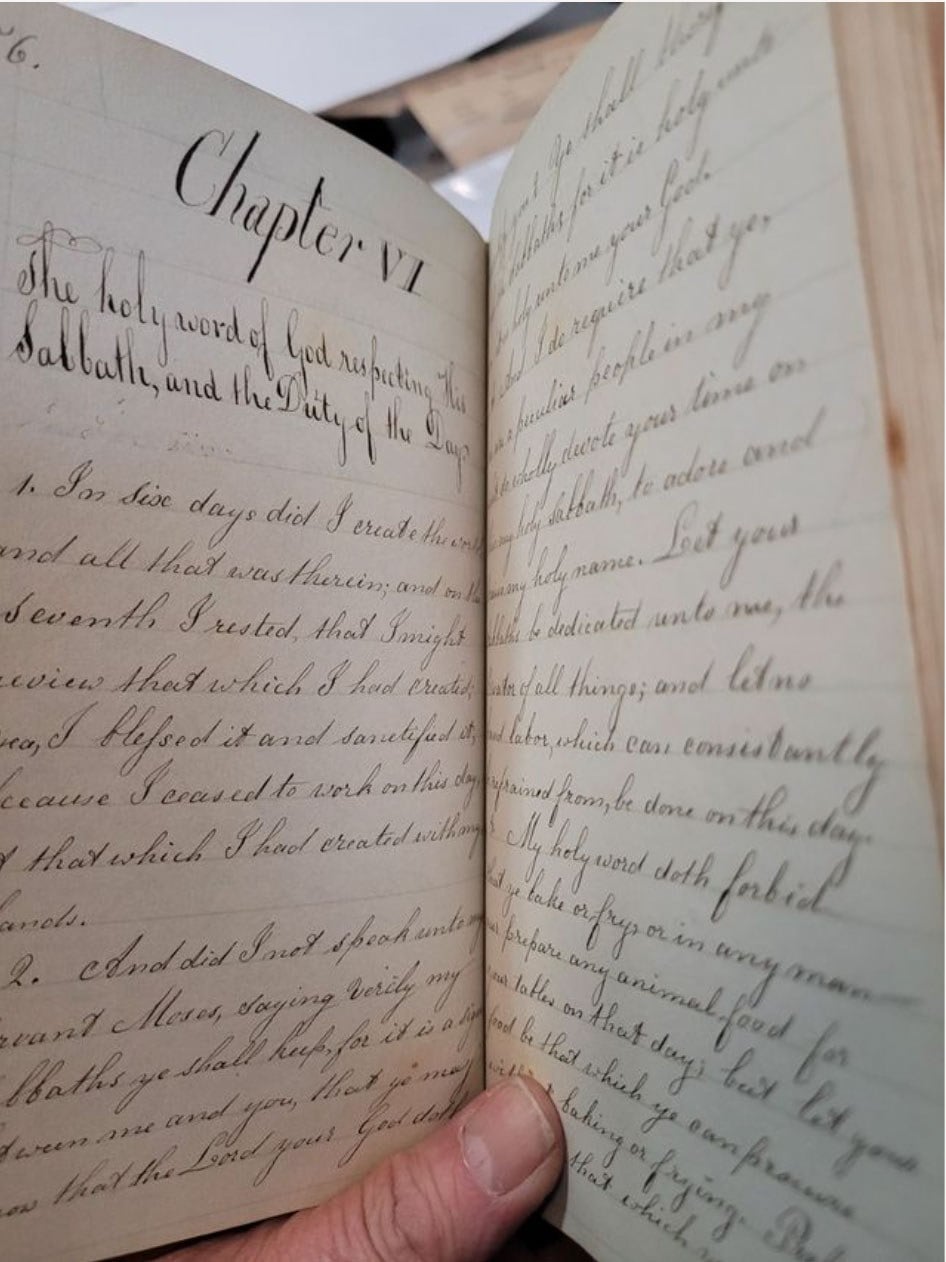
The Holy Word of the Lord God Almighty, The Holy One of His Chosen People, Throughout Zion’s Habitations. Given at Wisdom’s Valley, And Written by Inspiration at the Holy Mount, March 5th, 1843. 111, [3] pp. Rebound but retaining an original title on blue paper glued on the inside front cover reading “A Book of Inspiration Written at Holy Mount Given to us by Hancock Ministry.” The book is from the collection of Gerard Wertkin, who was the former director of the American Folk Art Museum in New York. Transcribed in a fine hand, this lovely manuscript consists of nine chapters, beginning with the Lord conveying to the Instrument an overview of religious points that culminate in the Lord sending his Spirit to Mother Ann Lee (1736-1784). Jesus and Ann Lee represent the dual gender duality of God and the equality of men and women in the Shaker faith.
This manuscript is representative of many similar works received from Spirits, angels, and the dead, supporting Shaker life and beliefs during the period known as Mother’s Work, or the Era of Manifestation (circa 1837-1857). Messages were often received by young women and described topics such as proper behavior, care of Shaker property, worship, obedience, interaction between the sexes, work, and messages from God,
and often from Mother Ann Lee and other founders of the faith who visited in spirit form. The manuscript offered here is important because much of it is directed at young believers and instructs them to listen and respect the first generation of Believers who, by 1843, were dying off. Reading the text, you come away with the strong feeling that the first generation of believers was concerned that the younger generation might lose
shaker its way, and that this was a means of shepherding these younger members back into the gospel order. The rules state how to keep the Sabbath, what to eat on the Sabbath, to be calm and quiet in the living spaces, and, generally, how to be a good Shaker. Chapter nine consists of a 5-page message from Angel Vikalen, who confirms what is written and suggests that this short work be read to members on the 6th of August every year, the date Mother Ann Lee arrived in America.
Shakerism developed in Manchester, England. Eventually, a young woman named Ann Lee became the leader of the small group. In 1774, she and seven followers left England and settled near Albany. From there, they grew by sending missionaries through New England, New York, Ohio, and Kentucky, converting thousands of people. Shakers are the oldest American communal group, and at one time had over 20 villages
with as many as 6,000 followers. Shakers are celibate, live communally, are pacifists, believe in equality between men and women and races, and practice confession of sin. By the late nineteenth century, Shakers began a slow decline. Today, three Shakers are carrying on the faith at the last village Sabbathday in New Gloucester, Maine.
DeWolfe and Wood have always specialized in Shaker and American Communal material. Scott DeWolfe and Frank Wood worked for the last Shaker community years ago, as did Scott’s wife, Elizabeth, who is the author of Shaking the Faith: Women, Family, and Mary Marshall Dyer's Anti-Shaker Campaign, 1815-1867.
Offered by DeWolfe & Wood, booth E4.
ALWAYS JOLLY!
by Lothar Meggendorfer.
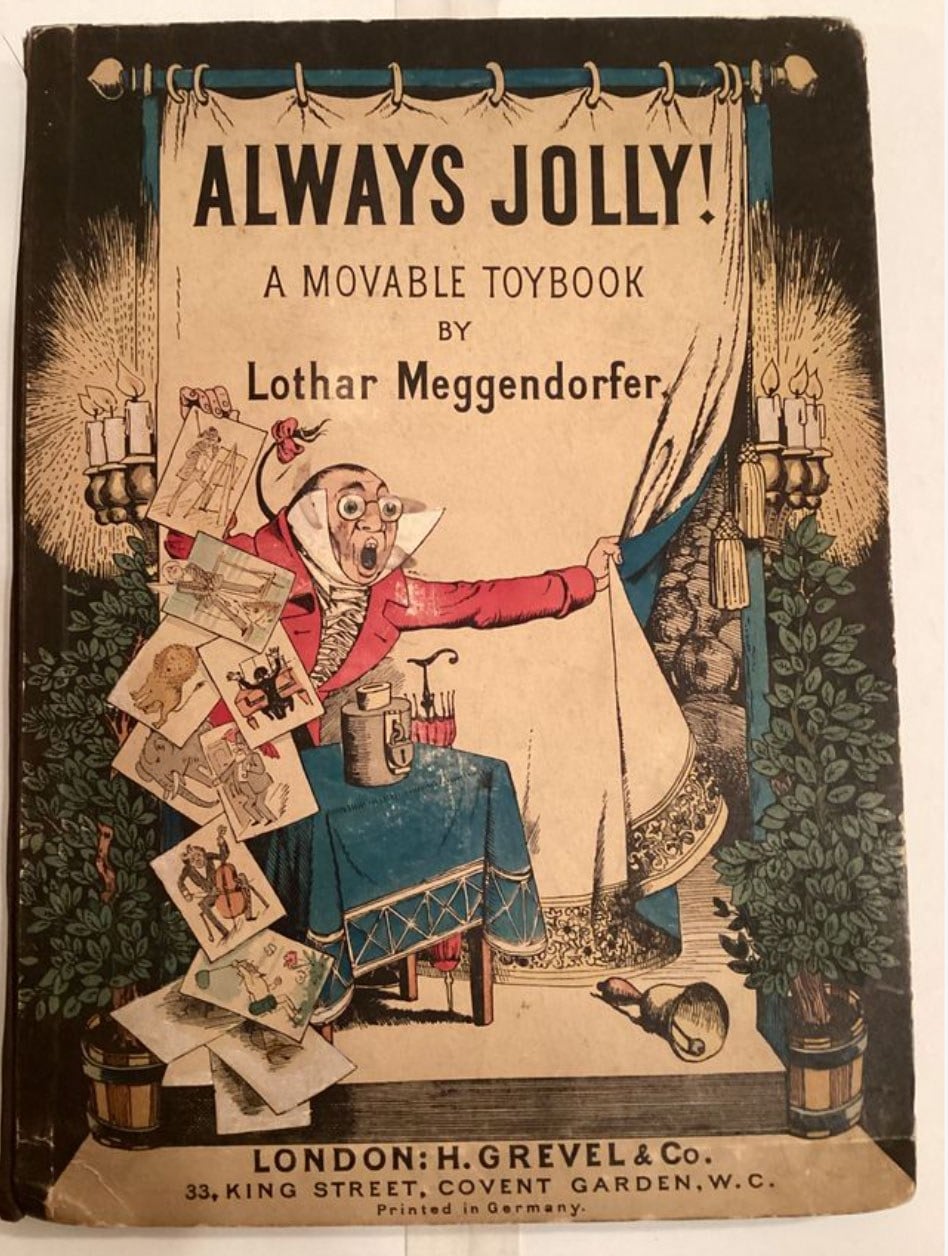
Scarce Children's Moveable from Maurice Sendak's Personal Library makes this copy even more special. Sendak's bookplate on inside front cover.
London:H. Grevel, 1st English Edition,1890. Eight Hand-Colored Moveable tab-operated plates. Many of Meggendorfer's moveable plates in the German 1st ed-were not used in the English edition-so most of the plates here are truly printed for the first time.
Offered by Enchanted Rare Books, booth A11.
Truth, Sojourner; [Gilbert, Olive]
NARRATIVE OF SOJOURNER TRUTH; A BONDSWOMAN OF OLDEN TIME; EMANCIPATED BY THE NEW YORK LEGISLATURE IN THE EARLY PART OF THE PRESENT CENTURY; WITH A HISTORY OF HER LABORS AND CORRESPONDENCE, DRAWN FROM HER "BOOK OF LIFE"

Boston: Published for the Author, 1875. Third edition overall (First revised and expanded edition). Hardcover. 8vo. [5], vi-xi, [1], 13-320, [2] pp. Brown publisher's cloth with a portrait of Truth in gold on the front board, borders in blind on each board, the portrait in blind on the rear board,
gold lettering and gold decoration on the spine. With a frontispiece of Truth (with a tissue guard). Errata slip tipped in after the copyright page. With a preface by the abolitionist William Lloyd Garrison. The " Book of Life" with its own fly-title. The first edition of this work was published in
1850, a second edition was done in 1853, this is the third overall edition but the first enlarged, expanded edition (the material in the "Book of Life" was added to this edition to supplement the shorter biography printed in 1850 and 1853). The initial biography in this work was dictated by Truth to her friend Olive Gilbert. Blockson 29. Truth's famous "Ain't I a Woman" speech from 1851 is printed here, along with several direct quotations from her.
The book provides a thorough history of Truth's struggles: being born into slavery, growing up enslaved, and eventually escaping to freedom. In 1828 she went to the New York state court to win back custody of her son Peter and became the first Black woman to win a lawsuit against a white man in the United States. Truth spent the rest of her life preaching, speaking out against slavery, speaking in favor of women's rights, and speaking on behalf of the temperance movement. She was a legendary orator and deeply moved those who heard her cries for the right to vote, to work, and to live a dignified life. Truth regarded the idea of women as delicate creatures to be nonsense and she herself traveled the country preaching at a breakneck pace: she was a regular at camp meetings outside New York City for several years, until she dedicated her energies to helping the Union in the U.S. Civil War. For years after the war Truth assisted with the Freedmen's Bureau, and fought segregation in Washington D.C. street cars (this work is also recorded here). Her unending dedication to a better world for working women, especially working-class Black women, is recorded here in this book. She was an outspoken advocate for these women in the nascent stages of the women's suffrage movement. This work is a shining example of resilience, determination, and sheer grit in the nineteenth-century United States. Very Good.
The corners of the boards a bit rubbed, a small piece of the crown and the foot of the spine rubbed away, light offsetting on the half-title page from a small floral decoration. With the name of a man from Plymouth, Michigan on the front pastedown, written in pencil and dated 1877.
Offered by Evening Star Books, booth A16.
The earliest herbarium still in private hands.
[HERBARIUM.] HARDER Hieronymus (1523-1607).
Herbarium.
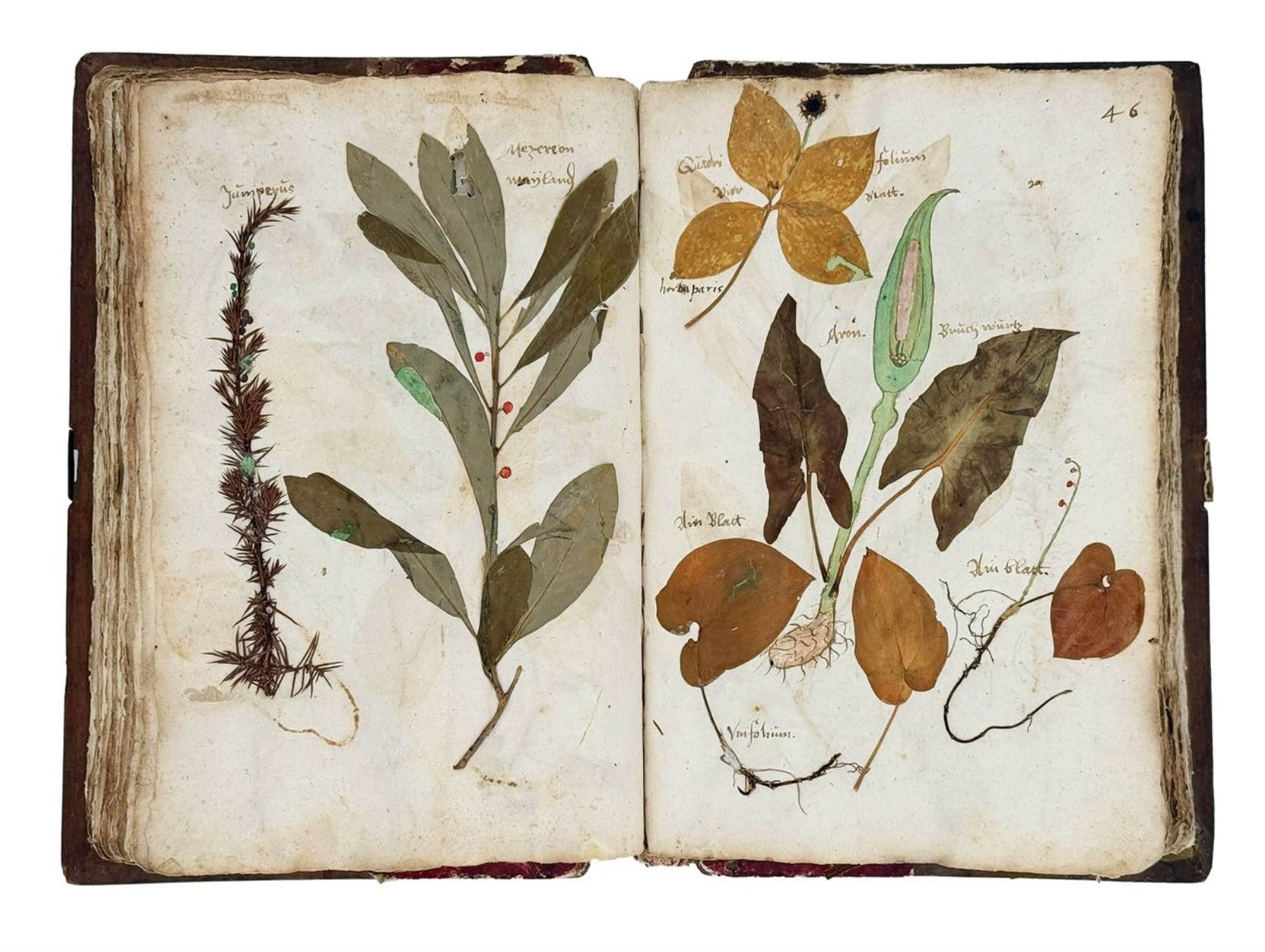
[Geislingen, 1562]. Folio (330 x 210mm), manuscript in German, 123 ff. numbered 1–100 (the first seven and last eighteen leaves unnumbered,
a few blanks), ink on paper. Contemporary half red leather, spine with three double raised bands, wooden boards, remnants of a clasp.
Hieronymus Harder was a teacher at the Latin school in Geislingen from 1561 to 1571, and later at Überkingen until 1578. Around Geislingen, he passionately collected local plants and, over the course of his life, created herbaria of exceptional documentary and scientific value. His early interest in botany stemmed from a desire to deepen his understanding of the flora of his region. Since the systematic classification of plants was not yet established in Harder’s time, the specimens in his herbaria were arranged according to the annual growth cycle. Parts of plants that could not be pressed—such as roots and fruits—were supplemented with drawings.
It is estimated that Hieronymus Harder compiled twelve herbaria during his lifetime. They are generally listed according to their current locations: Basel (1562, the present volume), Munich (two), Rome (Vatican Library, Pal. Lat. 1276 – “Erbario dello Harder”), Salzburg, Ulm, Vienna (two), Linz, Überlingen, Zurich, and finally Lindau (1607).
In the Ulm herbarium dated 1594, Harder himself notes that until now he had created six herbaria, the first two of which were presented to Duke Albert of Bavaria, who stayed in Überkingen in 1574 and 1576; the third to the Elector Palatine; the fourth to the Margrave of Baden-Durlach; the fifth to the Bishop of Augsburg, von Kneringen; and the sixth to Dr. Joan Kern of Innsbruck. The present volume is thus the oldest herbarium remaining in private ownership, as well as the earliest known botanical collection by Hieronymus Harder, and the only one not held in a public
institution.
Offered by ERASMUSHAUS AG, booth D17.
Cut-glass sulphide portrait plaque of Jean-Pierre Boyer
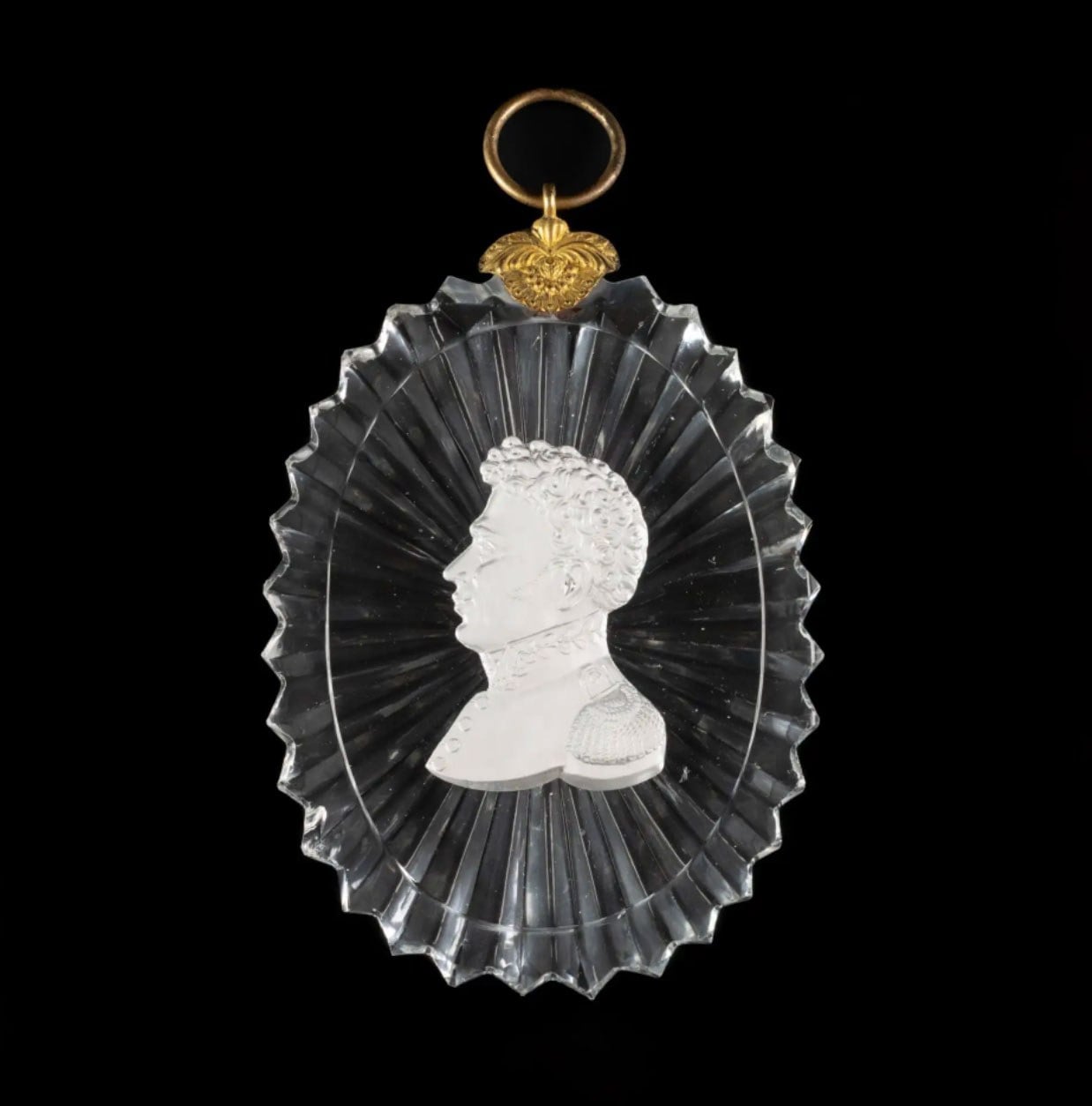
Rare French cut-glass sulphide portrait plaque of Jean-Pierre Boyer, Haiti’s president of African descent — such depictions of Black leaders in this prestigious medium appear to be virtually unknown.
Offered by Földvári, booth A14.
Presentation copy to the first Earl of Salisbury of the rare first English edition of a famous illustrated military manual, magnificently coloured by a contemporary hand.
GHEYN, Jacob II de.
The exercise of armes for calivres, muskettes, and pikes. After the ordre of his Excellence Maurits Prince of Orange Count of Nassau etc. Governour and captaine generall over Geldreland, Holland, Zeeland, Utrecht, Overijssel, etc. Sett forthe in figures by Jacob de Gheyn. With written instructions for the service of all captaines and comaundours. For to shewe hereout the better unto their jong or untrayned souldiers the playne and perfett maner to handle these armes.
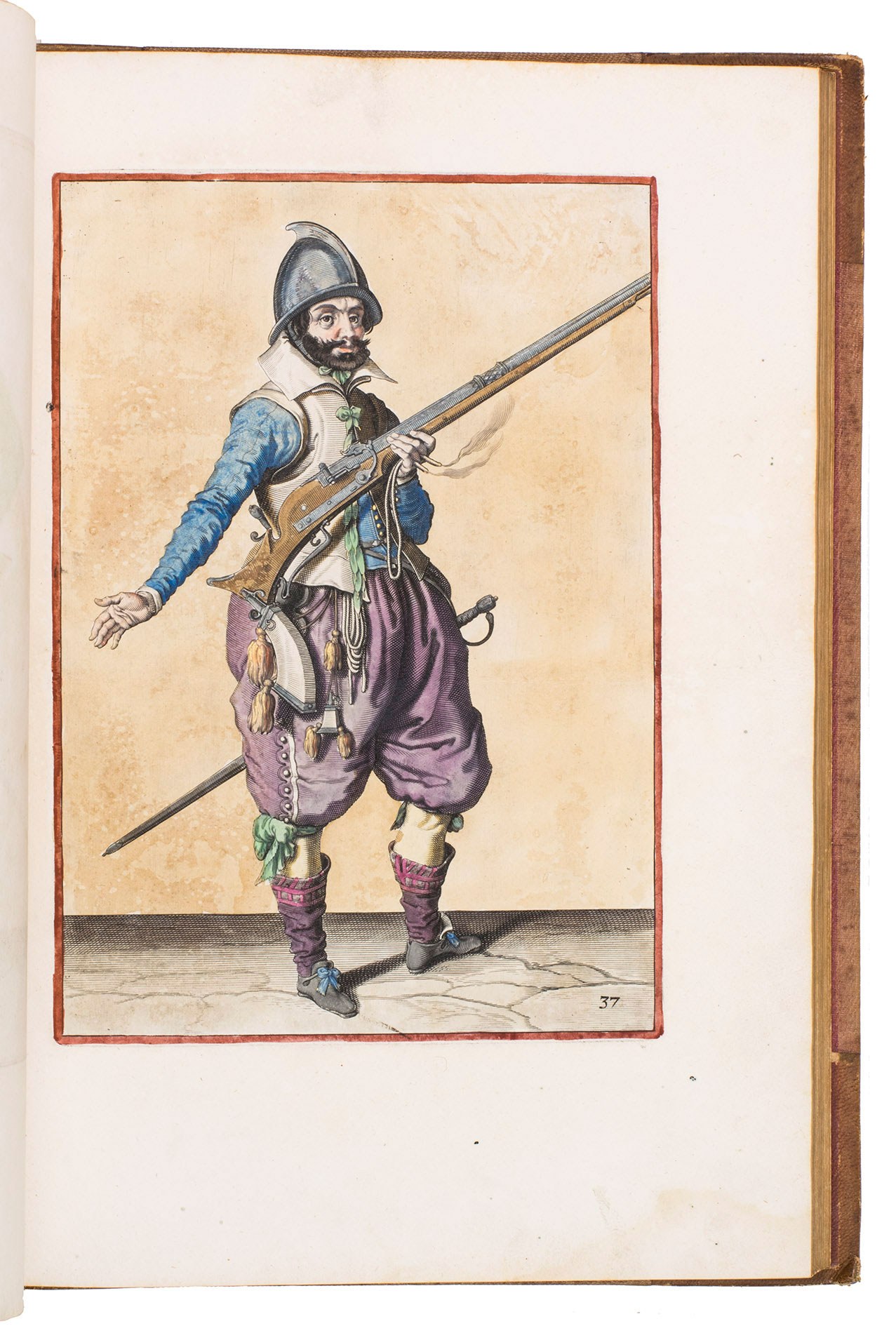
The Hague, [1607 (added in manuscript on the title page)]. 3 parts in 1 volume. Folio (ca. 37 x 27 cm). With an engraved title page with at the head of the page the coat of arms of the dedicatee, Prince Henry Frederick, eldest son of King James I of England within a wreath of lilies and roses, which - together with the title and the imprint were engraved on 3 separate slips of paper pasted over areas left blank for that purpose; and 117 (including one repeat) expertly engraved plates (ca. 26 x 19 cm): 42 numbered plates in part 1, 43 partly-numbered plates in part 2 and 32 numbered plates in part 3. All engravings including the engraved title-page are magnificently coloured and highlighted in gold and silver by a contemporary hand. The plates show exercises with the arquebus (part 1), musket (part 2), and pike (part 3). Mid-19th-century gold-tooled half (faded) red morocco and red cloth sides, gilt edges, marbled endpapers, bound in 1840-ca. 1860 by the celebrated British bookbinder Robert Riviere (1808-1882) with his stamp "Bound by Riviere" in the bottom outer corner of the verso of the first flyleaf.
Splendid copy of this very rare English edition of De Gheyn's illustrated major military manual, with the plates in their first state, before they were numbered and with some details added during the colouring stage instead of being engraved (several puffs of smoke in the illustrations). The present copy is one of the three "presentation copies" of the first English edition (New Hollstein, The De Gheyn family, II, p. 159, 1b.)
Offered by Antiquariaat Forum, booth E3.
Dona Ann McAdams Collection

A large gathering of over 150 original vintage prints from 1980s and '90s by the photographer, queer social documentarian and street activist Dona Ann McAdams. The collection includes images of queer liberation, ACT UP, pro-choice activism, and other elements of queer and feminist NYC life during this period as seen from inside the community.
The series, which McAdams titled "Arresting Images," documents ACT UP demonstrations and meetings at the Center, including the Grand Central Terminal die-in; lesbian organizing; and queer life at the height of the AIDS crisis. I've attached a folder with some sample images from the collection, including demonstrations following the death of artist David Wojnarowicz; the protest outside of Artists Space after the NEA pulled funding for Nan Goldin's exhibition, Witnesses: Against Our Vanishing, because of Wojnarowicz's essay; the LES needle exchange in action; queer sex worker and performance artists Annie Sprinkle and Veronica Vera; and more. Though not included in these images, the collection also includes McAdam's photos of friends and lovers in hospitals and receiving medical care for AIDS-related illnesses, personal documentation of these unnecessary deaths, and brief glimpses of joy in the face of the government-sanctioned mass death event that was the AIDS crisis.
Offered by Fugitive Materials, booth C29.
The City of New York.
1870 (undated)22.5 x 33.5 in (57.15 x 85.09 cm)
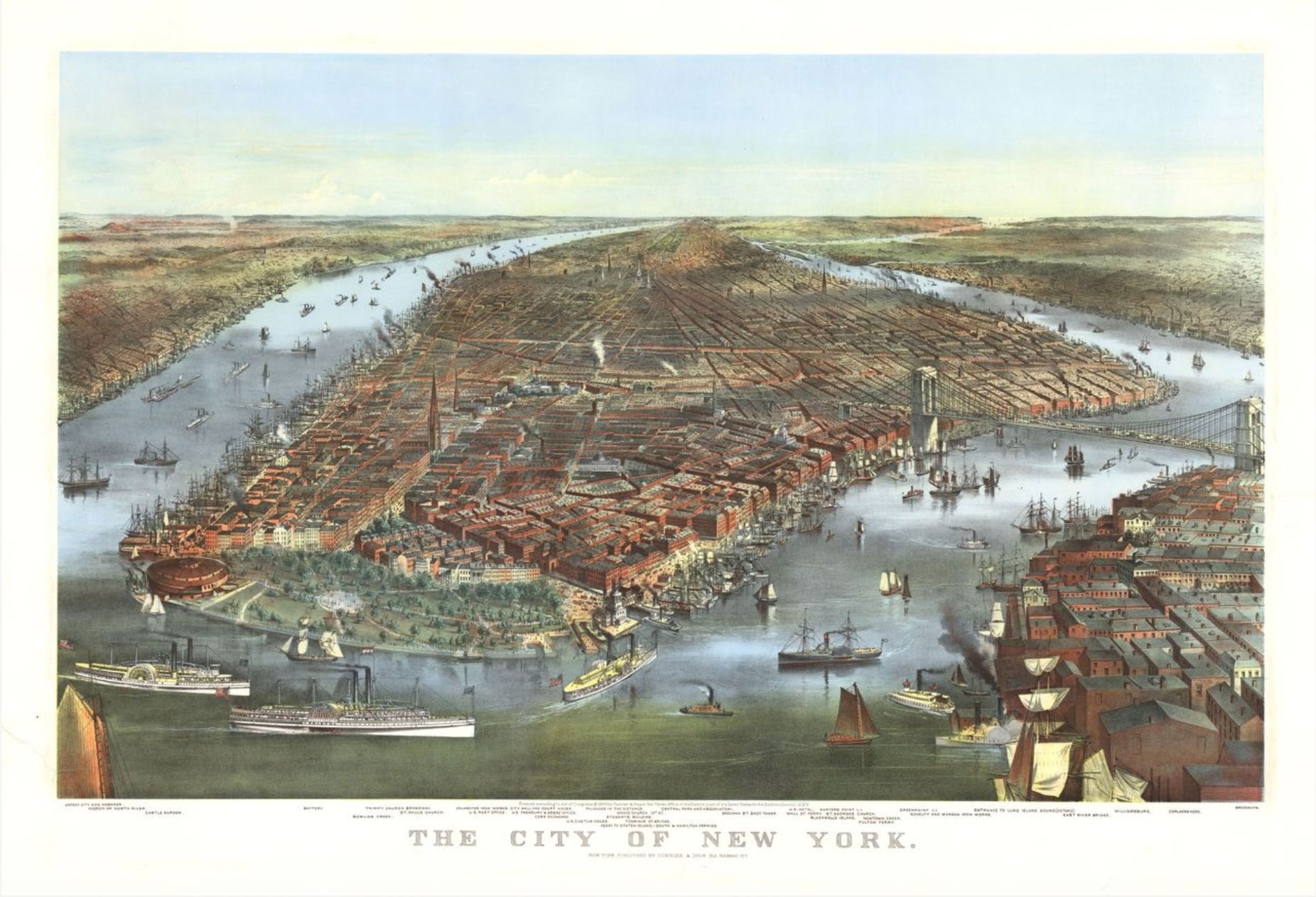
This is a beautiful example of the iconic 1870 Currier and Ives chromolithograph view of New York City, specifically Manhattan. It is the first edition of this famous view to include the Brooklyn Bridge, in the year construction on the wonder began, but 13 years before it opened!
The view looks northeast over Manhattan from a high point in New York Harbor. It is presented from a medium-oblique perspective in brilliant chromolithographic color. From Battery Park, Manhattan stretches into the distance. Major arteries, especially Broadway and Canal Street, stand out. The vertical perspective is exaggerated to highlight church steeples and other significant buildings, thus City Hall and churches are easily
recognizable. Hundreds of ships are docked along the Hudson and East Rivers, underscoring New York's role as a bustling port. The Brooklyn Bridge is shown complete, teeming with traffic crossing the East River to Brooklyn Heights. The bridge would not open for another 13 years, but construction did begin in 1870 and may have been the impetus for this view's issue.
The foreground features several paddlewheel steamers: The City of New York, Bristol, and the Old Colony. Central Park in upper Manhattan and the Palisades across the Hudson are evident in the background.
The Bird's-Eye view industry emerged in the United States in the middle part of the 19th century and coincided with the commercial development of lithographic printing. Before the rise of lithography, the ability to own and display artwork in the home was largely limited to the extremely wealthy, but the advent of lithographic printing made it possible for everyone to own visually striking artwork. A robust trade developed in portraits of political leaders, allegorical and religious images, and city views. City views were being produced in the United States as early as the 1830s, but the genre exploded after the American Civil War (1861-1865). Bridging the gap between maps and pictures, most 19th-century American bird's-eye views presented cities to the public from high points. Some were imagined, but others were drawn from hot-air balloons or nearby hills.
Offered by Geographicus, booth C26.
Barbara Kruger, Paste-Ups
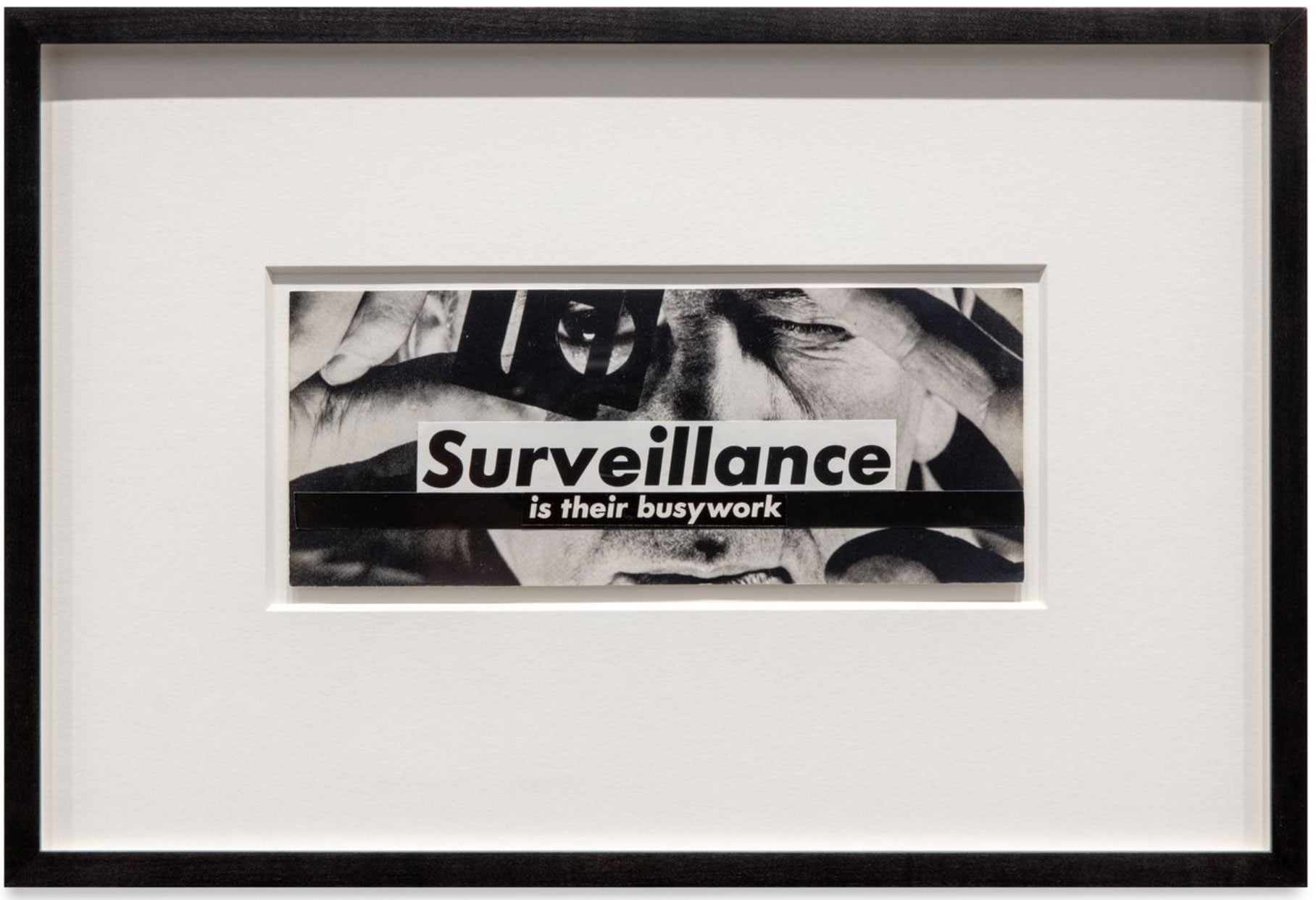
For the 2026 Armory Book Fair, Harper’s Books is pleased to exhibit a group of original paste-ups from Barbara Kruger. These unique collage works provide an intimate glimpse into Kruger’s artistic methodology — developed during her time as designer for both Mademoiselle magazine and leftist book publisher Schocken — with these word/image syntheses serving as foundations for her large-format gelatin silver prints, billboards,
subway posters, and postcards.
Offered by Harper's Books, booth C25.
[Keulen, Gerard and Johannes van, and others]
Composite sea atlas containing 56 detailed charts including 3 manuscript charts

Amsterdam, [Johannes van Keulen and others, 1700-1753, engraved title page dated 1734].
Magnificent contemporary hand-colored composite sea atlas containing 53 detailed printed charts and 3 remarkable, excellently produced manuscript charts of South East Asia. The printed charts were designed by the best chart-makers and originally published by the best Dutch map-publishers of the time, primarily Van Keulen. The original owner has apparently made up his Atlas with the purpose to have all the charts covering the sea-route to the East Indies and beyond, along the coasts of China and Japan. A veritable VOC treasure.
Importantly: 3 charts are in manuscript, drawn on paper with pre-printed compass lines and borders (charts numbered 44, 46-47 in the present atlas). The Van Keulen firm supplied pilots of the Dutch East India Company (VOC) and other companies and private enterprisers with manuscript charts to navigate the waters en route to the East Indies. They kept a vast collection of master copies up-to-date, which were used to produce the manuscript charts like those in the present work. The three maps have similar printed counterparts, known under their titles listed below. It is remarkable that these charts were supplied in manuscript, instead of in print, and do not concern the larger scale, and thus more detailed, manuscript charts otherwise more commonly associated with Van Keulen.
Offered by HS Books, booth C17.
The Bells and Other Poems
Edgar Allan Poe
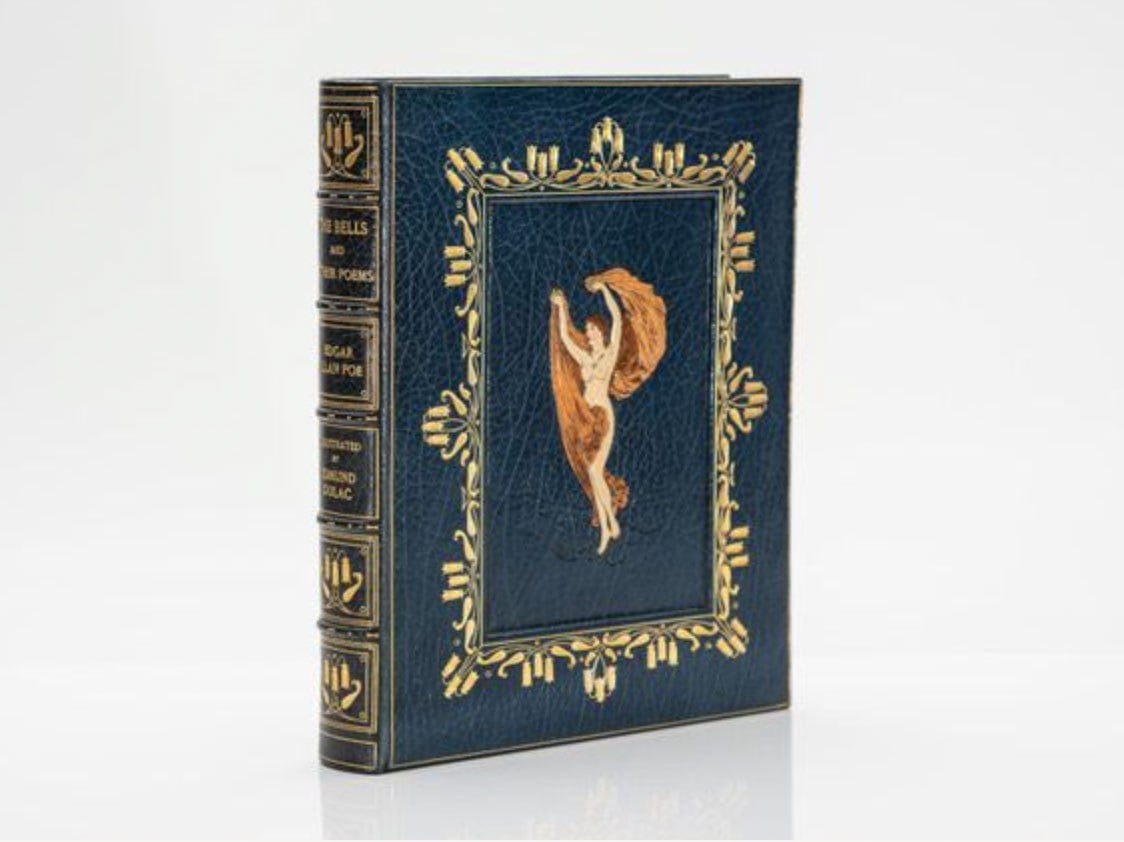
London: Hodder and Stoughton, 1912. Edmund Dulac. Edition de Luxe, Limited Edition. Leather Bound. Very Good. Limited to 750 numbered copies signed by artist, of which this is No. 171. Illustrated beautifully throughout by Edmund Dulac with colored plates. All edges gilt. Raised bands. Beautifully bound in blue Morocco leather by Bayntun. Front cover with large inset panel with inlaid angelic figure of a woman with cape resembling wings. Gilt floral embellishments on spine panels. Light blue silk moire doublures and endpapers. H: 12” W: 10” D: 1 5/8”.
Offered by Imperial Fine Books, booth A22.
AYMES. La gastronomie provençale.
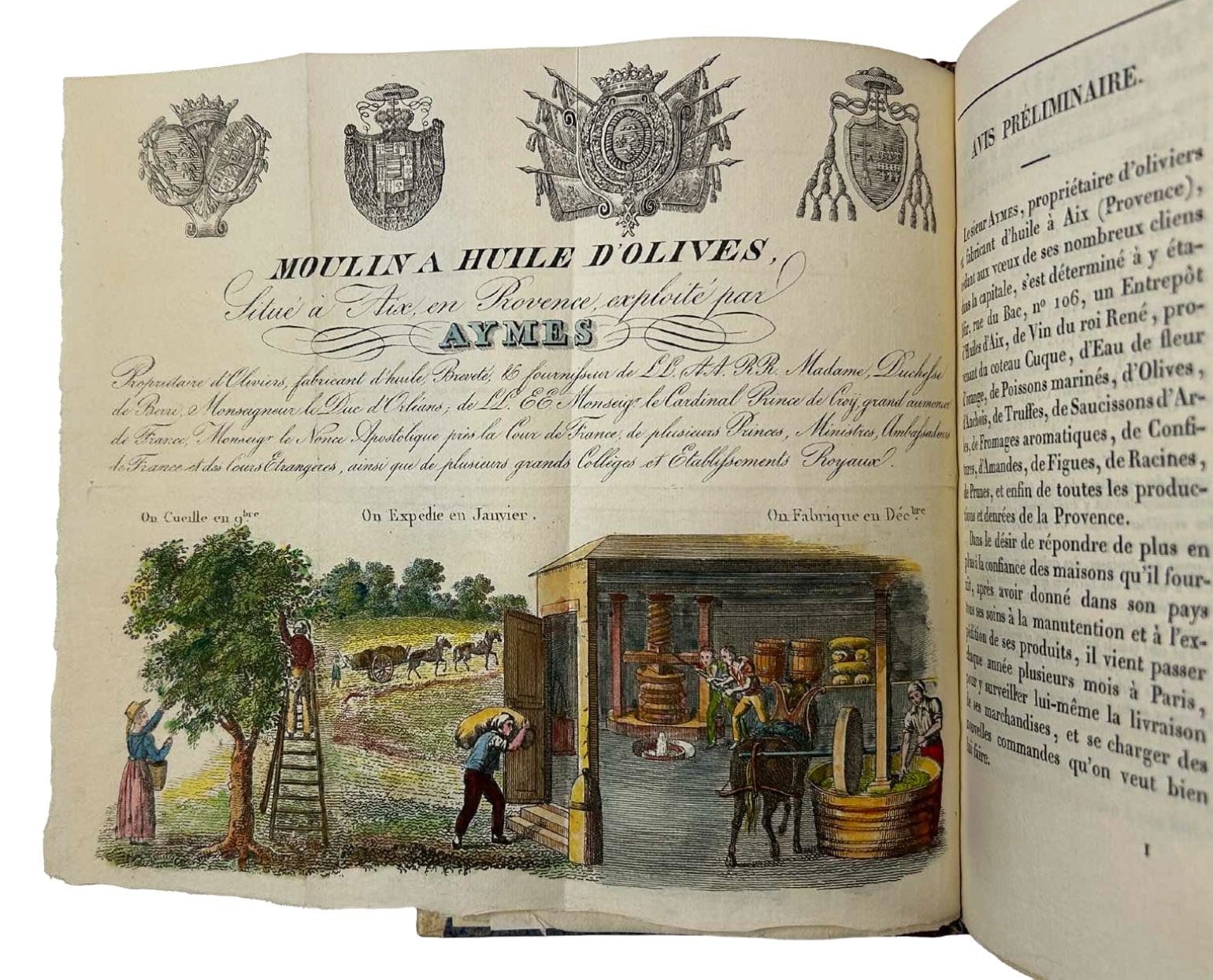
Paris: l’Entrepot [Imprimerie de Poussielgue-Rusand, rue de Sèvres], 1828.
Two folding hand-colored engraved plates, one folding hand-colored engraved map, three title page vignettes (two of which repeat and are
hand - colored), and one woodcut in the text. 3 p.l., 40, [ 2 ] pp. (at both the beginning and end there are also two interleaved leaves probably
added later when the work was rebound). Original printed and hand-colored wrappers bound in expert red quarter morocco over pastepaper
boards in the style of the period, vellum tips, spine gilt, short split at one of the folds of one of the plates, untrimmed.
The exceptionally rare FIRST & ONLY EDITION of this book devoted to the gastronomic riches of Provence. I have been able to trace only one other known copy (Morcrette collection); it’s wrapper was printed on blue paper and it did not include the English version of the title page (see below).
As is noted in the “Avis Préliminaire,”
Mr. Aymes, owner of olive trees and oil manufacturer in Aix (Provence), yielding to the wishes of his many customers in the capital, decided to establish there... a Warehouse for Aix olive oils, vin du roi Rene, coming from the Cuque billside, orange blossom water, marinated fish, olives, anchovies, truffles, Arles sausages, aromatic cheeses, jams, almonds, figs, root vegetables, plums, and finally all the products and foodstuffs of Provence.
After a few chapters describing the olive oil from Aix, the book lists the fifty- five different foods that Aymes brings to Paris to sell at
his warehouse. These include various olive oils; a triple orange flower water from Grasse; vinegar made from the wines of Provence;
vin du Roi René from the Cuque hillside (both a white dessert wine and a vin rouge ordinaire are offered; King Rene of Anjou was a ruler in Provence during the medieval period); different types of fish marinated in olive oil (tuna, sole, red mullet, and sardines); capers; different types of olives; truffles preserved in olive oil; pickles; sausages from Arles; Provençal cheeses; salted cod from Marseille; string beans from Africa; and so on. There is even a chapter on the use of olive oil for watches and other machines made from steel.
The first folding plate depicts three stages of making olive oil: the harvest, the transportation of the olives, and the pressing of the fruit. The second folding plate shows the six different sizes of terracotta jars that are used to store olive oil. One of them is as large as the man who is depicted dispensing the oil into a vase with a ladle. The last folding plate shows the layout of Aymes’ property and its various products. These include a vineyard, a pigsty, a rabbit warren, bee hives, olive trees, and a grove of mulberry trees (possibly to make silk). All three are hand-colored.
Interestingly, the on the verso of the lower wrapper is a second title page, this time in English. It reads:
The epicure provençale; or a catalogue descriptive of the productions of the south of France, their price, and the necessary instructions to detect their being adulterated; dedicated to the three Brothers Provenceaux, the heads of families, chief cooks, etc.
It is also noted on the recto of the final leaf that the warehouse at no. 106, rue du Bac, is closed on Sundays and for holidays. In fine condition. Not in OCLC.
Offered by Ben Kinmont Bookseller, booth C23.
Polydori Vergilii Urbinatis Anglicae Historiae Libri Vigintiseptem.
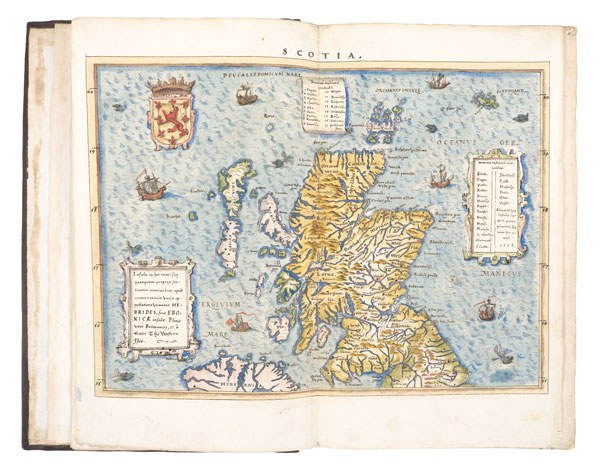
A work of supreme national importance, this extraordinary suite of four unique manuscript maps, created for Queen Mary I of England in 1558, is the first to depict the territories claimed by the English crown. Never before had each territory—England and Wales, Scotland, Ireland, and the Channel holdings—been depicted in a series of individual maps. On their own, each map is of superlative cartographic importance: here we find the first separate map of Scotland, the first proper separate map of Ireland, and one of the earliest separate maps of England and Wales. But here they are, gathered in sequence, to extra-illustrate an example of Polydore Vergil's 1555 Anglicae Historiae elaborately bound for the Queen with her arms. Together, the book and its maps are perhaps the most significant artifact of Tudor intellectual history still in private hands, equal to such monuments of royal cartographic patronage as King Henry VIII's Map (Cotton MS Augustus I i 9) and the Queen Mary Atlas (Add MS 5415 A) in the British Library.
The marriage of the maps with Vergil's text is not coincidental: while his narrative traces England's story from ancient origins through the transformative reign of Mary's father, Henry VIII, the maps present a contemporary visual accounting of her realm. By presenting each territory as an individual subject rather than parts of a unified whole, they suggest the nascent idea of an incremental and expanding British dominion, presaging the Empire. This volume thus captures a pivotal moment in Tudor territorial consciousness: before England's attention could turn decisively outward in the Elizabethan era, it first had to know itself.
The conjunction of royal provenance, groundbreaking cartography, and national historical narrative makes this a relic of foundational importance to British identity. Together, the text and maps offer an unprecedented window into how England's first queen regnant understood her dominions in 1558—at once the threshold of her realm's emergence as a global power and the final year of her role in guiding it. Within months of its creation, Mary had died and this volume likely passed to her half-sister Elizabeth, who would lead England across that threshold and establish it as a global empire.
Offered by Barry Lawrence Ruderman Antique Maps, booth B17.
Aleksandr Deineka and the title is Work, Build and Do Not Complain
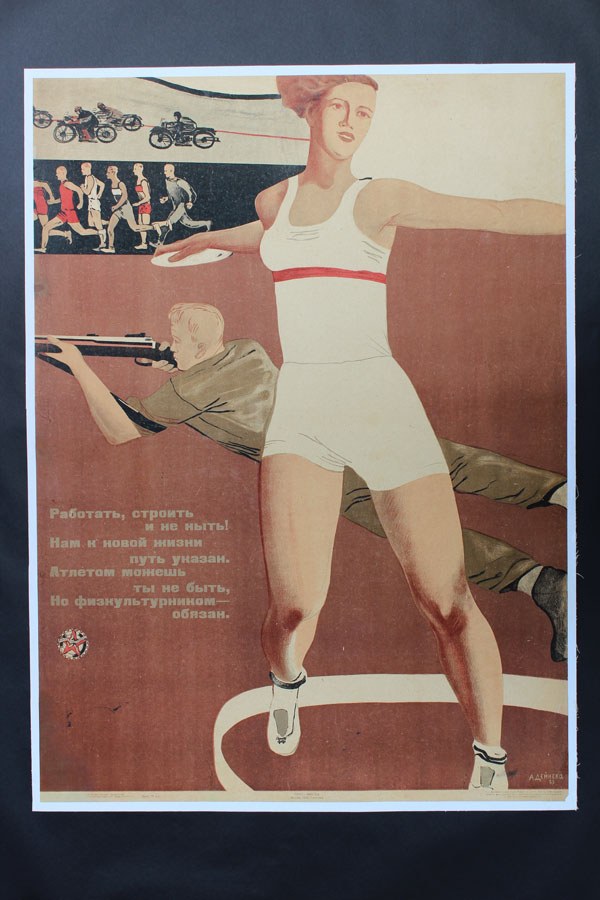
Cover art by Valentina Kulagina. Krasnaya niva. Red Field. 1929 #45. 28 pp. 12 x 9”. Exhibited at, Gustav Klutsis and Valentina Kulagina
— Photography and Montage After Constructivism. International Center of Photography. New York. 2004
Offered by Productive Arts, booth D9.
Edward F Ventris, ‘THE GREATEST FEATURE OF THIS WONDERFUL CITY IS THE SKYSCRAPER: A Four Week Ocean-Going Trip to Visit New York City in the Summer of 1903

‘A Trip to America’, recorded by a young, bumptious traveller from a successful English military family (his father was Commander of British Forces in China at the time), determined not to be overawed by New York City, and then completely overawed by people, elevated railways and high-rise architecture: ‘The structures at first sight, strike one as ridiculous. Why go up to such outrageous heights? Well it is necessary for New York cannot expand... It is surrounded by water and must therefore go up, & it has gone up to a wonderful height.’
Young Mr Ventris is eloquent on the sorrow of emigrants around him in Liverpool and Queenstown in Ireland as ‘smiles fade away and give place to serious looks & then the tears come’. And on the outward journey he found himself sharing R.M.S. Umbria with homeward-bound performers who’d taken part in the landmark London musical that represented a leap forward for African-American representation in vaudeville theatre, In Dahomey: a Negro Musical. Ventris responds to his new friends in the language of the era: ‘the two smart neggresses who had been performing in London in t
he n***** play “In Dahomey”. They were “great” the life of our part of the boat-singing, laughing (what a laugh they had, what pearly teeth).’ But best of all, perhaps, Ventris has tipped into his diary all manner of ephemera , postcards, menus, a sensational newspaper front page, recording every aspect of his trip, culminating in a page of business cards of those he met on board the return trip. A lovely meeting of cultures.
A bespoke buckram binding on this elephant folio volume, in very good condition titled ‘A Trip to America’ in gilt to front board. Measures 43 cm x
28 cm. Cracked over front and rear gutters; text block is sound. Paper watermarked ‘County Palatine’, a little age toned as expected. Ventris writes in a neat easily legible hand, 24 pp. Circa 7500 words. Signed on completion, ‘Edw F Ventris 1906’ to recto of last leaf.
Offered by Christian White Rare Books, Ltd., booth B12.
LANGLAND, William (c.1330-c.1386).
The Vision of Pierce Plowman, now fyrste imprynted by Roberte Crowley,dwellyng in Ely rentes in Holburne. Anno Domini. 1505. Cum privilegio ad imprimendu[m] solum.
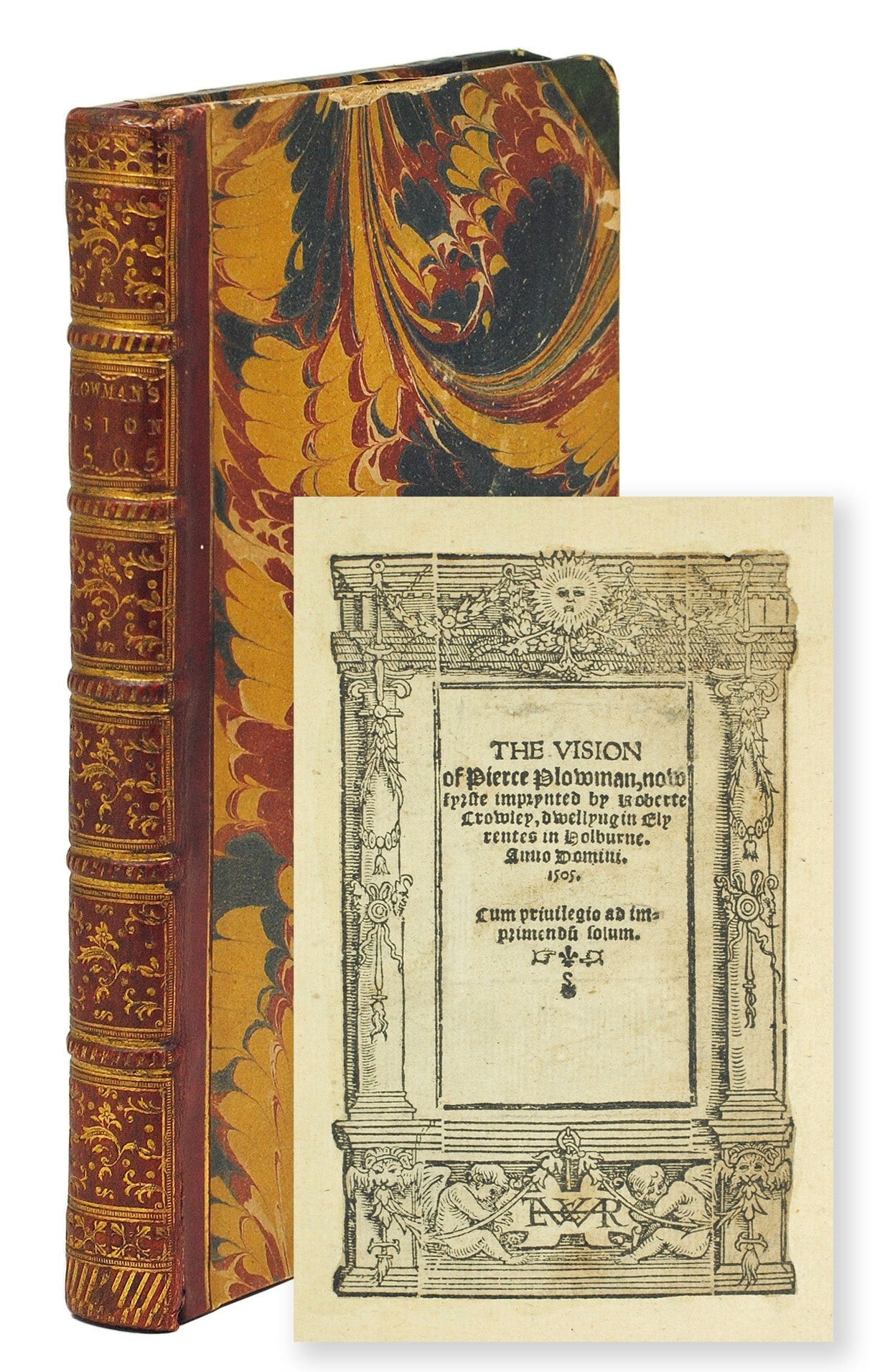
Colophon: Imprinted at London by Roberte/Crowley, dwellyng in Elye rentes/in Holburne. The yere of/our Lord. M.D.L. [1550]. Small 4to (191 x 134mm): [2], 117 ff. Collation: *2, A-Z4, Aa-Ff4, Gg1 (U3 and Ff2 incorrectly numbered T3 and F2 respectively). Many pagination errors.
Black letter. Title within ornamental border, device of Edward Whitchurch. 4- and 3-line woodcut floreated initials. Woodcut printer's device on the t/p *1r. Late eighteenth century binding of marbled boards with gilt-tooled red morocco spine, green leather corners, slight wear to corners. Text preceded by two later blanks, see below.
First edition, first issue, three copies extant including this one, with the date 1505 on the title page being a misprint for 1550. Title, next and last leaves inlaid and slightly defective; otherwise perfect and in good condition. [Sotheby’s, Ashburnham sale, 1897]. The text in notably fine condition, good margins extending well beyond the side notes. Shelfmark "31.K" above a half bookplate on pastedown, with "Mr. Cole" lightly in pencil beneath. Ink and pencil annotations on front free endpaper. Blank leaf, followed by a half-page statement in ink ending "This is altogether a very fine copy. J.W.C. 1843." This is likely to be Jane Welch Carlyle, wife of Thomas. Very early ink signatures in brown ink on the first text leaf “Rychard Reddes,” “Robert Bains” and “Wm. Walker." all of whom are not readily identified.
“Like the Pearl Poet's Sir Gawain and the Green Knight, Piers Plowman is considered by many critics to be one of the greatest works of English literature of the Middle Ages, preceding and even influencing Chaucer's Canterbury Tales. Piers Plowman contains the first known reference to a literary tradition of Robin Hood tales.” (Wikipedia).
Stephen Tabor (Huntington Library, co-editor of the ESTC) notes (3/2026) that two other copies only are reliably recorded. Folger (https://digitalcollections.folger.edu/bib163740-157236) is identical. Warner, Census of Piers Plowman, adds the Ashburnham copy (i.e. this copy), agreeing with Tabor.
Provenance (lot 2261 Ashburnham sale 1897): buyer unknown; sold to Colin Franklin (before 1986), by him to a private collector; by inheritance to current consignor.
A later issue (correctly dated 1550) from the Collection of Phyllis Goodhart Gordan 2025: Price Realised hammer USD 95,250 or approximately $135,000.
Offered by John Windle Bookseller, booth C22.
Header photo credit: Meredith Nierman Photography.