


Browse a selection of preview highlights from the upcoming ABAA Virtual Book Fair: Spring Edition.
Our next virtual book fair is the Spring Edition, from April 9-11, 2026. As usual, the Fair will take place at www.abaa.org/vbf
We invite collectors and bibliophiles to join us to shop the booths of prestigious domestic and international sellers specializing in rare and antique books, maps, prints, ephemera, and much more. Below, you'll find a selection of preview highlights from among the rare and collectible items our exhibitors will be offering at the Fair.
Psychedelic Review. Vol. 1, No. 1 (June 1963) through No. 11 (Winter 1970/1971) (all published)

A complete collection in 11 issues of the controversial journal on psychedelic substances. Various sizes, octavo and quarto. Original wrappers, some printed, some illustrated, two side-stapled. Issue no. 1 with some light soiling and a small tear to top edge of back cover, other issues with extremely minor scattered handling wear, overall excellent. Cambridge/New Hyde Park/New York City/San Francisco: Psychedelic Review, 1963-1971. Sold together with: The Harvard Review, Vol. I No. 4 (Summer 1963), containing an essay by Timothy Leary on psychedelic substances. This controversial magazine was co-founded and edited by American psychologist Timothy Leary after being fired from Harvard in May 1963, following an essay which was published in the Harvard Review by Leary and his colleague, Richard Alpert (later known as Ram Dass) titled "The Politics of Consciousness Expansion." Their controversial research led to their dismissal and also helped make psychedelics better known in the aftermath of the scandal.
The first issue of the Psychedelic Review came out just one month later, and was edited over the course of its publication by Leary, Paul A. Lee, Ralph Metzner, Rolf von Eckartsberg, and Gunther Weil. The statement of purpose in the first issue reads, "Recent years have witnessed a widespread increase of interest in the alteration and expansion of consciousness. The discovery of...psychedelic substances...has been a major contributing factor in this development...The Psychedelic Review is designed to serve as a forum for the exchange of information and ideas about these issues. It will publish original research reports, scholarly and historical essays, outstanding phenomenological accounts of spontaneous or induced transcendent experiences, and reviews of relevant pharmacological and other literature."
Topics covered in the issues of this journal include hallucinogenic fungi of Mexico, pharmacology of psychedelics, LSD, psychosis, botanical sources of narcotics, psychometabolism, treating alcoholism with psychedelics or cannabis, psilocybin experiences, mescaline, the uterine stimulant effects of morning glory seeds, regulation of drugs, peyote, psychotherapy, treating female "frigidity" with LSD and Ritalin, metaphysics, Zen Buddhism, ayahuasca, transcendental experiences, a yogic experience with mescaline, how to live with schizophrenia, telepathically induced amnesia, marijuana, and the use of psychedelic drugs in prisoner rehabilitation.
A rare, complete collection of the groundbreaking journal in the field of psychedelic research.
Offered by Bernett Rare Books Inc.
Papers by Doctors Murie, Mivart, Flower, Cobbold, Etc.
Cobbold, Thomas Spencer, Flower, William Henry, Huxley, Thomas Henry, Kirk, John, Mivart, St George Jackson and Murie, James
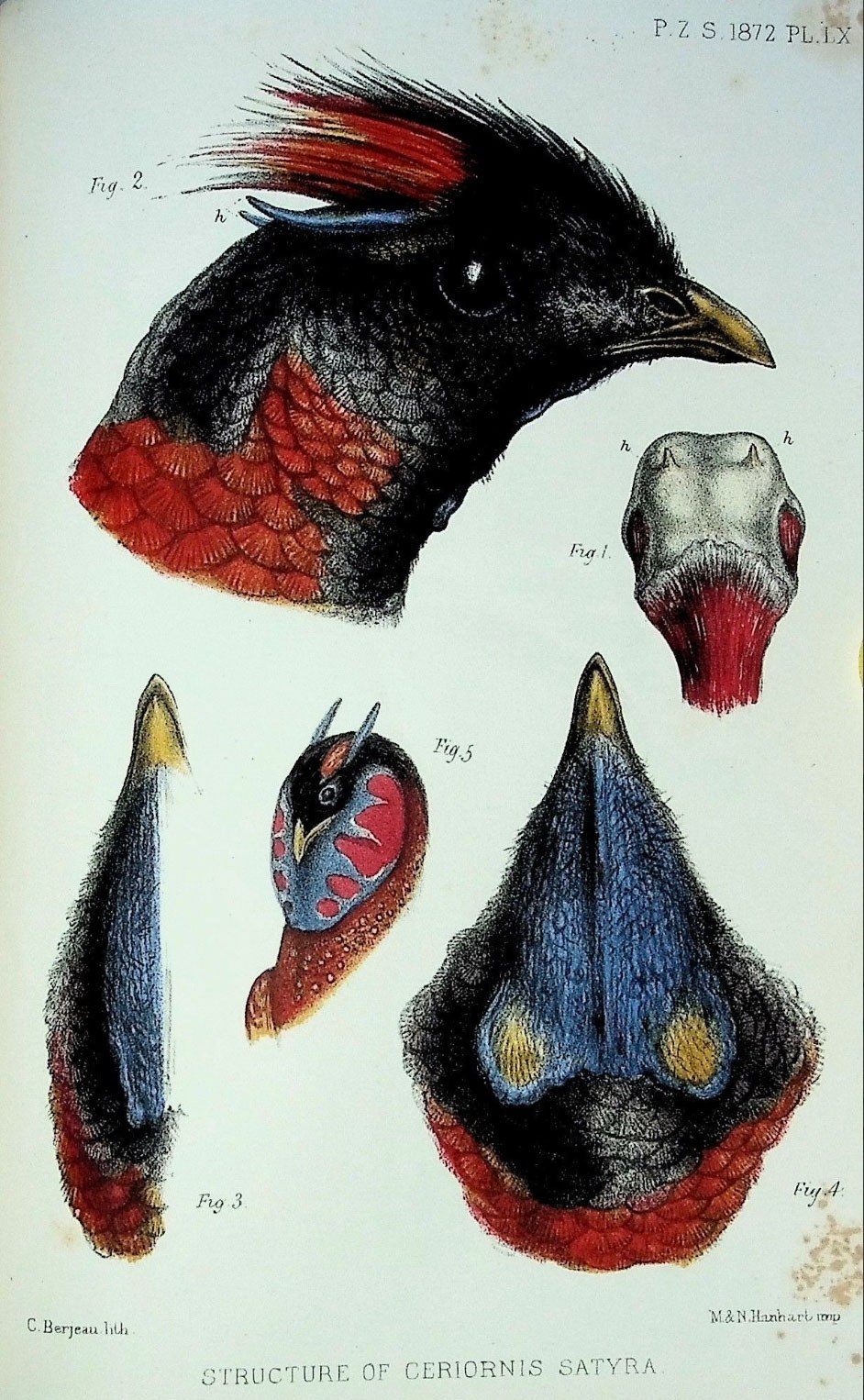
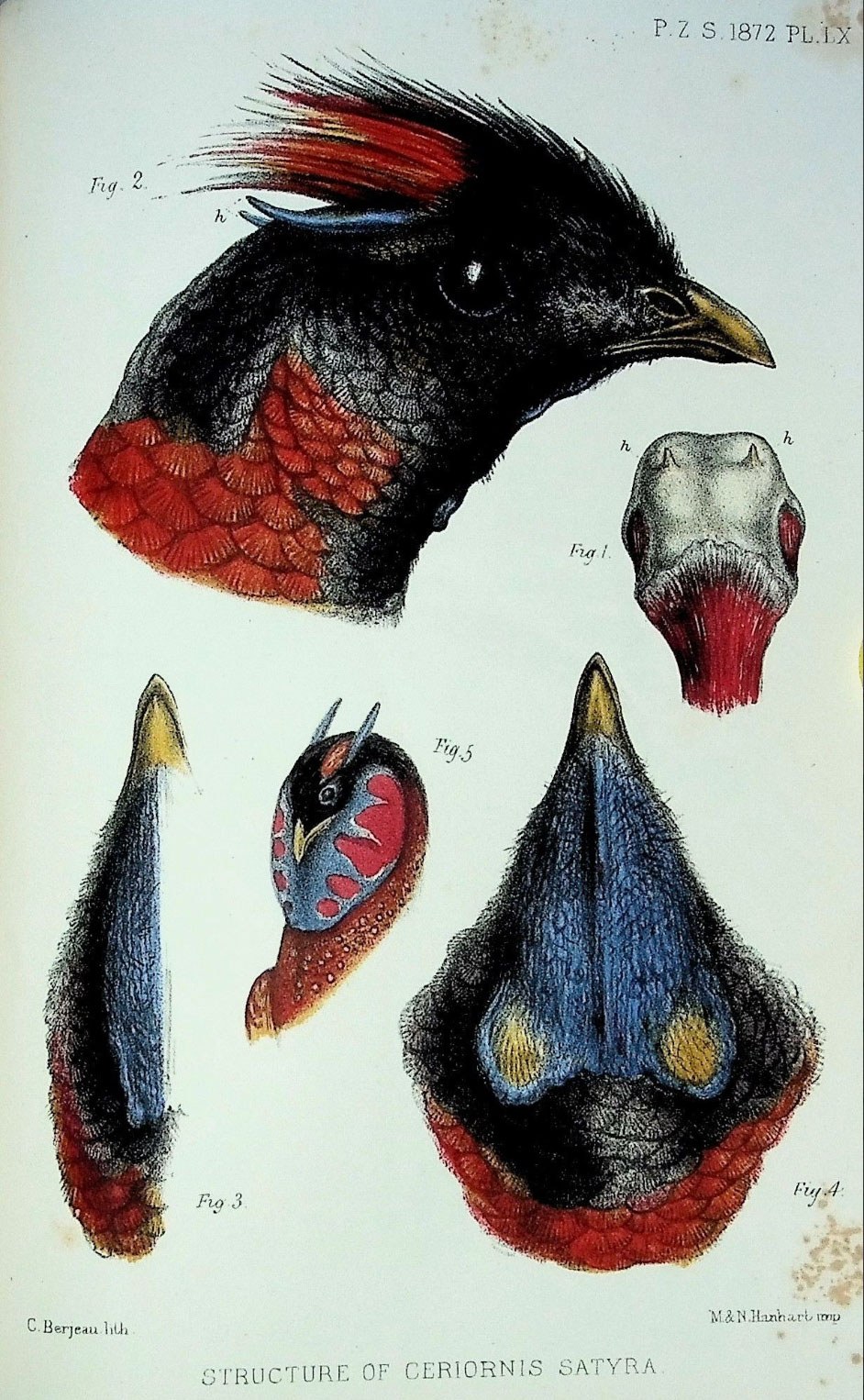
London: Zoological Society of London, 1860-1872. First editions.
44 OFFPRINTS COLLECTED BY PROMINENT BRITISH NATURALIST, AUTHORED AND INSCRIBED BY COLLEAGUES IN THE DECADE FOLLOWING DARWIN'S ORIGIN OF SPECIES.
14x21.5 cm 3/4 leather & burgundy cloth bound collection of offprints from Proc Zool Soc London, 1860-1872, presumably collected by JB Pettigrew, to whom a number of the papers is inscribed by the authors. The papers vary in length from 2 pages to substantial #monographs, total size in the region of 400 pp. with 10 colored plates and several full page engraved plates as well as numerous text ills. Most concern mammalian or avian #anatomy. Of the 44, 29 are by James Murie (2 jointly with Mivart), 6 by Mivart alone, 3 by Cobbold and 4 by Flower, and one each by Kirk and Huxley. Flower sided with Darwin against Richard Owen over the nature of the human brain and one of the papers here is on the anatomy, including brain, of the South American saki monkey Pithecia monachus.
Offered by Biomed Rare Books LLC.
Not Without Laughter
Hughes, Langston

New York: Alfred A. Knopf, 1930. Second printing. The Jacket shows some wear and loss especially at the head and tail of the spine.. 224, [1] pp. The Jacket shows some wear and loss especially at the head and tail of the spine. The edges of the bottom of the boards show some rubbing. The copyright of this printing reads First and Second Printings Before Publication. Published July 1930.
Offered by De Wolfe and Wood.
Satchmo; My Life in New Orleans
Armstrong, Louis
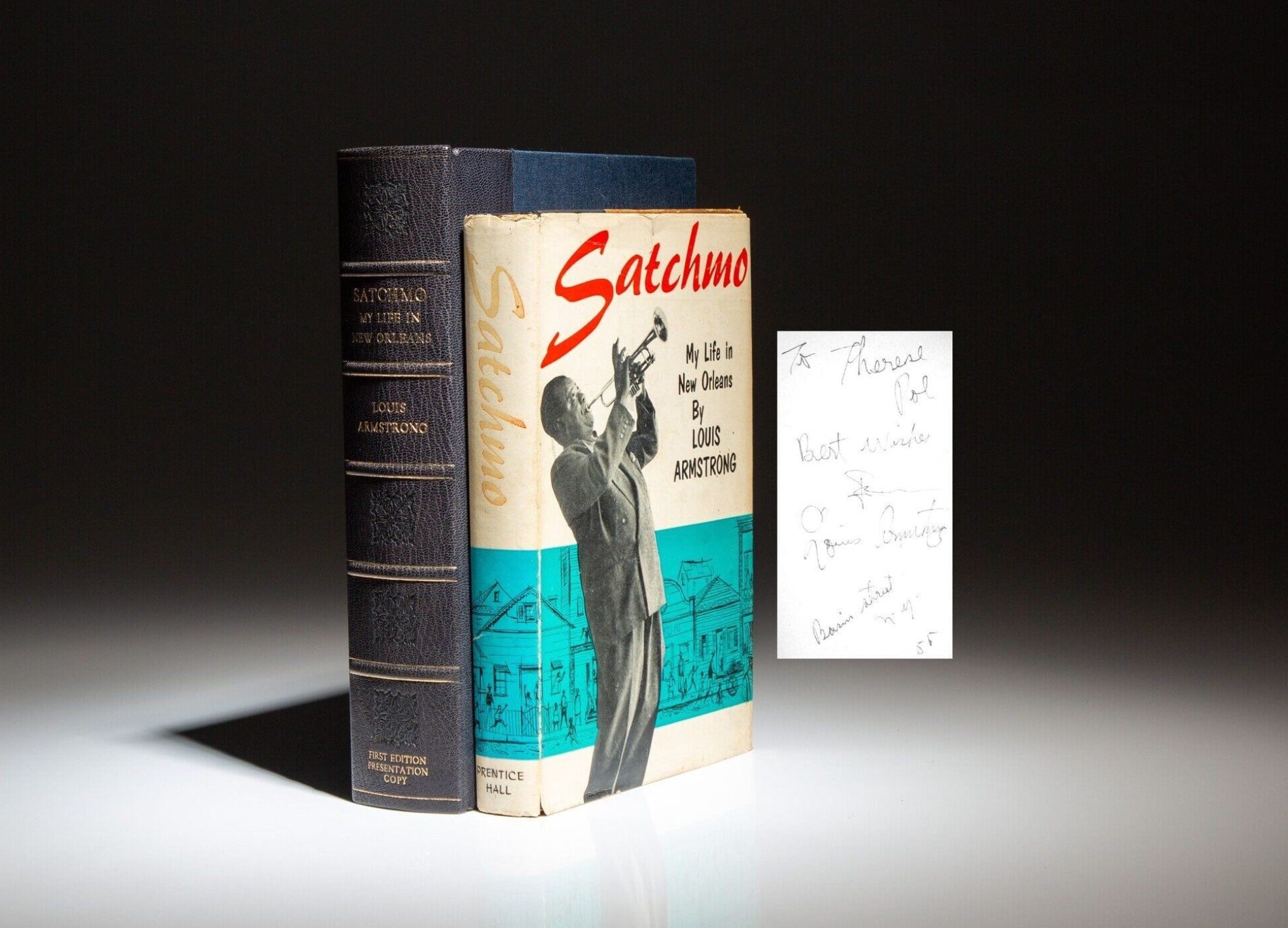
New York: Prentice-Hall, 1954. First Edition, First Printing. Hardcover. Very good/very good. The author's copy of Satchmo: My Life in New Orleans by Louis Armstrong, a presentation copy from the publisher to "Satchmo," and inscribed by the author.. Octavo, 240pp. Tan hardcover, title in gilt on black spine, mostly rubbed away. Illustrated endpapers. No additional printings listed on copyright page, indicating first printing. Solid text block, faint soiling to covers, worn corners and edges of spine, a very good example. In the publisher's dust jacket, $3.50 retail price, small chips to corners and spine, shelf worn, with light sunning to spine. Inscribed by the publisher's house to Armstrong on the half-title: "To Satchmo / from / Prentice Hall." Inscribed by Armstrong opposite the title page: "To Therese Pol / Best Wishes / Louis Armstrong / Basin Street N.Y. 1955." The nickname "Satchmo," inseparably associated with Louis Armstrong, derives from "Satchelmouth," a contemporary term referring to his wide grin and powerful embouchure when playing the trumpet, and originated during his early New Orleans years. The name was embraced by Armstrong himself, often using it in correspondence.
Offered by The First Edition Rare Books, LLC.
Coniglietti Buffi [Funny Bunnies]
Disney, Walt
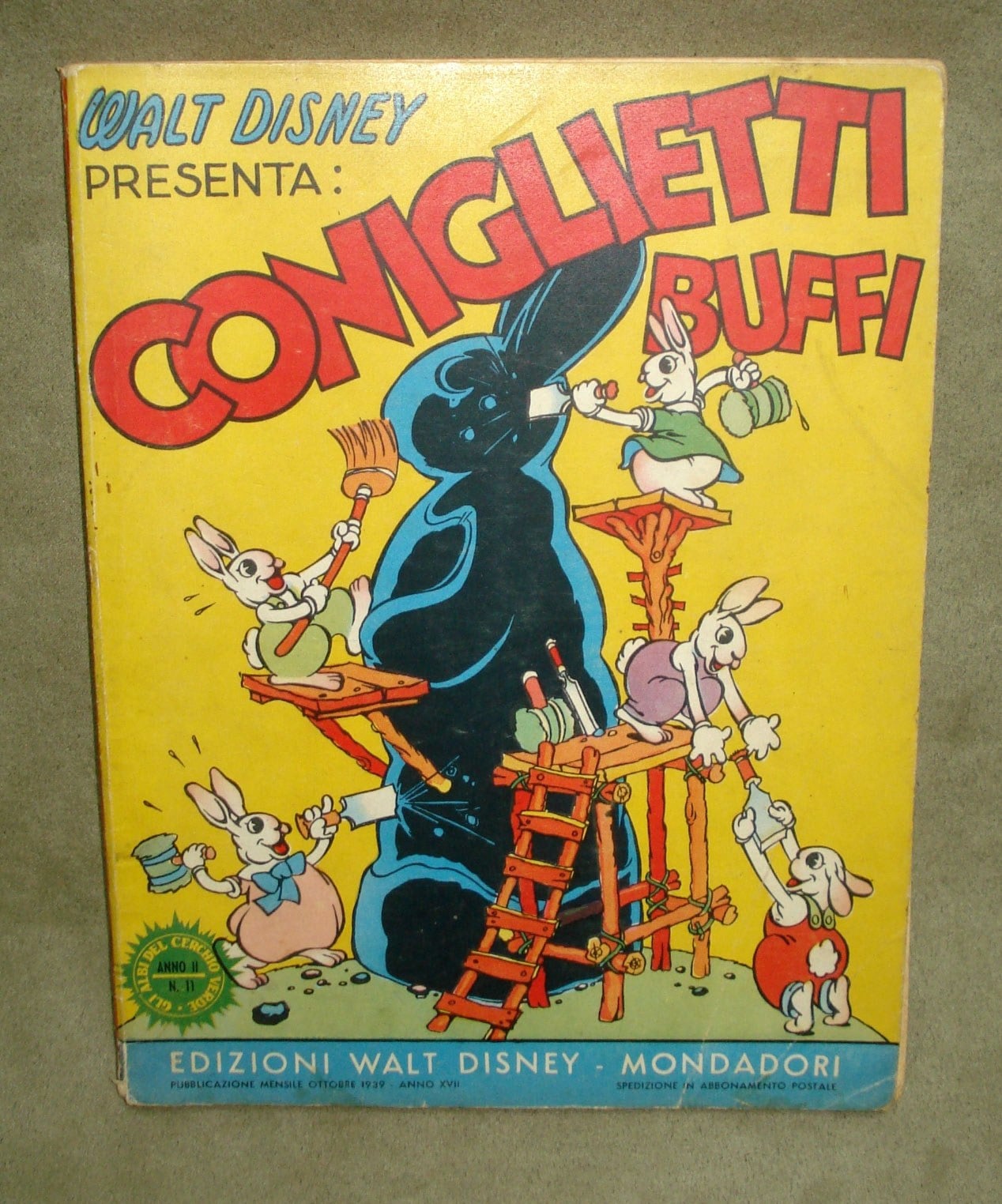
Verona: Mondadori, 1939. Book. Illus. by Disney, Walt. Very Good. Soft cover. 1st Edition. In pictorial wraps, 7" x 9", 61 pages. 30 duotone illustrations. Two pages of book advertisements at rear. Some creasing to cover, scattered spotting, overall very good. Scarce.
Offered by Alan Foljambe, Bookseller
Fratelli Alinari (fl. ca. 1850s-1890s) and others. Interesting Collection of Five Early Original Albumen Studio Photos, Showing Thessaloniki (Arch of Galerius, Street in the Kalamaria District with a Minaret, General View Taken from the Heptapyrgion Fortress) and Ruins of the Temples of Athena and Apollo in Selinunte (Sicily). Ca. 1880s-1890s.
FRATELLI ALINARI (fl. ca. 1850s-1890s) and others
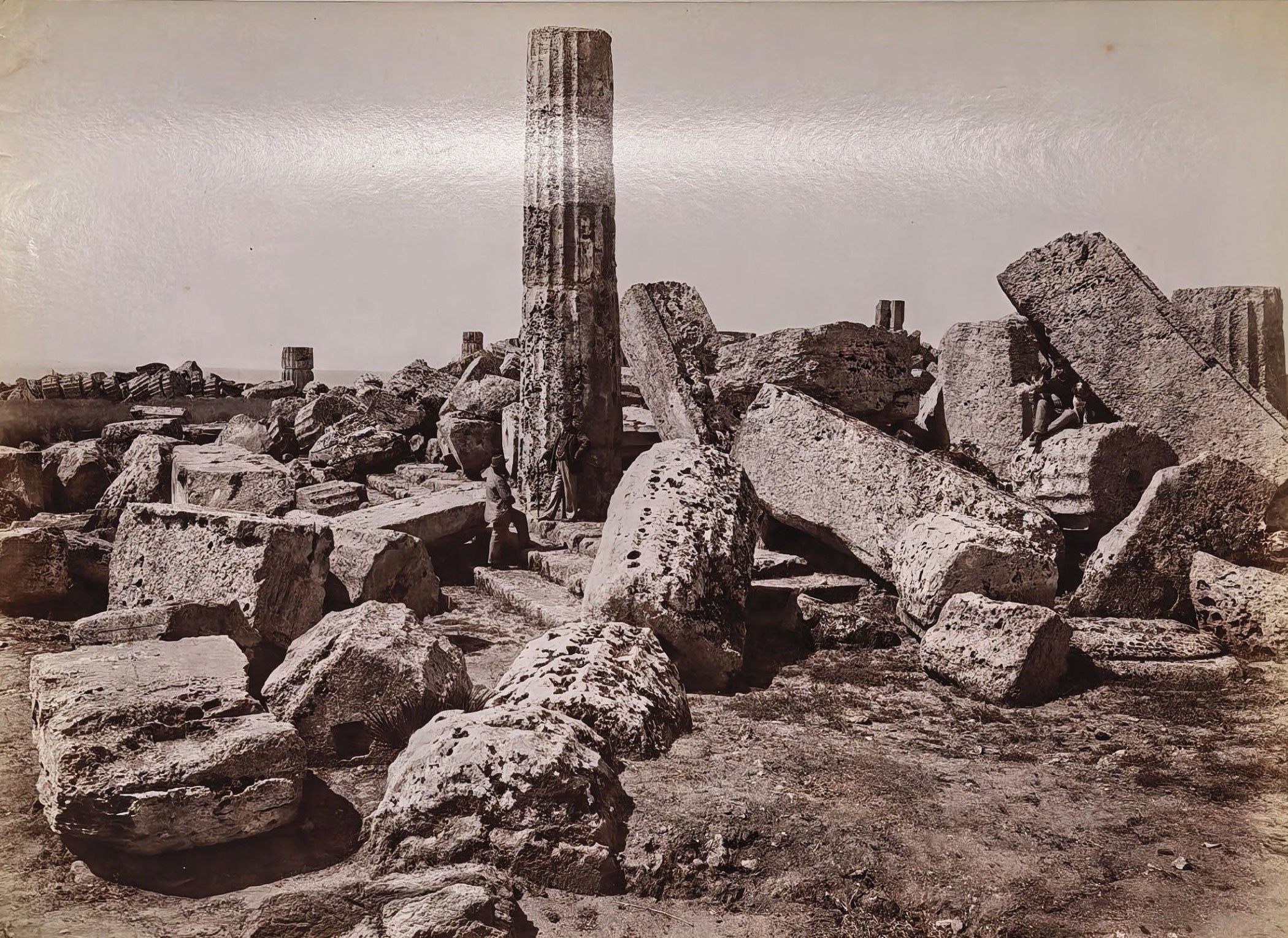
Five original albumen photos, all ca. 20x25,5 cm (7 ¾ x 10 in) or slightly smaller. Three photos are captioned in negative, two also with the studio credentials in negative; three with period pencil captions in Italian on verso. Photos slightly waved, minor fading, one with a remnant of an old mount on verso; overall a very good collection of interesting photos.
Interesting collection of five early, well-preserved original albumen studio photos of Thessaloniki and ruins of ancient Greek temples in Selinunte, Italy. Three views of Thessaloniki (Salonika) include a photo of the early Byzantine triumphal Arch of Galerius, erected to celebrate the victory of Roman Emperor Galerius over Persian king Narseh in 299 AD. The image shows the arch with the adjacent buildings, which were later removed; today, the arch is situated in an open area at the intersection of Egnatia and Dimitriou Gounari streets. Two other photos include a general view of Thessaloniki taken from the Heptapyrgion fortress and a view of a street in the Kalamaria district with a minaret in the background. Two photos by the studio of Fratelli Alinari show the ruins of the Temples of Athena and Apollo in Selinunte in southwestern Sicily.
Offered by Globus Rare Books & Archives.
(Women Olympians) Tivoli Circo Ecuestre
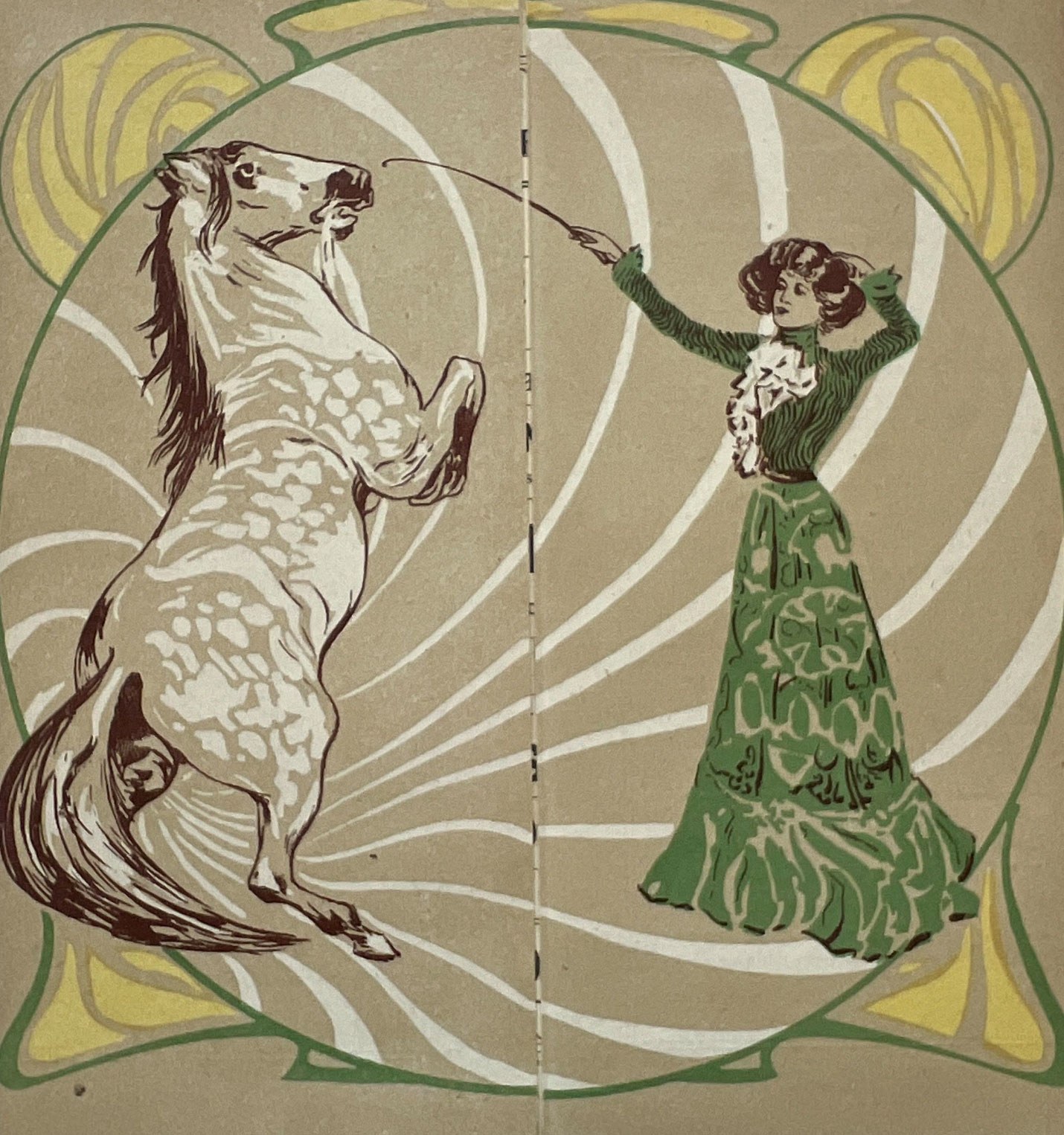
Tivoli Circo Ecuestre. Temporada 1906-1907. Barcelona: 1906. 17.4 x 16 cm [open 17.4 x 32 cm]; single sheet, gate folded program. Color pictorial illustration recto.
Vibrant Art Nouveau program advertising the 1906 circus season at the Tivoli theater in Barcelona. That season the company featured the likely subject of the illustration: one of the first female Olympians, equestrian Elvira Guerra (Italian, competed in Paris, 1900). Other important items on the bill: magician Chung-Ling Soo (aka William Ellsworth Robinson); and the incorporation of a cinema projection (Vitagraph). Not found in OCLC records, one copy in the archives of Barcelona's MAE, Centre de Documentació, Institut del Teatre.
Offered by Graph Books.
UNION PACIFIC LINE GANG WORKER’S AUTOMOBILE TRAVEL ALBUM – 359 PHOTOS – AMERICAN WEST, NATIONAL PARKS, PROHIBITION-ERA TIJUANA, 1917–1930s
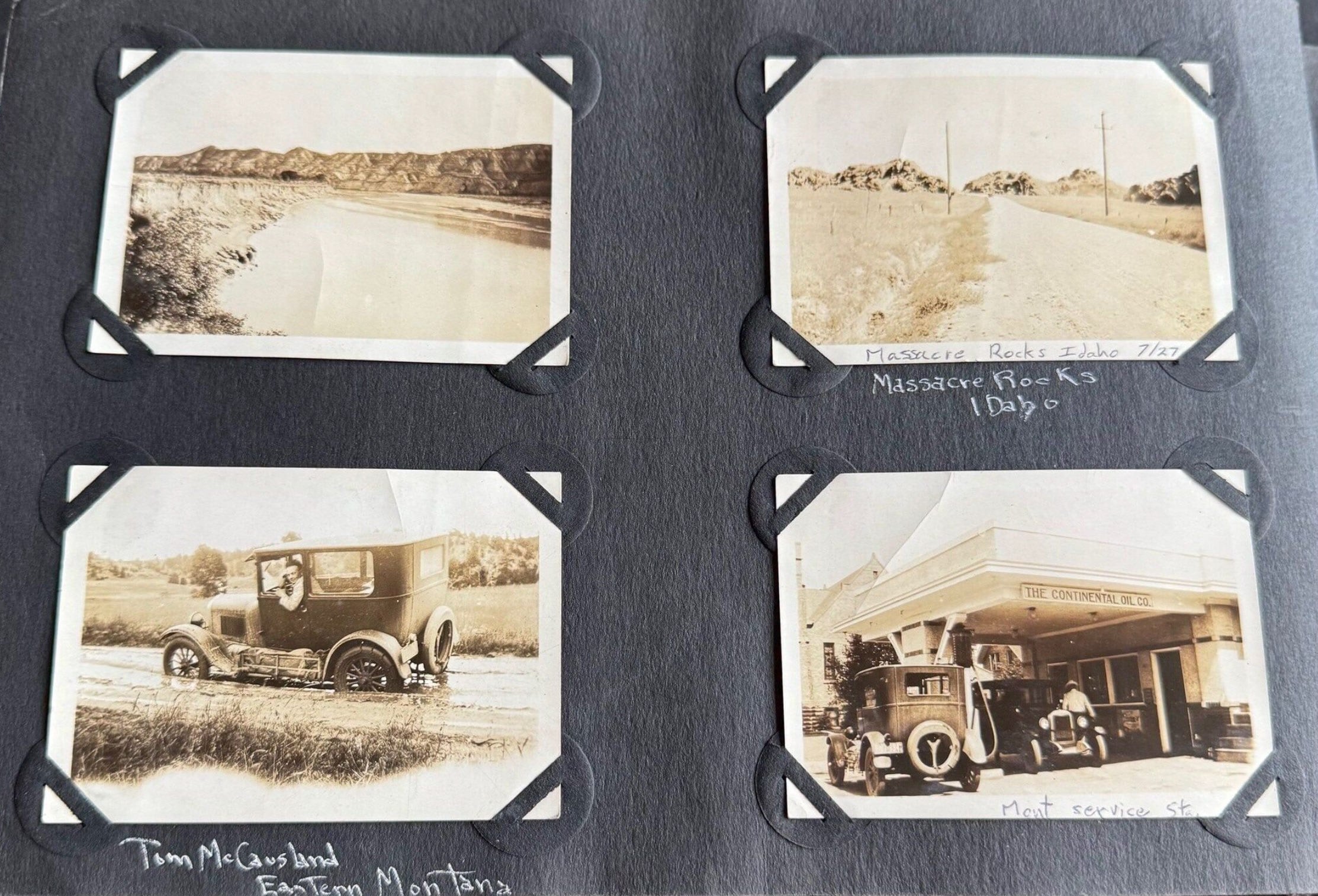
A remarkable vernacular photo album compiled by a Union Pacific line gang worker documenting his travels across the United States during the early automobile age. Beginning in the Upper Midwest and extending west to California, south toward Florida, and even into Mexico, the album combines personal snapshots, souvenir views, and a hand-drawn travel map that traces the compiler’s journeys across the country.
The album measures 11 3/4” x 7 1/2” and contains 47 leaves (94 pages). In total there are 359 photographs, roughly half of which are souvenir views. Five blank leaves remain at the back. Mounted to the final page is a printed map of the United States on which the compiler has drawn bold travel routes. Many begin in the Wisconsin and Minnesota region and extend west across the country and south along the Gulf Coast, creating a visual record of extensive automobile journeys during the 1920s and early 1930s.
The photographs range from personal snapshots to commercial souvenir views and postcards. Among the tourist photographs are images of Yellowstone National Park, including Old Faithful and the hot springs; the Grand Canyon; Chicago; Cleveland; Buffalo and Niagara Falls; New York City landmarks including Columbia University, Central Park, Times Square, and the Brooklyn Bridge; Philadelphia; Washington, D.C.; Los Angeles; San Diego; Kansas City; and several colorful souvenir cards from Tijuana, Mexico depicting the Red Mill Club, the Vernon Club, and other scenes associated with the lively border nightlife of the Prohibition era.
Many of the photographs made by the compiler himself are captioned and several explicitly identify him as “me,” giving the album a clear personal narrative. He appears with friends and family, in the Carlton City Band, at the Barnum Fair, beside automobiles on road trips, at Yellowstone, on the beach at Santa Monica, and posed beside a giant cactus in Arizona. A particularly engaging series from June 3, 1928 shows him standing beside early gasoline pumps and automobiles at a service station, suggesting he worked there at the time.
The earliest photographs in the album date to 1917 and were taken in “Carlton,” presumably Carlton, Minnesota. These include striking images of young men gathered in front of the high school after the draft came to town, captioned “Army Draftees at High School,” documenting the local mobilization during World War I. Later photographs in the album extend well beyond the 1920s road trips and include family images and a portrait dated September 1942 showing the compiler in uniform holding a rifle beside an automobile, suggesting he may have later served as a police officer. The latest image appears to be a portrait of an elderly couple from 1954, indicating the album remained in use for many years.
Together the photographs form an engaging and unusually full record of one man’s movement through early twentieth-century America—combining railroad labor, automobile travel, national park tourism, Prohibition-era border excursions, and family life into a vivid vernacular travel narrative spanning nearly four decades.
Offered by House of Mirth Photos.
To Keep the Ball Rolling: The Memoirs of Anthony Powell. Infants of the Spring, Messengers of Day, Faces in My Time, The Strangers Are All Gone (4 volumes) -- Two titles signed by Powell
Powell, Anthony
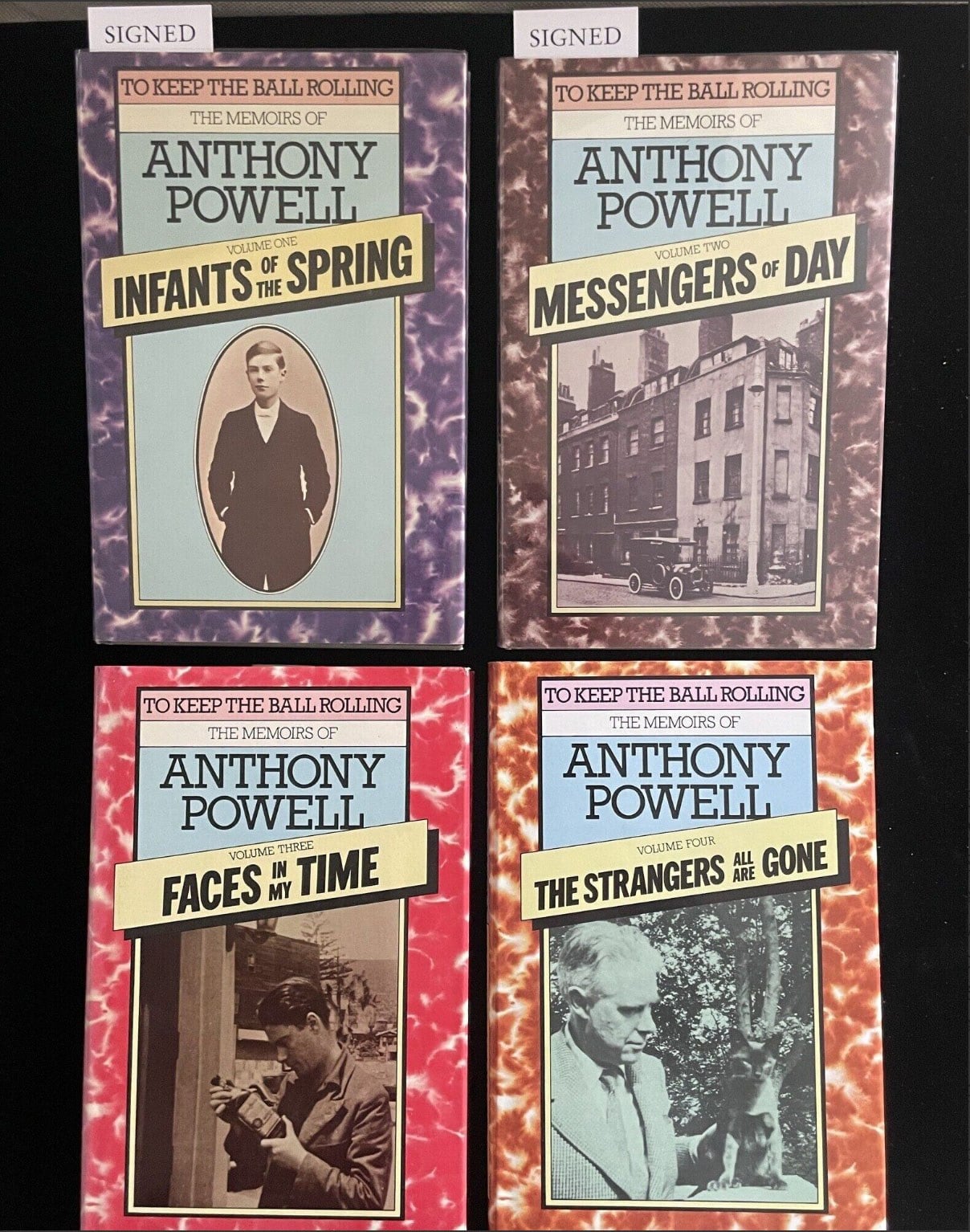
London: Heinemann, 1976. 1st Edition. Hardcover. Near Fine/Near Fine. Complete set of the 4 volumes of Powell's memoirs, published 1976 - 198x. Each a first edition in at least near fine condition. The first two volumes are both signed on the title page - with Powell striking through his printed name with his autograph below it - and also inscribed by Powell to the same reader. Infants is inscribed on the ffe: "Andrew Myleth/ The Travelling/ February 1977/ Tony." Messengers is inscribed on the bottom of the title page; "For Andrew/ The Chantry/ September 1984/ Tony
Offered by Johnnycake Books ABAA, ILAB
[Archive] Large Collection of 18th and 19th century Spanish Periodicals: Art, Politics, Science, Fashion, Women, Literature
Spain
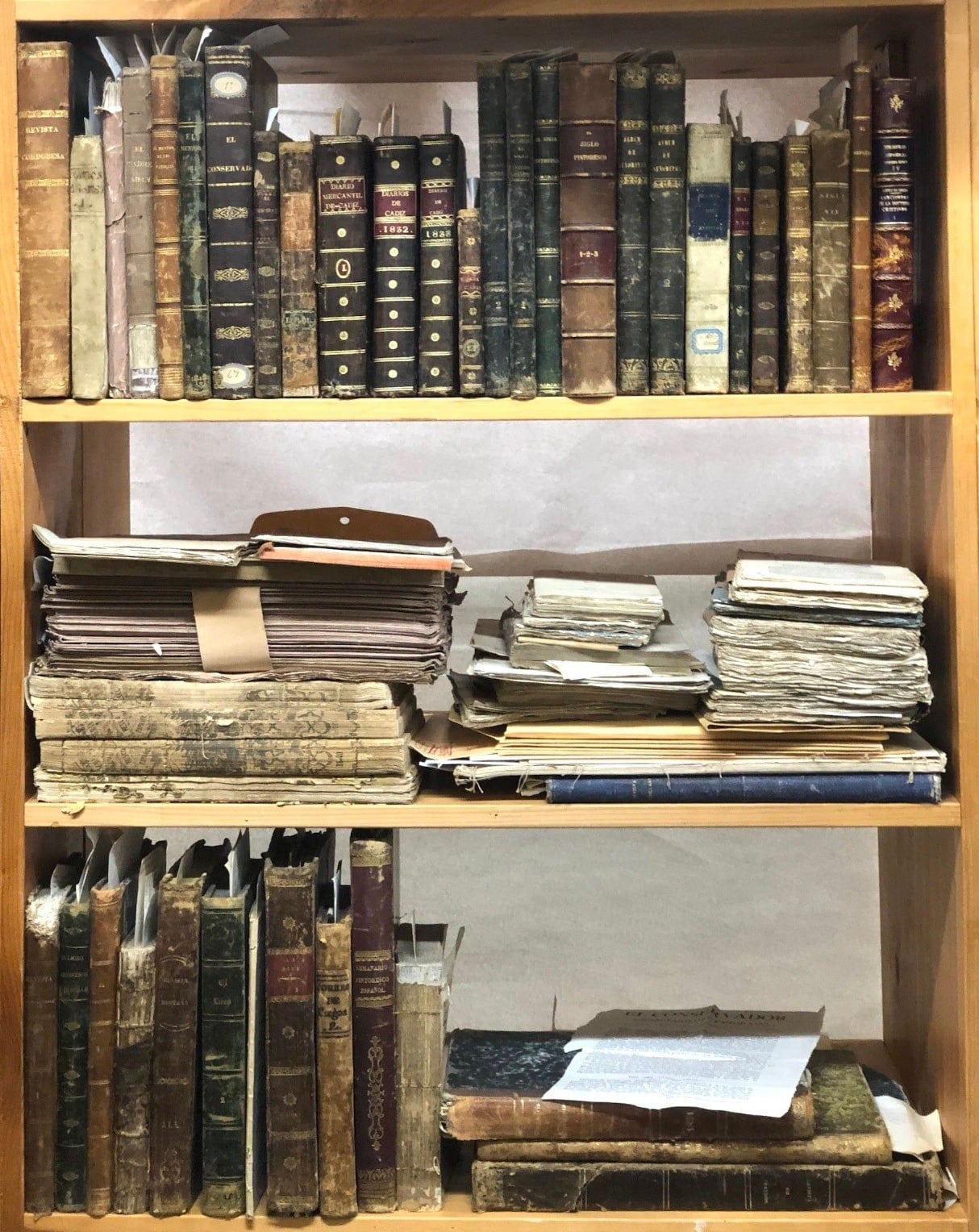
1897. Fair to very good or better.. Spanning 110 years, 64 different titles, nearly 2000 issues, and tens of thousands of pages, with numerous illustrations, both black and white and colored. A few are more popular titles, but most are quite uncommon, rarely for sale, found only at a few institutions, a number only at the Duque de T' Serclaes periodical collection at the Univ. Connecticut. Many of the Cadiz publications remarkably have only scattered holdings. The content is varied, from the first Spanish periodical edited by a woman, to a description of the massive defeat of the Spanish at the Battle of Trafalgar just after it occurred, to periodicals aimed at women, illustrated with color fashion plates, including a very rare set of periodicals from a philanthropic organization whose goal was to educate the people free of charge,to satire, to politics such as the transfer of the Cortes to Madrid, and so on. Detailed list upon request.
Offered by Kaaterskill Books, ABAA/ILAB.
Alphabet offert par Tisane Cisbey.
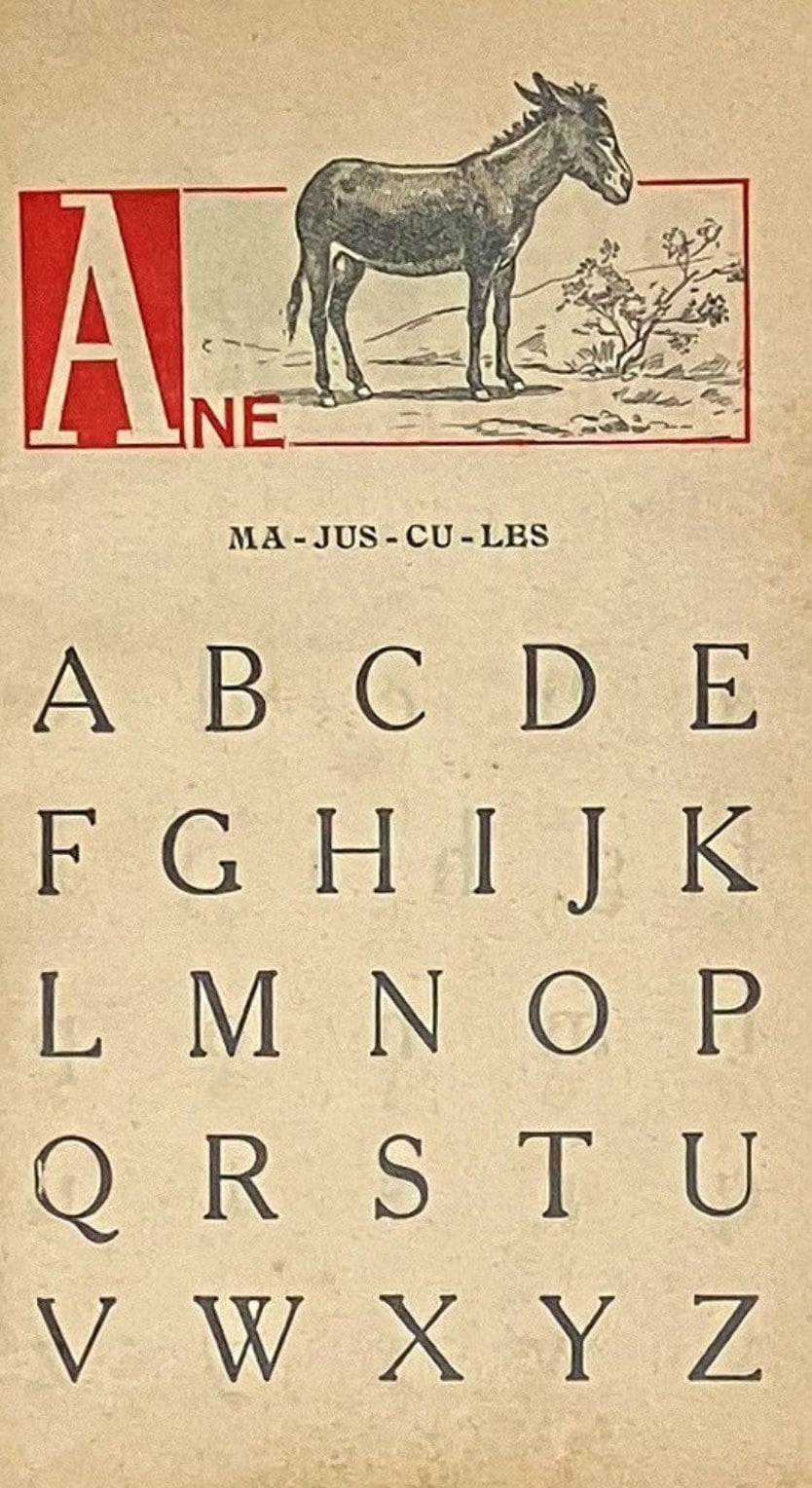
(Paris, c. 1935). Size: (8,5 x 15 cm) 22pp. Wrs.
Small publicity booklet which shows alphabets, syllables, numbers, short texts etc. It was given by Tisane Cisbey, a brand of herbal tea, to young mothers.
Offered by Knuf Rare Books.
[Substantial Archive of Correspondence Between Private Walter Dianni and His Family and Friends Back Home in Connecticut]
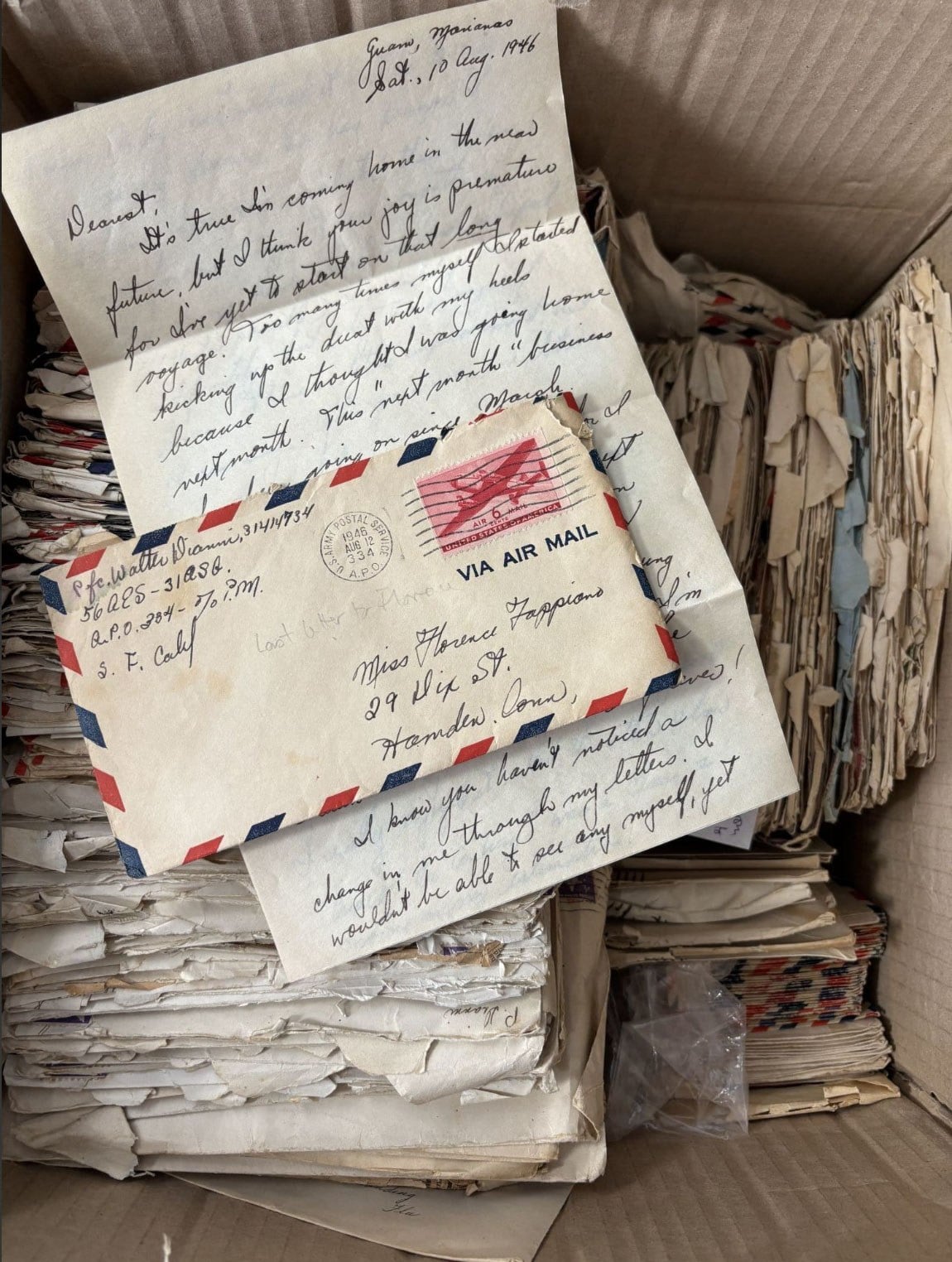
[Various locations, including New Haven, Ct.], 1946. Very good.. Approximately 900 letters, plus two photographs. Most letters with original envelopes. Light wear and soiling. A large archive of letters written from Private First Class Walter Dianni to his parents and his girlfriend during his military service in World War II, together with their letters written to him. Walter Dianni was a New Haven native who entered the army shortly after his eighteenth birthday. Initially training at Camp Blanding in Florida, he spent a short time in Fort Meade, Maryland, before shipping overseas to the Pacific theater in August 1945. He was at sea when Japan surrendered, and wrote to his girlfriend, Florence: "The day that we have all been waiting for has finally arrived, and we feel so good inside for once in our lives. That day is, of course, the day the Japs surrendered and peace encompassed the earth once again. … When the news came to the ship, we all gathered on deck there the chaplain led us in prayer and the singing of the anthem. Everyone really cheered when that was over." He was posted to Leyte in the Philippines from September 1945 to January 1946, before being transferred to Guam at the beginning of February. He spent the remainder of his time in the military there, until September 1946. After his return to New Haven, Walter enrolled at Yale and continued to date Florence. The two were married on June 24, 1950; Walter graduated from Yale the following summer.
The archive consists of about 300 letters from Walter to his parents, Pasquale and Rose DeVivo Dianni, in New Haven; circa 180 letters from Walter to his girlfriend, Florence Fappiano; about 150 letters from Mr. & Mrs. Dianni to their son; circa 170 letters from Florence to Walter; as well as a group of related letters, Christmas cards, and other ephemera from and to Walter from friends and family. Also included are a formal panoramic group photograph (two copies) taken at Camp Blanding Florida, and an informal snap shot of Walter and a fellow soldier with palm trees in the background. Walter does not seem to have enjoyed his stint in the military. Writing from the Philippines in November 1945, he says, "You may wonder why I'd rather be on some other island. I can't say from personal experience, but many of the older men have been on others and they say Leyte is the worst place. The cities are poorest, the people more illiterate, and the living conditions the lousiest. The other islands sound wonderful. Even the shows there were first class. Hope I get a chance to see some other place." And in his final letter to Florence, in August 1946, he writes, "I know you haven't noticed a change in me through my letters. ... I believe I'm more realistic than I ever was for one thing. These months in the service have made me more stupid (if that's possible). I could go on indefinitely, but why tear myself down. There's little improvement, that I can say. After you've seen me, let me know the verdict." Most letters are several pages long, relaying news of family and home, as well as military routines and bits of Walter's travels. His final few missives describe the convoluted process of mustering out and traveling home from Guam. Of particular interest, of course, is that both sides of the correspondence are present here, providing a full picture of Walter's relationship with his parents and Florence during this formative time in his life. Worthy of research.
Offered by McBride Rare Books.
Les Portraicts anatomiques de toutes les parties du corps humain.
VESALIUS, Andreas, & GRÉVIN, Jacques
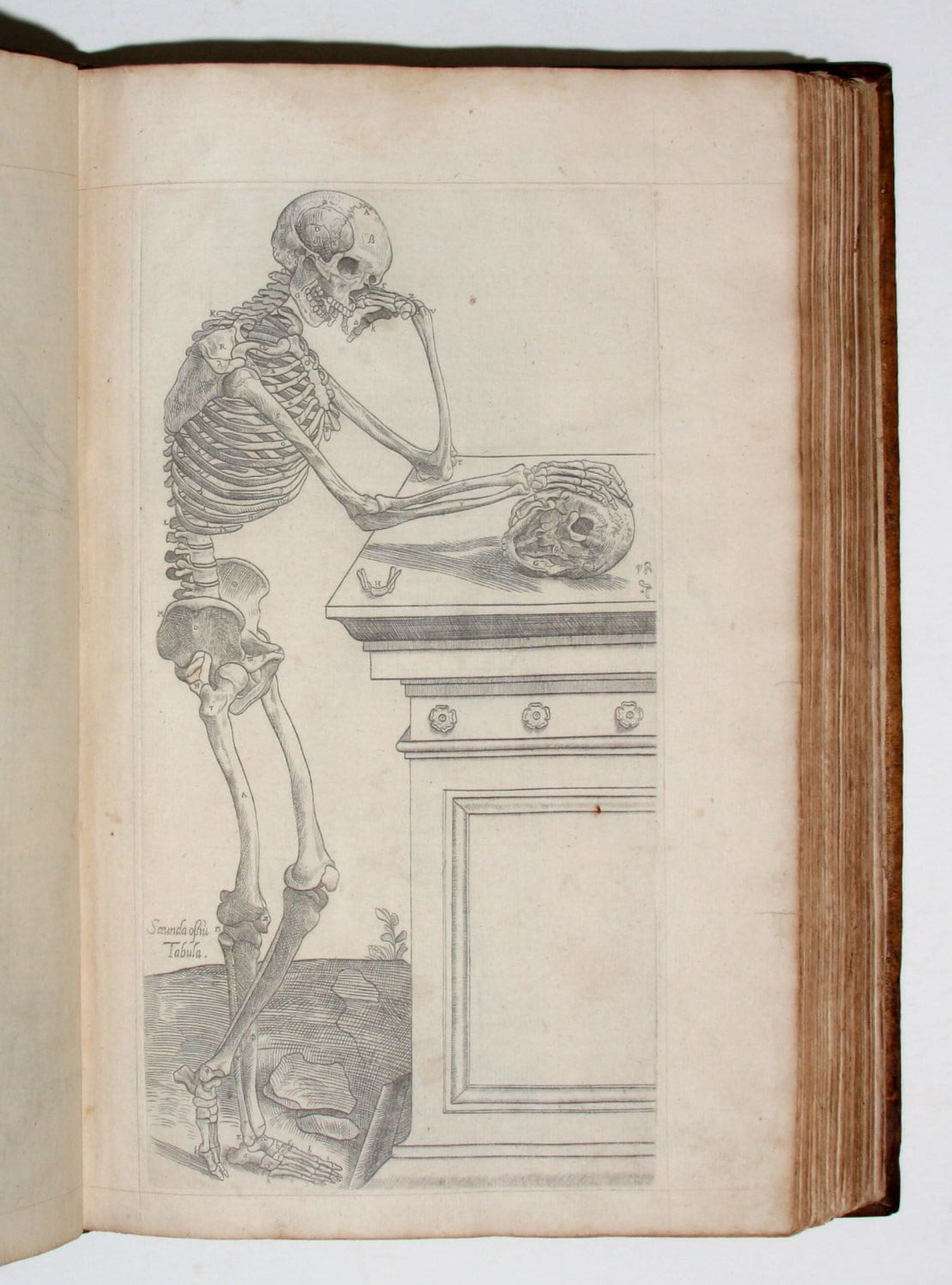
THE FIRST ENGRAVED ANATOMICAL ILLUSTRATIONS EVER PRODUCED
AMONG THE EARLIEST "MODERN" ANATOMICAL ILLUSTRATIONS IN WOODCUT
Folio (40 x 25.5 cm), [4] ff, 106 pp, [1] ff with printer's device on verso, plus 40 engraved full-page plates.
[BOUND WITH:] ESTIENNE, Charles & RIVIÈRE, Estienne de la. La Dissection des parties du corps humain. Paris, de Colines, 1546. [8] ff, 405 pp, (1 integral blank), including 64 full-page woodcuts.
Folios, bound in early, possibly contemporary, reversed calf, covers somewhat worn, extremities with careful restoration. All pages neatly ruled in red/brown ink. With early ownership inscription scored on first tp. and several other inscriptions principally on rear paste down and verso of final blank; occasional marginal handsoiling; a few minor marginal tears neatly mended. Pages generally very clean. Attractive genuine copies of both works.
A handsome sammelband of the two most important anatomical works of the French Renaissance, both in their first French editions. Charles Estienne's superbly-illustrated Dissection des Parties du Corps Humain is bound here after Jacques Grévin's adaptation of Vesalius' De Humani Corporis Fabrica, being the first appearance of Vesalius in the French language. Grévin's work famously employs a set of 40 copper plates engraved and printed in London by Geminus for the publisher Wechel's Parisian ventures. Vesalius complained of Geminus' unauthorized reproductions, but it is generally agreed by historians that they proved invaluable in the dissemination of Vesalian anatomy in vernacular translations such as the present one. Together, these two spectacularly illustrated works present the pinnacle of 16th century anatomical illustration, each in a different form -- the woodcut (Estienne) and the copper engraving (Vesalius) -- providing a vivid picture of the state of the art at the heart of the sixteenth century.
Grévin's text, presented in two columns, is as clear as the engraved illustrations themselves, which closely follow Vesalius' original woodcuts. Alongside brief discursive chapters explaining the anatomy and bodily functions, Grévin follows Vesalius in providing a detailed legend to each illustration, explaining the precise role of each muscle or bone in the human body. Overall, the structure is highly organized and eminently practical, and probably served much the same audience as Vesalius' German Epitome ? the 'unlatined' barber-surgeons who were nevertheless responsible for the majority of surgical procedures in the Early Modern era. The engraved plates themselves were "as influential as the woodcuts in the development of anatomical illustration" (Mortimer, Harvard French 541). They were originally cut for a London publication of 1545 (see below), and were later re-used, with 3 plates having been amended by cutting away sections and re-inserting a new figure, in the Latin and present French editions published by Wechel. Although these latter two editions were printed at Paris, the plates appear by their watermarks to have been printed in London and the sheets sent to Paris, presumably being easier and less costly than sending the copper-plates themselves to Paris (cf. Mortimer).
Vesalius' own publications, while monumental in scope and execution, failed to herald the revolution in anatomical teaching methods and surgery we associate with him today. De Humani Corporis Fabrica was never directly translated into any modern European language during Vesalius' lifetime, and it was only the abbreviated Epitome which enjoyed a (today exceedingly rare) vernacular German edition published the same year as the Latin original. More successful and influential in the dissemination of Vesalian anatomy were the works of Thomas Geminus, a Flemish refugee living in London and a former roommate of Vesalius at Padua. In 1545 Geminus published some of the earliest engravings ever produced in England: a set of 40 folio plates engraved after Vesalius' own striking woodcuts in De Fabrica. Despite Vesalius' protestations, Geminus' illustrations do show artistic and anatomical fidelity to the originals, although Geminus dispensed with the scenic backdrops employed in Vesalius' woodcuts. Geminus' Compendiosa totius Anatomie delineatio enjoyed numerous Latin and English editions, all very rare, and his plates were soon copied for use in German Vesalian anatomies as well (Anatomia Deutsch, 1551). Finally, in 1564 André Wechel published an adaptation of Vesalius using Geminus' original plates in Paris accompanied by a commentary on Vesalian anatomy by the French humanist Jacques Grévin, who may have met Geminus in London where he spent several years. This work was translated into French in 1569 (offered here).
In fascinating juxtaposition to Grevin's fine engravings are the woodcut figures in Charles Estienne's Dissection des parties du corps humain designed by Estienne de la Rivière, a famous French anatomist of his time and a contemporary rival of Vesalius. The present example of this work is very large, measuring 15 11/16" x 10", ruled in red. Its huge margins show off the illustrations to spectacular effect.
While unable to compete with the realism offered by Geminus' Vesalian engraving, Rivière's woodcuts show decidedly more artistic flair, often situating his partially dissected specimens in remarkably detailed Renaissance townscapes or gardens. The lobotomized figure on p. 261 reclines uncomfortably in his large chair with his back to the viewer, amidst a perspective view of the inside of a small cottage with a round porthole and various day-to-day objects on display on shelves; the top half of his head rests casually on a table nearby. A series of figures in the Third Book are devoted to obstetrics and other aspects of female anatomy, whose subjects appear nude but in the surroundings of a nobleman's house, reclining on mountains of plump, tasseled cushions ? scenes inspired, according to Carlino, by a series of engraved erotic figures by Périno del Vaga published in 1527. See Norman Cat. #728 for the "interesting connection between pornography and anatomy" in this work.
Rivière's images, accompanied by the text of the esteemed physician Charles Estienne, were in fact prepared far earlier (1539) than Vesalius' De Fabrica and in many ways rightfully bear claim to the birth of modern anatomical illustration. "Had De dissectione been published in 1539, it would have been the first work to show detailed illustrations of dissection in serial progression, the first to discuss and illustrate the total human body, the first to publish instructions on how to mount the skeleton, and the first to set the anatomical figures in a fully developed panoramic landscape" (Norman). Unfortunately the two collaborators became involved in a lengthy lawsuit which pushed the publication of the Dissection des parties du corps humain back to 1546 (the Latin edition appearing in 1545). Nonetheless, Estienne's work still contained numerous original contributions to anatomy, including the first published illustrations of the whole external venous and nervous systems, and descriptions of the morphology and purpose of the "feeding holes" of bones, the tripartate composition of the sternum, the valvulae in the hepatic veins and the scrotal septum. In addition, the work's eight dissections of the brain give more anatomical detail than had previously appeared. Estienne's preface to the present work is also of interest for its pointed consideration of the role of illustration in anatomy textbooks (cf. Carlino, 19).
Both the Latin and French Grévin adaptations of Vesalius are rare in census, but the French is slightly rarer. OCLC shows Columbia and Yale only holding the present work; the Latin edition (1565) is held by Cornell, Yale, Huntington, Columbia, and Harvard. Estienne's Dissection des parties du corps humain is more widely held institutionally.
* Cushing, Vesalius 130; Durling 2175 & 1391; Mortimer, Harvard French 541 (Latin ed) & 213; Garrison-Morton 378; Heirs of Hippocrates 256; Norman 728 (Latin ed). Cf also Carlino, Paper Bodies; Kellett, "Perino del Vaga et les illustrations pour l'anatomie d'Estienne," Aesculape 37 (1955), pp. 74-89; and Fossard, "Estienne de La Rivière, anatomiste précurseur de la Renaissance, malheureusement oublié" Histoire des Sciences médicales 23 (1989), pp. 261-6.
Offered by Martayan Lan, Inc.
[THE TRIUMPH OF COLOR: EARLY COLOR SYSTEM FOR CMYK OFFSET PRINTING] Syst-O-Color: Vier-Kleurensysteem [Syst-O-Color: four-color system]. – From the library of the daughter of Paul Schuitema
Schuitema, Paul
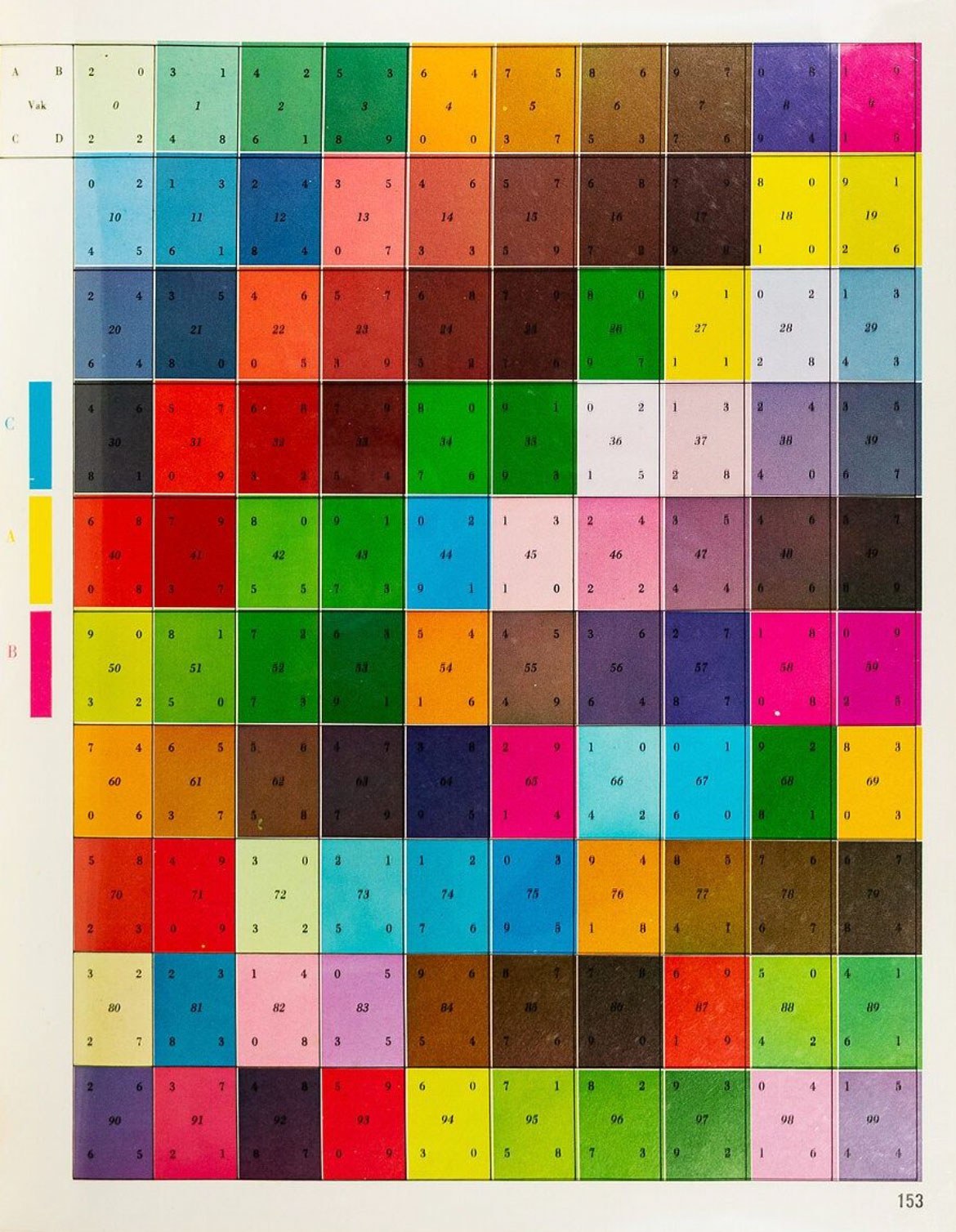
The Hague: Mouton & Co., 1965. Folios (43 × 34.5 cm). Original stab-bound imitation leather bindings (the first volume red, the second blue) in original printed cardboard slipcases; [14] pp., 1 transparent leaf, 152 plates; [6] pp., 1 transparent leaf, plates 153–296, each of the plates showing a 10 × 10 grid of colored blocks, each volume with a transparent overlay with a numbered grid printed on it. Ownership note by Schuitema's daughter Hanneke on one of the two slipcases. The slipcases worn, with waterstains and soiling, but intact; the blue binding is slightly stained; else very good. First and only published edition of the early color reference system for CMYK printed products by Dutch pioneer of New Typography and New Photography Paul Schuitema. The two volumes contain 28,000 color fields with 10,000 different colors, which were created using different screen combinations and printed in the process colors yellow, cyan, magenta, and black. The transparent overlays make it possible to see the screens and colors used at a glance. The comprehensive, perfectly printed volumes were also called the “color organ.” (See Maan p. 115.)
“Syst-O-Color” was Schuitema's last major project. The printer Mouton from The Hague had asked him to develop a color system. The assignment was based on the goal of enabling cost-effective color printing without expensive individual color mixtures. In an essay from 1969, Schuitema presented his system in a short text, not without mobilizing his skills as an advertiser. Among other things, it states: "the syst-o-color (s-o-c) system is a revolutionary breakthrough. it is an extremely efficient work method which makes old design and printing customs completely out of date. formerly, the printer had to decide upon a printing method via the design and the number of colors necessary for the best results. color was always mixed on the press by the printer, he tried to imitate the colors of the design as well as he could c.g., posters designed on a drawing board as a kind of painting and reproduced by a printer. a-o-c haa made this primitive sort of production method technically out of style. a-o-c is built up in such a way that 10.000 colors can be made from four standard colors; this is done by dividing the four colors into ten gray steps (black and white inclusive) according to a photographic scale, by means of this system, each resulting color, through its different 'intensity values' makes the colors analyzable and, as such, codable. (…) the s-o-a breakthrough is a work method in which the printer does not have to go by his drawing-table colors but by the printed technical final results, he organizes his design in two, three, or four colors (more is never needed) for each color. the s-o-c books show how to analyze the selected colors, the printer then builds up his design via the analysis, the system is an inspiring manual grace à the enormous celor variations and color combinations presented, of course, the grammar of this color language has to be studied, unlike a word dictionary, this work is a collection of color études. (it is not by accident that this work has been likened to bach's well-tempered clavichord.)“ (Paul Schuitema in: Art & Project Bulletin no. 5, 1969.)
In the 1920s, Schuitema established himself alongside Piet Zwart as one of the leading figures of Nieuwe Fotografie (New Photography) and Nieuwe Typografie (New Typography) in the Netherlands. Like Zwart, with whom he also published joint texts, he primarily used the field of advertising design as a testing ground. At the end of the 1920s, Schuitema actively participated in the traveling exhibitions of the “Ring neuer Werbegestalter” (Ring of New Advertising Designers), founded by Kurt Schwitters, among others. From the 1930s onwards, he was also co-owner of the tubular steel furniture company d3, for which he designed an aluminum and wood chair that Mart Stam rejected as a “macaroni-looking steel monster.” However, he remained primarily a print graphic designer who was committed to the design principles of De Stijl, New Typography, and the Bauhaus. Moholy-Nagy's combination of photography and typography was particularly influential for Schuitema. After the Second World War, Schuitema relaxed the form he had consistently followed in the 1920s and 1930s, which was characterized by consistent lowercase or uppercase letters, sans serif fonts, strictly organized open spaces, and a restriction to the colors red, blue, black, and white. Alongside Zwart, Schuitema is one of the pioneers of Nieuwe Fotografie in the Netherlands, and he was one of the leading designers in Europe in the field of phototypography in the 1930s and 1940s. (Cf. AKL CII, p. 249)
Cf. Dick Maan, Paul Schuitema: Bildender Organisator, Rotterdam 2006, p. 122f.
Offered by Penka Rare Books and Archives.
THE PLAYERS' SHAKESPEARE . . . NEWLY PRINTED FROM THE FIRST FOLIO OF 1623
(SHAKESPEARE HEAD PRESS). SHAKESPEARE, WILLIAM
Edition: No. 11 OF 106 SIGNED SETS printed on Batchelor's Kelmscott paper
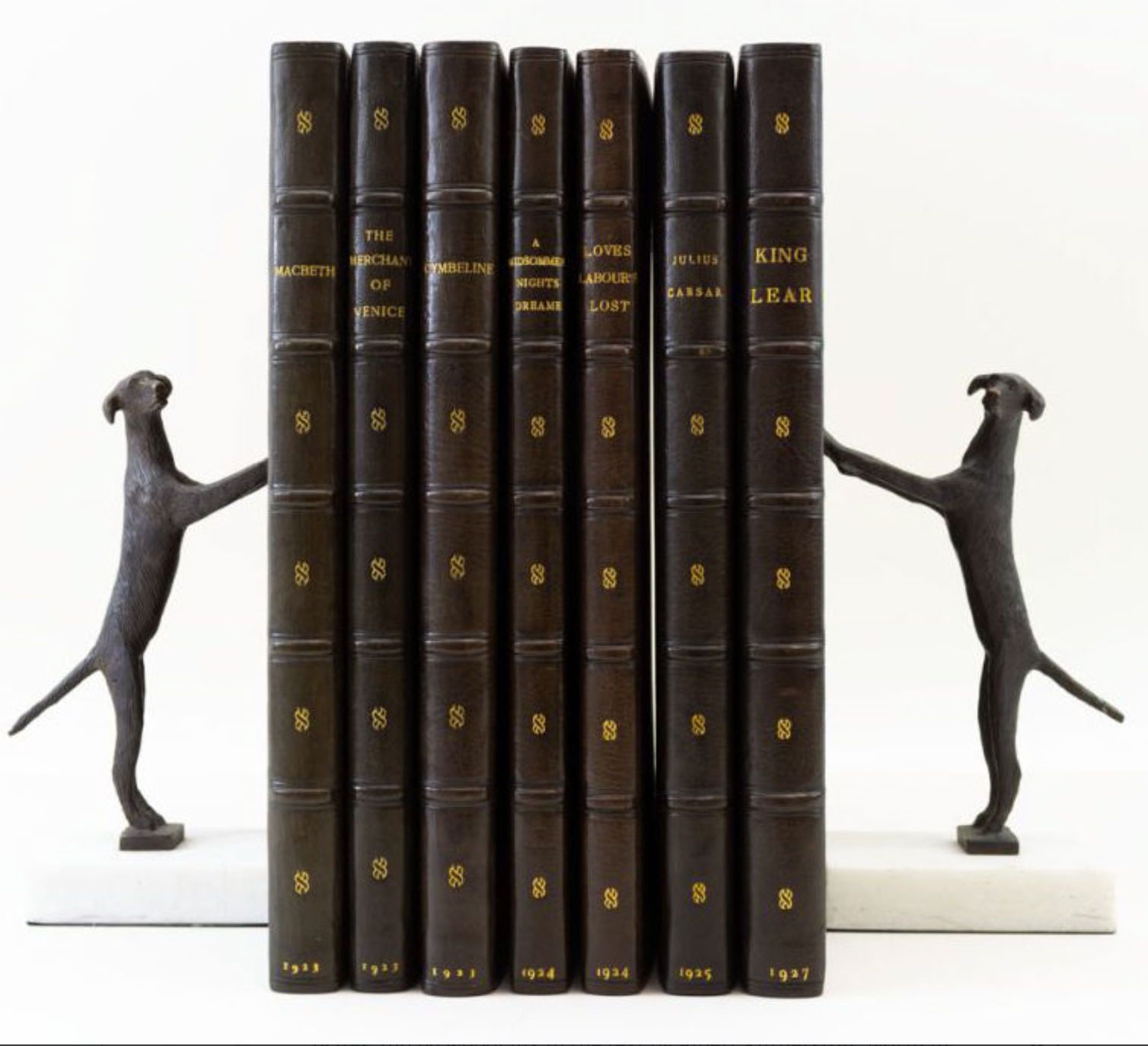
Stratford-upon-Avon: Shakespeare Head Press, [1923-27]. No. 11 OF 106 SIGNED SETS printed on Batchelor's Kelmscott paper, this being one of 100 copies for sale, from an overall edition limited to 606 copies, each volume signed by the editor Harley Granville-Barker, the art editor Albert Rutherston, and the volume's illustrator. 328 x 242 mm. (13 x 9 1/2"). Seven volumes..
Publisher's deluxe chocolate brown morocco by Riviere & Son (three volumes) or olive brown morocco by Zaehnsdorf (four volumes), sides tooled in gilt with a Grolieresque-style border containing dolphins, fleurs-de-lys, acanthus leaves, and flame tool, raised bands, spine panels with small gilt "X" tool, gilt titling, top edges gilt, other edges untrimmed. With a total of 42 color collotype plates and 99 woodcuts in the text by Albert Rutherston, Norman Wilkinson, Charles Ricketts, Thomas Lowinsky, Paul Nash, and Ernst Stern. Front pastedown with bookplate of John Herbert Bankes and Mary Priscilla Smith. Ransom, p. 12. Spines sunned to more closely matching shades of brown, leather with other trivial imperfections (just a hint of rubbing, one volume with small traces of insect activity, faint residue from leather preservative), but the bindings in very fine condition, bright, essentially unworn, and making a very pleasing appearance on the shelf. Occasional minor foxing to endpapers or tissue guards, but a clean, fresh, and bright set internally.
From a press that was established for the express purpose of printing an edition of Shakespeare in his home town, this is a handsome folio-sized series of Shakespearean plays with text from the First Folio, enhanced with illustrations by leading artists of the day and with bindings from two of the longest-running premier binderies in England. The set comprises: "Cymbeline," illustrated by Albert Rutherston (1923); "The Merchant of Venice," illustrated by Thomas Lowinsky (1923); "Macbeth," illustrated by Charles Ricketts (1923); "Loves Labour's Lost," illustrated by Norman Wilkinson (1924); "A Midsommer Nights Dreame," illustrated by Paul Nash (1924); "Julius Caesar," illustrated by Ernst Stern (1925); and "King Lear," illustrated by Paul Nash (1927). Ransom notes that the first two plays were issued on 23 April, the date of Shakespeare's birth. The Shakespeare Head Press was founded in Stratford by Arthur Henry Bullen in 1904 and was acquired after Bullen's death in 1920 by Basil Blackwell of Oxford (and others), who appointed the distinguished scholar-printer Bernard Newdigate (1869-1944) as typographer. Under Newdigate, the Shakespeare Head Press produced a substantial number of impressive editions, sometimes employing a hand press used by William Morris at the Kelmscott Press. According to Franklin, while under Newdigate's direction, the Shakespeare Head Press "became the most mature and sophisticated of the private presses." Both the Zaehnsdorf and the Riviere workshops opened in the second quarter of the 19th century, and quickly became leading West End binderies, continuing in business well into the 20th century. While individual volumes from the present series appear on the market with some regularity (though not usually in the deluxe binding), complete runs of the seven volumes of the deluxe edition are rarely seen..
Offered by Phillip J. Pirages Fine Books and Medieval Manuscripts.
[DISCOVERY OF AMERICA, KAMCHATKA AND THE ALEUTIAN ISLANDS: Stories for Children] - Otkrytie Ameriki...
Western (and Russian!) conquests with unexpected comments
RAZIN, Aleksei
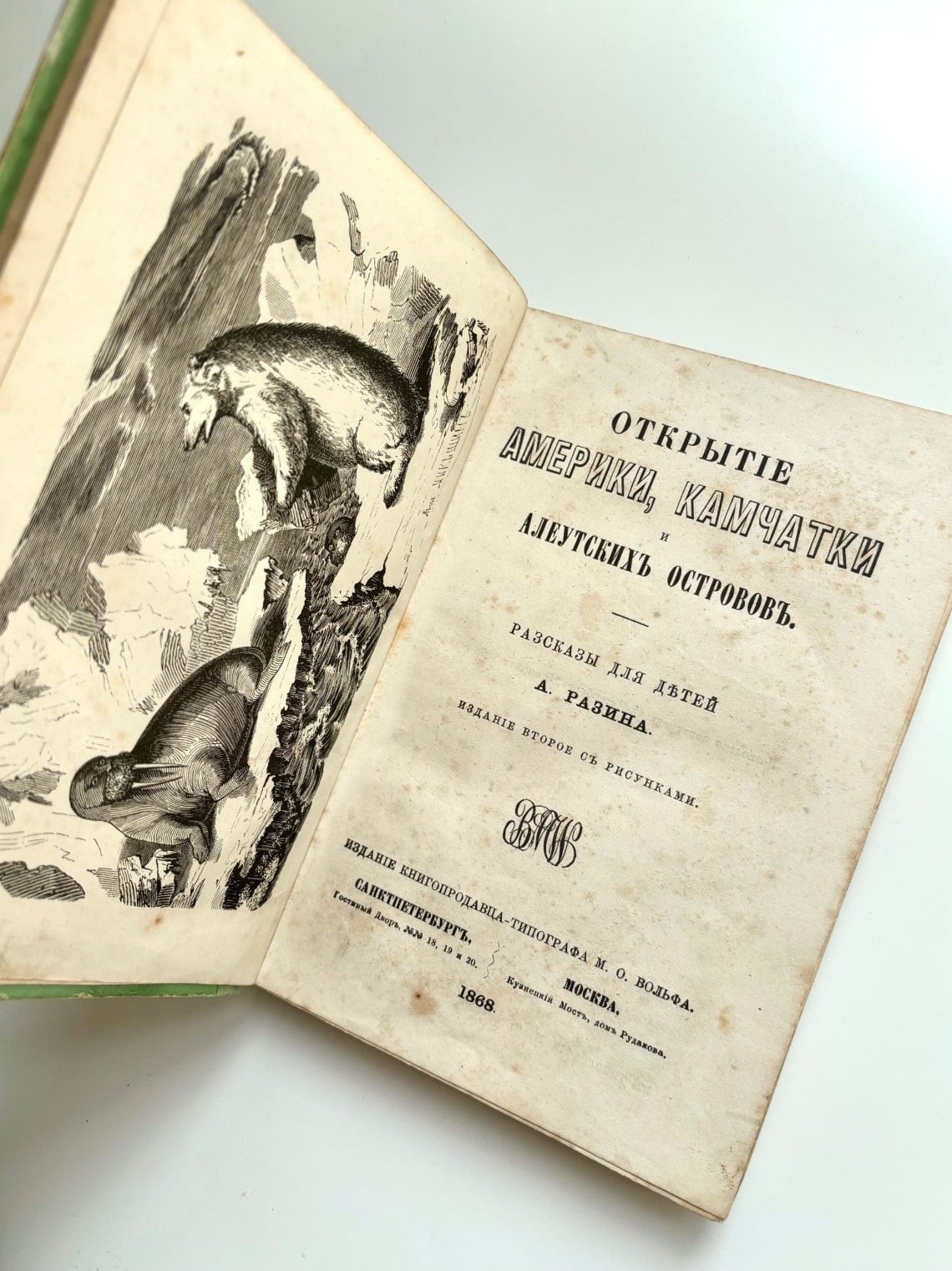
An unusual history of early America, with an early critique of the colonial conquests worldwide, including in Siberia and Alaska, aimed at Russian children, published at the time of the sale of Alaska to the USA.
Rare, especially in publisher's boards: we could locate only two copies of this edition (Yale, Smithsonian), and one copy of the first, almost identical, 1860 edition (Alaska Rasmusson) in addition to a handful of examples in Russian libraries. No copies of any edition at auctions in the West; in Russia we traced only one other copy of this edition (without original boards) and two examples of the first edition (one incomplete and another washed).
Nicely written for younger readers, the book is divided into four parts: Columbus's discovery of America, the first Europeans in North America, Vladimir Atlasov's expedition to Kamchatka and the Kuril Islands, and the history of the Aleutian Islands, told through the voice of an Aleut man.
The preface makes a bold claim for its time: "It turns out that the conquest and discovery of lands everywhere were marked by the same things?unfairness, cruelty, bloodshed, theft. Christopher Columbus in the early 1500s, Vladimir Atlasov in the early 1700s, both discovered unknown lands [...] both encountered gentle, humble peoples, and both shed blood on the lands they found. Just as Julius Caesar discovered Gaul and Britain, so Yermak discovered Siberia, the English discovered India, the Spanish Mexico, the Viceroy of Egypt the source of the Nile, and the French Kabylia" (our translation here and below).
The first part, "The Discovery of America and the First Settlements on San Domingo," recounts Columbus's early voyages and his crew's encounters with the paradise-like landscapes and innocent inhabitants of present-day Cuba, the Dominican Republic, and Haiti, resulting in atrocities. The author also notes that America was discovered long before Columbus, in the 11th century by the Vikings, as told in the Vinland Sagas. The following chapter covers later expeditions, including those of John Cabot and Hernando de Soto, whose brutal actions are described in even more graphic detail.
"The Story of the Conquest of Kamchatka" takes on a noticeably more positive tone, despite the preface's clear criticism of violent subjugations. The Koriaks and Kamchadals ? indigenous peoples of Kamchatka and Chukotka ? are first portrayed as harmless, but are then accused of attacking the explorers, who allegedly responded with force only after being provoked. Even so, the narrator acknowledges that explorers extorted food and valuables from the locals, and that further conflicts led to sharp population decline: "many industrialists came to Kamchatka and began to oppress the natives by all means, forcing them to hand over valuable furs under the pretext of collecting toll [...] this deception so embittered the savages that they began to take revenge on all the newcomers."
This section contains five chapters, beginning with the first expedition to the Far East led by the Yakut Cossack Luka Semenov Morozko in the late 17th century. The second and larger expedition, led by Atlasov in 1696, included hired Yukaghir people. During this journey, the explorers encountered a captured Japanese man whose accounts led them south towards the Kuril Islands and to the discovery of Cape Lopatka. One chapter focuses on Kamchatka's rich flora and fauna, the locals' methods of hunting and fishing, their cuisine, the use of hallucinogenic mushrooms, and clever household tricks?such as how to keep huts warm. The final chapter discusses the 1728 discovery of the Bering Strait, as well as earlier explorations by Semen Dezhnev and Nikita Semenov in the 1650s, driven by "a desire for profit and a passion for an active life."
The final part introduces a fictional narrator, 'an Aleutian former sailor', who, as a child, helped his uncle Ivan Shadurov (d. 1820, possibly a real historical figure later mentioned in Russian studies) bring food to Russian explorers hiding from local revenge attacks in the 1760s. After being captured, the boy was sentenced to a ritual death but was rescued by the Russians. His account continues with vivid stories of island life, including detailed descriptions of hunting and fishing. These lead to the conclusion that made the book acceptable to the censor: "[the explorer Ivan] Solovev and the other Aleut exterminator, [Stepan] Glotov, along with all their companions, were uneducated men, and it's no surprise that they took revenge for their comrades' deaths far too harshly, killing a great many of my fellow countrymen [...] But after we came under the high hand of the Russian Tsar, we began to live quietly and peacefully?far better than before." The only drawback, the narrator notes, is that "since the Russians arrived, there are fewer animals in our area"?a loss justified by the benefits of economic growth.
The illustrations include a humorous frontispiece, signed by the artist Mikhail Mikeshin, depicting a walrus-and-bear encounter among drifting ice; an image of Columbus's three modest ships from his first voyage; a map of Kamchatka with the various peoples marked; and a hunting scene showing locals and Russians together, surrounded by Kamchatka's impressively tall and varied vegetation. The final plate shows Indigenous people ? likely Aleutians ? gathering eggs on seaside cliffs.
This copy is preserved in its original bright green (possibly coloured with arsenic-based pigments?) and gold binding, with lace-like frames displaying the title and the name of the children's book series: Zelenaia biblioteka [Green Library], one of the earliest Russian popular science series for children. It was published by the prominent publisher Mavrikii Volf, founder of the famous Russian geographic magazine Vokrug Sveta [Around the World], which remains in print to this day.
The author, Aleksei Razin (1822?75), was born into a family of former serfs. A schoolteacher by profession, he also worked as a publisher and editor of Zhurnal dlia detei, one of the most successful children's magazines of the time, and wrote prolifically for children. In 1860, he joined the literary circle of Fedor Dostoevsky, who spoke positively of his work.
Description
Octavo (18.3 x 12.5 cm). Half-title, title, 219 pp., with 5 engr. plates on glossy paper.
Binding
Publisher's green decorative boards with gilt and blind-stamped frames, lettering, and centrepiece vignettes.
Condition
Rebacked preserving original boards, corners restored and rubbed; foxing and light staining throughout, a couple of marginal pencil inscriptions.
Bibliography
Markov, Sergei. Zemnoi krug: kniga o zemleprokhodtsakh i morekhodakh, Sovremennik, 1976. ref: [3135]
Offered by PY Rare Books.
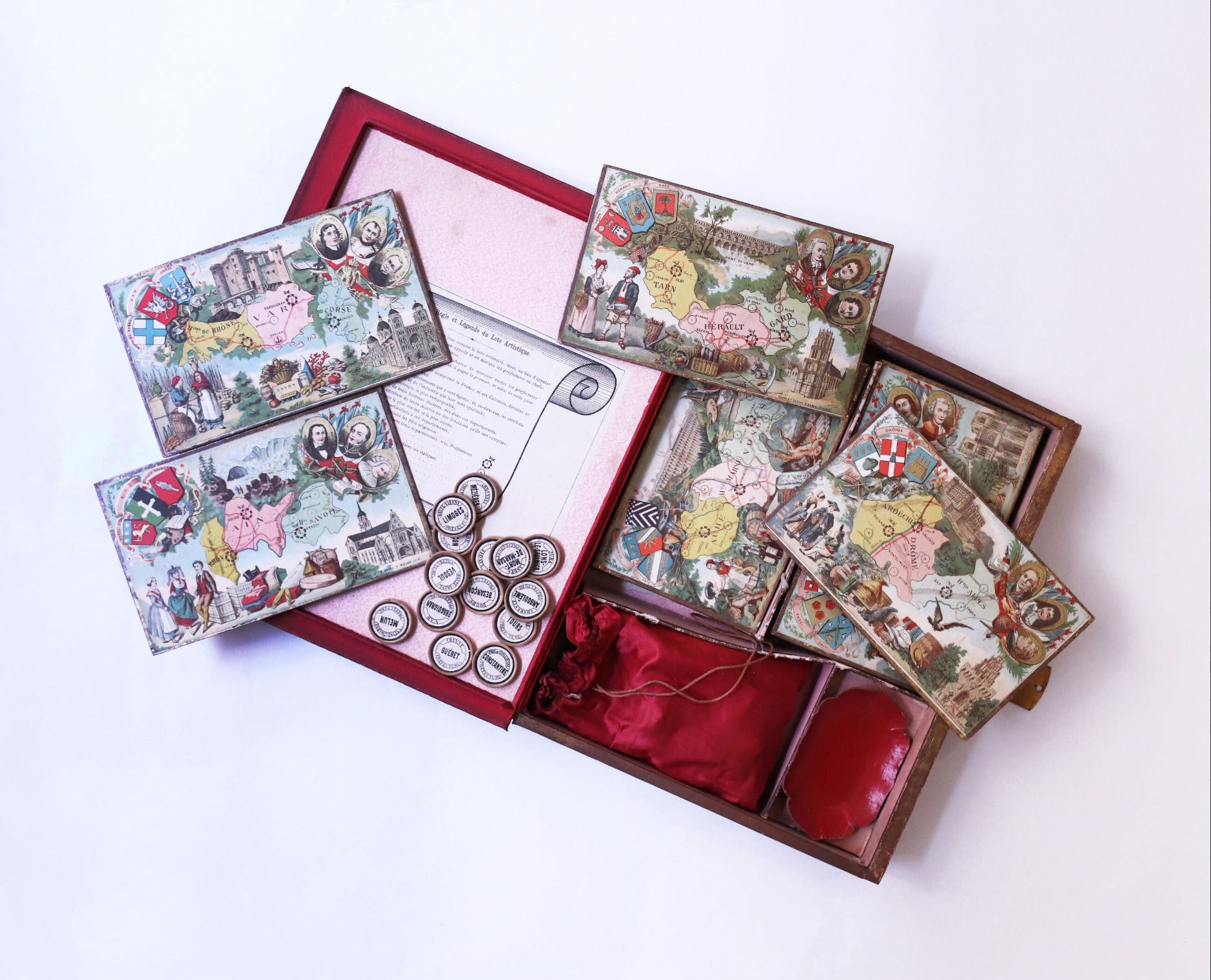
Loto artistique. Géographie & Histoire.
[GEOGRAPHICAL LOTTO]
Paris : Jullien, n. d. [ca 1870].
Size of the box : 36x30x6 cm ; size of the cards : 20,5x12,5 cm.
Opening of the token pouch torn, inner compartments detached.
A wooden and cardboard box in the form of a book bound in red cloth with clasp, the covers framed in gold and black. The rules of the game are pasted to the inner board. The inside of the box is divided into 4 compartments containing a red silk pouch with 98 wooden tokens, each bearing the name of a department and its prefecture, 30 chromolithographed and gilded cards, each illustrated with a local map and representations of regional specialities : products, sites and monuments, coats of arms, costumes, famous people, etc., and a red cardboard dish.
Without the leaflet "Légendes du loto artistique", but complete with all the elements.
Offered by Librairie des Seraines.
Le Voyage Mouvemente Au Pays Des Blancs (Eventful Journey to the Land of the Whites)
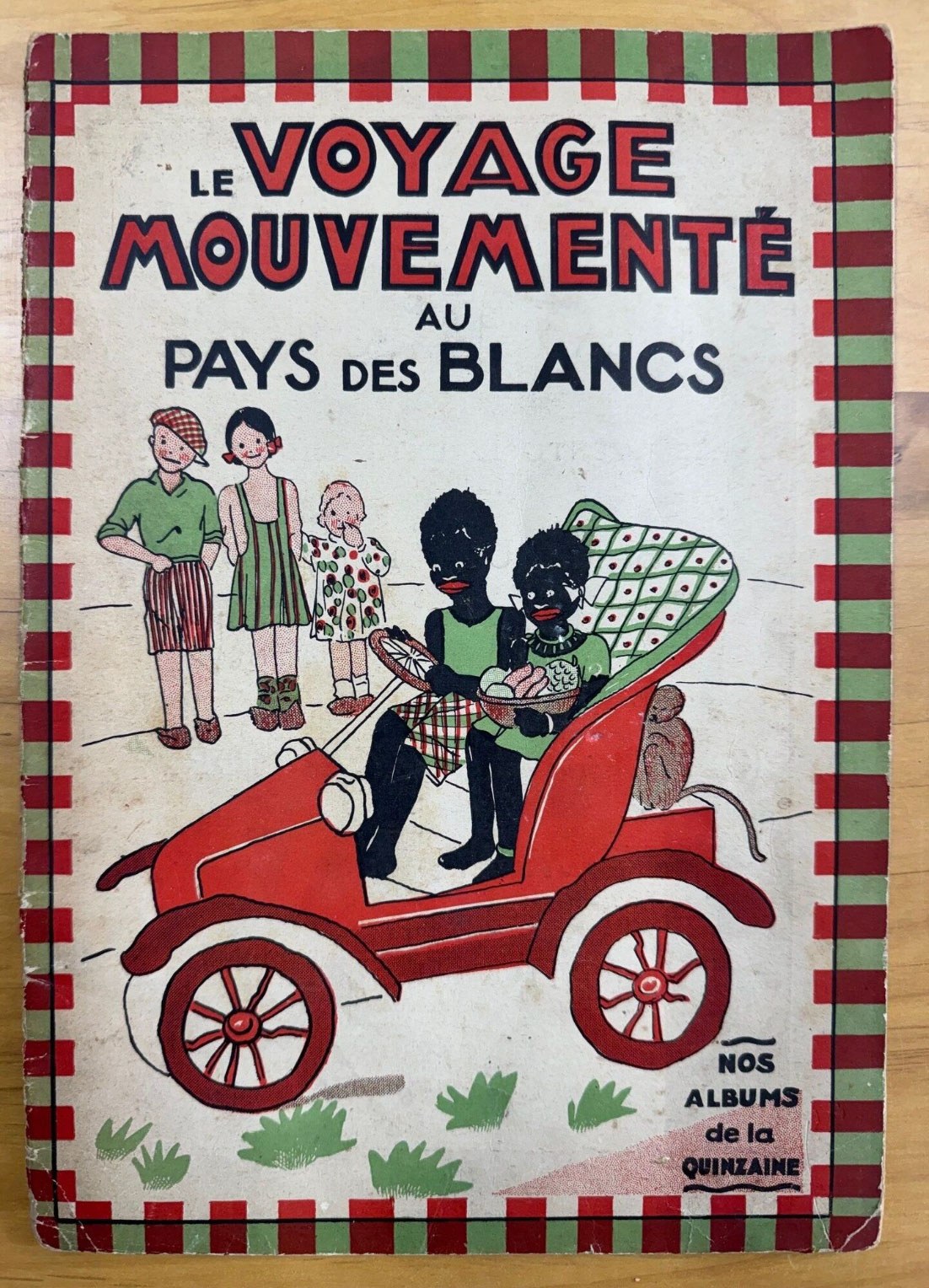
Paris: Editions Enfantines, 1931. Le Voyage Mouvemente Au Pays Des Blancs (Eventful Journey to the Land of the Whites), Editions Enfantines, Paris, 1931. 10 1.2 x 7 3/8 inches [16pp].
Original staple-bound printed wrappers. Obvious edge wear and light soiling. Wrappers split about halfway. Minor pencil markings on back wrapper. Interior is clean. Good condition.
The story of two young African children who are sent to France to be educated and learn a trade. Book six of a series of at least 34 books. Published in France in the 1930's.
Uncommon in the United States.
Offered by Stellar Books & Ephemera, ABAA.
FRANK TOUSEY'S LATEST CATALOGUE. FIVE CENT WEEKLIES. TEN CENT HAND BOOKS.; This catalogue contains lists of titles of the most popular publications issued. They are sent by return mail to any address by Frank Tousey Publisher 24 Union Square, New York
[Publisher Trade Catalogue]
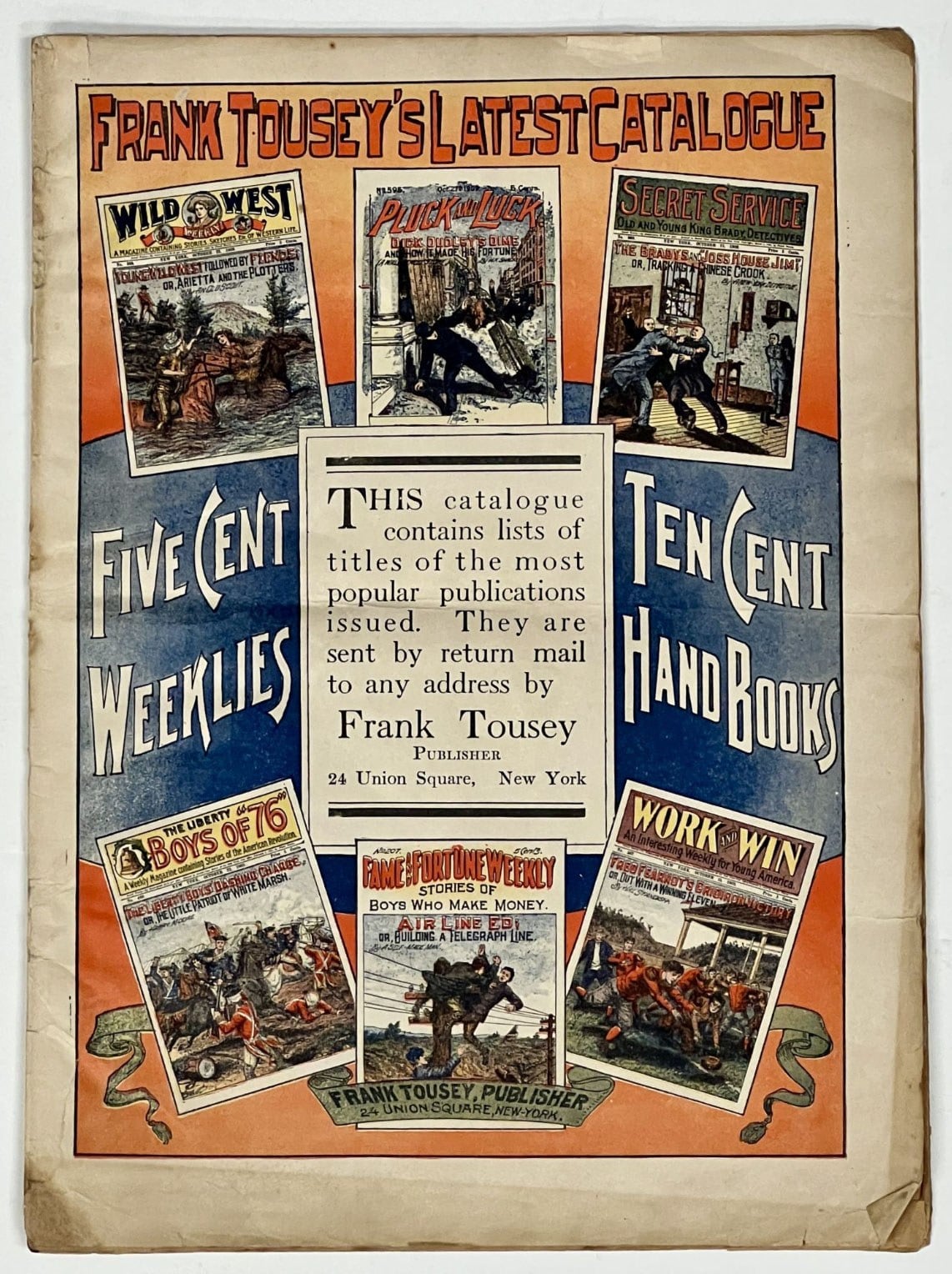
New York: Frank Tousey, Publisher, 24 Union Square, 1911. 1st Printing thus (i.e., of this catalogue). 31, [1] pp. Story paper extracts, with text printed double column. Adverts. 11" x 8-1/8". Printed paper covers, color front cover, stapled. Advert to rear cover. Now housed in an archival mylar sleeve. Wear, soiling & staining to covers, which has paper reinforcement along inner center fold. Age-toning to paper. Small bookseller stamp to rear wrapper lower margin. An About Good copy of this rare survivor.
"Frank Tousey (1853 - 1902) was among the top five publishers of dime novels in the late 1800s and early 1900s. Based in New York, his sensationalism drew a large audience of youth hungry for scenes of daring and tormented heroes and damsels in distress. Of particular notice in his approach to the 'blood and thunder' genre were the vivid cover illustrations of his dime novels, which were consistently larger and more thrilling than previous publications. Although focused on fictional weeklies, Tousey managed a variety of materials over time, including some handbooks, gossip sheets, and even a newspaper on current events in the Spanish American War." [Wiki]
Offered by Tavistock Books, ABAA.
Alphabet des Insectes
BECKER, Léon
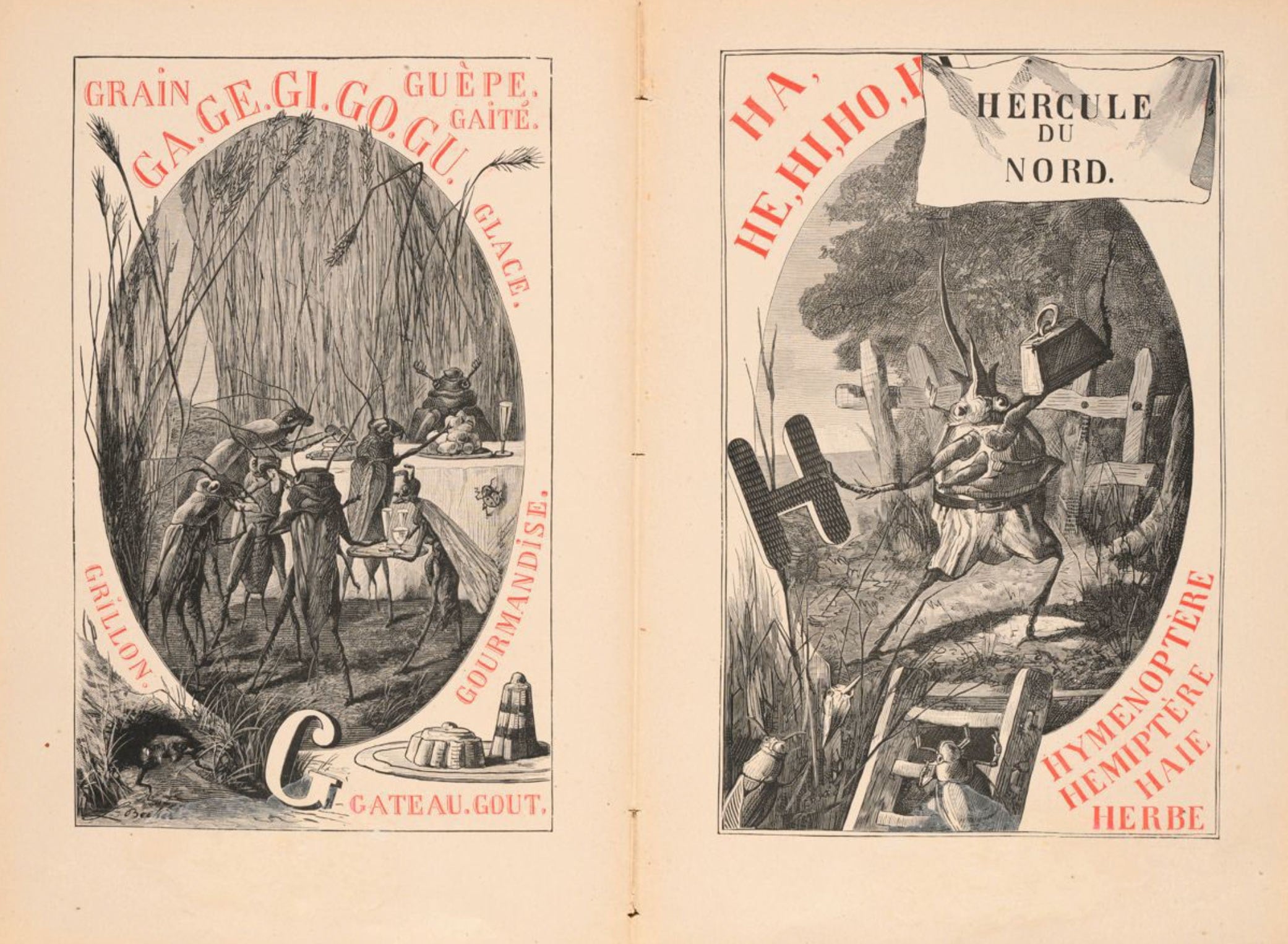
1883. BECKER, Léon. Alphabet des insectes. 24 ff., 8 pp. of publisher's catalogue, including 23 b&w engravings with text in red. 275 x 185 mm., publisher's boards, in a new cloth folding box. Paris: Bibliothèque d'éducation et de récréation. Hetzel & Cie, [1883]. A wonderful late nineteenth-century alphabet conjuring up the work of Doré and Grandville by the Belgian artist, Léon Becker. A fine copy, still preserved in its original decorated publisher's boards. Very rare. OCLC lists Newberry, Princeton. British Library, BN and Royal Library in the Hague.
Offered by Ursus Books.
Album Full of Photos of (all?) WWI Liberty Bonds from the United States c1918
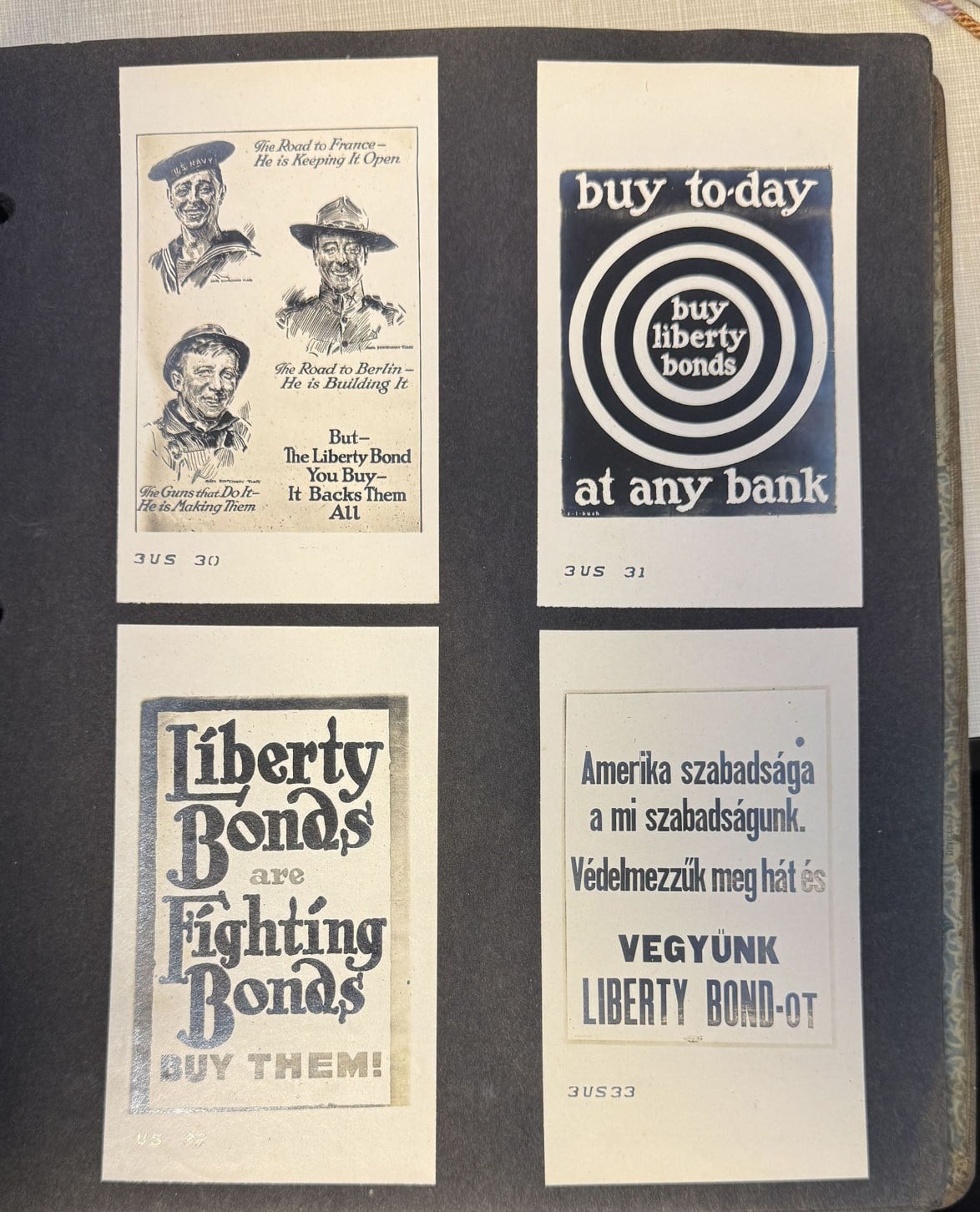
Perhaps this was an index? The photos are generally all in very good condition with minor silvering. The last five pages have old water damage.
Each photo is numbered with a series number and then another number in order. There are 4 series of about 50. I photographed the spine and front cover to show the grime of over 100 years… That said, the binder and photos have held up rather well.
Offered by Erin Waters Fine Photographs
Le Costume, Les Armes, Ustensiles, Outils, des Peuples Anciens et Modernes. Dessinés et décrits par Frederic Hottenroth
Hottenroth, Frederic
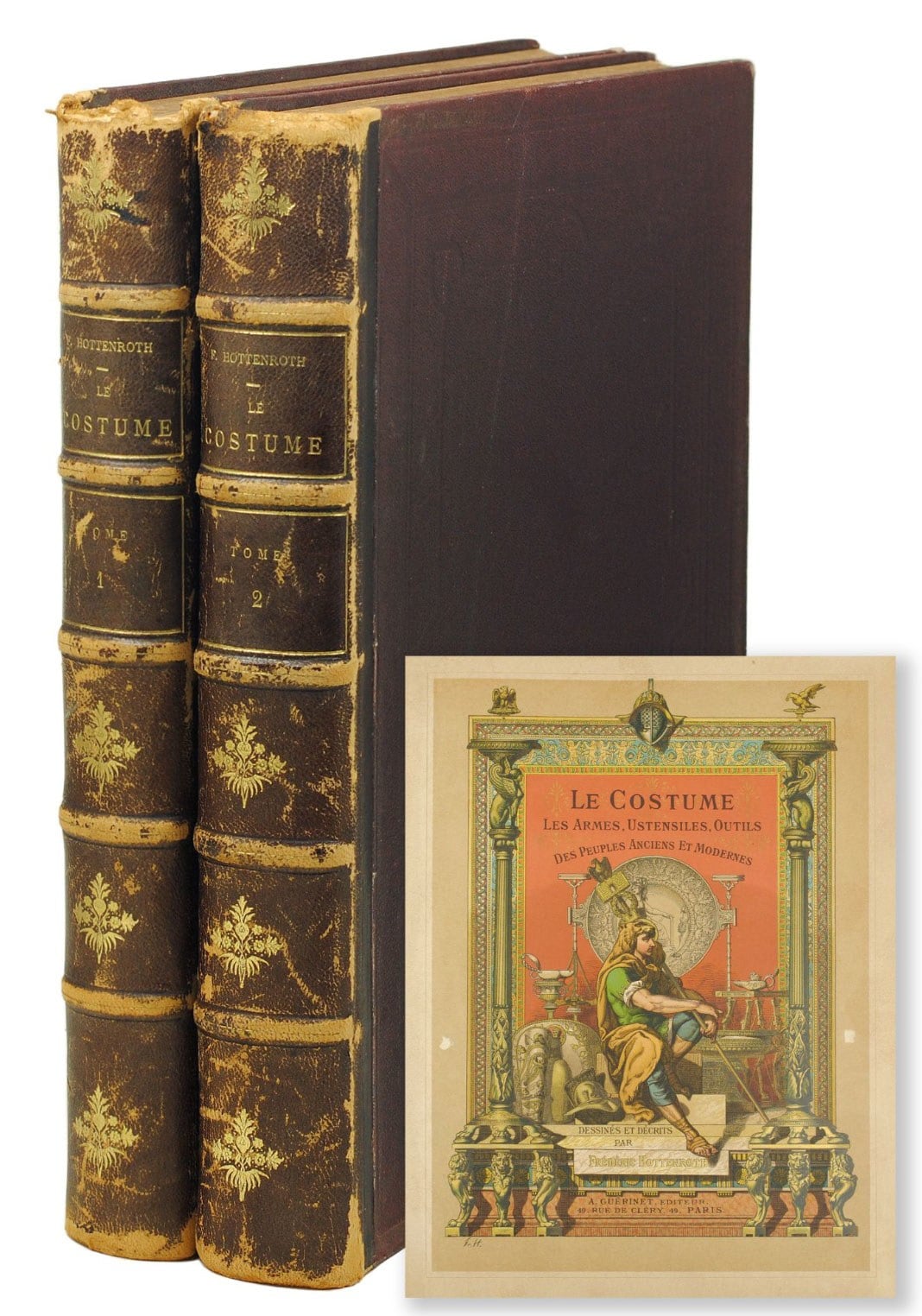
2 vols. 4to. Each volume with numerous woodcut initials and woodcut illustrations in the text, as well as 120 chromolithographed plates. Publisher's maroon cloth, rebacked. Backstrips rubbed. Two small abrasions to title page. Plates age-toned but free from foxing. Very good.
§ Friedrich Hottenroth (1840-1917) was a German painter and lithographer and a highly influential researchers of traditional costumes and customs. This is the first French edition of a compendium of separate works that had previously appeared in Germany. At the time it was published it was the first complete works of the artist and it remains a fabulous reference book with thousands of examples of historical costumes, weapons, and tools, illustrated in full color.
Offered by John Windle Antiquarian Bookseller.

Join us at www.abaa.org/vbf for the ABAA Virtual Book Fair: Spring Edition, April 9-11, 2026.