

A Copperhead Newspaper Prints, Then Criticizes, the Emancipation Proclamation
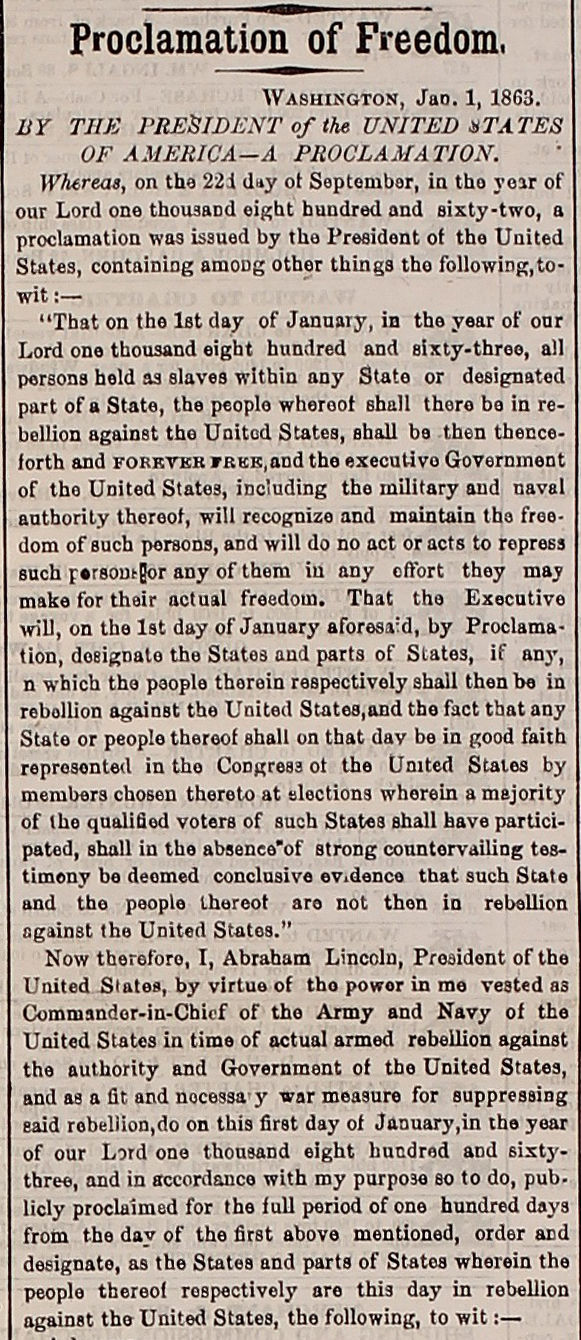
- No binding
- New York, N.Y. , 1863
New York, N.Y., 1863. No binding. Fine. New York Journal of Commerce. Newspaper. New York Journal of Commerce. New York, N.Y., January 3, 1863. 4 pp., 24 x 32 1/2 in. An early report of the Emancipation Proclamation, where the editors describe Lincoln's bold move as ""a farce coming in after a long tragedy....Most of the people regard it as a very foolish piece of business."" Historical BackgroundThe Emancipation Proclamation was the single most important act of Lincoln's presidency. Its text reveals the major themes of the Civil War: the importance of slavery to the war effort on both sides; the courting of border states; Lincoln's hopes that the rebellious states could somehow be convinced to reenter the Union; the role of black soldiers; Constitutional and popular constraints on emancipation; the place of African Americans in the United States, and America's place in a worldwide movement toward the abolition of slavery. In sounding the death knell for slavery and the ""Slave power,"" the President took a decisive stand on the most contentious issue in American history, and the United States joined other western nations in embracing a future of free labor.In addition to the moral impact of this ""sincerely believed...act of justice,"" the Proclamation aided the Union cause tangibly and decisively. Because it focused on territory still held by the Confederacy, only small numbers of slaves (compared to the total slave population) were immediately freed. However, the Proclamation deprived the South of essential labor by giving all slaves a reason to escape to Union lines. Failing that, it freed slaves immediately upon the Union Army's occupation of Confederate territory. The Proclamation also encouraged the enlistment of black soldiers, who made a crucial contribution to the Union war effort. Moreover, England and France, who had already abolished slavery, were restrained from supporting the Confederacy, which would have been in their own economic interests. Lincoln summed up the Proclamation's importance in 1864: ""no human power can subdue this rebellion without using the Emancipation lever as I have done.""Nonetheless, the editors of the Journal of Commerce disagreed, and their opinion reflects the truly controversial nature of the act for many contemporary Americans.
Details
Title
A Copperhead Newspaper Prints, Then Criticizes, the Emancipation Proclamation
Author
ABRAHAM LINCOLN. EMANCIPATION PROCLAMATION
Binding
No binding
Condition
Fine
Publisher
New York, N.Y.
Date
1863