

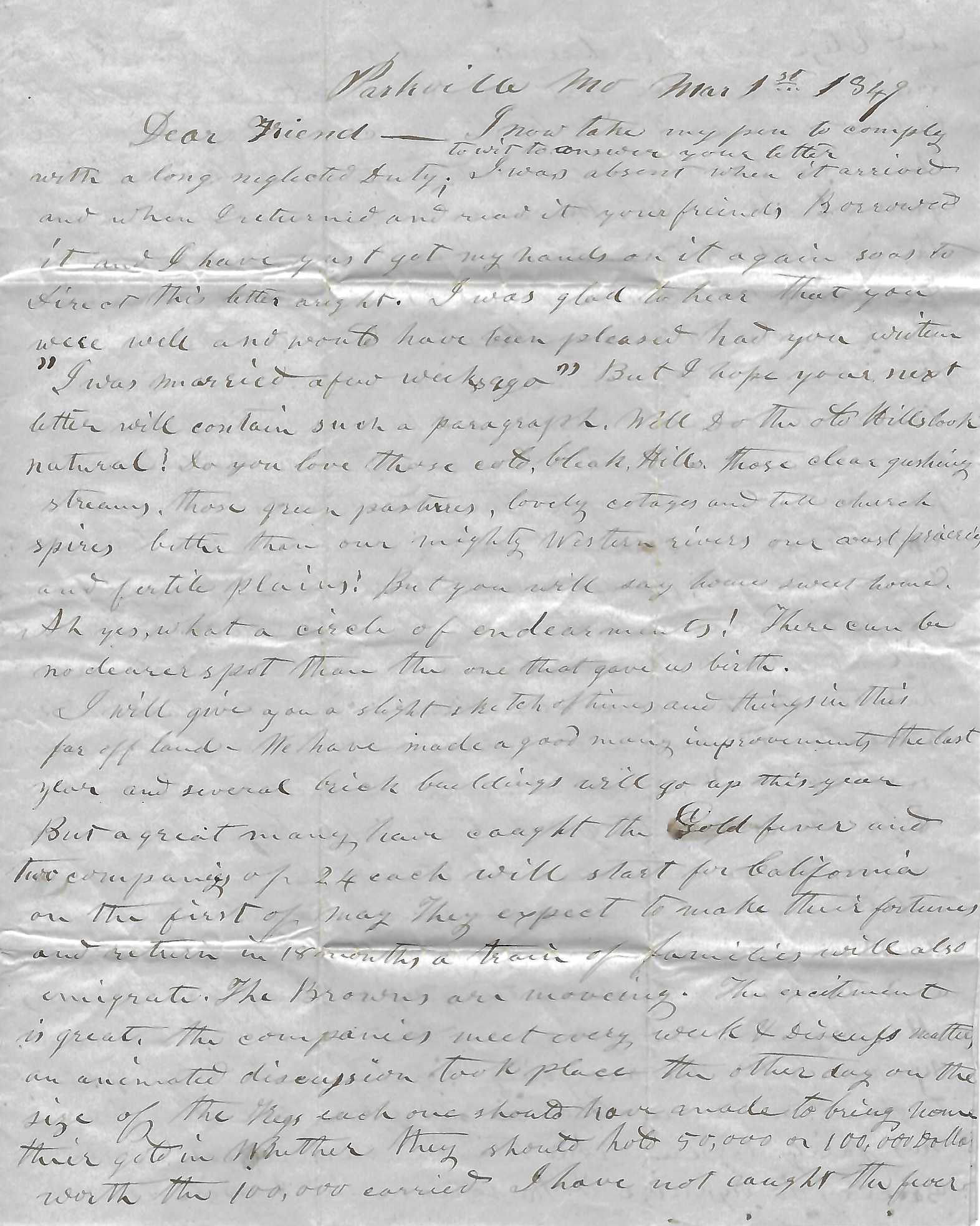
Autograph Letter Signed, Parkville, Missouri, March 1, 1849 to Rev. C. D. Herbert, Ellsworth, Maine
George Shepherd Park had an amazing life, first as a hero of the Texas War of Independence and then as a Missouri and Kansas pioneer who founded two cities and two colleges. Born in Grafton, Vermont, lived for a time in Maine, then taught school in Ohio and Illinois. In 1835, at age 24, he went to Texas, serving under James Fannin in the Texas War of Independence. Park joined Fannin's men at Refugio, Texas. More than 400 of Fannin's troops were killed by Antonio Lopez de Santa Anna in the Goliad Massacre and Park was one of the few survivors. He then moved to Jackson County, Missouri to teach school. Following the Platte Purchase, in which Native Americans sold what became northwest Missouri in 1838, Park took on a 99-year lease on a steamboat landing site, English Landing. Therese built a home on the bluffs above the Missouri River and platted the town of Parkville in 1844. In this new city of Parkville, which bore his name, he started a Presbyterian Church in 1845. In 1853 he started the Industrial Luminary, a newspaper some believed to be abolitionist. He owned slaves and termed the newspaper pro-commerce. He generally believed that slavery in Kansas would be bad for business there.
In 1854, while leading a trip up the Kansas River, Park established the town of Polistra near the mouth of the Big Blue River. On April 14, 1855, Park's newspaper was raided by a pro-slavery mob, its printing press thrown in the Missouri river. Park was in Polistra at the time closing a deal to turn over the town into a newly named Boston, Kansas. Boston was to be run by members of the abolitionist New England Emigrant Aid Company, who renamed it Manhattan. Immediately after the mob raid, Park moved to Magnolia, Illinois, where he made a fortune in real estate, and he returned to Parkville in late 1855. In 1858, Park pledged $ 500.00 toward establishing Bluemont Central College in the newly named Manhattan. This would become present day Kansas State University.
In 1859, Park promoted a proposed railroad route from Cameron, Missouri to Parkville, to be called the Parkville and Grand River Railroad. It was planned to cross the Missouri River at Parkville. However, in 1869, Kansas City won the race for the first bridge to cross the river at the Hannibal Bridge which transformed it into the dominant city in the region. Park was elected to the Missouri State Senate in 1866, where he introduced a bill to establish an industrial college, however, the bill failed.
Park formally moved back to Magnolia, Illinois in 1874. He donated part of his land on the bluffs for a college to be headed by John A. McAfee, then president of Highland College, in Highland, Kansas. The school was founded in 1875, which became Park College, was initially aimed at preparing students for missionary life for the Presbyterian Church.
This letter, written in his early Missouri pioneer days to a friend in Maine, show's Park's religiosity – and that of his wife, who may have been a Quaker. At the start of the Gold Rush, Park declares his conviction that the country was headed down a dangerous path of immorality and disunion.
"Dear Friend,
… do the old Hills look natural? Do you love those cold bleak hills, those clear, gushing streams, those green pastures, lovely cottages and tall church spires better than our mighty Western rivers, our vast prairies and fertile plains? But you will say home sweet home. Ah yes, what a circle of endearments! There can be no dearer spot than the one that gave us birth.
… I will give you a slight sketch of times and things in this far off land. We have made a great many improvements the last year and several brick buildings will go up this year. But a great many has caught the Gold fever and two companies of 24 each will start for California on the first of May … The excitement is great. The companies meet every week and discuss matters, an animated discussion took place the other day on the size of the Kegs each one should have made to bring home their gold in. Whether they should hold 50,000 or 100,000 Dollars worth, the 100,000 carried. I have not caught the fever and Eliza [his wife] says she does not want so much gold. It was quite healthy here last summer but we expect the Cholera soon on the boats. It has been a dry cold winter. The rive has been froze and the snow has laid on the ground all winter. The river has risen now 5 ft but the ice still holds.
Some talk of a dissolution of the Union but I hope there is moderate men enough North and South to save the Union … The Methodist have preaching twice a month. The old Methodist church have established a circuit and preach once in two months some places. They suffer much persecution & are driven off. The people call them abolitionists…
We have got a brick schoolhouse built 20 by 30 on top of the hill in front of the graveyard and last though not least a division of the sons of temperance with 40 members and prospering. We are getting up a library for the Sons. We have foes on every hand but our division stand up manfully. We are going to petition the county court to grant no more [liquor] licences so you see the war has fairly begun. And the Gamblers collect in the grocery to organize and the sons in the division room.
But sir I tremble at the prospect of our country. Every thing seems unsettled – people moving to and for, Gambling, drinking, Idleness, Ignorance, the evils of Slavery, negroes prowling about to pillage & burn, no Sunday schools, a want of moral & religious. If the sons of temperance fail I shall be discouraged, and try and sell out and go over and live among the peaceful Quakers over in Illinois. Eliza says she would like to have our little Quaker brought up over there. But before we give up the foes of temperance will have a hard struggle.
I hope you will sympathize with us and pray for us. If you can send us once in a while a paper to cheer us on we shall be thankful… may God richly reward you in all your Pious labors and when you have finished your labors in this world receive you to the other mansions of Eternal rest …'
Details
Title
Autograph Letter Signed, Parkville, Missouri, March 1, 1849 to Rev. C. D. Herbert, Ellsworth, Maine
Author
Park, George S.
Condition
Unknown