

Early American Medicine Benjamin Waterhouse Signed Note from the Harvard Physician Who Introduced Smallpox Vaccination to the United States
- SIGNED
- 1814
1814. Waterhouse, Benjamin. Autograph note signed written after 1814 by Benjamin Waterhouse, the Harvard physician who introduced Edward Jenner's smallpox vaccination to the United States and helped establish the earliest vaccination campaigns in North America. Waterhouse emerged as a central figure in early American public health after learning of Jenner's experiments in England and promoting the new inoculation method in the United States at the beginning of the nineteenth century. Through his advocacy and experimentation, including early vaccination trials in Massachusetts, Waterhouse played a decisive role in demonstrating the practicality of vaccination as a preventive measure against smallpox, a disease that had caused repeated epidemics in the Atlantic world.
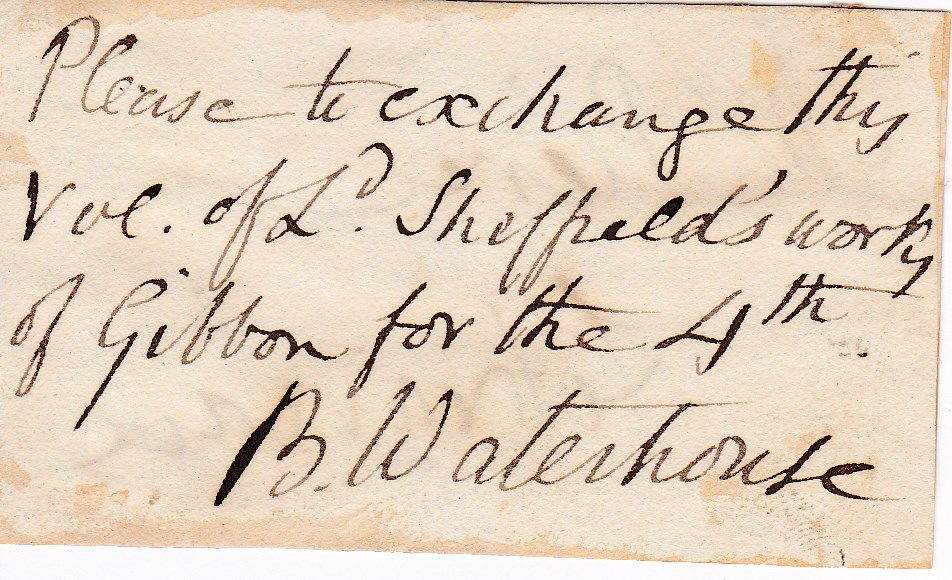
Waterhouse, Benjamin. Autograph note signed. [After 1814]. The brief manuscript reads: "Please to exchange this vol. of Ld. Sheffield's works of Gibbon for the 4th." Boldly signed "B. Waterhouse." The note refers to the collected works of historian Edward Gibbon edited by John Baker Holroyd, Earl of Sheffield, whose multi volume edition of Gibbon's Miscellaneous Works was issued in expanded form beginning in 1814. Waterhouse's request concerns the exchange of volumes within that set, specifically requesting the fourth volume which contained Gibbon's classical and critical writings.
Benjamin Waterhouse served as the first professor of the theory and practice of physic at Harvard Medical School and became one of the earliest American proponents of vaccination following Edward Jenner's discovery of the cowpox vaccine in 1796. In 1800 he carried out the first successful vaccination experiments in the United States and actively promoted the method through publications and public demonstrations, helping to establish vaccination as a recognized medical practice in the early republic. Manuscript material signed by Waterhouse provides documentary evidence from a physician whose efforts helped introduce vaccination to American medicine during the formative years of public health in the United States. Glue residue along the edges and general age toning. Otherwise very good condition.
Waterhouse, Benjamin. Autograph note signed. [After 1814]. The brief manuscript reads: "Please to exchange this vol. of Ld. Sheffield's works of Gibbon for the 4th." Boldly signed "B. Waterhouse." The note refers to the collected works of historian Edward Gibbon edited by John Baker Holroyd, Earl of Sheffield, whose multi volume edition of Gibbon's Miscellaneous Works was issued in expanded form beginning in 1814. Waterhouse's request concerns the exchange of volumes within that set, specifically requesting the fourth volume which contained Gibbon's classical and critical writings.
Benjamin Waterhouse served as the first professor of the theory and practice of physic at Harvard Medical School and became one of the earliest American proponents of vaccination following Edward Jenner's discovery of the cowpox vaccine in 1796. In 1800 he carried out the first successful vaccination experiments in the United States and actively promoted the method through publications and public demonstrations, helping to establish vaccination as a recognized medical practice in the early republic. Manuscript material signed by Waterhouse provides documentary evidence from a physician whose efforts helped introduce vaccination to American medicine during the formative years of public health in the United States. Glue residue along the edges and general age toning. Otherwise very good condition.
Details
Title
Early American Medicine Benjamin Waterhouse Signed Note from the Harvard Physician Who Introduced Smallpox Vaccination to the United States
Author
Benjamin Waterhouse
Condition
Unknown
Date
1814