

Original holograph manuscript in pencil of his poem "To Will H. Low", 3 pages on lined paper (the original sheet was evidently cut into three pieces for the purpose of binding), several small marginal printer's notations in ink in another hand noting directions for leading, this manuscript fair copy presumably prepared for the printer of Underwoods where the poem first appeared in 1887; 3 pages on lined paper (the original sheet was evidently cut into three pieces for the purpose of binding), several small marginal printer's notations in ink in another hand noting directions for leading, this manuscript fair copy presumably prepared for the printer of Underwoods where the poem first appeared in 1887
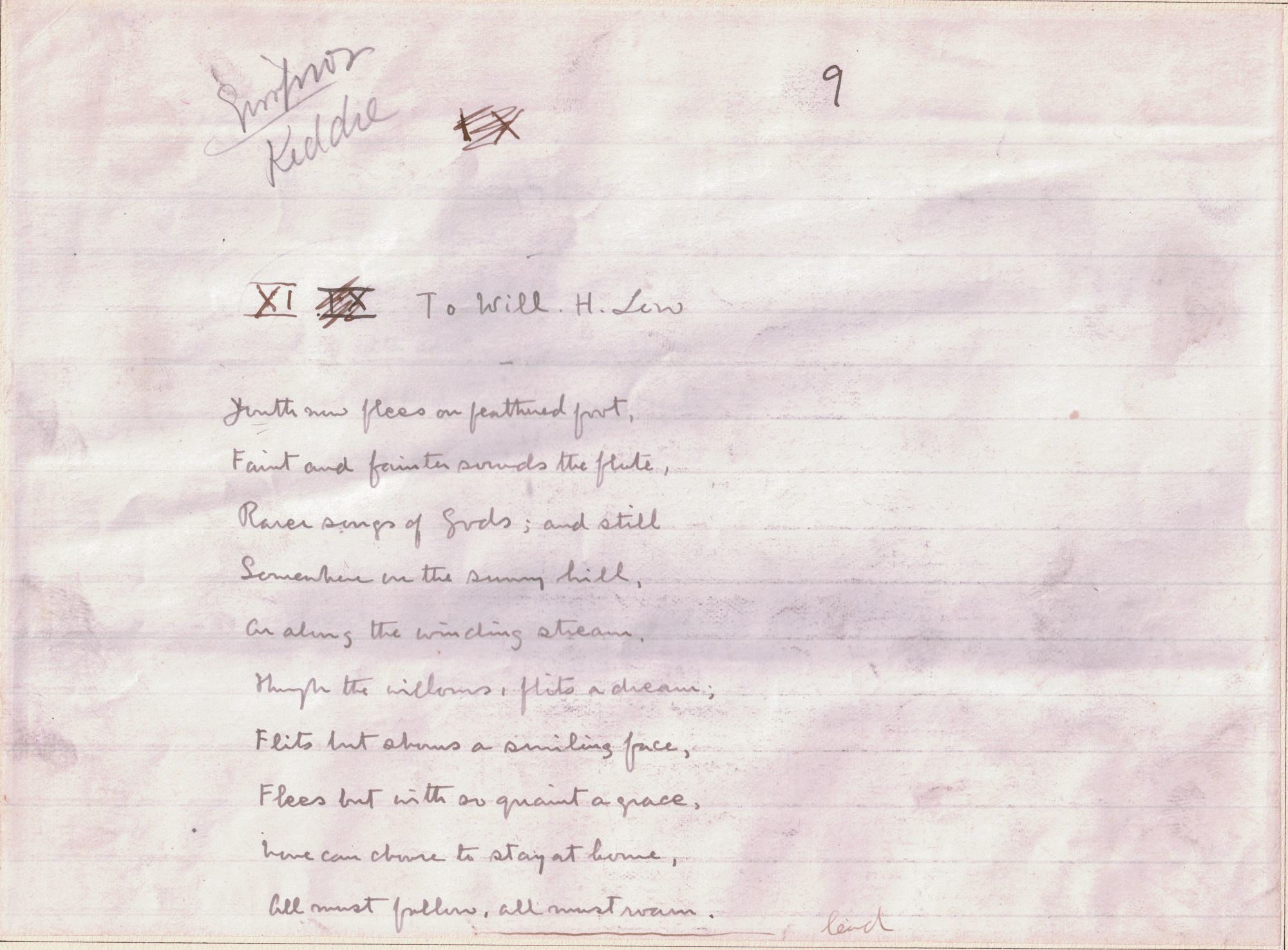
To Will H. Low" was published as the 11th poem in Stevenson's book Underwoods, and there are several notations at the head of the first sheet, likely in Stevenson's hand, that designate the poem variously as IX, 9 and XI. Another note in ink in the margin of the third sheet, clearly in Stevenson's hand, notes "XII is wanting," referring to the next poem in the sequence, which was Stevenson's companion poem "To Mrs. Will H. Low". "To Will H. Low" was written in France, therefore likely composed in1886 or 1887. Stevenson traveled to the Continent during the 1870s-1880s to relieve the symptoms of tuberculosis from which he suffered, and eventually died. He met Will Hickok Low, an American artist, there and often stayed with him in Paris and Grez-sur-Loing near Barbizon. Low was also a friend of Augustus Saint-Gaudens, who also befriended Stevenson during these years. Low published an endearing book of his reminiscences of his associations with Stevenson and Saint-Gaudens, A Chronicle of Friendships, 1873-1900 in 1908. The manuscript leaves are elaborately housed in a red three-quarter morocco and cloth book-like case with marbled end leaves, 7 7/8 x 10 1/2 inches, the binding including a photogravure frontispiece portrait of Stevenson, followed by three reproductions of paintings by Will H. Low, and a printed text of the poem presented as three stanzas. All of the contents are inlaid to the page size. Covers detached, light wear to the binding, the manuscript showing finger-soiling but generally sound. There is a recess on the inside of the rear cover that apparently contained a related item, but it is no longer present. One of Stevenson's best-known poems, a brisk meditation on life's inevitable well-worn ways: "In wet wood and miry lane, / Still we pant and pound in vain; / Still with leaden foot we chace / Waning pinion, fainting face; / Still with grey hair we stumble on, / Till, behold, the vision gone! / Where hath fleeting beauty led? / To the doorway of the dead. / Life is over, life was gay: / We have come the primrose way.".
Details
Title
Original holograph manuscript in pencil of his poem "To Will H. Low", 3 pages on lined paper (the original sheet was evidently cut into three pieces for the purpose of binding), several small marginal printer's notations in ink in another hand noting directions for leading, this manuscript fair copy presumably prepared for the printer of Underwoods where the poem first appeared in 1887; 3 pages on lined paper (the original sheet was evidently cut into three pieces for the purpose of binding), several small marginal printer's notations in ink in another hand noting directions for leading, this manuscript fair copy presumably prepared for the printer of Underwoods where the poem first appeared in 1887
Author
STEVENSON, Robert Louis
Condition
Unknown