

Linen and silk thread stitched sampler
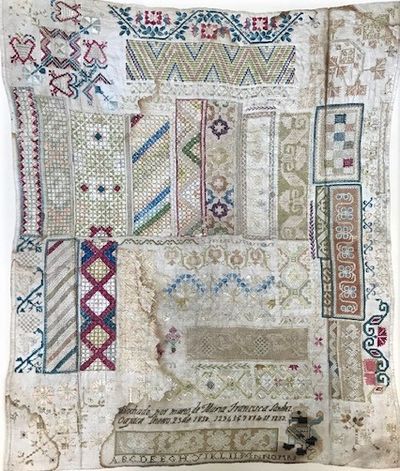
- Affixed to a backing board at three points with small strips of Holland tape.
- Oajaca [Oaxaca] Mexico , Onero [Enero?] - January 23, 185
Oajaca [Oaxaca] Mexico, Onero [Enero?] - January 23, 1850. Affixed to a backing board at three points with small strips of Holland tape.. Very good; some superficial soiling from damp but otherwise in fresh condition; NO tears or bug damage; colors firm.. Large linen and silk thread cross-stitch sampler measuring appx. 30 x 24.5 inches. The sampler bears the following stitched inscription: Dechado por mano de Maria Francisca Sanchez / Oajaca Onero 23 de 1850.
The English word 'sampler' derives from the Latin 'exemplum', or the old French term 'essamplaire', meaning 'an example'. Before the introduction of printed designs, embroiderers and lacemakers needed a way to record and reference different designs, stitches and effects. The answer was to create a sampler a personal reference work featuring patterns and elements that the owner may have learned or copied from others, to recreate again in new pieces. Instruction in sewing, embroidery, and other needlework was considered an essential element of a young womans education in Spain and the Spanish Americas during the early modern period until at least the late 1800s. Over the course of her education, especially when undertaken in a school outside the home, a girl would typically produce at least one advanced needlework exercise called a sampler (dechado in Spanish), a panel of embroidered cloth made to show off the students training and skill. Like the more well-known works from Great Britain and the United States, samplers made by schoolgirls across the Spanish-speaking world often include a wide variety of stitches and other needlework techniques, alphabets, numbers, verses, as well as religious and decorative motifs sometimes drawn from printed pattern books. Girls frequently signed and dated their samplers, and occasionally included the name of the school or instructor who supervised the project. Although proficiency in needlework was considered a practical skill, it also came to be equated with female virtue and popular conduct manuals such as Juan Luis Vives Education of a Christian Woman (first published in Latin in 1523) and other moralizing texts promoted textile work as a particularly appropriate type of feminine labor. In addition, the stitching of a sampler demonstrated more than needlework skills as the embroidered text and imagery often drew upon multiple aspects of a young womans education, including reading and writing, math, drawing and composition, religion, politics, and geography. The display and preservation of samplers by families further points to their role as a symbol of a young womans accomplishment, virtue, and social status. A sampler is oftentimes the only surviving record of a womans life. As objects of artistic and material culture, samplers not only chart the history of needlework, but give evidence of the limitations and opportunities in female education and literacy, and help to illuminate the lives of individual women, their families, and the specific cultural, religious, and political contexts in which they lived (Sabena Kull, Denver Art Museum). While not unusual to have the origin of a sampler identified it is an infrequent occurrence; more so with Mexican samplers of such a grand size. Background information on samplers is available in the two volume Ring collection monograph.
The English word 'sampler' derives from the Latin 'exemplum', or the old French term 'essamplaire', meaning 'an example'. Before the introduction of printed designs, embroiderers and lacemakers needed a way to record and reference different designs, stitches and effects. The answer was to create a sampler a personal reference work featuring patterns and elements that the owner may have learned or copied from others, to recreate again in new pieces. Instruction in sewing, embroidery, and other needlework was considered an essential element of a young womans education in Spain and the Spanish Americas during the early modern period until at least the late 1800s. Over the course of her education, especially when undertaken in a school outside the home, a girl would typically produce at least one advanced needlework exercise called a sampler (dechado in Spanish), a panel of embroidered cloth made to show off the students training and skill. Like the more well-known works from Great Britain and the United States, samplers made by schoolgirls across the Spanish-speaking world often include a wide variety of stitches and other needlework techniques, alphabets, numbers, verses, as well as religious and decorative motifs sometimes drawn from printed pattern books. Girls frequently signed and dated their samplers, and occasionally included the name of the school or instructor who supervised the project. Although proficiency in needlework was considered a practical skill, it also came to be equated with female virtue and popular conduct manuals such as Juan Luis Vives Education of a Christian Woman (first published in Latin in 1523) and other moralizing texts promoted textile work as a particularly appropriate type of feminine labor. In addition, the stitching of a sampler demonstrated more than needlework skills as the embroidered text and imagery often drew upon multiple aspects of a young womans education, including reading and writing, math, drawing and composition, religion, politics, and geography. The display and preservation of samplers by families further points to their role as a symbol of a young womans accomplishment, virtue, and social status. A sampler is oftentimes the only surviving record of a womans life. As objects of artistic and material culture, samplers not only chart the history of needlework, but give evidence of the limitations and opportunities in female education and literacy, and help to illuminate the lives of individual women, their families, and the specific cultural, religious, and political contexts in which they lived (Sabena Kull, Denver Art Museum). While not unusual to have the origin of a sampler identified it is an infrequent occurrence; more so with Mexican samplers of such a grand size. Background information on samplers is available in the two volume Ring collection monograph.
Details
Title
Linen and silk thread stitched sampler
Author
Sanchez, Maria Francesca - OAXACA DECHADO (SAMPLER)
Binding
Affixed to a backing board at three points with small strips of Holland tape.
Condition
Very Good
Publisher
Oajaca [Oaxaca] Mexico
Date
Onero [Enero?] - January 23, 185