

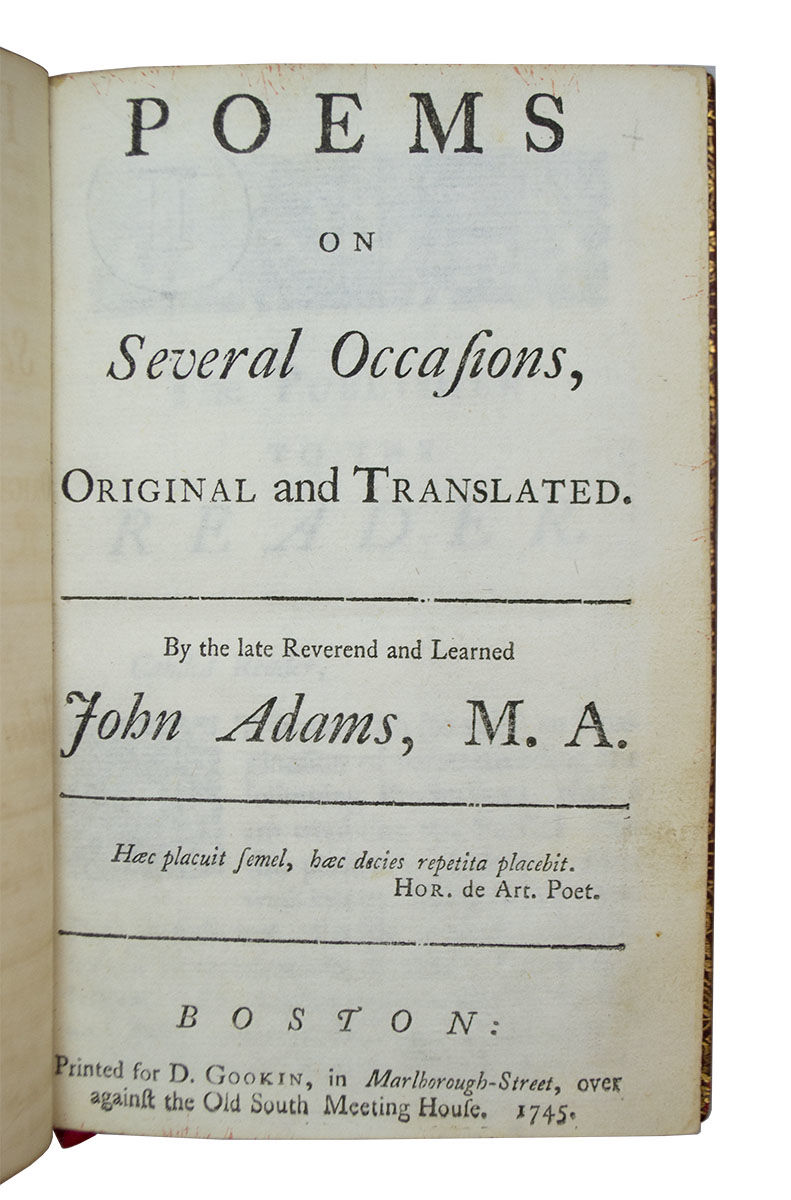
Poems on Several Occasions
Original and Translated.
- Boston: Printed for D. Gookin, 1745
Boston: Printed for D. Gookin, 1745. Boston: Printed [by Rogers and Fowle] for D. Gookin, 1745.
First edition, printed posthumously. Small octavo (5 3/4 x 3 3/4 inches; 145 x 95 mm). [8], 176 pp. Printers' names supplied by Evans. We could find no copies at auction in over 50 years.
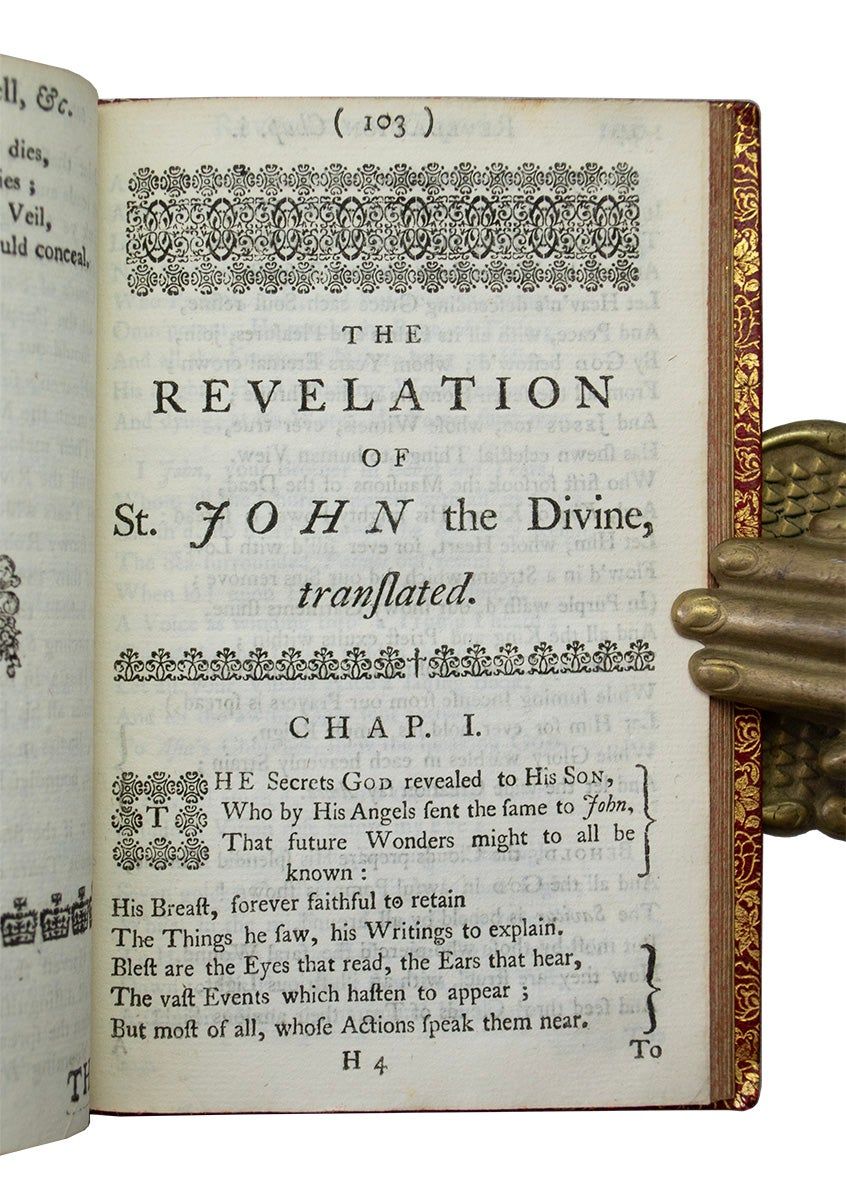
The final chapter of this book is John Adam's translation of "The Revelation of St. John the Divine" also know as the "Book of Revelations" or the "Apocalypse of John", being the last chapter of the New Testament. This is the first full version of this book of the Bible to be printed in English in America. Because England did not allow the printing of English Bibles in the colonies, no Bibles were printed in America in English until the Aiken "New Testament" of 1777 followed by the full Bible by Aiken in 1782. The first Bible ever printed in American is known as the "Eliot Indian Bible" which was printed in 1661 in the Native American Wampanoag language. In this Bible the "Book of Revelations" has chapter headers in English, but the full text is only in Wampanoag. Very few other early books contain parts of the Bible, those of which including the Bay Psalms Book of 1640 and the Massachuset Psalter of 1709. This present copy printed in 1745 seems to be the earliest American example of the full "Book of Revelations" and one of the earliest full books of the bible in English in America.
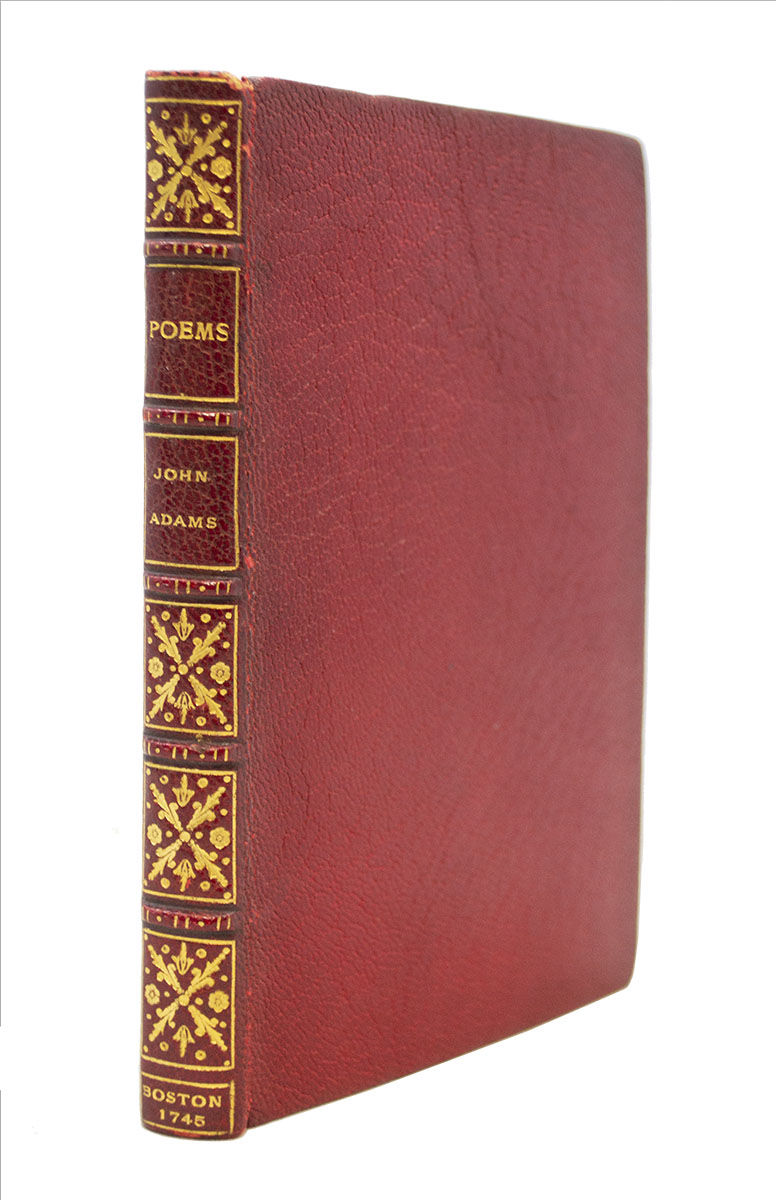
Bound by the Adams Bindery in full red morocco. Spine stamped and lettered in gilt. All edges gilt. Gilt dentelles. Marbled endpapers. Silk page marker. Previous owner's bookplate on front pastedown. Some occasional minor toning. Overall about fine.
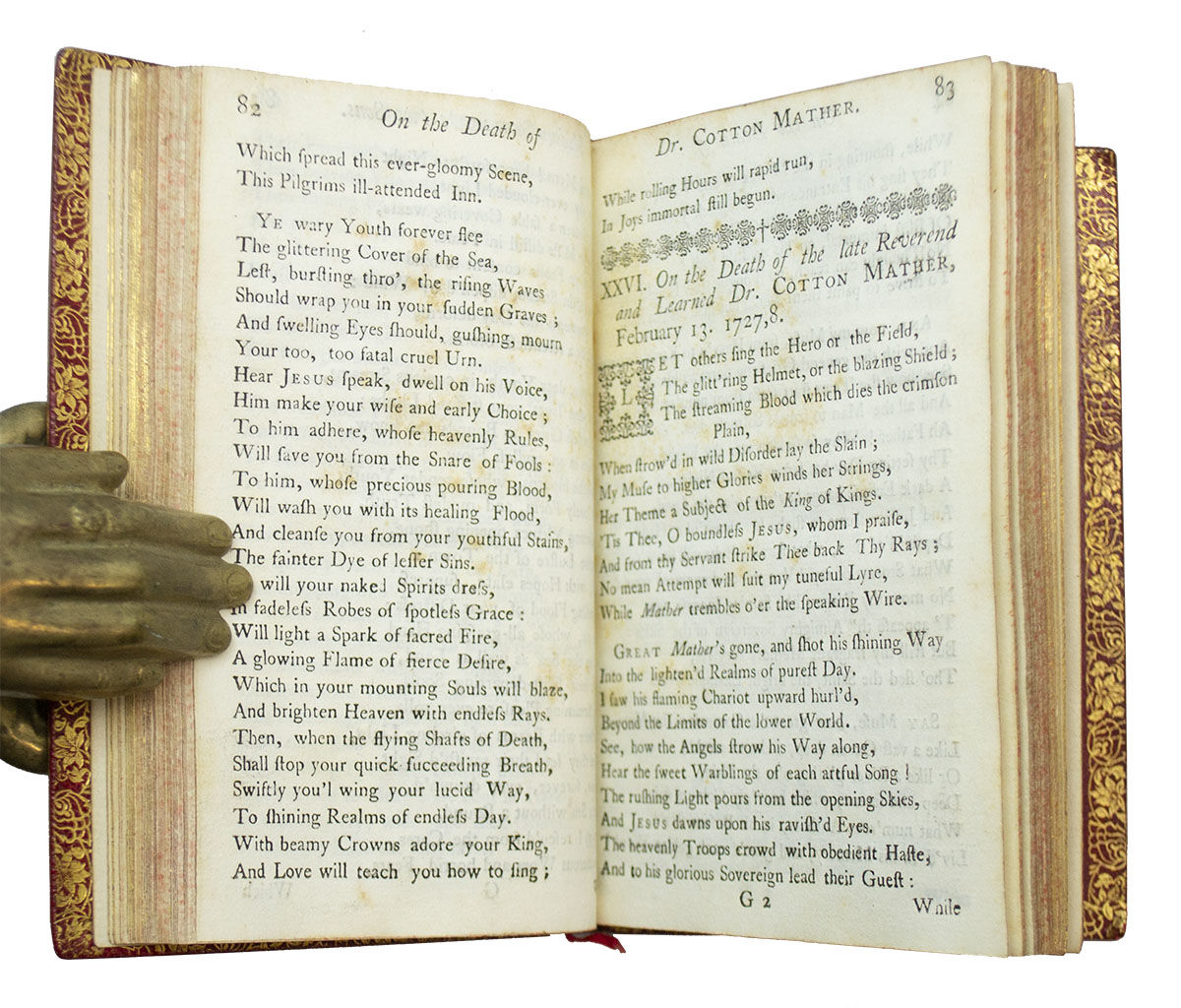
A rare example of early American poetry. Contains a poem On the Death of the late Reverend and Learned Dr. Cotton Mather, Feb. 13, 1727-8. "Though pervaded by the Puritan Spirit ye (poems) reveal a more purely aesthetic purpose, and a more careful style, than can generally be found before the latter years of the Century."--Cambridge History of American Literature.
John Adams, "poet and minister, was born in Boston, Massachusetts, the son of John Adams, a shopkeeper, and Hannah Checkley. His family relocated in Annapolis Royal, Nova Scotia, several years before the young Adams matriculated at Harvard College. Adams graduated from Harvard in 1721... While Adams's contemporaries knew him best as a minister, what is most memorable about him now is his poetry. His uncle Matthew Adams is largely responsible for John's reputation as a poet, having in 1745 gathered together enough of the younger man's verse to create a volume of 176 pages. Many of the poems, such as "The Perfection of Beauty," a paraphrase of Canticles 5:9, display a Platonic treatment of traditional Christian typology. Much of Adams's poetry is devoted to a treatment of the nature of poetic inspiration... In Adams's six translations of selections from Horace's Odes, however, the poet makes a marked shift from the Puritan habit of composing devotional verse toward the position that poetry should concern itself with aesthetic matters of taste... In such poems, Adams, along with his contemporaries Jane Turell, Mather Byles, and Joseph Green, was among the first Americans to depart from the belief that literature should serve religious conviction rather than provide pleasure."
(American National Biography).
ESTC W28916. Evans 5527. Sabin 222.
HBS 68573.
$10,000.
First edition, printed posthumously. Small octavo (5 3/4 x 3 3/4 inches; 145 x 95 mm). [8], 176 pp. Printers' names supplied by Evans. We could find no copies at auction in over 50 years.
The final chapter of this book is John Adam's translation of "The Revelation of St. John the Divine" also know as the "Book of Revelations" or the "Apocalypse of John", being the last chapter of the New Testament. This is the first full version of this book of the Bible to be printed in English in America. Because England did not allow the printing of English Bibles in the colonies, no Bibles were printed in America in English until the Aiken "New Testament" of 1777 followed by the full Bible by Aiken in 1782. The first Bible ever printed in American is known as the "Eliot Indian Bible" which was printed in 1661 in the Native American Wampanoag language. In this Bible the "Book of Revelations" has chapter headers in English, but the full text is only in Wampanoag. Very few other early books contain parts of the Bible, those of which including the Bay Psalms Book of 1640 and the Massachuset Psalter of 1709. This present copy printed in 1745 seems to be the earliest American example of the full "Book of Revelations" and one of the earliest full books of the bible in English in America.
Bound by the Adams Bindery in full red morocco. Spine stamped and lettered in gilt. All edges gilt. Gilt dentelles. Marbled endpapers. Silk page marker. Previous owner's bookplate on front pastedown. Some occasional minor toning. Overall about fine.
A rare example of early American poetry. Contains a poem On the Death of the late Reverend and Learned Dr. Cotton Mather, Feb. 13, 1727-8. "Though pervaded by the Puritan Spirit ye (poems) reveal a more purely aesthetic purpose, and a more careful style, than can generally be found before the latter years of the Century."--Cambridge History of American Literature.
John Adams, "poet and minister, was born in Boston, Massachusetts, the son of John Adams, a shopkeeper, and Hannah Checkley. His family relocated in Annapolis Royal, Nova Scotia, several years before the young Adams matriculated at Harvard College. Adams graduated from Harvard in 1721... While Adams's contemporaries knew him best as a minister, what is most memorable about him now is his poetry. His uncle Matthew Adams is largely responsible for John's reputation as a poet, having in 1745 gathered together enough of the younger man's verse to create a volume of 176 pages. Many of the poems, such as "The Perfection of Beauty," a paraphrase of Canticles 5:9, display a Platonic treatment of traditional Christian typology. Much of Adams's poetry is devoted to a treatment of the nature of poetic inspiration... In Adams's six translations of selections from Horace's Odes, however, the poet makes a marked shift from the Puritan habit of composing devotional verse toward the position that poetry should concern itself with aesthetic matters of taste... In such poems, Adams, along with his contemporaries Jane Turell, Mather Byles, and Joseph Green, was among the first Americans to depart from the belief that literature should serve religious conviction rather than provide pleasure."
(American National Biography).
ESTC W28916. Evans 5527. Sabin 222.
HBS 68573.
$10,000.
Details
Title
Poems on Several Occasions
Author
ADAMS, John
Condition
Unknown
Publisher
Printed for D. Gookin: Boston
Date
1745