

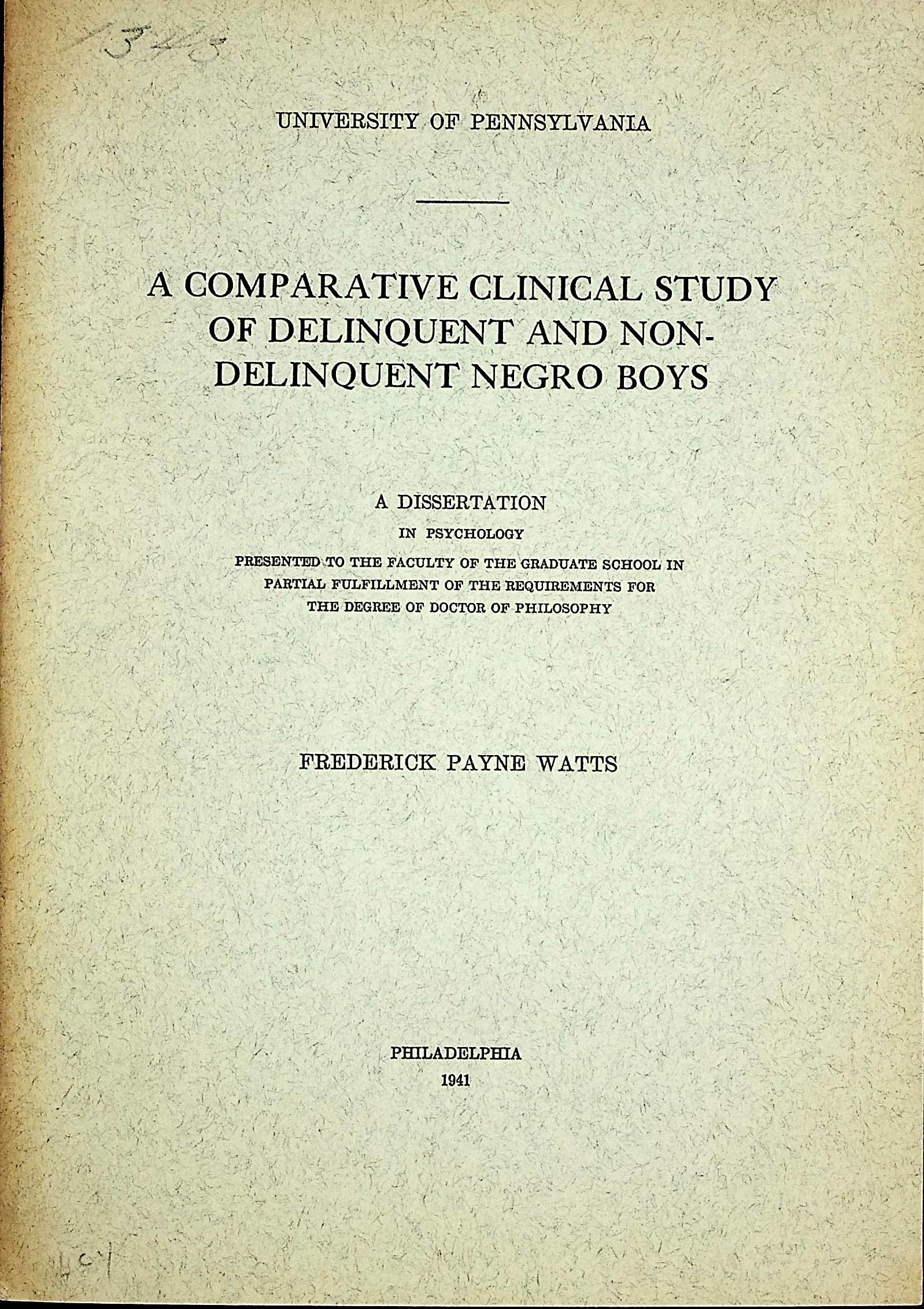
A Comparative Clinical Study of Delinquent and Non-Delinquent Negro Boys: A Dissertation in Psychology
- Offprint in paper covers
- Philadelphia: University of Pennsylvania, 1941
Philadelphia: University of Pennsylvania, 1941. First edition.
1941 SCARCE LANDMARK CONTROLLED STUDY OF DELINQUENT BEHAVIOR IN BLACK TEENS BY FIRST AFRICAN AMERICAN TO EARN A PHD FROM UNIVERSITY OF PENNSYLVANIA.
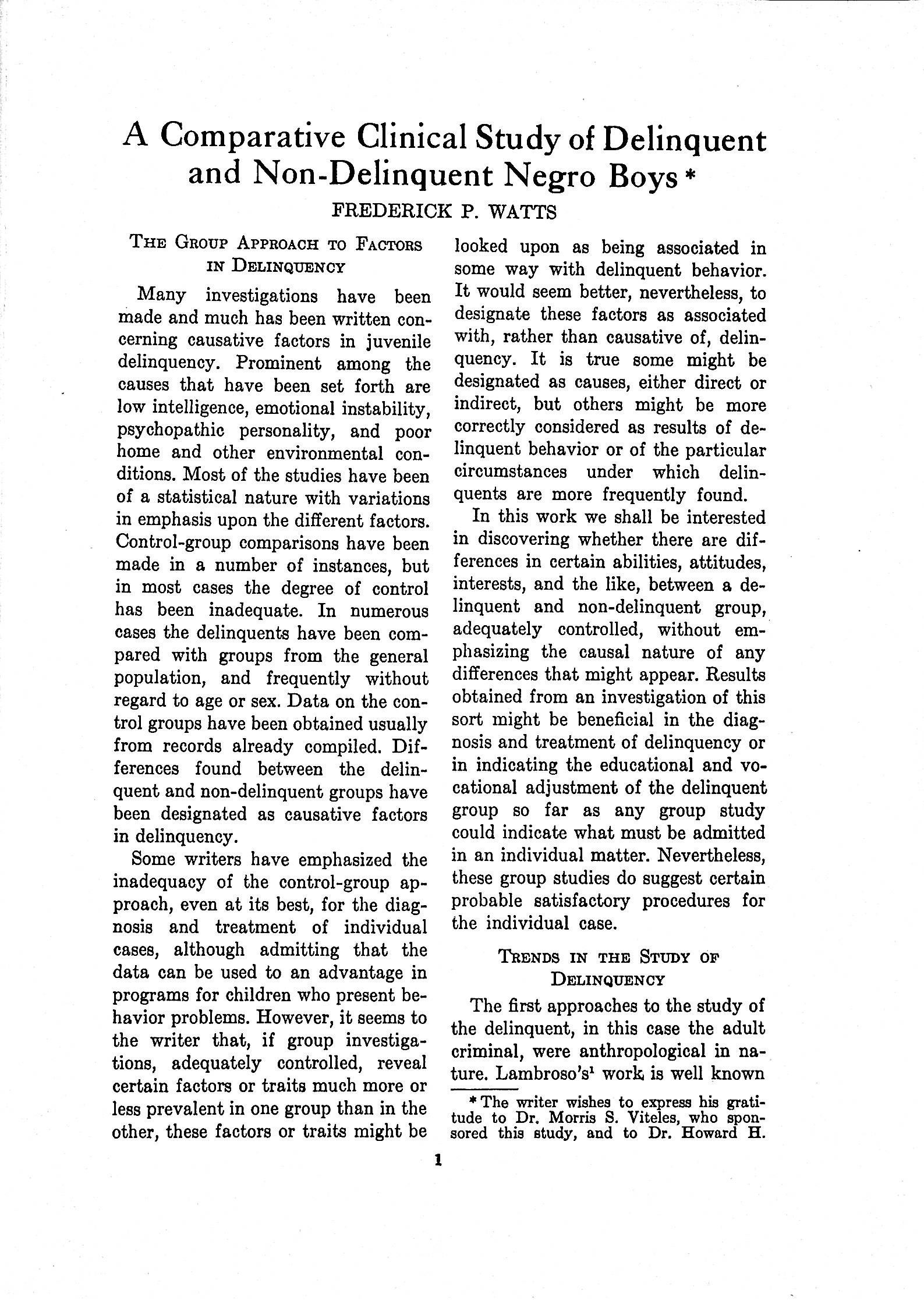
9 3/4 inches tall offprint; original grey printed staplebound card wrappers; [2], 18pp. Near Fine. Reprinted from the Journal of Negro Education, April, 1941.
Dissertation presented to the faculty of the graduate school of University of Pennsylvania in partial fulfillment of the requirements for the degree of Doctor of Philosophy. Prominent psychologist's first independently published piece, earning him the first PhD awarded to an African American from the University of Pennsylvania.
FREDERICK PAYNE WATTS (1904-2007) was one of five biracial children, three of whom went on to be a physician, a dentist and of course a psychologist. Watts was educated in the Washington, D.C. public school system. Upon graduating from Dunbar High School in 1922, he attended Howard University, graduating in 1926 with a BA in psychology and French, and with a teaching fellowship, which allowed him to complete his master's degree. After teaching for a year at Kittrell College in North Carolina, he returned to Washington, D.C. to accept a faculty position at Howard. While at Howard Watts independently researched and wrote A Comparative and clinical Study of Delinquent and Non-Delinquent Negro Boys. Watts worked with 92 boys in the Industrial Home School for Colored Children in the District of Columbia and 91 boys from the school they went to before being sent to the Industrial Home. Holding age (all participants were between 14 and 16) and IQ (average of 77) constant, the boys were tested to determine "whether there are: (1) differences in competency to respond to concrete situations as measured by standardized tests; (2) differences in emotional stability and tendencies toward problem behavior as measured by personality tests; (3) differences in social maturity as measured by a social maturity scale; (4) relationships among the various tests administered, and (5) differences as determined through a questionnaire." Watts concluded that when general intelligence and age remain constant, there is no significant difference between delinquent and non-delinquent boys in their competency to respond to concrete situations. He also did not find any notable differences within their tendencies towards problem behavior, emotional stability, and social maturity. He accused oppositional findings of other studies to inadequate control. Watts argues that it is impossible to differentiate between delinquent and non-delinquent Negro boys. He did however find that there were differences in interests, habits, and other general attitudes. Lastly, he noted that the delinquent boys had less parental or adult controls in their lives. Indicating that "further investigation in regard to parental or home control of the groups might lead to establishing useful and significant differences between delinquent and non-delinquent Negro boys. Watts remained at Howard until 1942, one year after he earned a PhD in clinical psychology from the University of Pennsylvania in 1941. According to the school's officials, he was the first African American to earn a PhD from the university and fourth in the nation to earn a PhD in psychology.
Details
Title
A Comparative Clinical Study of Delinquent and Non-Delinquent Negro Boys: A Dissertation in Psychology
Author
Watts, Frederick Payne
Binding
Offprint in paper covers
Condition
Unknown
Publisher
University of Pennsylvania: Philadelphia
Date
1941
Edition
First edition