

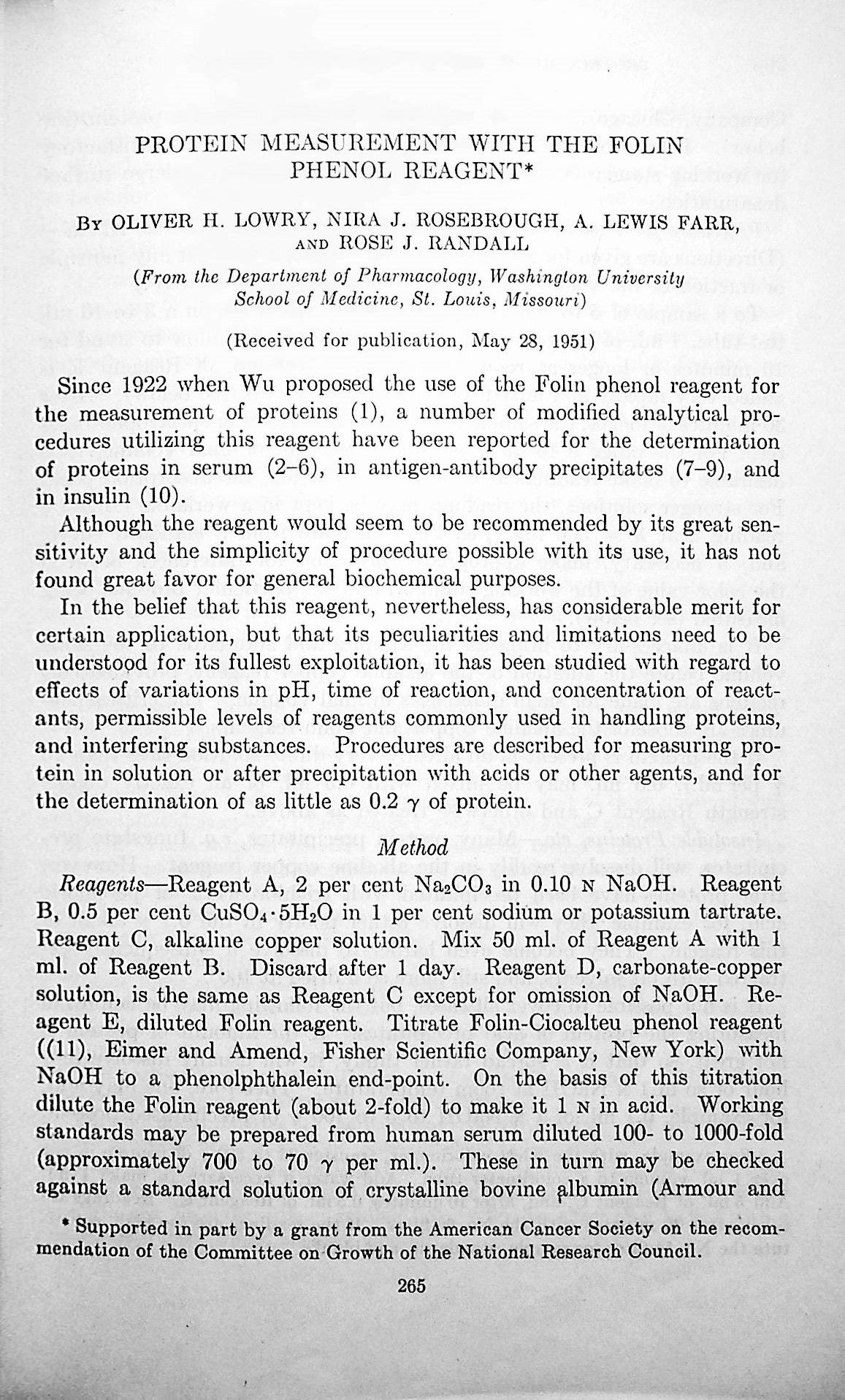
350,000 CITATIONS. Protein measurement with the folin phenol reagent IN The Journal of Biological Chemistry, Vol. 193, pp 265-275
- extract from bound volume
- 1951
1951.
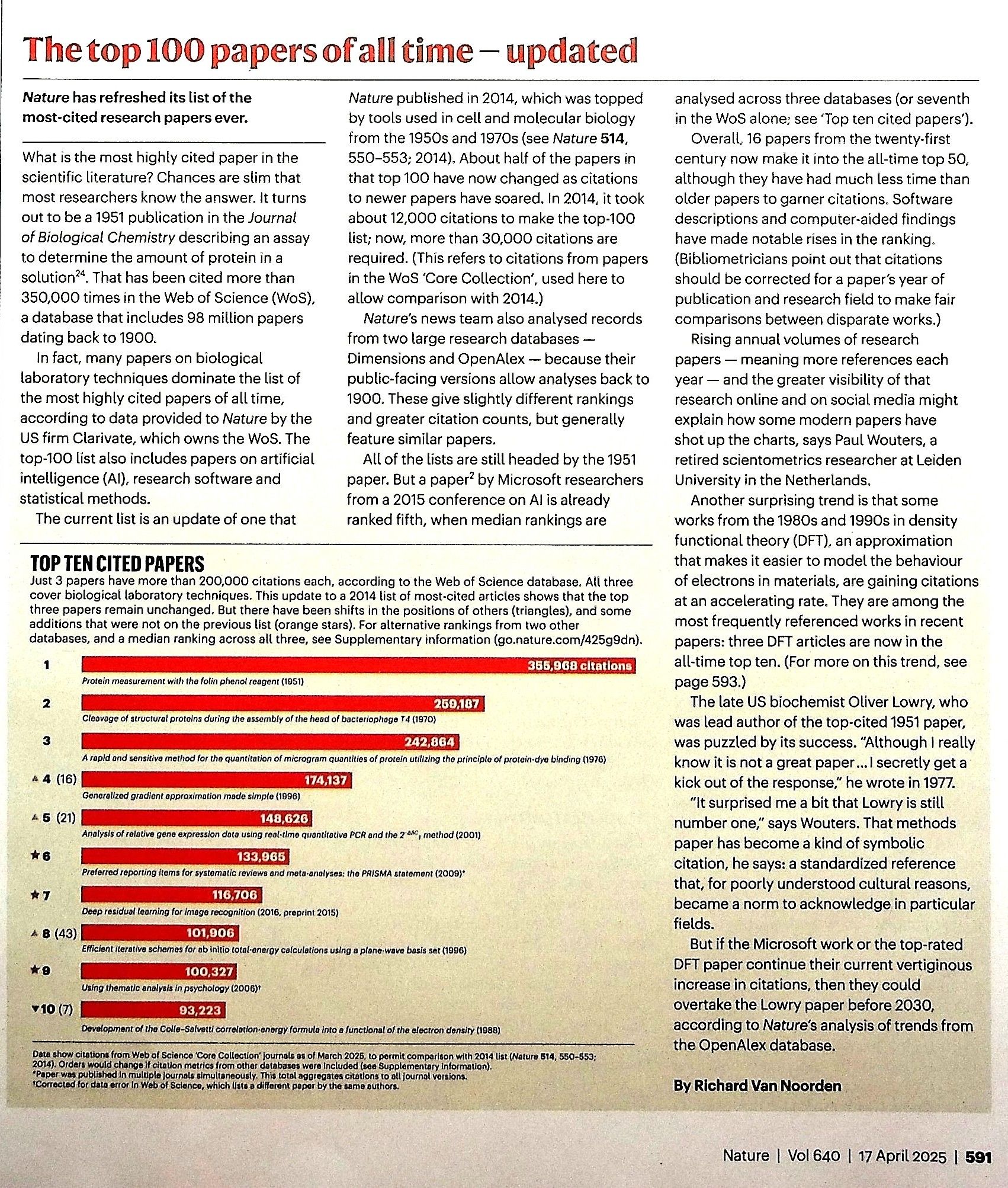
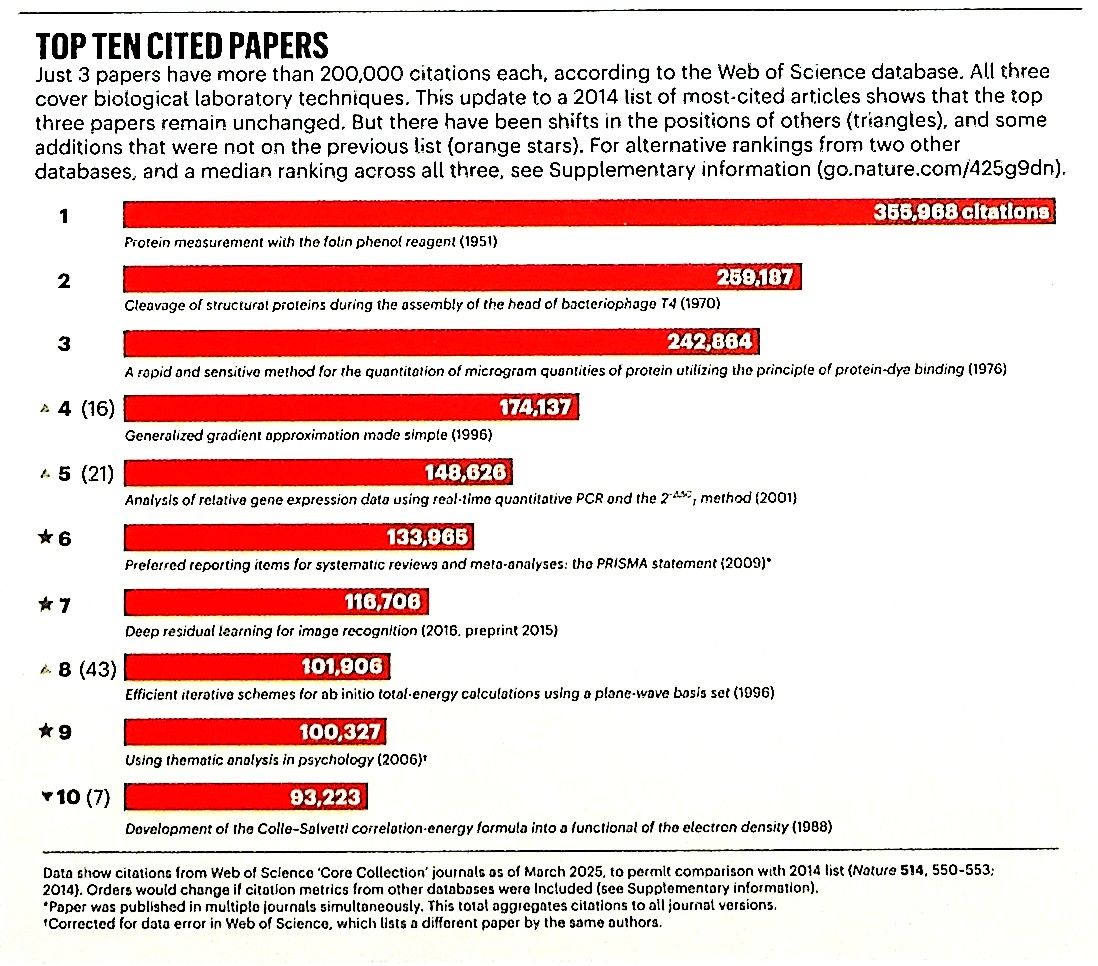
SCARCE FIRST EDITION OF THE MOST HIGHLY CITED RESEARCH PAPER OF ALL TIME: THE LOWRY PROTEIN ASSAY, PUBLISHED IN THE JOURNAL OF BIOLOGICAL CHEMISTRY, 1951, WITH OVER 350,000 CITATIONS AS OF APRIL 2025. 6x9 inches extract from bound volume, very good in custom binder with transparent covers. Lowry OH, Rosebrough NJ, Farr AL, Randall RJ. J Biol Chem 193:265-275 (1951). LAID IN: Richard Van Noorden. Nature 640:591 (17 April 2025).
OLIVER HOWE LOWRY (1910-1996) was an American biochemist. He is best remembered for devising the Lowry protein assay. He attended Northwestern University in Evanston, Illinois, for his undergraduate studies, having intended to major in chemical engineering. However, upon the advice of a fellow student, he ended up shifting his focus towards biochemistry. After graduating from Northwestern in 1932, he enrolled at the University of Chicago, where he sought to study "physiological chemistry". During his second year, a dean of the University offered Lowry admission to the university's MD/PhD program, which he accepted and from which he graduated in 1937. He left Chicago to work at Harvard University under A. Baird Hastings. While at Harvard, Hastings was able to arrange for Lowry to work for five months at the Carlsberg Laboratory in Copenhagen, Denmark, where he worked with Kaj Ulrik Linderstrøm-Lang. By 1942, Otto Bessey persuaded his friend Lowry to join him at the newly established Public Health Research Institute in New York City, where Lowry would work until 1947, when he moved to Washington University in St. Louis to head its Department of Pharmacology, which he chaired for 29 years. He also served as dean of the Washington University School of Medicine from 1955 to 1958. Lowry was elected to the American Academy of Arts and Sciences in 1957 and to the National Academy of Sciences in 1964.
THE LOWRY PROTEIN ASSAY (first described in the volume offered here) is a biochemical assay for determining the total level of protein in a solution. The total protein concentration is exhibited by a color change of the sample solution in proportion to protein concentration, which can then be measured using colorimetric techniques. The method combines the reactions of copper ions with the peptide bonds under alkaline conditions (the Biuret test) with the oxidation of aromatic protein residues. The Lowry method is best used with protein concentrations of 0.01-1.0 mg/mL and is based on the reaction of Cu+, produced by the oxidation of peptide bonds, with Folin-Ciocalteu reagent (a mixture of phosphotungstic acid and phosphomolybdic acid in the Folin-Ciocalteu reaction). The reaction mechanism is not well understood, but involves reduction of the Folin-Ciocalteu reagent and oxidation of aromatic residues (mainly tryptophan, also tyrosine). Experiments have shown that cysteine is also reactive to the reagent. Therefore, cysteine residues in protein probably also contribute to the absorbance seen in the Lowry Assay. The concentration of the reduced Folin reagent is measured by absorbance at 750 nm. As a result, the total concentration of protein in the sample can be deduced from the concentration of Trp and Tyr residues that reduce the Folin-Ciocalteu reagent.
CITATIONS OF THE LOWRY PAPER: The top 100 papers. Nature explores the most-cited research of all time. "The most cited work in history is a 1951 paper describing an assay to determine the amount of protein in a solution. It has now [2014] gathered more than 305,000 citations."--Van Noorden RV, Maher B, Nuzzo R. Nature 514:550-553, 2014. However, 17 April 2025, Vol 640 p 591, Nature published The top 100 papers of all time--updated, including the top ten papers, and the Lowry paper remains number 1, now with 355,968 citations. The colossal size of the scholarly literature means that the top-100 papers are extreme outliers (the average number of citations per paper is well below 10; less than 2% of papers receive more than 100 citations). Yet even with all the caveats, the old-fashioned hall of fame still has value. If nothing else, it serves as a reminder of the nature of scientific knowledge. To make exciting advances, researchers rely on relatively unsung papers to describe experimental methods, databases and software. For decades, the top-100 list has been dominated by protein biochemistry. The 1951 paper describing the Lowry method for quantifying protein remains practically unreachable at number 1, even though many biochemists say that it and the competing Bradford assay - described by paper number 3 on the list - are a tad outdated. The dominance of these techniques is attributable to the high volume of citations in cell and molecular biology, where they remain indispensable tools." David Pendlebury. The 4 Most Cited Papers: Magic In These Methods. The Scientist, | August 8, 1988. It will surprise few that methods papers lead the list of the most cited scientific articles ever-at least those tracked in the Institute for Scientific Information's Science Citation Index, 1955 to 1987. "The lowry paper," as it is known, stands head-and-shoulders above all others. This 1951 article by Oliver H. Lowry Nira J. Rosenbrough, A. Lewis Farr, and R.J. Randall, published in the Journal of Biological Chemistry, 193,265-75, reported an improved procedure for measuring proteins. Although more sensitive methods have since been introduced, it still ranks as the King of the Classics, with over 180,000 citations by the end of 1987. It continues to receive 10,000 citations per year. Why is this the most cited paper? Lowry observed: "It filled a need in the beginning-and a lot of people measure proteins. Once it became established... other people may have thought it was the method to use, or at least checked the procedure they were using against it."
Details
Title
350,000 CITATIONS. Protein measurement with the folin phenol reagent IN The Journal of Biological Chemistry, Vol. 193, pp 265-275
Author
Lowry, Oliver H., Rosebrough, Nira J., Farr, A. Lewis and Randall, Rose J.
Binding
extract from bound volume
Condition
Unknown
Date
1951