

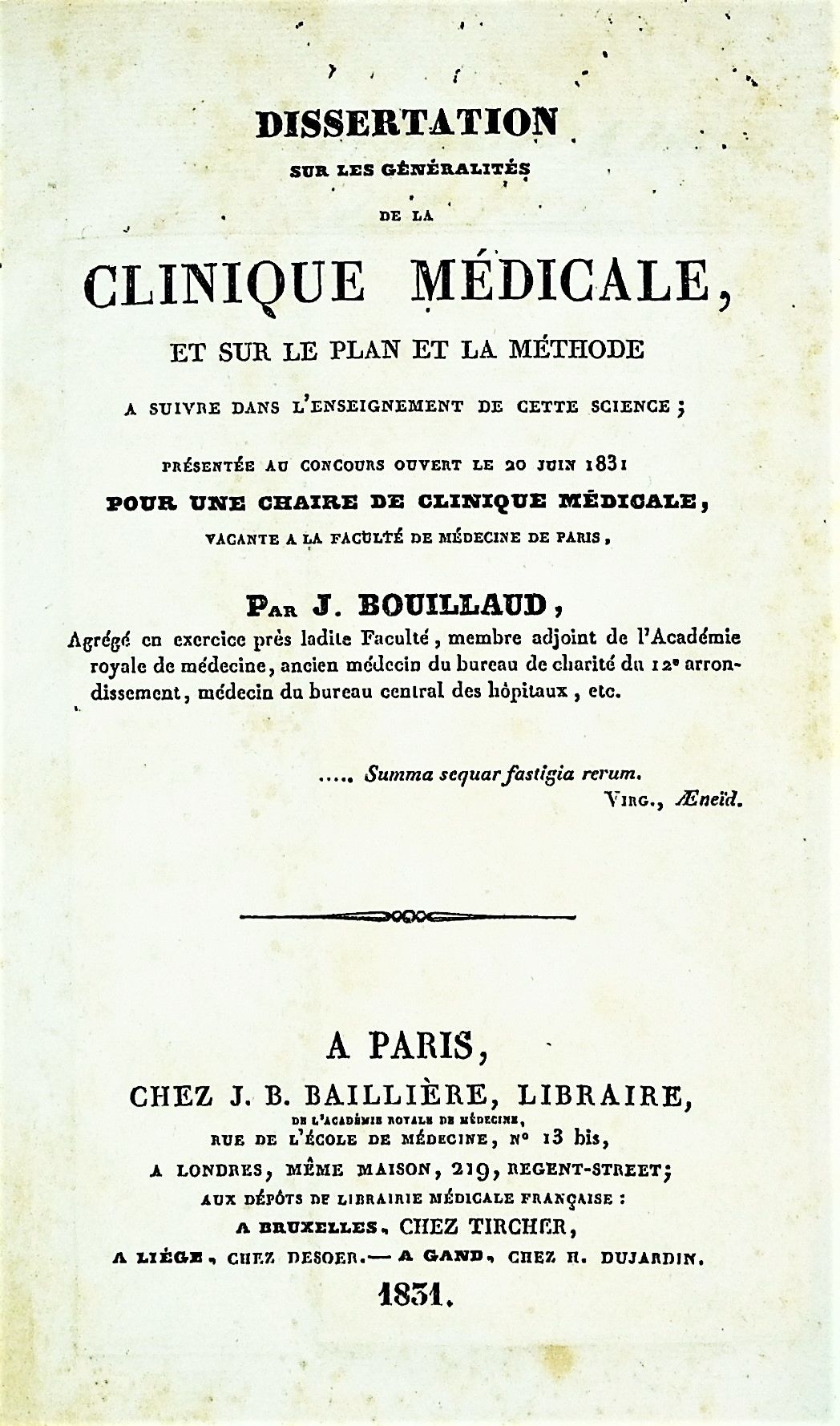
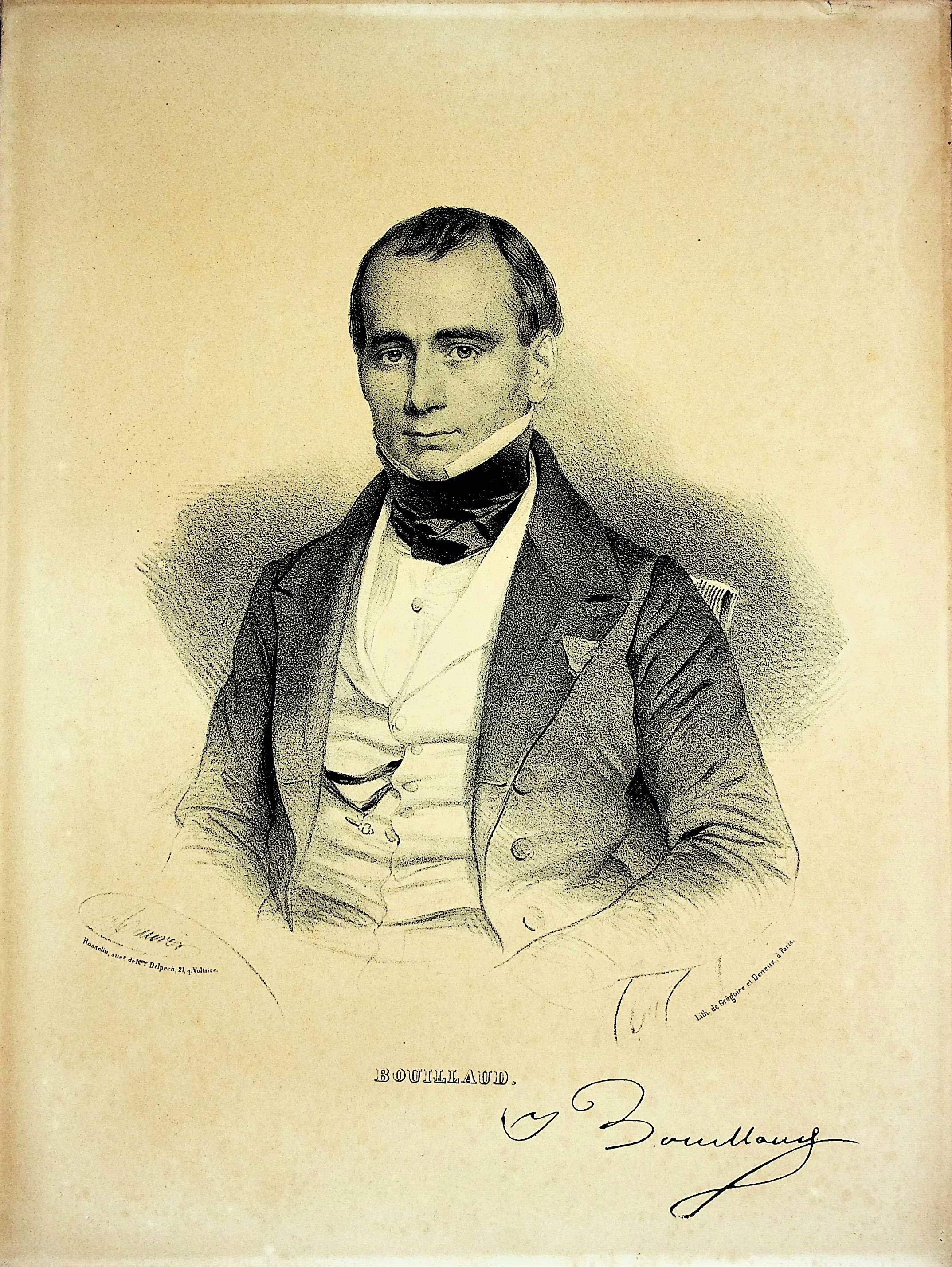
Dissertation sur les Generalites de la Clinique Medicale, et Sur le Plan et la Methode a Suivre dans l’Enseigement de de Cette Science; Presentee au Concours Ouvert le 20 Juin 1831 Pour Une Chaire de Clinique Medicale, Vacante a la Faculte de Medecine de Paris TOGETHER WITH original lithograph of Dr. Bouillaud signed by him
[Dissertation on the Generalities of the Medical Clinic, and on the Plan and Method to be Followed in the Teaching of This Science; Presented at the Open Competition on June 20, 1831 for a Chair of Medical Clinic, Vacant at the Faculty of Medicine of Pari
- SIGNED Cloth binding
- Paris: J. B. Bailliere, 1831
Paris: J. B. Bailliere, 1831. First edition.
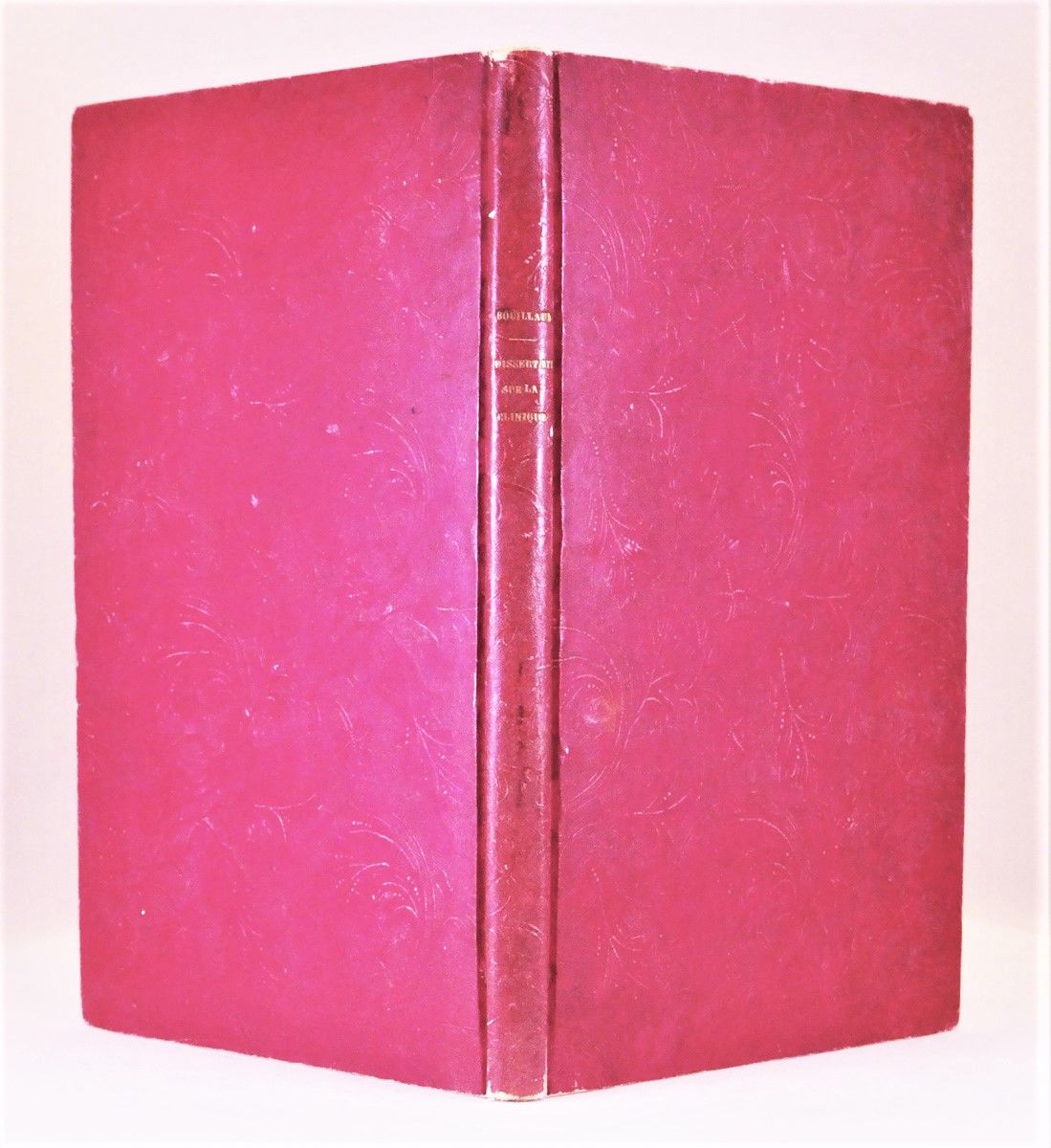
DISSERTATION ON MEDICAL PRACTICE BY NOTED FRENCH PHYSICIAN DR. BOUILLAUD, INSCRIBED TO HIS MENTOR, WHOSE AUTOGRAPH CRITIQUE IS INCLUDED, COPY OF PUBLISHER, JB BAILLIERE - PLUS ORIGINAL CONTEMPORARY LITHOGRAPH OF BOUILLAUD.
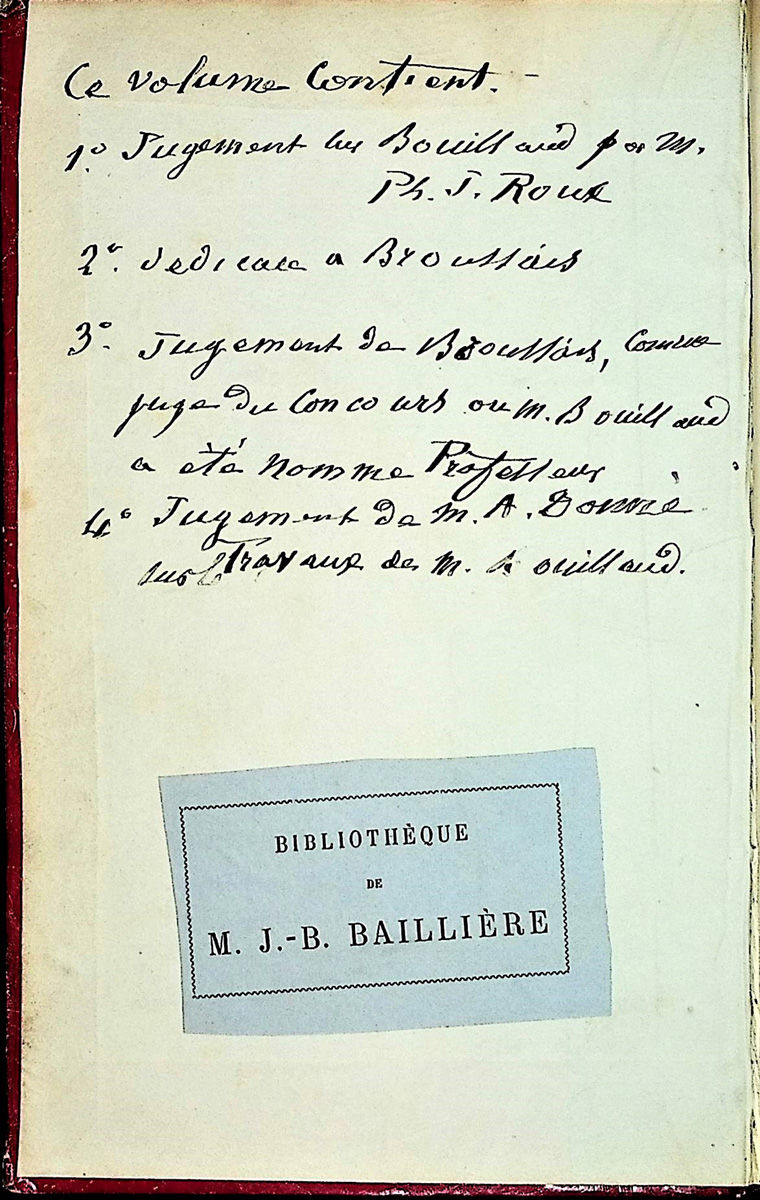
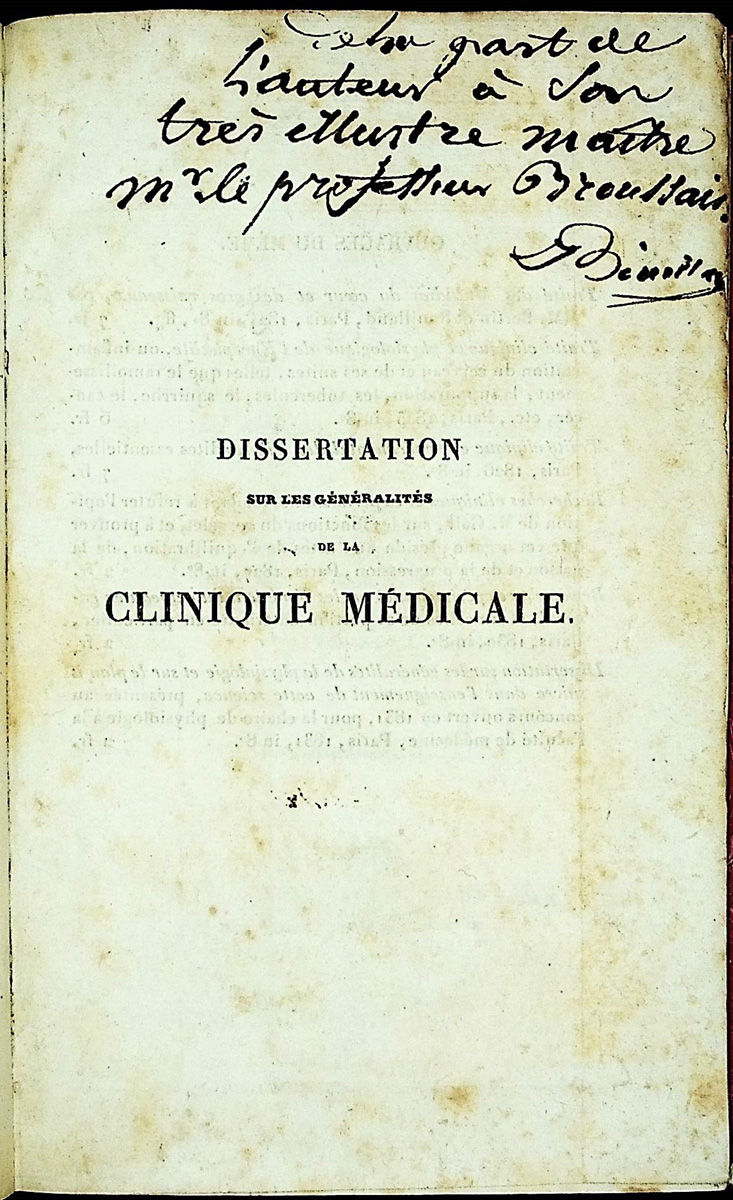
8 inches tall hardcover, period red cloth binding, decorative blindstamped covers, gilt title to spine, 83 pp, signed association copy: top of title page: signed ink inscription to Professor Broussais, " de la part de l'auteur a son tres illustre maitre Mr le Professeur Broussais/ Bouillaud " [From the author to his most distinguished mentor, Professor Broussais/Bouillaud]. Front paste-down: Ink inscription (presumably by J.-B. Bailliere): "Ce volume contient: 1) Jugement de Bouillaud par M. Ph. J. Roux; 2) Dedicace a Broussais; 3) Jugement de Broussais, comme juge du concours ou M. Bouillaud a été nomme Professeur; 4) Jugement de M. A. Donne sur les travaux de M. Bouillaud" [This volume contains: 1) Judgment of Bouillaud by Mr. Ph. J. Roux; 2) Dedication to Broussais; 3) Judgment of Broussais, as a judge of the competition in which Mr. Bouillaud was appointed Professor; 4) Judgment of Mr. A. Donne on the works of Mr. Bouillaud]; Book-label of J.-B. Bailliere. Light wear to cover edges, light foxing to page edges and first and last pages, otherwise very good in custom archival mylar cover.
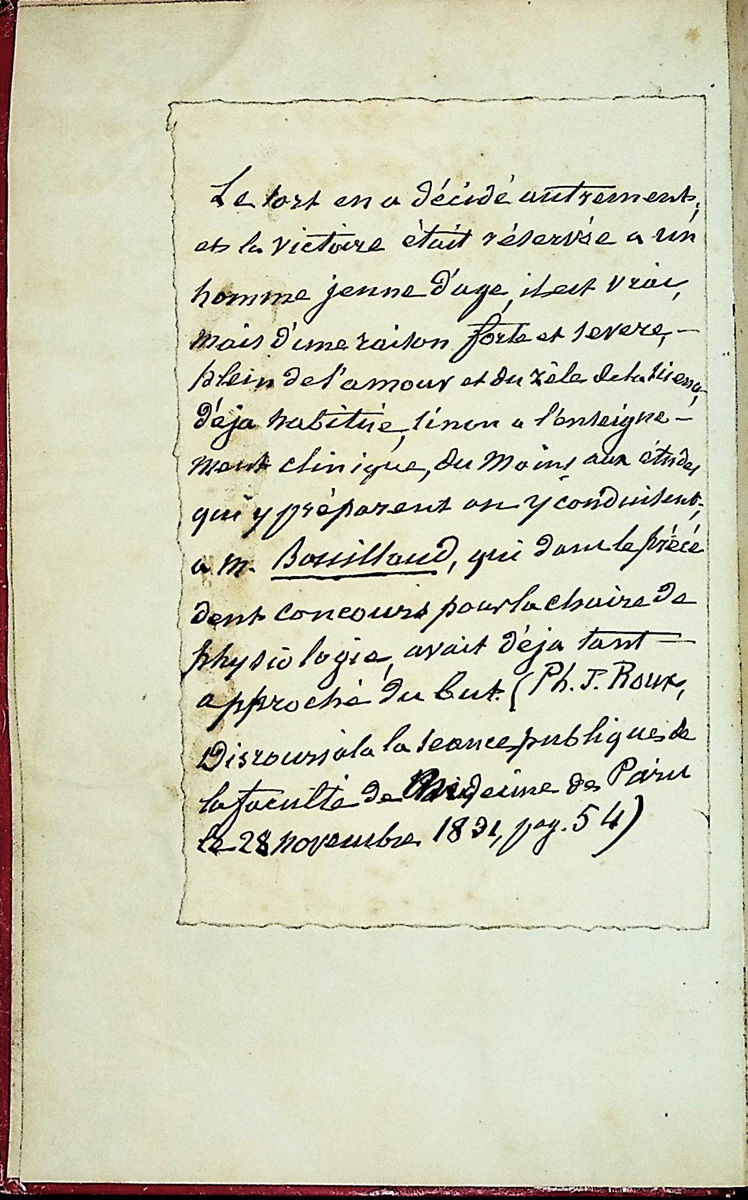
Verso front free endpaper: LAID IN autograph congratulatory note from Philibert Joseph Roux, "Le tort en a decide autrement, et la victoire était reservee a un homme jeune d'age, il est vrai, mais d'une raison forte et severe, dlein de l'amour et du zele de la science, déjà habitue, sinon a l'enseigement clinique, Du Moins aux etudes qui y preparent en y conduisant a M. Bouillaud, qui dans le precedent coucours pour la chaire de physiologie, avait déjà tant approche du but (Ph. J. Roux, Discours de les seances publiques de la faculte de Medecine de Paris le 28 novembre 1831, p… 54)." [Fate decided otherwise, and the victory was reserved for a man young in age, it is true, but of strong and discerning intellect, full of love and zeal for science, already accustomed, if not to clinical teaching, at least to the studies that prepare for it and lead to it—namely, Mr. Bouillaud, who in the previous competition for the chair of physiology, had already come so close to achieving his goal (Ph. J. Roux, Discourse at the public sessions of the Faculty of Medicine of Paris on November 28, 1831, p. 54)].
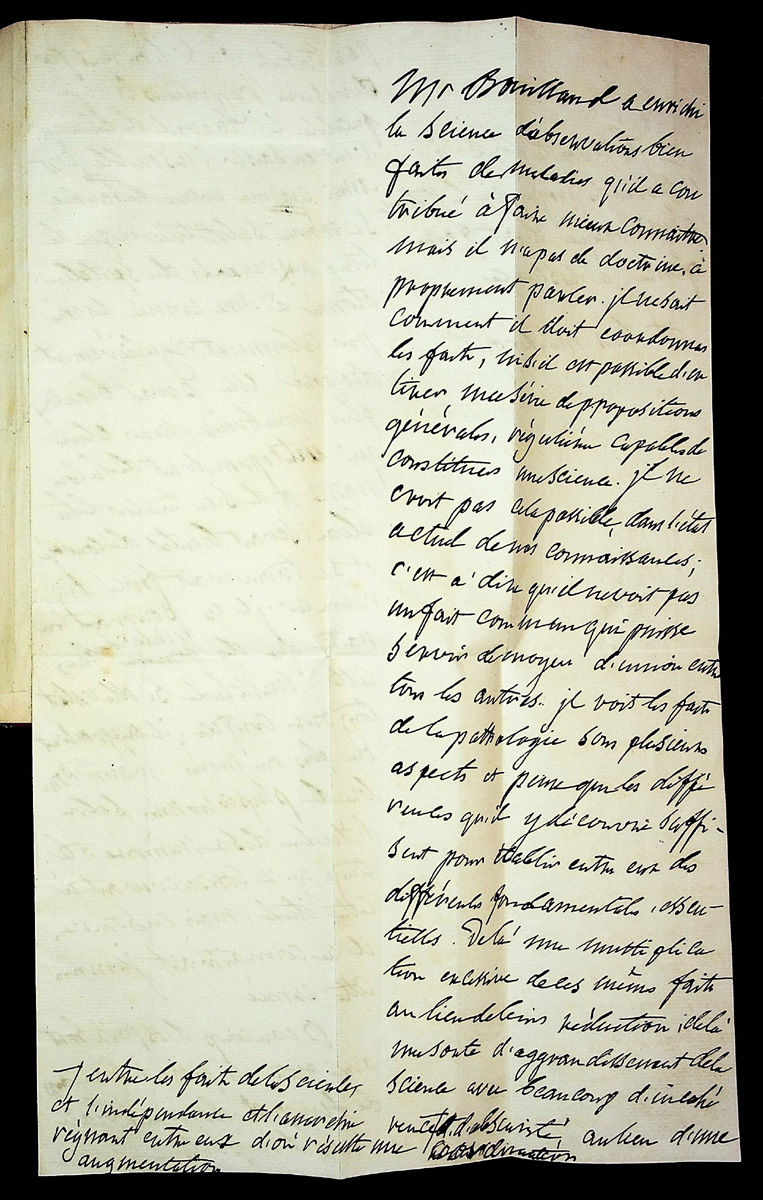
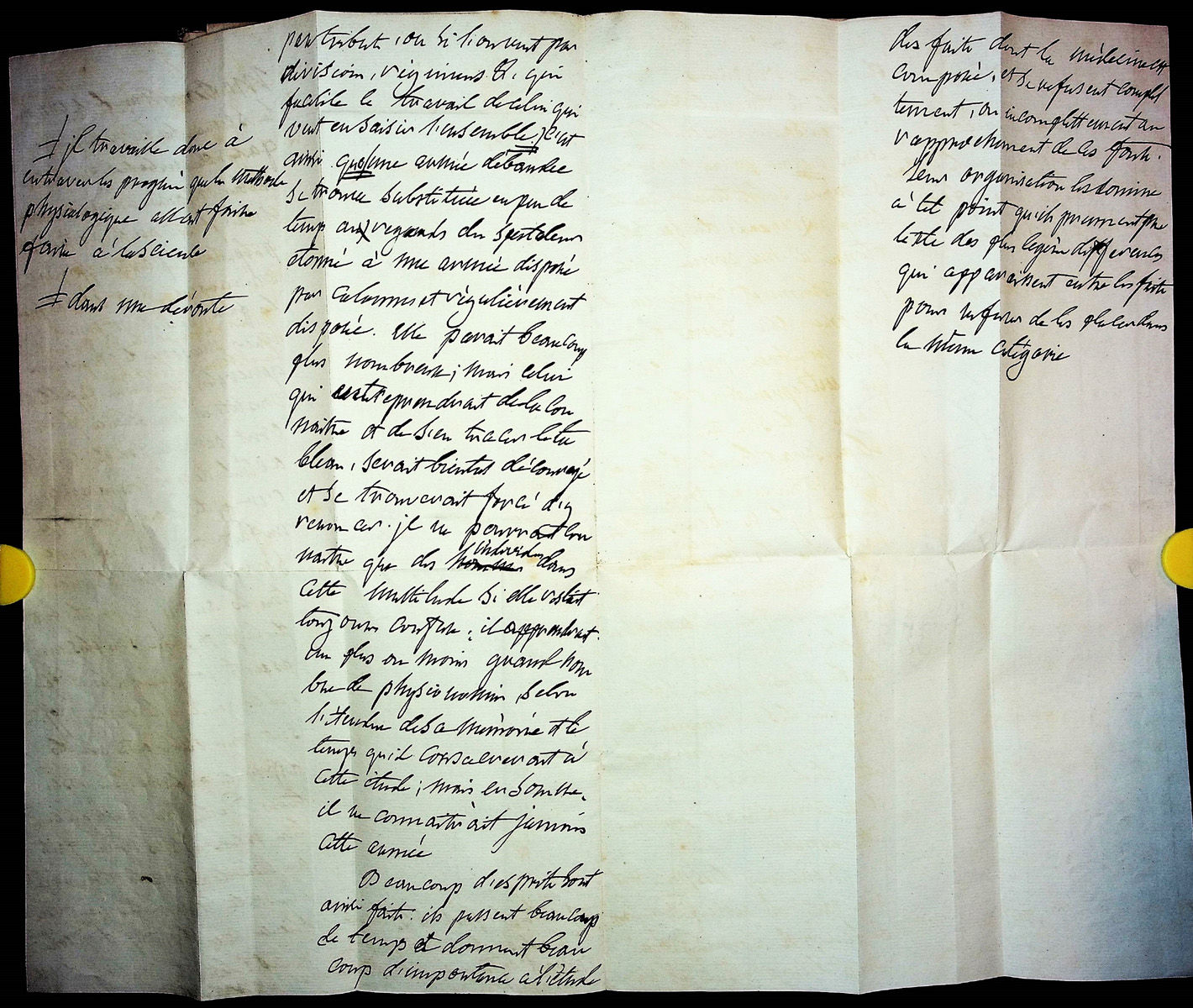
LAID IN following the title page: Folded 8 x 13 inch 3-page autograph critique of Bouillaud's work by Broussais.
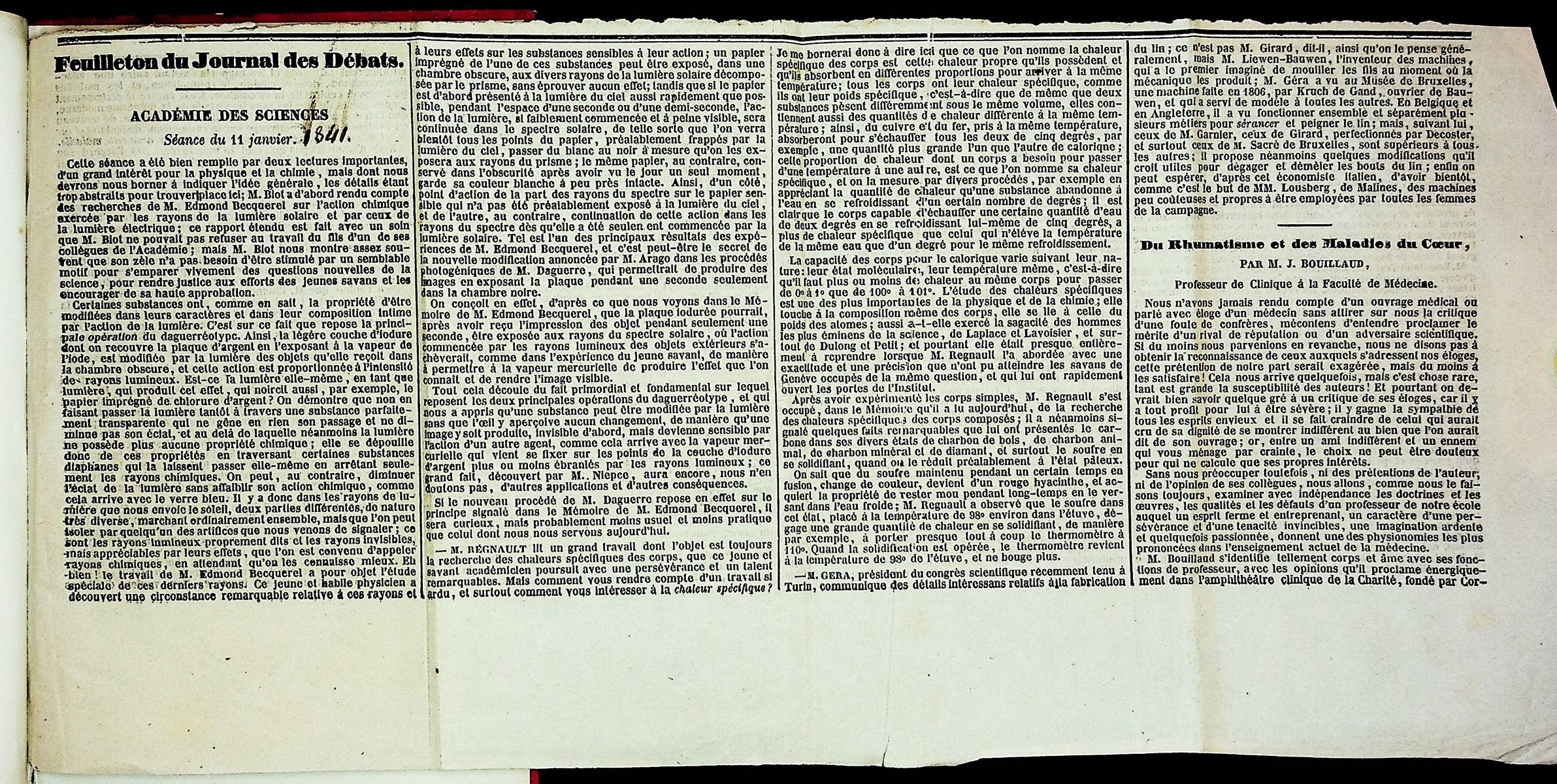
LAID IN affixed to back endpaper: Two-page folded 7 x 14 ½ inches newspaper clipping titled "Feuilleton du Journal des Debats, Academie des Sciences, séance du 11 janvier 1841 with a review of Bouillaud's Du Rheumatisme et des Maladies du Coeur by Dr. A. L. Donne.
ALSO INCLUDED: 9x12 inch original lithographic portrait, mounted on heavy card, of Bouillaud by "Rosselin, sucr. De Mme. Delpech, 21 q, Voltaire, Lith. de Gregoire et Deneux, a Paris." Rosselin, successor to Madame Delpech, was a notable 19th-century lithographer located at 21 Quai Voltaire, Paris. Active during the 1820s and 1830s, he was known for producing portrait lithographs of eminent contemporary figures and worked with the printer Grégoire et Deneux.
Both Bouillaud and Broussais were well known to the French public, and characters based on them are featured in Balzac's Comedie Humaine and many of his other novels. Bouillaud is represented by Dr. Bianchon, brilliant student, honest, faithful in friendship and good company, of which he takes care of practically all the characters. Bianchon is the literary equivalent of the priest, a sort of benefactor of humanity who hides behind his function. In Contrast, Dr. Brisset (a thinly veiled Broussais), another physician appearing in many of Balzac's novels, is less sympathetic. Shunning the work of most physicians who preceded him as well as his contemporaries, he regards the alimentary tract as responsible for most disorders, and extreme bleeding as the principal treatment.
JEAN-BAPTISTE BOUILLAUD (1796 -1881) spent his student time under the guidance of his uncle Jean Bouillaud - chirurgien-major in the army. Following the completion of his studies Bouillaud received his doctorate in Paris in 1823 and subsequently distinguished himself by publishing a treatise on diseases of the heart. In 1831 he was appointed to the chair of clinical medicine at the Charité through competition (winning dissertation offered here), and soon enjoyed the reputation of an outstanding clinician. However, an enthusiastic follower of his mentor François Joseph Victor Broussais, his therapy of bloodletting was heavily criticized. Bouillaud's works concerned different fields of medicine; he published on hermaphroditism, on cholera, encephalitis, diseases of the heart, cancer, and various forms of fever. His main achievement, however, was in the field of rheumatism. Acute rheumatoid endocarditis is still commonly termed Bouillaud's disease in medical dictionaries in the French language. He recognised the cartilaginous and synovial lesions of this disease and was the first to describe them. By 1861, Bouillaud was Doyen of the Faculty, Membre de I'Institut, and head of La Charité, and in 1868 he became a member of the Académie des sciences. Bouillaud has 6 entries in Garrison-Morton; 10 copies of Generalites de la Clinique Medicale listed in OCLC.
FRANCOIS-JOSEPH-VICTOR BROUSSAIS (1772 -1838) was a French physician who received his first instructions in medicine from his physician father, and obtained an appointment as surgeon in the navy. In 1799 he proceeded to Paris, where he studied under the famous Xavier Bichat. In 1803 he graduated as M.D. and in 1805 he joined the army and served in Germany and the Netherlands. He returned to Paris in 1814 and was appointed assistant-professor to the military hospital of the Val-de-Grace, and in 1831 he was appointed professor of general pathology in the academy of medicine. Disagreeing with many of his predecessors, such as Laennec, Bayle, and Louis, Broussais believed in the importance of physiology. Broussais' theory, known as medical physiology, argued that some diseases are just a result of irritation due to excitation or stimulation. This medical physiology became the most popular form of medical theory in Paris in the 19th century. It is believed that irritation then caused inflammation, which primarily occurred at the gastrointestinal tract in most diseases. This led Broussais to believe that mild bloodletting could heal every illness.
PHILIBERT JOSEPH ROUX (1780-1854), a French surgeon, was a student and friend of Marie Xavier François Bichat, the father of modern pathology and histology. He was assigned as a surgeon to the Hôpital Beaujon (1806), the Hôpital de la Charité (1810) and to Hôtel-Dieu de Paris (1835), where he succeeded to Guillaume Dupuyrten, a French anatomist, as a Chief Surgeon. Roux is best known for having performed the surgical repair of a cleft palate and for having been the first surgeon to stitch a ruptured female perineum. His contribution to surgery has also included the publication of Quarante années de pratique chirurgicale. Roux was awarded the grade of Chevalier of the National Order of the legion of Honor and that of Officer. He also served as a President of the Academy of Sciences. He died of a stroke on 3 March 1854.
ALFRED FRANCOIS DONNE (1801 -1878) was a French bacteriologist and doctor, discoverer of Trichomonas vaginalis and leukemia. He was also the inventor of the photomicrography.
JEAN-BAPTISTE MARIE BAILLIERE (1797-1885), was a French publisher and bookseller. Coming from a family of drapers who had lived in Beauvais for a very long time, Jean-Baptiste Baillière started out in bookshops in 1812, as a clerk at Méquignon the elder, bookseller of the Faculty of Medicine. In 1818, he opened a small shop, at 14 rue de l'École-de-Médecine. In 1831, he opened his first international branch in London and appointed one of his brothers as director there. This branch became the British Museum Bookshop. Other establishments were opened in New York , then Melbourne and Madrid by his nephews. From 1827 to 1872, Jean-Baptiste Baillière was the official publisher of the National Academy of Medicine. The Baillière family was one of the most important editorial dynasties of the 19th century. Baillière editions have long edited one of the most famous French medical journals, La Revue du praticien , created in 1951.
Details
Title
Dissertation sur les Generalites de la Clinique Medicale, et Sur le Plan et la Methode a Suivre dans l’Enseigement de de Cette Science; Presentee au Concours Ouvert le 20 Juin 1831 Pour Une Chaire de Clinique Medicale, Vacante a la Faculte de Medecine de Paris TOGETHER WITH original lithograph of Dr. Bouillaud signed by him
Author
Bouillaud, Jean-Baptiste
Binding
Cloth binding
Condition
Unknown
Publisher
J. B. Bailliere: Paris
Date
1831
Edition
First edition