

Memoires sur la Nature Sensible et Irritable des Parties du Corps Animal (Volumes I-IV, complete)
[Memoirs on the Sensitive and Irritable Nature of Parts of the Animal Body]
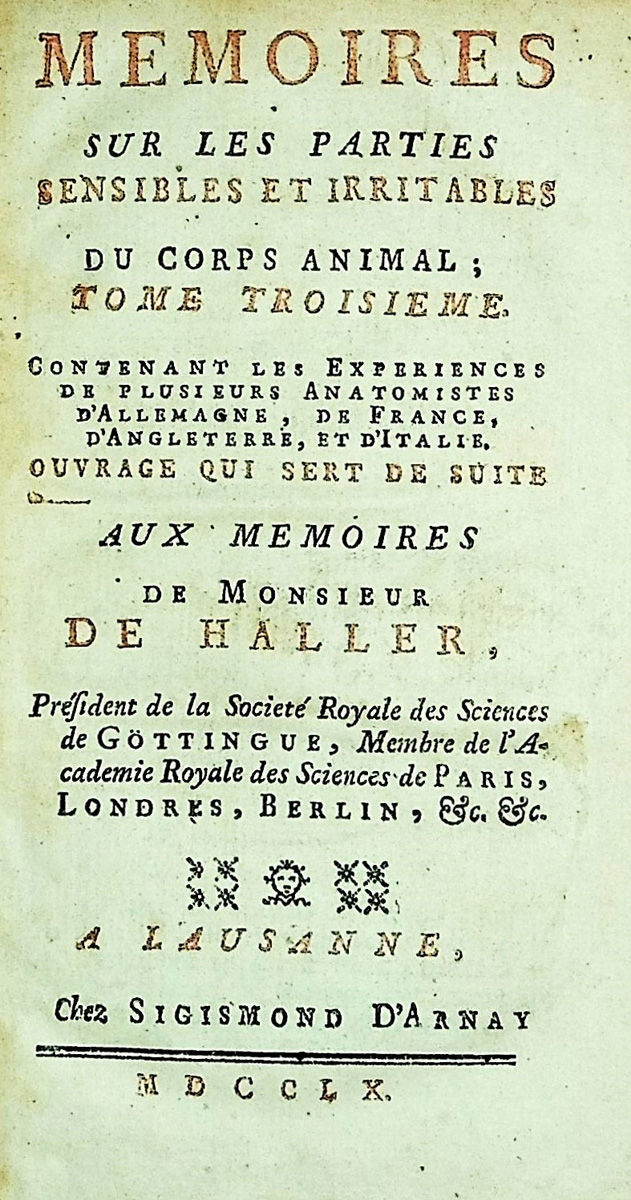
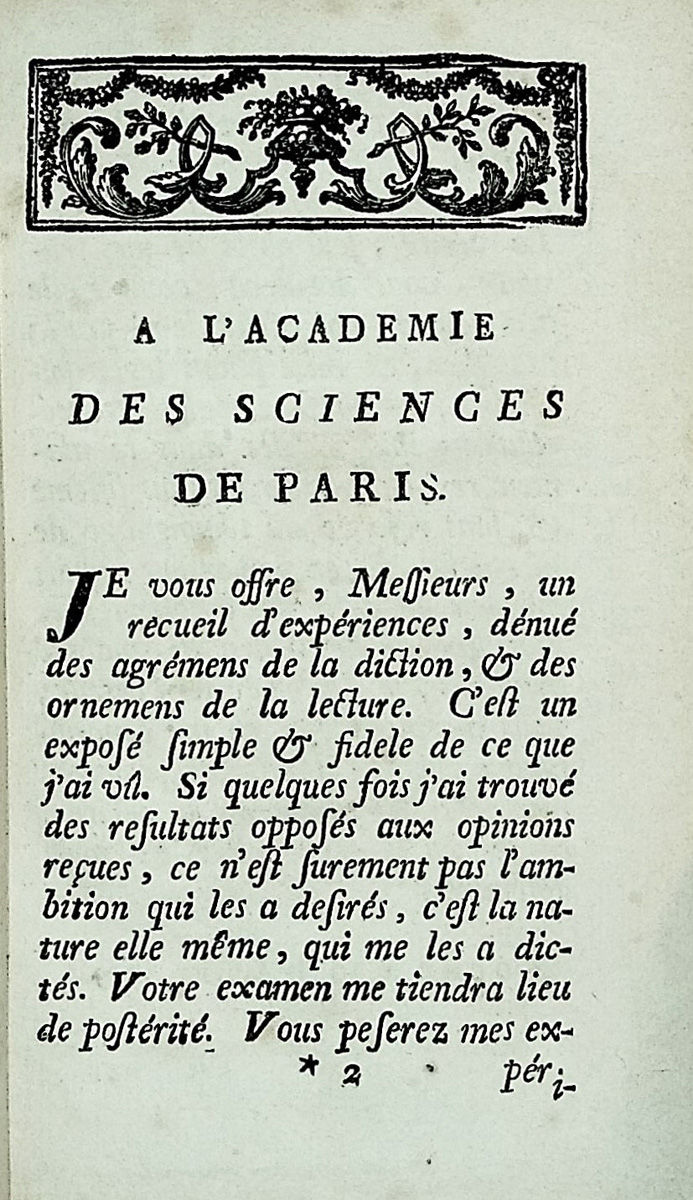
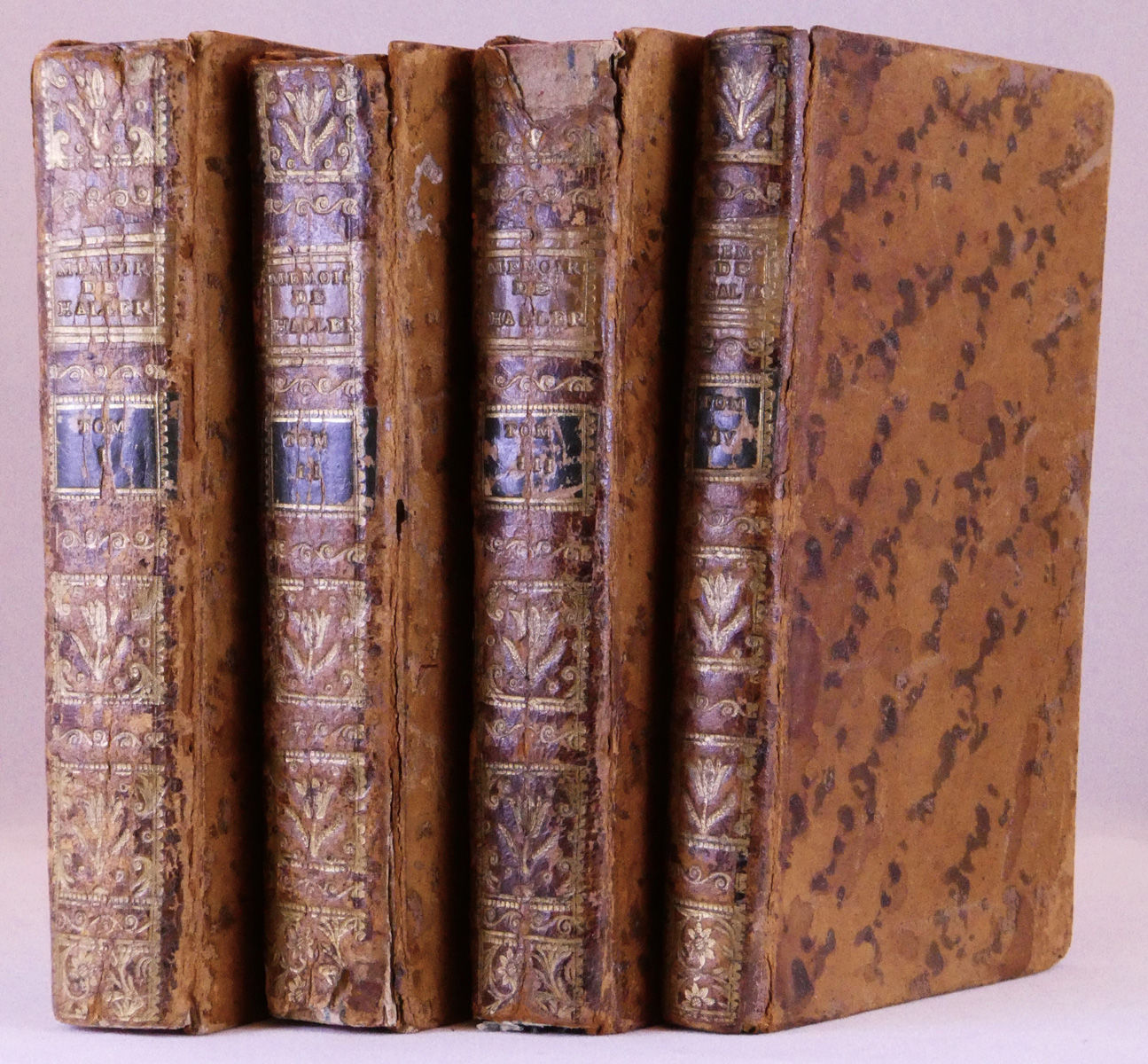
- Full leather binding
- Lausanne: Marc-Michel Bosquet, Sigismond d'Arnay, 1756, 1760
Lausanne: Marc-Michel Bosquet, Sigismond d'Arnay, 1756, 1760. First French edition (translated from the Latin by Samuel Auguste Tissot).
FOUR-VOLUME PIONEERING TREATISE DISTINGUISHING NEURAL "SENSIBILITY" FROM MUSCULAR "IRRITABILITY" BY SWISS POLYMATH FATHER OF PHYSIOLOGY.
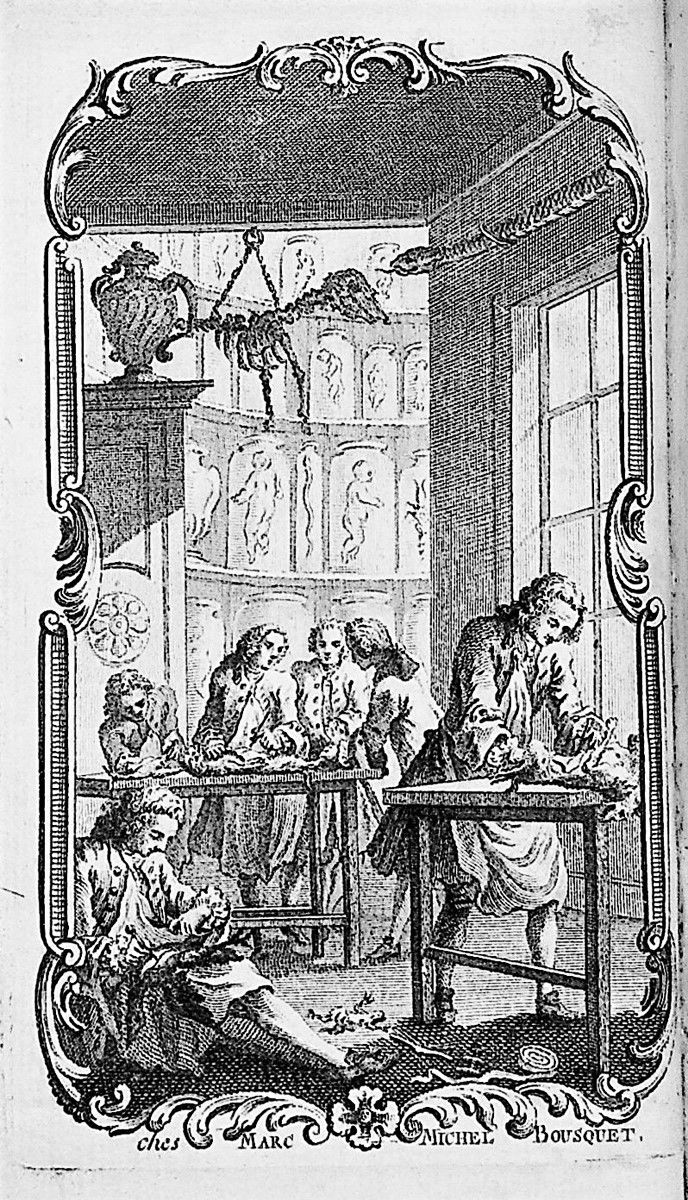
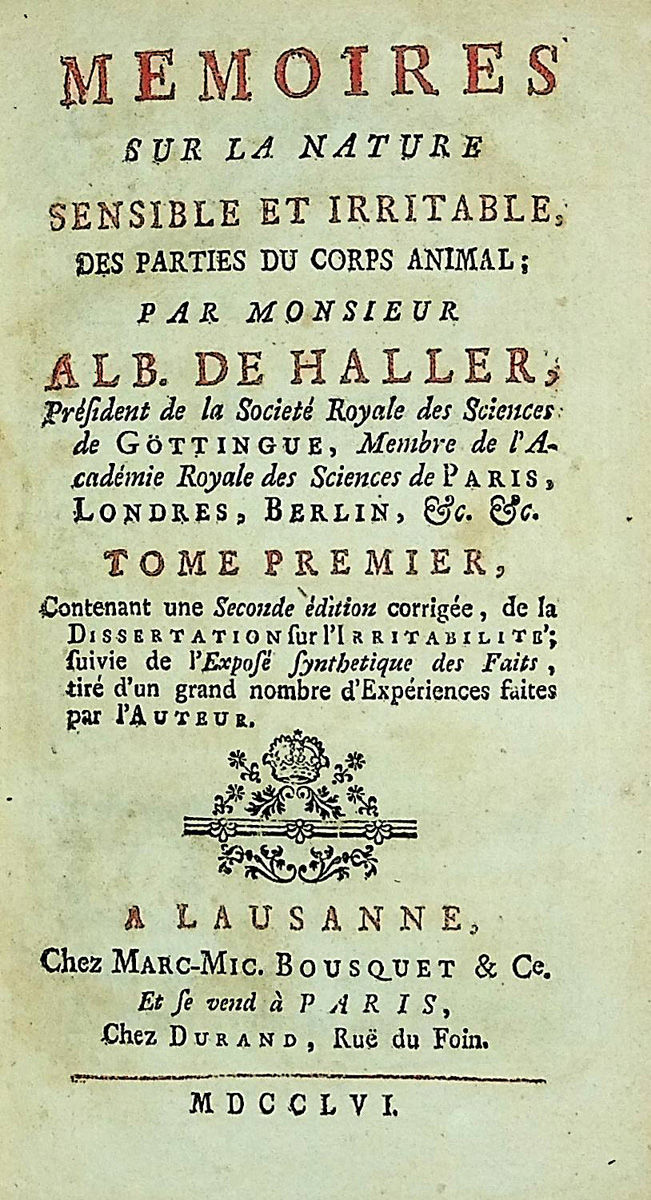
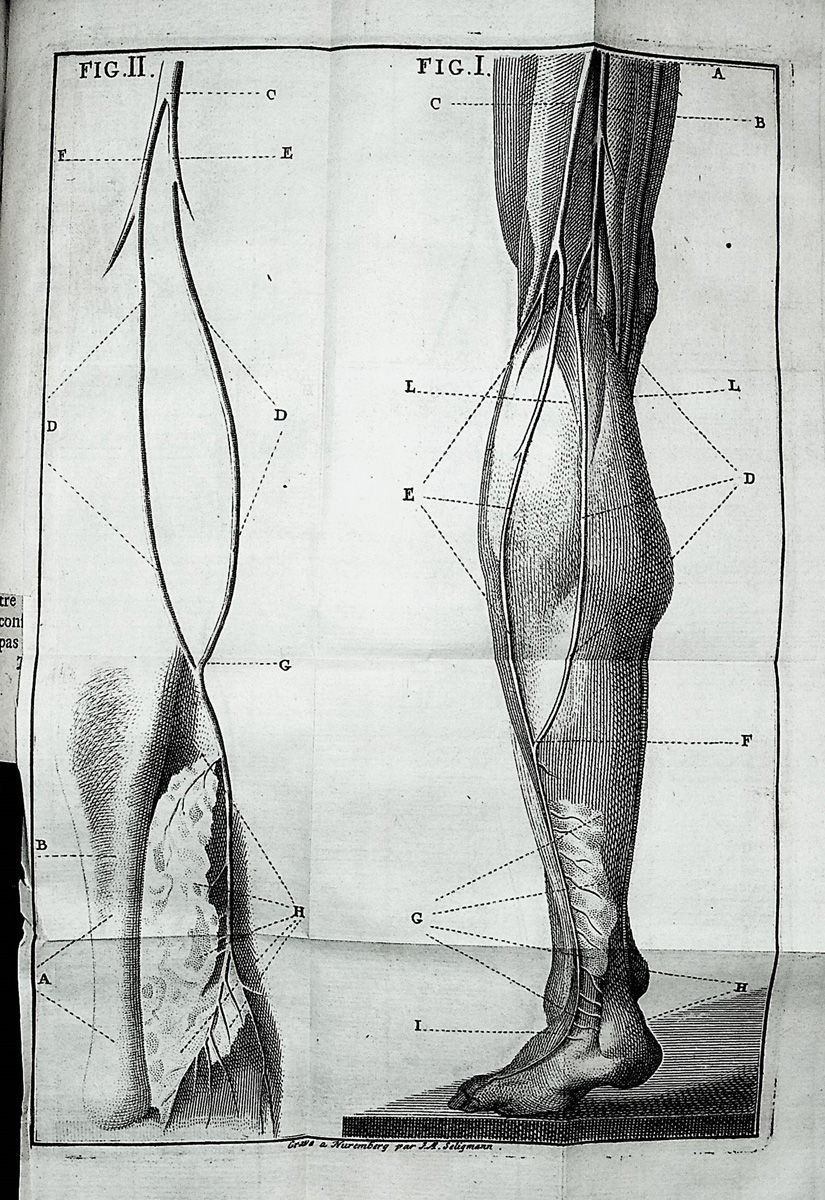
Four 12mo hardcover volumes 6 1/2 inches tall, original full leather binding, gilt compartments to spine with gilt red and green leather labels, all edges stained red, marbled endpapers,. 12mo. x, 399; [vi], 500; [ii], 512, [4], 232 pp. Engraved frontis depicting vivisections, titles printed in red and black, small title vignettes, tailpieces, 2 engraved folding plates (Vol. II facing p. 432; Vol. III facing p.322). Wear to cover edges and spines, bindings tight, text and plates crisp and unmarked, very good in custom archival mylar covers. French language.
ALBRECHT VON HALLER (1708 – 1777) was a Swiss anatomist, physiologist, naturalist, encyclopedist, bibliographer and poet. A pupil of Herman Boerhaave, he is often referred to as "the father of modern physiology." When still hardly fifteen he was already the author of numerous metrical translations from Ovid, Horace and Virgil, as well as of original lyrics, dramas, and an epic of four thousand lines on the origin of the Swiss confederation. While still a sickly and excessively shy youth, he went in his sixteenth year to the University of Tübingen (December 1723), where he studied under Elias Rudolph Camerarius Jr. and Johann Duvernoy. Dissatisfied with his progress, he in 1725 exchanged Tübingen for Leiden, where Boerhaave was in the zenith of his fame, and where Albinus had already begun to lecture in anatomy. In 1752, at the University of Göttingen, Haller published his thesis (De partibus corporis humani sensibilibus et irritabilibus) discussing the distinction between "sensibility" and "irritability" in organs, suggesting that nerves were "sensible" because of a person's ability to perceive contact while muscles were "irritable" because the fiber could measurably shorten on its own, regardless of a person's perception, when excited by a foreign body. Later in 1757, he conducted a famous series of experiments to distinguish between nerve impulses and muscular contractions (described in the volumes offered here). Haller then visited London, making the acquaintance of Sir Hans Sloane, William Cheselden, John Pringle, James Douglas and other scientific men; next, after a short stay in Oxford, he visited Paris, where he studied under Henri François Le Dran and Jacob Winslow; and in 1728 he proceeded to Basel, where he devoted himself to the study of higher mathematics under John Bernoulli. In 1729 he returned to Bern and began to practice as a physician; his best energies, however, were devoted to the botanical and anatomical researches which rapidly gave him a European reputation, and procured for him from George II in 1736 a call to the chair of medicine, anatomy, botany and surgery in the newly founded University of Göttingen. He became a Fellow of the Royal Society in 1743, a foreign member of the Royal Swedish Academy of Sciences in 1747, and was ennobled in 1749. See: Garrison and Morton 587 [1752 first Latin edition.].
FOUR-VOLUME PIONEERING TREATISE DISTINGUISHING NEURAL "SENSIBILITY" FROM MUSCULAR "IRRITABILITY" BY SWISS POLYMATH FATHER OF PHYSIOLOGY.
Four 12mo hardcover volumes 6 1/2 inches tall, original full leather binding, gilt compartments to spine with gilt red and green leather labels, all edges stained red, marbled endpapers,. 12mo. x, 399; [vi], 500; [ii], 512, [4], 232 pp. Engraved frontis depicting vivisections, titles printed in red and black, small title vignettes, tailpieces, 2 engraved folding plates (Vol. II facing p. 432; Vol. III facing p.322). Wear to cover edges and spines, bindings tight, text and plates crisp and unmarked, very good in custom archival mylar covers. French language.
ALBRECHT VON HALLER (1708 – 1777) was a Swiss anatomist, physiologist, naturalist, encyclopedist, bibliographer and poet. A pupil of Herman Boerhaave, he is often referred to as "the father of modern physiology." When still hardly fifteen he was already the author of numerous metrical translations from Ovid, Horace and Virgil, as well as of original lyrics, dramas, and an epic of four thousand lines on the origin of the Swiss confederation. While still a sickly and excessively shy youth, he went in his sixteenth year to the University of Tübingen (December 1723), where he studied under Elias Rudolph Camerarius Jr. and Johann Duvernoy. Dissatisfied with his progress, he in 1725 exchanged Tübingen for Leiden, where Boerhaave was in the zenith of his fame, and where Albinus had already begun to lecture in anatomy. In 1752, at the University of Göttingen, Haller published his thesis (De partibus corporis humani sensibilibus et irritabilibus) discussing the distinction between "sensibility" and "irritability" in organs, suggesting that nerves were "sensible" because of a person's ability to perceive contact while muscles were "irritable" because the fiber could measurably shorten on its own, regardless of a person's perception, when excited by a foreign body. Later in 1757, he conducted a famous series of experiments to distinguish between nerve impulses and muscular contractions (described in the volumes offered here). Haller then visited London, making the acquaintance of Sir Hans Sloane, William Cheselden, John Pringle, James Douglas and other scientific men; next, after a short stay in Oxford, he visited Paris, where he studied under Henri François Le Dran and Jacob Winslow; and in 1728 he proceeded to Basel, where he devoted himself to the study of higher mathematics under John Bernoulli. In 1729 he returned to Bern and began to practice as a physician; his best energies, however, were devoted to the botanical and anatomical researches which rapidly gave him a European reputation, and procured for him from George II in 1736 a call to the chair of medicine, anatomy, botany and surgery in the newly founded University of Göttingen. He became a Fellow of the Royal Society in 1743, a foreign member of the Royal Swedish Academy of Sciences in 1747, and was ennobled in 1749. See: Garrison and Morton 587 [1752 first Latin edition.].
Details
Title
Memoires sur la Nature Sensible et Irritable des Parties du Corps Animal (Volumes I-IV, complete)
Author
Haller, Albert von
Binding
Full leather binding
Condition
Unknown
Publisher
Marc-Michel Bosquet, Sigismond d'Arnay: Lausanne
Date
1756, 1760
Edition
First French edition (translated from the Latin by Samuel August