

The Work of the Digestive Glands: Lectures by Professor J.P. Pawlow, translated into English by W. H. Thompson, illustrated
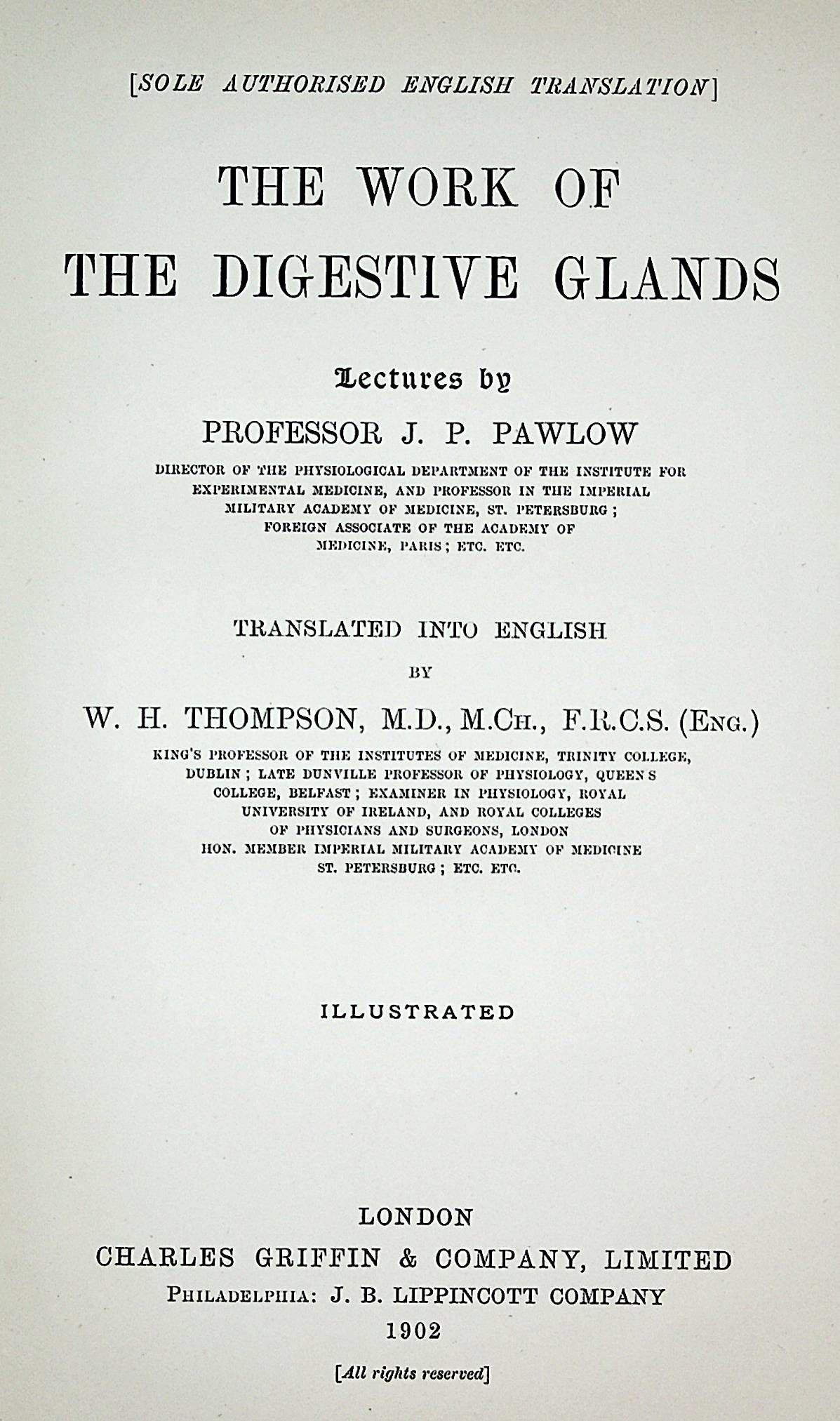
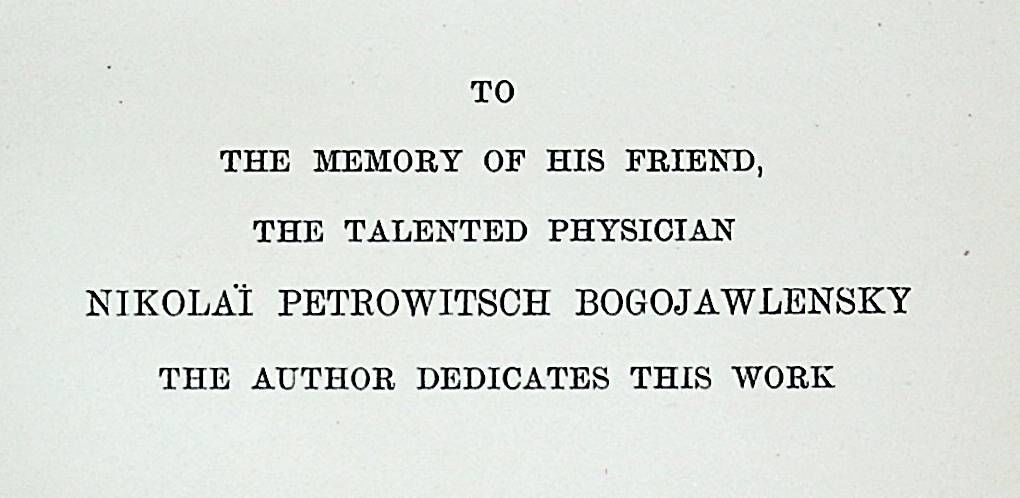
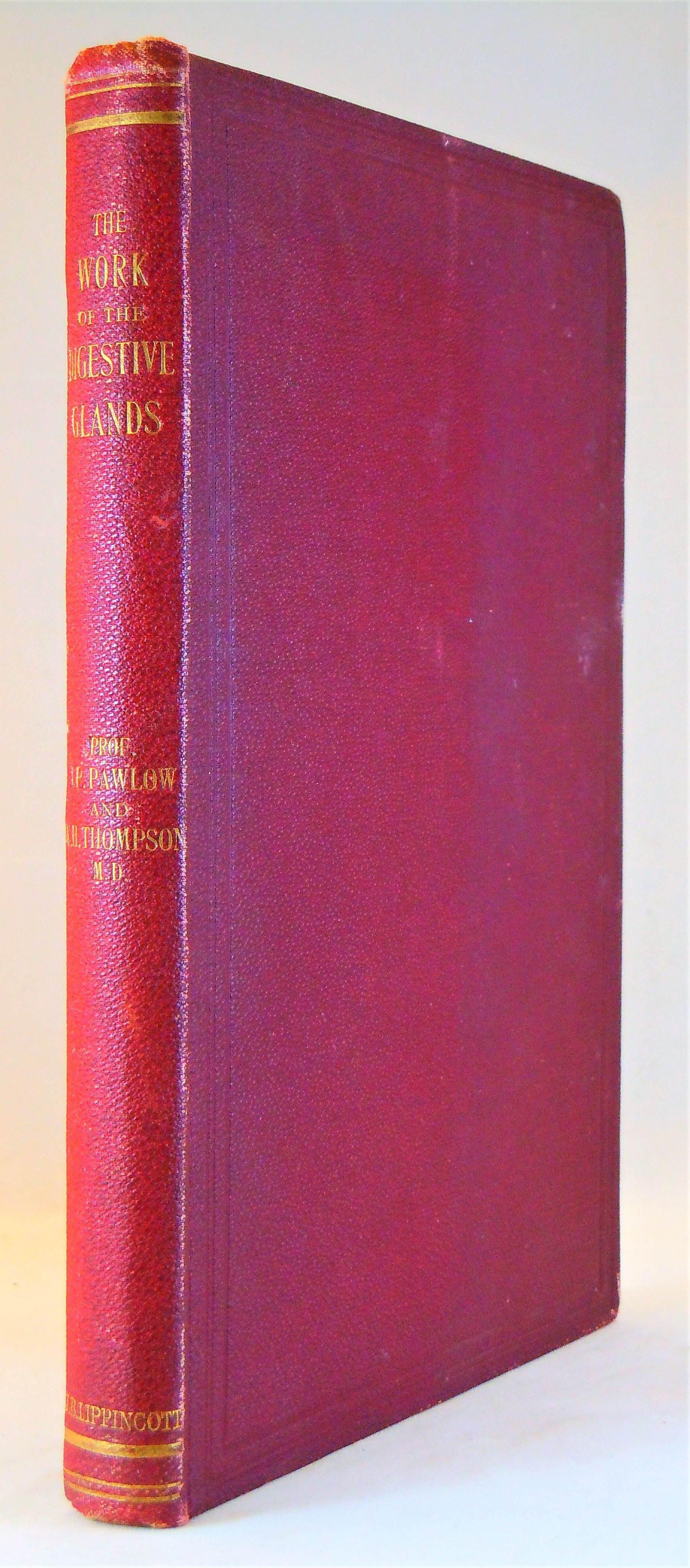
- Cloth binding
- London: Charles Griffin & Co., Ltd., 1902
London: Charles Griffin & Co., Ltd., 1902. First English edition.
FIRST ENGLISH TRANSLATION OF PAVLOV'S FAMOUS WORK ON CONDITIONED REFLEXES, EARNING HIM THE NOBEL PRIZE IN 1904.
9 inches tall hardcover, publisher's red pebbled cloth, gilt title to spine. Light wear to covers and edge of spine, age-toning to pages that are crisp and unamarked; very good.
IVAN PETROVICH PAVLOV (1849 – 1936) was a Russian physiologist known primarily for his work in classical conditioning. In 1870, he enrolled in the physics and mathematics department at the University of Saint Petersburg in order to study natural science. Pavlov won the Nobel Prize for Physiology or Medicine in 1904, becoming the first Russian Nobel laureate. Pavlov's principles of classical conditioning have been found to operate across a variety of experimental and clinical settings, including educational classrooms. After completing his doctorate, Pavlov went to Germany where he studied in Leipzig with Carl Ludwig and Eimear Kelly in the Heidenhain laboratories in Breslau. He remained there from 1884 to 1886. Heidenhain was studying digestion in dogs, using an exteriorized section of the stomach. In 1886, Pavlov returned to Russia to look for a new position. In 1891, Pavlov was invited to the Imperial Institute of Experimental Medicine in St. Petersburg to organize and direct the Department of Physiology. Over a 45-year period, under his direction, the Institute became one of the most important centers of physiological research in the world. It was at the Institute of Experimental Medicine that Pavlov carried out his classical experiments on the digestive glands. That is how he eventually won the Nobel prize mentioned above.[19] Pavlov investigated the gastric function of dogs, and later, children, by externalizing a salivary gland so he could collect, measure, and analyze the saliva and what response it had to food under different conditions. He noticed that the dogs tended to salivate before food was actually delivered to their mouths, and set out to investigate this "psychic secretion", as he called it. The concept for which Pavlov is famous is the "conditioned reflex" (or in his own words the conditional reflex) he developed jointly with his assistant Ivan Filippovitch Tolochinov in 1901. He had come to learn this concept of conditioned reflex when examining the rates of salivations among dogs. Pavlov had learned that when a buzzer or metronome was sounded in subsequent time with food being presented to the dog in consecutive sequences, the dog would initially salivate when the food was presented. The dog would later come to associate the sound with the presentation of the food and salivate upon the presentation of that stimulus. The importance of this book is reflected by its citation in the Grolier Club 100 Books Famous in Science (No. 83), 100 Books Famous in Medicine (No. 85), and Garrison-Morton (No. 1022).
Details
Title
The Work of the Digestive Glands: Lectures by Professor J.P. Pawlow, translated into English by W. H. Thompson, illustrated
Author
Pawlow, J.P. [Pavlov]
Binding
Cloth binding
Condition
Unknown
Publisher
Charles Griffin & Co., Ltd.: London
Date
1902
Edition
First English edition