

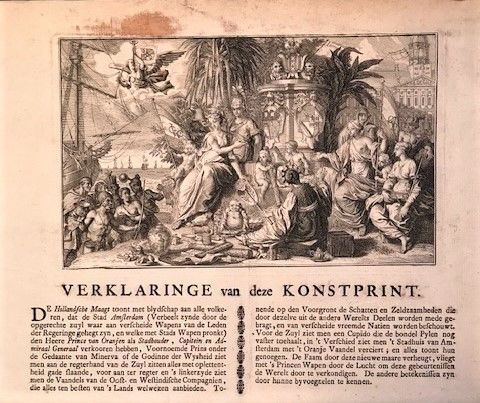
Verklaringe van deze Konstprint
- Not bound.
- Amsterdam: H W van Welbergen, May 1, 1747
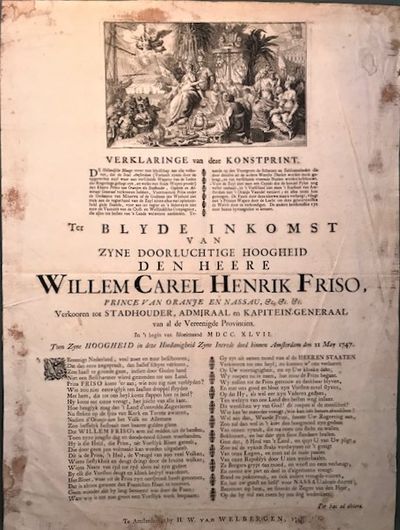
Amsterdam: H W van Welbergen, May 1, 1747. First Edition (?). Not bound.. Good; blank margins cut-down; backed with a paper sheet of 18th century laid paper that has been glued at the perimeter on the verso; some glue stains showing.. Folio, letterpress, illustrated broadside measuring appx. 510 x 375 mm. The engraved illustration measures appx. 120 x 190 mm.
The son of John William Friso of the house of Nassau-Dietz, William became stadtholder of Friesland and then later also of Groningen and of Gelderland. On March 25, 1734, he married Anne of Hanover (170959), eldest daughter of George II of Great Britain. By the extinction of other branches of the Ottonians of Nassau, he acquired a number of territories in Germany. In April 1747, during the War of the Austrian Succession, the French invaded Dutch territory. A spontaneous popular movement arose, first in Zeeland, then in Holland, in Utrecht, and in Overijssel, for the elevation of William to the stadtholdership in these provinces, vacant since William IIIs death (1702), and to the ranks of captain general and admiral general. William was appointed, and all his offices were made hereditary. The first man to be stadtholder of all seven provinces, William IV now had more power than any of his predecessors; but he proved incompetent as a leader during his short reign. The Dutch people expected reforms to make the rule of the urban oligarchies in Holland less absolute. William made attempts to abolish the greatest abuses, but when he died (1751) the most urgent problems were unresolved. The print illustrating the broadside at the head of the text celebrates his enthronement and illustrates the fealty of the colonized people of the Dutch empire. The text explains the iconography of the celebratory print and is accompanied by a 48 line poetical encomium printed in two columns at the base of the broadside. Unlocated.
The son of John William Friso of the house of Nassau-Dietz, William became stadtholder of Friesland and then later also of Groningen and of Gelderland. On March 25, 1734, he married Anne of Hanover (170959), eldest daughter of George II of Great Britain. By the extinction of other branches of the Ottonians of Nassau, he acquired a number of territories in Germany. In April 1747, during the War of the Austrian Succession, the French invaded Dutch territory. A spontaneous popular movement arose, first in Zeeland, then in Holland, in Utrecht, and in Overijssel, for the elevation of William to the stadtholdership in these provinces, vacant since William IIIs death (1702), and to the ranks of captain general and admiral general. William was appointed, and all his offices were made hereditary. The first man to be stadtholder of all seven provinces, William IV now had more power than any of his predecessors; but he proved incompetent as a leader during his short reign. The Dutch people expected reforms to make the rule of the urban oligarchies in Holland less absolute. William made attempts to abolish the greatest abuses, but when he died (1751) the most urgent problems were unresolved. The print illustrating the broadside at the head of the text celebrates his enthronement and illustrates the fealty of the colonized people of the Dutch empire. The text explains the iconography of the celebratory print and is accompanied by a 48 line poetical encomium printed in two columns at the base of the broadside. Unlocated.
Details
Title
Verklaringe van deze Konstprint
Author
Anon. - WILLIAM IV, Prince of Nassau
Binding
Not bound.
Condition
Good
Publisher
H W van Welbergen: Amsterdam
Date
May 1, 1747
Edition
First Edition (?)