

Ecological Adaptations for Breeding in Birds
- Cloth binding
- London: Methuen & Co. Ltd., 1968
London: Methuen & Co. Ltd., 1968. First edition.
ILLUSTRATED COMPREHENSIVE STUDY OF ADAPTATIONS OF BIRDS FOR BREEDING BY EXPERT ON DARWIN'S FINCHES.
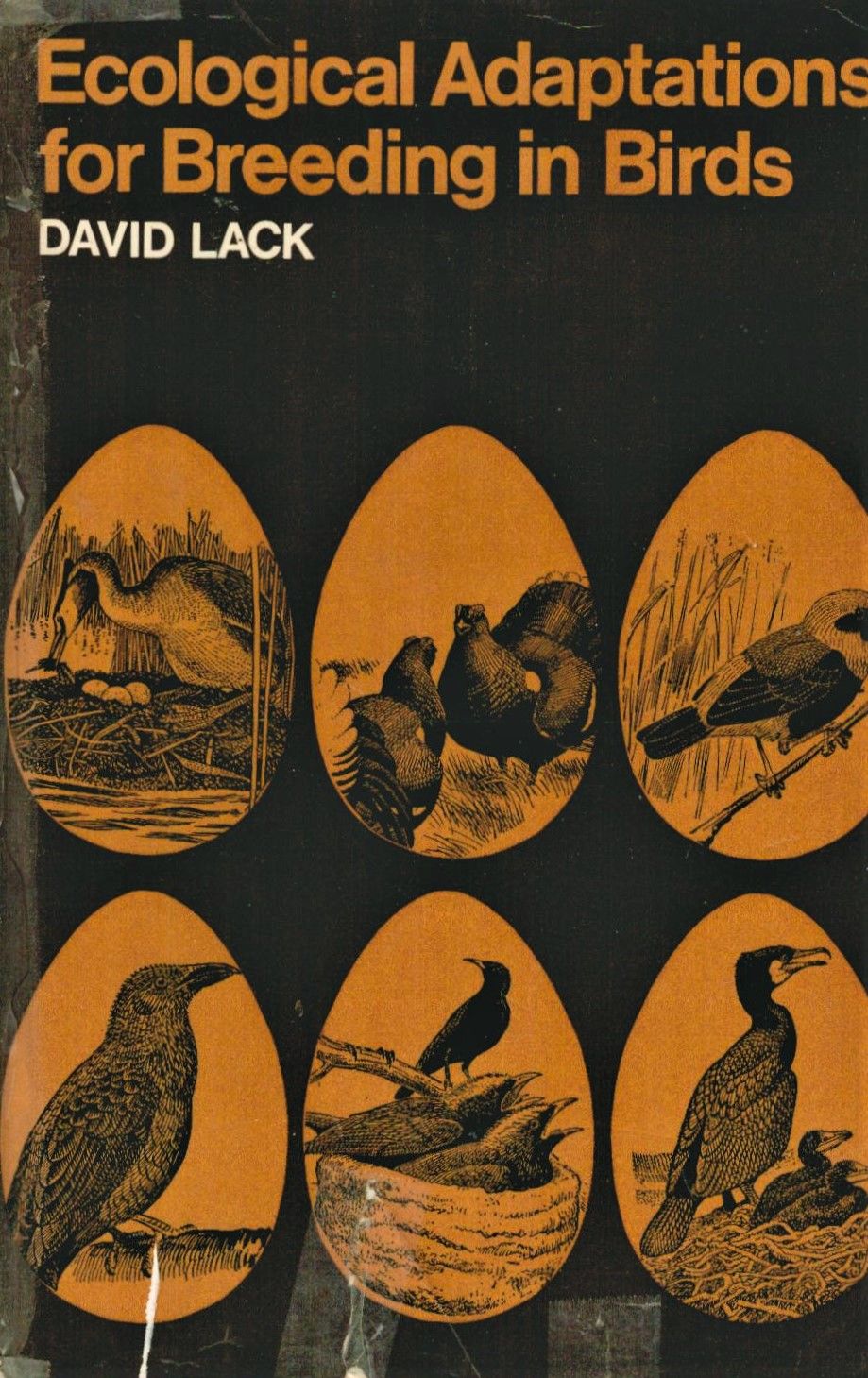
10 inches tall mauve cloth binding, gilt title to spine, unmarked, very good in good price-clipped dust jacket with edge tears. From dust jacket: "The primary aim of this book is an interpretation of the main adaptations of birds for breeding-whether a species lests solitarily or in colonies, whether it is monogamous or has several mates, the lumber of eggs that it lays, the relative size of its eggs, the rate of development of its eggs and young, and the age at which it first breeds. This book is the first comprehensive survey of these points that has been made, so readers can see what is known, and what emains to be discovered, and hence may be stimulated to add to knowledge. However it is much more than a summary of the facts, for these various adaptations have been interpreted in terms of natural selection, and the author has suggested how each of them is best suited to the way of life of the species concerned and how it may lead to the production of most young. Adaptations have been interpreted chiefly by means of comparisons between species, but it is important that views obtained by these means should, wherever possible, be tested by experiments, in which a start has been made. The author has worked almost throughout his life on the ecology, evolution and breeding habits of birds and in this book has brought together not only his personal research, but that of many other workers. both amateur and professional."
DAVID LAMBERT LACK (1910 - 1973) was a British evolutionary biologist who made contributions to ornithology, ecology and ethology. His book on the finches of the Galapagos Islands was a landmark work. Lack's work in ornithology was almost entirely based on studies of the living bird. He was one of the pioneers of life-history studies in Britain, especially those based on quantitative approaches, when some traditional ornithologists of the time were focusing their studies on morphology and geographic distribution. Lack's major scientific research included work on population biology and density dependent regulation. Lack's most famous work is Darwin's Finches, a landmark study whose title linked Darwin's name with the Galapagos group of species and popularised the term "Darwin's finches" in 1947, though the term had been introduced by Percy Lowe in 1936. It is often forgotten that there are two versions of this work, and they differ significantly in their conclusions. The first is a book-length monograph, written after his visit to the Galapagos, but not published until 1945. In it Lack interprets the differences in bill size as species recognition signals, that is, as isolating mechanisms. The second is the later book in which the differences in bill size are interpreted as adaptations to specific food niches, an interpretation that has since been abundantly confirmed. This change of mind, according to Lack's Preface, came about as a result of his reflections on his own data whilst he was doing war work. The effect of this change in interpretation is to put the emphasis for speciation onto natural selection for appropriate food handling instead of seeing it primarily as a by-product of an isolating mechanism. In this way his work contributed to the modern evolutionary synthesis, in which natural selection came to be seen as the prime mover in evolution, and not random or mutational events. Lack's work laid the foundations for the much more extensive work of Peter Grant and his colleagues. Also, Lack's work feeds into studies of island biogeography which continue the same range of issues presented by the Galapagos fauna on a more varied canvas.
ILLUSTRATED COMPREHENSIVE STUDY OF ADAPTATIONS OF BIRDS FOR BREEDING BY EXPERT ON DARWIN'S FINCHES.
10 inches tall mauve cloth binding, gilt title to spine, unmarked, very good in good price-clipped dust jacket with edge tears. From dust jacket: "The primary aim of this book is an interpretation of the main adaptations of birds for breeding-whether a species lests solitarily or in colonies, whether it is monogamous or has several mates, the lumber of eggs that it lays, the relative size of its eggs, the rate of development of its eggs and young, and the age at which it first breeds. This book is the first comprehensive survey of these points that has been made, so readers can see what is known, and what emains to be discovered, and hence may be stimulated to add to knowledge. However it is much more than a summary of the facts, for these various adaptations have been interpreted in terms of natural selection, and the author has suggested how each of them is best suited to the way of life of the species concerned and how it may lead to the production of most young. Adaptations have been interpreted chiefly by means of comparisons between species, but it is important that views obtained by these means should, wherever possible, be tested by experiments, in which a start has been made. The author has worked almost throughout his life on the ecology, evolution and breeding habits of birds and in this book has brought together not only his personal research, but that of many other workers. both amateur and professional."
DAVID LAMBERT LACK (1910 - 1973) was a British evolutionary biologist who made contributions to ornithology, ecology and ethology. His book on the finches of the Galapagos Islands was a landmark work. Lack's work in ornithology was almost entirely based on studies of the living bird. He was one of the pioneers of life-history studies in Britain, especially those based on quantitative approaches, when some traditional ornithologists of the time were focusing their studies on morphology and geographic distribution. Lack's major scientific research included work on population biology and density dependent regulation. Lack's most famous work is Darwin's Finches, a landmark study whose title linked Darwin's name with the Galapagos group of species and popularised the term "Darwin's finches" in 1947, though the term had been introduced by Percy Lowe in 1936. It is often forgotten that there are two versions of this work, and they differ significantly in their conclusions. The first is a book-length monograph, written after his visit to the Galapagos, but not published until 1945. In it Lack interprets the differences in bill size as species recognition signals, that is, as isolating mechanisms. The second is the later book in which the differences in bill size are interpreted as adaptations to specific food niches, an interpretation that has since been abundantly confirmed. This change of mind, according to Lack's Preface, came about as a result of his reflections on his own data whilst he was doing war work. The effect of this change in interpretation is to put the emphasis for speciation onto natural selection for appropriate food handling instead of seeing it primarily as a by-product of an isolating mechanism. In this way his work contributed to the modern evolutionary synthesis, in which natural selection came to be seen as the prime mover in evolution, and not random or mutational events. Lack's work laid the foundations for the much more extensive work of Peter Grant and his colleagues. Also, Lack's work feeds into studies of island biogeography which continue the same range of issues presented by the Galapagos fauna on a more varied canvas.
Details
Title
Ecological Adaptations for Breeding in Birds
Author
Lack, David
Binding
Cloth binding
Condition
Unknown
Publisher
Methuen & Co. Ltd.: London
Date
1968
Edition
First edition