

Archive of Unpublished Primary Correspondence from the Dorr Rebellion
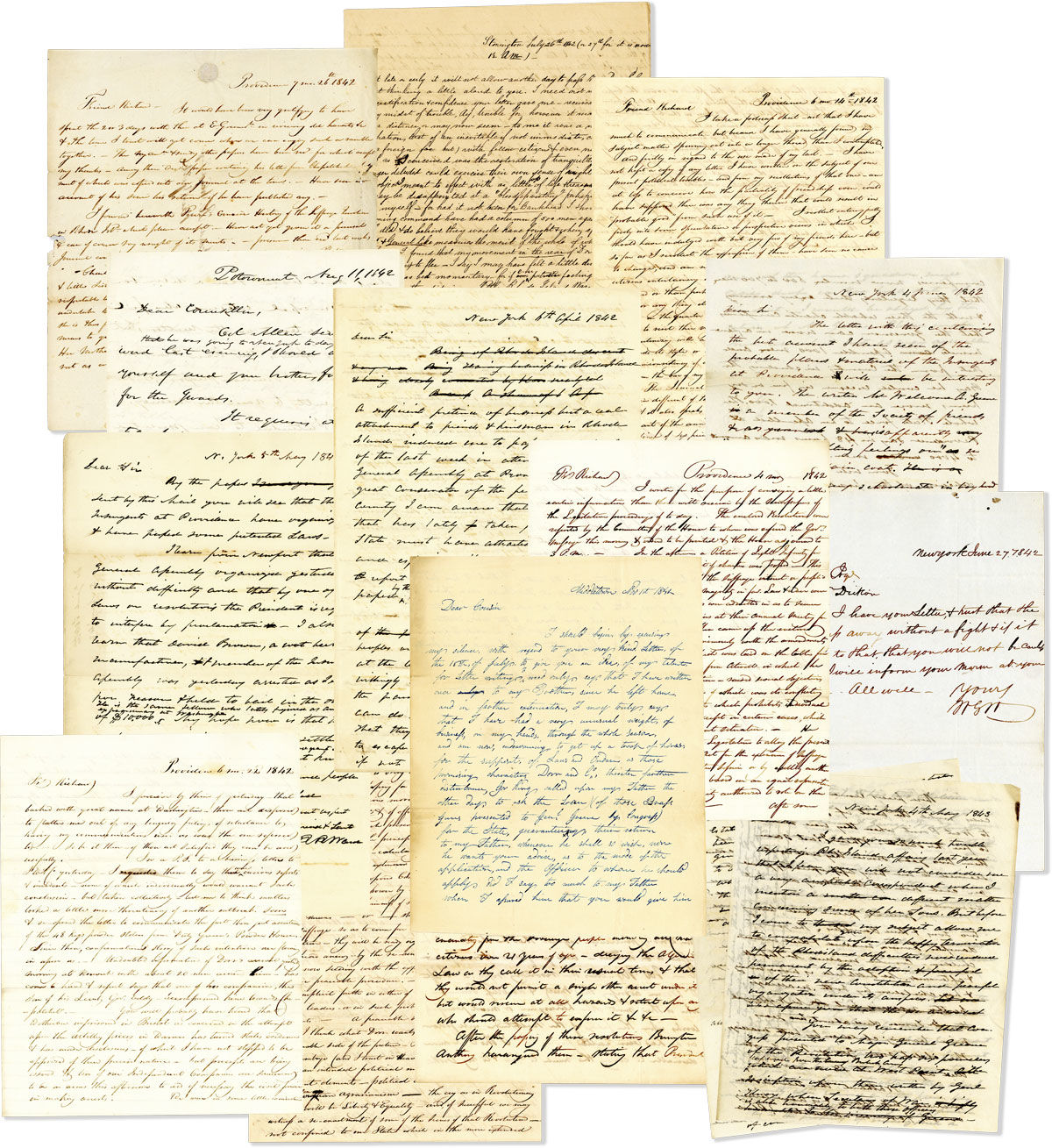
- Providence, New York, & Stonington, CT , 1842-3
Providence, New York, & Stonington, CT, 1842-3. Quarto and small folio, totaling 40 pages (not including address panels), all very legible with the exception of the last, most with typed transcriptions, and all in very good to fine condition.
A collection of 14 letters dating from 6 April 1842 to 4 May 1843, written by Rhode Island landowners who opposed the Dorr Rebellion, during the most intense phase of the uprising.
In 1841 Rhode Island lacked a constitution and was still governed under the colonial charter of 1663, which restricted suffrage to men only who owned at least $134 in land. In 1840, nearly 60% of free adult males in Rhode Island were disenfranchised-many of them urbanites, whose numbers had greatly increased with the growth of industry.
Thomas W. Dorr, an idealistic Providence attorney who had studied under Chancellor James Kent in New York, pleaded with the Rhode Island General Assembly to call a constitutional convention to address the accumulating grievances. When the ruling conservatives were deaf to reform, Dorr's own party called a constitutional convention in October 1841.
In response, the General Assembly called a rival convention and drafted a new constitution that made some concessions to democratic demands. This Freemen's Constitution was defeated in a state-wide referendum, thanks to Dorrite opposition. Meanwhile, the Dorrite convention drafted the People's Constitution, which was overwhelmingly approved in a second referendum. Both the conventions and referendums had been extralegal, but the Dorrites claimed that their Constitution had been approved by a majority of those entitled to vote under the old charter.
Early in 1842, both Dorr's followers and the charter government forces elected and organized separate governments, Dorr heading one and incumbent governor Samuel Ward King the other. King requested federal protection from President Tyler. The federal government declined to intervene before any actual violence had occurred, but did order two artillery companies to Fort Adams in Newport.
In May, Dorr finally resorted to a show of arms. After an abortive assault on the Providence armory, his government collapsed and Dorr fled the state. King declared martial law, many Dorrites were arrested, and Dorr himself was indicted for high treason. Minor armed clashes and demonstrations caused much excitement. Ultimately the conservatives, finally convinced of the strength of Dorr's cause, called another convention. A new constitution, greatly liberalizing voting requirements, was accepted by both parties.
This archive offers a remarkable view of this pivotal moment in Rhode Island history as seen through the eyes of well-born Rhode Islanders who were not at all pleased with the turmoil fomented by Dorr. Welcome Arnold Greene's letters to his cousin, Richard Ray Ward are especially valuable, as they offer a narrative of the events of the spring and summer of 1842 as they unfold. Notable is the extent and duration of the fear that Dorr's adherents would rise up again. Ward's letters to General Winfield Scott, as well as W. A. Greene's appeal to fund a militia, are the letters of participants who fear for their lives and property. From a scholarly perspective, the tone of patrician disdain for the suffrage agitators reinforces Patrick Conley's argument for a strong nativist dimension in the conflict. At issue also is the role of the federal government in the Rhode Island political crisis.
At the center of this archive is Welcome Arnold Greene (1795-1870). At an early age he entered the employ of his cousin, Samuel Greene Arnold, a prominent merchant of Providence, and was soon entrusted by him with the responsible position of supercargo. In this capacity he made voyages to South America, Spain, Norway, Russia, and the East. Returning from his voyages, Greene accepted the position of cashier of the Mechanics' National Bank of Providence, which he filled from January 7, 1830, to July 11, 1836, when he resigned and withdrew from active business. He was a member of the Franklin Society for the Encouragement of Domestic Industry, and also of the Rhode Island Historical Society, where he filled several offices and was for years its valued Treasurer. He was also a member of the Society of Friends.
His cousin, Richard Ray Ward (1795-1873) was a New York City lawyer. His father was an international merchant who traveled to China and acted as the president of the New York Marine Insurance Company. Ward practiced law in New York City for many years and was also a noted antiquarian. He was an honorary member of the Rhode Island Historical Society from 1823 onwards.
Winfield Scott (1786-1866) is the well-known military commander who took part in the War of 1812, the Mexican-American War, and the early stages of the Civil War, and was the presidential nominee of the Whig Party in 1852.
CONTENTS:
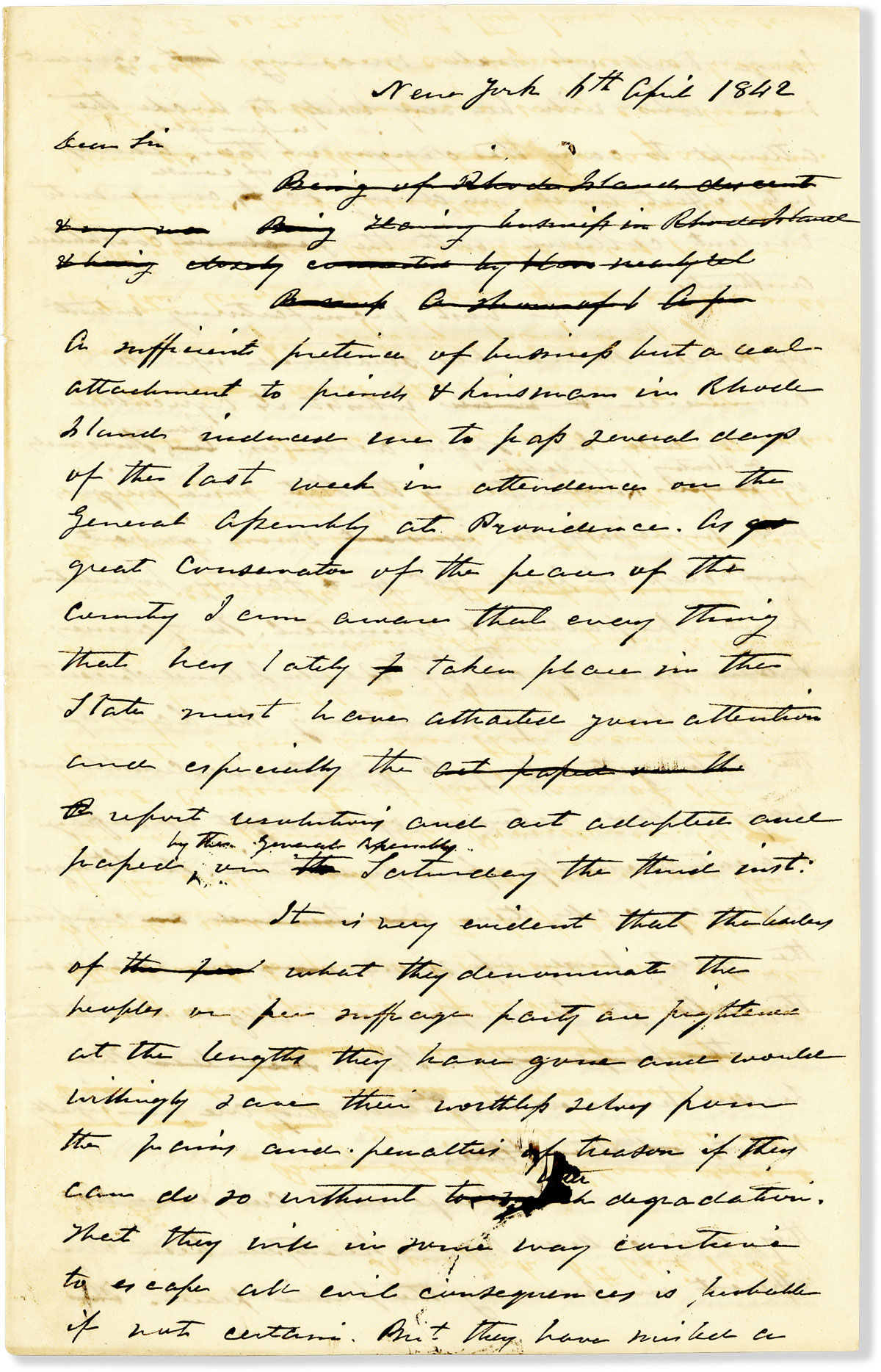
1) Richard Ray Ward to Winfield Scott, 6 April, 1842. Lengthy 4-page A.L.s. on integral leaves. Ward describes a visit to family in Rhode Island and reports on his concern over the agitation for a new constitution extending voting rights. The nativist strain of Dorr's opponents is never more evident than here. Writing of the General Assembly where he has recently spent "several days ... in attendance," Ward reports "that they will in some way continue to escape all evil consequences ... But they have misled a large body of well-meaning ignorant men who will be very likely to make the attempt to carry the design of their leaders into effect and in doing so come into violent collision with the constitutional authorities."
He goes on to say that "the vast manufacturing interests of Rhode Island has swallowed up its commerce while it's agriculture has made but slight advances. Many thousands of floating population now throng the state, some foreigners but principally the more ignorant class fit for factory population from Massachusetts and Connecticut." Complaining of the agitation for a new constitution, Ward asserts "the strangers...compose the great body of men concerned in an attempt to impose an illegal constitution on the State. The leaders however I regret to say are principally Native." Ward concludes by appealing to Scott: "feeling a deep interest in the safety of my friends, as well as in their welfare and honor of that glorious state... might not ... a little additional force of US troops be spared for the forts at Newport and a vessel or two of war be stationed in Narragansett Bay?"
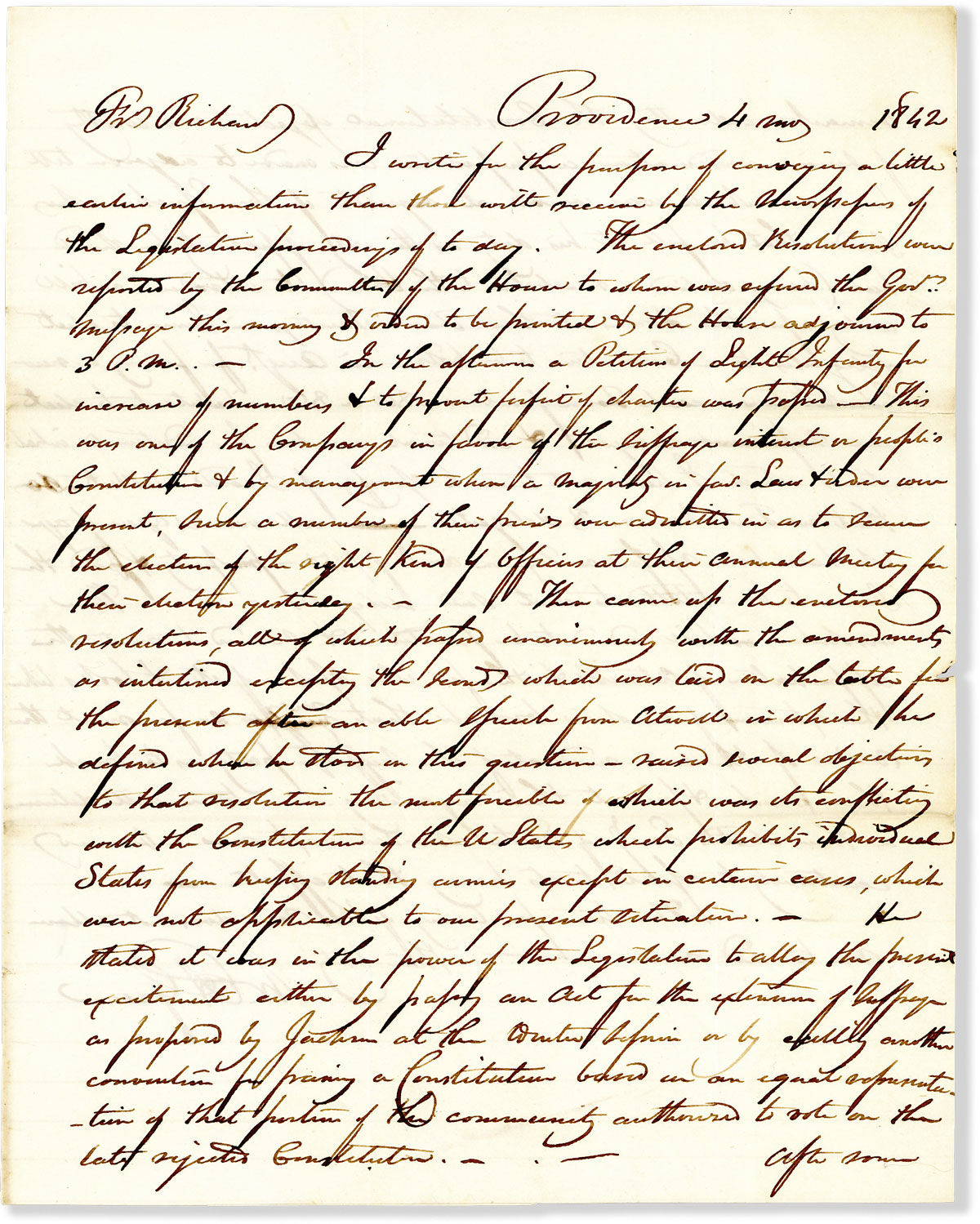
2) Welcome Arnold Greene to Richard Ray Ward, 4 May, 1842. 2-page A.L.s., on integral leaves with address panel. Greene reports on the actions of the General Assembly: "In the afternoon a Petition of Light Infantry for increase of numbers and to prevent forfeit of charter was passed. This was one of the Companys in favor of the suffrage interest or People's Constitution and by management when a majority in favor [of] law and order were present. Such a number of their friends were admitted in as to secure the election of the right kind of officers at their annual meeting ... Then came up the enclosed resolutions [not present], all of which passed unanimously ... except the second which was laid on the table for the present after an able speech from Atwood ... rais[ing] several objections ... the most forcible of which was its conflicting with the Constitution of the United States which prohibits individual states from keeping standing armies. He stated it was in the power of the Legislature to allay the present excitement either by passing an Act for the extension of suffrage as proposed by Jackson ... or by calling another convention for framing a constitution based on an equal representation of that portion of the community authorized to vote on the late rejected Constitution ... Looks like the extension of an olive branch that so far meets the view of the more moderate of the suffrage party as to break their ranks and prevent their organizing..."
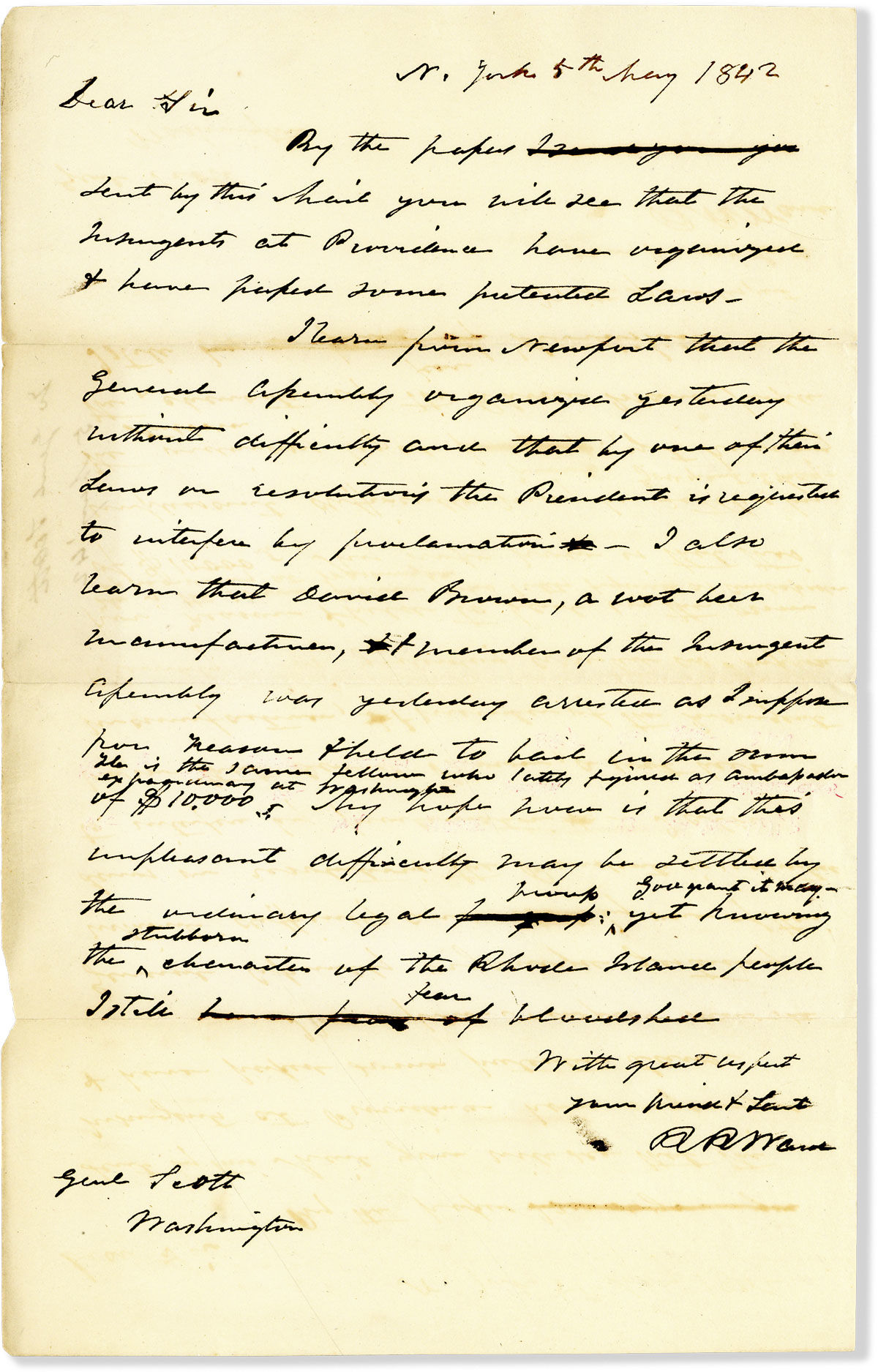
3) Richard Ray Ward to General Winfield Scott, 5 May, 1842. 1-page A.L.s. Ward informs Scott of late news regarding the General Assembly and the Dorrites: "You will see that the insurgents at Providence have organized and have passed some pretended laws ... I learn from Newport that the General Assembly organized yesterday ... I also learn that Daniel Brown, a root beer manufacturer and member of the insurgent assembly was yesterday arrested ... for treason and held to bail in the sum of $10,000 ... My hope now is that this unpleasant difficulty may be settled by the ordinary legal means. God grant it may yet, knowing the stubborn character of the Rhode Island people I still fear."
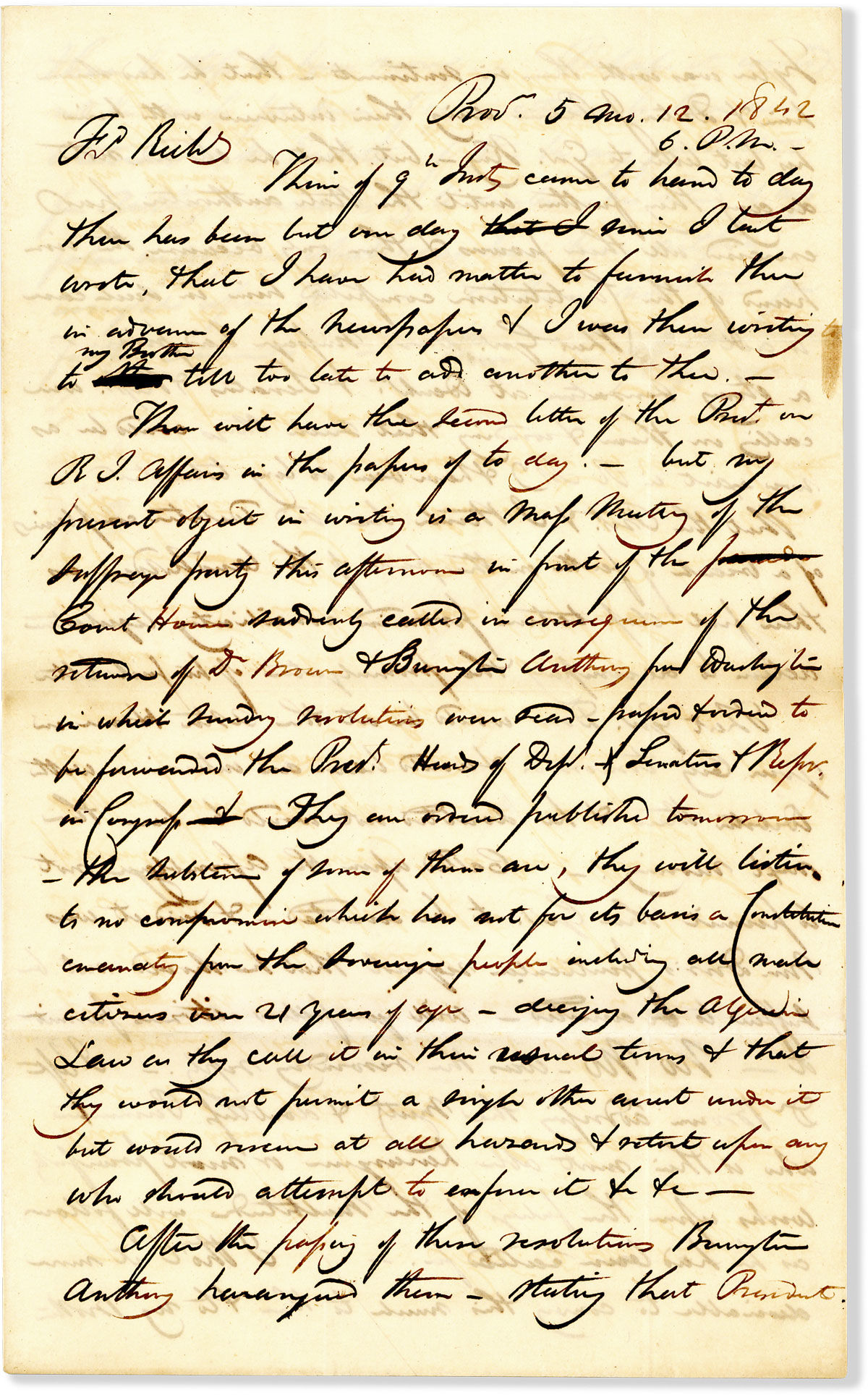
4) Welcome Arnold Greene to Richard Ray Ward, 12 May, 1842. 3-page A.L.s. on integral leaves. Greene expresses his concern about a "mass meeting of the Suffrage Party in front of the courthouse...in which sundry resolutions were read, passed, and ordered to be forwarded [to] the President, Senators, and Representatives in Congress ... they will listen to no compromise which has not for its basis a Constitution emanating from the sovereign people including all male citizens over 21 years of age -- the Algerine Law as they call it..." Greene also addresses at length the question of which side President Tyler supports in this controversy.
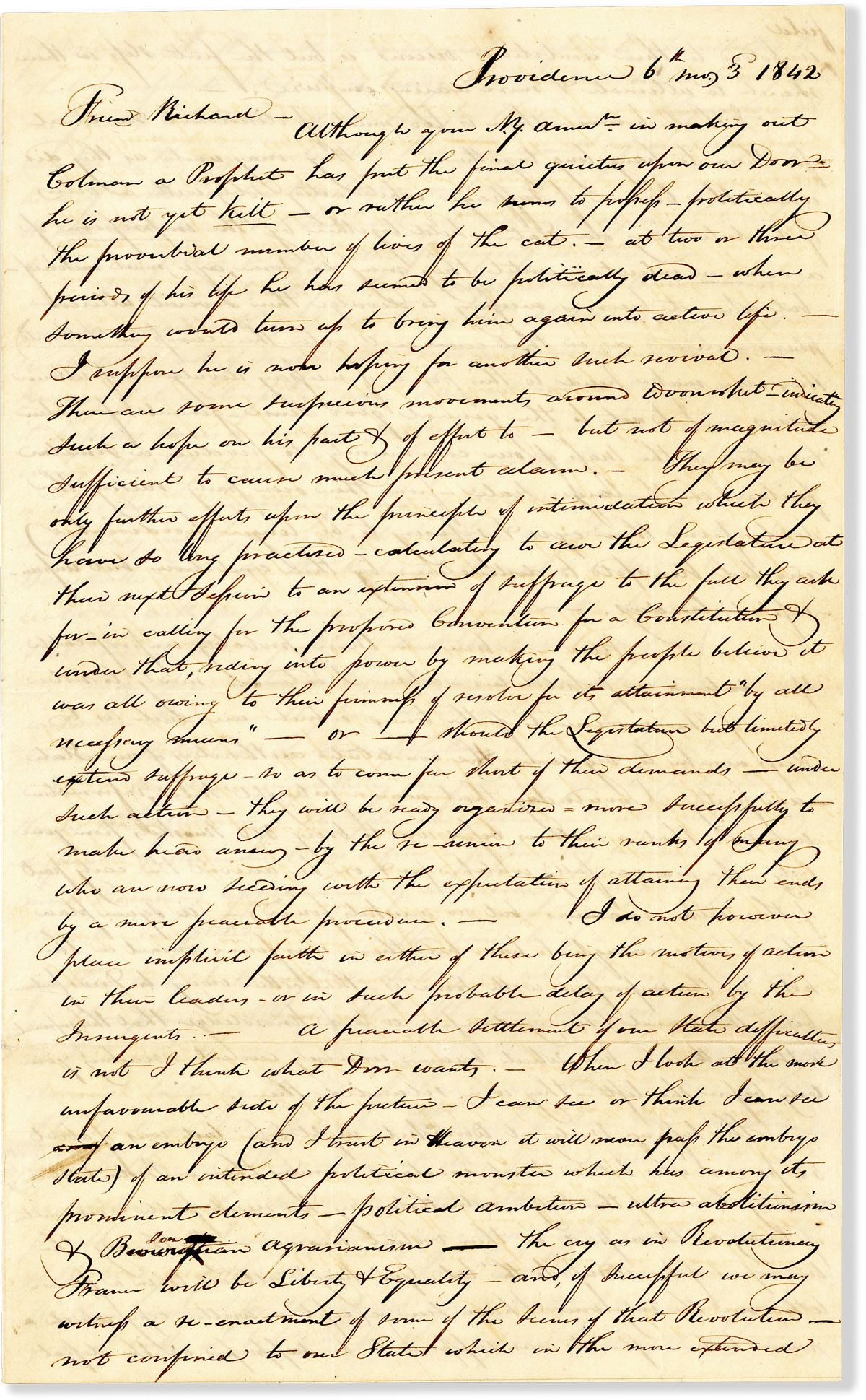
5) Welcome Arnold Greene to Richard Ray Ward, 3 June, 1842. Lengthy 4-page A.L.s. Writing two weeks after Dorr's abortive raid on the Cranston Armory, and his subsequent flight, Green writes to Ward of Dorr's persistence, and the threat his movement posed: "I can see or think I can see ... an intended political monster that has among its prominent elements political ambition, ultra-abolitionism, and -- agrarianism. The cry as in revolutionary France will be Liberty and Equality and if successful we may witness a reenactment of some of the scenes of that Revolution..."
Greene describes the situation of Dorr sympathizers in Woonsocket, and suggests that the federal government will be more willing to intercede in the event of a new uprising. The final sentences of the letter offer a peculiar perspective on the role of racism and nativism in this affair. Greene reports that a Suffrage man has bragged that if their plans do not miscarry, "the time would not be very far distant when the great Nabobs of the south would be seen sitting down at table with their greasy slaves," and that this boast has "to say the least no bad effect upon our cause of 'law and order' at Washington," to which Greene adds, "do not understand from this that I am disposed to join in any effort for the continuance of the bondage of the slaves." Greene adds a postscript detailing his suspicion that the arms of the insurgents may have come from New York, and that his young son performs an antic rendition of Dorr's Retreat at the mention of Dorr's name.
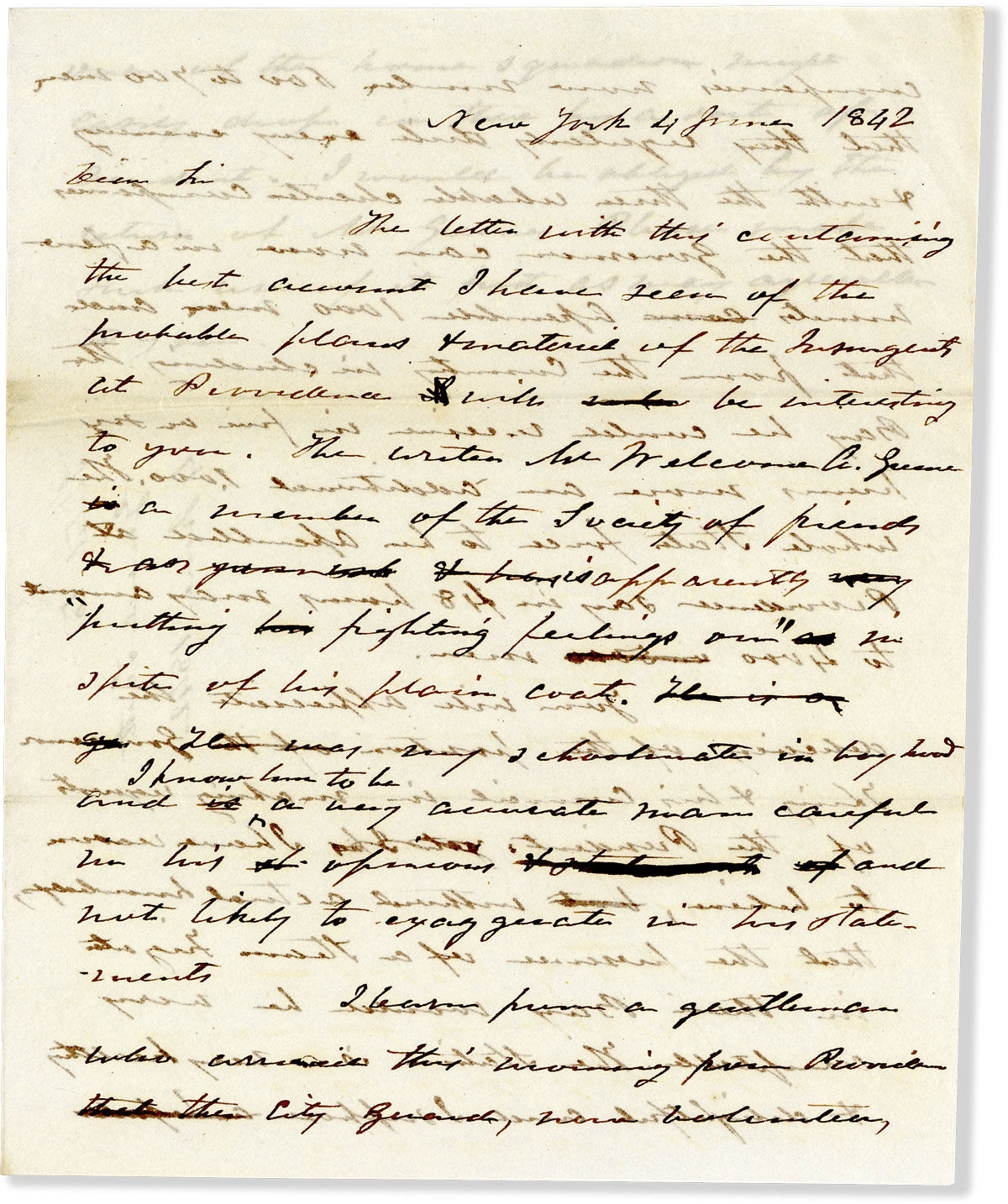
6) Richard Ray Ward to General Winfield Scott, 4 June, 1842. 3-page A.L.s. on integral leaves. Ward forwards Greene's account of the situation of the Suffrage partisans to General Scott, and reiterates his suggestion of a naval presence in the bay. He also informs Scott of the number and disposition of the state militia units loyal to Governor King. He described Greene as "a member of the Society of Friends who is apparently 'putting fighting feelings on' in spite of his plain coat."
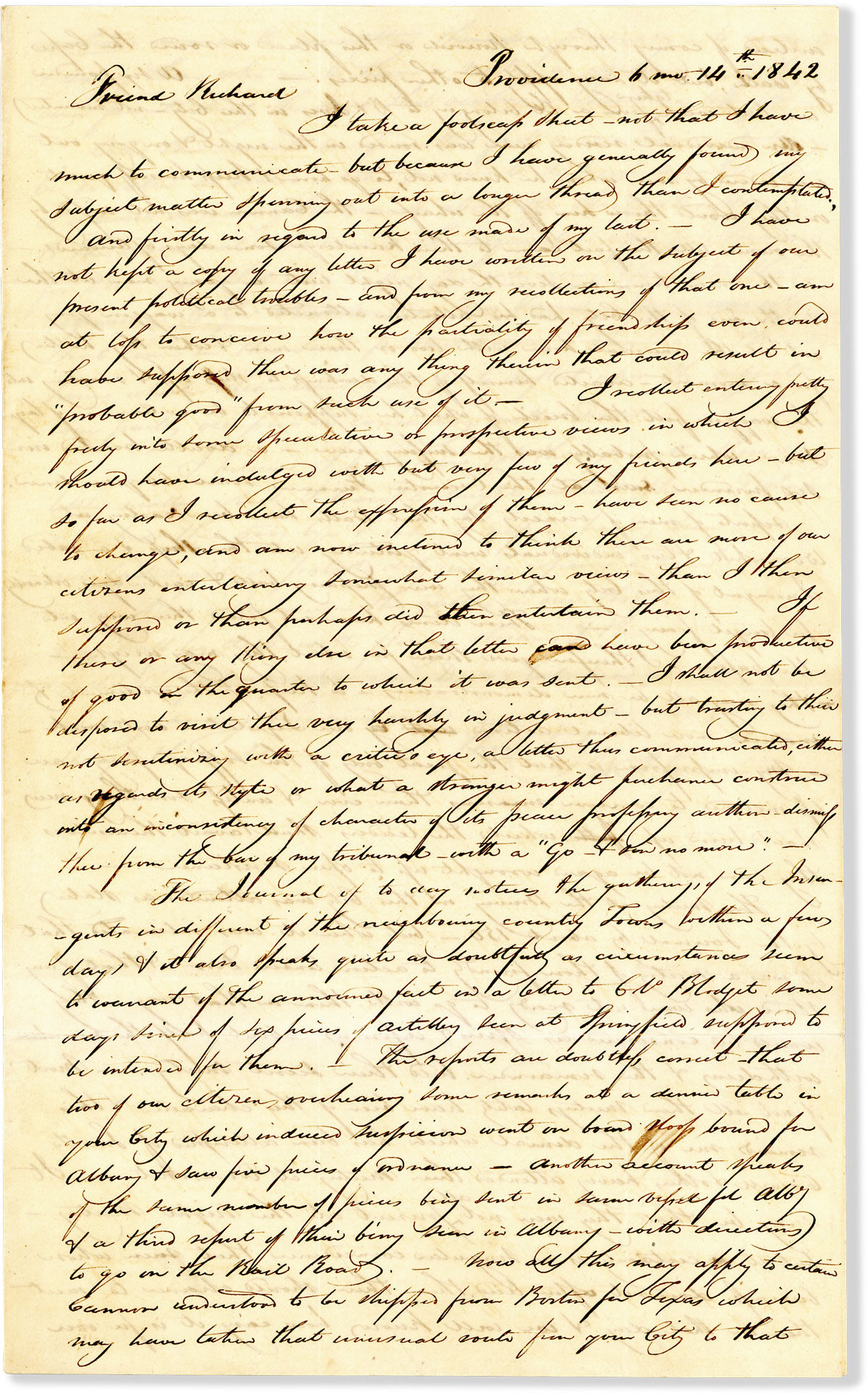
7) Welcome Arnold Greene to Richard Ray Ward, 14 June, 1842. Lengthy 3-page A.L.s. on integral leaves. Greene takes strong issue with Ward's forwarding of his letter to General Winfield Scott, fearing that it might well be misconstrued. The bulk of the letter concerns news and developments in the Dorr affair since his last letter, especially speculation on the movements of ordnance into the hands of Dorr sympathizers. Greene refers several times to items reported in the Providence Journal, a rabidly anti-Dorr, anti-immigrant newspaper. In closing he mentions that he is tired from having been up much of the night patrolling the city.
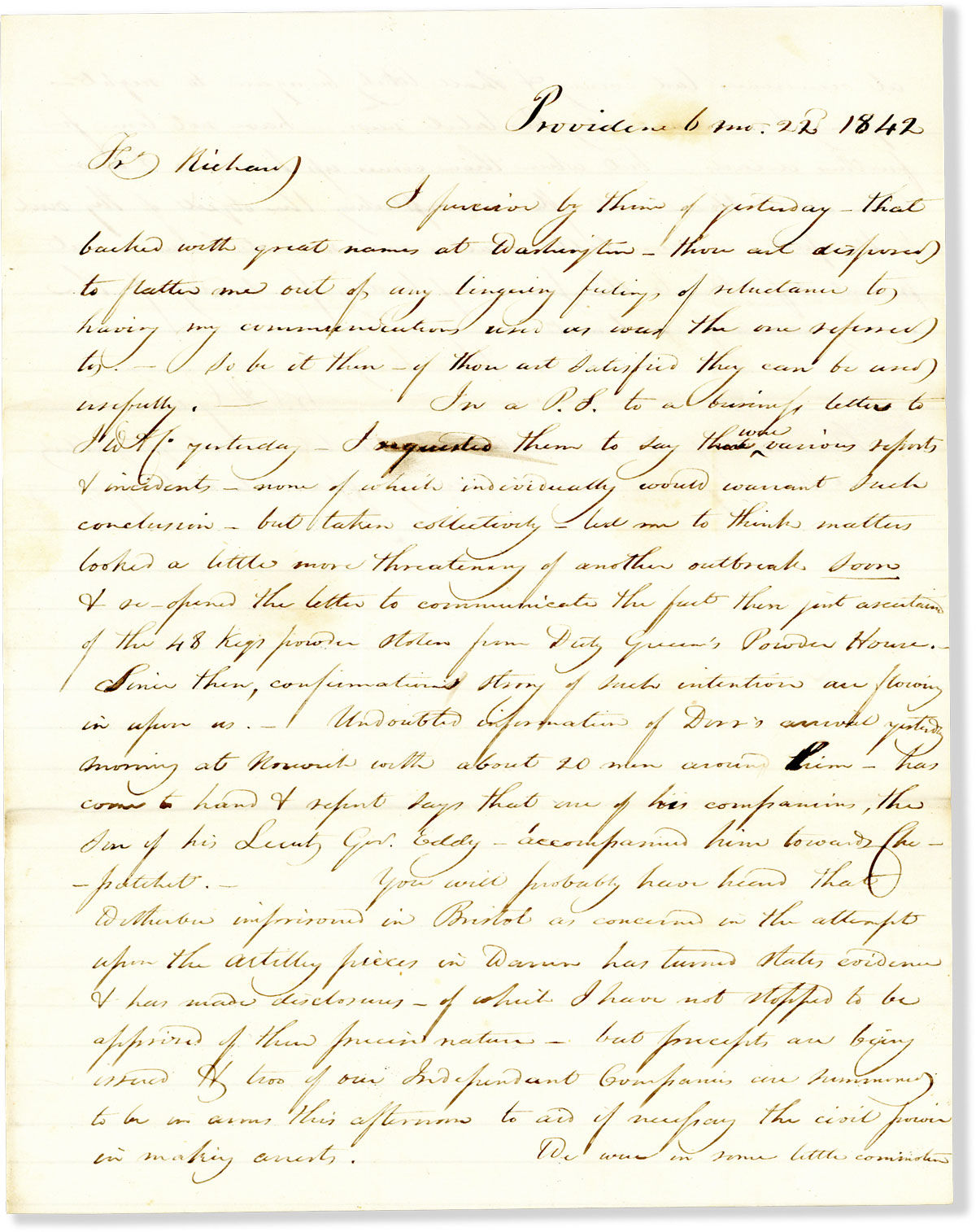
8) Welcome Arnold Greene to Richard Ray Ward, 22 June, 1842. 2-page A.L.s. address panel on integral leaf. Greene expresses his concern that another outbreak of violence is imminent, with news of Dorr's return "with about twenty men around him," and the theft of 48 kegs of powder "stolen from Duty Greene's powder house."
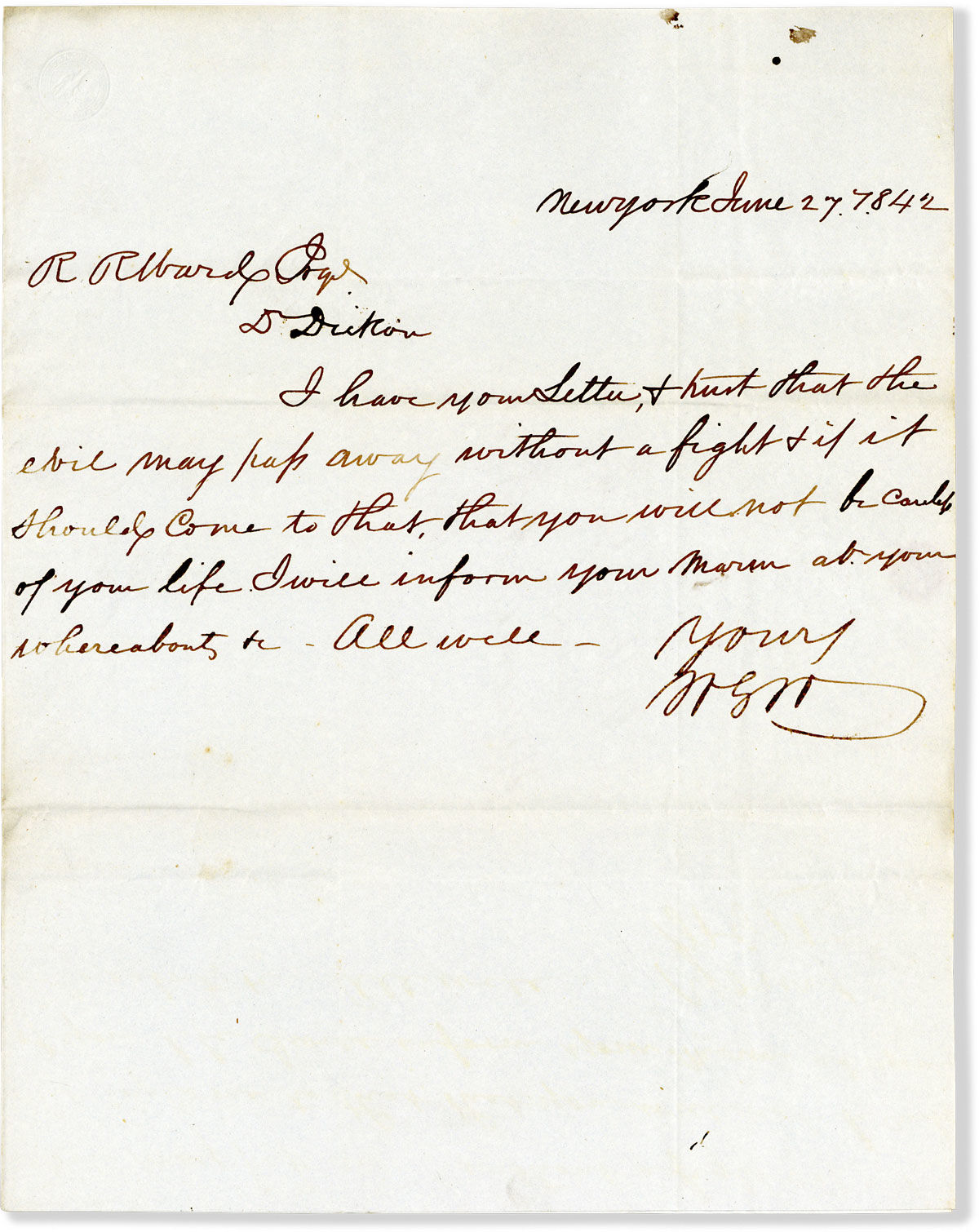
9) William G. Ward (?) to Richard Ray Ward, New York, 27 June, 1842. 1-page A.L.s, address panel on verso of integral leaf. Acknowledgment of a receipt of a letter (not present) but evidently describing the tense situation in Rhode Island, and urges Richard R. Ward that if it should come to a fight, "you will not be careless with your life."
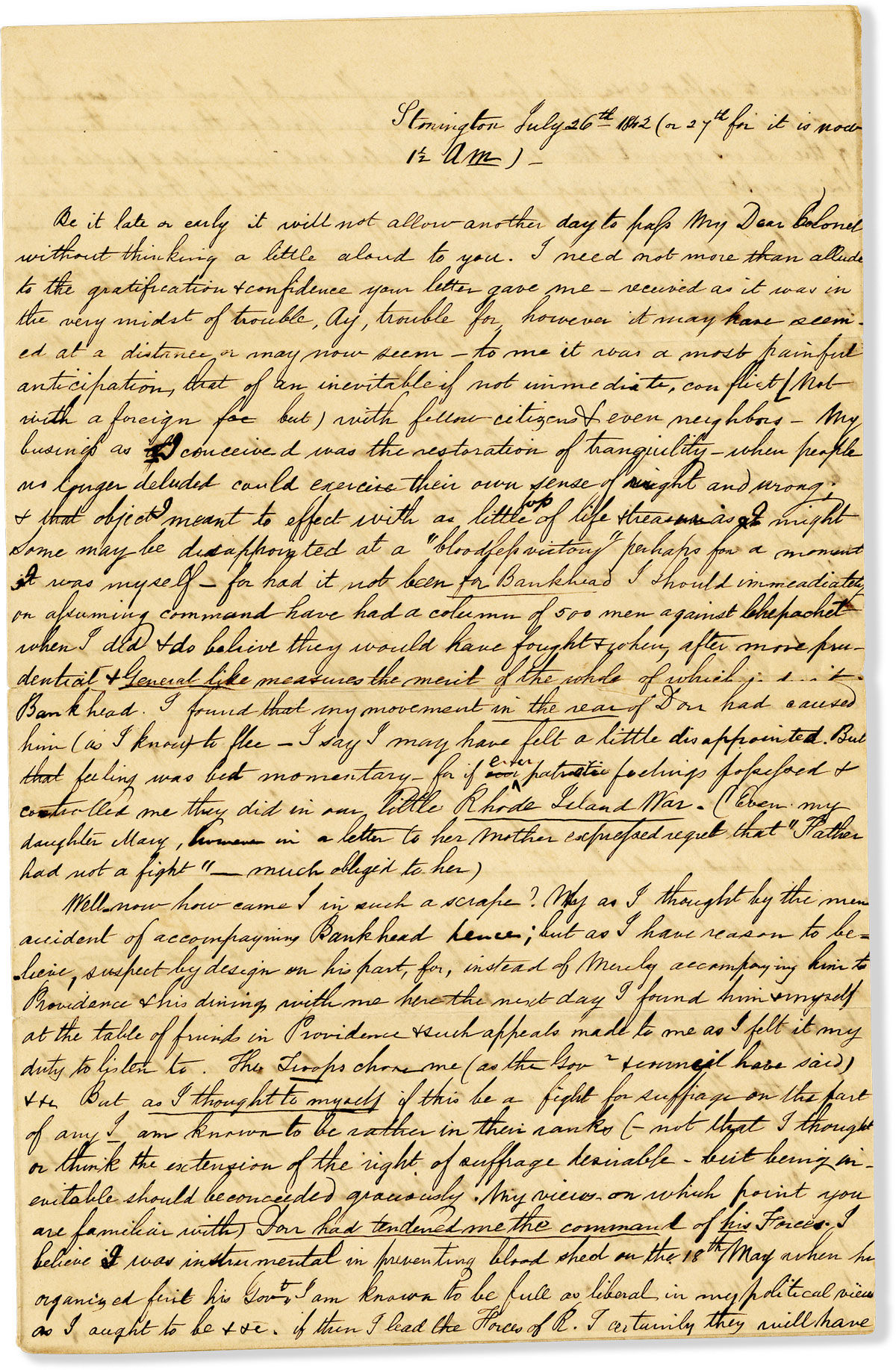
10) General John McNeil to Colonel John Abert, Stonington, 26 July, 1842. Lengthy 3-page A.L.s., address panel on verso of integral leaf. "Had it not been for Bankhead I should immediately on assuming command have had a column of 500 men against Chepachet." William Gibbs McNeil, Major-General and Army Engineer, was a native of Stonington, and builder of the railroad from there to Providence. McNeil's involvement in this affray seems to have been fairly spontaneous, for he says that he was asked to play a role while dining in Providence. Moreover, he expresses some ambivalence about the affair, for "Dorr had tendered me the command of his forces." The RIHS has a letter from Winfield Scott, commending McNeil's suppression of the rebellion without federal troops (see Conley, Democracy in Decline, p. 350). Colonel John Abert (17688-1863) was a founder and the first head of the Corps of Topographical Engineers.
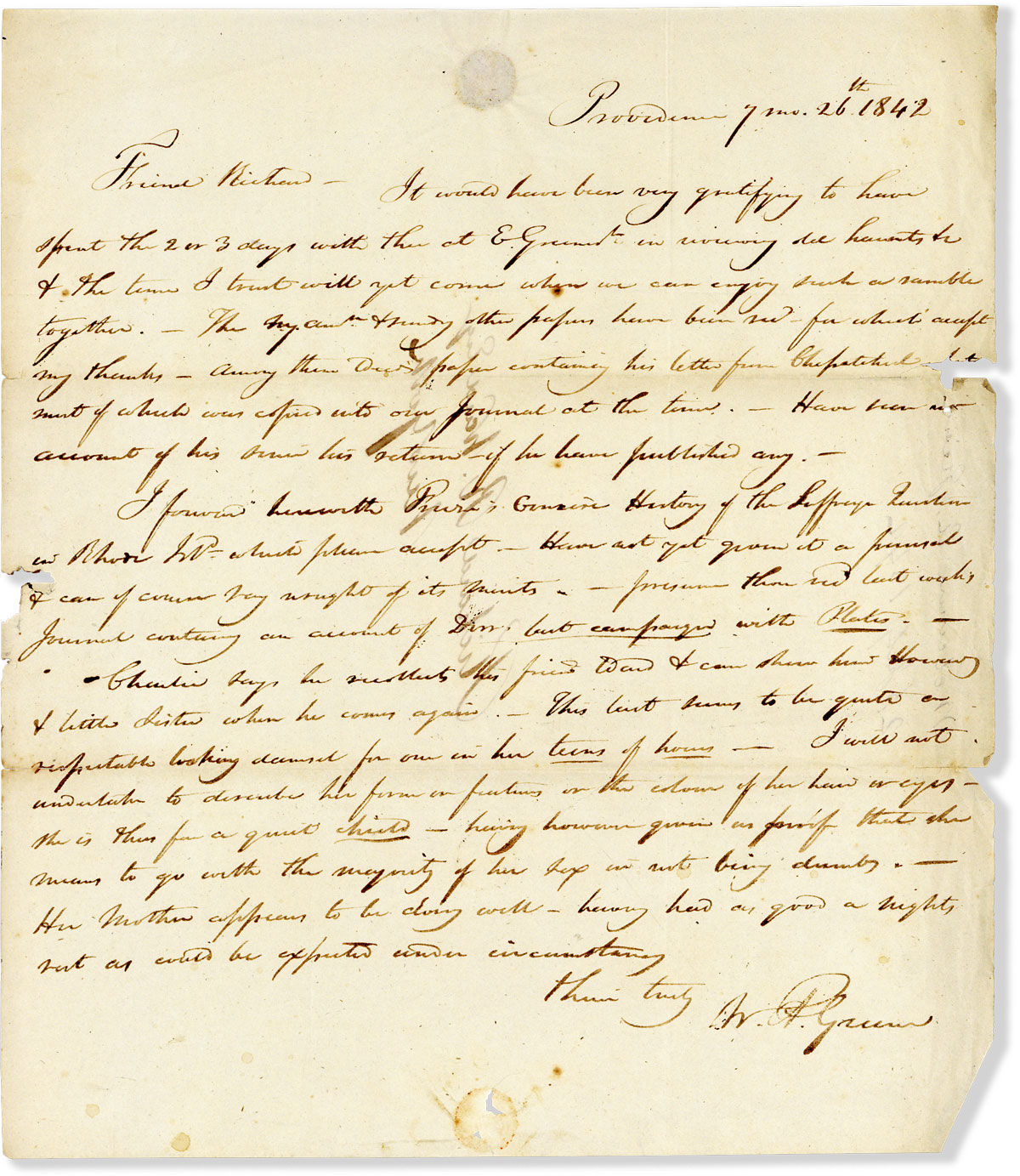
11) William Arnold Greene to Richard Ray Ward, Providence 26 July, 1842. 1-page A.L.s. Primarily a social letter thanking Ward for forwarding New York papers, which included Dorr's letter from Chepachet, and forwarding a "General History of the Suffrage Question in Rhode Island" (apparently Jacob Frieze's A Concise History, of the Efforts to Obtain an Extension of Suffrage in Rhode Island from the Year 1811 to 1842). He also announces the birth of a daughter.
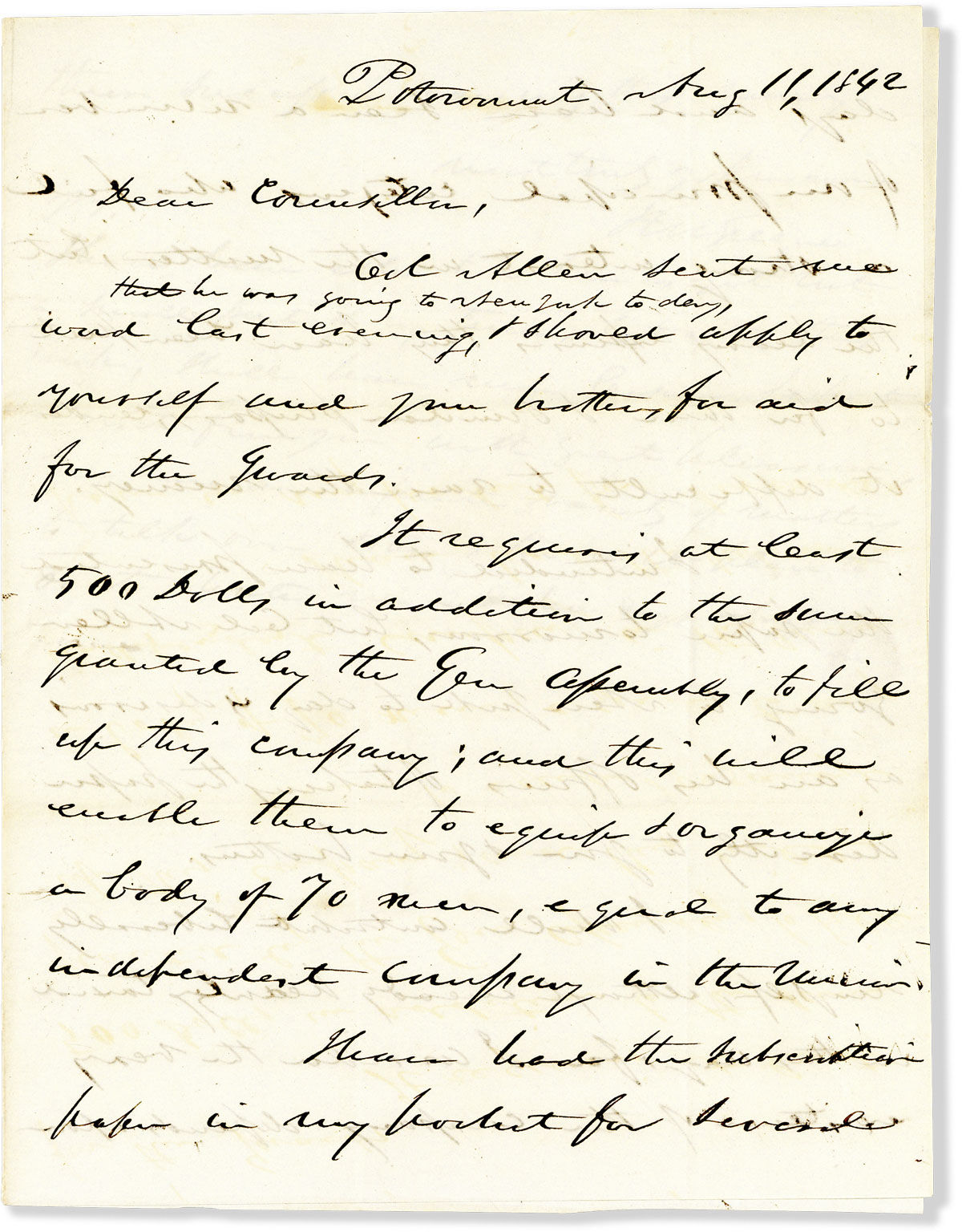
12) William Arnold Greene to Richard Ray Ward, Potowomut, 11 August, 1842. 3-page A.L.s. Greene seeks financial support of Ward and his brother in raising a militia, here referred to as the "Guards." "It requires at least $500 in addition to the seven granted by the General Assembly to fill up this company and this will enable them to equip and organize a body of 70 men ... It is difficult to raise money ... I shall contribute liberally myself, although already heavily taxed..." Greene's tone in this letter bespeaks an urgency that suggests he still feels the threat posed by Dorr's adherents.
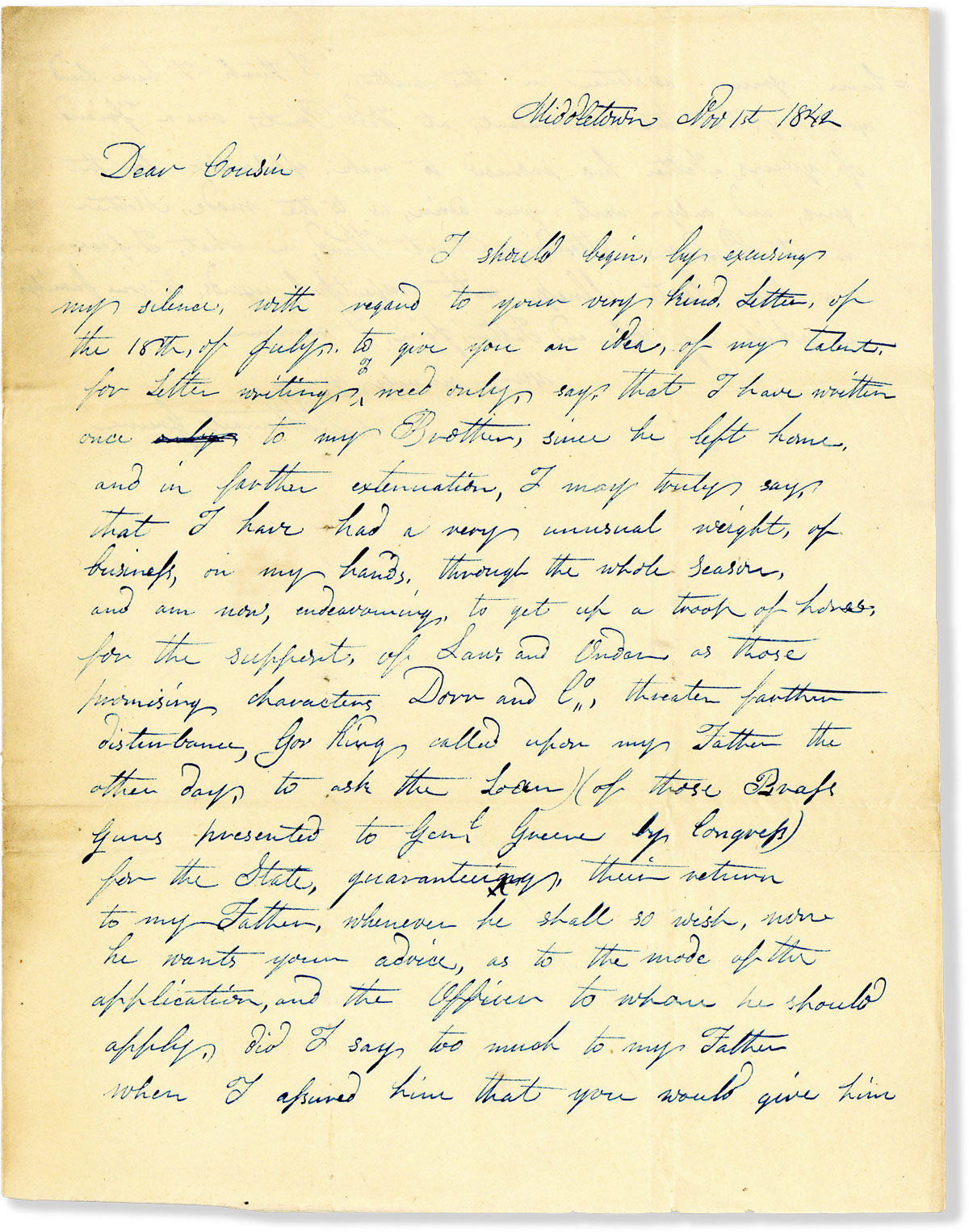
13) Major Nathaniel Greene to Richard Ray Ward, Middletown, 1 November, 1842. 2-page A.L.s., address panel on verso of integral leaf. Greene apologizes for his slow response to Ward's letter of 18 July, but pleads the press of his responsibilities, and explains that he is "now endeavoring to get up a troop of horses for the support of law and order as those promising characters Dorr and Co. threaten further disturbances." He also mentions that Governor King had asked the family for the loan of three brass cannon presented to General Nathaniel Greene by Congress.
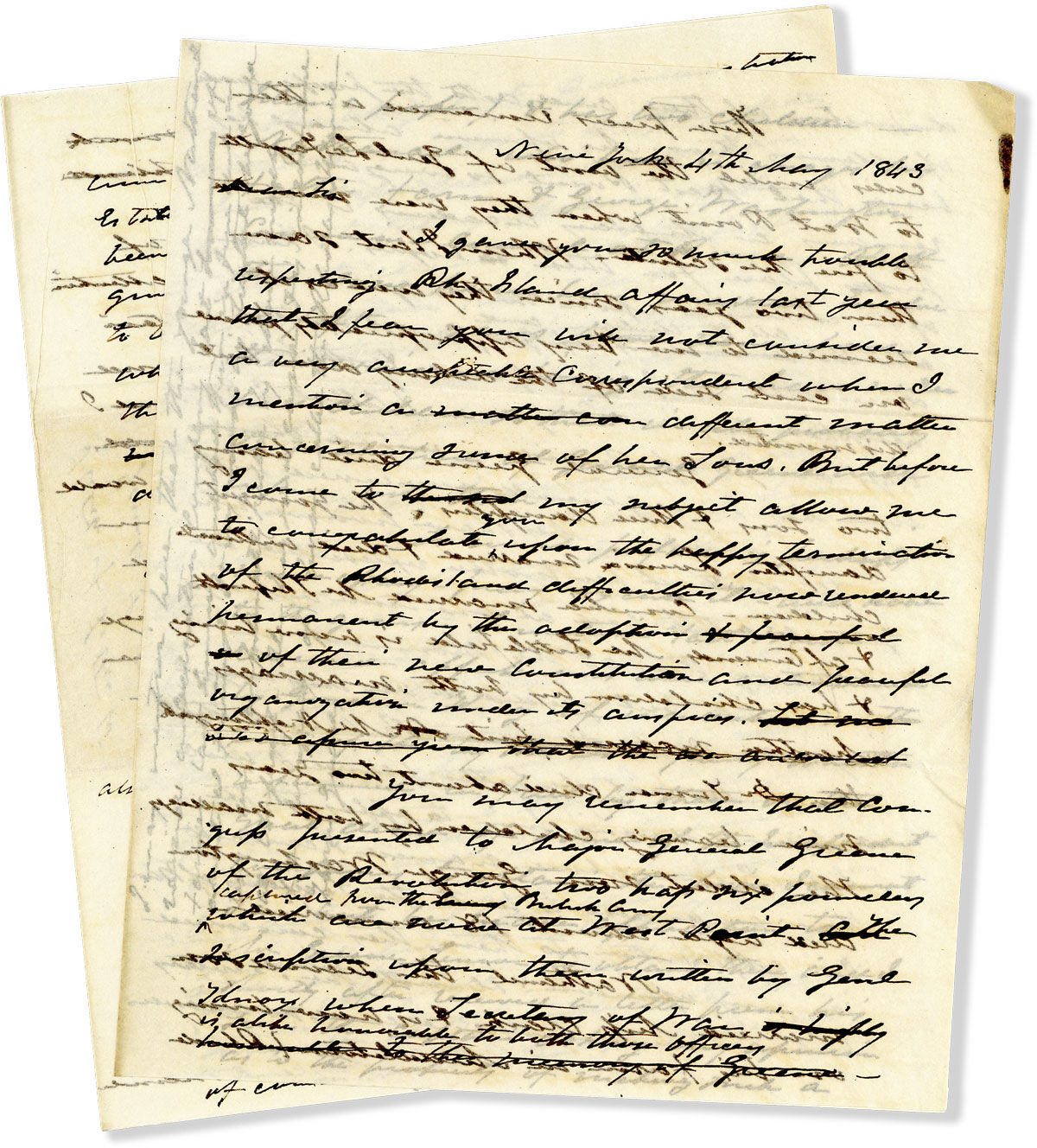
14) Richard Ray Ward to General Winfield Scott, New York, 4 May, 1843. Lengthy 8-page A.L.s. Ward apologizes for the importunities of the previous year, and congratulates the General on the restoration of peace in Rhode Island. He refers to General Greene's cannon, but the thrust of his interest is difficult to discern (unlike the rest of these letters, this is written on thin onion-skin, and the show-through makes it difficult to make out some passages).
A collection of 14 letters dating from 6 April 1842 to 4 May 1843, written by Rhode Island landowners who opposed the Dorr Rebellion, during the most intense phase of the uprising.
In 1841 Rhode Island lacked a constitution and was still governed under the colonial charter of 1663, which restricted suffrage to men only who owned at least $134 in land. In 1840, nearly 60% of free adult males in Rhode Island were disenfranchised-many of them urbanites, whose numbers had greatly increased with the growth of industry.
Thomas W. Dorr, an idealistic Providence attorney who had studied under Chancellor James Kent in New York, pleaded with the Rhode Island General Assembly to call a constitutional convention to address the accumulating grievances. When the ruling conservatives were deaf to reform, Dorr's own party called a constitutional convention in October 1841.
In response, the General Assembly called a rival convention and drafted a new constitution that made some concessions to democratic demands. This Freemen's Constitution was defeated in a state-wide referendum, thanks to Dorrite opposition. Meanwhile, the Dorrite convention drafted the People's Constitution, which was overwhelmingly approved in a second referendum. Both the conventions and referendums had been extralegal, but the Dorrites claimed that their Constitution had been approved by a majority of those entitled to vote under the old charter.
Early in 1842, both Dorr's followers and the charter government forces elected and organized separate governments, Dorr heading one and incumbent governor Samuel Ward King the other. King requested federal protection from President Tyler. The federal government declined to intervene before any actual violence had occurred, but did order two artillery companies to Fort Adams in Newport.
In May, Dorr finally resorted to a show of arms. After an abortive assault on the Providence armory, his government collapsed and Dorr fled the state. King declared martial law, many Dorrites were arrested, and Dorr himself was indicted for high treason. Minor armed clashes and demonstrations caused much excitement. Ultimately the conservatives, finally convinced of the strength of Dorr's cause, called another convention. A new constitution, greatly liberalizing voting requirements, was accepted by both parties.
This archive offers a remarkable view of this pivotal moment in Rhode Island history as seen through the eyes of well-born Rhode Islanders who were not at all pleased with the turmoil fomented by Dorr. Welcome Arnold Greene's letters to his cousin, Richard Ray Ward are especially valuable, as they offer a narrative of the events of the spring and summer of 1842 as they unfold. Notable is the extent and duration of the fear that Dorr's adherents would rise up again. Ward's letters to General Winfield Scott, as well as W. A. Greene's appeal to fund a militia, are the letters of participants who fear for their lives and property. From a scholarly perspective, the tone of patrician disdain for the suffrage agitators reinforces Patrick Conley's argument for a strong nativist dimension in the conflict. At issue also is the role of the federal government in the Rhode Island political crisis.
At the center of this archive is Welcome Arnold Greene (1795-1870). At an early age he entered the employ of his cousin, Samuel Greene Arnold, a prominent merchant of Providence, and was soon entrusted by him with the responsible position of supercargo. In this capacity he made voyages to South America, Spain, Norway, Russia, and the East. Returning from his voyages, Greene accepted the position of cashier of the Mechanics' National Bank of Providence, which he filled from January 7, 1830, to July 11, 1836, when he resigned and withdrew from active business. He was a member of the Franklin Society for the Encouragement of Domestic Industry, and also of the Rhode Island Historical Society, where he filled several offices and was for years its valued Treasurer. He was also a member of the Society of Friends.
His cousin, Richard Ray Ward (1795-1873) was a New York City lawyer. His father was an international merchant who traveled to China and acted as the president of the New York Marine Insurance Company. Ward practiced law in New York City for many years and was also a noted antiquarian. He was an honorary member of the Rhode Island Historical Society from 1823 onwards.
Winfield Scott (1786-1866) is the well-known military commander who took part in the War of 1812, the Mexican-American War, and the early stages of the Civil War, and was the presidential nominee of the Whig Party in 1852.
CONTENTS:
1) Richard Ray Ward to Winfield Scott, 6 April, 1842. Lengthy 4-page A.L.s. on integral leaves. Ward describes a visit to family in Rhode Island and reports on his concern over the agitation for a new constitution extending voting rights. The nativist strain of Dorr's opponents is never more evident than here. Writing of the General Assembly where he has recently spent "several days ... in attendance," Ward reports "that they will in some way continue to escape all evil consequences ... But they have misled a large body of well-meaning ignorant men who will be very likely to make the attempt to carry the design of their leaders into effect and in doing so come into violent collision with the constitutional authorities."
He goes on to say that "the vast manufacturing interests of Rhode Island has swallowed up its commerce while it's agriculture has made but slight advances. Many thousands of floating population now throng the state, some foreigners but principally the more ignorant class fit for factory population from Massachusetts and Connecticut." Complaining of the agitation for a new constitution, Ward asserts "the strangers...compose the great body of men concerned in an attempt to impose an illegal constitution on the State. The leaders however I regret to say are principally Native." Ward concludes by appealing to Scott: "feeling a deep interest in the safety of my friends, as well as in their welfare and honor of that glorious state... might not ... a little additional force of US troops be spared for the forts at Newport and a vessel or two of war be stationed in Narragansett Bay?"
2) Welcome Arnold Greene to Richard Ray Ward, 4 May, 1842. 2-page A.L.s., on integral leaves with address panel. Greene reports on the actions of the General Assembly: "In the afternoon a Petition of Light Infantry for increase of numbers and to prevent forfeit of charter was passed. This was one of the Companys in favor of the suffrage interest or People's Constitution and by management when a majority in favor [of] law and order were present. Such a number of their friends were admitted in as to secure the election of the right kind of officers at their annual meeting ... Then came up the enclosed resolutions [not present], all of which passed unanimously ... except the second which was laid on the table for the present after an able speech from Atwood ... rais[ing] several objections ... the most forcible of which was its conflicting with the Constitution of the United States which prohibits individual states from keeping standing armies. He stated it was in the power of the Legislature to allay the present excitement either by passing an Act for the extension of suffrage as proposed by Jackson ... or by calling another convention for framing a constitution based on an equal representation of that portion of the community authorized to vote on the late rejected Constitution ... Looks like the extension of an olive branch that so far meets the view of the more moderate of the suffrage party as to break their ranks and prevent their organizing..."
3) Richard Ray Ward to General Winfield Scott, 5 May, 1842. 1-page A.L.s. Ward informs Scott of late news regarding the General Assembly and the Dorrites: "You will see that the insurgents at Providence have organized and have passed some pretended laws ... I learn from Newport that the General Assembly organized yesterday ... I also learn that Daniel Brown, a root beer manufacturer and member of the insurgent assembly was yesterday arrested ... for treason and held to bail in the sum of $10,000 ... My hope now is that this unpleasant difficulty may be settled by the ordinary legal means. God grant it may yet, knowing the stubborn character of the Rhode Island people I still fear."
4) Welcome Arnold Greene to Richard Ray Ward, 12 May, 1842. 3-page A.L.s. on integral leaves. Greene expresses his concern about a "mass meeting of the Suffrage Party in front of the courthouse...in which sundry resolutions were read, passed, and ordered to be forwarded [to] the President, Senators, and Representatives in Congress ... they will listen to no compromise which has not for its basis a Constitution emanating from the sovereign people including all male citizens over 21 years of age -- the Algerine Law as they call it..." Greene also addresses at length the question of which side President Tyler supports in this controversy.
5) Welcome Arnold Greene to Richard Ray Ward, 3 June, 1842. Lengthy 4-page A.L.s. Writing two weeks after Dorr's abortive raid on the Cranston Armory, and his subsequent flight, Green writes to Ward of Dorr's persistence, and the threat his movement posed: "I can see or think I can see ... an intended political monster that has among its prominent elements political ambition, ultra-abolitionism, and -- agrarianism. The cry as in revolutionary France will be Liberty and Equality and if successful we may witness a reenactment of some of the scenes of that Revolution..."
Greene describes the situation of Dorr sympathizers in Woonsocket, and suggests that the federal government will be more willing to intercede in the event of a new uprising. The final sentences of the letter offer a peculiar perspective on the role of racism and nativism in this affair. Greene reports that a Suffrage man has bragged that if their plans do not miscarry, "the time would not be very far distant when the great Nabobs of the south would be seen sitting down at table with their greasy slaves," and that this boast has "to say the least no bad effect upon our cause of 'law and order' at Washington," to which Greene adds, "do not understand from this that I am disposed to join in any effort for the continuance of the bondage of the slaves." Greene adds a postscript detailing his suspicion that the arms of the insurgents may have come from New York, and that his young son performs an antic rendition of Dorr's Retreat at the mention of Dorr's name.
6) Richard Ray Ward to General Winfield Scott, 4 June, 1842. 3-page A.L.s. on integral leaves. Ward forwards Greene's account of the situation of the Suffrage partisans to General Scott, and reiterates his suggestion of a naval presence in the bay. He also informs Scott of the number and disposition of the state militia units loyal to Governor King. He described Greene as "a member of the Society of Friends who is apparently 'putting fighting feelings on' in spite of his plain coat."
7) Welcome Arnold Greene to Richard Ray Ward, 14 June, 1842. Lengthy 3-page A.L.s. on integral leaves. Greene takes strong issue with Ward's forwarding of his letter to General Winfield Scott, fearing that it might well be misconstrued. The bulk of the letter concerns news and developments in the Dorr affair since his last letter, especially speculation on the movements of ordnance into the hands of Dorr sympathizers. Greene refers several times to items reported in the Providence Journal, a rabidly anti-Dorr, anti-immigrant newspaper. In closing he mentions that he is tired from having been up much of the night patrolling the city.
8) Welcome Arnold Greene to Richard Ray Ward, 22 June, 1842. 2-page A.L.s. address panel on integral leaf. Greene expresses his concern that another outbreak of violence is imminent, with news of Dorr's return "with about twenty men around him," and the theft of 48 kegs of powder "stolen from Duty Greene's powder house."
9) William G. Ward (?) to Richard Ray Ward, New York, 27 June, 1842. 1-page A.L.s, address panel on verso of integral leaf. Acknowledgment of a receipt of a letter (not present) but evidently describing the tense situation in Rhode Island, and urges Richard R. Ward that if it should come to a fight, "you will not be careless with your life."
10) General John McNeil to Colonel John Abert, Stonington, 26 July, 1842. Lengthy 3-page A.L.s., address panel on verso of integral leaf. "Had it not been for Bankhead I should immediately on assuming command have had a column of 500 men against Chepachet." William Gibbs McNeil, Major-General and Army Engineer, was a native of Stonington, and builder of the railroad from there to Providence. McNeil's involvement in this affray seems to have been fairly spontaneous, for he says that he was asked to play a role while dining in Providence. Moreover, he expresses some ambivalence about the affair, for "Dorr had tendered me the command of his forces." The RIHS has a letter from Winfield Scott, commending McNeil's suppression of the rebellion without federal troops (see Conley, Democracy in Decline, p. 350). Colonel John Abert (17688-1863) was a founder and the first head of the Corps of Topographical Engineers.
11) William Arnold Greene to Richard Ray Ward, Providence 26 July, 1842. 1-page A.L.s. Primarily a social letter thanking Ward for forwarding New York papers, which included Dorr's letter from Chepachet, and forwarding a "General History of the Suffrage Question in Rhode Island" (apparently Jacob Frieze's A Concise History, of the Efforts to Obtain an Extension of Suffrage in Rhode Island from the Year 1811 to 1842). He also announces the birth of a daughter.
12) William Arnold Greene to Richard Ray Ward, Potowomut, 11 August, 1842. 3-page A.L.s. Greene seeks financial support of Ward and his brother in raising a militia, here referred to as the "Guards." "It requires at least $500 in addition to the seven granted by the General Assembly to fill up this company and this will enable them to equip and organize a body of 70 men ... It is difficult to raise money ... I shall contribute liberally myself, although already heavily taxed..." Greene's tone in this letter bespeaks an urgency that suggests he still feels the threat posed by Dorr's adherents.
13) Major Nathaniel Greene to Richard Ray Ward, Middletown, 1 November, 1842. 2-page A.L.s., address panel on verso of integral leaf. Greene apologizes for his slow response to Ward's letter of 18 July, but pleads the press of his responsibilities, and explains that he is "now endeavoring to get up a troop of horses for the support of law and order as those promising characters Dorr and Co. threaten further disturbances." He also mentions that Governor King had asked the family for the loan of three brass cannon presented to General Nathaniel Greene by Congress.
14) Richard Ray Ward to General Winfield Scott, New York, 4 May, 1843. Lengthy 8-page A.L.s. Ward apologizes for the importunities of the previous year, and congratulates the General on the restoration of peace in Rhode Island. He refers to General Greene's cannon, but the thrust of his interest is difficult to discern (unlike the rest of these letters, this is written on thin onion-skin, and the show-through makes it difficult to make out some passages).
Details
Title
Archive of Unpublished Primary Correspondence from the Dorr Rebellion
Author
[AMERICAN INSURRECTIONS] [DORR REBELLION] GREENE, Welcome Arnold, et al.
Condition
Unknown
Publisher
Providence, New York, & Stonington, CT
Date
1842-3