

Ten Late Victorian 'Crystographs for Glass Decoration,' designed to represent Stained glass windows, including examples of borders and center pieces
- 1890
1890. [No imprint, but presumed to be made by Fandel, Phillips & Sons, Newgate St., London, circa 1890].
10 examples of colored transparent crystographs of varying sizes, printed in lithograph? on translucent paper; some displaying signs of wear and having previously been mounted; offered together with five extracted advertisements, neatly cut and mounted on card, together with a photocopy of the title-page of the Fandel, Phillips, & Sons trade catalogue; a lovely group of extremely fragile survivors.
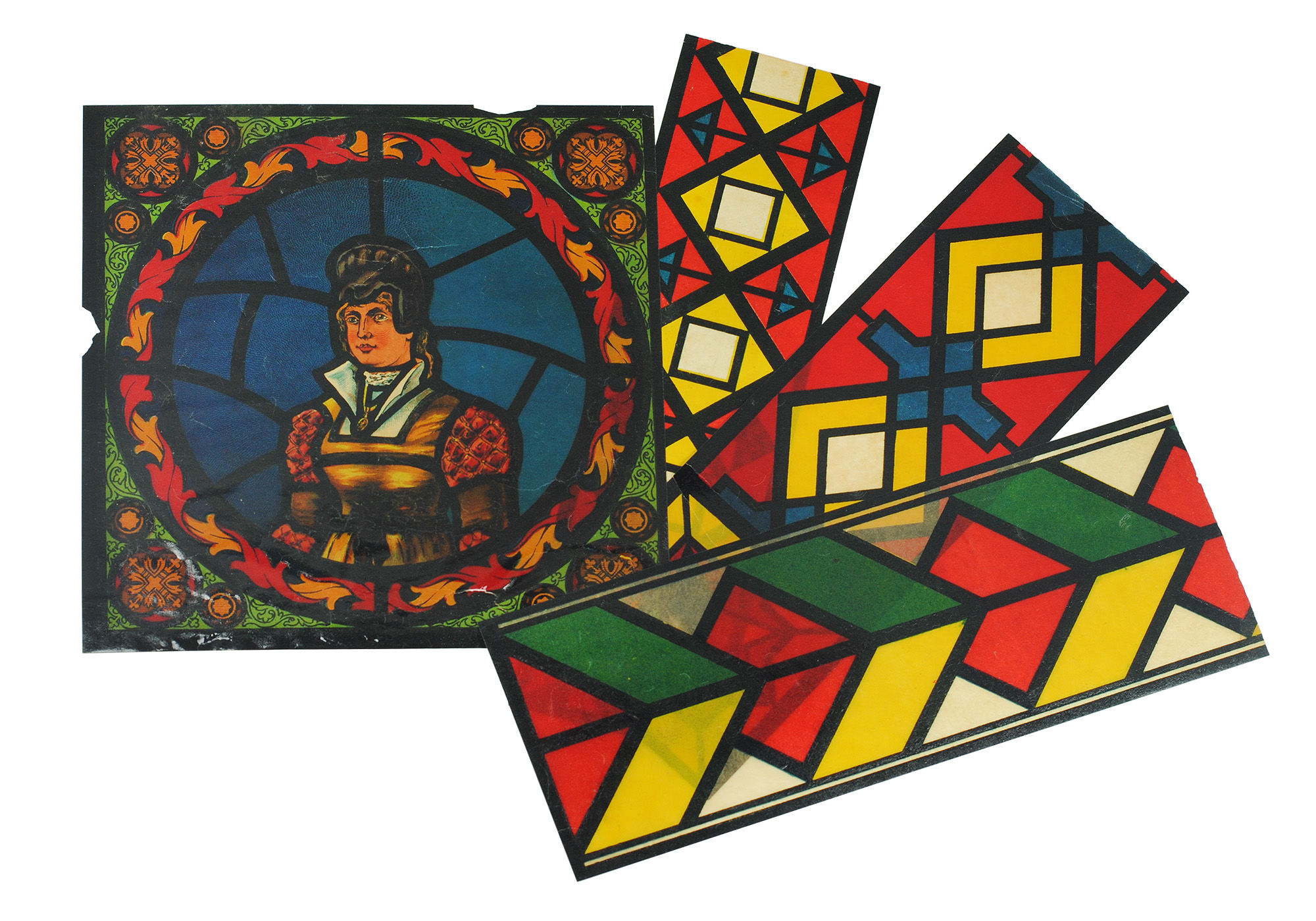
ß Rare surviving specimens of imitation stained glass transparencies; an interesting and rather lovely example of the Victorian passion for illuminated spectacle and of the democratization of the arts and crafts aesthetic.
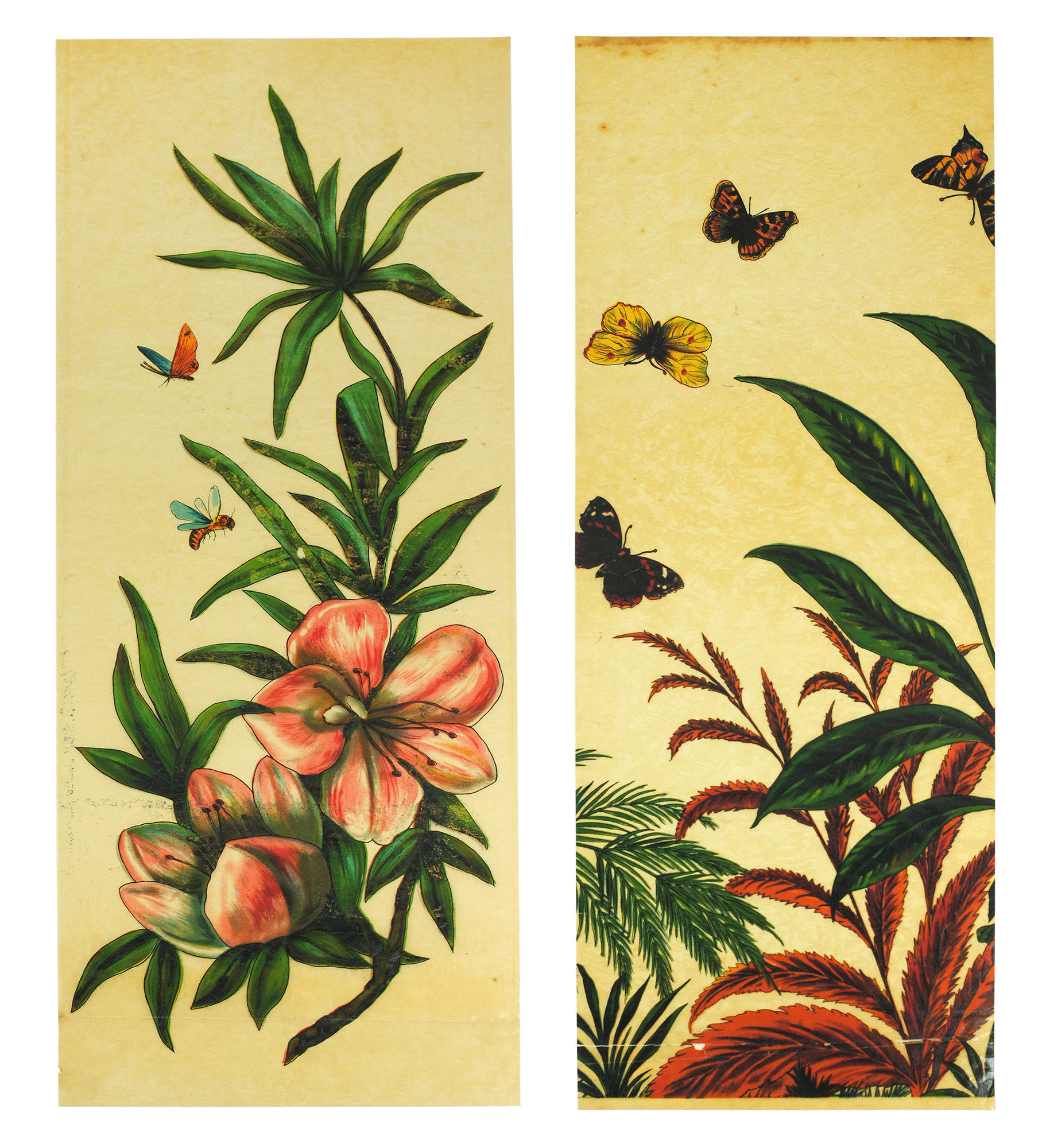
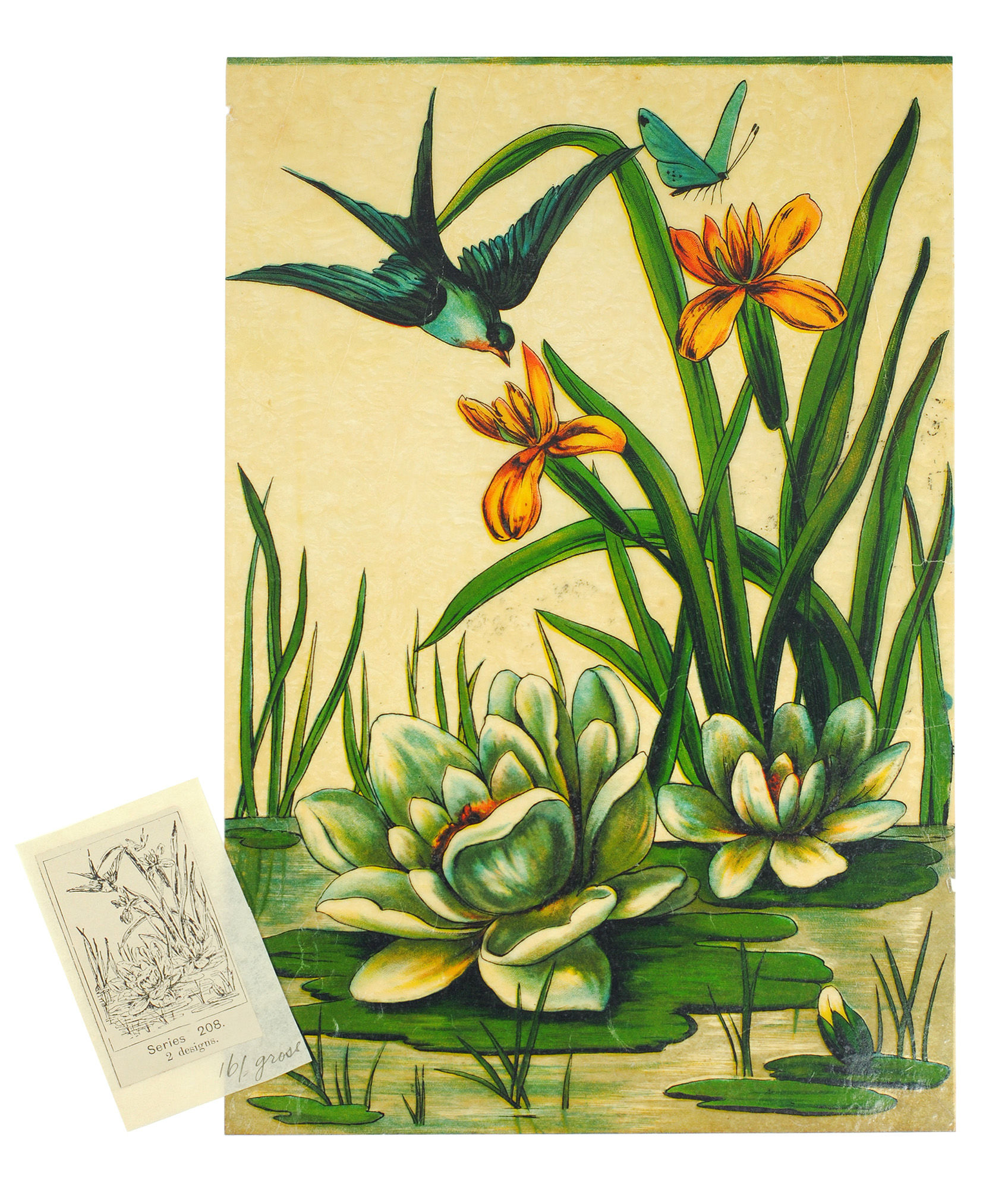
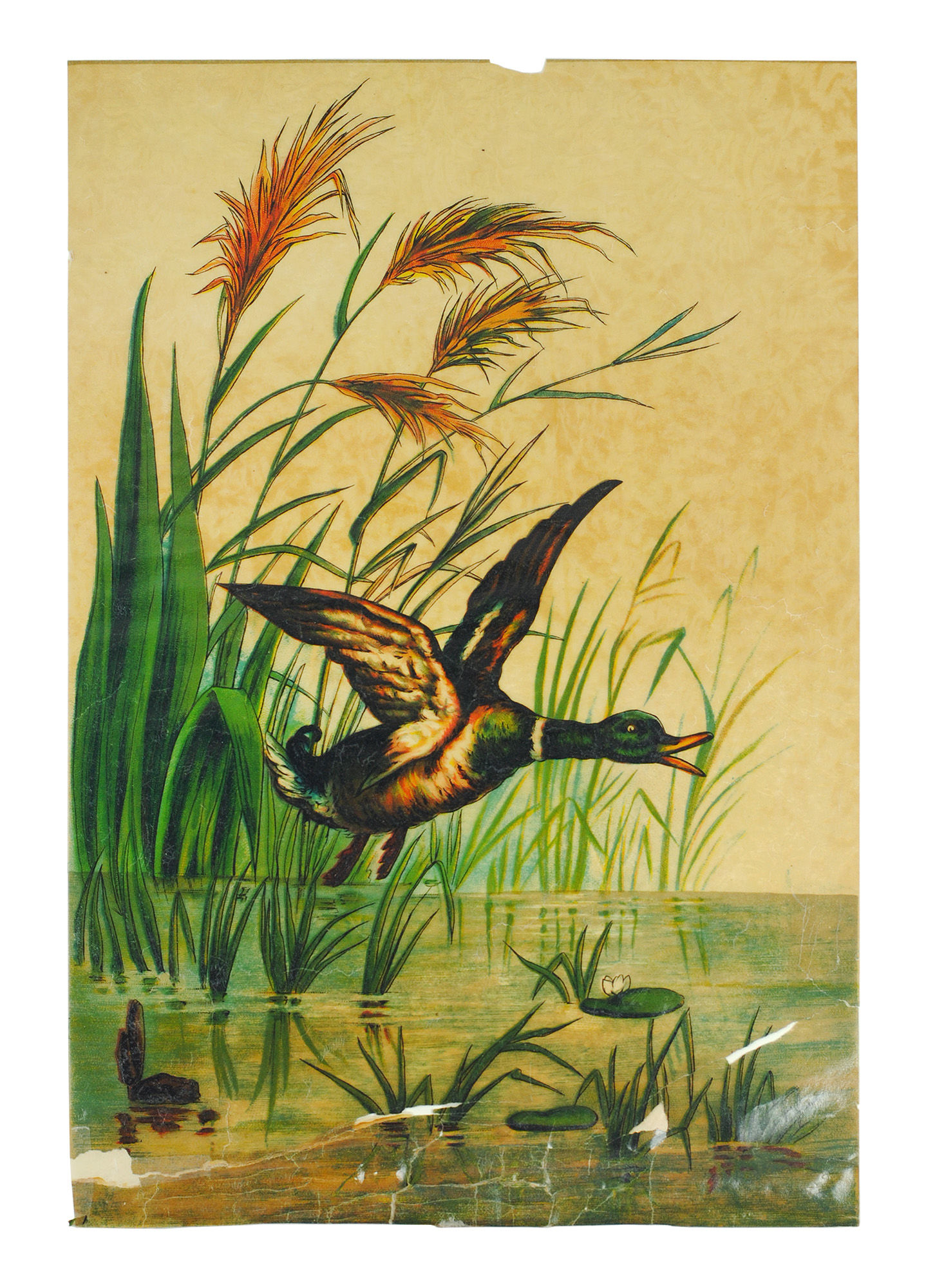
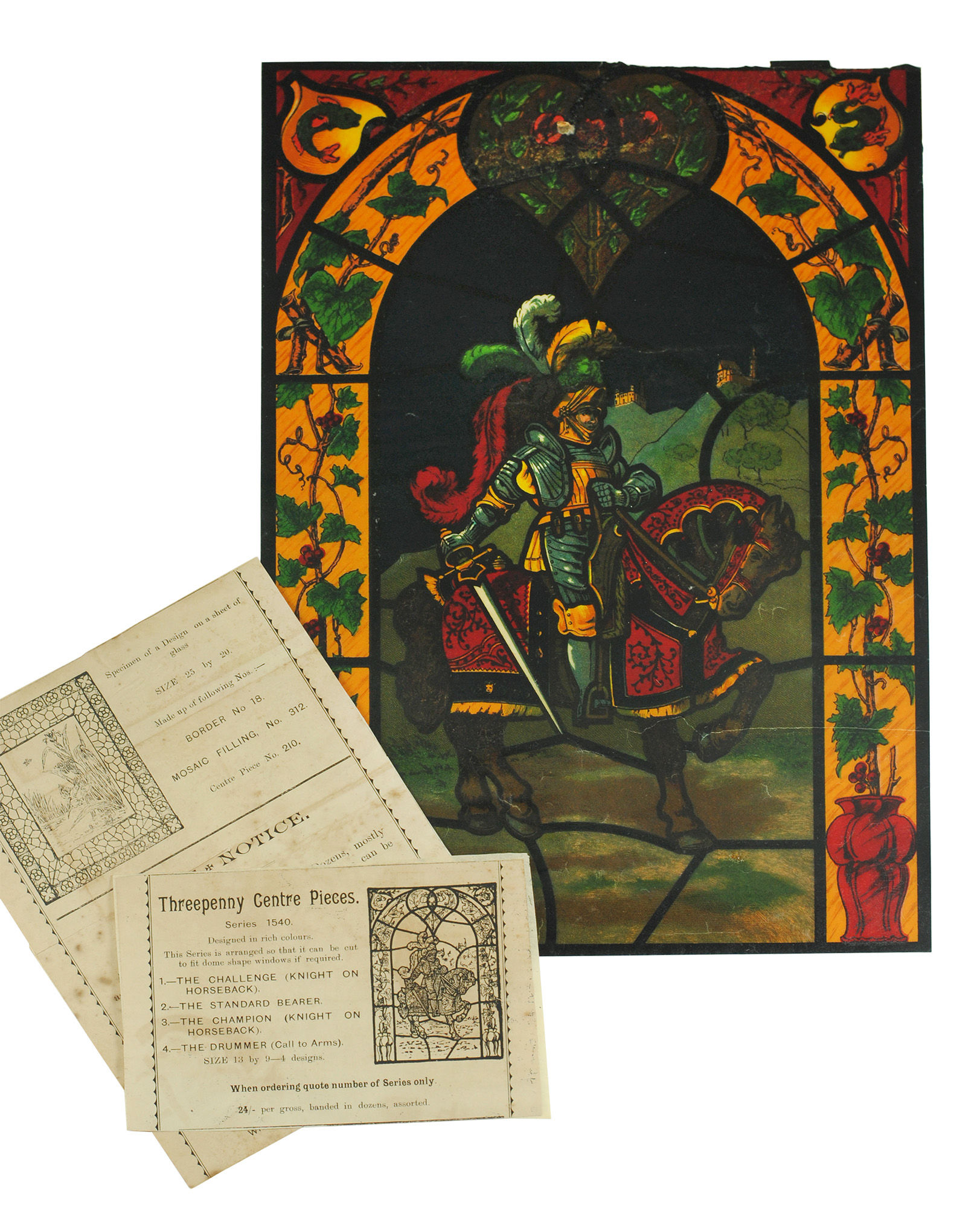
A vibrant and eye-catching small collection of beautiful late-Victorian transparencies or 'Crystographs' for glass and window decoration, presumably done in lithograph, and we believe produced and sold by the London merchants Fandel, Phillips & Sons of Newgate Street, London. Described as being 'cheaper than any imitation stained glass introduced to the public,' they were developed at the end of the 19th century and soon found popularity, with a number of companies, both in the UK and the US offering them for sale. Relatively cheap to purchase, often bought in boxes "banded in dozens, mostly assorted," the innovation could enable "a large surface of blank cheerless glass... [to] be converted into a rich artistic and antique picture for about one shilling" (Fandel trade catalogue description, provided in photocopy). "The material on which subjects are depicted is a new one, and is unaffected by the atmospheric influence, does not allow the colors to fade, and so affords a scope for talent in adapting the design to any size window, or other glass object that may be desired" (ibid). As one of the accompanying advertisements reveals, the crystographs were divided into center pieces, border pieces, and large sheets, with all manner of themes printed, the present selection including attractive images of birds, flowers and butterflies, a knight on his charger, a medieval lady, together with geometric border patterns. The present collection includes designs of various size, with examples of center pieces and borders. Other advertisements included here note a series of "imitation photographs" of churches, figures from folklore, "scripture subjects," with more prosaic images also available for more commercial use perhaps, such as "hot sausages and potatoes" and "ice creams."
With regards to the provenance of this group, it is our understanding that they were originally found within a Victorian trade catalogue issued by Kingsbury & Co, presumably as specimen pieces, accompanied by the advertisements, the catalogue having sadly been broken up some time ago by a previous owner. Kingsbury & Co. seems likely to have been the Fleet Street newsagent Kingsbury & Co., which is listed at being at 7 Racquet Court in the Post Office Directory for 1891. Henry Fandel and Benjamin Samuel Phillips are listed as working together in the London Gazette of 1839, and they are later described in the Post Office Directory as 'Warehousemen, importers of berlin & other wools, toys, fancy & japanese & oriental goods, & manufacturers of every description of embroidery silks, haberdashers & lace warehousemen." We are unsure as to whether the photocopy we have of their "Catalogue of Crystographs to Represent Stained Glass Windows" was bound together with the Kingsbury & Co Catalogue, but it seems likely.
We have found online advertisements for other producers of crystographs, including John Thridgould & Co., of London, who promoted them as being "the most perfect substitute for costly stained glass windows" (in the journal Literary World, Vol. 42 1890) and the Penfield [paper] manufacturing Company of Philadelphia, promoting them in an 1892 Church Magazine as being of use in "Churches, Schools, houses, Offices, Libraries etc."
Bearing in mind their fragility, a wonderful and scarce survivor.
The group includes:
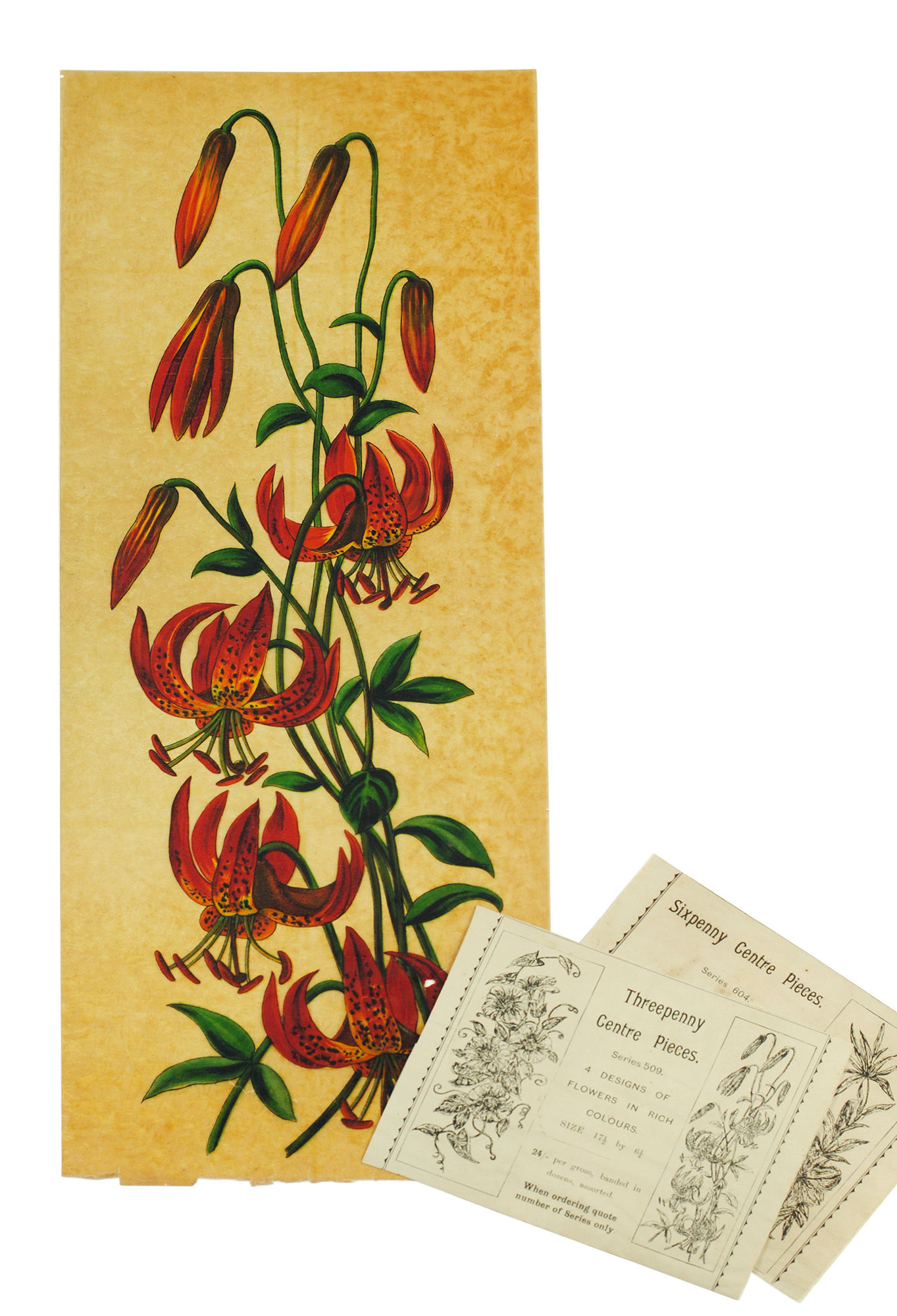
1. Image of Lillies (444 x 168 mm): 'Threepenny Centre Pieces - Series 509, 4 Designs of Flowers in Rich Colors.' (1 of 4 seemingly) ; a little browned, tail edge somewhat nicked with slight loss though not touching image; with original extracted advertisement mounted on card.
2. I. Flowers, Butterfly, and Bee (517 x 195 mm); with foliage and Four Butterflies (410 x 168 mm): 'Sixpenny Centre Pieces - Series 604, 2 Designs of Flowers in Rich Colours' and seemingly both designs; a little browned and soiled, slight cracking towards tail of second sheet; with original extracted advertisement mounted on card.
3. 'Threepenny Centre Pieces. Series 1560. 'Designed in Rich Colours. This series is arranged so that it can be cut to fit dome shape windows if required. I - The Challenge (Knight on Horseback)' (1 of 4). 330 x 228 mm; some discrete tape repairs to verso, upper margin nicked with slight loss; with original extracted advertisement mounted on card.
4. Two penny Centre Piece? Possibly Series 545 'My Lady Bountiful,' depicting Lady in Waiting in Tudor Costume, 190 x 178 mm, some minor cracking visible, with remains of old mount at tail of verso.
5. One Penny Centre Piece? 'Series 208, 2 designs,' (1 of 2) Blue Bird flying over a lily pond (290 x 195 mm), discrete tape repairs to verso; with original extracted advertisement mounted on card.
6. One Penny Centre Piece, possibly Series 208 or 210 (290 x 195 mm); torn and cracked with loss of image at tail, with remains of old mount at tail of verso, and small nick at upper margin.
7. Three geometric cords pieces, (230 x 75 mm; 228 x 85 mm; 230 x 65 mm); each very good.
10 examples of colored transparent crystographs of varying sizes, printed in lithograph? on translucent paper; some displaying signs of wear and having previously been mounted; offered together with five extracted advertisements, neatly cut and mounted on card, together with a photocopy of the title-page of the Fandel, Phillips, & Sons trade catalogue; a lovely group of extremely fragile survivors.
ß Rare surviving specimens of imitation stained glass transparencies; an interesting and rather lovely example of the Victorian passion for illuminated spectacle and of the democratization of the arts and crafts aesthetic.
A vibrant and eye-catching small collection of beautiful late-Victorian transparencies or 'Crystographs' for glass and window decoration, presumably done in lithograph, and we believe produced and sold by the London merchants Fandel, Phillips & Sons of Newgate Street, London. Described as being 'cheaper than any imitation stained glass introduced to the public,' they were developed at the end of the 19th century and soon found popularity, with a number of companies, both in the UK and the US offering them for sale. Relatively cheap to purchase, often bought in boxes "banded in dozens, mostly assorted," the innovation could enable "a large surface of blank cheerless glass... [to] be converted into a rich artistic and antique picture for about one shilling" (Fandel trade catalogue description, provided in photocopy). "The material on which subjects are depicted is a new one, and is unaffected by the atmospheric influence, does not allow the colors to fade, and so affords a scope for talent in adapting the design to any size window, or other glass object that may be desired" (ibid). As one of the accompanying advertisements reveals, the crystographs were divided into center pieces, border pieces, and large sheets, with all manner of themes printed, the present selection including attractive images of birds, flowers and butterflies, a knight on his charger, a medieval lady, together with geometric border patterns. The present collection includes designs of various size, with examples of center pieces and borders. Other advertisements included here note a series of "imitation photographs" of churches, figures from folklore, "scripture subjects," with more prosaic images also available for more commercial use perhaps, such as "hot sausages and potatoes" and "ice creams."
With regards to the provenance of this group, it is our understanding that they were originally found within a Victorian trade catalogue issued by Kingsbury & Co, presumably as specimen pieces, accompanied by the advertisements, the catalogue having sadly been broken up some time ago by a previous owner. Kingsbury & Co. seems likely to have been the Fleet Street newsagent Kingsbury & Co., which is listed at being at 7 Racquet Court in the Post Office Directory for 1891. Henry Fandel and Benjamin Samuel Phillips are listed as working together in the London Gazette of 1839, and they are later described in the Post Office Directory as 'Warehousemen, importers of berlin & other wools, toys, fancy & japanese & oriental goods, & manufacturers of every description of embroidery silks, haberdashers & lace warehousemen." We are unsure as to whether the photocopy we have of their "Catalogue of Crystographs to Represent Stained Glass Windows" was bound together with the Kingsbury & Co Catalogue, but it seems likely.
We have found online advertisements for other producers of crystographs, including John Thridgould & Co., of London, who promoted them as being "the most perfect substitute for costly stained glass windows" (in the journal Literary World, Vol. 42 1890) and the Penfield [paper] manufacturing Company of Philadelphia, promoting them in an 1892 Church Magazine as being of use in "Churches, Schools, houses, Offices, Libraries etc."
Bearing in mind their fragility, a wonderful and scarce survivor.
The group includes:
1. Image of Lillies (444 x 168 mm): 'Threepenny Centre Pieces - Series 509, 4 Designs of Flowers in Rich Colors.' (1 of 4 seemingly) ; a little browned, tail edge somewhat nicked with slight loss though not touching image; with original extracted advertisement mounted on card.
2. I. Flowers, Butterfly, and Bee (517 x 195 mm); with foliage and Four Butterflies (410 x 168 mm): 'Sixpenny Centre Pieces - Series 604, 2 Designs of Flowers in Rich Colours' and seemingly both designs; a little browned and soiled, slight cracking towards tail of second sheet; with original extracted advertisement mounted on card.
3. 'Threepenny Centre Pieces. Series 1560. 'Designed in Rich Colours. This series is arranged so that it can be cut to fit dome shape windows if required. I - The Challenge (Knight on Horseback)' (1 of 4). 330 x 228 mm; some discrete tape repairs to verso, upper margin nicked with slight loss; with original extracted advertisement mounted on card.
4. Two penny Centre Piece? Possibly Series 545 'My Lady Bountiful,' depicting Lady in Waiting in Tudor Costume, 190 x 178 mm, some minor cracking visible, with remains of old mount at tail of verso.
5. One Penny Centre Piece? 'Series 208, 2 designs,' (1 of 2) Blue Bird flying over a lily pond (290 x 195 mm), discrete tape repairs to verso; with original extracted advertisement mounted on card.
6. One Penny Centre Piece, possibly Series 208 or 210 (290 x 195 mm); torn and cracked with loss of image at tail, with remains of old mount at tail of verso, and small nick at upper margin.
7. Three geometric cords pieces, (230 x 75 mm; 228 x 85 mm; 230 x 65 mm); each very good.
Details
Title
Ten Late Victorian 'Crystographs for Glass Decoration,' designed to represent Stained glass windows, including examples of borders and center pieces
Author
[Decorative Arts]
Condition
Unknown
Date
1890