

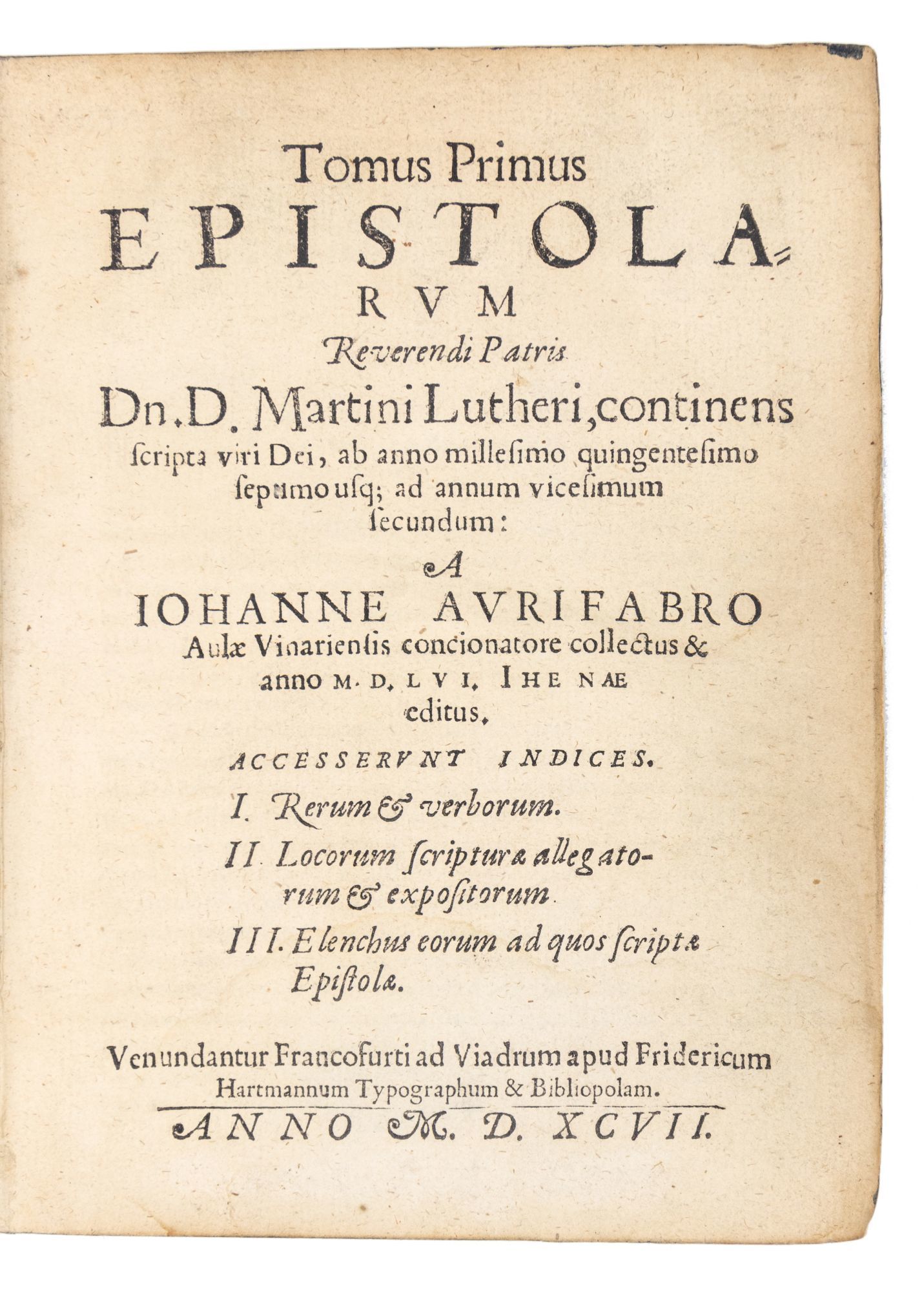
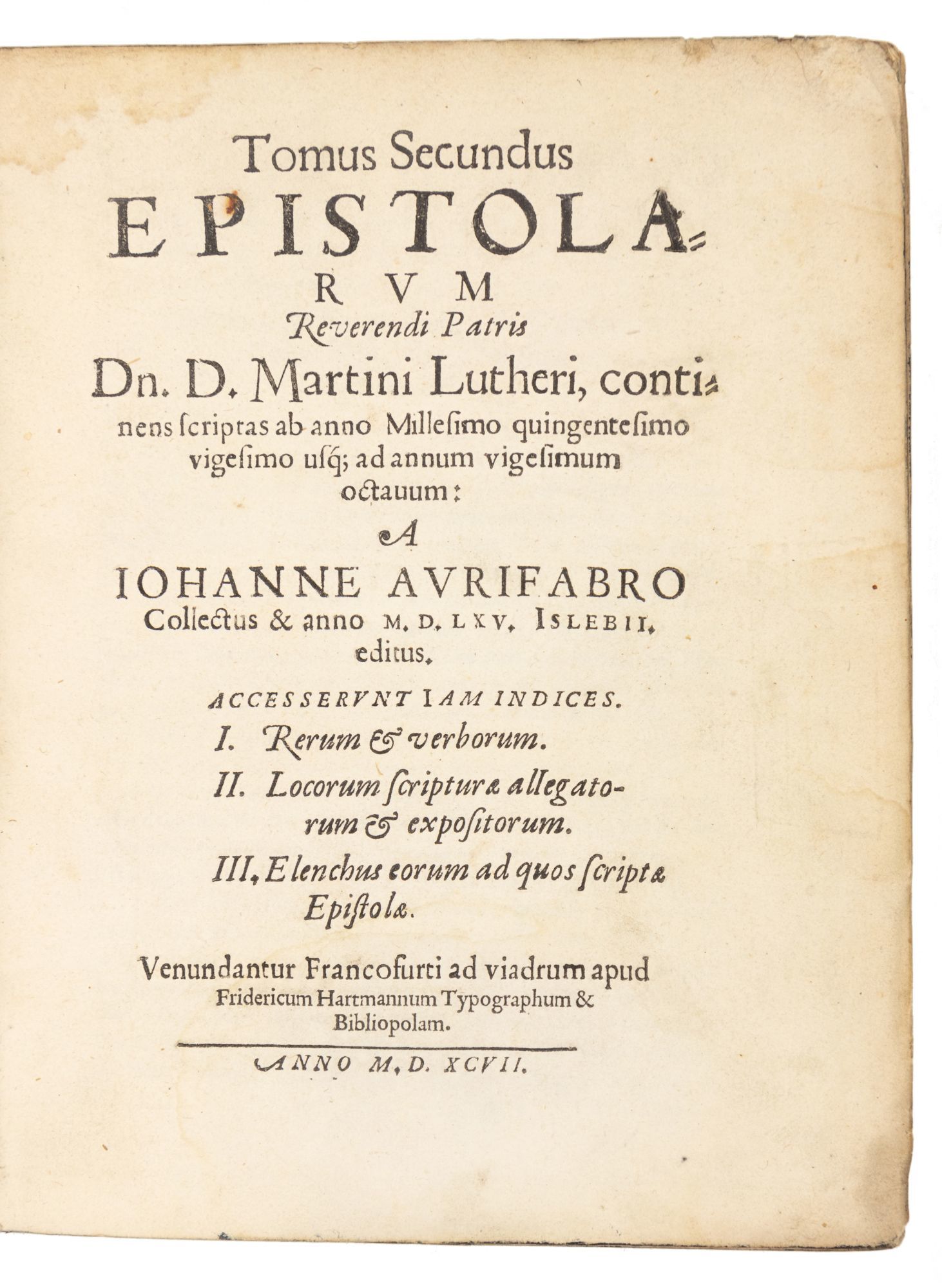
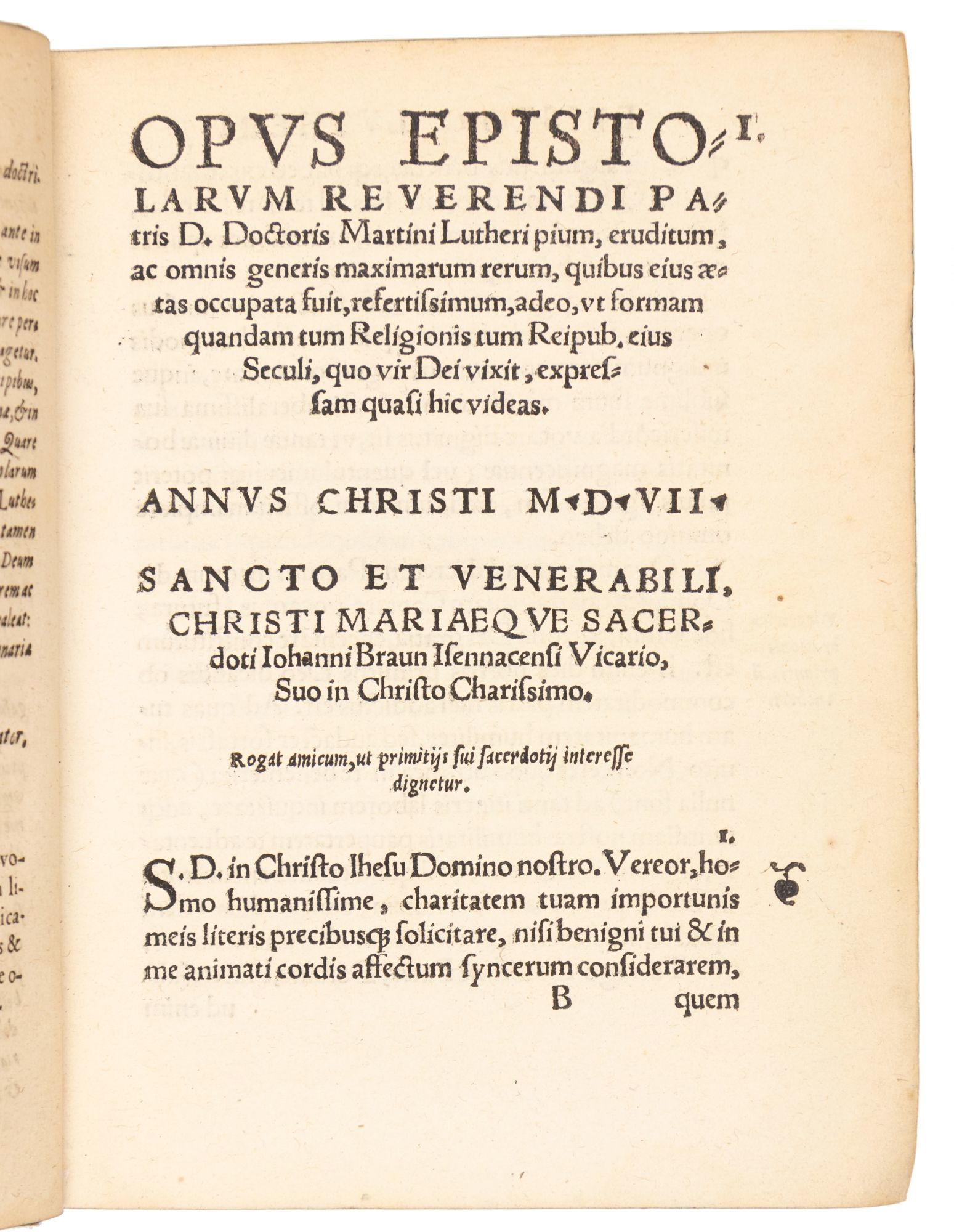
Tomus Primus Epistolarum… continens scripta viri Dei, ab anno millesimo quingentesimo septimo usq(ue) ad annum vicesimum secundum: A Iohanne Aurifabro…. collectus & anno M.D.LVI... editus… [and] Tomus secundus Epistolarum … continens scriptas ab anno millesimo quingentesimo vigesimo usq(ue) ad annum vigesimum octavum: A Iohanne Aurifabro Collectus & anno M.D.LXV... editus
- Hardcover
- Frankfurt an der Oder: Friedrich Hartmann, 1597
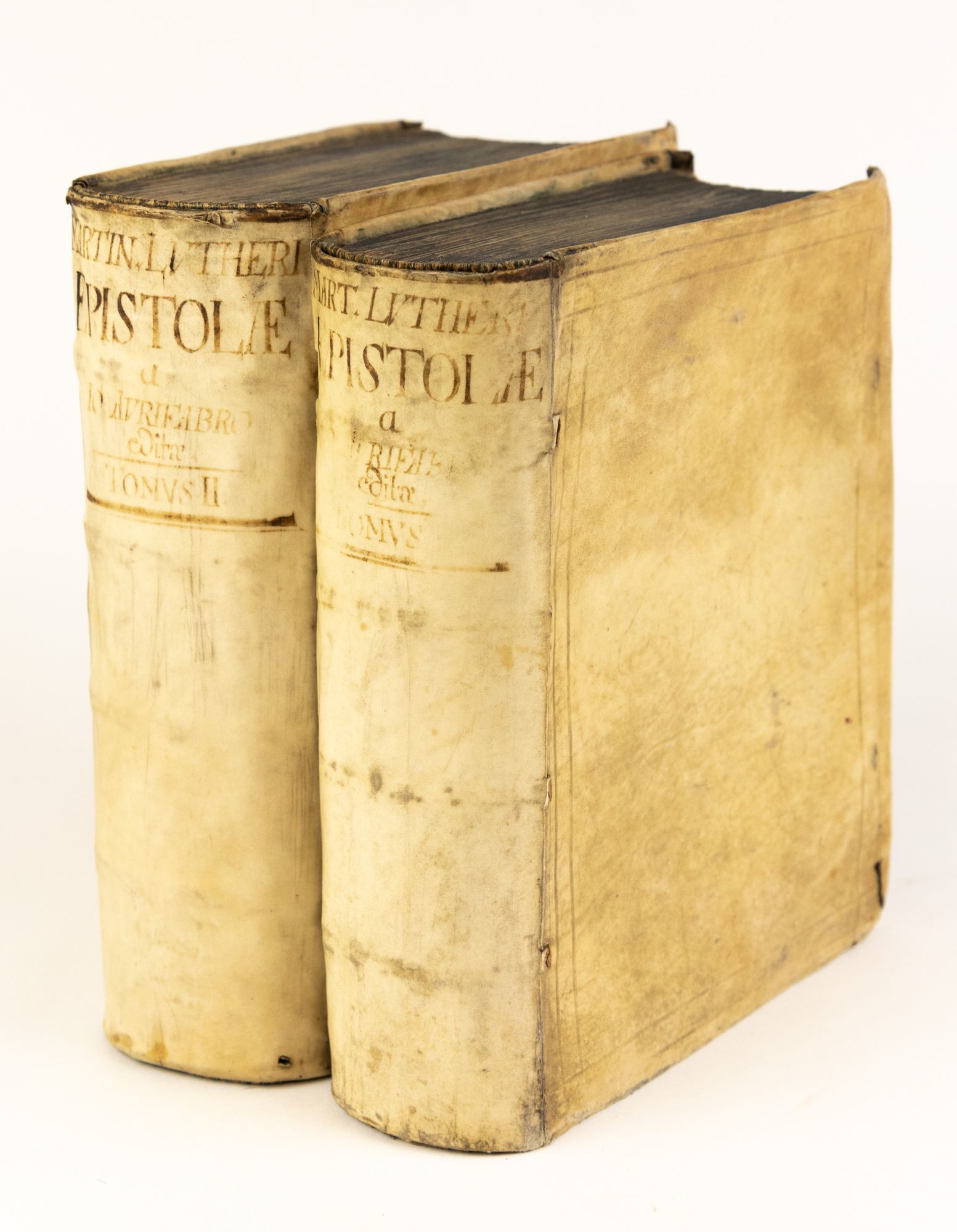
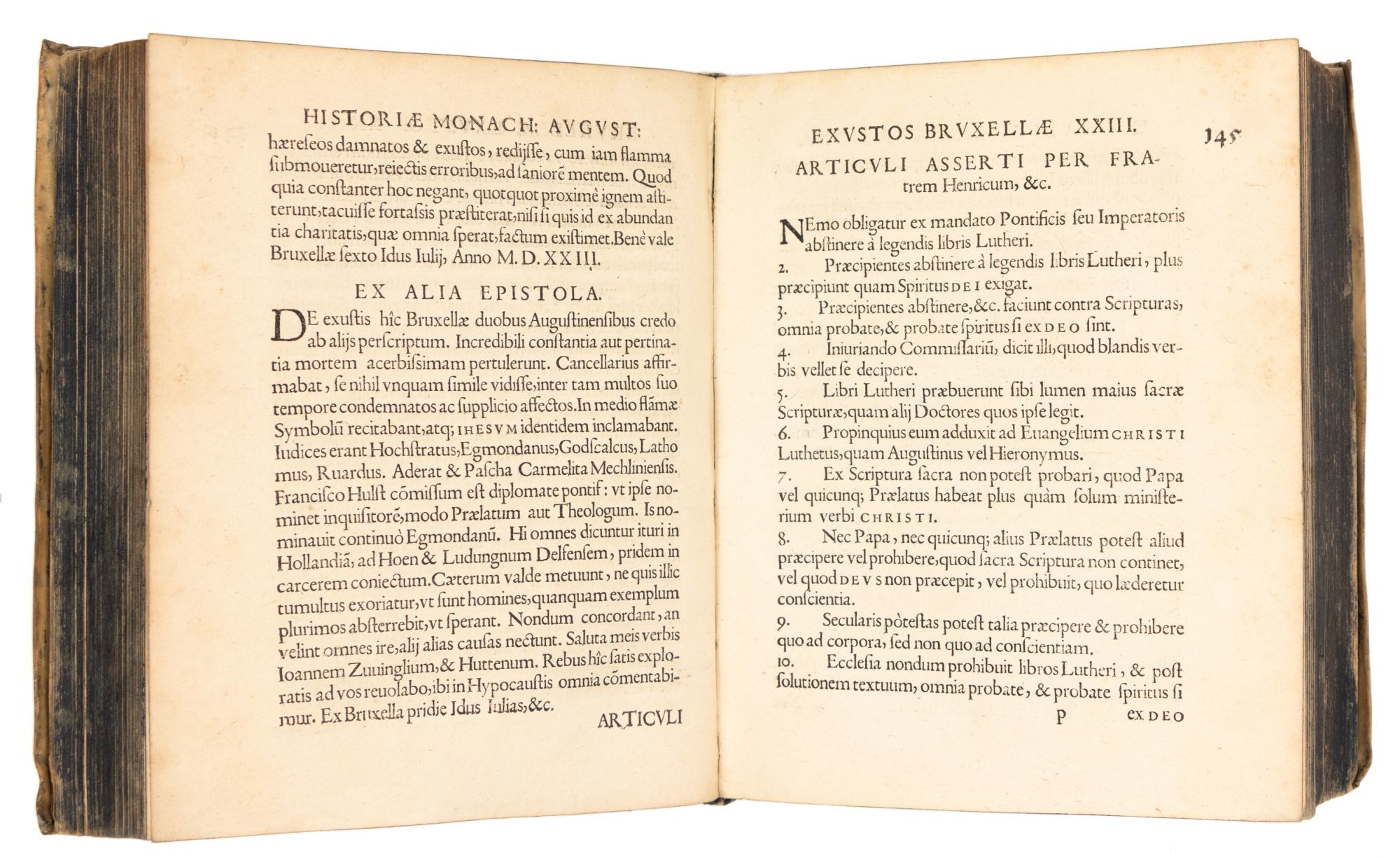
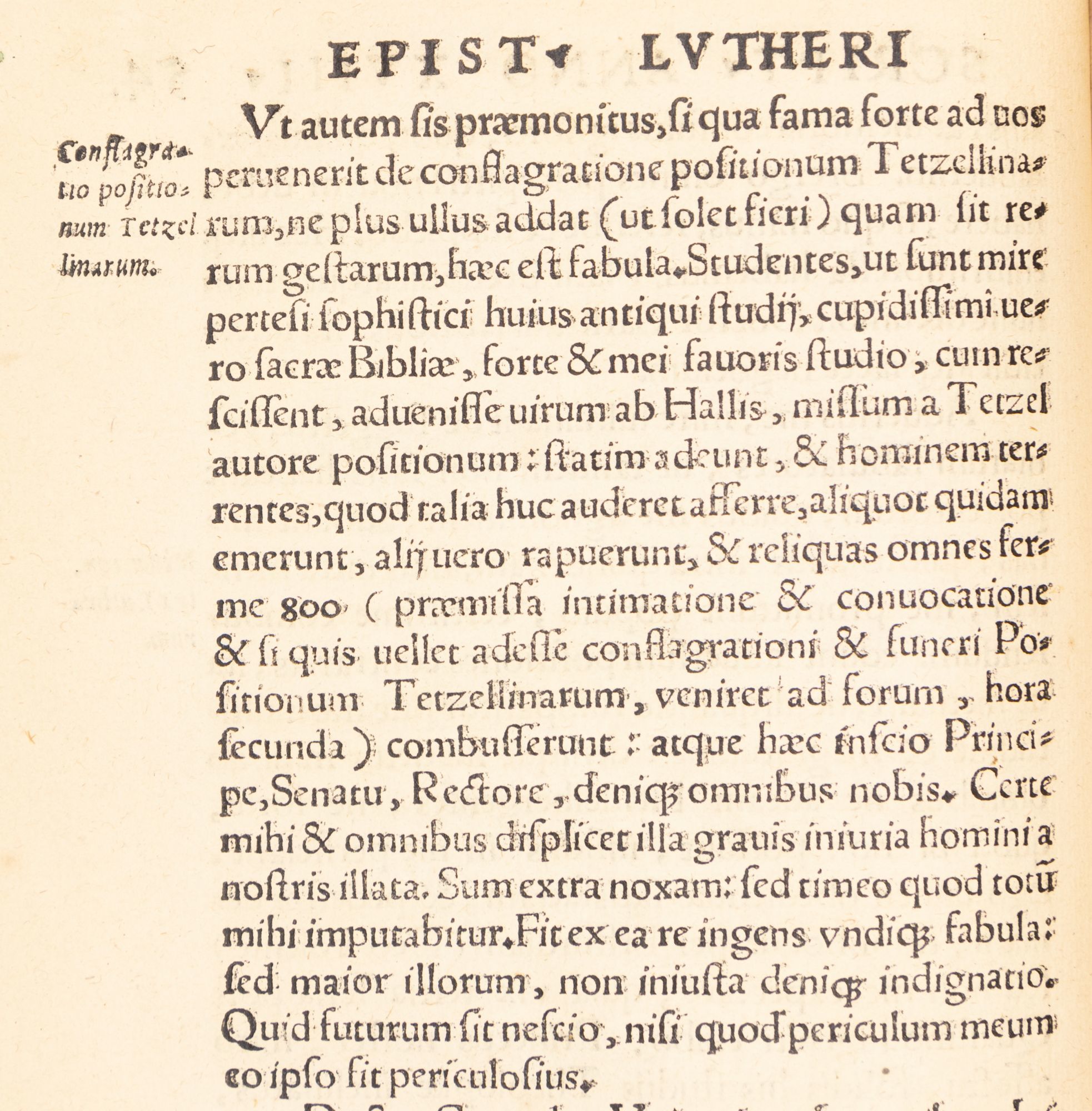
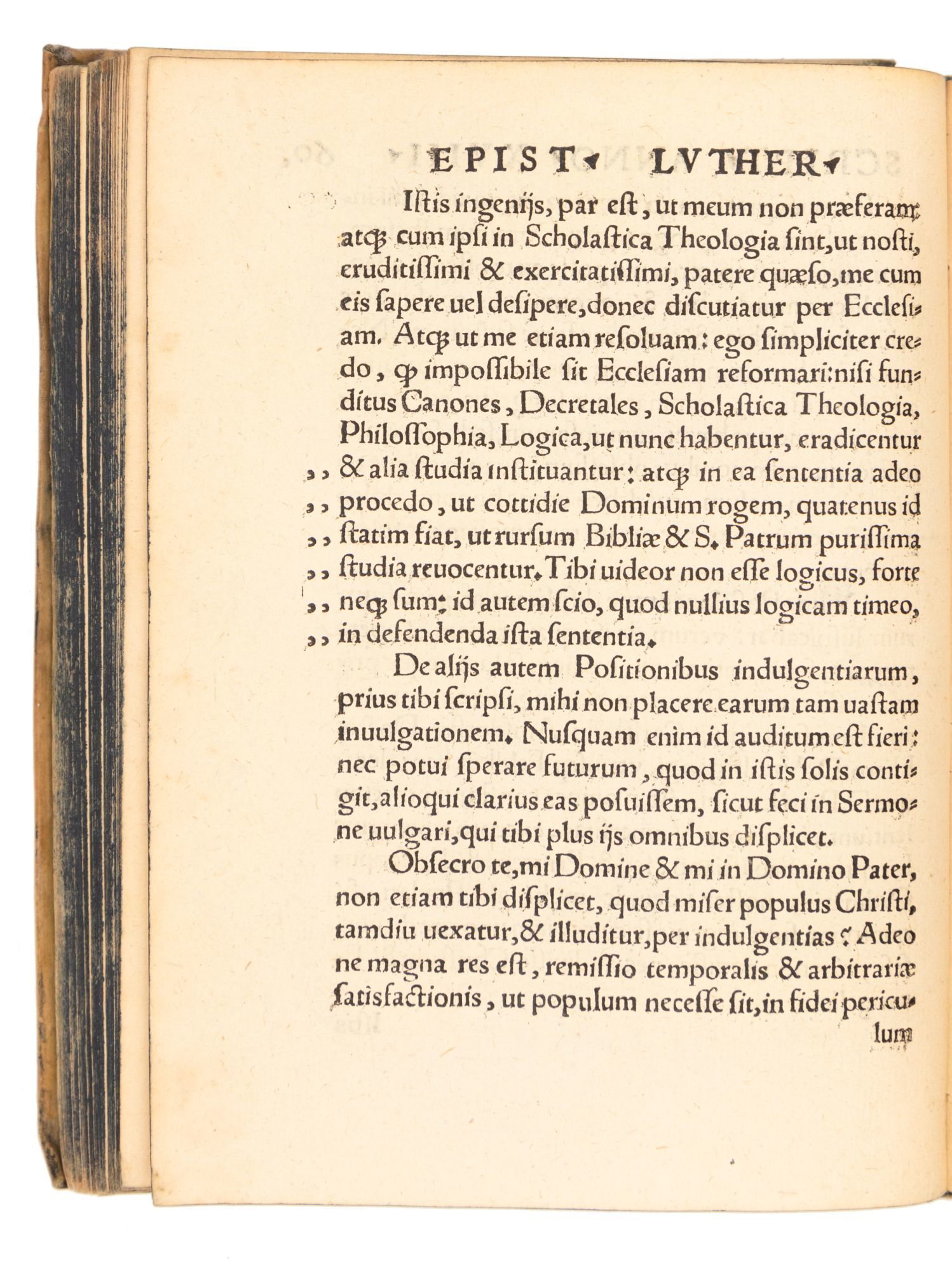
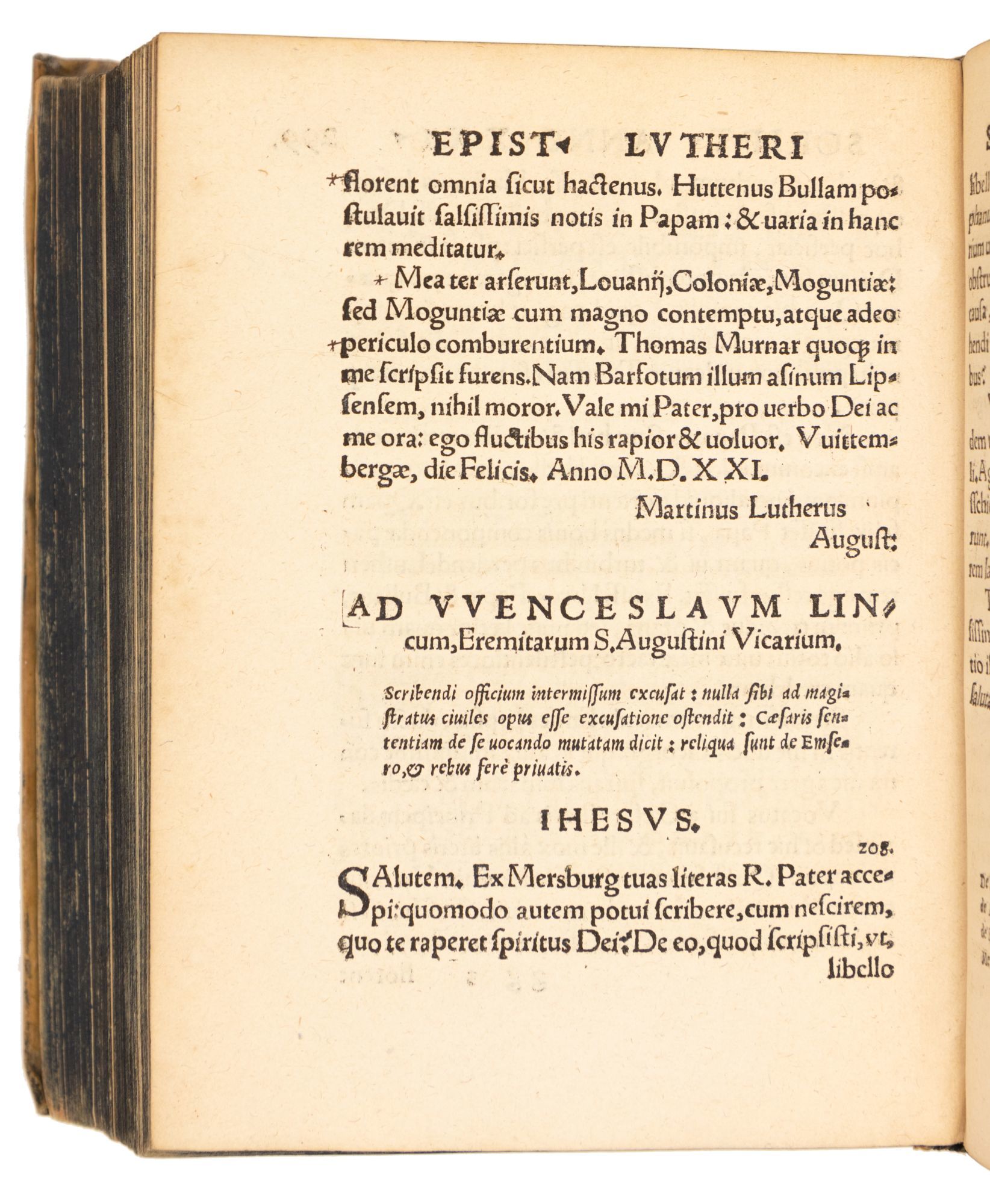
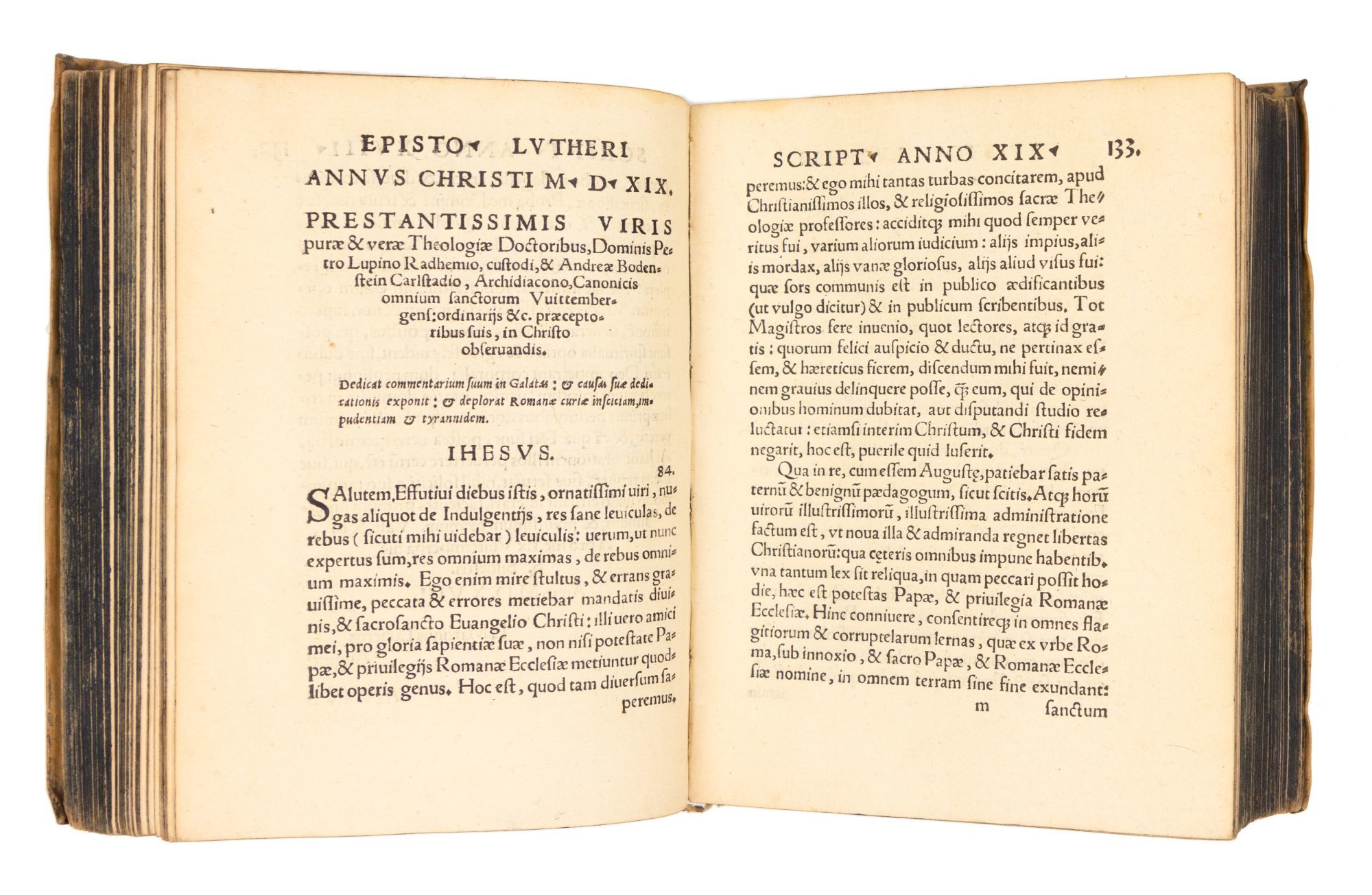
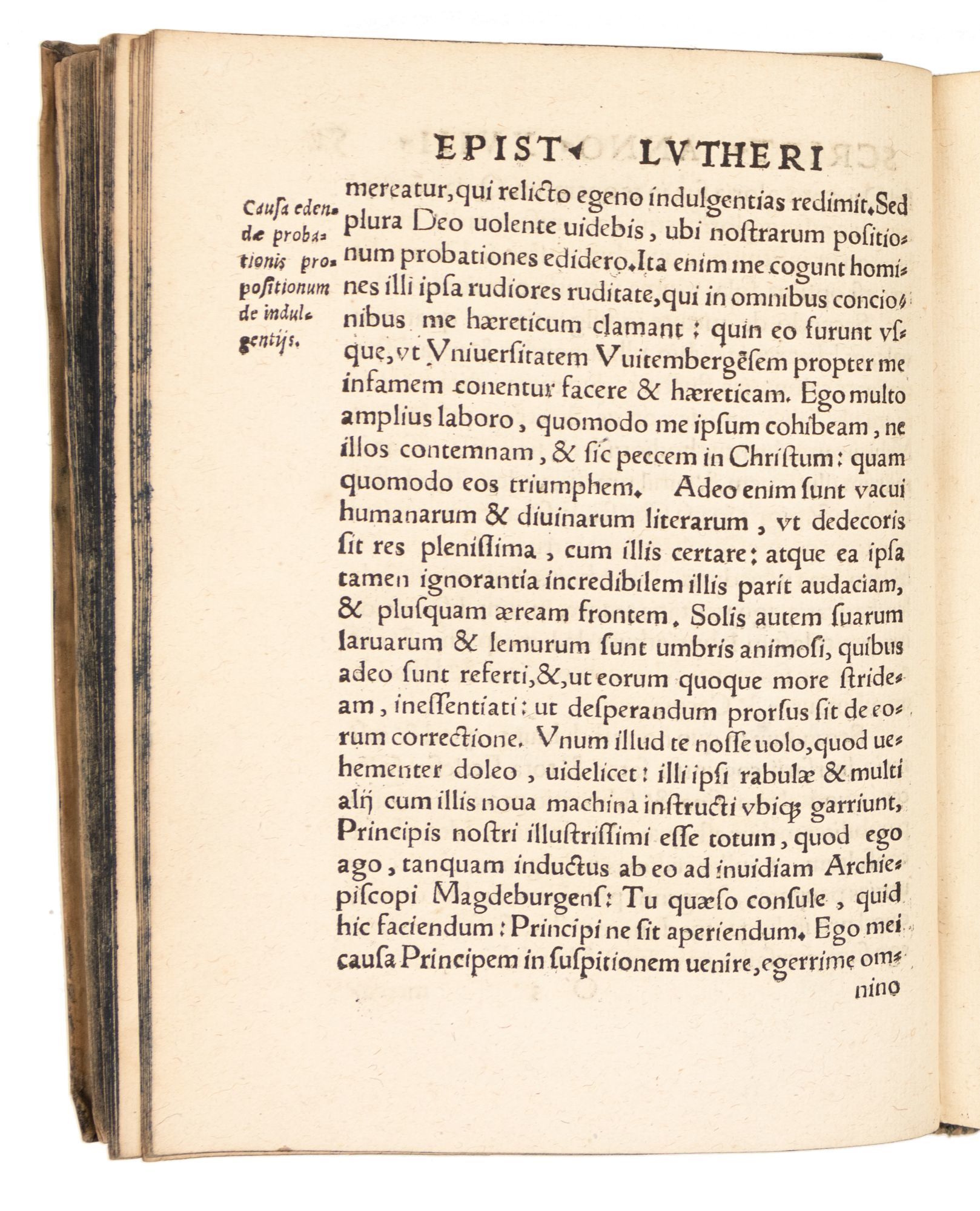
Frankfurt an der Oder: Friedrich Hartmann, 1597. THIRD EDITION (the 1st ed. of Vol. I appeared in 1556; 1st ed. of Vol. II in 1565). Hardcover. Fine. Bound in matching 17th c. stiff vellum, ruled in blind (covers slightly bowed, vellum lightly soiled, small split at head of rear hinge of Vol. I, 1 end-band loose). The contents are in overall excellent condition, with minor blemishes (Vol I: leaf D2 with small natural paper flaw affecting a few letters, small paste stain to lvs. m3, q2, and GG1; a few index lvs. lightly browned. Vol. II: title very slightly frayed; first four lvs. damp-stained at head, a handful of gatherings with very light damp-stains in the lower margin.) The dimensions of the two volumes, in matching early bindings, differ in size by about 1 cm. Edges of text-block stained an even blue. Third printing of Martin Luther's early correspondence, edited by Joannes Aurifaber (1519-1575), Luther’s private secretary, who lived with Luther at the time of the Reformer’s death. The first volume contains 255 letters from 1507 to 1522 (from the celebration of his first Mass to his removal to Wartburg Castle after the Diet of Worms). The second has 407 letters, from 1520 to 1528.
These letters offer a revealing view of Luther’s private and public thoughts on matters of pivotal importance to the early reformation. They include a "cover letter" to a copy of the 95 Theses, written on the very day (October 31st, 1517) that Luther nailed the Theses to the door of the Castle Church in Wittenberg. In this letter, addressed to Cardinal Albrecht, Archbishop of Magdeberg and Mainz, Luther requests that the indulgence traffic be halted. In a related letter, written as a dedication to his explanations of the 95 Theses, Luther gives an account of his understanding of penitence, which led him finally to the attack on indulgences.
Included are letters to Pope Leo X (1475-1521), King Henry VIII (1491-1547), Georg Spalatin (1484-1545), Philip Melanchthon (1497-1560), Frederick, Elector of Saxony (1463-1525), Emperor Charles V (1500-1558), Andreas Karlstadt (1486-1541), Cardinal Tommaso de Vio Cajetan (1470-1534), and many others. This collection also includes Luther’s first letter to Erasmus, written at Wittenberg on March 28th, 1519 (Vol. I, p. 156-158) and several letters in which Luther discusses his opinions of Erasmus’ theology.
The letters’ chronological arrangement allows the reader to follow the development of Luther’s thought and the political ramifications of his actions. Luther provides first-hand accounts of his efforts to avoid a trial in Rome, his negotiations with the Pope’s secretary, Karl von Miltitz, and the papal legate, Cardinal Cajetan, and his eventual appearance before the Emperor at the Diet of Worms. Included are Luther’s letter to Cajetan (Oct., 1518), written as Luther fled the Augsburg to avoid being kidnapped and taken to Rome, and a letter of apology to Pope Leo X (Jan., 1519) in which Luther argues that he is now powerless to control the power of his own ideas: "The demand is made that I recant my Disputation. If such a revocation could accomplish what I was attempting to do with my theses, I would issue it without hesitation. Now, however, through the antagonism and pressure of my enemies, my writings are spread farther than I ever had expected and are so deeply rooted in the hearts of so many people that I am not in the position to revoke them.".
In a letter written after his appearance at Worms, Luther writes to the Emperor to express his gratitude and ask for continued protection. He also gives a vivid account of the proceedings and a critique of his own performance. "Your Sacred Majesty ordered that I be asked first whether I would acknowledge said little books as mine, and second whether or not I would be ready to revoke them, or would uphold the. When I had acknowledged that [these books] were mine... I pointed out with great reverence and submission that the following was my opinion: since I had fortified my books with clear and intelligible Scripture passages, it does not seem to me right or just to deny the Word of God and revoke my little books in this way, nor could I do it in any way. [...] In addition to all this, it was requested and demanded of me that I answer simply and plainly whether or not I was ready to recant. Again I answered as humbly as I could: since my conscience is bound by the Scripture passages which I have quoted in my little books, I could under no circumstances recant anything, unless I be better informed."
In a letter to Nicholas von Amsdorf (folio 326), Luther describes his capture and the ride to Wartburg Castle. The first volume concludes with a series of letters to Melanchthon and others, written from the Wartburg, in which Luther discusses the volatile situation at Erfurt and Wittenberg and the actions of Karlstadt, in particular. In these letters, Luther discusses his ideas on clerical and monastic celibacy, communion, private mass, the dynamics of faith, etc.
These letters offer a revealing view of Luther’s private and public thoughts on matters of pivotal importance to the early reformation. They include a "cover letter" to a copy of the 95 Theses, written on the very day (October 31st, 1517) that Luther nailed the Theses to the door of the Castle Church in Wittenberg. In this letter, addressed to Cardinal Albrecht, Archbishop of Magdeberg and Mainz, Luther requests that the indulgence traffic be halted. In a related letter, written as a dedication to his explanations of the 95 Theses, Luther gives an account of his understanding of penitence, which led him finally to the attack on indulgences.
Included are letters to Pope Leo X (1475-1521), King Henry VIII (1491-1547), Georg Spalatin (1484-1545), Philip Melanchthon (1497-1560), Frederick, Elector of Saxony (1463-1525), Emperor Charles V (1500-1558), Andreas Karlstadt (1486-1541), Cardinal Tommaso de Vio Cajetan (1470-1534), and many others. This collection also includes Luther’s first letter to Erasmus, written at Wittenberg on March 28th, 1519 (Vol. I, p. 156-158) and several letters in which Luther discusses his opinions of Erasmus’ theology.
The letters’ chronological arrangement allows the reader to follow the development of Luther’s thought and the political ramifications of his actions. Luther provides first-hand accounts of his efforts to avoid a trial in Rome, his negotiations with the Pope’s secretary, Karl von Miltitz, and the papal legate, Cardinal Cajetan, and his eventual appearance before the Emperor at the Diet of Worms. Included are Luther’s letter to Cajetan (Oct., 1518), written as Luther fled the Augsburg to avoid being kidnapped and taken to Rome, and a letter of apology to Pope Leo X (Jan., 1519) in which Luther argues that he is now powerless to control the power of his own ideas: "The demand is made that I recant my Disputation. If such a revocation could accomplish what I was attempting to do with my theses, I would issue it without hesitation. Now, however, through the antagonism and pressure of my enemies, my writings are spread farther than I ever had expected and are so deeply rooted in the hearts of so many people that I am not in the position to revoke them.".
In a letter written after his appearance at Worms, Luther writes to the Emperor to express his gratitude and ask for continued protection. He also gives a vivid account of the proceedings and a critique of his own performance. "Your Sacred Majesty ordered that I be asked first whether I would acknowledge said little books as mine, and second whether or not I would be ready to revoke them, or would uphold the. When I had acknowledged that [these books] were mine... I pointed out with great reverence and submission that the following was my opinion: since I had fortified my books with clear and intelligible Scripture passages, it does not seem to me right or just to deny the Word of God and revoke my little books in this way, nor could I do it in any way. [...] In addition to all this, it was requested and demanded of me that I answer simply and plainly whether or not I was ready to recant. Again I answered as humbly as I could: since my conscience is bound by the Scripture passages which I have quoted in my little books, I could under no circumstances recant anything, unless I be better informed."
In a letter to Nicholas von Amsdorf (folio 326), Luther describes his capture and the ride to Wartburg Castle. The first volume concludes with a series of letters to Melanchthon and others, written from the Wartburg, in which Luther discusses the volatile situation at Erfurt and Wittenberg and the actions of Karlstadt, in particular. In these letters, Luther discusses his ideas on clerical and monastic celibacy, communion, private mass, the dynamics of faith, etc.
Details
Title
Tomus Primus Epistolarum… continens scripta viri Dei, ab anno millesimo quingentesimo septimo usq(ue) ad annum vicesimum secundum: A Iohanne Aurifabro…. collectus & anno M.D.LVI... editus… [and] Tomus secundus Epistolarum … continens scriptas ab anno millesimo quingentesimo vigesimo usq(ue) ad annum vigesimum octavum: A Iohanne Aurifabro Collectus & anno M.D.LXV... editus
Author
Luther, Martin (1483-1546)
Binding
Hardcover
Condition
Fine
Publisher
Friedrich Hartmann: Frankfurt an der Oder
Date
1597
Edition
THIRD EDITION (the 1st ed. of Vol. I appeared in 1556; 1st ed. o