

Maehwa si 梅花詩 [Plum Blossom Poems]
![Maehwa si 梅花詩 [Plum Blossom Poems]](https://d3525k1ryd2155.cloudfront.net/h/629/570/1563570629.0.x.jpg)
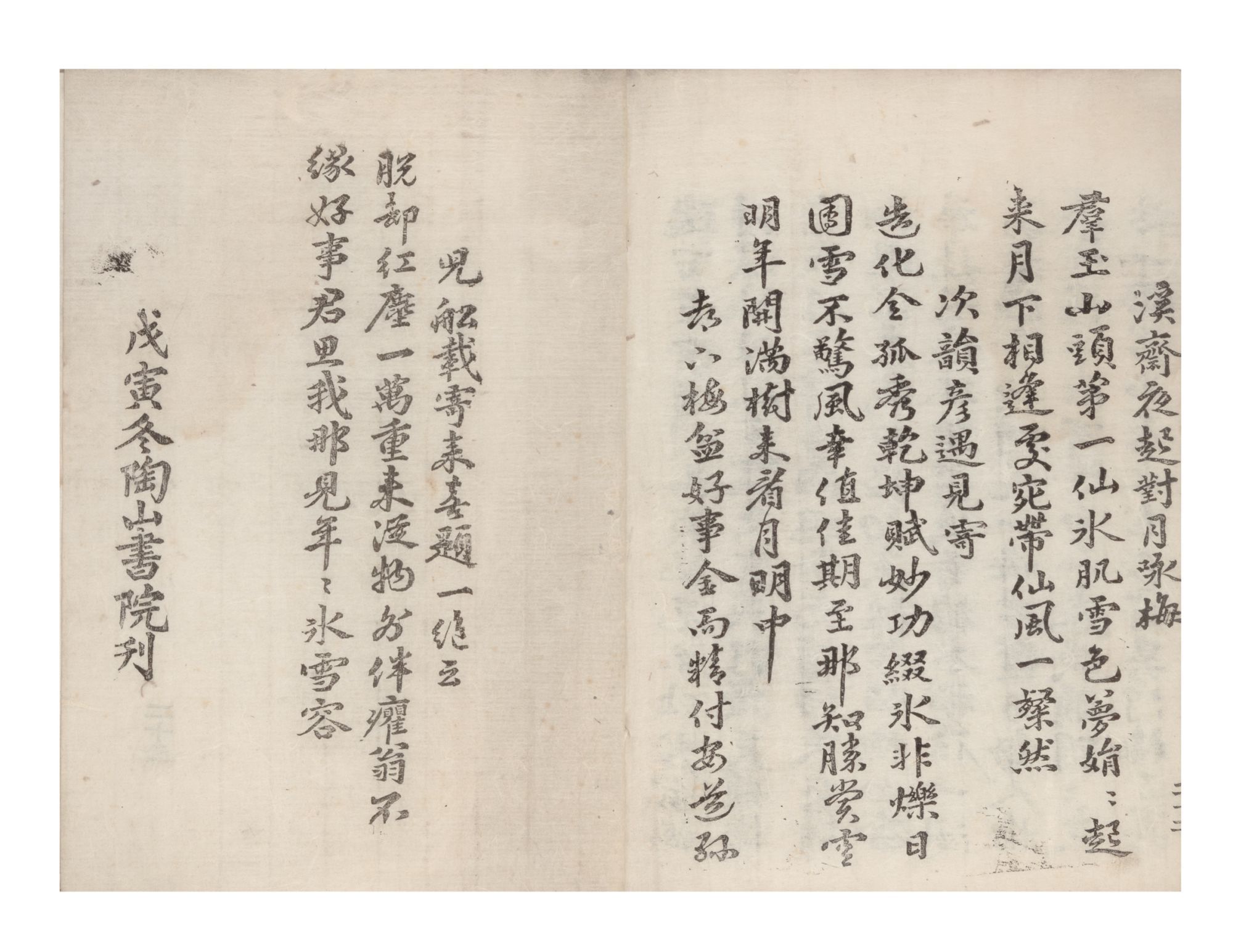
Wood-block printed. 23 folding leaves. Folio (364 x 270 mm.), orig. wrappers (wrappers somewhat soiled & marked), new stitching. [Andong: Privately Printed at] Tosan sŏwŏn [or Dosan seowon], [most likely 1578 or, perhaps, 1638].
First edition, privately printed at the Tosan Academy, the private Confucian academy established in 1574, following Yi’s death; this is certainly one of the earliest books to be printed there, if not the first. Yi Hwang (1501-70), also known as Yi T’oegye, was the most influential Neo-Confucian thinker in Chosŏn Korea (his portrait was used on the 1000 won banknote from 1975 to 2007). The academy named in his honor is today a UNESCO World Heritage Site.
Plum blossoms were an old motif in Chinese and Korean literature. Yi had an “ardent love” for plum blossoms as they often began to bloom in the middle of winter. He found them the perfect subject to express the value of endurance and self-cultivation. Yi turned to writing poetry as an escape from the partisan politics he endured while serving four kings. The first poem in the collection is dated 1542.
Our book is most attractive, printed in a small folio format; the woodblocks were carved to imitate the calligraphy of Yi Hwang.
Our copy carries the note “Printed in the winter [i.e., eleventh month] of the muin year at Tosan Academy.” The character “To” was featured in several style names used by Yi, and hence in the name of the academy founded near a mountain where he stayed. The academy had an active printing program and three libraries, two for books and one to store woodblocks.
Jangseogak (the Academy of Korean Studies) has a copy printed from the same blocks as our copy (K4-5985; the last folio appears to have been folded differently). The catalogue conjectures that the muin year here corresponds to 1578. The cataloguers of the copy held at Busan Metropolitan Simin library (call number 811.9-11), however, conjecture that the date in this description corresponds to 1638. We note that the Busan copy is described as having 29 folios and is probably a later printing.
The outside cover carries the title T’oegye sŏnsaeng maehwa si [The Plum Blossom Poems by Master T’oegye].
The covers of our copy have wastepaper leaves from a copy of the genealogy of the Sin clan of Yŏnghae.
Nice copy and very rare; we find no copy in WorldCat.
References
Digital Jangseogak. https://jsg.aks.ac.kr/
Han’guk komunhŏn chonghap mongnok 한국고문헌종합목록. https://www.nl.go.kr/korcis/index.do
Kim Tae-ho. “T’oegye ŭi maehwasarang kwa maehwasi ŭi kyoyukchŏk hamŭi” 퇴계의 매화사랑과 매화시의 교육적 함의. Hangukhak nonjip 한국학논집.
First edition, privately printed at the Tosan Academy, the private Confucian academy established in 1574, following Yi’s death; this is certainly one of the earliest books to be printed there, if not the first. Yi Hwang (1501-70), also known as Yi T’oegye, was the most influential Neo-Confucian thinker in Chosŏn Korea (his portrait was used on the 1000 won banknote from 1975 to 2007). The academy named in his honor is today a UNESCO World Heritage Site.
Plum blossoms were an old motif in Chinese and Korean literature. Yi had an “ardent love” for plum blossoms as they often began to bloom in the middle of winter. He found them the perfect subject to express the value of endurance and self-cultivation. Yi turned to writing poetry as an escape from the partisan politics he endured while serving four kings. The first poem in the collection is dated 1542.
Our book is most attractive, printed in a small folio format; the woodblocks were carved to imitate the calligraphy of Yi Hwang.
Our copy carries the note “Printed in the winter [i.e., eleventh month] of the muin year at Tosan Academy.” The character “To” was featured in several style names used by Yi, and hence in the name of the academy founded near a mountain where he stayed. The academy had an active printing program and three libraries, two for books and one to store woodblocks.
Jangseogak (the Academy of Korean Studies) has a copy printed from the same blocks as our copy (K4-5985; the last folio appears to have been folded differently). The catalogue conjectures that the muin year here corresponds to 1578. The cataloguers of the copy held at Busan Metropolitan Simin library (call number 811.9-11), however, conjecture that the date in this description corresponds to 1638. We note that the Busan copy is described as having 29 folios and is probably a later printing.
The outside cover carries the title T’oegye sŏnsaeng maehwa si [The Plum Blossom Poems by Master T’oegye].
The covers of our copy have wastepaper leaves from a copy of the genealogy of the Sin clan of Yŏnghae.
Nice copy and very rare; we find no copy in WorldCat.
References
Digital Jangseogak. https://jsg.aks.ac.kr/
Han’guk komunhŏn chonghap mongnok 한국고문헌종합목록. https://www.nl.go.kr/korcis/index.do
Kim Tae-ho. “T’oegye ŭi maehwasarang kwa maehwasi ŭi kyoyukchŏk hamŭi” 퇴계의 매화사랑과 매화시의 교육적 함의. Hangukhak nonjip 한국학논집.
Details
Title
Maehwa si 梅花詩 [Plum Blossom Poems]
Author
YI, Hwang 李滉
Condition
Unknown