

Pianta di Roma e del Campo Marzo
- Hardcover
- Rome: ca, 1774
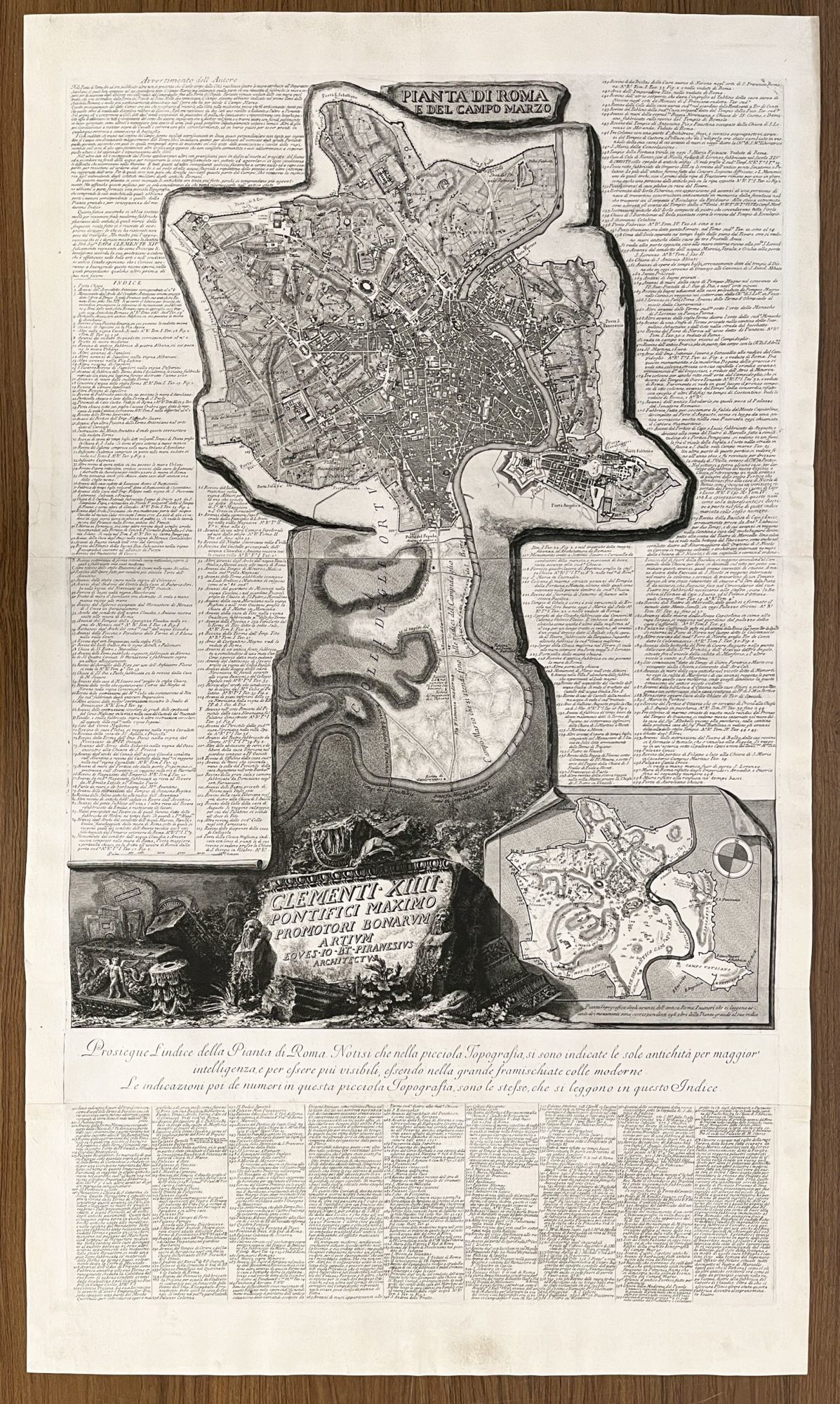
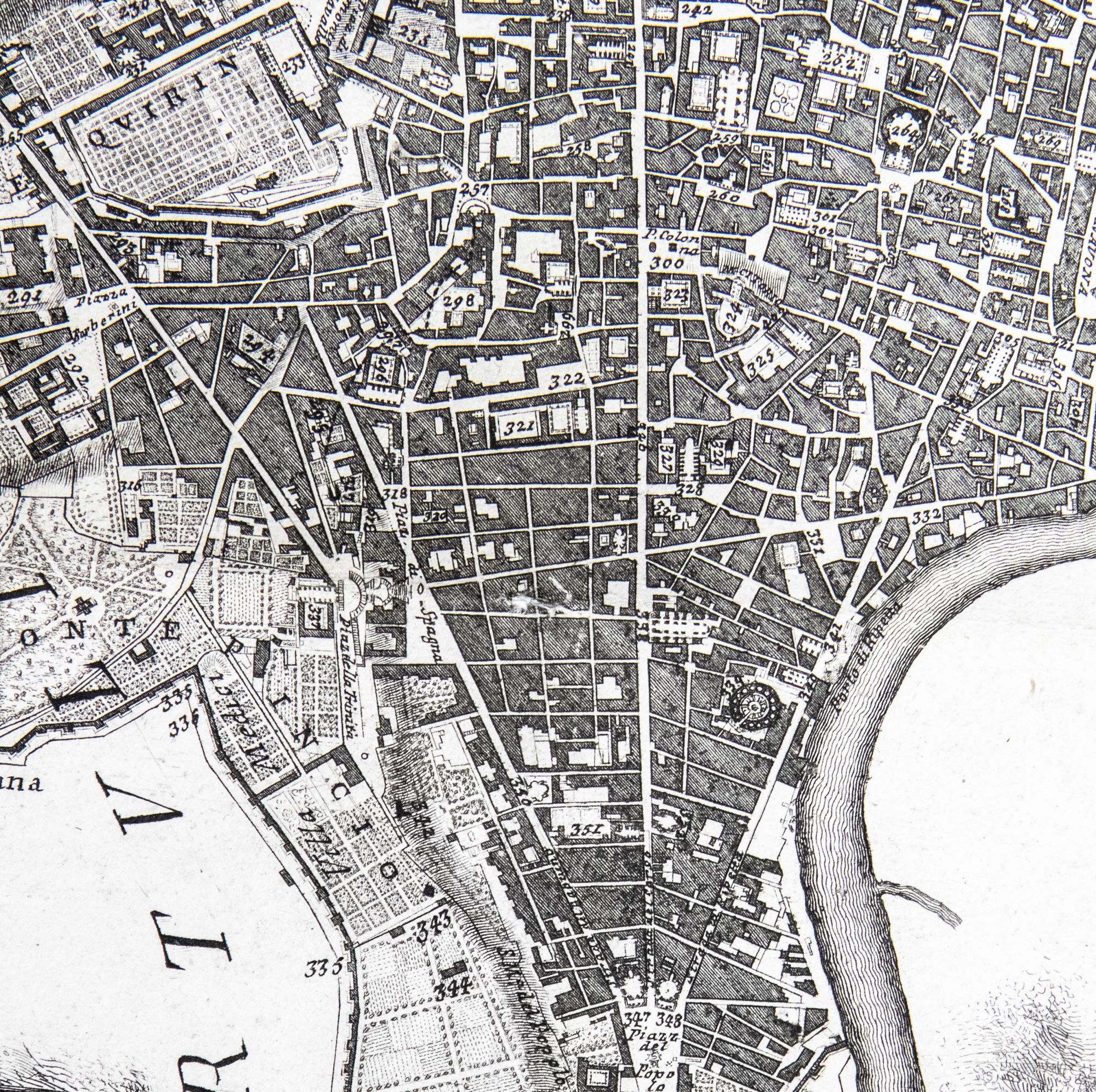
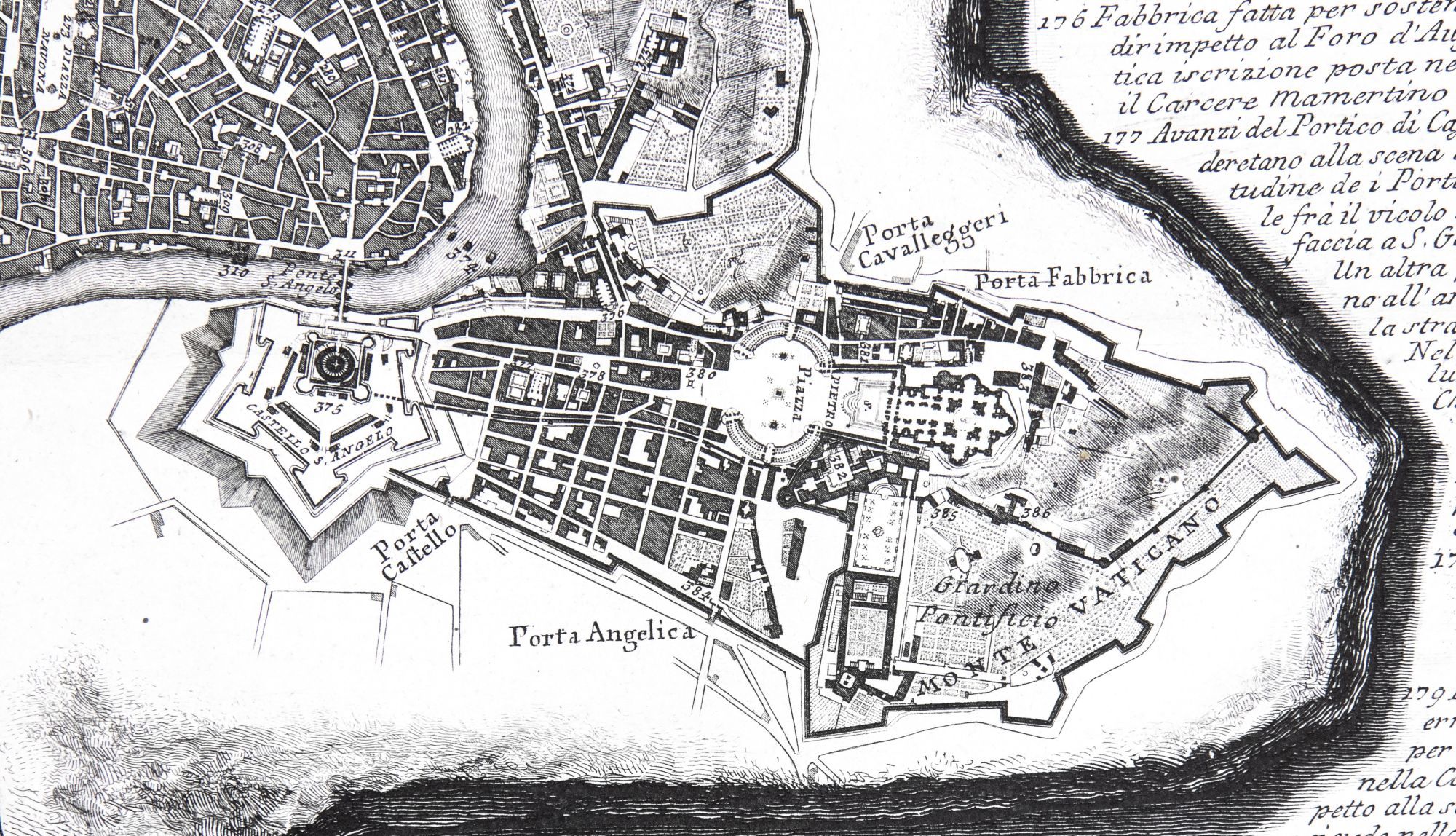
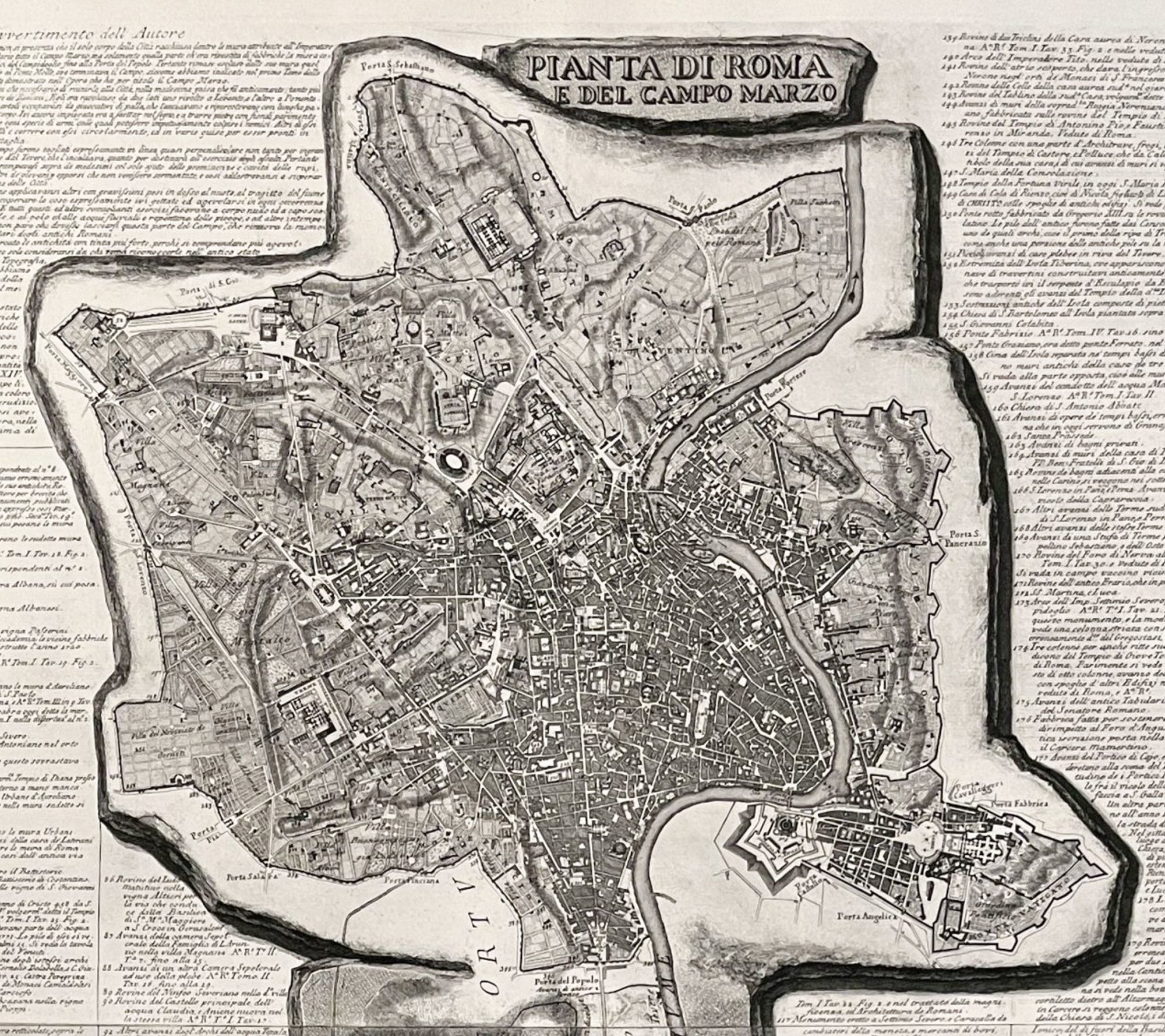
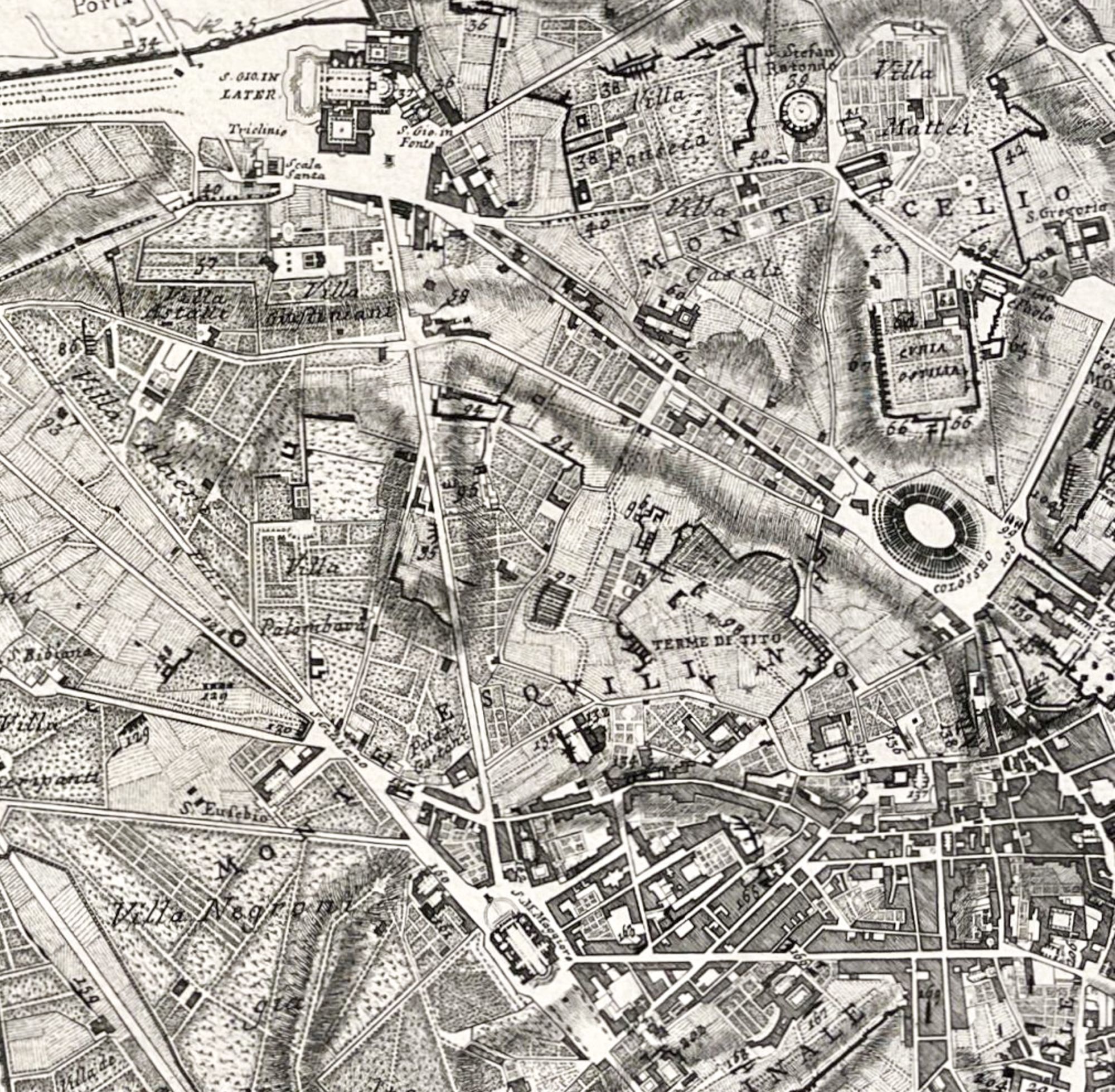
Rome: ca, 1774. FIRST EDITION. Hardcover. Fine. Image size (from plate mark): 121.2 x 71.1 cm. A fine impression, tiny area of blank left margin neatly repaired, some light marginal soiling. With no staining or discoloration where the three sheets are joined. Paper with watermark of a fleur-de-lis within a double circle. Giovanni Piranesi’s monumental map of Rome, which incorporates the earlier, extraordinarily precise plan of the cartographer Giovanni Battista Nolli (1748). The 1748 map was the first plan of Rome to represent the architectural developments in the city since the plan by Giovanni Battista Falda of 1676. It marked the first use of what was to become a fundamental graphic convention: the figure-ground plan in which buildings are illustrated as a black mass surrounded by white open ground.
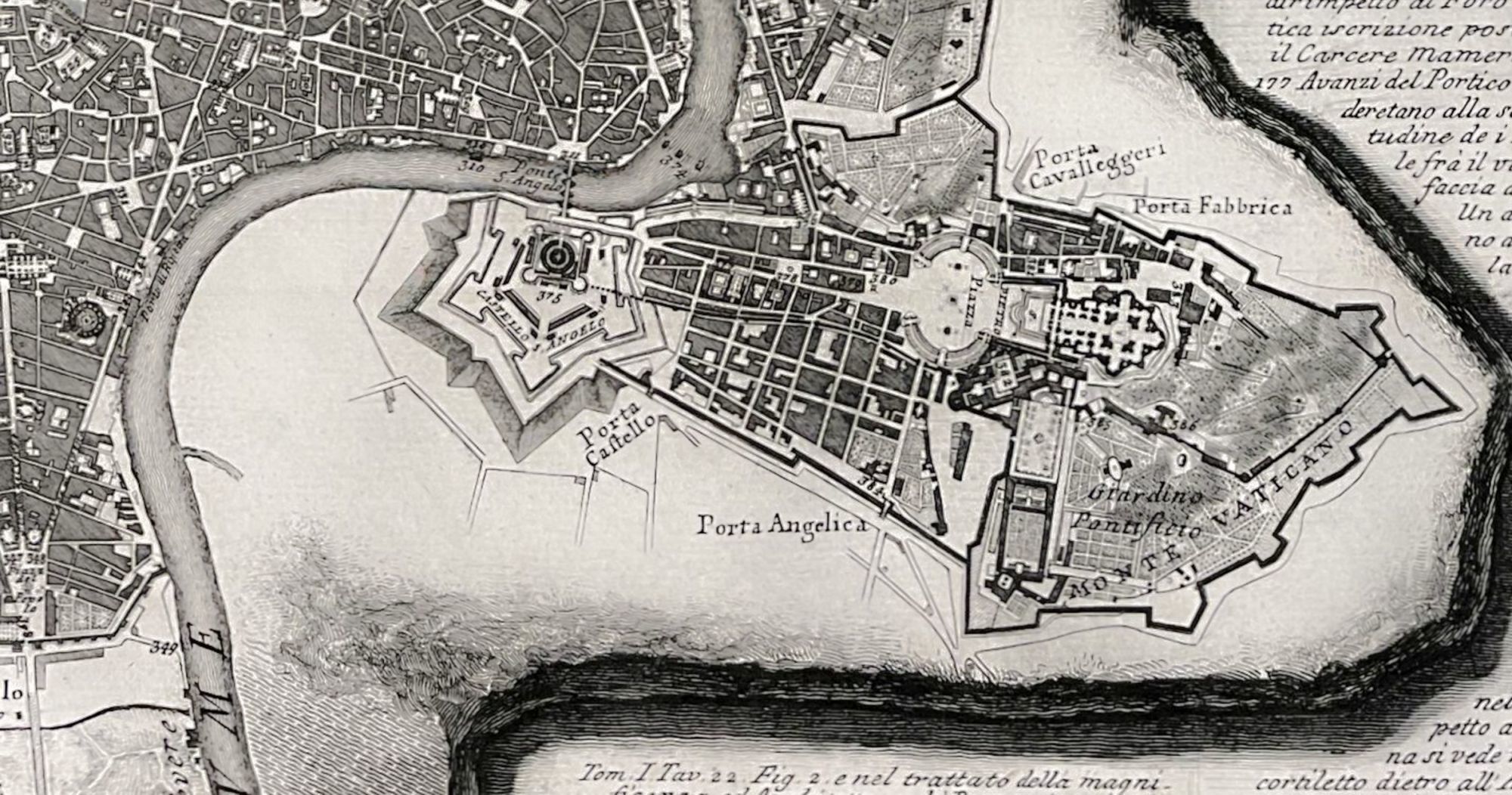
Piranesi has greatly expanded the area covered by the Nolli plan to include the Campo Marzo (the ancient “Field of Mars”), with the Ponte Milvio (the Milvian Bridge) on the Tiber marking the plan's northern terminus. Piranesi had worked with Nolli on the 1748 plan and it was in Piranesi’s own map of 1774, published almost twenty years after Nolli’s death, that the two artists’ collaboration found its ultimate expression.
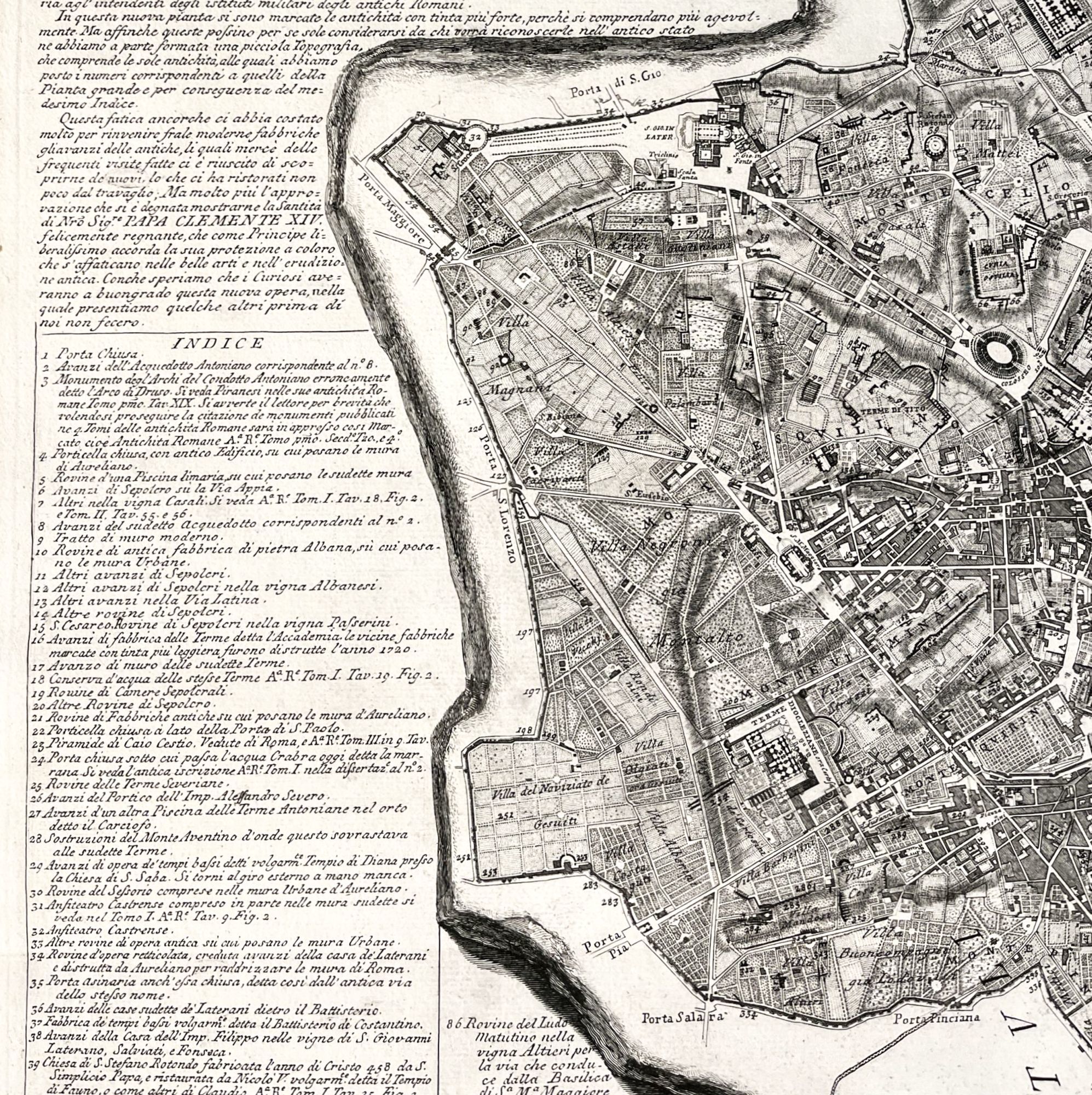
For this monumental view of the city, Piranesi made an important innovation, identifying 402 archaeologically important sites, with each monument shown in plan and in correct proportion, and keyed to Piranesi’s vast output of engravings of those structures.
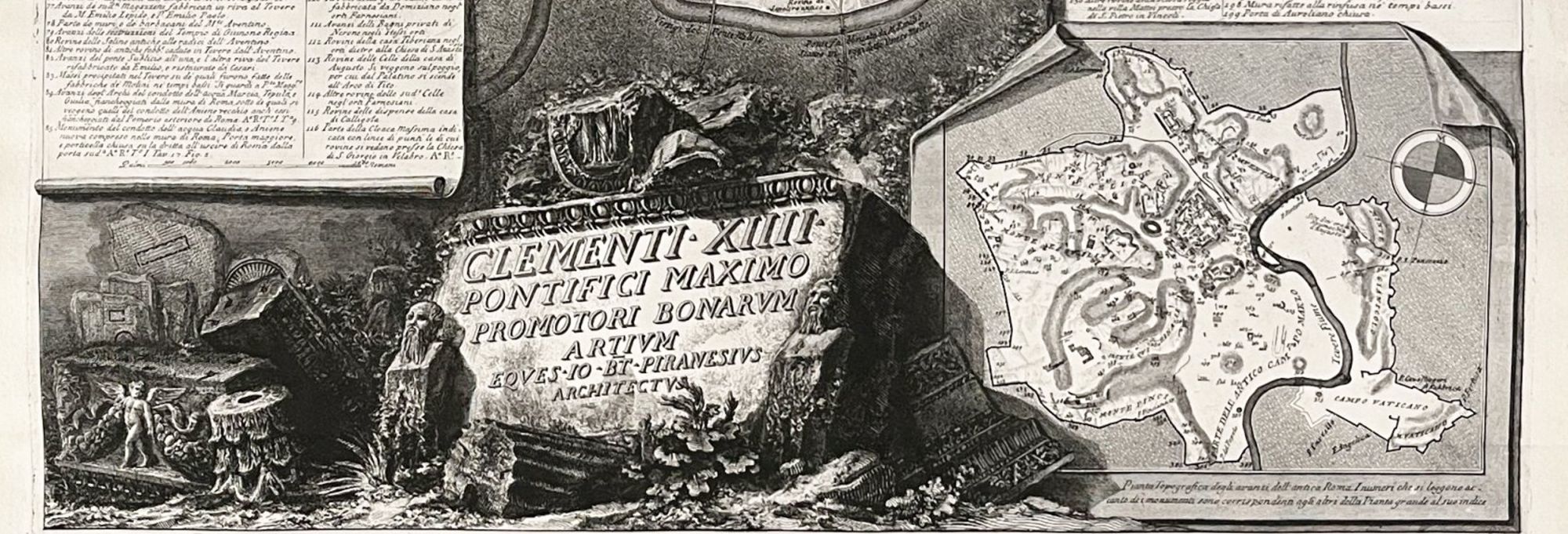
"By the mid-1770's, at the height of his career, Piranesi had produced a comprehensive record of ancient and modern Rome in the form of the well-over-a-hundred plates of the ‘Vedute di Roma’(The Views of Rome). He may have felt the need for a reference map to accompany collections of these plates and devised this work, usually found in associations with the ‘Vedute’, to fill this need. Exercising his skills in presenting formidable quantities of information coherently, he sought to relate the surviving remains of antiquity to the contemporary topography of Rome and to offer a way to reference published information about them. He therefore produced a large map of the modern city within the Aurelian Walls, together with an extension showing the territory to the north, between Porta del Popolo and Ponte Milvio and including the Campus Martius area. This is augmented by a smaller map isolating the principal antiquities, which were marked with numbers corresponding to those in the larger map. Around these Piranesi arranged a detailed index listing the monuments according to their assigned number and referring to relevant passages in his major publications, including the ‘Antichità Romane’, ‘Della Magnificenza’ and ‘Campo Marzio’.
“The dating of the map is problematic, since, although it is dedicated prominently to Clement XIV (1769-1774), Francesco Piranesi's 1792 catalogue assigns it to 1778 and most authorities, including Giesecke, Focillon and Hind, have accepted a late, if not posthumous date; however, this dating is certainly based on error, since Giambattista, in his Avvertimento at the top of the main map, refers to ‘l'approvazione che si è degnata mostrarne la Santità di N.ro Sig.re PAPA CLEMENTE XIV felicemente regnate.’ Supporting evidence for an earlier date comes from an impression of the ‘Catalogo delle Opere’ referred to by Scott, which contains manuscript entries for the three ‘Vedute di Roma’ datable to 1774 and indicates that the map was already available.”(Wilton-Ely).
Piranesi has greatly expanded the area covered by the Nolli plan to include the Campo Marzo (the ancient “Field of Mars”), with the Ponte Milvio (the Milvian Bridge) on the Tiber marking the plan's northern terminus. Piranesi had worked with Nolli on the 1748 plan and it was in Piranesi’s own map of 1774, published almost twenty years after Nolli’s death, that the two artists’ collaboration found its ultimate expression.
For this monumental view of the city, Piranesi made an important innovation, identifying 402 archaeologically important sites, with each monument shown in plan and in correct proportion, and keyed to Piranesi’s vast output of engravings of those structures.
"By the mid-1770's, at the height of his career, Piranesi had produced a comprehensive record of ancient and modern Rome in the form of the well-over-a-hundred plates of the ‘Vedute di Roma’(The Views of Rome). He may have felt the need for a reference map to accompany collections of these plates and devised this work, usually found in associations with the ‘Vedute’, to fill this need. Exercising his skills in presenting formidable quantities of information coherently, he sought to relate the surviving remains of antiquity to the contemporary topography of Rome and to offer a way to reference published information about them. He therefore produced a large map of the modern city within the Aurelian Walls, together with an extension showing the territory to the north, between Porta del Popolo and Ponte Milvio and including the Campus Martius area. This is augmented by a smaller map isolating the principal antiquities, which were marked with numbers corresponding to those in the larger map. Around these Piranesi arranged a detailed index listing the monuments according to their assigned number and referring to relevant passages in his major publications, including the ‘Antichità Romane’, ‘Della Magnificenza’ and ‘Campo Marzio’.
“The dating of the map is problematic, since, although it is dedicated prominently to Clement XIV (1769-1774), Francesco Piranesi's 1792 catalogue assigns it to 1778 and most authorities, including Giesecke, Focillon and Hind, have accepted a late, if not posthumous date; however, this dating is certainly based on error, since Giambattista, in his Avvertimento at the top of the main map, refers to ‘l'approvazione che si è degnata mostrarne la Santità di N.ro Sig.re PAPA CLEMENTE XIV felicemente regnate.’ Supporting evidence for an earlier date comes from an impression of the ‘Catalogo delle Opere’ referred to by Scott, which contains manuscript entries for the three ‘Vedute di Roma’ datable to 1774 and indicates that the map was already available.”(Wilton-Ely).
Details
Title
Pianta di Roma e del Campo Marzo
Author
Piranesi, Giovanni Battista (1720-1778); Nolli, Giovanni Battista (1692-1756)
Binding
Hardcover
Condition
Fine
Publisher
ca: Rome
Date
1774
Edition
FIRST EDITION