

Jing shi fang xiang zhi 京師坊巷志 [Treatise on the Neighborhoods and Alleys of the Capital]
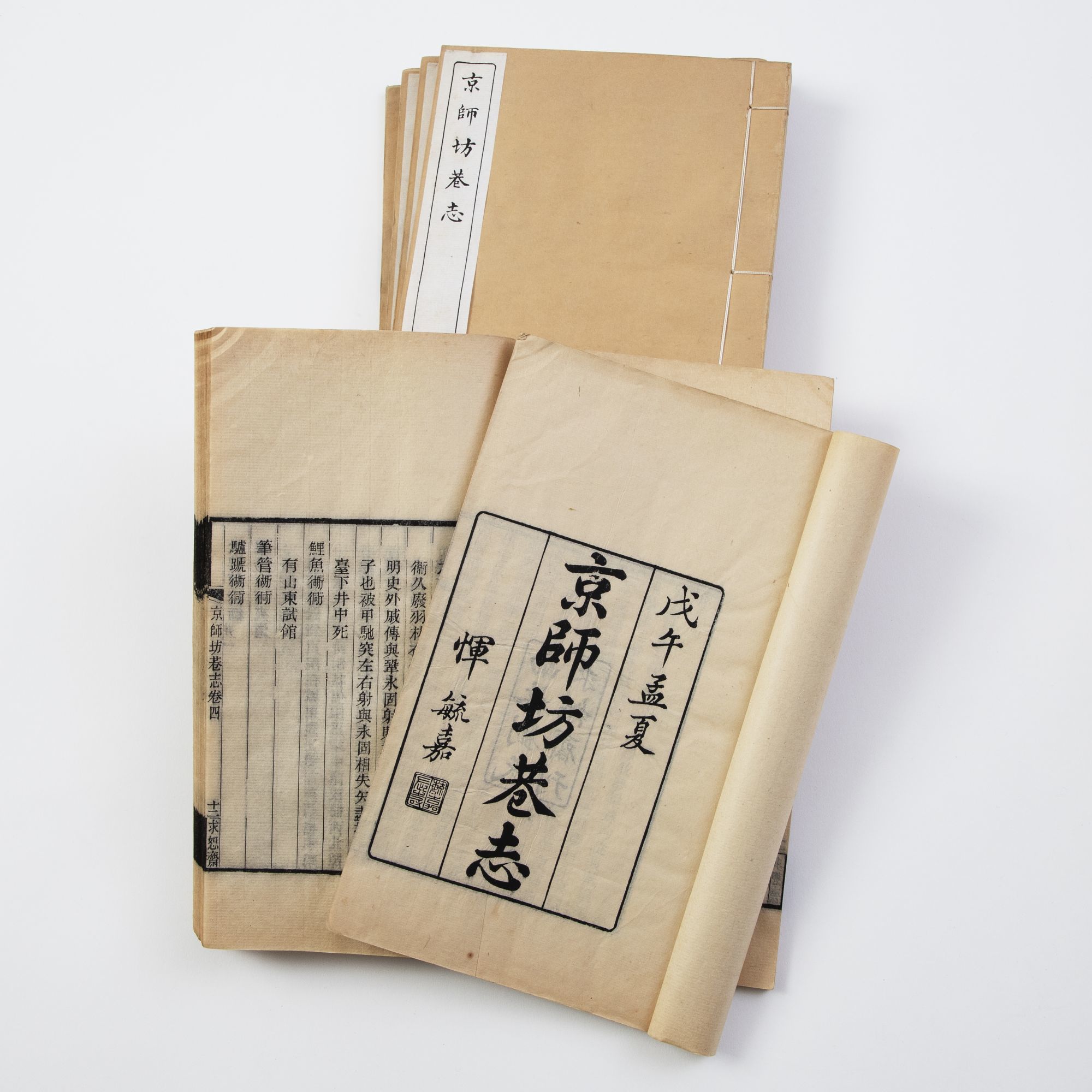
Six vols. 8vo, orig. wrappers, orig. block-printed title labels on upper covers (two missing), orig. stitching. [China]: Liu shi Qiushu zhai 劉氏求恕齋, 1918.
A scarce edition of this work on the local history of Beijing, initially written for inclusion in a so-called gazetteer. “A gazetteer is a cumulative record of a territorial unit published in book format, generally by a local government, and arranged by topics such as topography, institutions, population, taxes, biographies, and literature” (Dennis, Writing, Publishing, and Reading Local Gazetteers in Imperial China, 1100-1700, 1). Our book originated as a draft for a section in a gazetteer of Shuntian prefecture, which comprised the capital of Beijing.
The initial author of our book, Zhu Yixin (1846-94), had worked in Beijing beginning in 1870, and after 1876 as a presented scholar and bachelor, then compiler, in the Hanlin Academy. In 1879, the prefect of Shuntian presented a project for a gazetteer and asked numerous scholars to participate. Zhu was one of them, and he was put in charge of the treatise on Beijing’s neighborhoods. He took this task very seriously, “asking detailed questions of the inhabitants of every alley” that he described, while also consulting older literature and maps. When he was sent to Hubei as an examiner, the text was not entirely finished. Zhu asked his friend Miao Quansun to finish it in his stead, but the gazetteer was nevertheless published with an incomplete chapter on neighborhoods and alleys. After Zhu passed away, his younger brother published his writings, including a draft of the Treatise, in 1896. Zhu’s brother also entrusted the manuscript separately to Long Fengbiao 龍鳳鑣 for collation and printing, but when Long was sent to serve in Anhui, Wang Zhaoquan 汪兆銓 did the last round of collation. The corrected edition was published in 1897 (Zhang, Lao Beijing shuwen shiji zhishu, 166-68).
Our edition was part of the Qiushu zhai congshu 求恕齋叢書, the “Collectanea of the Studio of Seeking Compassion” in 1918 (wuwu), published by Liu Chenggan 劉承幹. It primarily included works by authors of the late Qing and early Republic. Liu was a great book collector whose collection became the basis for the rare books at Zhejiang Provincial Library (Luo, Zhongguo congshu zonglu xuanzhu, 194-95).
Fine set, preserved in a hantao.
References
Dennis, Joseph. Writing, Publishing, and Reading Local Gazetteers in Imperial China, 1100-1700. Cambridge, Mass.: Harvard University Asia Center, 2015.
Luo Zhihuan 罗志欢. Zhongguo congshu zonglu xuanzhu 中国丛书综录选注. Vol. 1. Ji’nan: Qi-Lu shushe, 2017.
Zhang Yi 张毅, ed. Lao Beijing shuwen: shiji zhishu 老北京述闻:史籍志书. Beijing: Beijing chubanshe, 2021.
A scarce edition of this work on the local history of Beijing, initially written for inclusion in a so-called gazetteer. “A gazetteer is a cumulative record of a territorial unit published in book format, generally by a local government, and arranged by topics such as topography, institutions, population, taxes, biographies, and literature” (Dennis, Writing, Publishing, and Reading Local Gazetteers in Imperial China, 1100-1700, 1). Our book originated as a draft for a section in a gazetteer of Shuntian prefecture, which comprised the capital of Beijing.
The initial author of our book, Zhu Yixin (1846-94), had worked in Beijing beginning in 1870, and after 1876 as a presented scholar and bachelor, then compiler, in the Hanlin Academy. In 1879, the prefect of Shuntian presented a project for a gazetteer and asked numerous scholars to participate. Zhu was one of them, and he was put in charge of the treatise on Beijing’s neighborhoods. He took this task very seriously, “asking detailed questions of the inhabitants of every alley” that he described, while also consulting older literature and maps. When he was sent to Hubei as an examiner, the text was not entirely finished. Zhu asked his friend Miao Quansun to finish it in his stead, but the gazetteer was nevertheless published with an incomplete chapter on neighborhoods and alleys. After Zhu passed away, his younger brother published his writings, including a draft of the Treatise, in 1896. Zhu’s brother also entrusted the manuscript separately to Long Fengbiao 龍鳳鑣 for collation and printing, but when Long was sent to serve in Anhui, Wang Zhaoquan 汪兆銓 did the last round of collation. The corrected edition was published in 1897 (Zhang, Lao Beijing shuwen shiji zhishu, 166-68).
Our edition was part of the Qiushu zhai congshu 求恕齋叢書, the “Collectanea of the Studio of Seeking Compassion” in 1918 (wuwu), published by Liu Chenggan 劉承幹. It primarily included works by authors of the late Qing and early Republic. Liu was a great book collector whose collection became the basis for the rare books at Zhejiang Provincial Library (Luo, Zhongguo congshu zonglu xuanzhu, 194-95).
Fine set, preserved in a hantao.
References
Dennis, Joseph. Writing, Publishing, and Reading Local Gazetteers in Imperial China, 1100-1700. Cambridge, Mass.: Harvard University Asia Center, 2015.
Luo Zhihuan 罗志欢. Zhongguo congshu zonglu xuanzhu 中国丛书综录选注. Vol. 1. Ji’nan: Qi-Lu shushe, 2017.
Zhang Yi 张毅, ed. Lao Beijing shuwen: shiji zhishu 老北京述闻:史籍志书. Beijing: Beijing chubanshe, 2021.
Details
Title
Jing shi fang xiang zhi 京師坊巷志 [Treatise on the Neighborhoods and Alleys of the Capital]
Author
ZHU, Yixin 朱一新 & MIAO, Quansun 繆荃孫
Condition
Unknown