

RUBAIYAT OF OMAR KHAYYAM
- 1872-1921
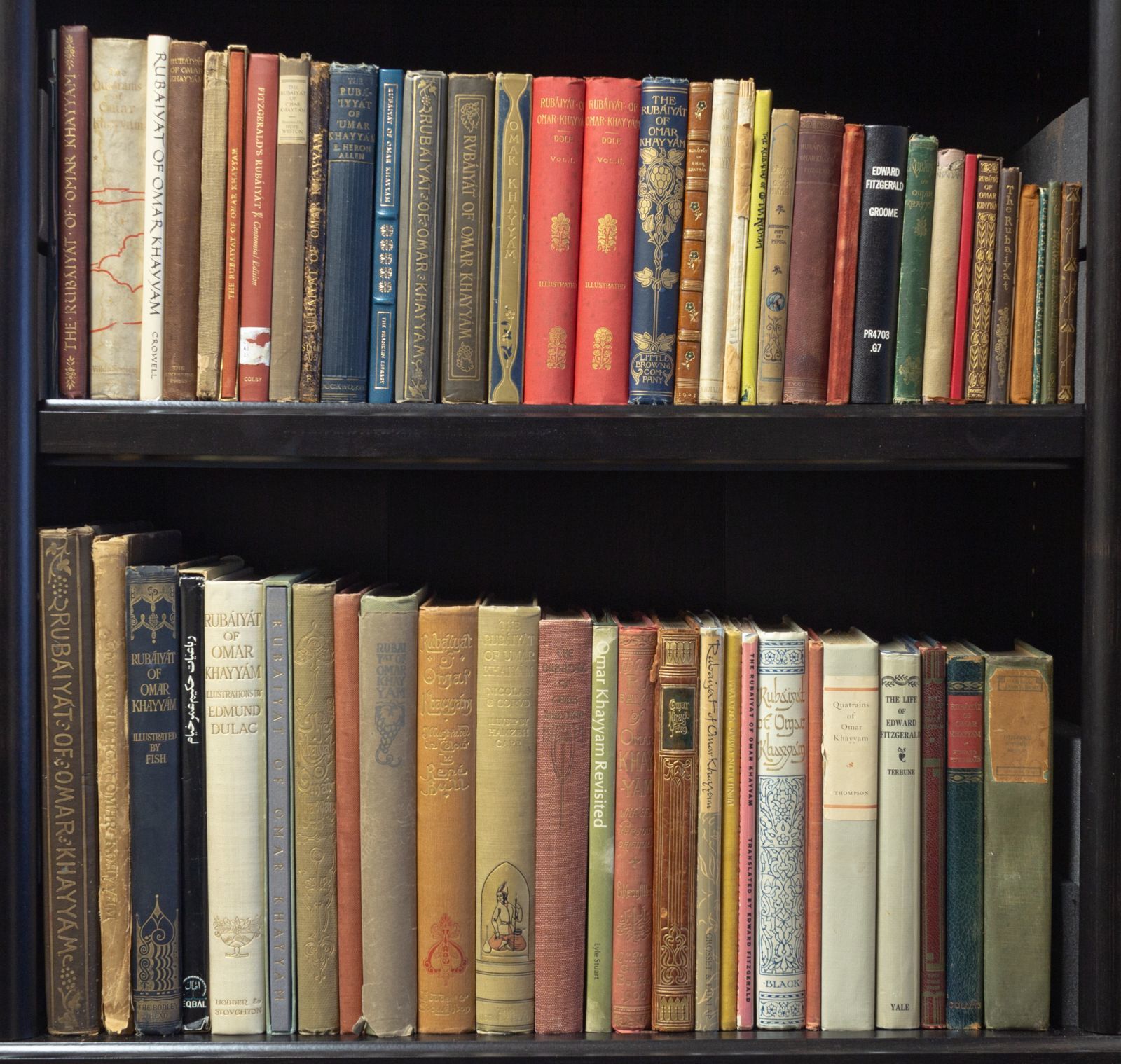
1872-1921. 60 different editions in 61 volumes..
Most items in their original publisher's bindings (mostly cloth or wrappers, and a few in limp suede); one in half morocco. Condition ranging from very good to very fine; many of the cloth items with light shelfwear (rubbing to edges, mild soiling, fraying to head and tail of spine) and minor condition issues internally (light scattered foxing and browning), a handful of items with more noticeable condition issues (spine partially lost, rubbed joints, moderate browning, etc.), but on the whole, an excellent group.
Amassed over the course of many years by a passionate collector of the Rubaiyat, this is a very substantial and wide-ranging group of 60 works that attest to the work's enduring popularity more than 150 years after Edward FitzGerald introduced it to the West. Son of a wealthy Irish landowner, FitzGerald had enough money to pursue a rather desultory literary career as a "genteel gipsy" (in Terhune's words) before beginning to study languages in middle age. He started his translation of the quatrains ("rubáiyát" in Persian) attributed to "Umar Khayyam" in 1856; according to DNB, about half of FitzGerald's final work paraphrases (rather than directly translates) portions of the 11th century poem, while the rest is original verse inspired by Omar. "The result is generally seen as being in some ways an original English poem, one that is much better known than Omar's poem is in Persian." (DNB) In Jewett's opinion, it certainly earned FitzGerald "a prominent place among the immortals of English literature." In 1858, FitzGerald submitted 25 of the "less wicked" verses to "Fraser's Magazine," only to be rejected. He had 250 copies published, anonymously, at his own expense, but had no luck selling them. Admitting defeat, he gave 200 copies to Quaritch; these sold so poorly that they were relegated to the penny bin, where Potter says they were discovered--and soon celebrated--by Dante Gabriel Rossetti and Algernon Swinburne. Those copies that remained unsold when Quaritch moved to Piccadilly in 1860 were either lost or destroyed, but by 1861, Rossetti and his Pre-Raphaelite brethren, along with Celtic scholar Whitley Stokes, were evangelizing for the work, embracing the lush, lyrical verse that would move English poetry away from Victorian orthodoxy and convention. According to Day, by the end of the 19th century, "a copy of the 'Rubaiyat' upon an Oxford table was a symbol of sophistication. Today . . . it remains the most popular single poem of the Victorian era." The present collection is especially strong in illustrated editions, with more than 25 artists represented, including Edmund Dulac, Elihu Vedder, Willy Pogany, Adelaide Hanscom, Gilbert James, Edmund J. Sullivan, Arthur Szyk, René Bull, and Abanindro Nath Tagore. Notable text editions in this group include a Third Edition of FitzGerald's translation; a First Published American Edition; and a signed and inscribed copy of Eben Francis Thompson's translation. There is also a small group of fine press printings, including examples by the Gregynog Press, Thomas Mosher, and Elbert Hubbard. There are no duplicated editions in this collection, and there are no trade paperbacks. A full list of the collection's contents is available upon request..
Most items in their original publisher's bindings (mostly cloth or wrappers, and a few in limp suede); one in half morocco. Condition ranging from very good to very fine; many of the cloth items with light shelfwear (rubbing to edges, mild soiling, fraying to head and tail of spine) and minor condition issues internally (light scattered foxing and browning), a handful of items with more noticeable condition issues (spine partially lost, rubbed joints, moderate browning, etc.), but on the whole, an excellent group.
Amassed over the course of many years by a passionate collector of the Rubaiyat, this is a very substantial and wide-ranging group of 60 works that attest to the work's enduring popularity more than 150 years after Edward FitzGerald introduced it to the West. Son of a wealthy Irish landowner, FitzGerald had enough money to pursue a rather desultory literary career as a "genteel gipsy" (in Terhune's words) before beginning to study languages in middle age. He started his translation of the quatrains ("rubáiyát" in Persian) attributed to "Umar Khayyam" in 1856; according to DNB, about half of FitzGerald's final work paraphrases (rather than directly translates) portions of the 11th century poem, while the rest is original verse inspired by Omar. "The result is generally seen as being in some ways an original English poem, one that is much better known than Omar's poem is in Persian." (DNB) In Jewett's opinion, it certainly earned FitzGerald "a prominent place among the immortals of English literature." In 1858, FitzGerald submitted 25 of the "less wicked" verses to "Fraser's Magazine," only to be rejected. He had 250 copies published, anonymously, at his own expense, but had no luck selling them. Admitting defeat, he gave 200 copies to Quaritch; these sold so poorly that they were relegated to the penny bin, where Potter says they were discovered--and soon celebrated--by Dante Gabriel Rossetti and Algernon Swinburne. Those copies that remained unsold when Quaritch moved to Piccadilly in 1860 were either lost or destroyed, but by 1861, Rossetti and his Pre-Raphaelite brethren, along with Celtic scholar Whitley Stokes, were evangelizing for the work, embracing the lush, lyrical verse that would move English poetry away from Victorian orthodoxy and convention. According to Day, by the end of the 19th century, "a copy of the 'Rubaiyat' upon an Oxford table was a symbol of sophistication. Today . . . it remains the most popular single poem of the Victorian era." The present collection is especially strong in illustrated editions, with more than 25 artists represented, including Edmund Dulac, Elihu Vedder, Willy Pogany, Adelaide Hanscom, Gilbert James, Edmund J. Sullivan, Arthur Szyk, René Bull, and Abanindro Nath Tagore. Notable text editions in this group include a Third Edition of FitzGerald's translation; a First Published American Edition; and a signed and inscribed copy of Eben Francis Thompson's translation. There is also a small group of fine press printings, including examples by the Gregynog Press, Thomas Mosher, and Elbert Hubbard. There are no duplicated editions in this collection, and there are no trade paperbacks. A full list of the collection's contents is available upon request..
Details
Title
RUBAIYAT OF OMAR KHAYYAM
Author
A LARGE GROUP OF ITEMS OF, OR RELATED TO, THE
Condition
Unknown
Date
1872-1921