

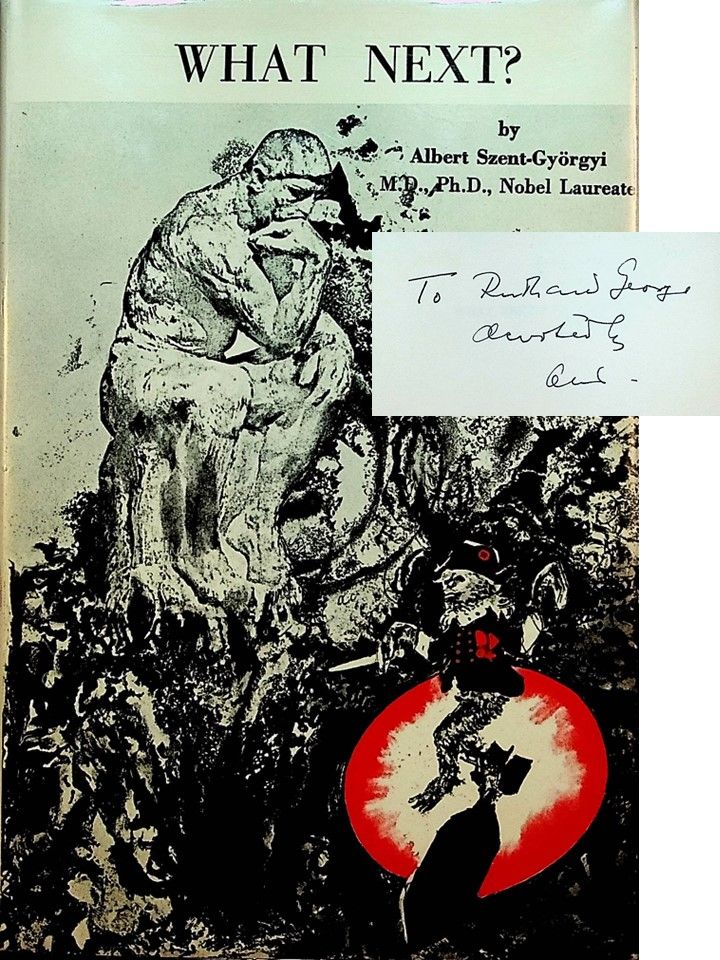
SIGNED NOBELIST TO NOBELIST. What Next?
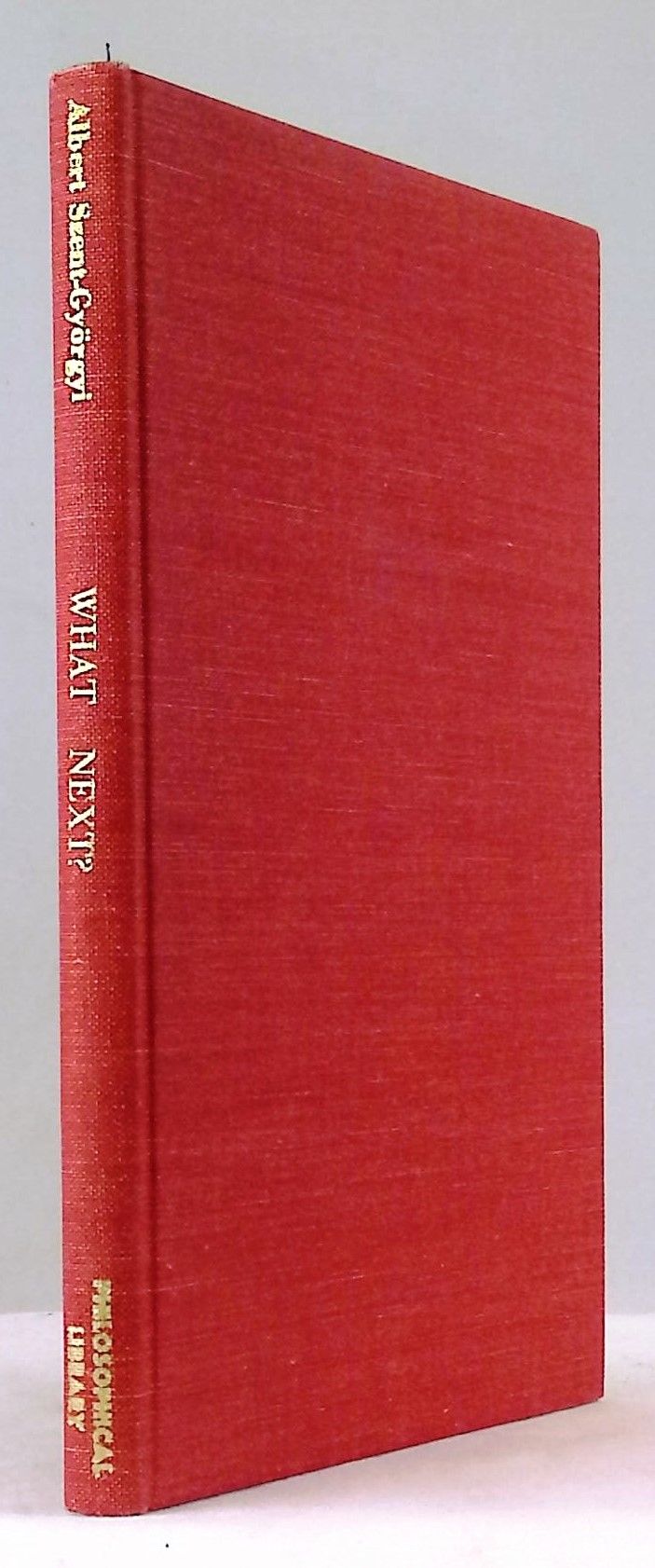
- SIGNED cloth binding
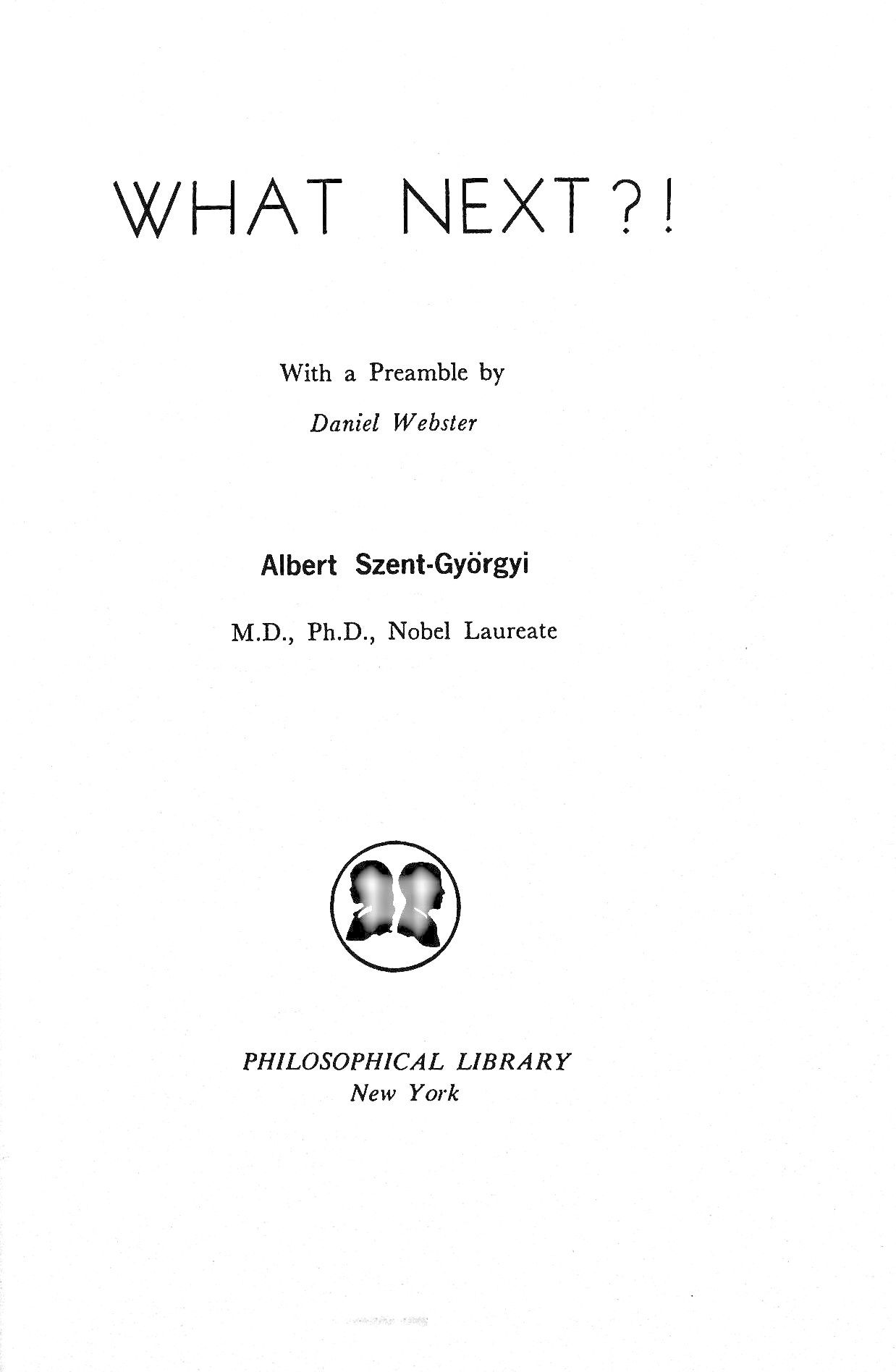
- New York: Philosophical Library, 1971
New York: Philosophical Library, 1971. First edition.
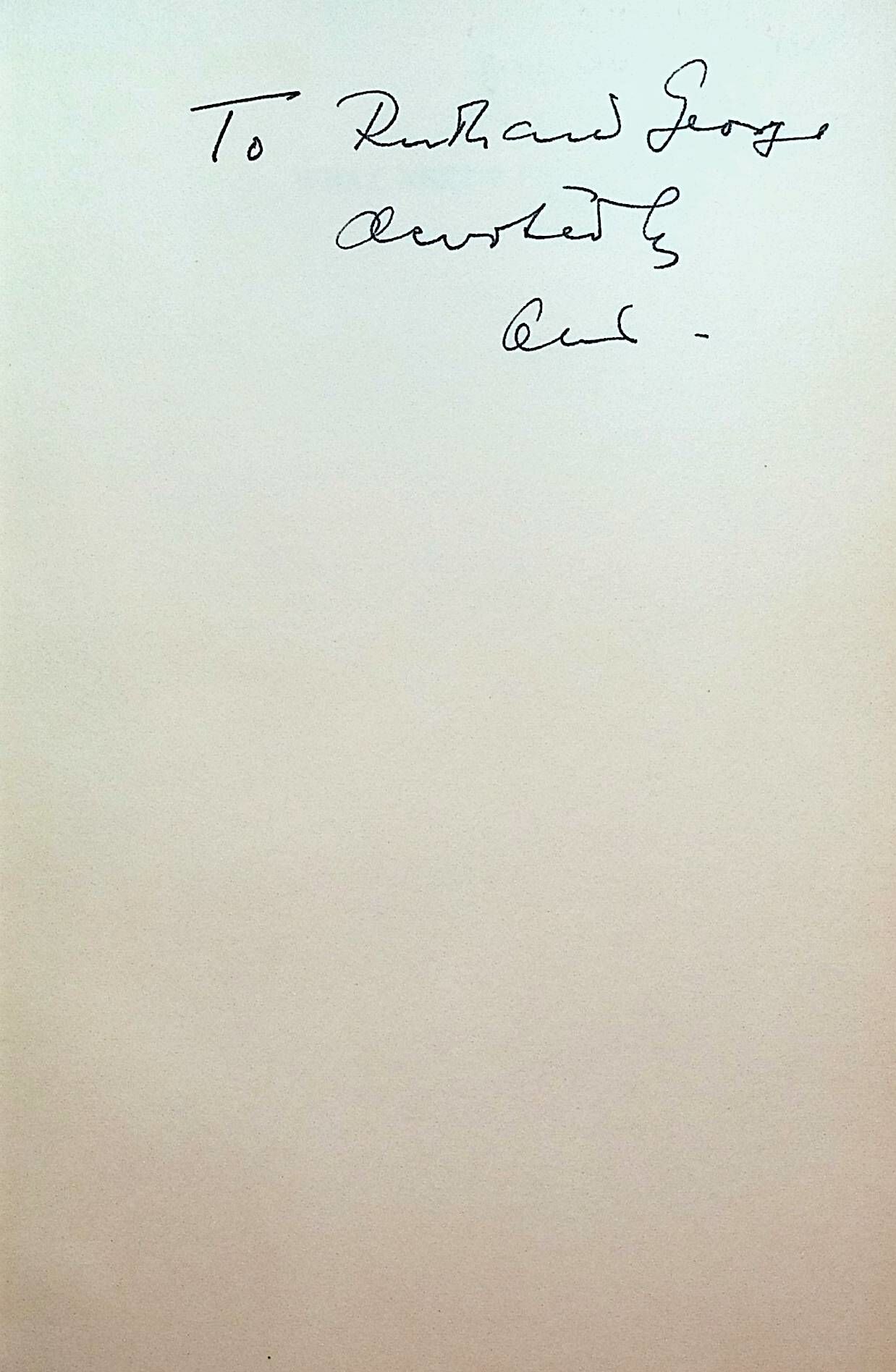
1971 INSCRIBED BY ACTIVIST NOBEL LAUREATE TO ANOTHER ACTIVIST NOBELIST AT PEAK OF THE VIETNAM WAR.
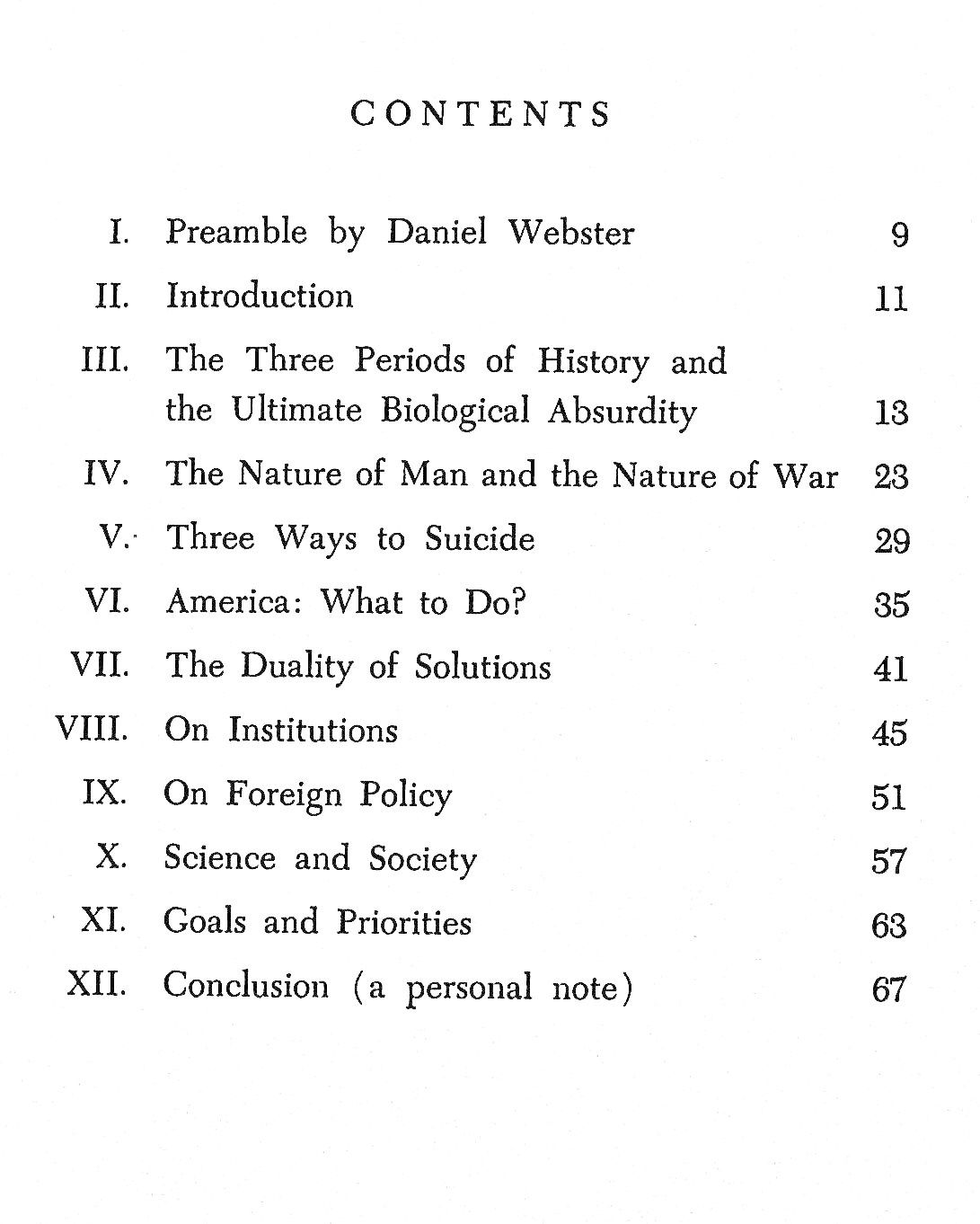
13.5x21 cm hardcover, red cloth binding, blindstamped publisher's emblem to cover, gilt title to spine, inscribed ffep, "To Ruth and George [Wald], devotedly, Albert." 68 pp, near fine in near fine jacket in protective mylar sleeve. FROM THE JACKET FLAP: "In this follow-up to The Crazy Ape, Dr. Szent-Gyorgyi expands on some of the topics he introduced in the first book, notably the problem of how to achieve the social and political changes necessary deal with the rapidly cosmo-technic omplexion the world is taking on. The book is addressed primarily to young readers, especially to those concerned youth who feel an increasing despair over the general apathy they see around them."
FROM THE INTRODUCTION: "After my last book, The Crazy Ape, appeared, I found that in discussing its contents with my Young friends a common complaint was voiced: "It does not tell us what to do, or how." I have written the present book to correct this shortcoming. To make myself clear I will have to enlarge upon a few points discussed in my first book, which makes a moderate amount of repetition unavoidable."
ALBERT SZENT-GYORGYI (1893-1986) was a Hungarian biochemist who In 1937 received the Nobel Prize in Physiology or Medicine "for his discoveries in connection with the biological combustion process with special reference to vitamin C and the catalysis of fumaric acid". In 1938 he began work on the biophysics of muscle movement. He found that muscles contain actin, which when combined with the protein myosin and the energy source ATP, contract muscle fibers. In 1947 Szent-Györgyi established the Institute for Muscle Research at the Marine Biological Laboratory in Woods Hole, Massachusetts. However, HE still faced funding difficulties for several years, due to his foreign status and former association with the government of a Communist nation. In 1948, he received a research position with the National Institutes of Health and began dividing his time between there and Woods Hole. Szent-Györgyi conducted research at the MBL from 1947 to 1986 year-round. In the late 1950s, Szent-Györgyi developed a research interest in cancer and developed ideas on applying the theories of quantum mechanics to the biochemistry of cancer. Late in life, Szent-Györgyi began to pursue free radicals as a potential cause of cancer. He came to see cancer as being ultimately an electronic problem at the molecular level. In 1974, reflecting his interests in quantum physics, he proposed the term "syntropy" replace the term "negentropy". During World War II, he joined the Hungarian resistance movement. Although Hungary was allied with the Axis Powers, the Hungarian prime minister Miklós Kállay sent Szent-Györgyi to Istanbul in 1944 under the guise of a scientific lecture to begin secret negotiations with the Allies. The Germans learned of this plot and Adolf Hitler himself issued a warrant for the arrest of Szent-Györgyi. He escaped from house arrest and spent 1944 to 1945 as a fugitive from the Gestapo. In 1967, Szent-Györgyi signed a letter declaring his intention to refuse to pay taxes as a means of protesting against the U.S. war against Vietnam, and urging other people to take a similar stand. He was one of the signatories of the agreement to convene a convention for drafting a world constitution. As a result, for the first time in human history, a World Constituent Assembly convened to draft and adopt a Constitution for the Federation of Earth.
PROVENANCE: GEORGE WALD (1906 - 1997) received his Bachelor of Science degree from New York University in 1927 and his PhD in zoology from Columbia University in 1932. Wald traveled to Germany to work with Otto Heinrich Warburg where he identified vitamin A in the retina. he left Europe for the University of Chicago in 1933 when Adolf Hitler came to power. In 1934, Wald went to Harvard University where he discovered that vitamin A was a component of the retina. In the 1950s, Wald and his colleagues used chemical methods to extract pigments from the retina. He was elected to the National Academy of Sciences in 1950 and in 1967 was awarded the Nobel Prize for Physiology or Medicine for his discoveries in vision. Wald spoke out on many political and social issues and his fame as a Nobel laureate brought national and international attention to his views. He was a pacifist and vocal opponent of the Vietnam War and the nuclear arms race. RUTH HUBBARD (1924 – 2016) was a professor of biology at Harvard University, where she was the first woman to hold a tenured professorship position in biology. During her active research career from the 1940s to the 1960s, she made important contributions to the understanding of the biochemistry and photochemistry of vision in vertebrates and invertebrates. After receiving her PhD from Harvard, Ruth became a research fellow. She worked under George Wald, investigating the biochemistry of retinal and retinol, and were married in 1958. Together they built on the work that Wald had researched during a fellowship following his own doctorate degree. They were awarded the Paul Karrer Gold Medal specifically for their work with rhodopsin. Like her husband, in the late 1960s and early 1970s, Hubbard became interested in social and political dimensions of biological issues. In her book The Politics of Women's Biology, she wrote that she had been a "devout scientist" from 1947 until the late 1960s, but the Vietnam War and the women's liberation movement led her to change her priorities.
Details
Title
SIGNED NOBELIST TO NOBELIST. What Next?
Author
Szent-Gyorgyi, Albert
Binding
cloth binding
Condition
Unknown
Publisher
Philosophical Library: New York
Date
1971
Edition
First edition