

[Collection of Eight Manuscript Letters from a Young Man Working in Wyoming and Alaska in the Early-20th Century]
- [Alcova, Wy.; Gulham and Achorage, Ak , 1922
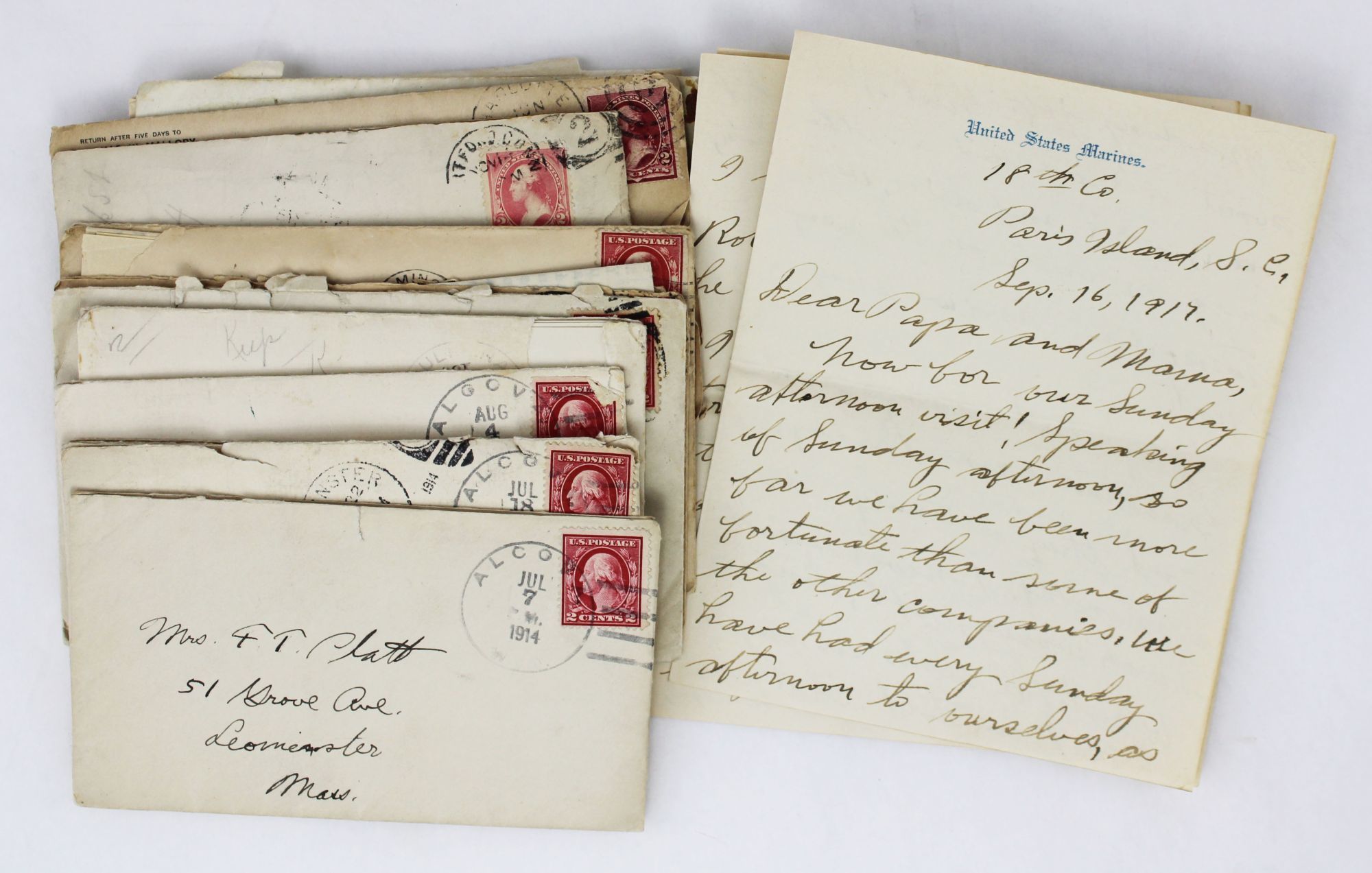
[Alcova, Wy.; Gulham and Achorage, Ak, 1922. Very good.. Eight autograph letters, signed, totaling approximately [32]pp. All in original transmittal envelopes. Old mailing folds, minor wear. A small archive of letters documenting brief bouts of time in the life of a young Massachusetts man working in Wyoming and Alaska in the years during and just after World War I. William Sherman Platt (1896-1969) was born in Troy, New York. Throughout his life, he worked as a shipper at a lumber yard and eventually as the manager and then proprietor of a coal company by 1950. He served in the military during the latter portion of the First World War, but apparently did not serve in Europe. Later, at the age of 46, he filled out a draft card for World War II, but it is unclear whether he served during the war, likely not. The present collection of his letters document two brief snapshots of Platt's life as a young man, from about ages eighteen to twenty-six.
Platt wrote his earliest five letters from Gate Ranch in Wyoming to his parents back in Leominster, Massachusetts. Platt's earliest letter from Wyoming, dated July 4, 1914, includes his initial reaction to the place and a stark appraisal of the locals: "I think I will enjoy things here very much indeed when I get accustomed to the place & the people. They are, for the most part, ignorant animals, but they all mean well." In his second letter, Platt complains about the slowness of the mail, then offers an appraisal of the food in Wyoming: "The food is plain but well cooked and palatable and there is always plenty of it." In his third letter, Platt describes the road work he was performing in and around Alcova: "Last week, myself and two other fellows went down toward Alcova, fixing the road.... We were fixing up an old wood road for Mr. Schoolmaker to use as an auto road We camped out, cooking out or meals and sleeping in our tents. It was very interesting." He describes some of his other work in his penultimate letter from Wyoming on July 30: "You want to know what I am doing. Well, I am working. So far I have worked at carpentering, surveying, irragating [sic], road building, and fence repairing, beside hoeing weeds and helping a little with the chores once in a while. I don't know what I may strike yet. I am very busy, but it is not what you would call distinctively Western work. I might do it anywhere. Still it is all right." He then provides another impression of the locals in Wyoming: "I have more fun than a little listening to these fellows around here talk. They are mostly old American stock who think that they are as good as anybody and a little better. They have views on all conceivable subjects, which they are glad to air on all occasions, aided with a copious flow of profanity. They sure are some fun." Platt writes his last letter from Wyoming on August 2, and reports further on his activities (reading, helping the cook), the food (again), and also discusses his prospects for college, which he apparently meant to start soon. He prefers to attend Clark University in Worcester, but also mentions staying on the ranch in Wyoming ("to learn something about ranch work") until December and then heading home to Massachusetts after going to see San Francisco.
Apparently, Platt enlisted in the Marines sometime in 1917, as one of his letters is dated September 16 from that year while at Paris Island, South Carolina. Platt details his training and "hard labor" in the military. He had apparently left the military for the timber industry in Alaska by 1920, as his final two letters emanate from Chitina, Alaska in the Fall of 1920. Platt's first letter is dated October 5, 1920 and describes his work in Alaska: "Since I wrote last I have been working in the woods steadily...so long as I stay here.... Really, the logging here is a joke. The timber is small, scattered, and almost all rotten at the butt. Today there were 7 of us in the woods and we only got 70 logs, short ones at that, 12 to 16 ft. I have been climbing the trees all the time, and I guess that will be my regular job from now on. It is easy. Most of the limbs are dead and break off." He also describes the short working day, his camping rituals, his like for malamute dogs and their work, eating caribou, and more. The present collection also includes two letters from Platt's mother sent to him in Alaska, reacting to his activities but largely reporting on events from home. Platt's second and last letter from Alaska dates from January 11, 1922 from Anchorage, when he writes a friend also named Bill. Platt spends about half of this letter detailing the opportunities for mining in Alaska, and describes a trip into the Alaskan interior: "But there is all kinds of mining on all sides of it. For quartz why the Willow Creek District is about the best. There is probably a dozen outfits operating. There is also a few coal mines in operation, some at Kenana, Healey, & Eska Creek and a few other smaller layouts in different places. Summer before last I took a trip in through the Interior, but I found it very unsatisfactory. Very expensive to move and the wages wasn't over 5 or 6 dollars a day and board for labor." In addition to his own letters, the present group includes a 1917 letter from Platt's grandmother asking him to stay away from the current "awful war," as well as four family letters from the late-19th century. A small but informative group of letters surrounding a young Massachusetts man adventuring in the American West and Alaska in his younger years.
Platt wrote his earliest five letters from Gate Ranch in Wyoming to his parents back in Leominster, Massachusetts. Platt's earliest letter from Wyoming, dated July 4, 1914, includes his initial reaction to the place and a stark appraisal of the locals: "I think I will enjoy things here very much indeed when I get accustomed to the place & the people. They are, for the most part, ignorant animals, but they all mean well." In his second letter, Platt complains about the slowness of the mail, then offers an appraisal of the food in Wyoming: "The food is plain but well cooked and palatable and there is always plenty of it." In his third letter, Platt describes the road work he was performing in and around Alcova: "Last week, myself and two other fellows went down toward Alcova, fixing the road.... We were fixing up an old wood road for Mr. Schoolmaker to use as an auto road We camped out, cooking out or meals and sleeping in our tents. It was very interesting." He describes some of his other work in his penultimate letter from Wyoming on July 30: "You want to know what I am doing. Well, I am working. So far I have worked at carpentering, surveying, irragating [sic], road building, and fence repairing, beside hoeing weeds and helping a little with the chores once in a while. I don't know what I may strike yet. I am very busy, but it is not what you would call distinctively Western work. I might do it anywhere. Still it is all right." He then provides another impression of the locals in Wyoming: "I have more fun than a little listening to these fellows around here talk. They are mostly old American stock who think that they are as good as anybody and a little better. They have views on all conceivable subjects, which they are glad to air on all occasions, aided with a copious flow of profanity. They sure are some fun." Platt writes his last letter from Wyoming on August 2, and reports further on his activities (reading, helping the cook), the food (again), and also discusses his prospects for college, which he apparently meant to start soon. He prefers to attend Clark University in Worcester, but also mentions staying on the ranch in Wyoming ("to learn something about ranch work") until December and then heading home to Massachusetts after going to see San Francisco.
Apparently, Platt enlisted in the Marines sometime in 1917, as one of his letters is dated September 16 from that year while at Paris Island, South Carolina. Platt details his training and "hard labor" in the military. He had apparently left the military for the timber industry in Alaska by 1920, as his final two letters emanate from Chitina, Alaska in the Fall of 1920. Platt's first letter is dated October 5, 1920 and describes his work in Alaska: "Since I wrote last I have been working in the woods steadily...so long as I stay here.... Really, the logging here is a joke. The timber is small, scattered, and almost all rotten at the butt. Today there were 7 of us in the woods and we only got 70 logs, short ones at that, 12 to 16 ft. I have been climbing the trees all the time, and I guess that will be my regular job from now on. It is easy. Most of the limbs are dead and break off." He also describes the short working day, his camping rituals, his like for malamute dogs and their work, eating caribou, and more. The present collection also includes two letters from Platt's mother sent to him in Alaska, reacting to his activities but largely reporting on events from home. Platt's second and last letter from Alaska dates from January 11, 1922 from Anchorage, when he writes a friend also named Bill. Platt spends about half of this letter detailing the opportunities for mining in Alaska, and describes a trip into the Alaskan interior: "But there is all kinds of mining on all sides of it. For quartz why the Willow Creek District is about the best. There is probably a dozen outfits operating. There is also a few coal mines in operation, some at Kenana, Healey, & Eska Creek and a few other smaller layouts in different places. Summer before last I took a trip in through the Interior, but I found it very unsatisfactory. Very expensive to move and the wages wasn't over 5 or 6 dollars a day and board for labor." In addition to his own letters, the present group includes a 1917 letter from Platt's grandmother asking him to stay away from the current "awful war," as well as four family letters from the late-19th century. A small but informative group of letters surrounding a young Massachusetts man adventuring in the American West and Alaska in his younger years.
Details
Title
[Collection of Eight Manuscript Letters from a Young Man Working in Wyoming and Alaska in the Early-20th Century]
Author
[Wyoming]. [Alaska]. Platt, William Sherman
Condition
Very Good
Publisher
[Alcova, Wy.; Gulham and Achorage, Ak
Date
1922