

TEXT PRESUMABLY FROM THE HOURS OF THE CROSS
- Metz , ca. 1440
Metz, ca. 1440. Leaf: 162 x 124 mm. (6 3/8 x 4 7/8"). Frame: 308 x 258 mm. (12 1/8 x 10 1/8"). Single column, three lines of text under the miniature (obverse with 18 ruled lines, five of which contain text), in a gothic book hand.
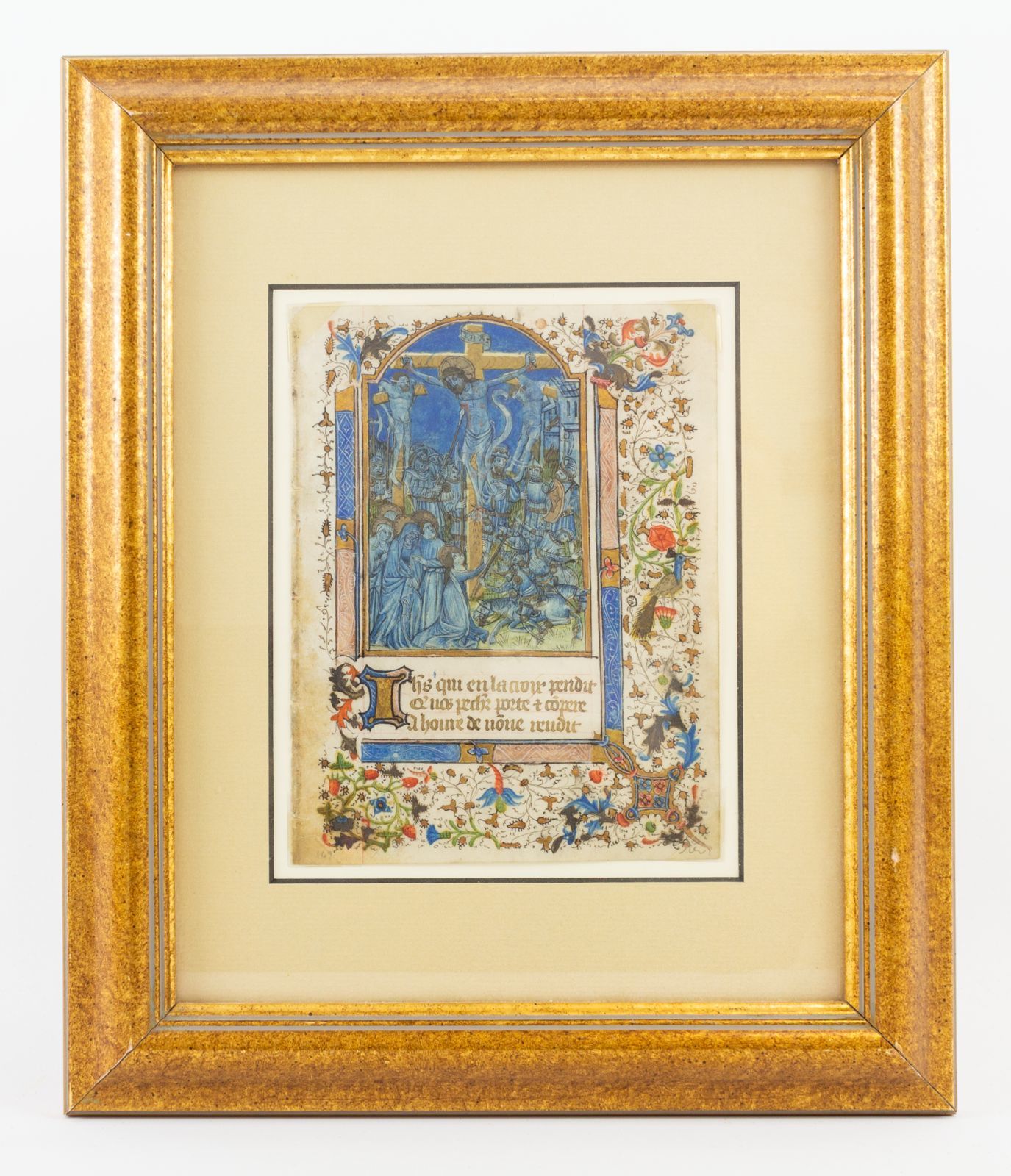
Attractively matted and framed. Recto with one three-line initial in gold on pink and blue ground, WITH A LARGE MINIATURE OF THE CRUCIFIXION WASHED IN BLUE, Christ on a painted gold cross, flanked by two thieves on painted gold crosses, surrounded by throngs of people including the Virgin, St. John, Mary Magdalene, and numerous soldiers, all in an arched gold frame inside a three-sided painted and gilt baguette and a FULL BORDER of colorful vine sprays and flowers inhabited by a peacock. See: "The Jeanne Miles Blacburn Collection of Manuscript Illuminations" nos. 29-38; Avril & Reynaud, pp. 182 & 190. Minor soiling/browning right at inner edge (away from border and image), otherwise IN VERY FINE CONDITION, THE MINIATURE REMARKABLY WELL PRESERVED, WITHOUT ANY LOSS OF PAINT.
This stunning miniature with its memorable nocturnal scene comes from a very fine Book of Hours probably executed by Henri d'Orquevaulz (or d'Orquevaulx) or a member of his workshop. D'Oquevaulz was active during the second quarter of the 15th century in Metz, the cultural and commercial capital of Lorraine during the period, and the center of a growing book trade. According to the catalogue of the Jeanne Miles Blackburn Collection in the Cleveland Museum of Art, which owns 10 leaves from the original manuscript, the parent Book of Hours can be localized based on the Lorraine dialect found in the French text on some of the leaves (including the present example), and because the calendar singled out two bishop-saints of Metz (Clement and Arnoul). Although little is known about d'Orquevaulz, his dated signature in the colophon of a Livy manuscript that he illuminated for an alderman of Metz indicates that he was active in that city in 1440. Artistic affinities with northern European styles make it possible that d'Orquevaulz had emigrated from the Netherlands or Germany to Lorraine; another possibility, one that Avril and Renaud suggest, is that the master himself was from Metz, but that he had German associates, perhaps from the Rhineland area. According to these two scholars, the painter's use of large flat areas of colors is more typical of the Rhineland, the Netherlands, or Bohemia than of France; in any case, they praise his "exquisite color harmonies." The artist has outdone himself in the present miniature, rising to the height of pathos and making it one of the most extraordinary leaves we have ever offered for sale. In contrast to the bright colors used in Books of Hours even to depict the most serious scenes, the present leaf presents a remarkable visual nocturne, with the figures and buildings painted in the same shades of blue as the sky, suggesting that heaven itself is darkening at the death of Christ. Mary Magdalen kneels at the foot of the cross, while St. John supports the devastated Virgin as a soldier pierces the Savior's side with a lance. The miniature is crowded with figures (we see well-defined faces of no fewer than 18 persons and two horses), but the artist has not lost his dramatic focus, as Christ on his cross of brushed gold dominates the scene. In choosing to make this a darkened composition, the artist has risked obscuring detail, but his skill has been equal to his concept here, as he has used a diluted blue paint that allows for a very successful delineation in various shades, almost like grisaille (this technique, not incidentally, has prevented the cracking and erosion so commonly seen with the normal thick applications of typical cobalt blue). The result of the decision to show the world in eclipse at Christ's death is to heighten and universalize the drama here to such an extent that the scene leaves a powerful and lasting impression. The text on this leaf is entirely in French in rhyming verse. Roughly it translates as: "Jesus on the cross did hang, / And took upon himself our sins, / Gave to humankind redemption, / Rendered up his soul to God. / The sunshine lost its glowing light, / The earth did tremble and did crack, / Grieving for the bitter death / Suffered by the son of God." Although the original Book of Hours was dismembered some time in the 20th century, extant leaves suggest that its visual program was much bigger than usual, and probably the result of an important commission by a wealthy patron--something likely to be painted by one of the chief artists in the workshop. Illuminated manuscripts from Metz--let alone examples of this quality--are uncommonly seen on the market..
Attractively matted and framed. Recto with one three-line initial in gold on pink and blue ground, WITH A LARGE MINIATURE OF THE CRUCIFIXION WASHED IN BLUE, Christ on a painted gold cross, flanked by two thieves on painted gold crosses, surrounded by throngs of people including the Virgin, St. John, Mary Magdalene, and numerous soldiers, all in an arched gold frame inside a three-sided painted and gilt baguette and a FULL BORDER of colorful vine sprays and flowers inhabited by a peacock. See: "The Jeanne Miles Blacburn Collection of Manuscript Illuminations" nos. 29-38; Avril & Reynaud, pp. 182 & 190. Minor soiling/browning right at inner edge (away from border and image), otherwise IN VERY FINE CONDITION, THE MINIATURE REMARKABLY WELL PRESERVED, WITHOUT ANY LOSS OF PAINT.
This stunning miniature with its memorable nocturnal scene comes from a very fine Book of Hours probably executed by Henri d'Orquevaulz (or d'Orquevaulx) or a member of his workshop. D'Oquevaulz was active during the second quarter of the 15th century in Metz, the cultural and commercial capital of Lorraine during the period, and the center of a growing book trade. According to the catalogue of the Jeanne Miles Blackburn Collection in the Cleveland Museum of Art, which owns 10 leaves from the original manuscript, the parent Book of Hours can be localized based on the Lorraine dialect found in the French text on some of the leaves (including the present example), and because the calendar singled out two bishop-saints of Metz (Clement and Arnoul). Although little is known about d'Orquevaulz, his dated signature in the colophon of a Livy manuscript that he illuminated for an alderman of Metz indicates that he was active in that city in 1440. Artistic affinities with northern European styles make it possible that d'Orquevaulz had emigrated from the Netherlands or Germany to Lorraine; another possibility, one that Avril and Renaud suggest, is that the master himself was from Metz, but that he had German associates, perhaps from the Rhineland area. According to these two scholars, the painter's use of large flat areas of colors is more typical of the Rhineland, the Netherlands, or Bohemia than of France; in any case, they praise his "exquisite color harmonies." The artist has outdone himself in the present miniature, rising to the height of pathos and making it one of the most extraordinary leaves we have ever offered for sale. In contrast to the bright colors used in Books of Hours even to depict the most serious scenes, the present leaf presents a remarkable visual nocturne, with the figures and buildings painted in the same shades of blue as the sky, suggesting that heaven itself is darkening at the death of Christ. Mary Magdalen kneels at the foot of the cross, while St. John supports the devastated Virgin as a soldier pierces the Savior's side with a lance. The miniature is crowded with figures (we see well-defined faces of no fewer than 18 persons and two horses), but the artist has not lost his dramatic focus, as Christ on his cross of brushed gold dominates the scene. In choosing to make this a darkened composition, the artist has risked obscuring detail, but his skill has been equal to his concept here, as he has used a diluted blue paint that allows for a very successful delineation in various shades, almost like grisaille (this technique, not incidentally, has prevented the cracking and erosion so commonly seen with the normal thick applications of typical cobalt blue). The result of the decision to show the world in eclipse at Christ's death is to heighten and universalize the drama here to such an extent that the scene leaves a powerful and lasting impression. The text on this leaf is entirely in French in rhyming verse. Roughly it translates as: "Jesus on the cross did hang, / And took upon himself our sins, / Gave to humankind redemption, / Rendered up his soul to God. / The sunshine lost its glowing light, / The earth did tremble and did crack, / Grieving for the bitter death / Suffered by the son of God." Although the original Book of Hours was dismembered some time in the 20th century, extant leaves suggest that its visual program was much bigger than usual, and probably the result of an important commission by a wealthy patron--something likely to be painted by one of the chief artists in the workshop. Illuminated manuscripts from Metz--let alone examples of this quality--are uncommonly seen on the market..
Details
Title
TEXT PRESUMABLY FROM THE HOURS OF THE CROSS
Author
A MEDIEVAL ILLUMINATED VELLUM MANUSCRIPT LEAF WITH A BREATHTAKING MINIATURE OF THE CRUCIFIXION, FROM A BOOK OF HOURS IN FRENCH
Condition
Unknown
Publisher
Metz
Date
ca. 1440