

TWENTY LEAVES OF ORIGINAL PEN AND INK DRAWINGS BY PROFESSIONAL WELDER AND PART-TIME CARTOONIST KERN UDO WHIPPLE, MANY SIGNED "WHIP" AND SOME LIKELY DONE FOR HIS COMPANY'S NEWSLETTER "THE SCOOP." ACCOMPANIED BY SIX OF WHIPPLE'S POCKET DIARIES, 1928-1933, DEPICTING A WORKING MAN'S LIFE IN THE EARLY YEARS OF THE GREAT DEPRESSION
- Evansville, IN , 1933
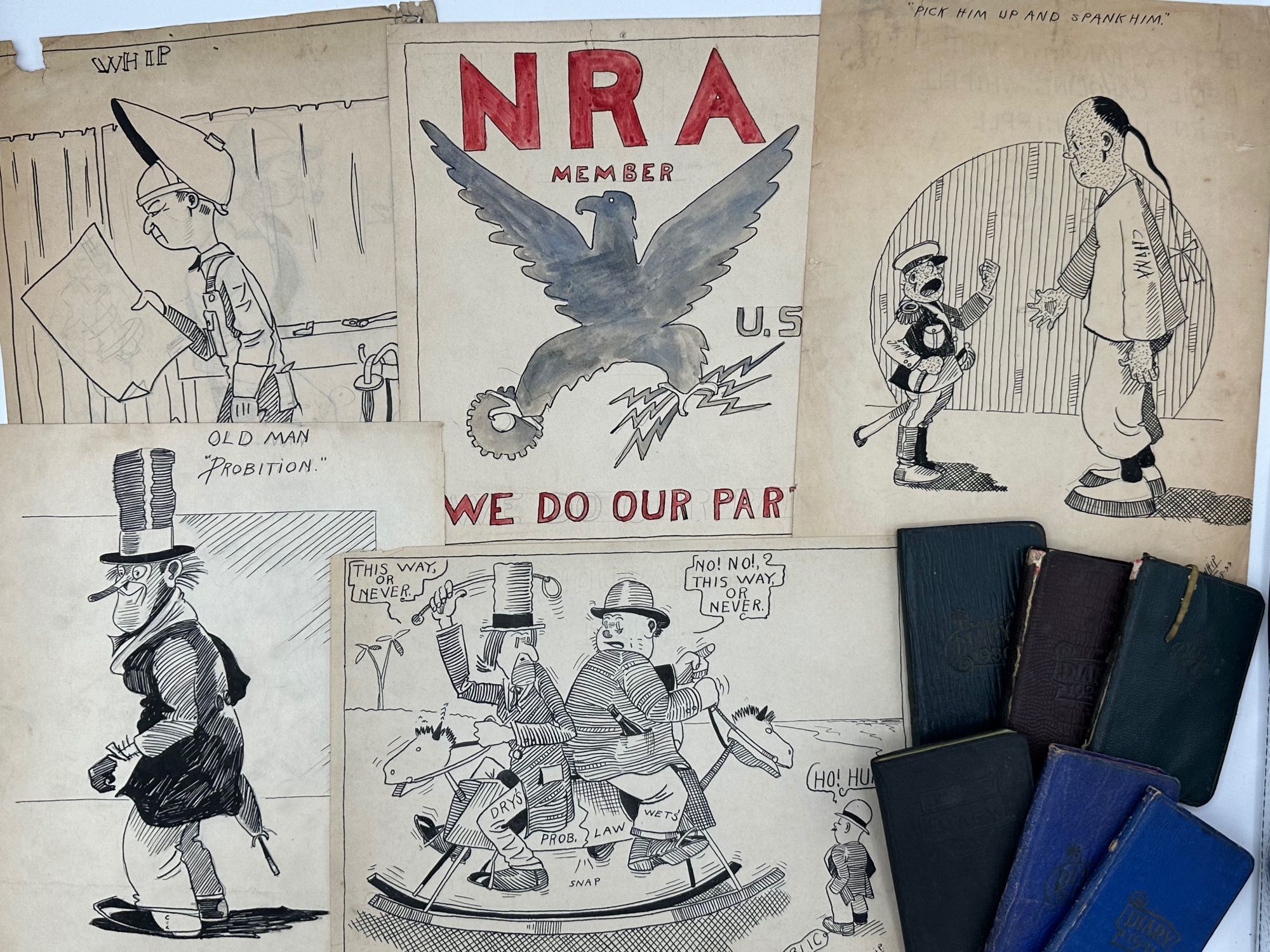
Evansville, IN, 1933. A collection of accomplished pen and ink drawings by a self-taught artist, some more fully realized them others, some just preliminary sketches, done by a welder working for the Bucyrus-Erie Company's branch plant in Evansville, Indiana in the boom-times of the 1920s and the early years of the Great Depression. Whipple's drawings, on company stationery, stiff card stock, or plain drawing paper, often done on both the recto and verso of the sheet, vary in size from 3 x 5 in.to 8 1/2 x 11 in. Some are signed, a few are dated between 1931-1934, and one in 1937, approx. 19 are full page illustrations, the remainder have more than one image on the page. One is a caricature of a welder studying a design; another shows a man in boots smoking a pipe, with a caption title "Whip Walking Around During the 37 Flood"; another is a poster-style image, a National Recovery Act sign, of an American Eagle holding a gear in one claw and lighting bolts in the other, entitled "NRA Member U.S. We Do Our Part." Others are political cartoons, addressing topics of the day: one refers to the on going conflict between Japan and China in 1933, depicting a small Japanese soldier standing in front of a much larger Chinese man, and captioned "Pick Him Up and Spank Him"; another is a delightful image of "Old Man Prohibition," a long nosed fellow in a top hat. Other sketches offer up caricatures of people, male and female, and several drawings have western themes: a lone cowboy on a horse, a man on a bucking bronco, two Native Americans on horseback watching the passing of a wagon train, etc. A few have Christmas scenes, including one of Santa Claus, finished with colored pencil or crayon; and one a proposed design for a 1933 Christmas Seal greeting. Accompanying the group is a printed rejection slip from the NEA Service [Newspaper Enterprise Association] based in Cleveland, signed in type by H.M. Cochran, Editor of the Comic Art Dept., stating that "...it is not possible for NEA to introduce a new comic into the service at this time..." and returning his drawings.
Udo Whipple (his preferred name) was born in Indiana and was working for the Bucyrus Company by the time he turned 18, according to his World War I draft card. He was employed as a riveter and a welder. He continued at the plant, a manufacturer of industrial steam shovels, bulldozer blades, and mining equipment, for the rest of his adult life. His six small pocket diaries, all leather bound, one approx. 4 x 2 3/4 in., the rest 5 1/4 x 2 3/4 in., depict the difficult times his family, friends, and the company went through in the early years of the Great Depression. In brief daily entries, approx. 15-20 words a day from January 1928 - December 1933, he records his work schedule, family activities, and interactions with friends and relatives, including playing cards, bottling beer, getting a radio, hunting squirrels, mushrooms, and ginseng, going fishing, dealing with a broken down car, and often, in the quiet evenings, a mention that he was "drawing for scoop." This is a reference to the company's publication of a quarterly magazine with business news, stories and information, often with illustrations by employees. [A copy of the March 1930 edition of "The Scoop," held by the South Milwaukee Public Library, lists Udo Whipple from Evansville among its cartoon contributors.]
Most of Whipple's entries for 1928 and 1929 begin with the word "worked." He was working 5 or 6 days a week at Bucyrus-Erie in the boom years of the late 1920s. By November 1930, however, he begins to mention days off, "not much work at shop," or "off to-day work is bad." His note at the end of the year says "1930 was not so good. I lost much time..." and he hopes for better in the new year. The entries for 1931 make it clear things were not getting better and he was beginning to juggle his bills. In May he notes that business "is very bad and going to get worse." In September he had to let their insurance drop. He also records the least amount of pay he had ever drawn since starting at the company, $6.84 on Sept. 22. His note at year's end: "The year is about gone and business is sure bad.... This year a bad year for everybody."
At the ends of each diary he lists his income by month, giving yearly totals of $1268.07 in 1928, and $1472.72 in 1929. There was a precipitous drop to $494.27 by the end of 1931, with worse news by the end of 1932, a total of $259.68. He occasionally received money from merchants in the town who paid him to make signs or posters, but at one point in March 1932 he had to get $30 from the Company in order to pay his rent. In April there was a big lay-off. The machine shop was stopped on May 16, and only 8 men were kept working. By mid-July all the men were laid off and he was out of work for 5 weeks. He also mentions the closing of several banks in town. The last diary in the group is for 1933. A small membership/identification card dated 1924 from an unidentified organization is laid in at the front. Whipple mentions an assassination attempt on the President Roosevelt in February. On March 6, 1933 he mentions that all the banks were closed for a week, a reference to the President's bank holiday, and that the company had sold 2 machines. In June he was laid off again. The remainder of the year, his entries list him as looking for work or working odd jobs, occasionally for the county or doing road work, or cleaning or mowing for people in town. By fall he sometimes mentions "work at shop" (presumably Bucyrus-Erie) and his year-end income as $466.49. His entry on Dec. 30: "One more day in this year. I have had peace and trouble but have had health in my home. I am thankful to be with my family and may the Lord bless them and me with health and employment for the next year. -- Whip." Udo Whipple continued to work for Bucyrus Foundry and Manufacturing Company until he retired five years before his death. According to an article by Keith Haddock in the Encyclopedia of Milwaukee (online), the Bucyrus Company, originally founded in Ohio in 1880, provided machinery used in the California gold fields, the New York State Barge Canal, and the Panama Canal in the early 1900s. Bucyrus merged with the Erie Steam Shovel Company in 1927 becoming Bucyrus-Erie. The company survived the Great Depression, successfully aligning with a British firm, Ruston & Hornsby in 1930, acquiring Armstrong Drill Company in 1933 and, a year later gaining control of the Monighan Manufacturing Corporation.
By the time the United States entered World War II, the company was on solid footing. Mention is made of their war efforts in the Evansville Press edition of June 24, 1944, in an article entitled "Caricatures of Buddies in Service Spur Bond Drive." Udo Whipple features prominently: “Most effective salesman proved to be Udo Whipple, an electric welder who doubles as a cartoonist. In his spare time, Whipple drew caricatures of former employees now in service on battle fronts. Since almost every department has someone in the fight, every department got one of his big cartoons- and the likenesses are unmistakable. Boys known to every man in every department appeal to them from the walls.”.
Udo Whipple (his preferred name) was born in Indiana and was working for the Bucyrus Company by the time he turned 18, according to his World War I draft card. He was employed as a riveter and a welder. He continued at the plant, a manufacturer of industrial steam shovels, bulldozer blades, and mining equipment, for the rest of his adult life. His six small pocket diaries, all leather bound, one approx. 4 x 2 3/4 in., the rest 5 1/4 x 2 3/4 in., depict the difficult times his family, friends, and the company went through in the early years of the Great Depression. In brief daily entries, approx. 15-20 words a day from January 1928 - December 1933, he records his work schedule, family activities, and interactions with friends and relatives, including playing cards, bottling beer, getting a radio, hunting squirrels, mushrooms, and ginseng, going fishing, dealing with a broken down car, and often, in the quiet evenings, a mention that he was "drawing for scoop." This is a reference to the company's publication of a quarterly magazine with business news, stories and information, often with illustrations by employees. [A copy of the March 1930 edition of "The Scoop," held by the South Milwaukee Public Library, lists Udo Whipple from Evansville among its cartoon contributors.]
Most of Whipple's entries for 1928 and 1929 begin with the word "worked." He was working 5 or 6 days a week at Bucyrus-Erie in the boom years of the late 1920s. By November 1930, however, he begins to mention days off, "not much work at shop," or "off to-day work is bad." His note at the end of the year says "1930 was not so good. I lost much time..." and he hopes for better in the new year. The entries for 1931 make it clear things were not getting better and he was beginning to juggle his bills. In May he notes that business "is very bad and going to get worse." In September he had to let their insurance drop. He also records the least amount of pay he had ever drawn since starting at the company, $6.84 on Sept. 22. His note at year's end: "The year is about gone and business is sure bad.... This year a bad year for everybody."
At the ends of each diary he lists his income by month, giving yearly totals of $1268.07 in 1928, and $1472.72 in 1929. There was a precipitous drop to $494.27 by the end of 1931, with worse news by the end of 1932, a total of $259.68. He occasionally received money from merchants in the town who paid him to make signs or posters, but at one point in March 1932 he had to get $30 from the Company in order to pay his rent. In April there was a big lay-off. The machine shop was stopped on May 16, and only 8 men were kept working. By mid-July all the men were laid off and he was out of work for 5 weeks. He also mentions the closing of several banks in town. The last diary in the group is for 1933. A small membership/identification card dated 1924 from an unidentified organization is laid in at the front. Whipple mentions an assassination attempt on the President Roosevelt in February. On March 6, 1933 he mentions that all the banks were closed for a week, a reference to the President's bank holiday, and that the company had sold 2 machines. In June he was laid off again. The remainder of the year, his entries list him as looking for work or working odd jobs, occasionally for the county or doing road work, or cleaning or mowing for people in town. By fall he sometimes mentions "work at shop" (presumably Bucyrus-Erie) and his year-end income as $466.49. His entry on Dec. 30: "One more day in this year. I have had peace and trouble but have had health in my home. I am thankful to be with my family and may the Lord bless them and me with health and employment for the next year. -- Whip." Udo Whipple continued to work for Bucyrus Foundry and Manufacturing Company until he retired five years before his death. According to an article by Keith Haddock in the Encyclopedia of Milwaukee (online), the Bucyrus Company, originally founded in Ohio in 1880, provided machinery used in the California gold fields, the New York State Barge Canal, and the Panama Canal in the early 1900s. Bucyrus merged with the Erie Steam Shovel Company in 1927 becoming Bucyrus-Erie. The company survived the Great Depression, successfully aligning with a British firm, Ruston & Hornsby in 1930, acquiring Armstrong Drill Company in 1933 and, a year later gaining control of the Monighan Manufacturing Corporation.
By the time the United States entered World War II, the company was on solid footing. Mention is made of their war efforts in the Evansville Press edition of June 24, 1944, in an article entitled "Caricatures of Buddies in Service Spur Bond Drive." Udo Whipple features prominently: “Most effective salesman proved to be Udo Whipple, an electric welder who doubles as a cartoonist. In his spare time, Whipple drew caricatures of former employees now in service on battle fronts. Since almost every department has someone in the fight, every department got one of his big cartoons- and the likenesses are unmistakable. Boys known to every man in every department appeal to them from the walls.”.
Details
Title
TWENTY LEAVES OF ORIGINAL PEN AND INK DRAWINGS BY PROFESSIONAL WELDER AND PART-TIME CARTOONIST KERN UDO WHIPPLE, MANY SIGNED "WHIP" AND SOME LIKELY DONE FOR HIS COMPANY'S NEWSLETTER "THE SCOOP." ACCOMPANIED BY SIX OF WHIPPLE'S POCKET DIARIES, 1928-1933, DEPICTING A WORKING MAN'S LIFE IN THE EARLY YEARS OF THE GREAT DEPRESSION
Author
WHIPPLE, Kern Udo (1900-1971)
Condition
Unknown
Publisher
Evansville, IN
Date
1933