

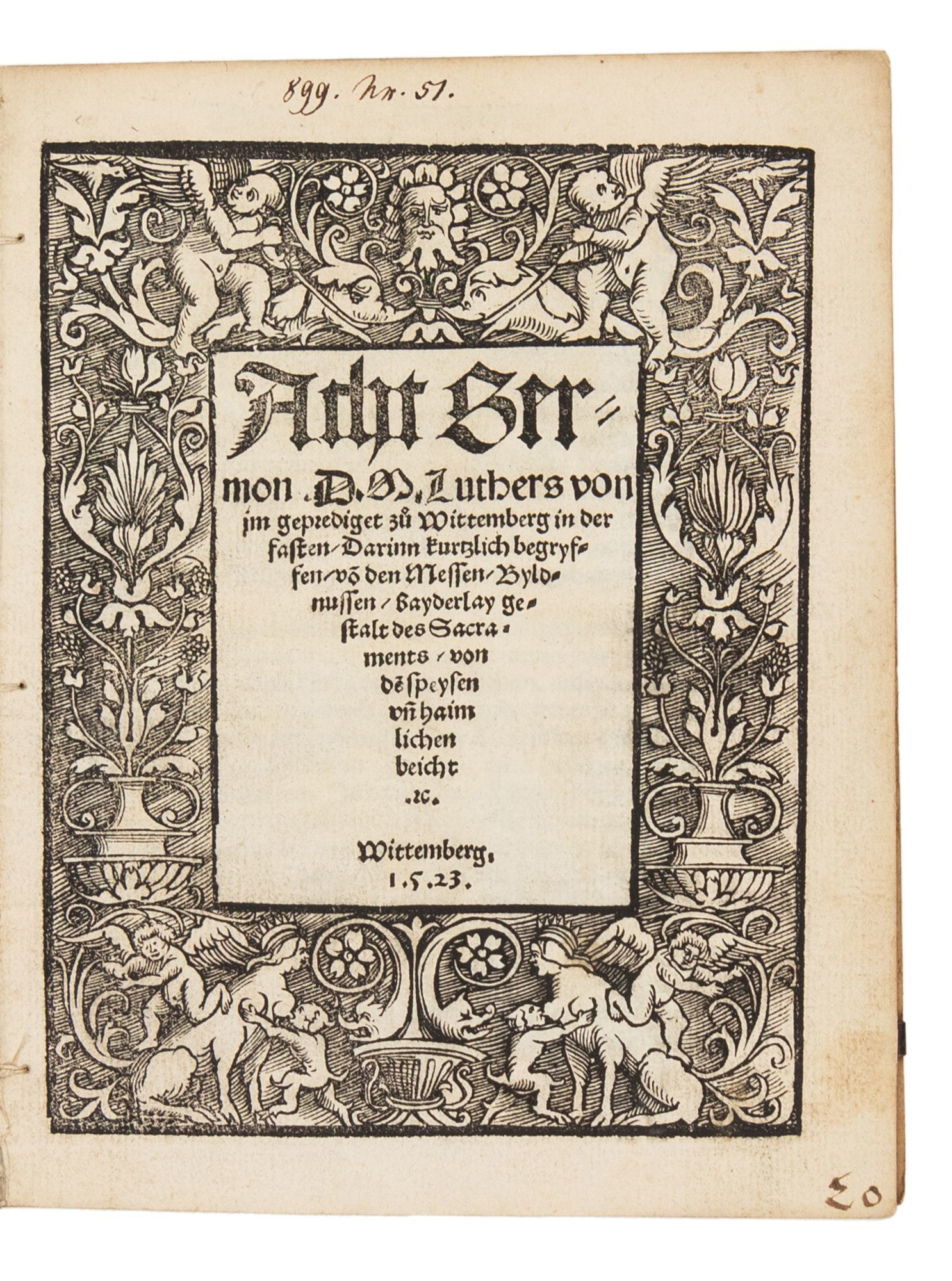
Acht Sermon von D.M. Luthers von jm geprediget zu Wittemberg in der fasten, Darinn kurtzlich begryffen, vo(n) den Messen, Byldnussen, bayderlay gestalt des Sacraments, von de(n) speysen un(d) haimlichen beicht etc.
- Hardcover
- [Augsburg]: [Heinrich Steiner], 1523
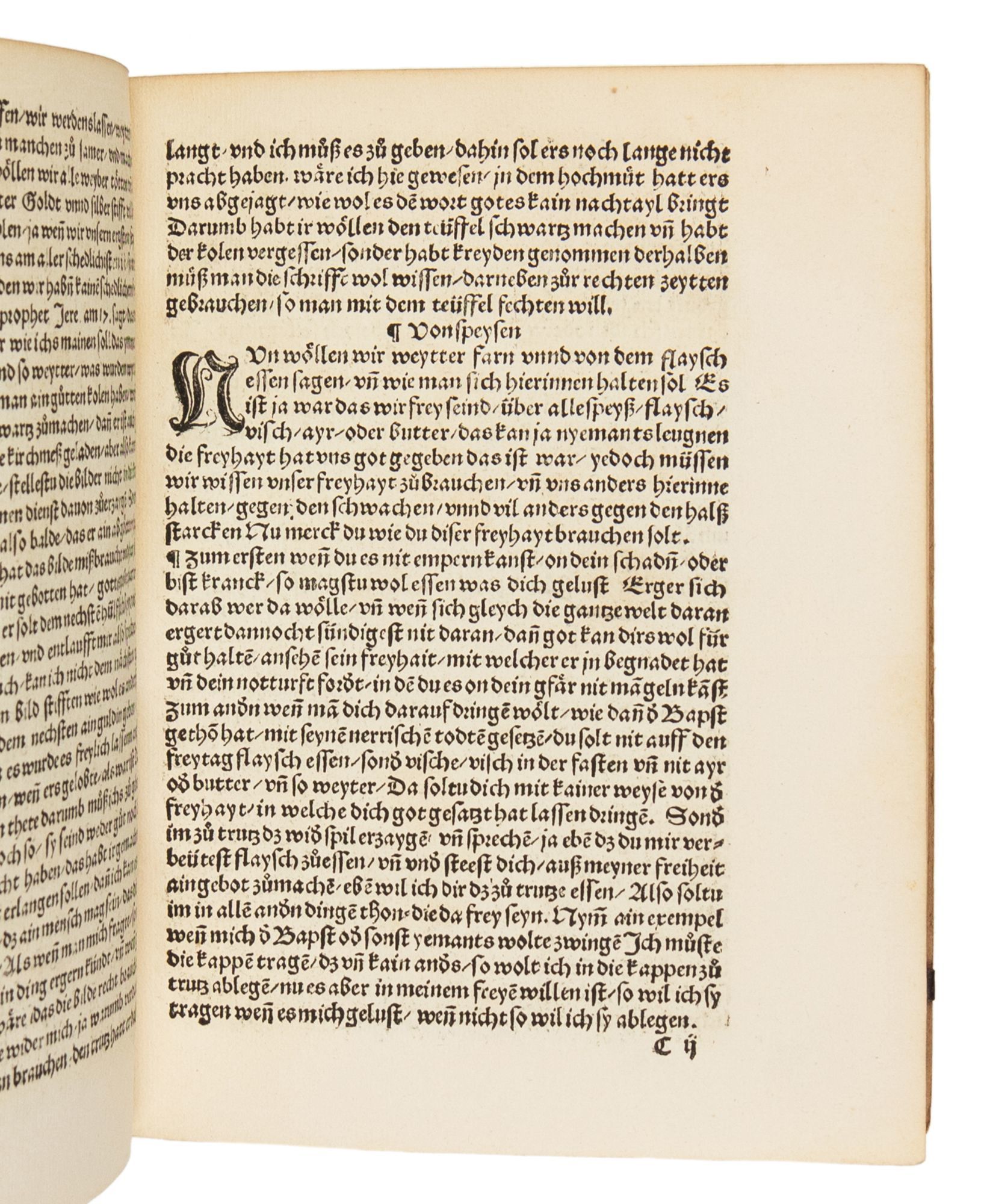
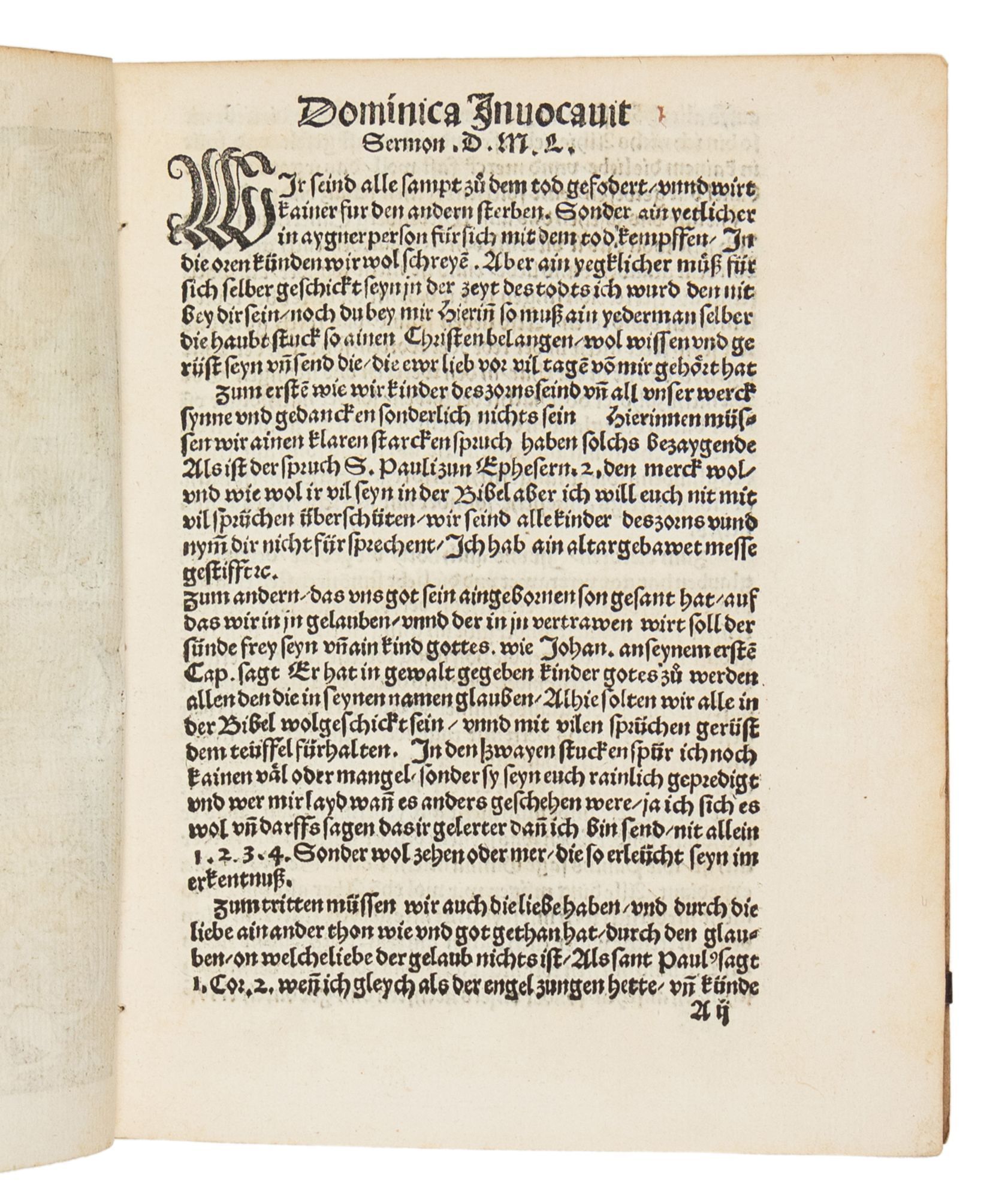
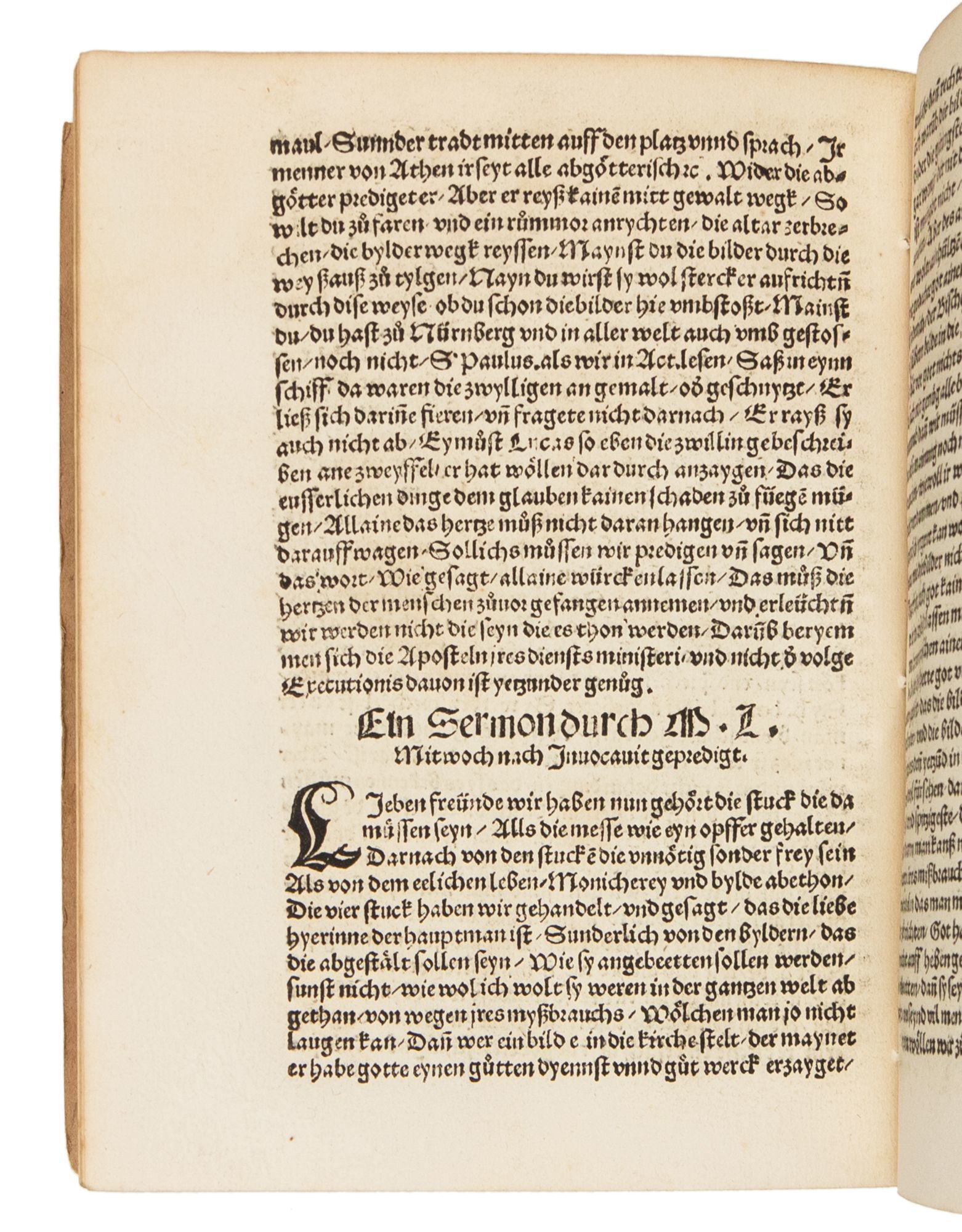
[Augsburg]: [Heinrich Steiner], 1523. One of 3 printings by Steiner in the year of the first edition. Hardcover. Fine. A very nice copy, stab-stiched in drab 20th c. wrappers. With an attractive woodcut title border (Pflugk-Hartung 23). Light maginal fingersoiling to title, blank verso of final leaf lightly soiled. . Two early marginal notes in ink in the blank margin of the title. With a duplicate stamp from the Stadtbibliothek Nürnberg on the rear inner cover. The "Eight Sermons by Dr. M. Luther, preached by him at Wittenberg in Lent, dealing briefly with the masses, images, both kinds in the sacrament, eating [of meats], and private confession, etc." document Luther's efforts to counteract the chaos in Wittenberg that had been caused by Andreas Rudolff-Bodenstein von Karlstadt (ca. 1480-1541), who had instituted radical reforms while Luther was in hiding at the Wartburg.
During Luther's stay in Wartburg Castle, Karlstadt became the head of the reform movement at Wittenberg. Over the course of a year, Karlstadt instituted radical changes in all aspects of religious life. As the leader of the Wittenberg movement and the head of the Wittenberg theological faculty, Karlstadt was in a unique position to both pronounce and enact changes within the church. He instituted most of his larger reforms with the support of the theologians and the city magistrates. These changes to established forms (particularly the institution of the reformed mass) displeased the Elector of Saxony, however, and by March 6th 1522, Luther would return (at the Elector's request) to take control of the Wittenberg movement. Prior to Luther's return, however, Wittenberg would see troubling public manifestations of the new reforms, as a radicalized populace took to the streets in the infamous "Wittenberg disturbances."
"In December, 1521, Luther returned secretly to Wittenberg from the Wartburg for a three day conference on how to meet the turbulence and confusion caused by the radical reformers. Soon after his return to the Wartburg, Karlstadt put himself at the head of those who favored immediate abolition of Roman practices. At Christmas Karlstadt administered communion "in both kinds"(i.e. by giving both the consecrated host and the wine to the laity) for the first time in the parish church. This had been done as early as September in the Augustinian monastery where Gabriel Zwilling conducted mass in the vernacular and abolished private masses. Karlstadt also declared that confession before communion was unnecessary, that images were not allowable in the church, and that rules of fasting were not binding, and this led to outbreaks of actual destruction of images and altars. He also taught the doctrine of direct illumination by the Spirit, which made scholarship and learning unnecessary for the understanding of the Scriptures. The consequence was that the city schools were closed and the university threatened with collapse. Allied with Karlstadt's followers were the Zwickau prophets, Storch, Drechsel, and Stübner, adherents of Thomas Münzer.
"Luther, who hitherto had relied upon Melanchthon's leadership to keep order, returned to Wittenberg on March 6. On March 8 he conferred with Melanchthon, Justus Jonas, Nicholas Amsdorf, and Hieronymus Schurf. On March 9, Invocavit Sunday, he mounted the pulpit in the parish church and preached each day from the ninth to the sixteenth. This remarkable series of sermons, which are powerful, inspired preaching of the gospel, had the effect of restoring tranquility and order almost at once. His task was to lead his congregation away from fanatical enthusiasm back to the spirit of the gospel and to answer the questions that were agitating his people in the light of the gospel. (Further details may be found in an excellent introduction to the sermons in PE 2, 387-390 and in the biographies of Luther and the church histories.). The sermons were transcribed by an unknown amanuensis."(Doberstein, Luther Works Vol. 51).
During Luther's stay in Wartburg Castle, Karlstadt became the head of the reform movement at Wittenberg. Over the course of a year, Karlstadt instituted radical changes in all aspects of religious life. As the leader of the Wittenberg movement and the head of the Wittenberg theological faculty, Karlstadt was in a unique position to both pronounce and enact changes within the church. He instituted most of his larger reforms with the support of the theologians and the city magistrates. These changes to established forms (particularly the institution of the reformed mass) displeased the Elector of Saxony, however, and by March 6th 1522, Luther would return (at the Elector's request) to take control of the Wittenberg movement. Prior to Luther's return, however, Wittenberg would see troubling public manifestations of the new reforms, as a radicalized populace took to the streets in the infamous "Wittenberg disturbances."
"In December, 1521, Luther returned secretly to Wittenberg from the Wartburg for a three day conference on how to meet the turbulence and confusion caused by the radical reformers. Soon after his return to the Wartburg, Karlstadt put himself at the head of those who favored immediate abolition of Roman practices. At Christmas Karlstadt administered communion "in both kinds"(i.e. by giving both the consecrated host and the wine to the laity) for the first time in the parish church. This had been done as early as September in the Augustinian monastery where Gabriel Zwilling conducted mass in the vernacular and abolished private masses. Karlstadt also declared that confession before communion was unnecessary, that images were not allowable in the church, and that rules of fasting were not binding, and this led to outbreaks of actual destruction of images and altars. He also taught the doctrine of direct illumination by the Spirit, which made scholarship and learning unnecessary for the understanding of the Scriptures. The consequence was that the city schools were closed and the university threatened with collapse. Allied with Karlstadt's followers were the Zwickau prophets, Storch, Drechsel, and Stübner, adherents of Thomas Münzer.
"Luther, who hitherto had relied upon Melanchthon's leadership to keep order, returned to Wittenberg on March 6. On March 8 he conferred with Melanchthon, Justus Jonas, Nicholas Amsdorf, and Hieronymus Schurf. On March 9, Invocavit Sunday, he mounted the pulpit in the parish church and preached each day from the ninth to the sixteenth. This remarkable series of sermons, which are powerful, inspired preaching of the gospel, had the effect of restoring tranquility and order almost at once. His task was to lead his congregation away from fanatical enthusiasm back to the spirit of the gospel and to answer the questions that were agitating his people in the light of the gospel. (Further details may be found in an excellent introduction to the sermons in PE 2, 387-390 and in the biographies of Luther and the church histories.). The sermons were transcribed by an unknown amanuensis."(Doberstein, Luther Works Vol. 51).
Details
Title
Acht Sermon von D.M. Luthers von jm geprediget zu Wittemberg in der fasten, Darinn kurtzlich begryffen, vo(n) den Messen, Byldnussen, bayderlay gestalt des Sacraments, von de(n) speysen un(d) haimlichen beicht etc.
Author
Luther, Martin (1483-1546)
Binding
Hardcover
Condition
Fine
Publisher
[Heinrich Steiner]: [Augsburg]
Date
1523
Edition
One of 3 printings by Steiner in the year of the first edition