

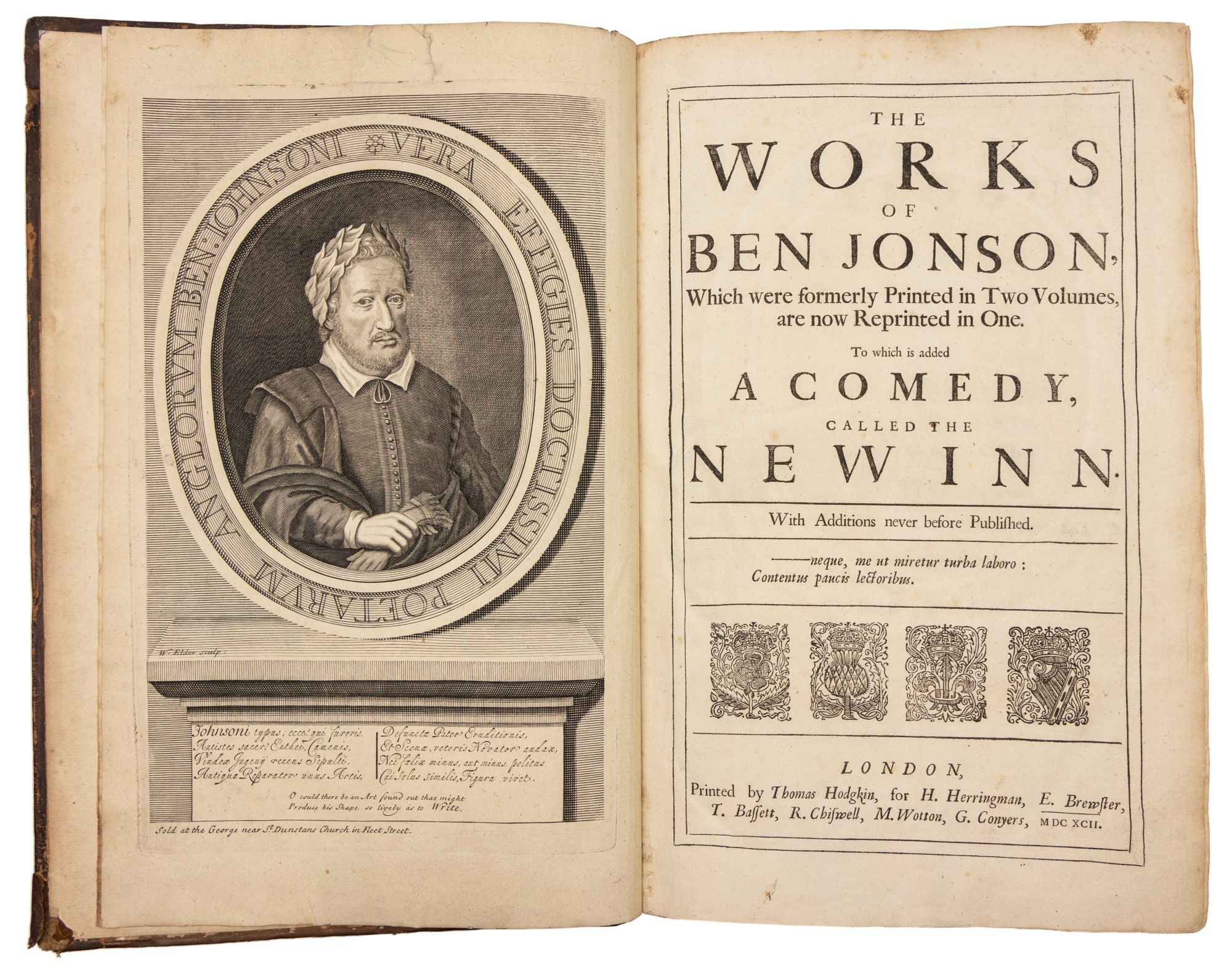
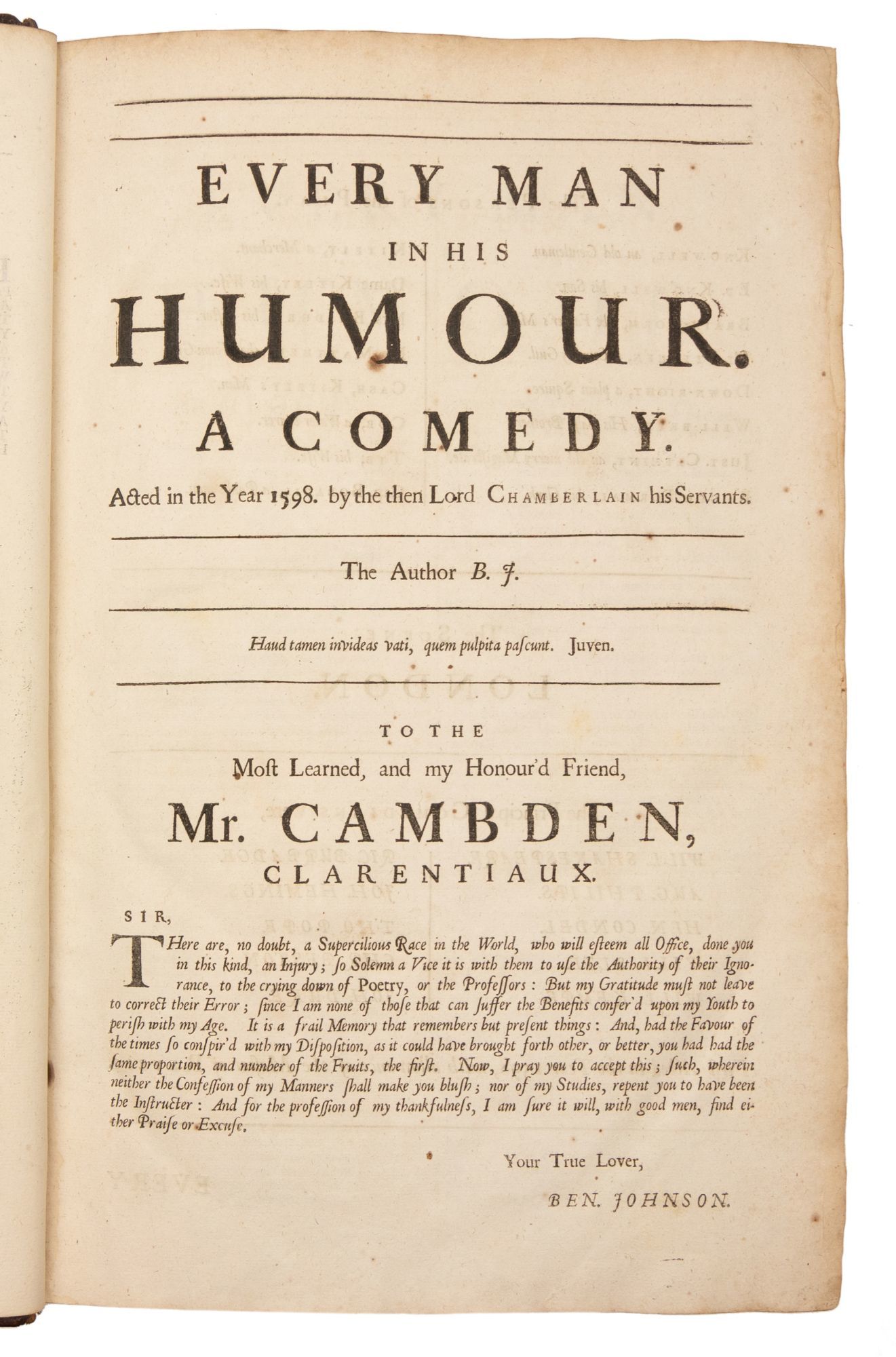
The Works of Ben Jonson, Which were formerly Printed in Two Volumes, are now Reprinted in One. To which is added A Comedy, Called the New Inn. With Additions never before Published. Neque, me ut miretur turba laboro: Contentus paucis lectoribus
- Hardcover
- London: Thomas Hodgkin for H. Herringman, E. Brewster, T. Basset, R. Chiswell, M. Wotton, and G. Conyers, 1692
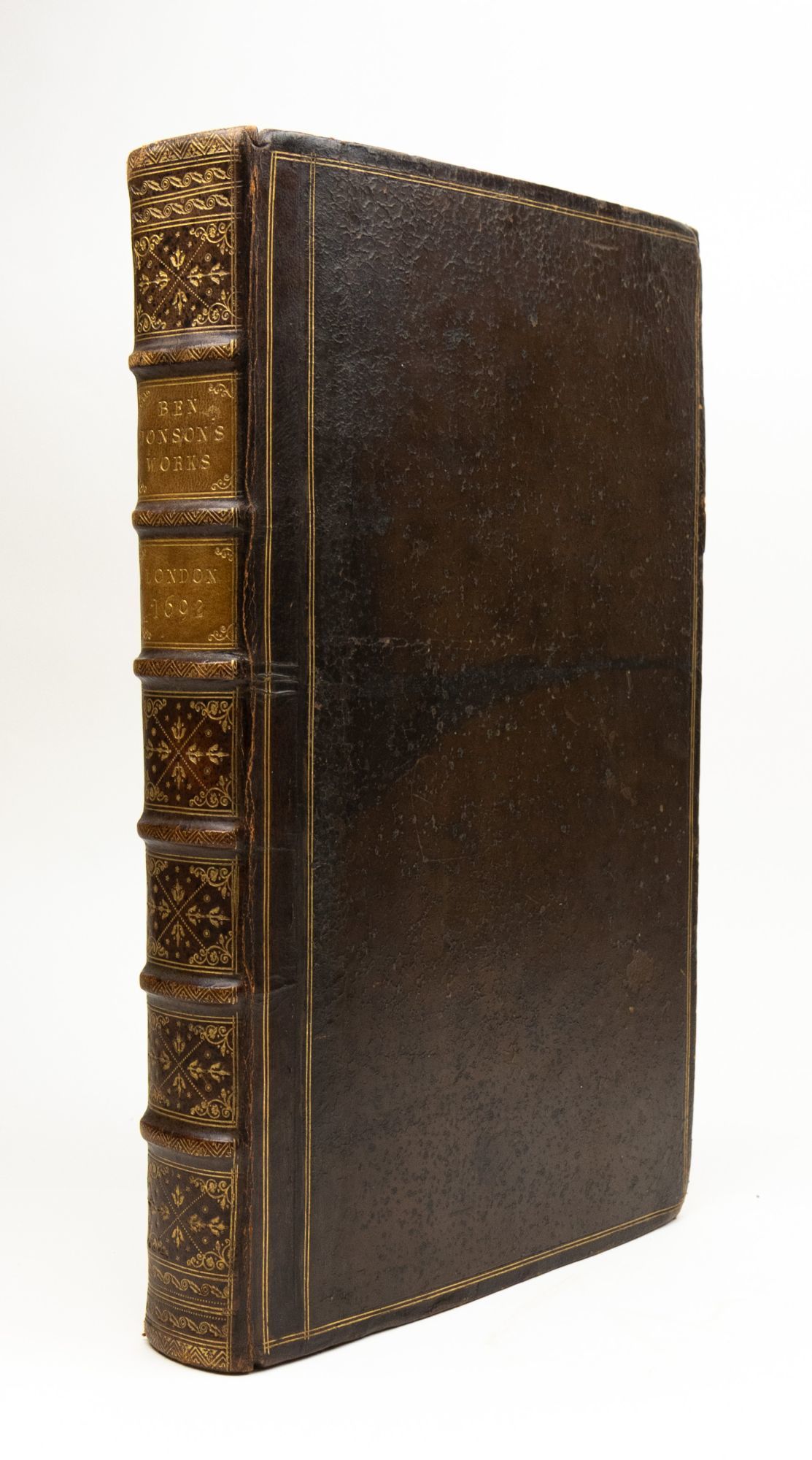
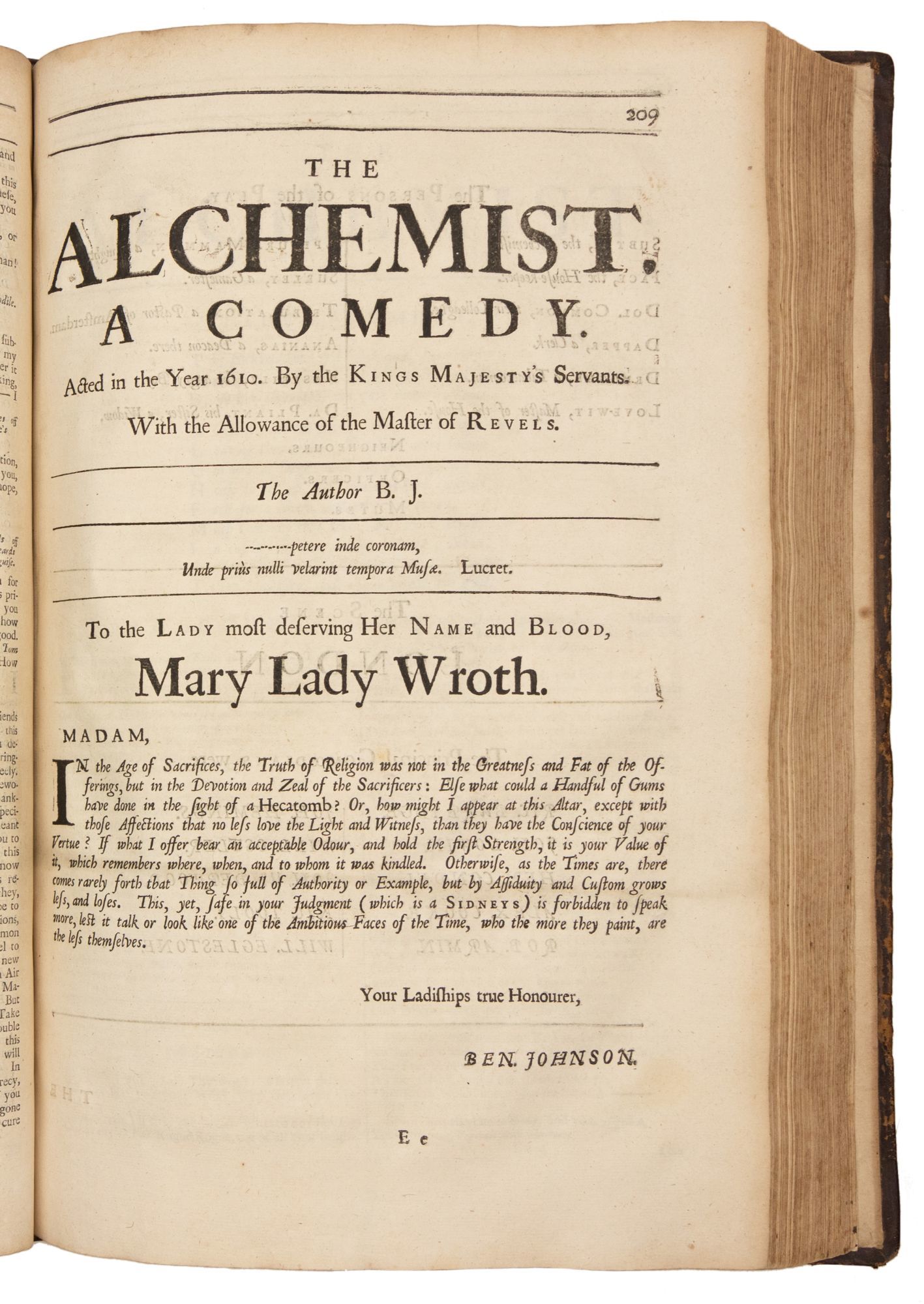
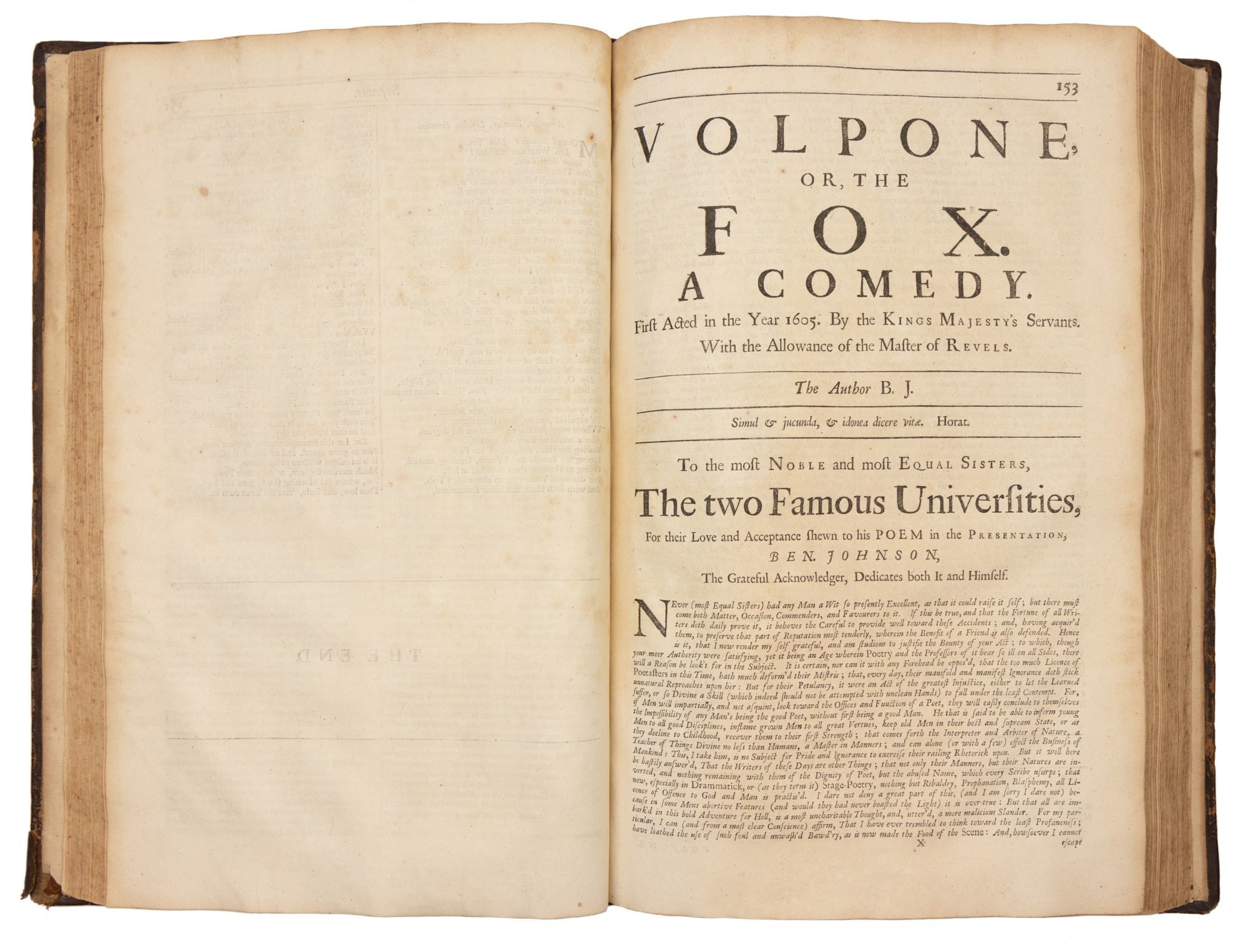
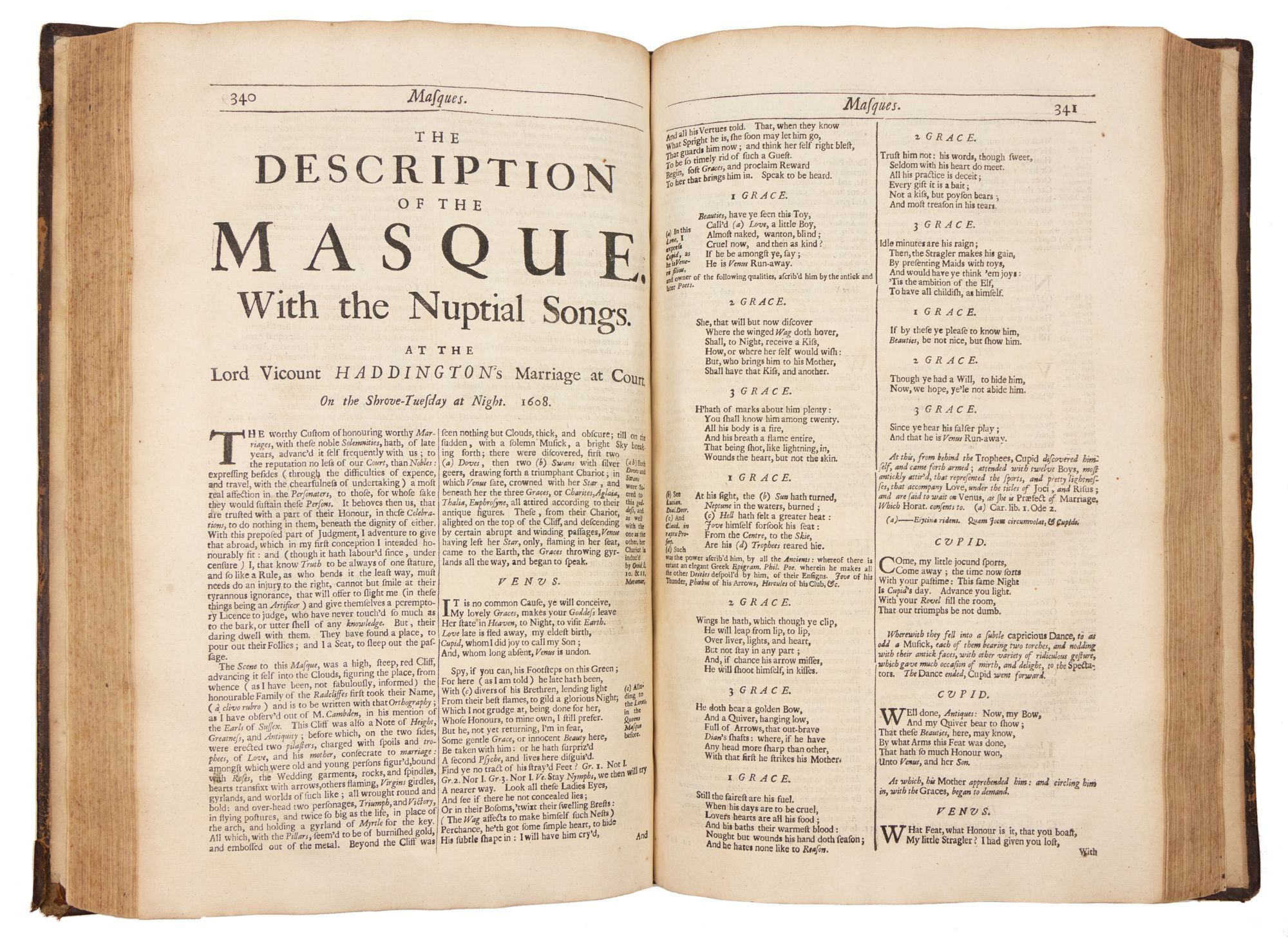
London: Thomas Hodgkin for H. Herringman, E. Brewster, T. Basset, R. Chiswell, M. Wotton, and G. Conyers, 1692. FIRST COMPLETE COLLECTED EDITION. With the engraved frontispiece portrait of Jonson as Poet Laureate, by William Elder after Robert Vaughn, bound opposite the title. Hardcover. Fine. Bound in contemporary speckled calf, very nicely re-backed, boards lightly pitted, board edges and corners bumped (with some small losses to the leather), boards ruled with a double gold filet. The spine is richly tooled in gold, with two citron labels. The contents are in fine condition with scattered light spotting and some rust marks due to impurities in the paper and minor defects as follows: Two repaired tears to blank upper margin of portrait leaf (not touching the image), leaf F4 with marginal defect, O4 with small hole in blank margin, Cc2 with a natural paper flaw affecting a few words, bifolium Zz2-3 browned as usual, Bb4-Cc2 lightly toned, leaf Nnn2 more heavily spotted, small rust hole in leaf Sss3 affecting one letter, tiny hole in Oooo3, small burn-hole in leaf Qqqq3. "This is the first edition in one volume and the last of the folio editions. The 'New Inne' is included in this collection for the first time... Dr. Greg calls attention to the fact that sheet Ccc of this edition is invariably discolored. Besides that leaf, in all copies examined, sheet Zz2-3 is likewise foxed."-Pforzheimer
This volume contains all of Jonson's masques, epigrams, plays, verse letters and panegyrics; sonnets, the English Grammar, Timber, or Discoveries; and the translation of Horace's de Arte Poetica.
"Jonson's life was tough and turbulent. After his father's early death, Ben was adopted in infancy by a bricklayer and educated by the great classical scholar and antiquarian William Camden, before necessity drove him to enter the army. In Flanders, where the Dutch with English help were warring against the Spaniards, he fought single-handed with one of the enemy before the massed armies, and killed his man. Returning to England about 1595, he began to work as an actor and playwright but was drawn from one storm center to another. He killed a fellow actor in a duel, and escaped the gallows only by pleading 'benefit of the clergy' (i.e., by proving he could read and write, which entitled him to plead before a more lenient court). He was jailed for insulting the Scottish nation at a time when King James was newly arrived from Scotland. He took furious part in an intricate set of literary wars with his fellow playwrights. Having converted to Catholicism, he was the object of deep suspicion after the Gunpowder Plot of Guy Fawkes (1605), when the phobia against his religion reached its height. Yet he rode out all these troubles, growing mellower as he grew older, and in his latter years became the unofficial literary dictator of London, the king's pensioned poet, a favorite around the court, and the good friend of men like Shakespeare, Donne, Francis Beaumont, John Selden, Francis Bacon, dukes, diplomats, and distinguished folk generally. In addition, he engaged the affection of younger men (poets like Robert Herrick, Thomas Carew, and Sir John Suckling, speculative thinkers like Lord Falkland and Sir Kenelm Digby), who delighted to christen themselves 'sons of Ben.' Sons of Ben provided the nucleus of the entire 'Cavalier school' of English poets" (Norton Anthology of English Literature).
"One of the most celebrated English poets and dramatists, was born at Westminster in 1574. [...] In 1598 he produced 'Every Man in His Humour', a drama, which at once brought him into notice. One of the characters of this play is said to have been performed by Shakespeare. It was followed by numerous productions, which added to the fame he had already acquired. [...] [Around 1607] he was created poet-laureate by James I. [...] Jonson's convivial habits (perhaps his greatest weakness) caused him to suffer from poverty in his declining years. He was accustomed to meet Shakespeare and other distinguished persons at the drinking houses of London. [...] As a poet he exhibits uncommon classical learning, great intellectual power and acuteness of perception. He unquestionably deserves much praise for refining English poetry and the morals of the English stage. 'I think him,' says Dryden, 'the most learned and judicious writer which any theatre ever had...If I would compare him with Shakespeare, I must acknowledge him the most correct poet, but Shakespeare the greater wit. Shakespeare was the Homer or the father of dramatic poets. Jonson was the Vergil, the pattern of elaborate writing. I admire him, but I love Shakespeare.'" (Thomas' Pronouncer)
"Jonson's literary position among his fellow-dramatists is quite unique. In passion, in buoyant humor, in spontaneous felicity of touch, he was inferior to most of them; but he had constructive imagination in an extraordinary degree, a force of intellect and memory which supplied it at every point with profuse material, and a personality which stamped with distinction every line he wrote. He lacked charm, and he failed altogether in drawing fresh and native forms of character; but no one equaled him in presenting the class-types of a highly organized or decadent society, with all their elaborate vesture of custom, manner, and phrase. While most of his fellow-dramatists, moreover, worked on the basis of existing stories, Jonson's plots, though full of traces of his curious reading, are as wholes essentially his own. As a masque-writer he gave lasting worth by sheer poetic force to an unreal and artificial genre. As a literary critic he had no rival."(DNB).
This volume contains all of Jonson's masques, epigrams, plays, verse letters and panegyrics; sonnets, the English Grammar, Timber, or Discoveries; and the translation of Horace's de Arte Poetica.
"Jonson's life was tough and turbulent. After his father's early death, Ben was adopted in infancy by a bricklayer and educated by the great classical scholar and antiquarian William Camden, before necessity drove him to enter the army. In Flanders, where the Dutch with English help were warring against the Spaniards, he fought single-handed with one of the enemy before the massed armies, and killed his man. Returning to England about 1595, he began to work as an actor and playwright but was drawn from one storm center to another. He killed a fellow actor in a duel, and escaped the gallows only by pleading 'benefit of the clergy' (i.e., by proving he could read and write, which entitled him to plead before a more lenient court). He was jailed for insulting the Scottish nation at a time when King James was newly arrived from Scotland. He took furious part in an intricate set of literary wars with his fellow playwrights. Having converted to Catholicism, he was the object of deep suspicion after the Gunpowder Plot of Guy Fawkes (1605), when the phobia against his religion reached its height. Yet he rode out all these troubles, growing mellower as he grew older, and in his latter years became the unofficial literary dictator of London, the king's pensioned poet, a favorite around the court, and the good friend of men like Shakespeare, Donne, Francis Beaumont, John Selden, Francis Bacon, dukes, diplomats, and distinguished folk generally. In addition, he engaged the affection of younger men (poets like Robert Herrick, Thomas Carew, and Sir John Suckling, speculative thinkers like Lord Falkland and Sir Kenelm Digby), who delighted to christen themselves 'sons of Ben.' Sons of Ben provided the nucleus of the entire 'Cavalier school' of English poets" (Norton Anthology of English Literature).
"One of the most celebrated English poets and dramatists, was born at Westminster in 1574. [...] In 1598 he produced 'Every Man in His Humour', a drama, which at once brought him into notice. One of the characters of this play is said to have been performed by Shakespeare. It was followed by numerous productions, which added to the fame he had already acquired. [...] [Around 1607] he was created poet-laureate by James I. [...] Jonson's convivial habits (perhaps his greatest weakness) caused him to suffer from poverty in his declining years. He was accustomed to meet Shakespeare and other distinguished persons at the drinking houses of London. [...] As a poet he exhibits uncommon classical learning, great intellectual power and acuteness of perception. He unquestionably deserves much praise for refining English poetry and the morals of the English stage. 'I think him,' says Dryden, 'the most learned and judicious writer which any theatre ever had...If I would compare him with Shakespeare, I must acknowledge him the most correct poet, but Shakespeare the greater wit. Shakespeare was the Homer or the father of dramatic poets. Jonson was the Vergil, the pattern of elaborate writing. I admire him, but I love Shakespeare.'" (Thomas' Pronouncer)
"Jonson's literary position among his fellow-dramatists is quite unique. In passion, in buoyant humor, in spontaneous felicity of touch, he was inferior to most of them; but he had constructive imagination in an extraordinary degree, a force of intellect and memory which supplied it at every point with profuse material, and a personality which stamped with distinction every line he wrote. He lacked charm, and he failed altogether in drawing fresh and native forms of character; but no one equaled him in presenting the class-types of a highly organized or decadent society, with all their elaborate vesture of custom, manner, and phrase. While most of his fellow-dramatists, moreover, worked on the basis of existing stories, Jonson's plots, though full of traces of his curious reading, are as wholes essentially his own. As a masque-writer he gave lasting worth by sheer poetic force to an unreal and artificial genre. As a literary critic he had no rival."(DNB).
Details
Title
The Works of Ben Jonson, Which were formerly Printed in Two Volumes, are now Reprinted in One. To which is added A Comedy, Called the New Inn. With Additions never before Published. Neque, me ut miretur turba laboro: Contentus paucis lectoribus
Author
Jonson, Benjamin (ca. 1572-1637)
Binding
Hardcover
Condition
Fine
Publisher
Thomas Hodgkin for H. Herringman, E. Brewster, T. Basset, R. Chiswell, M. Wotton, and G. Conyers: London
Date
1692
Edition
FIRST COMPLETE COLLECTED EDITION. With the engraved frontispiece