

The New–England Magazine
- Boston: J.T. Buckingham, 1835
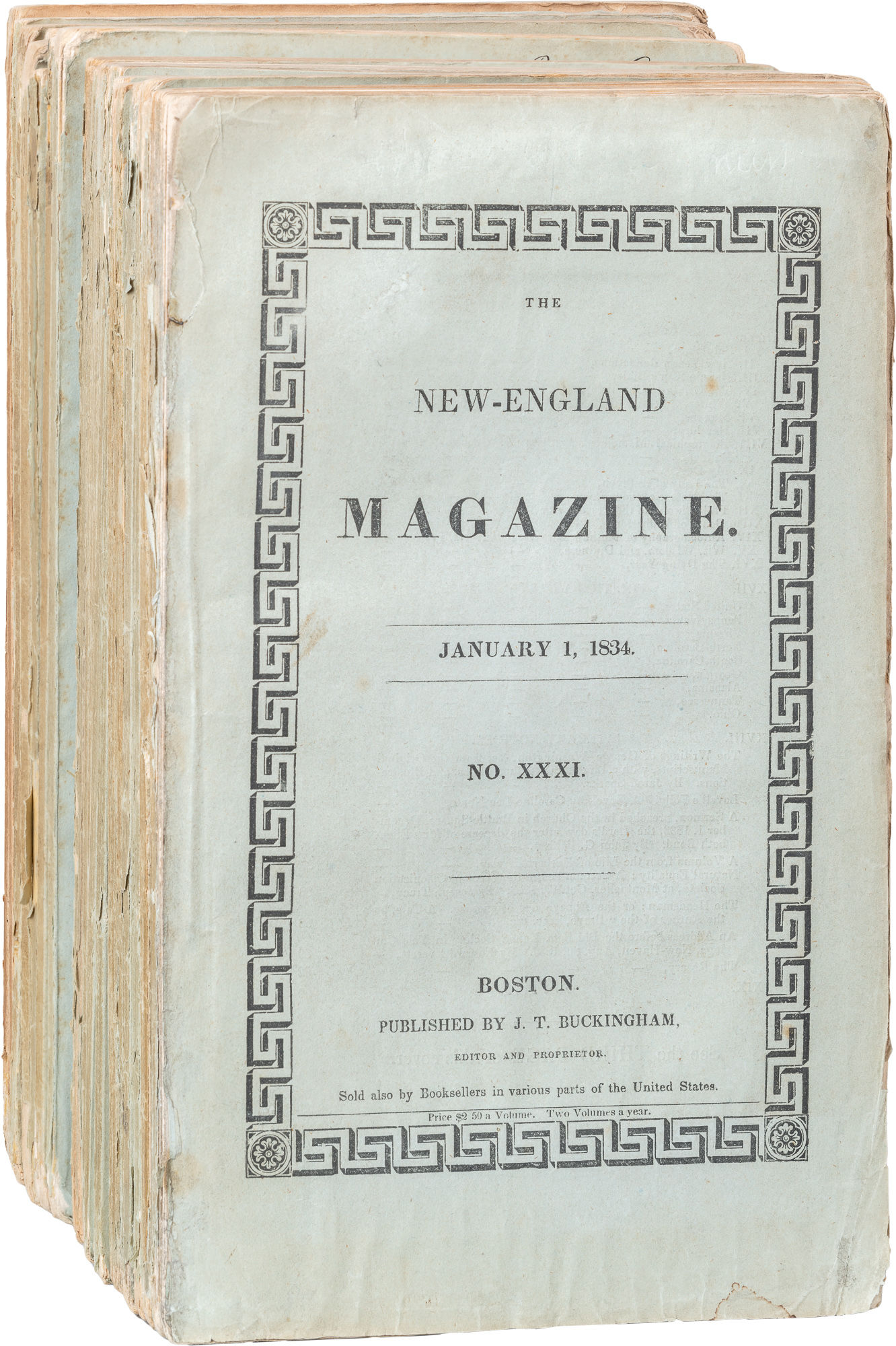
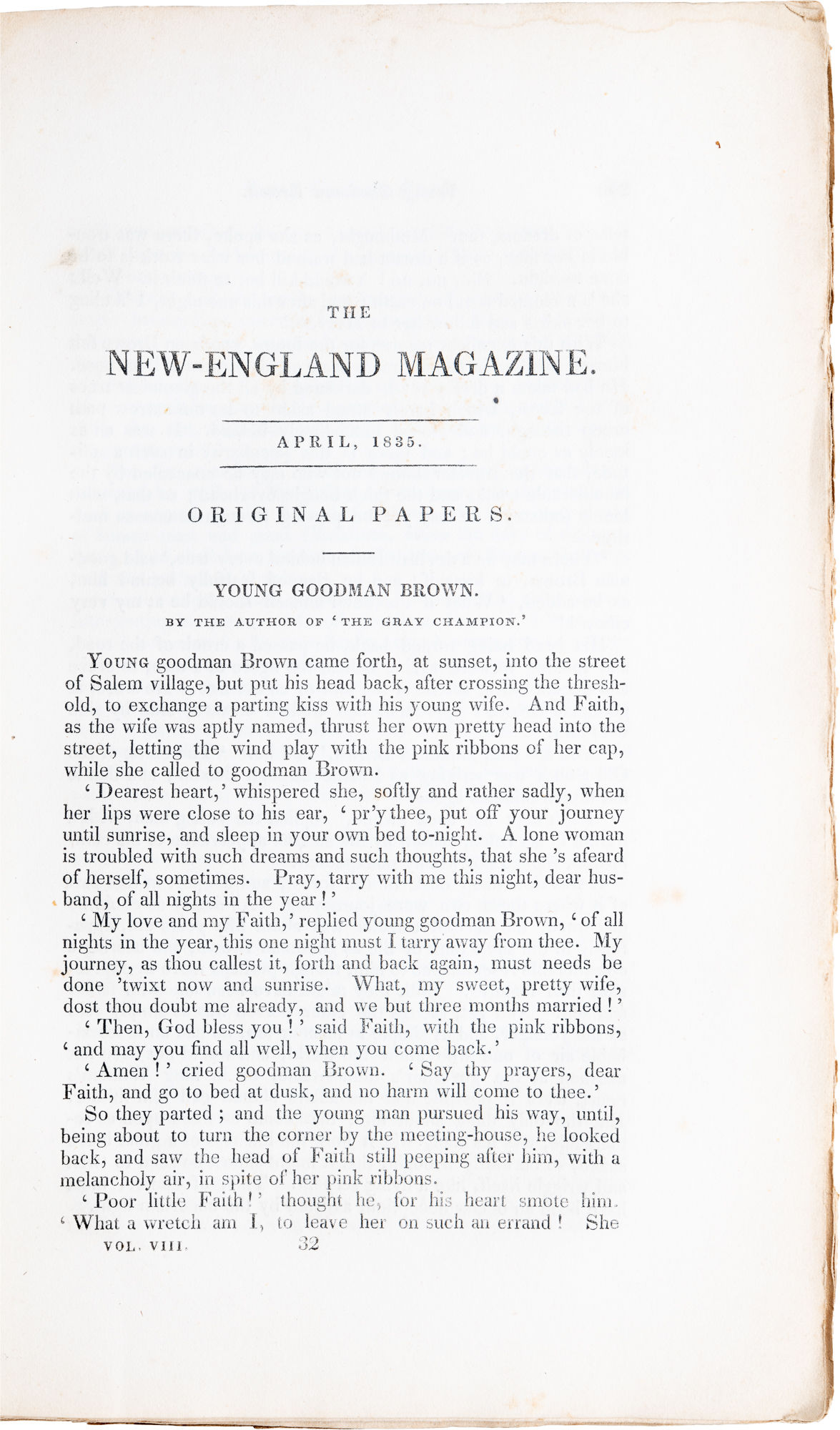
Boston: J.T. Buckingham, 1835. First Edition. Near fine. 23 vols. 1st appearances in original wrappers of 12 Hawthorne stories in The New–England Magazine, featuring tales from the allegorical (Young Goodman Brown) to a precursor to the detective story (Mr. Higginbotham’s Catastrophe). 2 complete years in the original wrappers with Jan. 1835 issue (The Gray Champion) extracted from an annual volume. Despite light wear and a few minor repairs, in near fine condition (extraordinary). 2 half morocco cases. These are the 1st printings of the stories that brought Hawthorne his first fame, and a run of this length in original wrappers is unheard of, and even single individual issues from 1834 and 1835 are rare. Ex–Rufus Choate (ownership inscriptions to an 1835 issue). Robert H. Hay (bookplates). Ref: Clark D9, D10, D12–D25.
Contains the following:
Mr. Higginbotham's Catastrophe (as an interior part of The Story–Teller # 1 & 2)
Old News Nos. 1–3
My Visit to Niagara
Young Goodman Brown
Wakefield
The Ambitious Guest
Graves and Goblins
A Rill from the Town–Pump
The Old Maid in the Winding Sheet
The Vision of the Fountain
Sketches from Memory Nos. 1 & 2
The Devil in Manuscript
Hawthorne's "Young Goodman Brown" stands as a masterful exploration of Puritan anxieties and moral ambiguity. The tale employs sophisticated allegorical techniques to interrogate the psychological dimensions of religious faith and human depravity. Through its protagonist's nocturnal journey into the forest—a liminal space representing moral uncertainty—Hawthorne crafts a narrative that deliberately blurs the boundaries between reality and hallucination. This ambiguity serves as the story's central philosophical inquiry: whether the Satanic ritual Brown witnesses reveals the hypocrisy of his community or merely reflects his own psychological projection of sin onto others. The text's linguistic precision creates a sustained atmosphere of dread through careful deployment of shadowplay imagery and biblical allusions, while simultaneously subverting Puritan literary conventions by refusing moral closure. Particularly notable is Hawthorne's nuanced characterization of Faith, Brown's wife, whose symbolic pink ribbons function as multivalent signifiers of innocence, sexuality, and moral compromise. Through this complex narrative structure, Hawthorne offers a sophisticated critique of Puritan moral absolutism while establishing themes of hidden sin and psychological isolation that would characterize his later, more celebrated works.
Contains the following:
Mr. Higginbotham's Catastrophe (as an interior part of The Story–Teller # 1 & 2)
Old News Nos. 1–3
My Visit to Niagara
Young Goodman Brown
Wakefield
The Ambitious Guest
Graves and Goblins
A Rill from the Town–Pump
The Old Maid in the Winding Sheet
The Vision of the Fountain
Sketches from Memory Nos. 1 & 2
The Devil in Manuscript
Hawthorne's "Young Goodman Brown" stands as a masterful exploration of Puritan anxieties and moral ambiguity. The tale employs sophisticated allegorical techniques to interrogate the psychological dimensions of religious faith and human depravity. Through its protagonist's nocturnal journey into the forest—a liminal space representing moral uncertainty—Hawthorne crafts a narrative that deliberately blurs the boundaries between reality and hallucination. This ambiguity serves as the story's central philosophical inquiry: whether the Satanic ritual Brown witnesses reveals the hypocrisy of his community or merely reflects his own psychological projection of sin onto others. The text's linguistic precision creates a sustained atmosphere of dread through careful deployment of shadowplay imagery and biblical allusions, while simultaneously subverting Puritan literary conventions by refusing moral closure. Particularly notable is Hawthorne's nuanced characterization of Faith, Brown's wife, whose symbolic pink ribbons function as multivalent signifiers of innocence, sexuality, and moral compromise. Through this complex narrative structure, Hawthorne offers a sophisticated critique of Puritan moral absolutism while establishing themes of hidden sin and psychological isolation that would characterize his later, more celebrated works.
Details
Title
The New–England Magazine
Author
Hawthorne, Nathaniel
Condition
Near Fine
Publisher
J.T. Buckingham: Boston
Date
1835
Edition
First Edition