

[MATHEMATICS - THE FIRST WOMAN MATHEMATICIAN]. Instituzioni analitiche, ad usi della gioventù italiana
![[MATHEMATICS - THE FIRST WOMAN MATHEMATICIAN]. Ins](https://d3525k1ryd2155.cloudfront.net/h/726/514/1586514726.0.x.0.jpg)
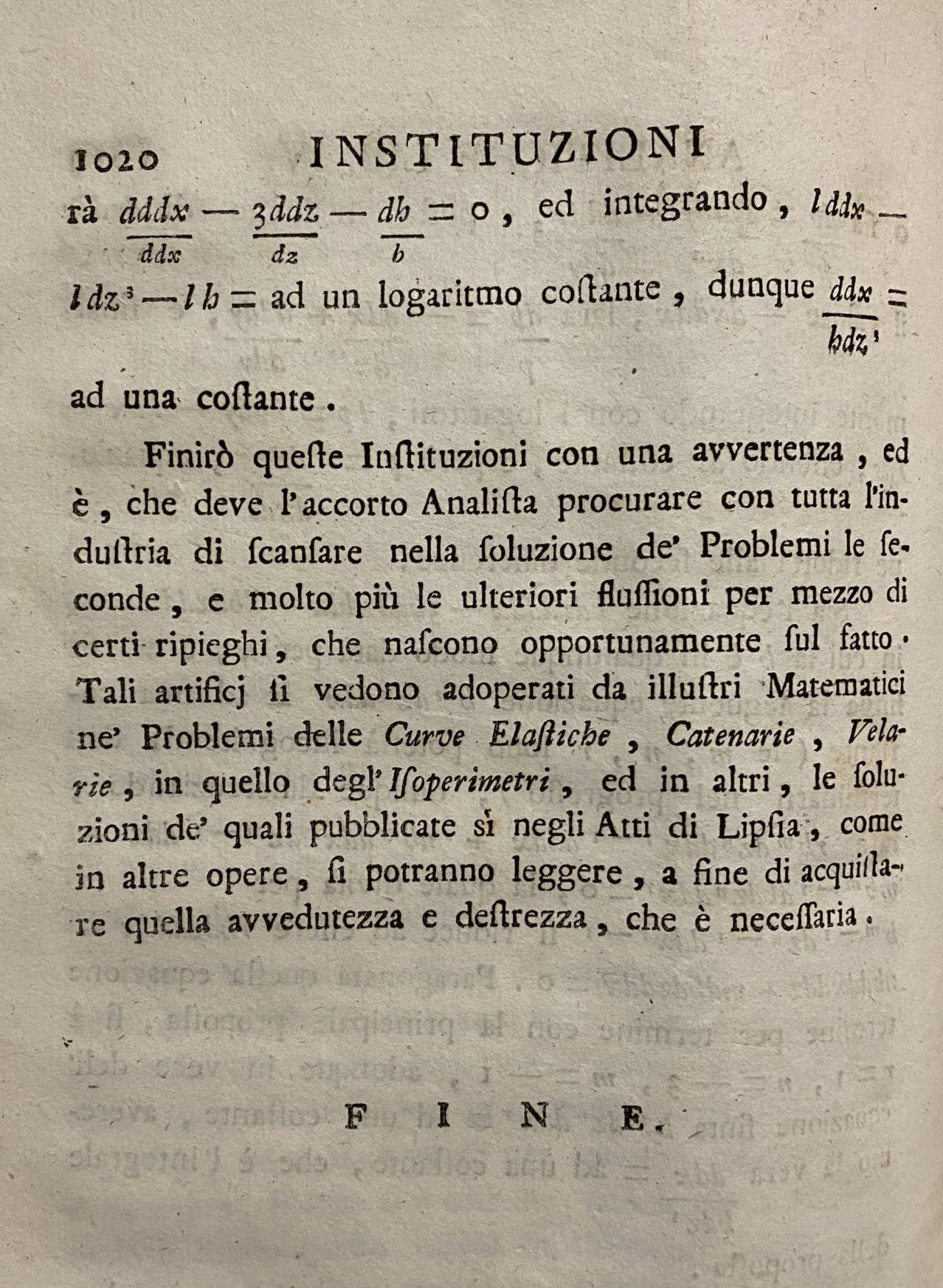
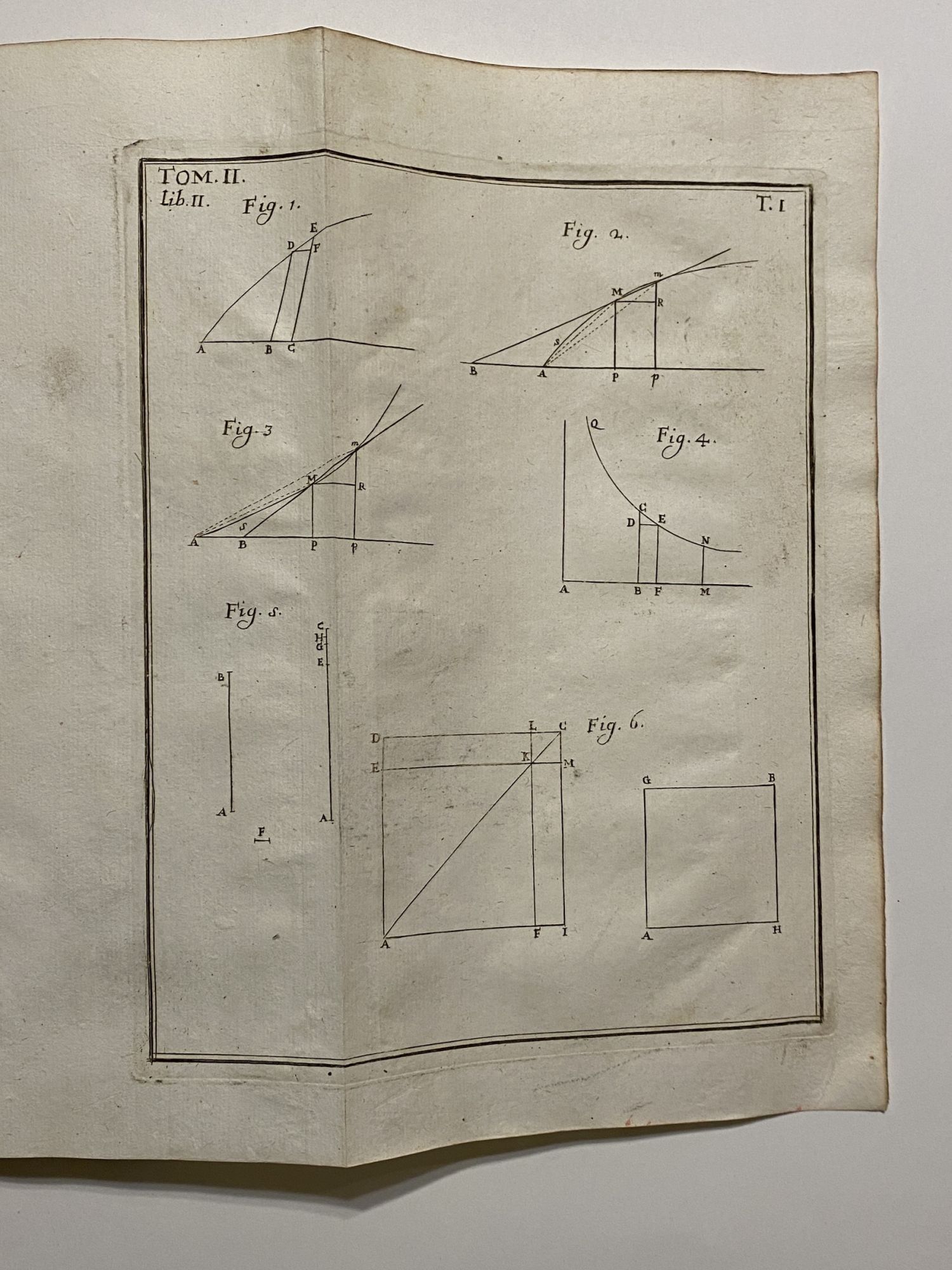
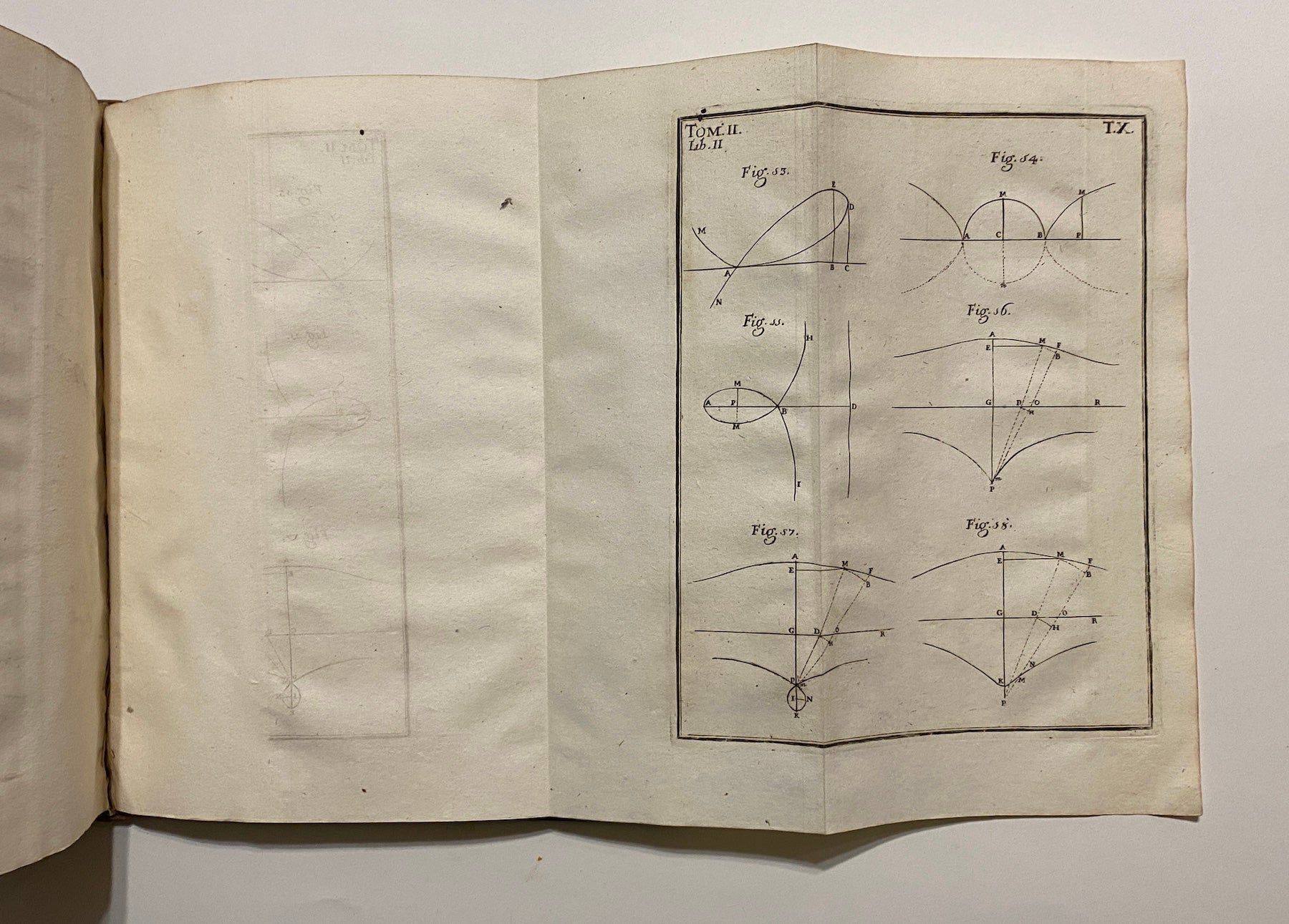
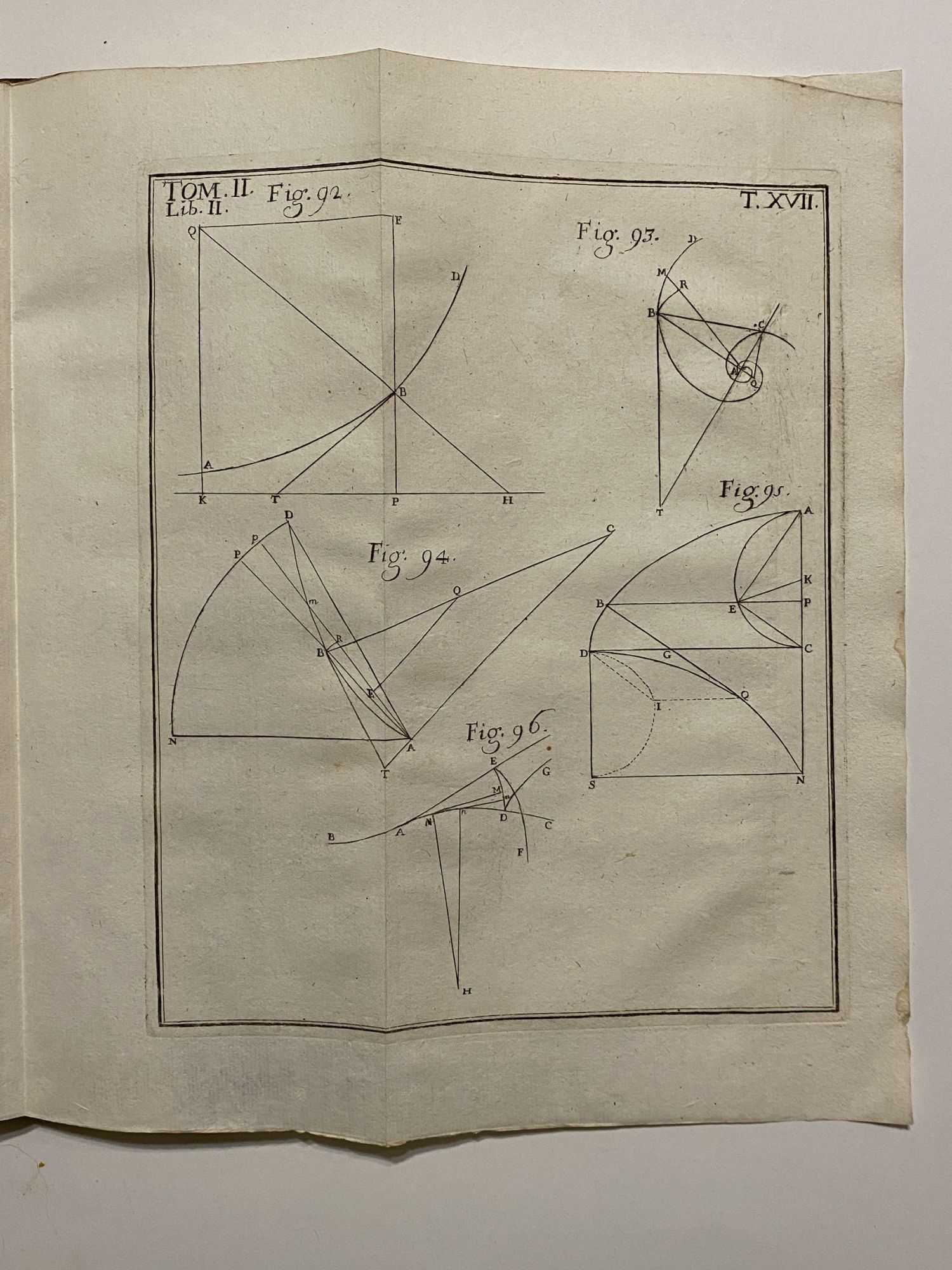
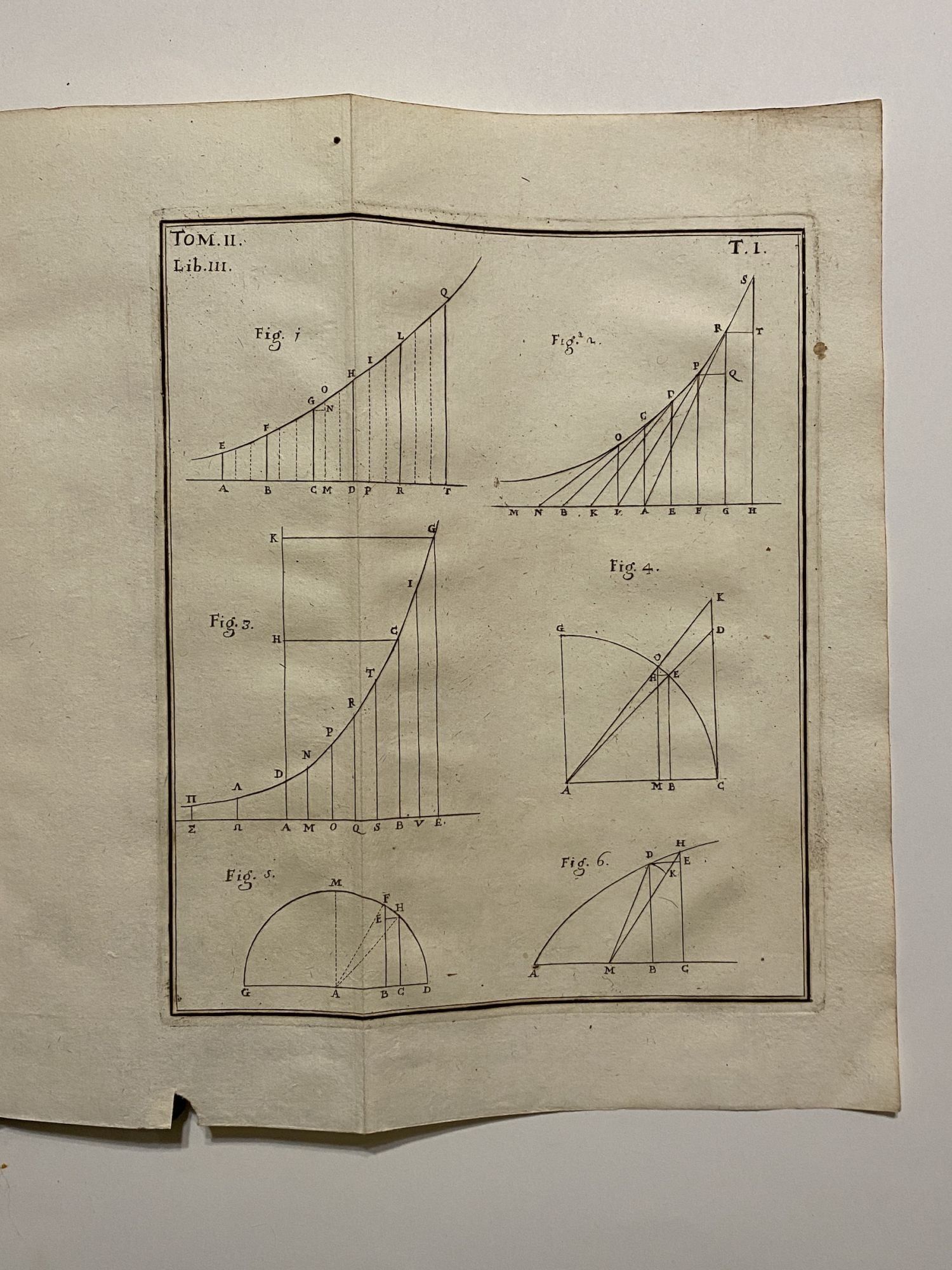
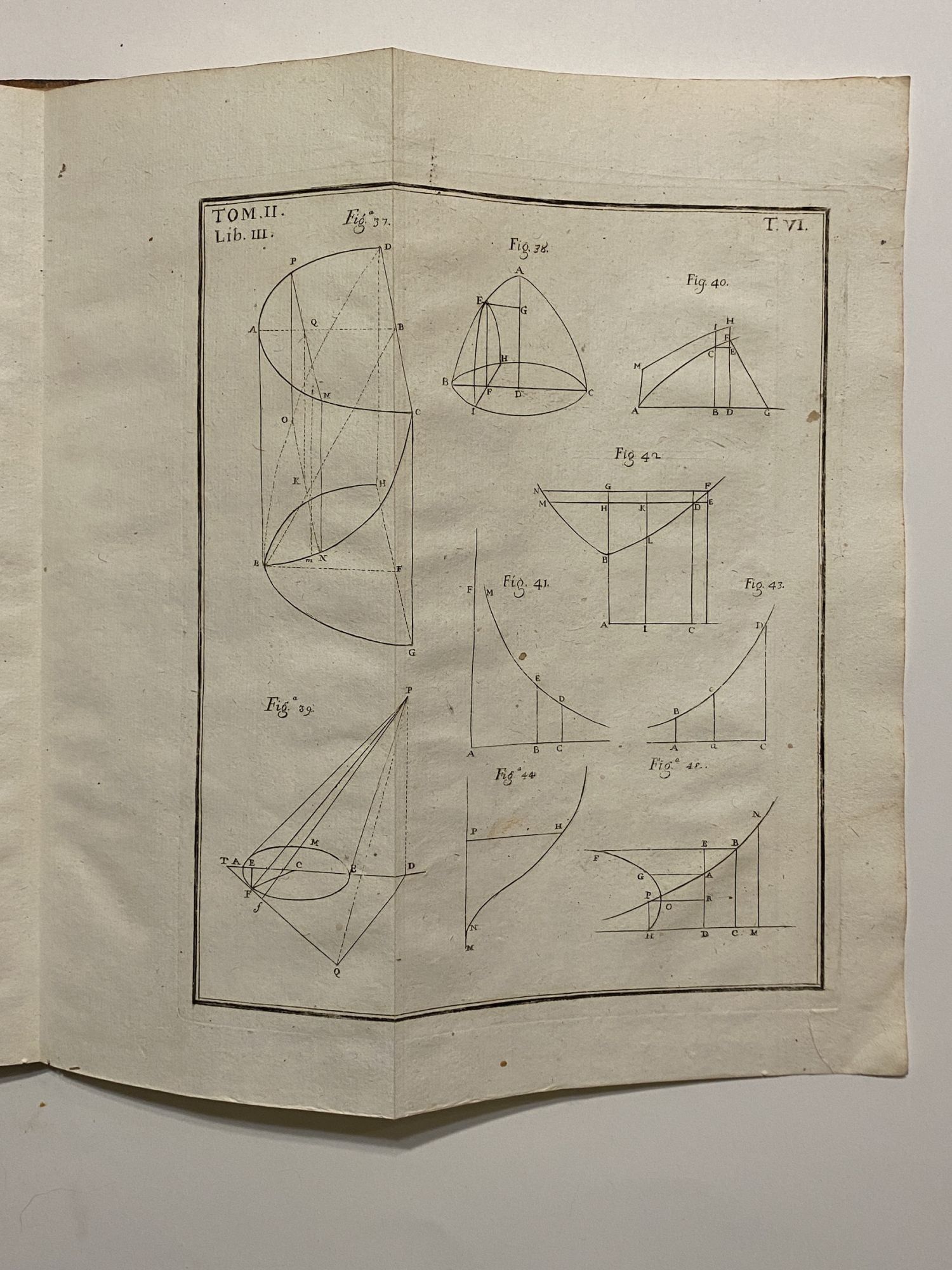
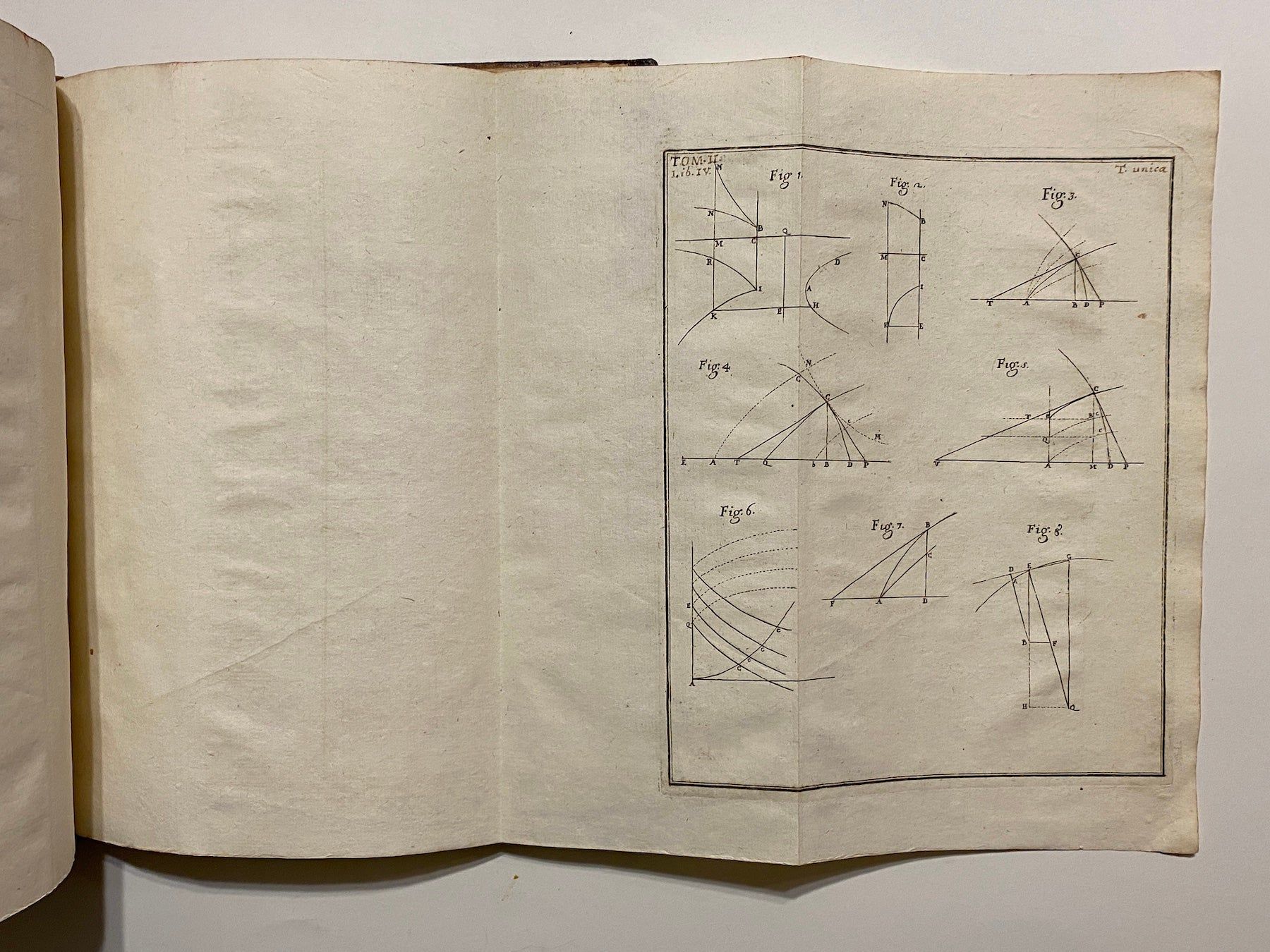
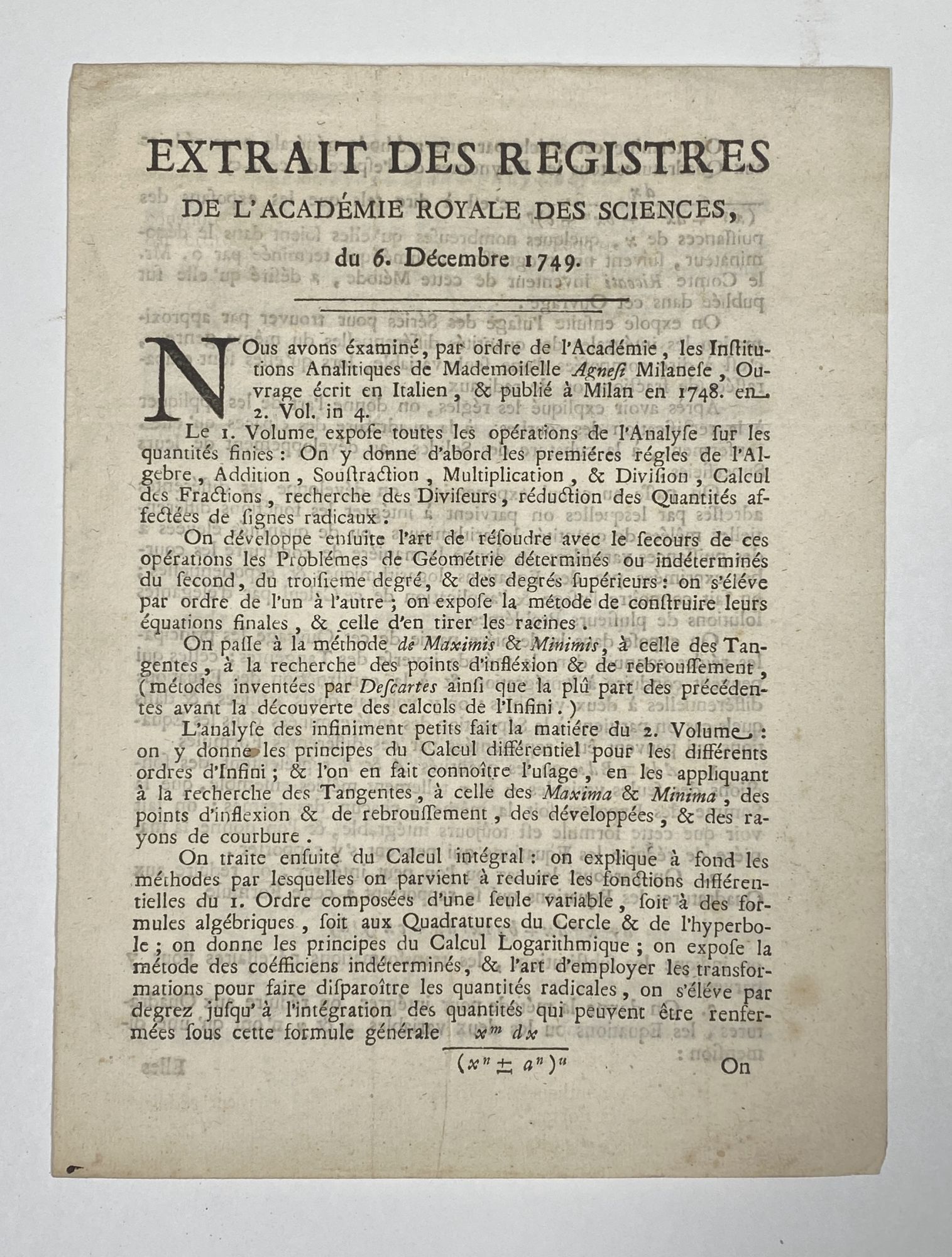
- Milan: Regia-Ducal Corte, 1748
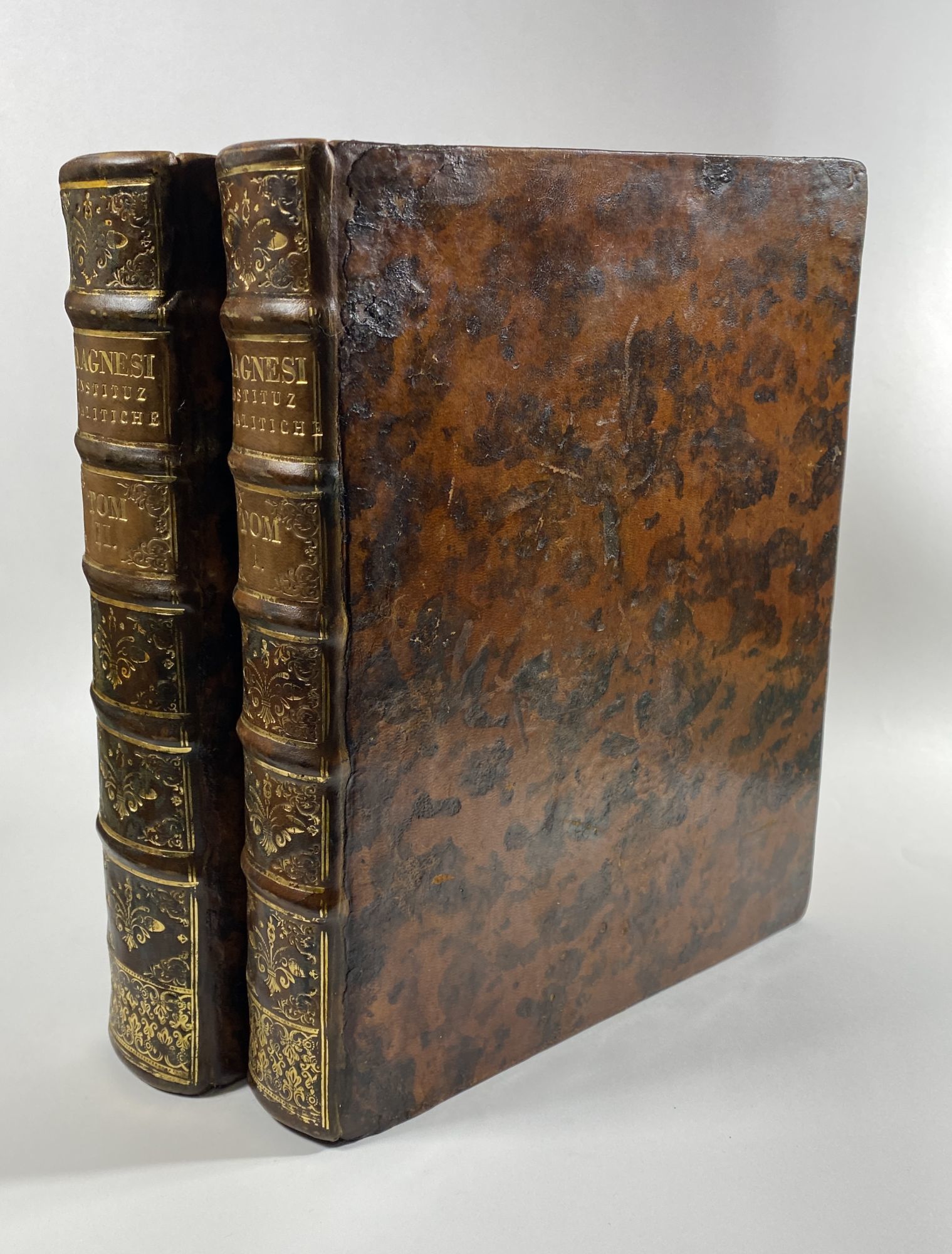
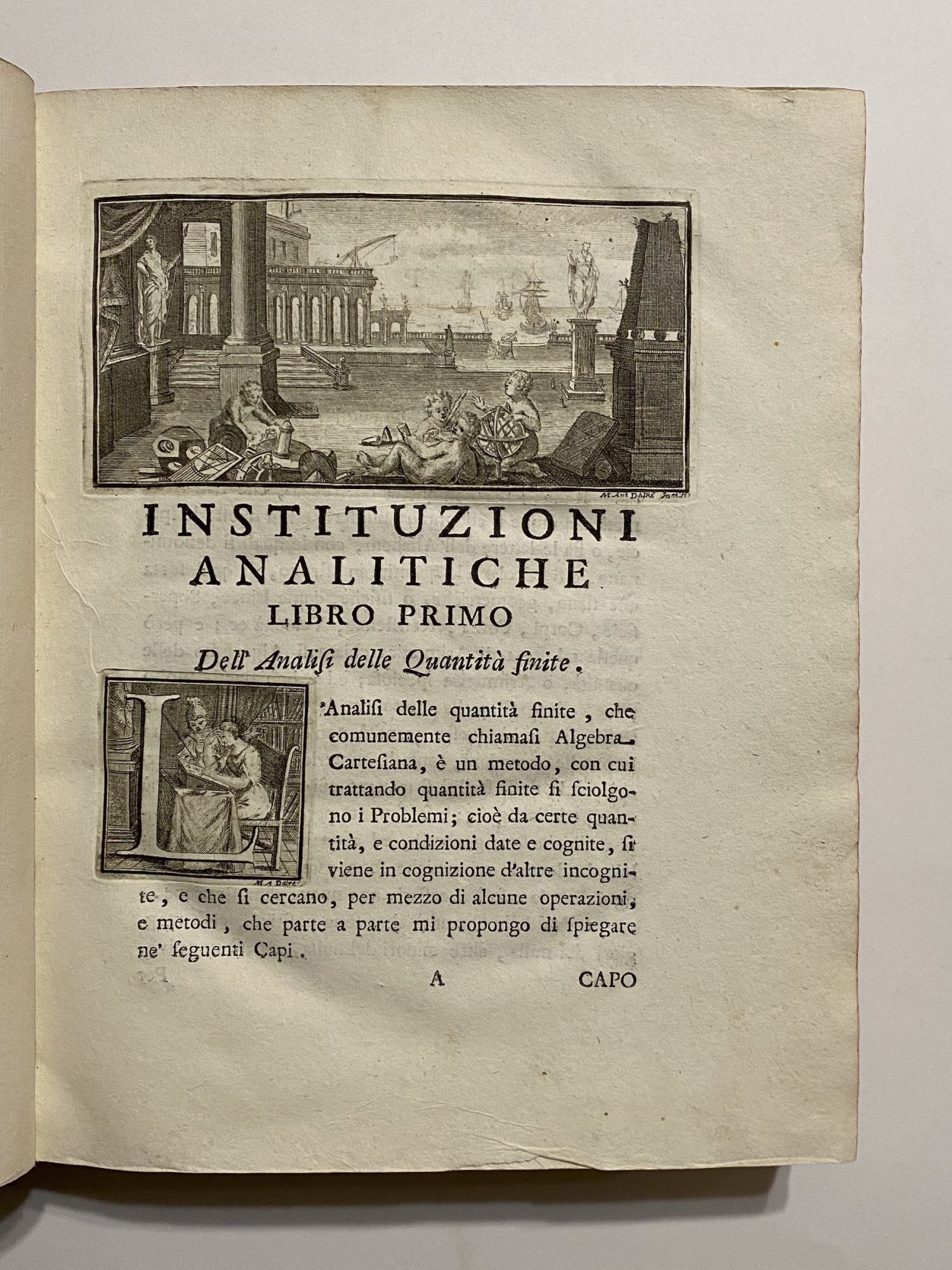
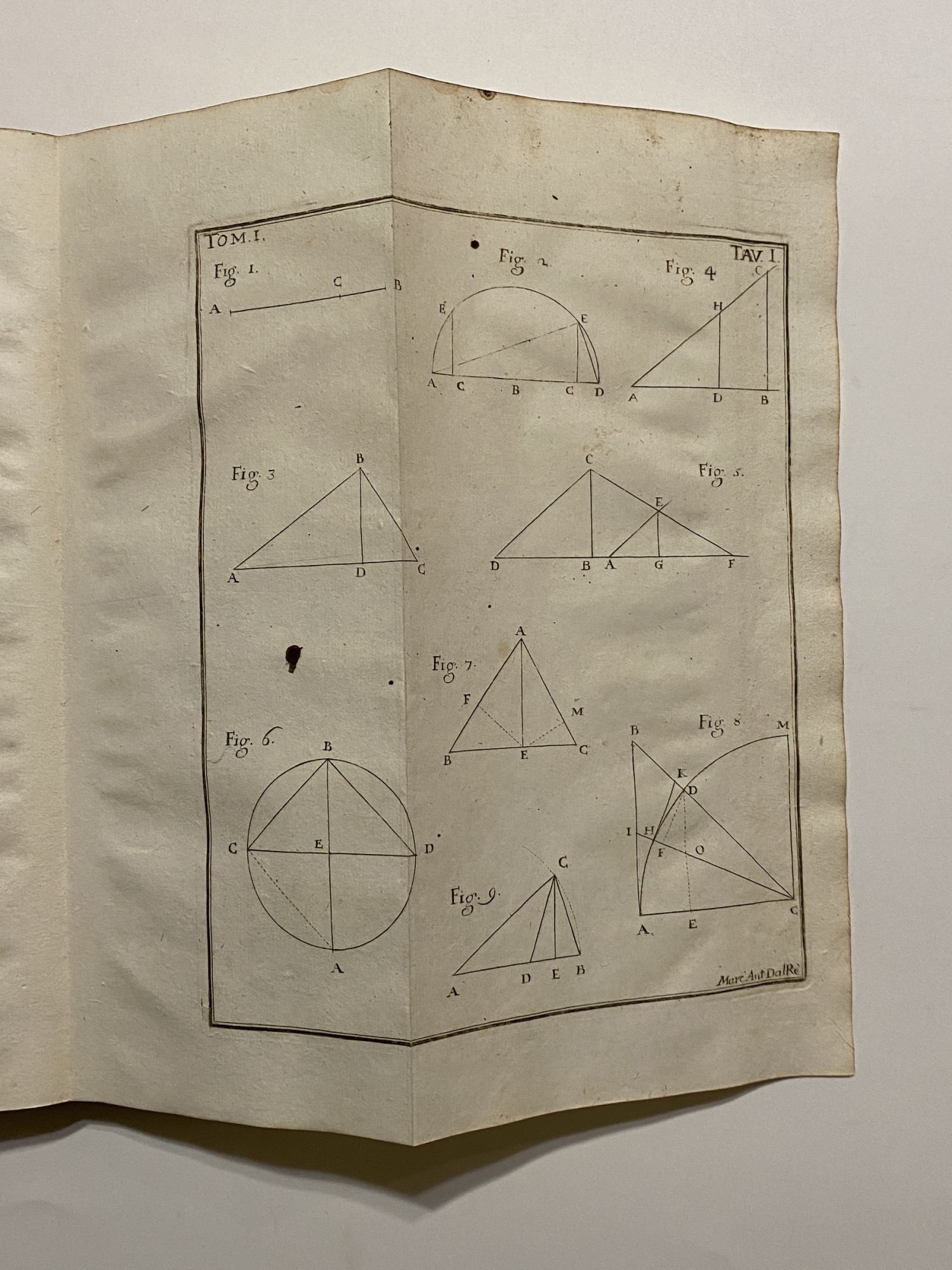
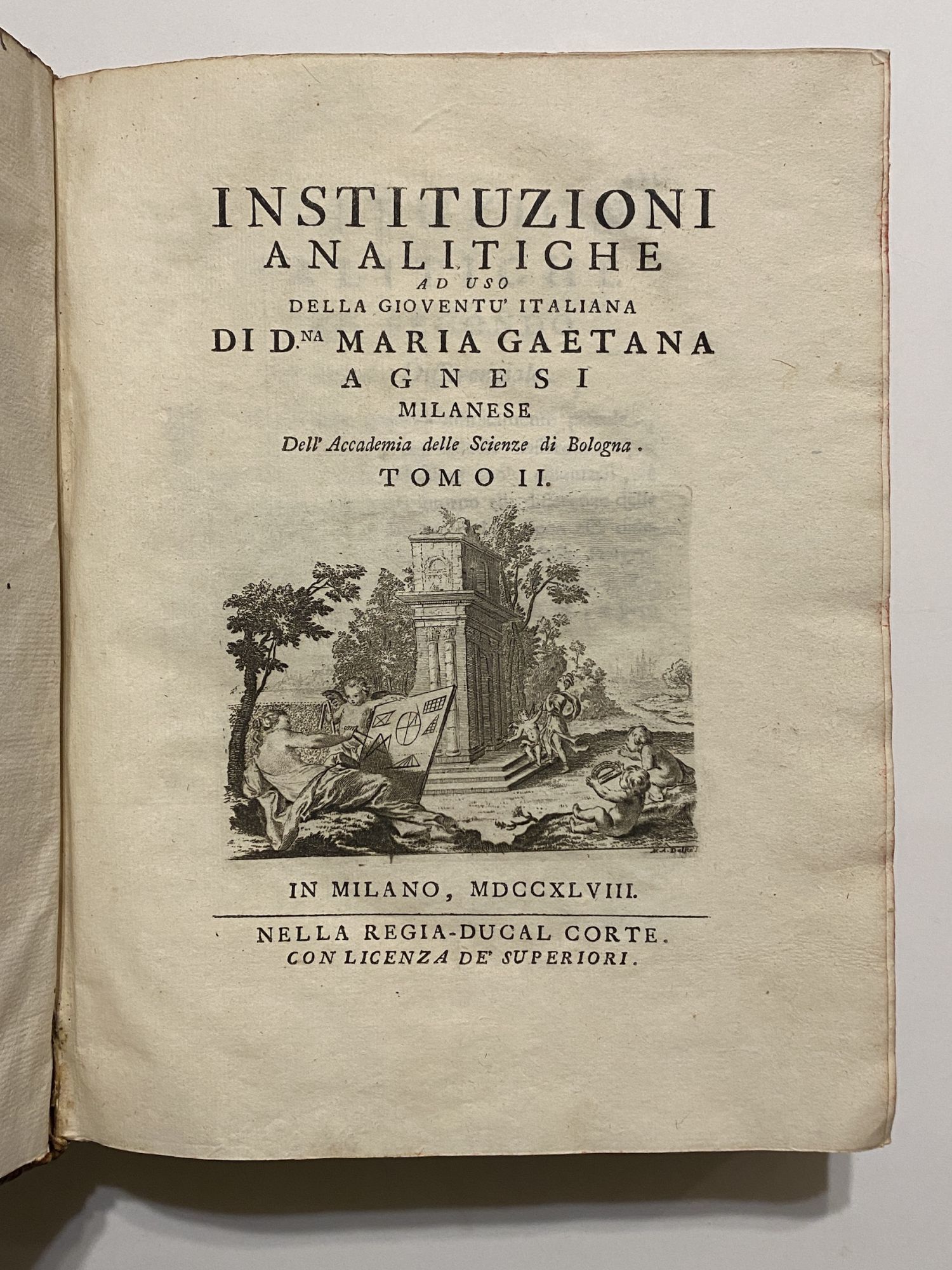
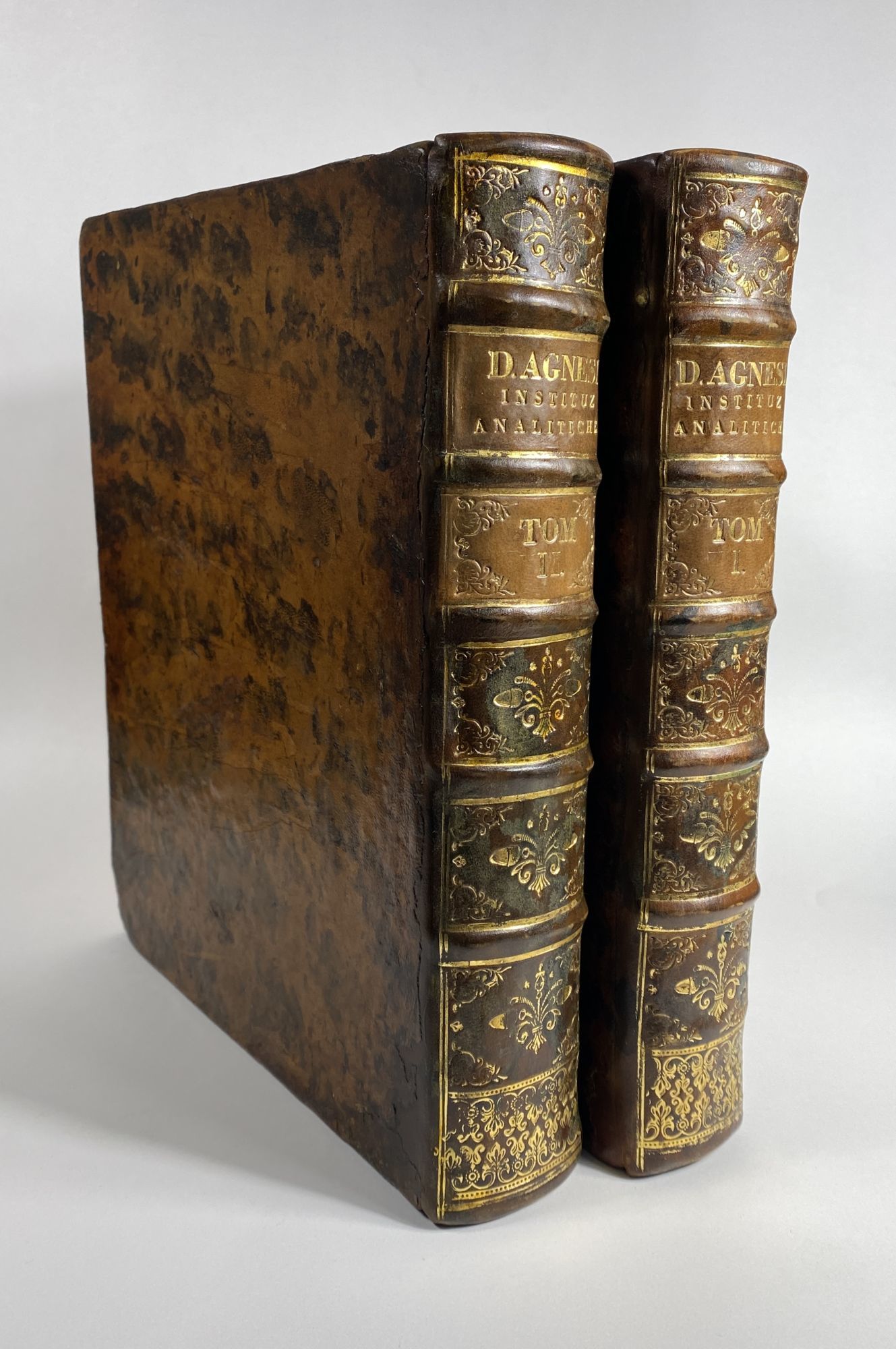
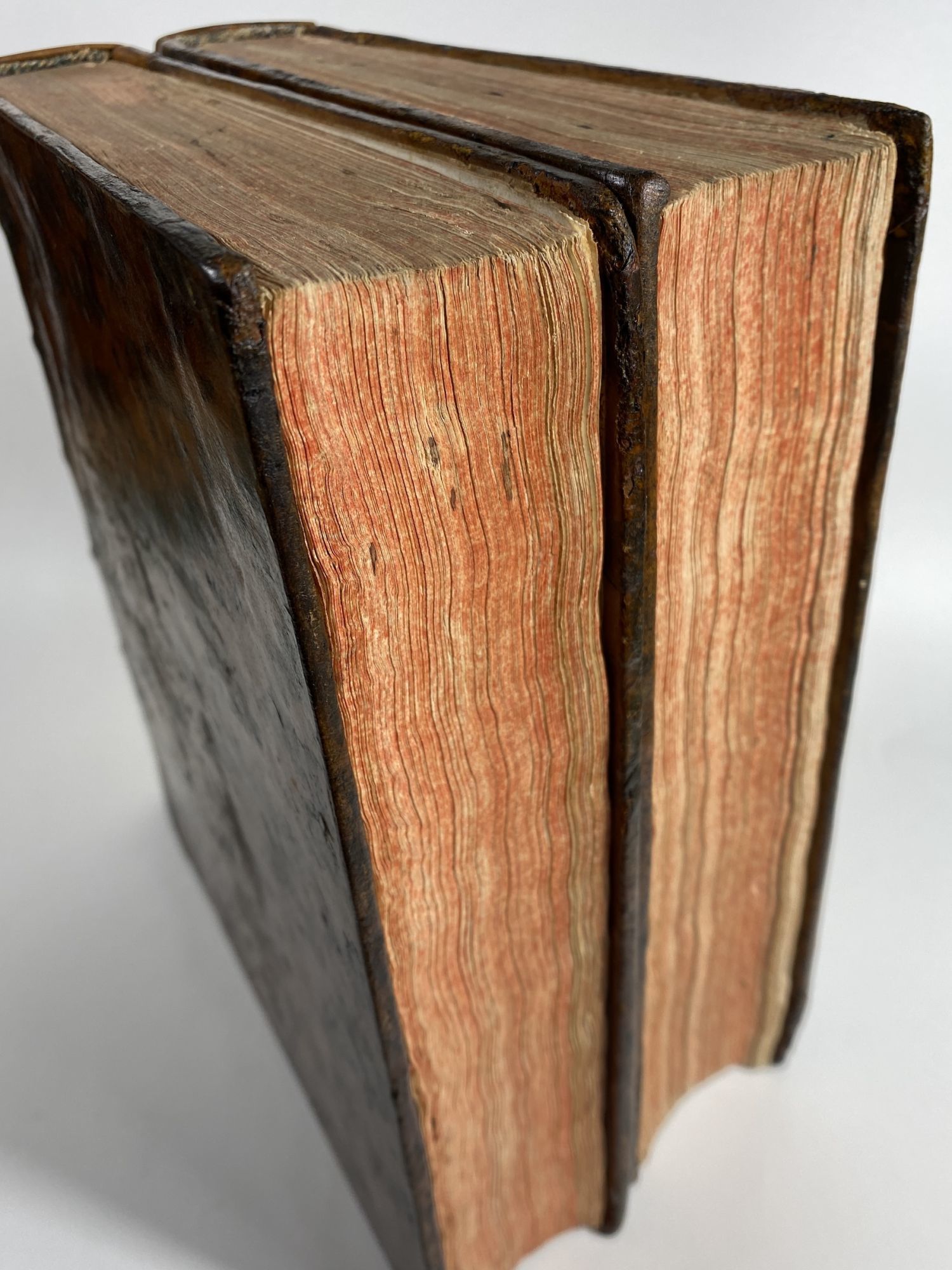
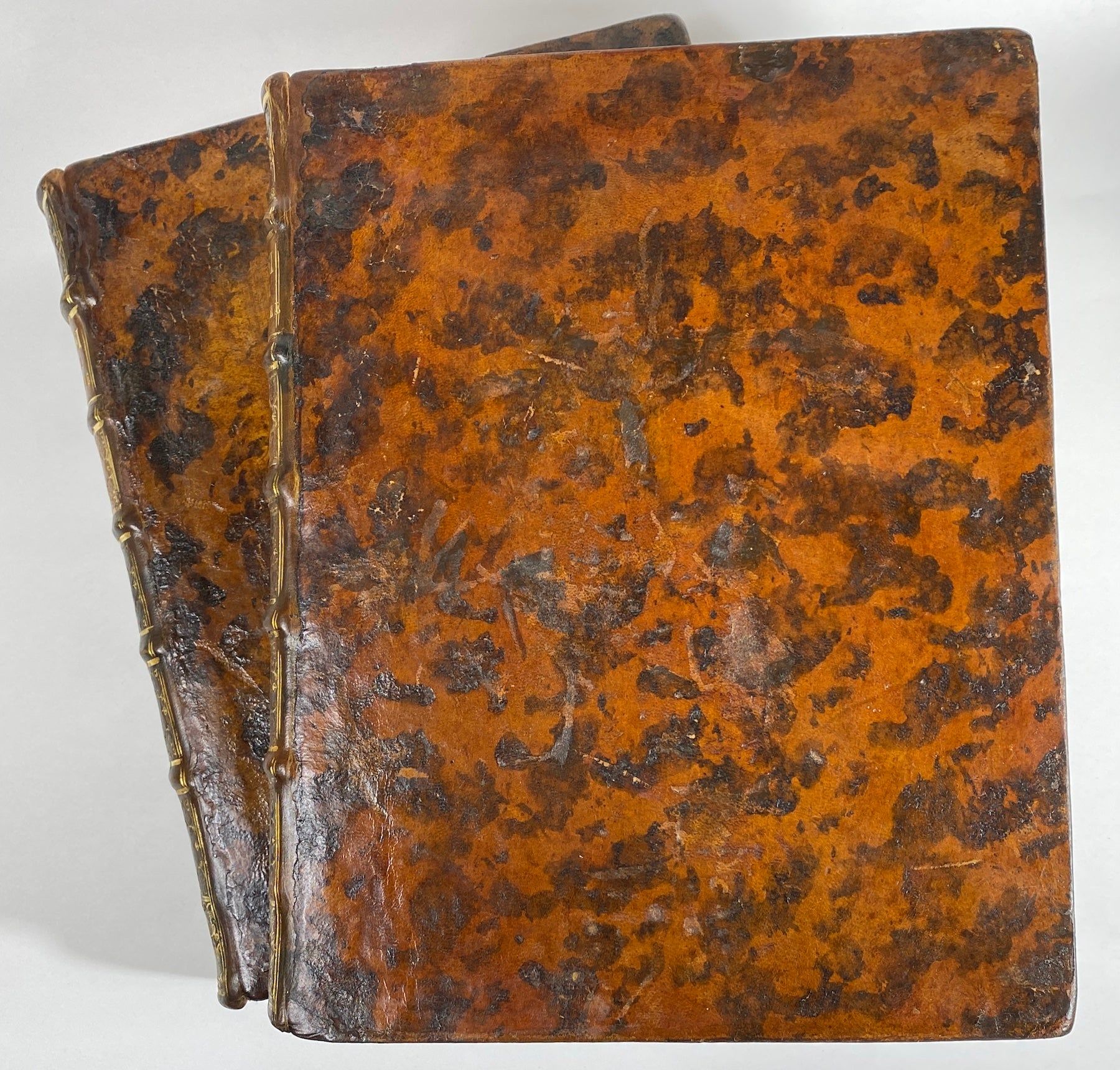
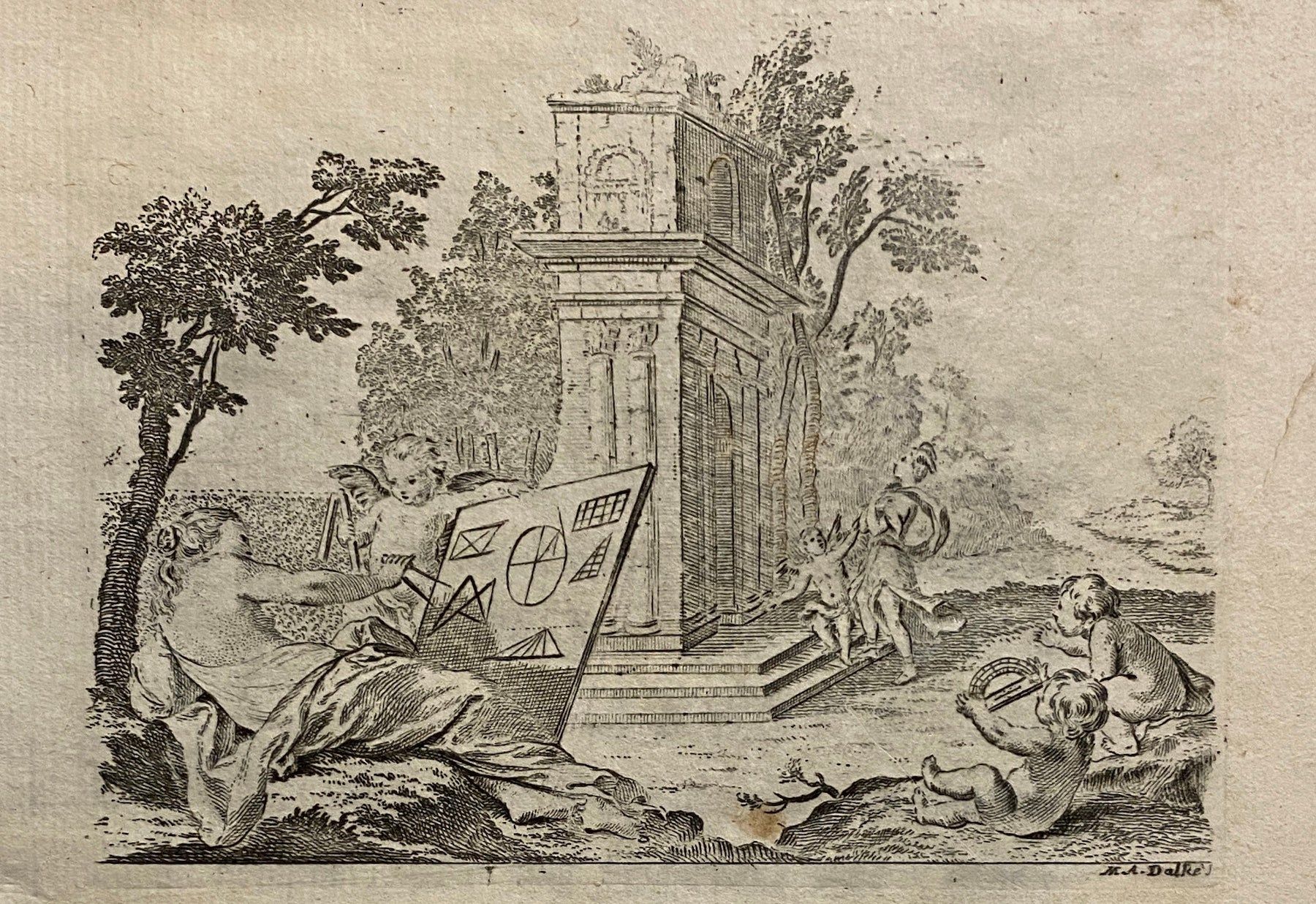
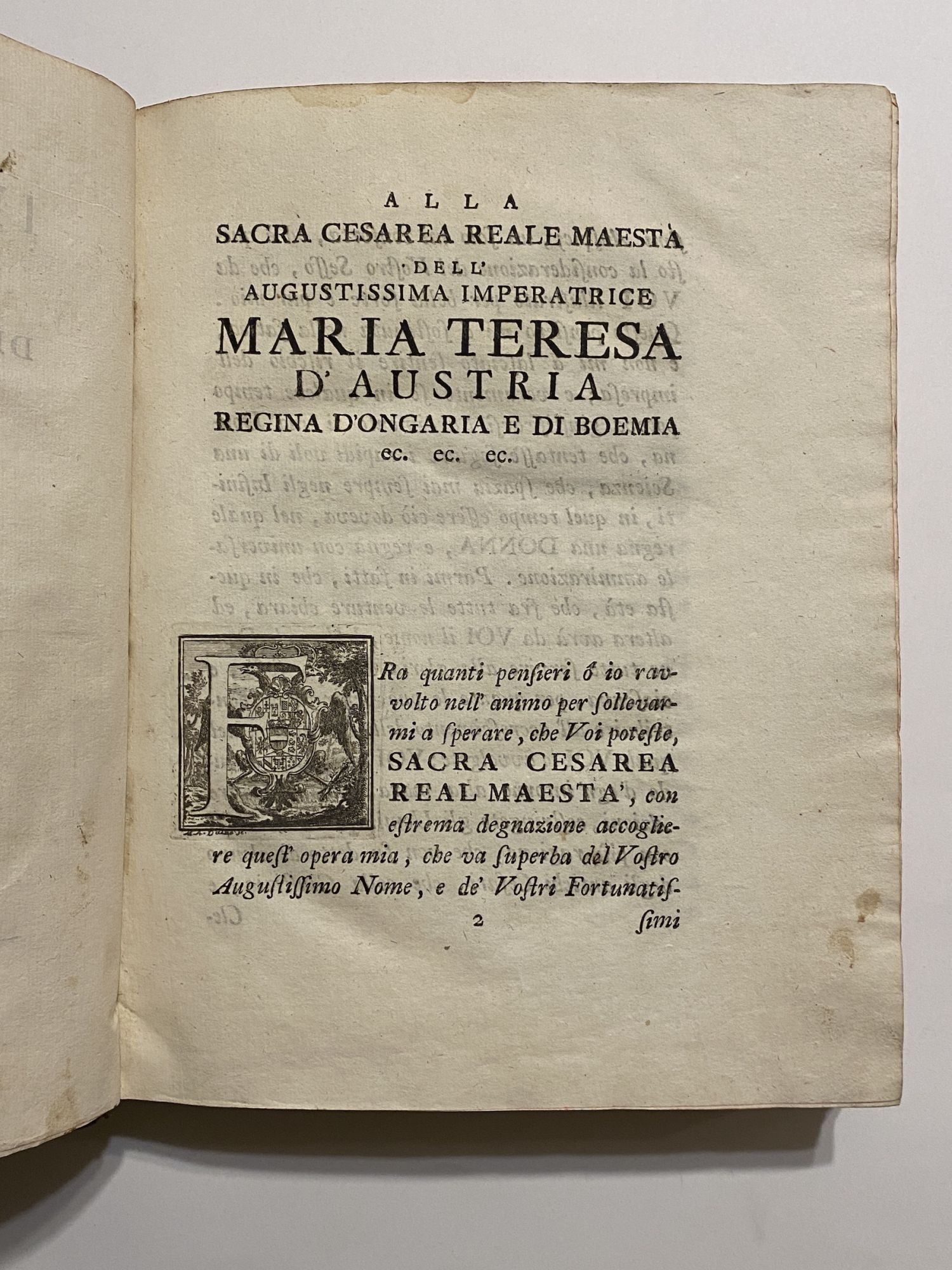
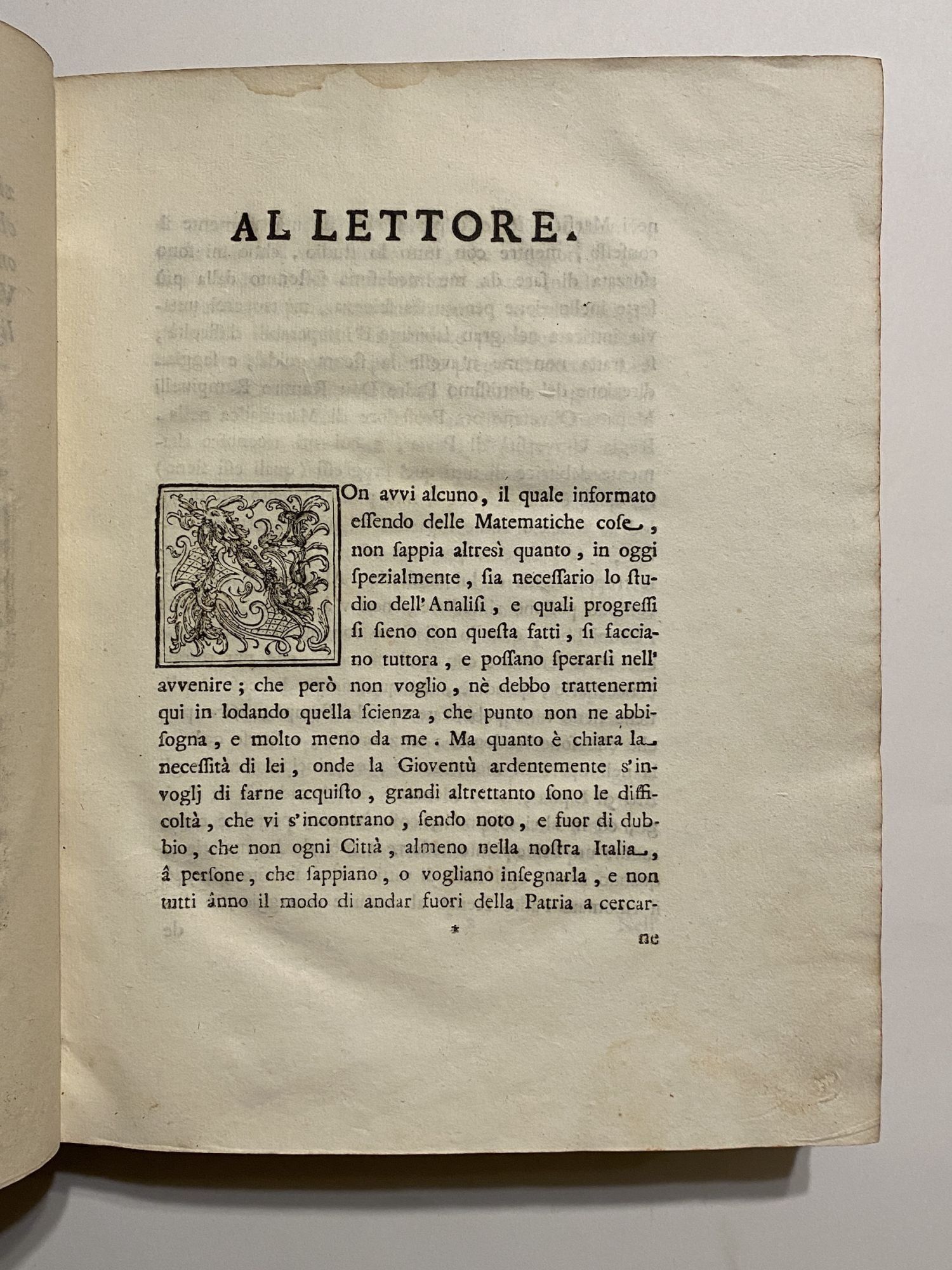
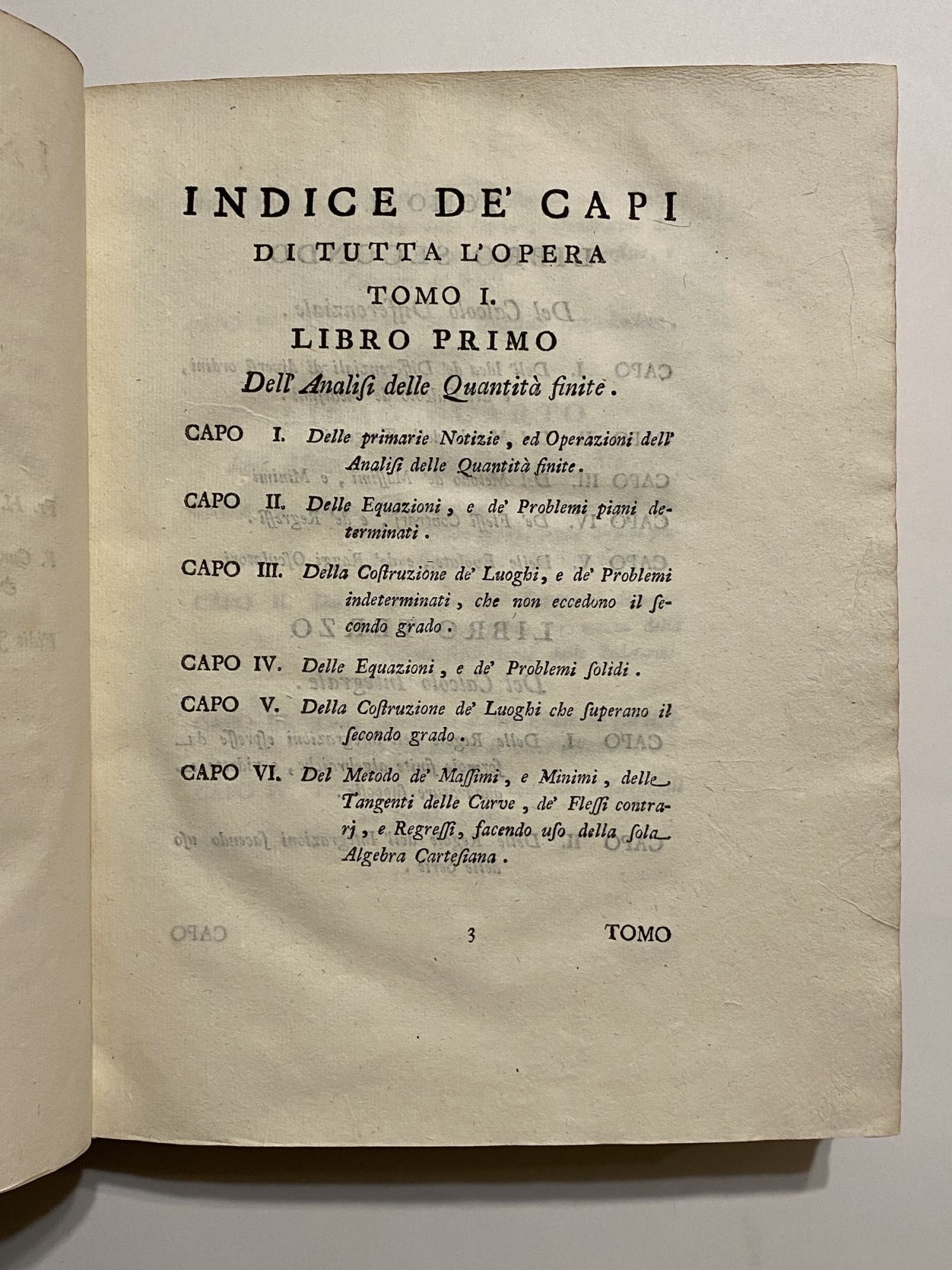
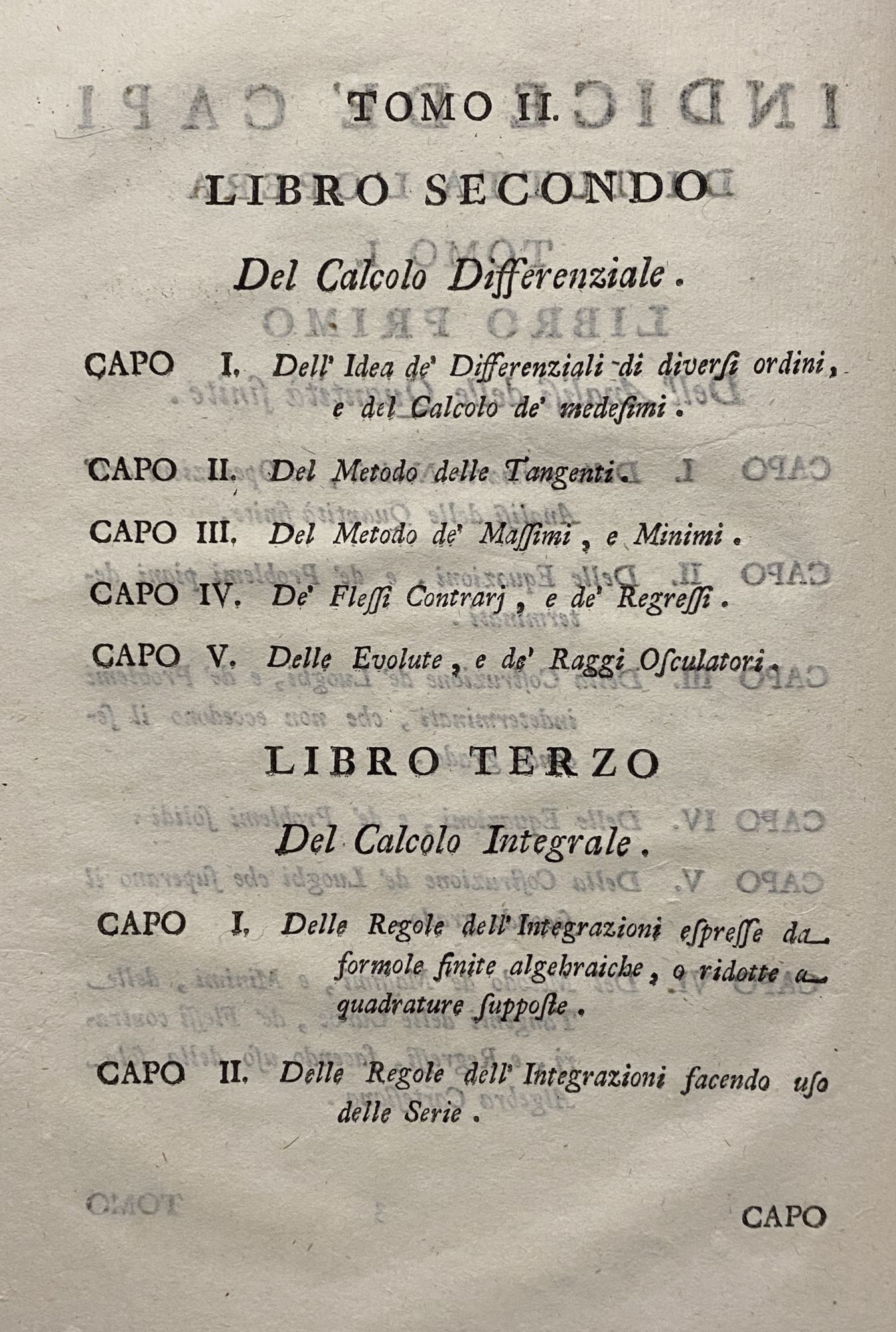
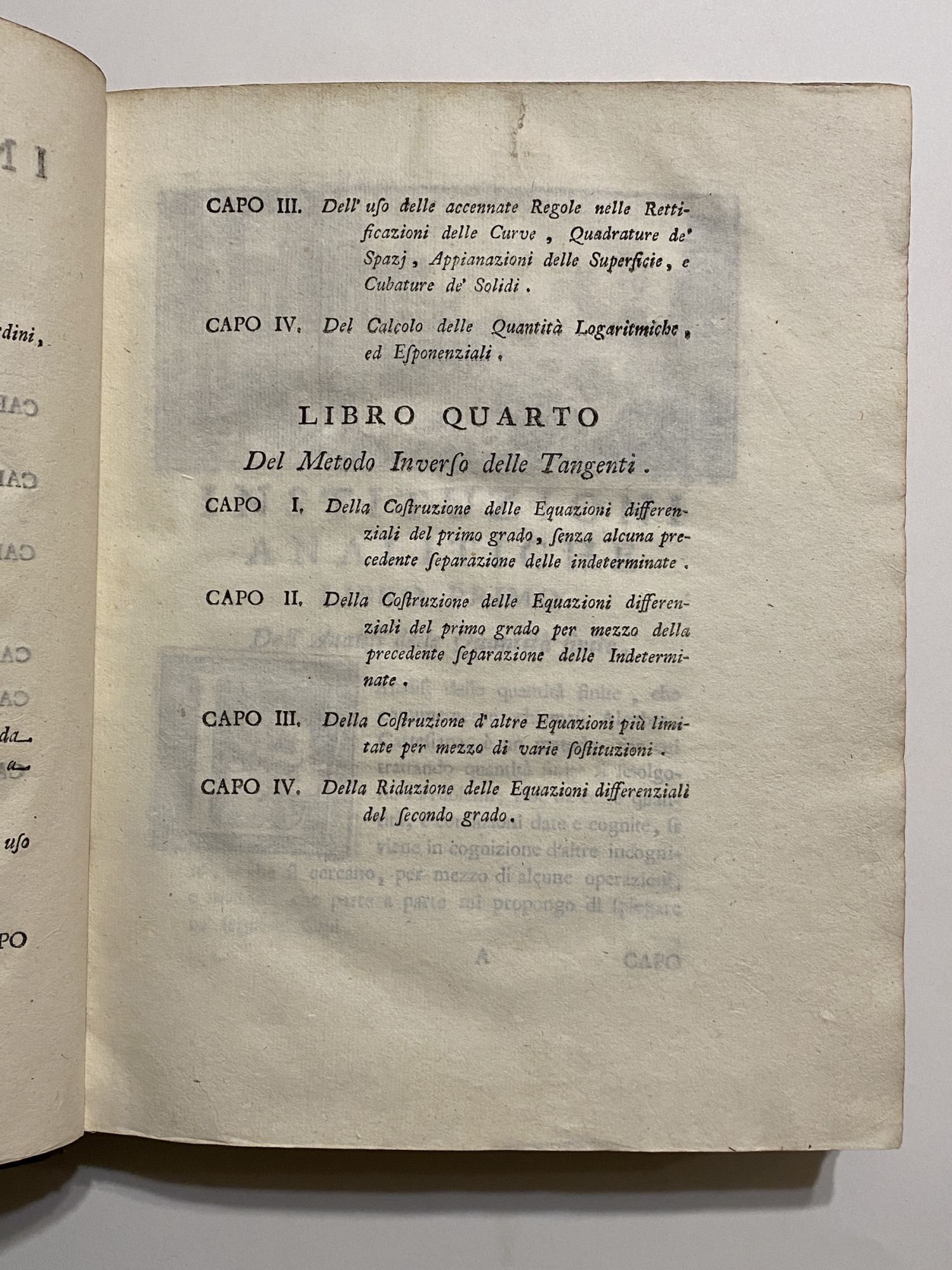
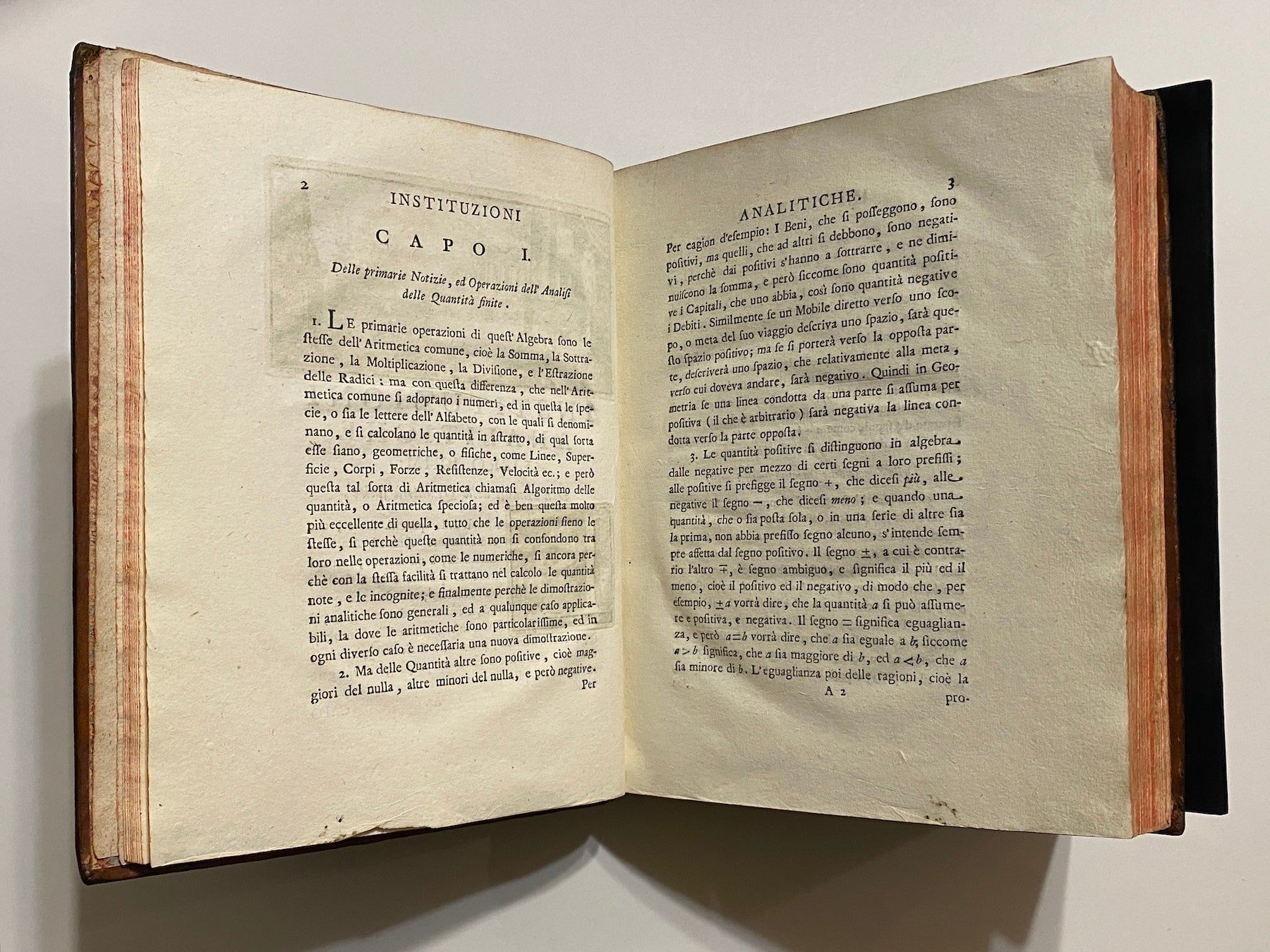
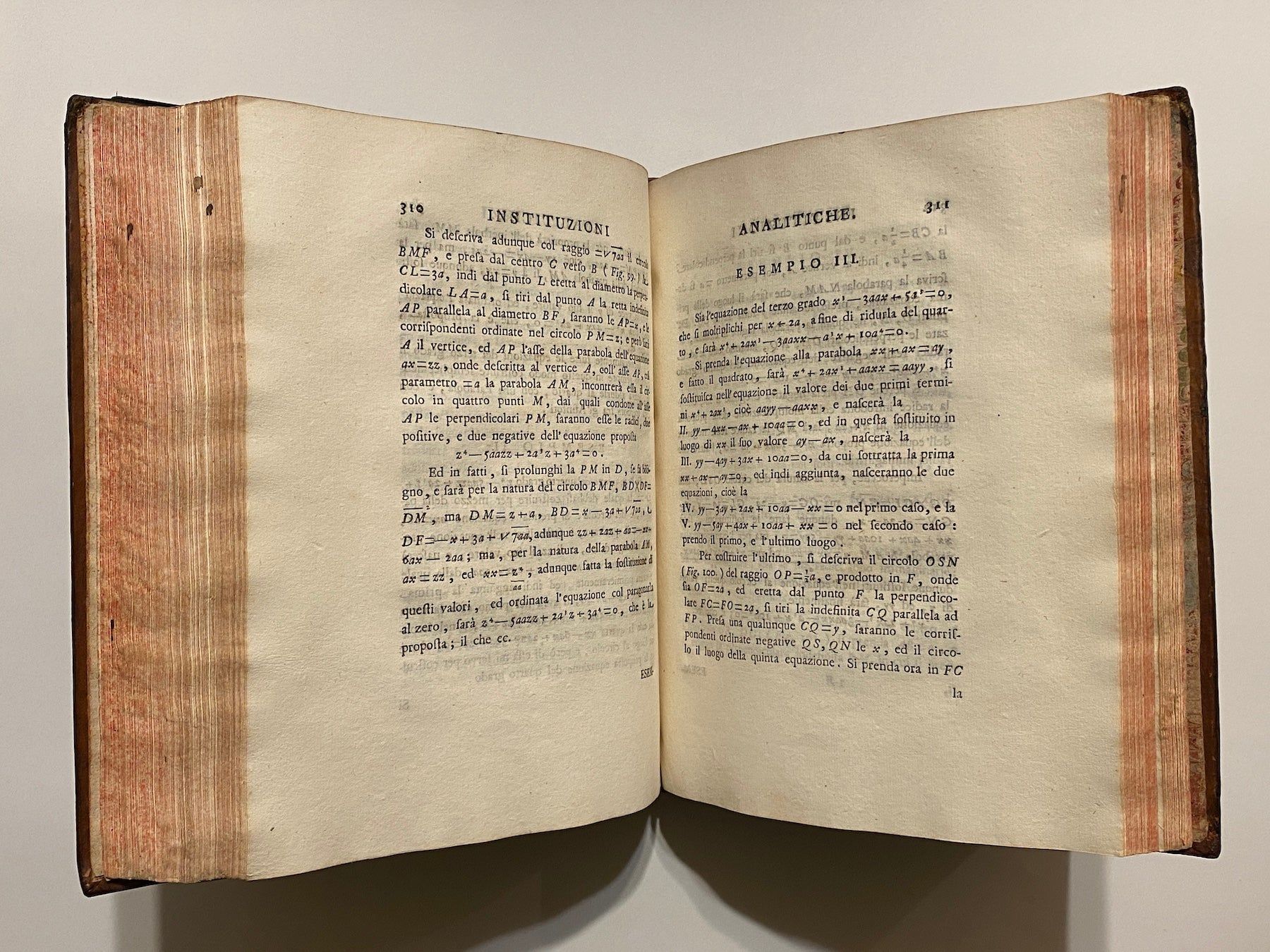
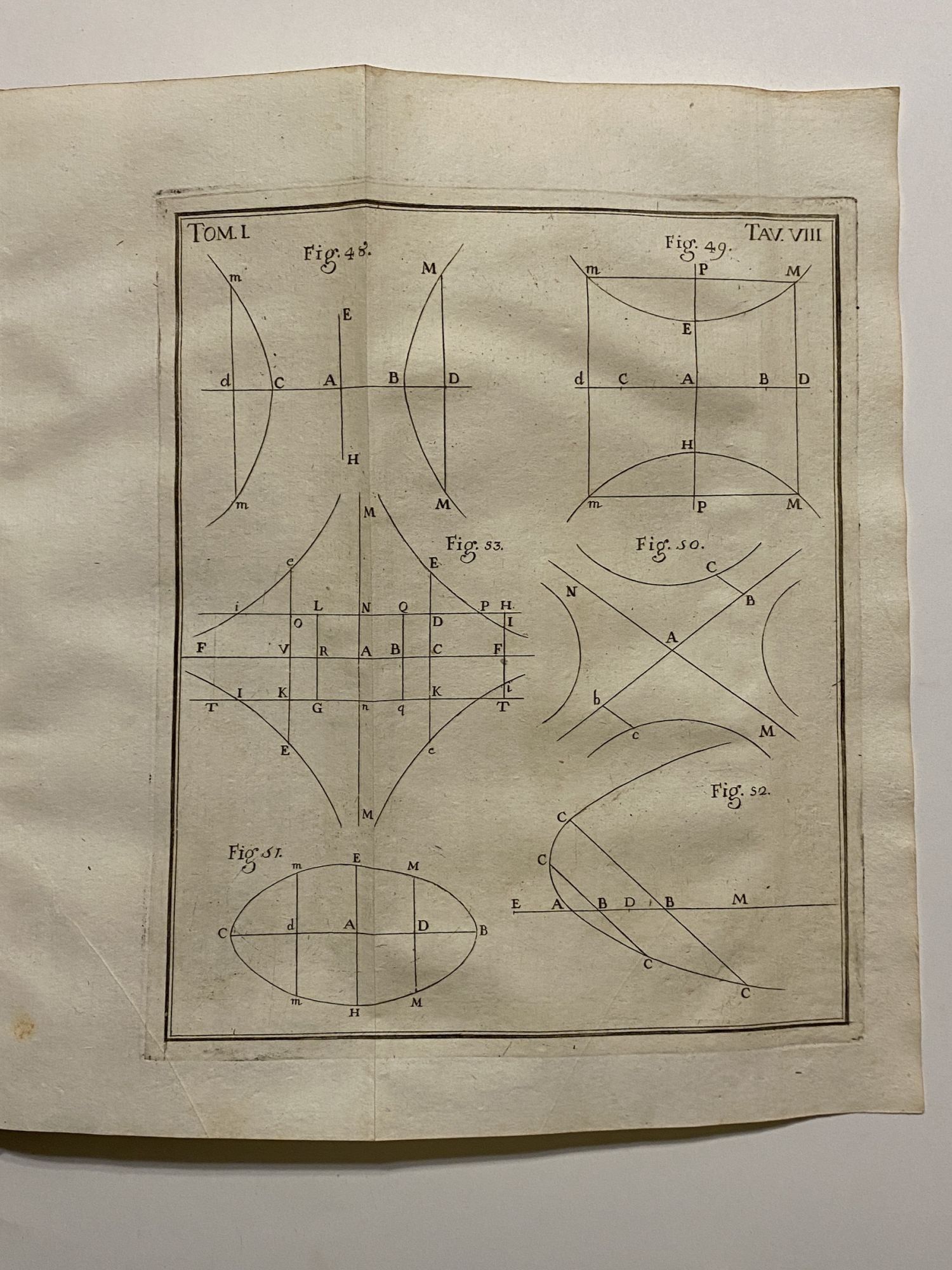
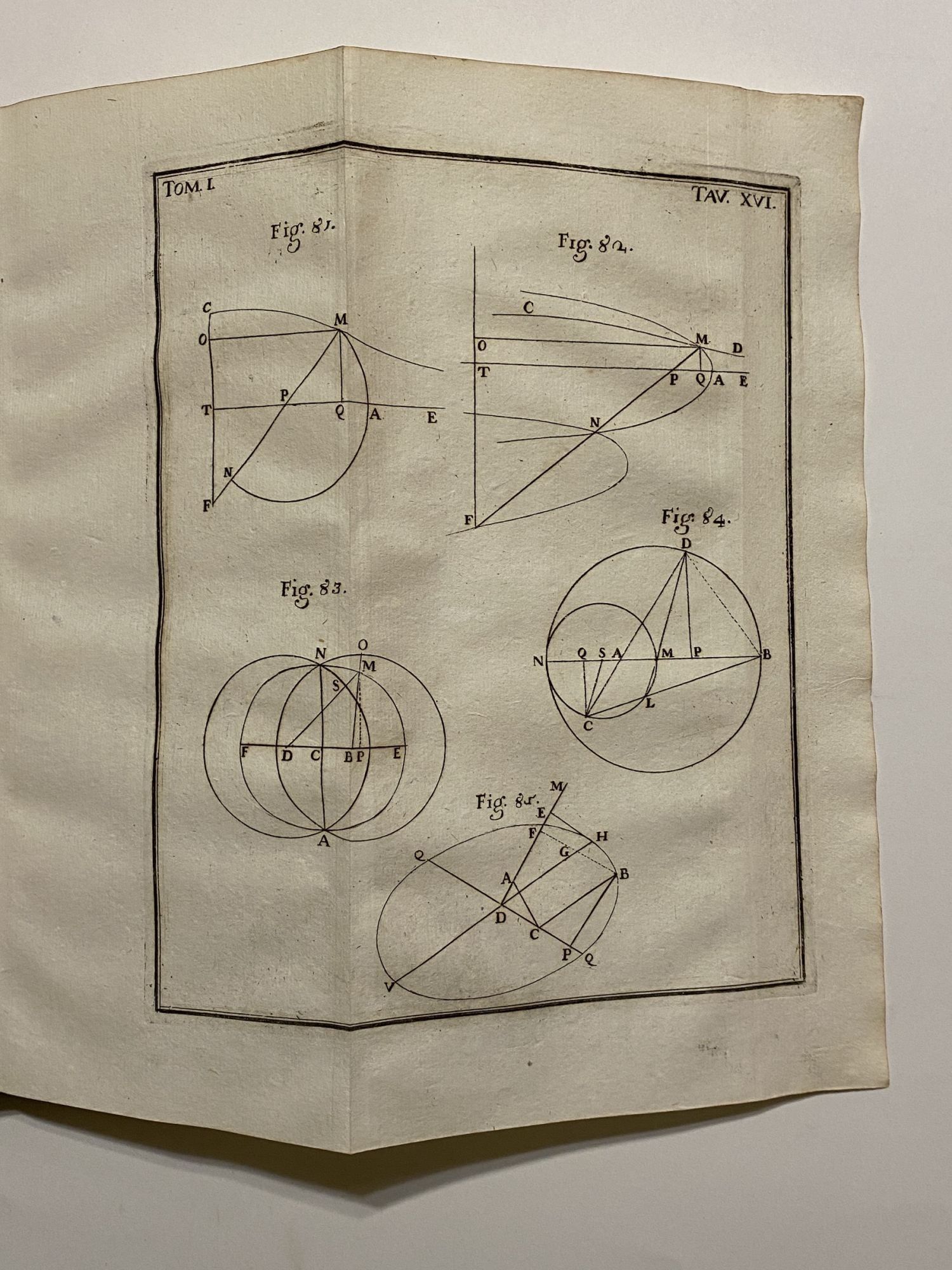
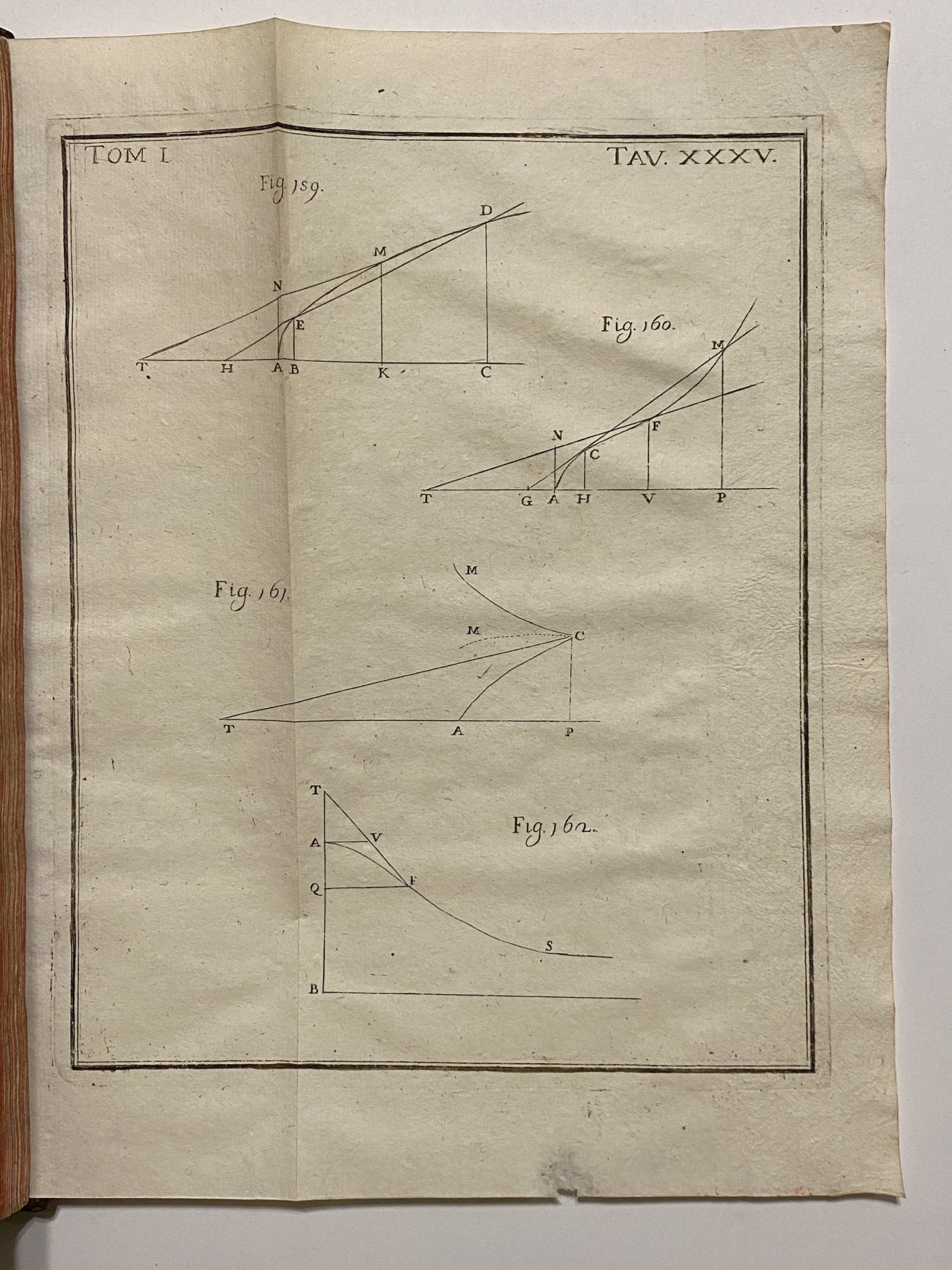
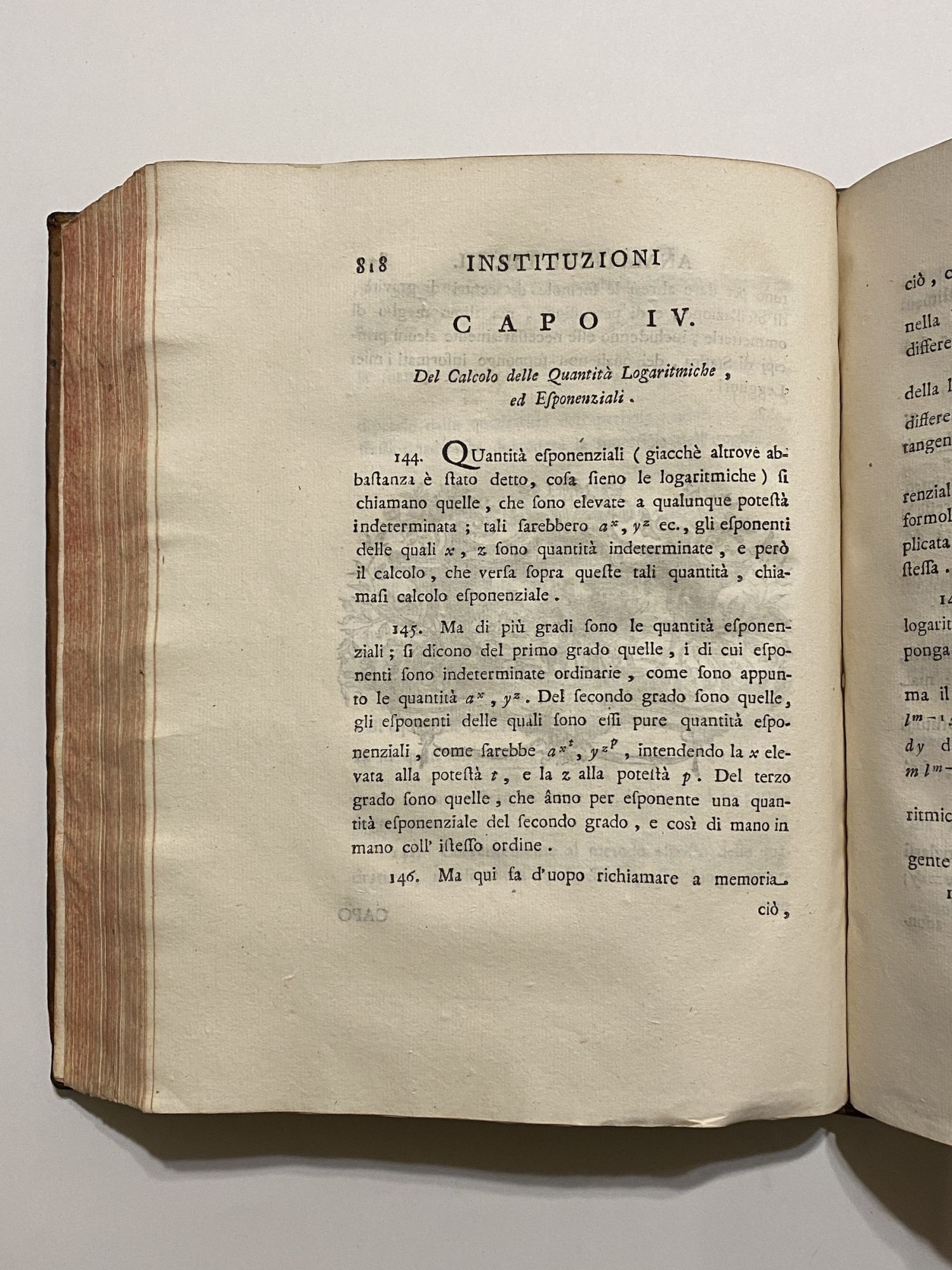
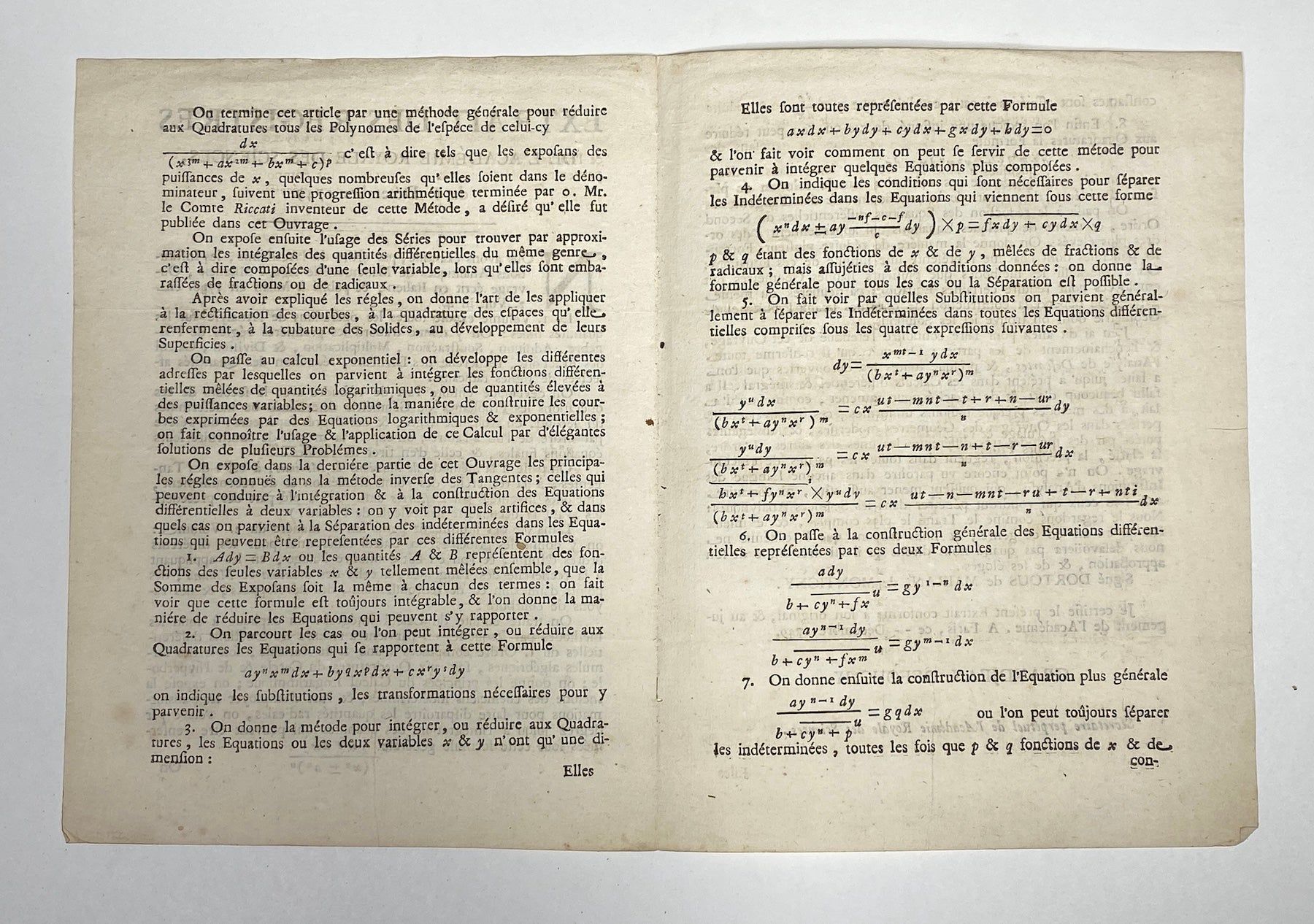
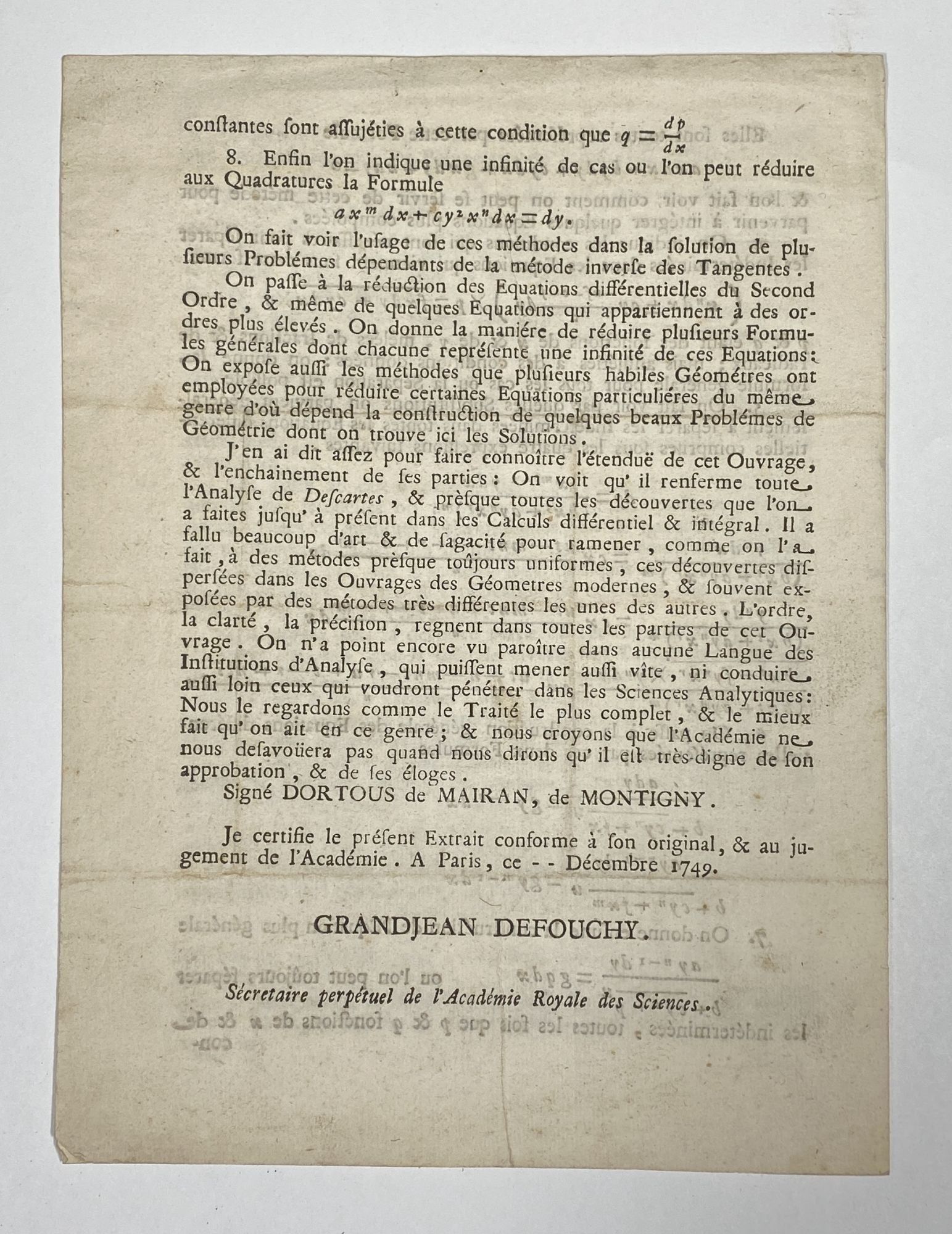
Milan: Regia-Ducal Corte, 1748. First Edition. Very good. Two vols., thick quarto. COMPLETE: [10] ff. (including title-page, dedication, letter to the reader, Imprimatur, and Table of Contents), 428 pp., [1] f. errata + 35 engraved plates (numbered 1-35); [1] f. (title), pp. 431-1020 pp., [1] f. errata, 2 folding letterpress tables, with 17 + 6 + 1 plates for a total of 59 engraved plates. Copperplate vignettes on title-pages, headpiece vignette, and two initials engraved by Marc'Antonio Del Re. Contemporary Italian mottled calf, new spines sympathetically gold-tooled and lettered direct, edges sprinkled red, comb-marbled endpapers. TOGETHER WITH: a copy of the separately printed 4-page "Extrait" report on the work ordered by the Academy Royale des Sciences (see below). AN OUTSTANDING COPY OF THE FIRST EDITION IN EXTREMELY FRESH STATE, THE PAPER CRISP AND PERFECTLY CLEAN, AND WITH A SIGNIFICANT PROVENANCE. THIS WORK WAS IMMEDIATELY RECOGNIZED AS A MASTERPIECE OF MATHEMATICAL ANALYSIS, AS IS ATTESTED BY THE 1749 REPORT OF THE WORK ORDERED BY THE FRENCH ROYAL ACADEMY OF SCIENCES, OF WHICH A RARE OFFPRINT ACCOMPANIES THE PRESENT OFFERING.
This is the first major work of mathematics published by a woman, Maria Gaetana Agnesi, the "Mathematician of God." DSB justly describes here as "the first woman in the Western world who can accurately be called a mathematician." After a decade of painstaking scholarship, Agnesi's "Instituzioni analitiche" was published in 1748 and was immediately heralded throughout Europe as a completely original approach to the integrated and comprehensible treatment of algebra and mathematical analysis.
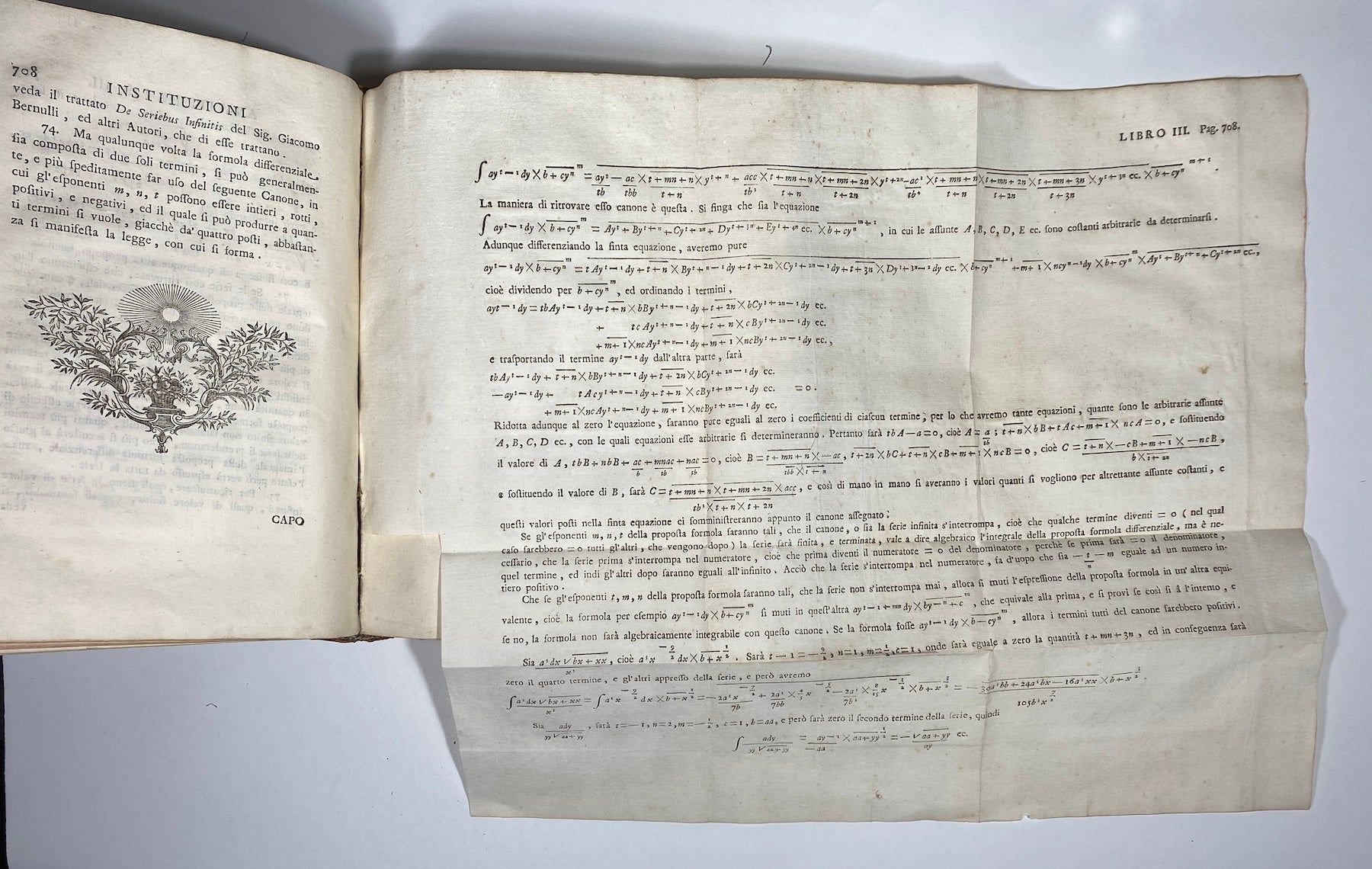
Written "for the youth of Italy," Agnesi's work was quite simply the best introduction to the interrelationship of integral and differential calculus. Her "Instituzioni analitiche" is at the same time a manual for the dissemination of the new infinitesimal calculus, and exposes the elements of algebra, algebraic equations, plane analytical geometry, differential and integral calculus, series developments, and first and second degree differential equations, as well as the treatment of plane curves (see below). The importance of this work is attested by complete translations into French (1775) under the Privilege of the Académie Royale des Sciences, and English (1801) under the guidance of John Colson. Writing in 1873, Pietro Riccardi, the great bibliographer of the history of mathematics in Italy, pronounced the "Instituzioni analitiche" as "one of the first and most complete treatises on finite and infinitesimal analysis" (translation ours).
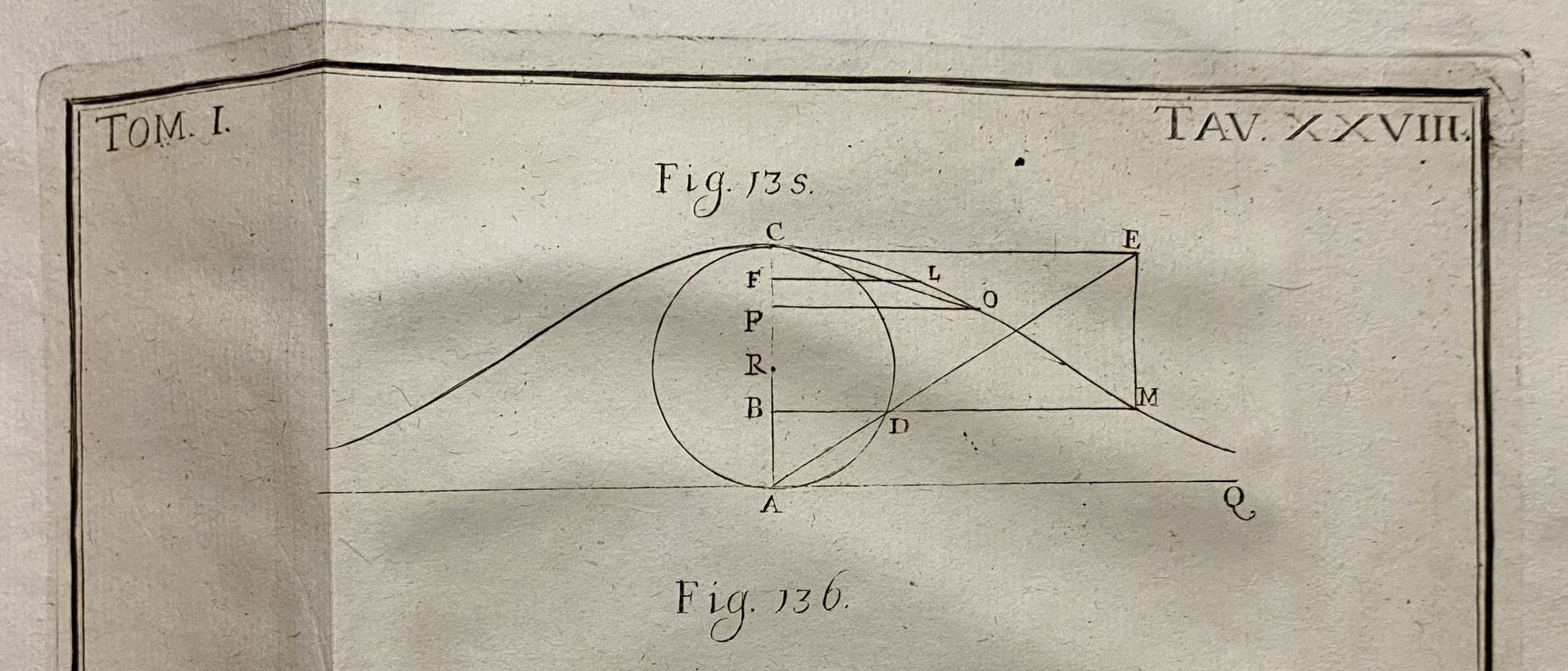
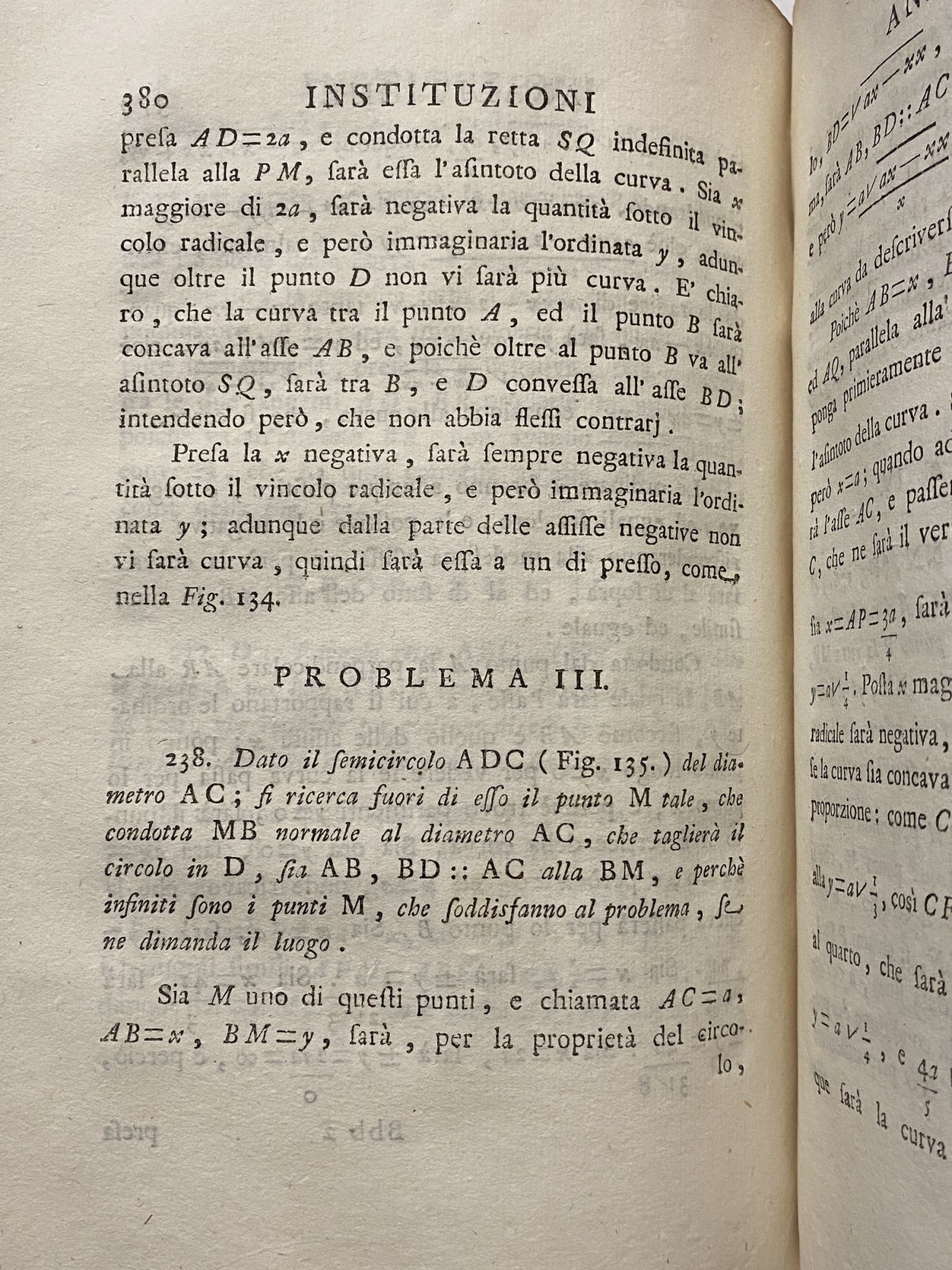
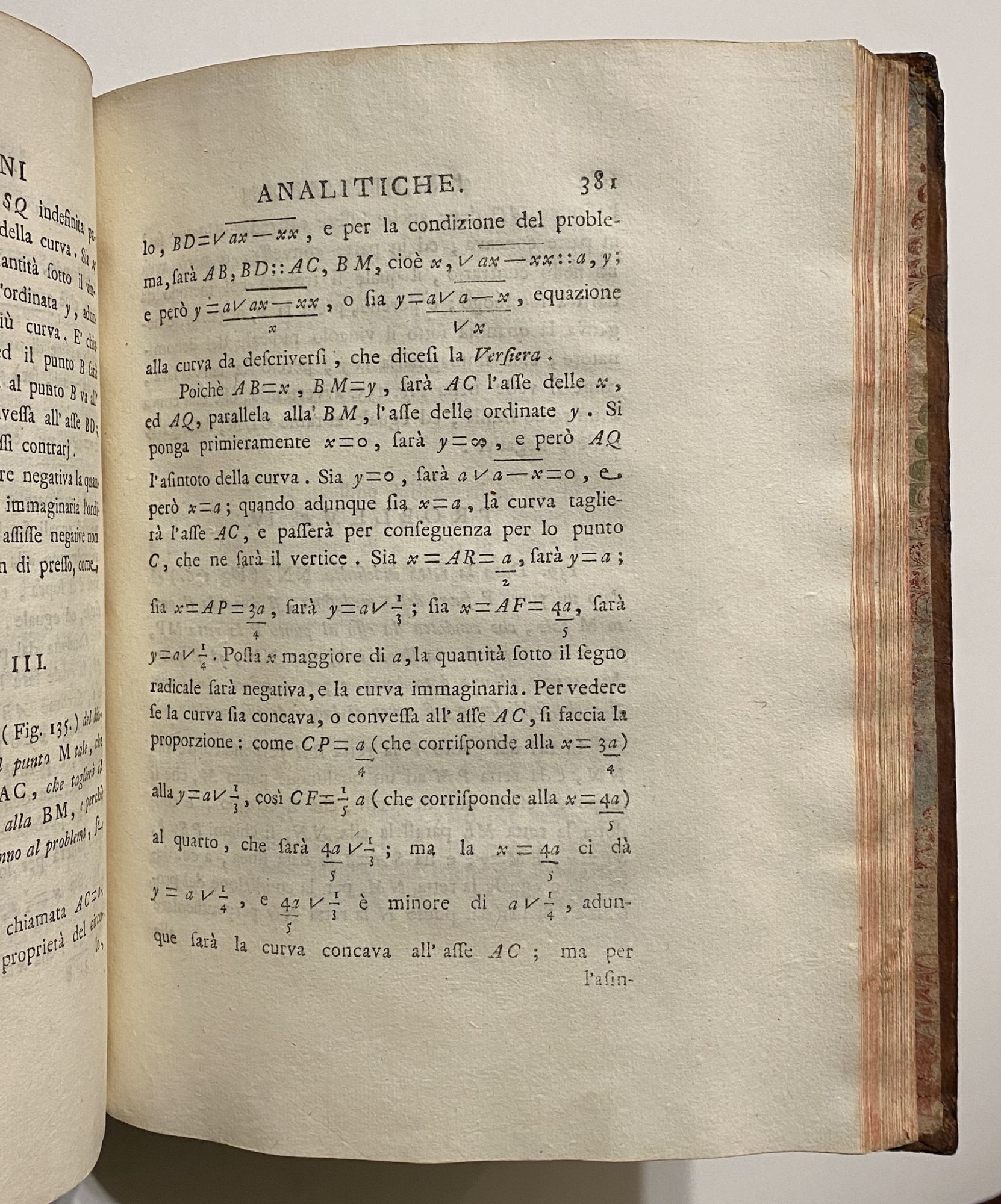
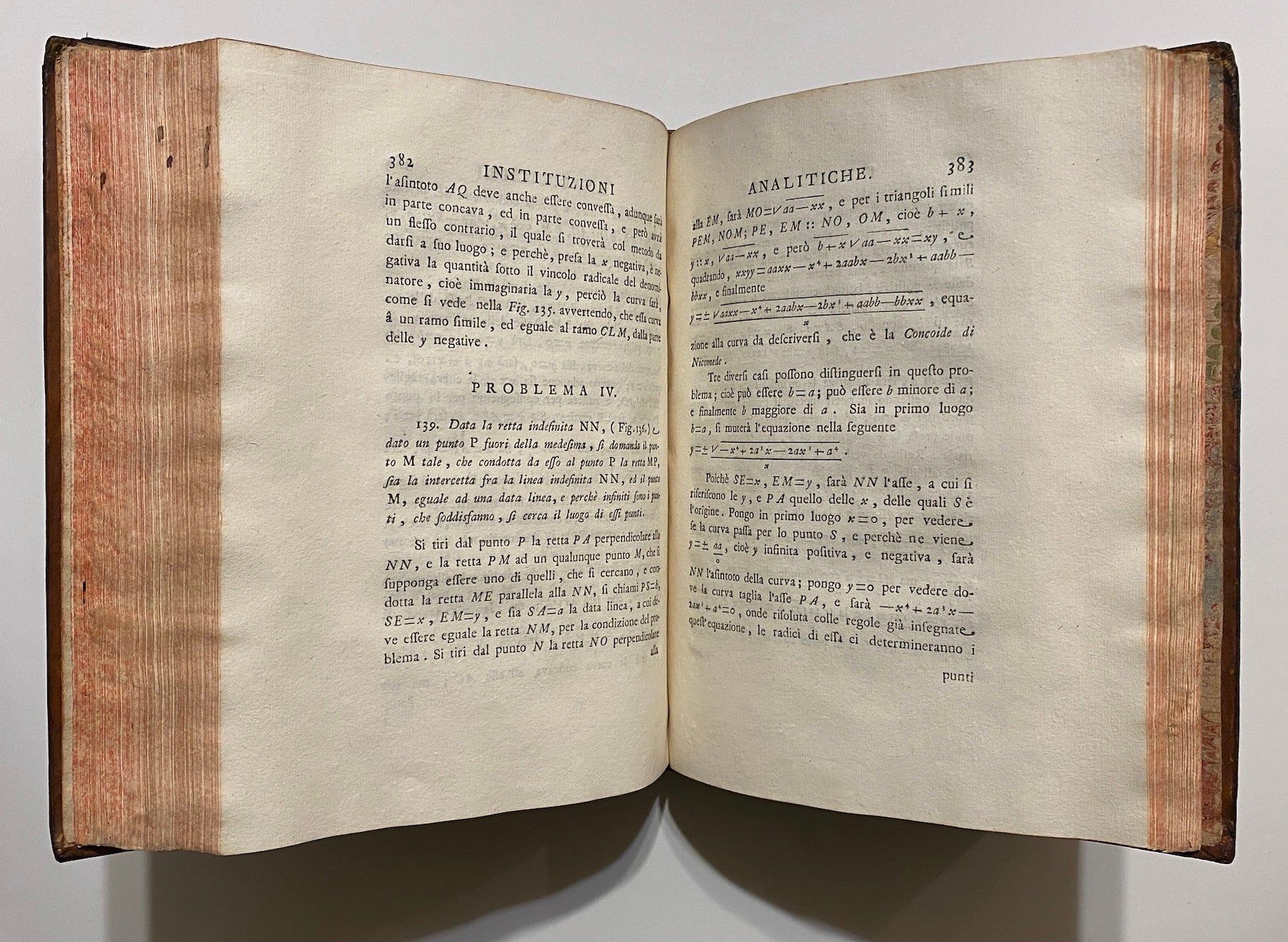
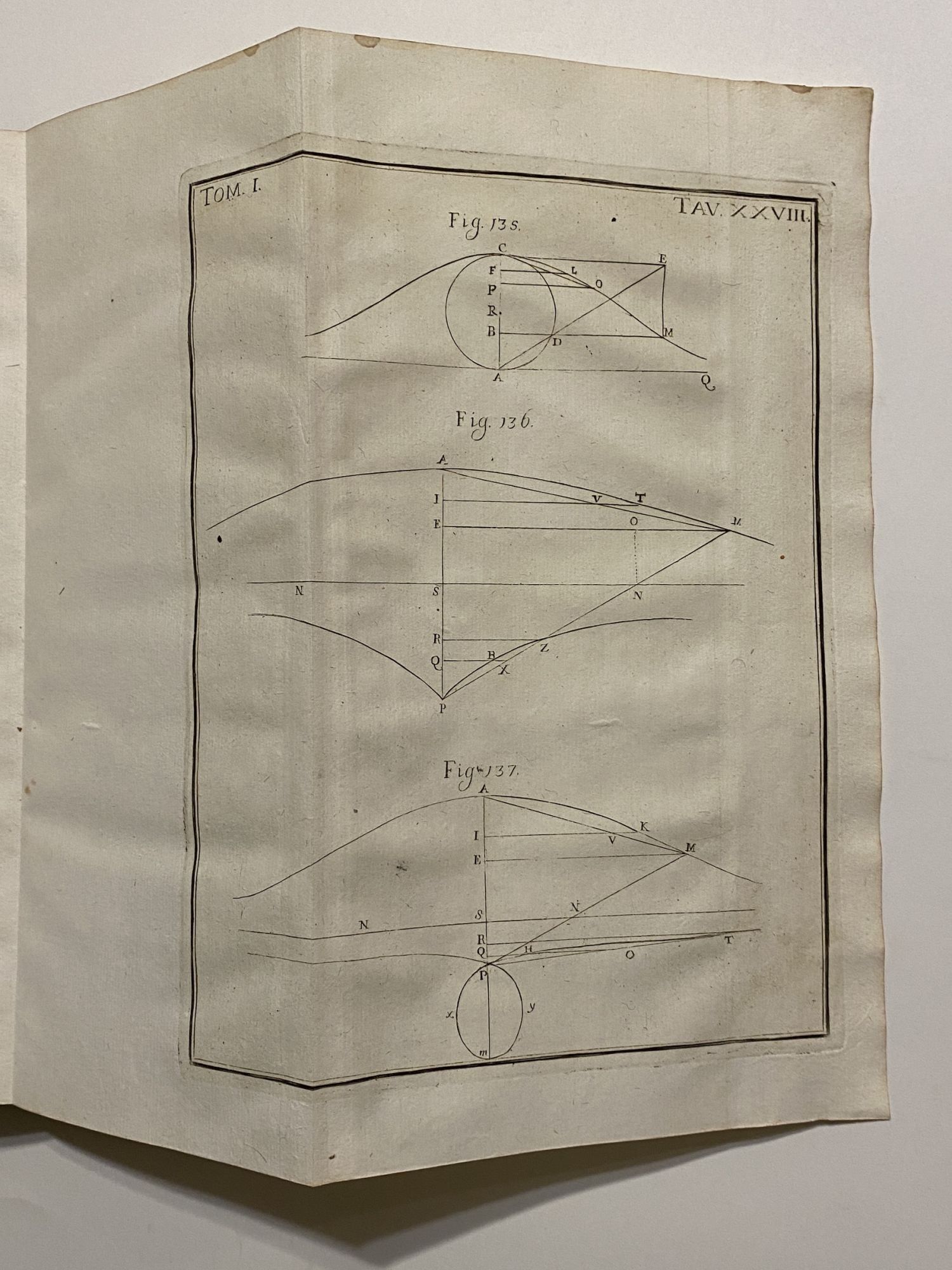
It is curious that our author's name is most frequently associated with a special type of cubic plane curve now known as the "Witch of Agnesi," a mistranslation (by John Colson) of her colloquial Italian term "versiera" (for "sailing sheet") as "witch." Despite its misnomer, the so-called "Witch of Agnesi" (and its name) continues to be applied in the analysis of contemporary probability distribution, numeral analysis, spectral energy distribution, topographic mathematical modeling, infinite series, and more. This "Witch of Agnese" curve is here illustrated in Vol. I, Tav. XXVIII (fig. 135) and described by Agnesi on pp. 380-382.
Born in Milan in 1718, Maria Gaetana Agnesi was the daughter of a mathematics professor at the University of Bologna who was encouraged by her father to undertake the study of science. Her "Instituzioni analitiche" was celebrated by mathematicians and natural philosophers in Britain and on the continent. Benedict XIV appointed her professor of the University of Bologna, but she declined to take the position and instead turned her attention to theology and a life of quiet reflection and charity. Agnesi was the second woman to be offered an official university teaching position (the first being Laura Bassi, for which see below).
Intensely pious from an early age, Agnesi effectively abandoned her mathematical career and devoted herself to the poor and the sick. In order to reduce their misery, she sold her worldly possessions and begged for their food and her own until the end of her days. She died indigent in 1799 and was buried in a mass pauper's grave into which were laid fifteen other corpses.
Such was the fate of this astonishing individual who has recently been termed "the Mathematician of God." (Massimo Mazzotti, "The World of Maria Gaetana Agnesi, Mathematician of God," Johns Hopkins University Press, 2007). "Despite being a remarkable woman for her time, Agnesi's reputation as a mathematician has suffered for three reasons. First, because of Colson's error [see above]; second because of preconceptions that women are incapable of the abstract thinking necessary for mathematics; and finally, because many believe that Agnesi did not make an original contribution to her field. According to Massimo Mazzotti, these gender stereotypes have prevented the rehabilitation of Agnesi's reputation. Contemporaries characterized her as a 'child prodigy with masculine skills and feminine virtues such as modesty and seclusion.' Agnesi's decision to withdraw from mathematics on the death of her father in 1735 and devote the rest of her life to charity and faith, as well as to writing works of devotion, meant that her mathematical career ended prematurely. Thus, she has been remembered more for her religious works -- more acceptably authored by a woman -- than for her contributions to mathematics." (Leigh Whaleyon, "Networks, Patronage and Women of Science during the Italian Enlightenment" in: Early Modern Women 10:2, Spring 2016, pp. 188-197).
TOGETHER WITH: The very rare 4-page Report on the work by prominent mathematicians J.-J. Dortous de Mairan and E.M. de Montigny (6 December 1749), written by order of the French Academy of Sciences. The authors were rich in praise, and recommended that a French translation of Agnesi's "Instituzioni analitiche" be undertaken. DSB explains: In 1749 an academy committee recorded its opinion [i.e. in THE PRESENT OFFPRINT]: 'This work is characterized by its careful organization, its clarity, and its precision. There is no other book, in any language, which would enable a reader to penetrate as deeply, or as rapidly, into the fundamental concepts of analysis. We consider this treatise the most complete and best written work of its kind.'" The printing of the present offprint was authorized by Grandjean Defouchy, Secretaire perpetuel of the Academy.
SELECTED REFERENCES: Parkinson, Breakthroughs p. 165. Honeyman 20. Riccardi I, (1)8. F. Govi. I classici che hanno fatto l'Italia (Modena, 2010) 237. Ron Meltzer, "Maria Gaetana Agnesi" in: Extraordinary Women in Science & Medicine, exhibition catalogue (The Grolier Club, 2013) pp. 72-75, nos. 66-70, with reproduction.
SELECTED LITERATURE: A. Cupillari, Biography of Maria Gaetana Agnesi, an Eighteenth-Century Woman Mathematician (Lewiston, New York, 2007), passim. See the long entry on Agnesi in DSB (I, 75; the "Witch of Agnesi" curve has its own separate entry). Clara Silvia Roero, "M.G. Agnesi, R. Rampinelli and the Riccati family: A Cultural Fellowship Formed for an Important Scientific Purpose, the 'Instituzioni analitiche'" in: Historia Mathematica 42:3 (August 2015), pp. 296-314, with numerous references. Marta Cavazza, "Between Modesty and Spectacle: Women and Science in Eighteenth-Century Italy" in: Italy's Eighteenth Century: Gender and Culture in the Age of the Grand Tour (Paula Findlen, ed.), 2009, pp. 275-302.
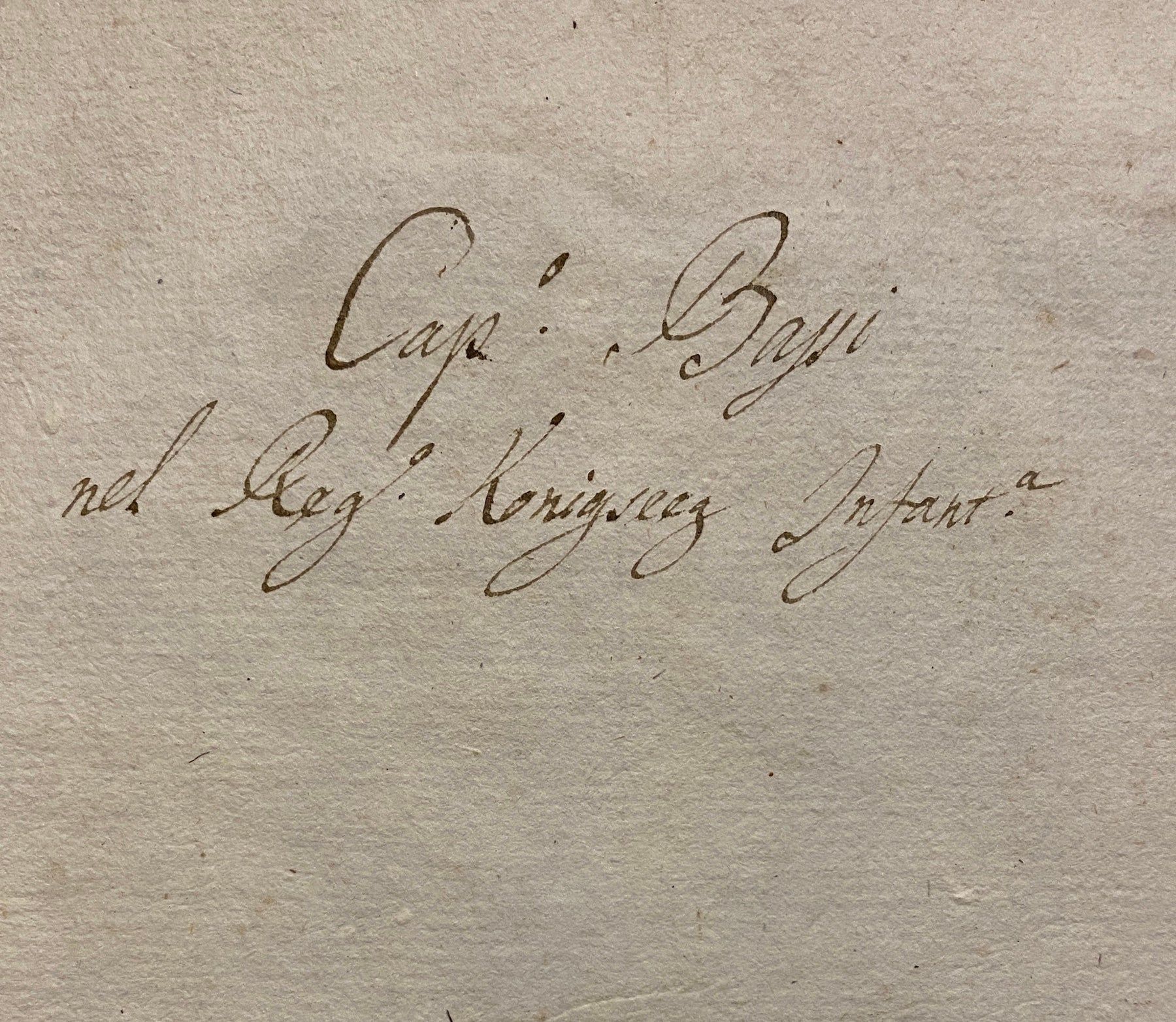
PROVENANCE: Both volumes bear an early ownership inscription in Italian on the first blank leaves: "Capi[tan]o Bassi nel Reg[giment]o Konigseeg (sic) Infant[eri]a." This Captain Bassi individual has resisted identification, but Königsegg was a small statelet in what is now Baden-Württemberg. It has not escaped our notice that his last name is identical to that of Laura Bassi (1711-1778), celebrated Bolognese polymath and Newton's great champion in Italy. With great fanfare and even celebrations in the streets, Bassi was one of the first women to earn a doctoral degree from a university, and the very first woman to be appointed as a salaried university professor. -- Dr. James M. Vaughn (1939-2022), Houston philanthropist who assembled the finest mathematics collection ever formed by a private individual: 125 rare and foundational books in the history of mathematics were donated by him to the Harry Ransom Center in 2021, including what is undoubtedly the finest copy of the first edition of Newton's "Principia" (inscribed: "Ex dono Autoris"). Our volume formed part of Vaughn's private collection and was sold to us by his estate. Dr. Vaughn funded the Mathematical Association of America and helped support the solution of the 300-year-old math puzzle known as "Fermat's Last Theorum." With J.M.V. bookplate in both volumes.
This is the first major work of mathematics published by a woman, Maria Gaetana Agnesi, the "Mathematician of God." DSB justly describes here as "the first woman in the Western world who can accurately be called a mathematician." After a decade of painstaking scholarship, Agnesi's "Instituzioni analitiche" was published in 1748 and was immediately heralded throughout Europe as a completely original approach to the integrated and comprehensible treatment of algebra and mathematical analysis.
Written "for the youth of Italy," Agnesi's work was quite simply the best introduction to the interrelationship of integral and differential calculus. Her "Instituzioni analitiche" is at the same time a manual for the dissemination of the new infinitesimal calculus, and exposes the elements of algebra, algebraic equations, plane analytical geometry, differential and integral calculus, series developments, and first and second degree differential equations, as well as the treatment of plane curves (see below). The importance of this work is attested by complete translations into French (1775) under the Privilege of the Académie Royale des Sciences, and English (1801) under the guidance of John Colson. Writing in 1873, Pietro Riccardi, the great bibliographer of the history of mathematics in Italy, pronounced the "Instituzioni analitiche" as "one of the first and most complete treatises on finite and infinitesimal analysis" (translation ours).
It is curious that our author's name is most frequently associated with a special type of cubic plane curve now known as the "Witch of Agnesi," a mistranslation (by John Colson) of her colloquial Italian term "versiera" (for "sailing sheet") as "witch." Despite its misnomer, the so-called "Witch of Agnesi" (and its name) continues to be applied in the analysis of contemporary probability distribution, numeral analysis, spectral energy distribution, topographic mathematical modeling, infinite series, and more. This "Witch of Agnese" curve is here illustrated in Vol. I, Tav. XXVIII (fig. 135) and described by Agnesi on pp. 380-382.
Born in Milan in 1718, Maria Gaetana Agnesi was the daughter of a mathematics professor at the University of Bologna who was encouraged by her father to undertake the study of science. Her "Instituzioni analitiche" was celebrated by mathematicians and natural philosophers in Britain and on the continent. Benedict XIV appointed her professor of the University of Bologna, but she declined to take the position and instead turned her attention to theology and a life of quiet reflection and charity. Agnesi was the second woman to be offered an official university teaching position (the first being Laura Bassi, for which see below).
Intensely pious from an early age, Agnesi effectively abandoned her mathematical career and devoted herself to the poor and the sick. In order to reduce their misery, she sold her worldly possessions and begged for their food and her own until the end of her days. She died indigent in 1799 and was buried in a mass pauper's grave into which were laid fifteen other corpses.
Such was the fate of this astonishing individual who has recently been termed "the Mathematician of God." (Massimo Mazzotti, "The World of Maria Gaetana Agnesi, Mathematician of God," Johns Hopkins University Press, 2007). "Despite being a remarkable woman for her time, Agnesi's reputation as a mathematician has suffered for three reasons. First, because of Colson's error [see above]; second because of preconceptions that women are incapable of the abstract thinking necessary for mathematics; and finally, because many believe that Agnesi did not make an original contribution to her field. According to Massimo Mazzotti, these gender stereotypes have prevented the rehabilitation of Agnesi's reputation. Contemporaries characterized her as a 'child prodigy with masculine skills and feminine virtues such as modesty and seclusion.' Agnesi's decision to withdraw from mathematics on the death of her father in 1735 and devote the rest of her life to charity and faith, as well as to writing works of devotion, meant that her mathematical career ended prematurely. Thus, she has been remembered more for her religious works -- more acceptably authored by a woman -- than for her contributions to mathematics." (Leigh Whaleyon, "Networks, Patronage and Women of Science during the Italian Enlightenment" in: Early Modern Women 10:2, Spring 2016, pp. 188-197).
TOGETHER WITH: The very rare 4-page Report on the work by prominent mathematicians J.-J. Dortous de Mairan and E.M. de Montigny (6 December 1749), written by order of the French Academy of Sciences. The authors were rich in praise, and recommended that a French translation of Agnesi's "Instituzioni analitiche" be undertaken. DSB explains: In 1749 an academy committee recorded its opinion [i.e. in THE PRESENT OFFPRINT]: 'This work is characterized by its careful organization, its clarity, and its precision. There is no other book, in any language, which would enable a reader to penetrate as deeply, or as rapidly, into the fundamental concepts of analysis. We consider this treatise the most complete and best written work of its kind.'" The printing of the present offprint was authorized by Grandjean Defouchy, Secretaire perpetuel of the Academy.
SELECTED REFERENCES: Parkinson, Breakthroughs p. 165. Honeyman 20. Riccardi I, (1)8. F. Govi. I classici che hanno fatto l'Italia (Modena, 2010) 237. Ron Meltzer, "Maria Gaetana Agnesi" in: Extraordinary Women in Science & Medicine, exhibition catalogue (The Grolier Club, 2013) pp. 72-75, nos. 66-70, with reproduction.
SELECTED LITERATURE: A. Cupillari, Biography of Maria Gaetana Agnesi, an Eighteenth-Century Woman Mathematician (Lewiston, New York, 2007), passim. See the long entry on Agnesi in DSB (I, 75; the "Witch of Agnesi" curve has its own separate entry). Clara Silvia Roero, "M.G. Agnesi, R. Rampinelli and the Riccati family: A Cultural Fellowship Formed for an Important Scientific Purpose, the 'Instituzioni analitiche'" in: Historia Mathematica 42:3 (August 2015), pp. 296-314, with numerous references. Marta Cavazza, "Between Modesty and Spectacle: Women and Science in Eighteenth-Century Italy" in: Italy's Eighteenth Century: Gender and Culture in the Age of the Grand Tour (Paula Findlen, ed.), 2009, pp. 275-302.
PROVENANCE: Both volumes bear an early ownership inscription in Italian on the first blank leaves: "Capi[tan]o Bassi nel Reg[giment]o Konigseeg (sic) Infant[eri]a." This Captain Bassi individual has resisted identification, but Königsegg was a small statelet in what is now Baden-Württemberg. It has not escaped our notice that his last name is identical to that of Laura Bassi (1711-1778), celebrated Bolognese polymath and Newton's great champion in Italy. With great fanfare and even celebrations in the streets, Bassi was one of the first women to earn a doctoral degree from a university, and the very first woman to be appointed as a salaried university professor. -- Dr. James M. Vaughn (1939-2022), Houston philanthropist who assembled the finest mathematics collection ever formed by a private individual: 125 rare and foundational books in the history of mathematics were donated by him to the Harry Ransom Center in 2021, including what is undoubtedly the finest copy of the first edition of Newton's "Principia" (inscribed: "Ex dono Autoris"). Our volume formed part of Vaughn's private collection and was sold to us by his estate. Dr. Vaughn funded the Mathematical Association of America and helped support the solution of the 300-year-old math puzzle known as "Fermat's Last Theorum." With J.M.V. bookplate in both volumes.
Details
Title
[MATHEMATICS - THE FIRST WOMAN MATHEMATICIAN]. Instituzioni analitiche, ad usi della gioventù italiana
Author
Agnesi, Maria Gaetana
Condition
Very Good
Publisher
Regia-Ducal Corte: Milan
Date
1748
Edition
First Edition