

Mesamashigusa 目さまし草 [The Wakeful Weed]
![Mesamashigusa 目さまし草 [The Wakeful Weed]](https://d3525k1ryd2155.cloudfront.net/h/287/747/1589747287.0.x.0.jpg)
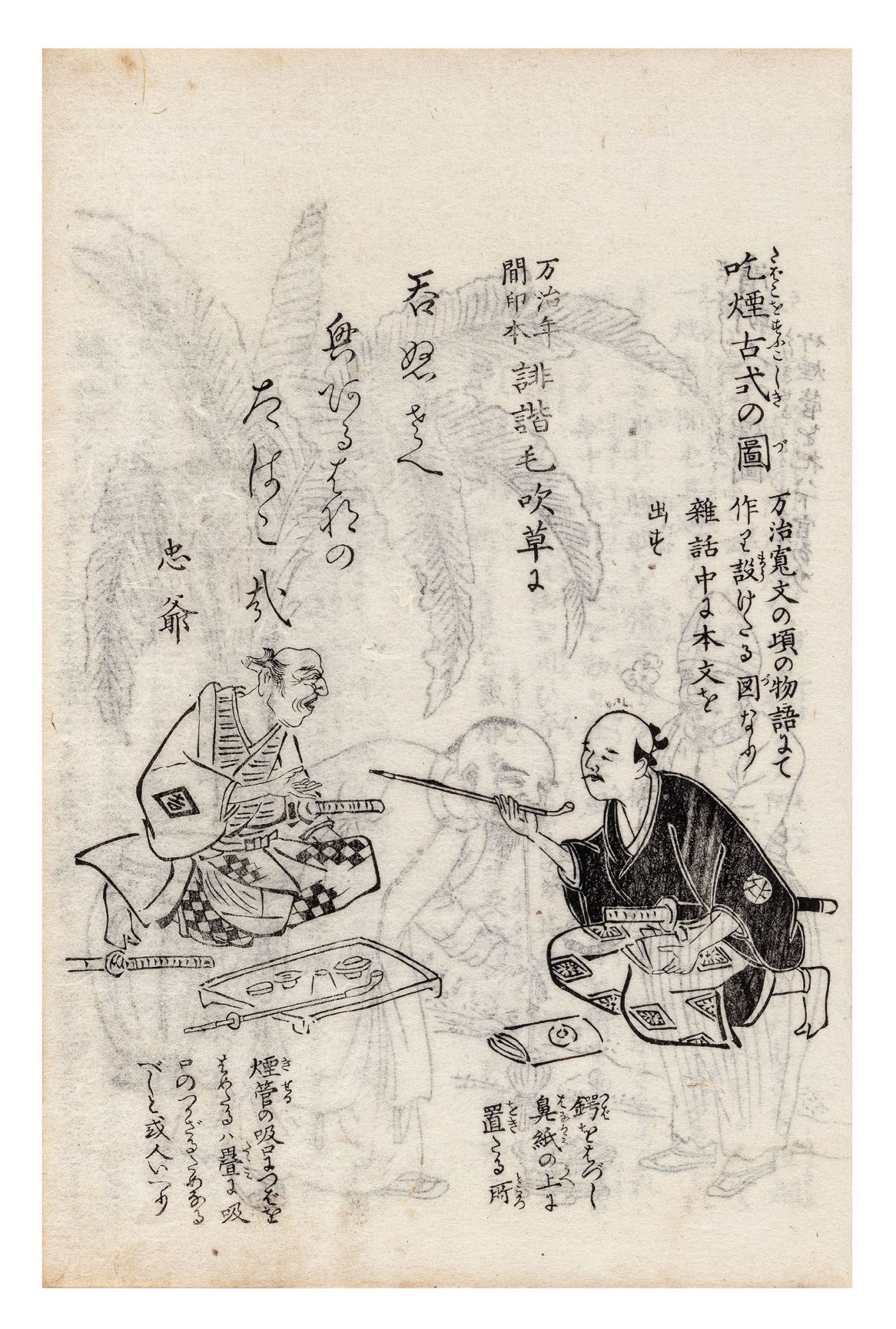
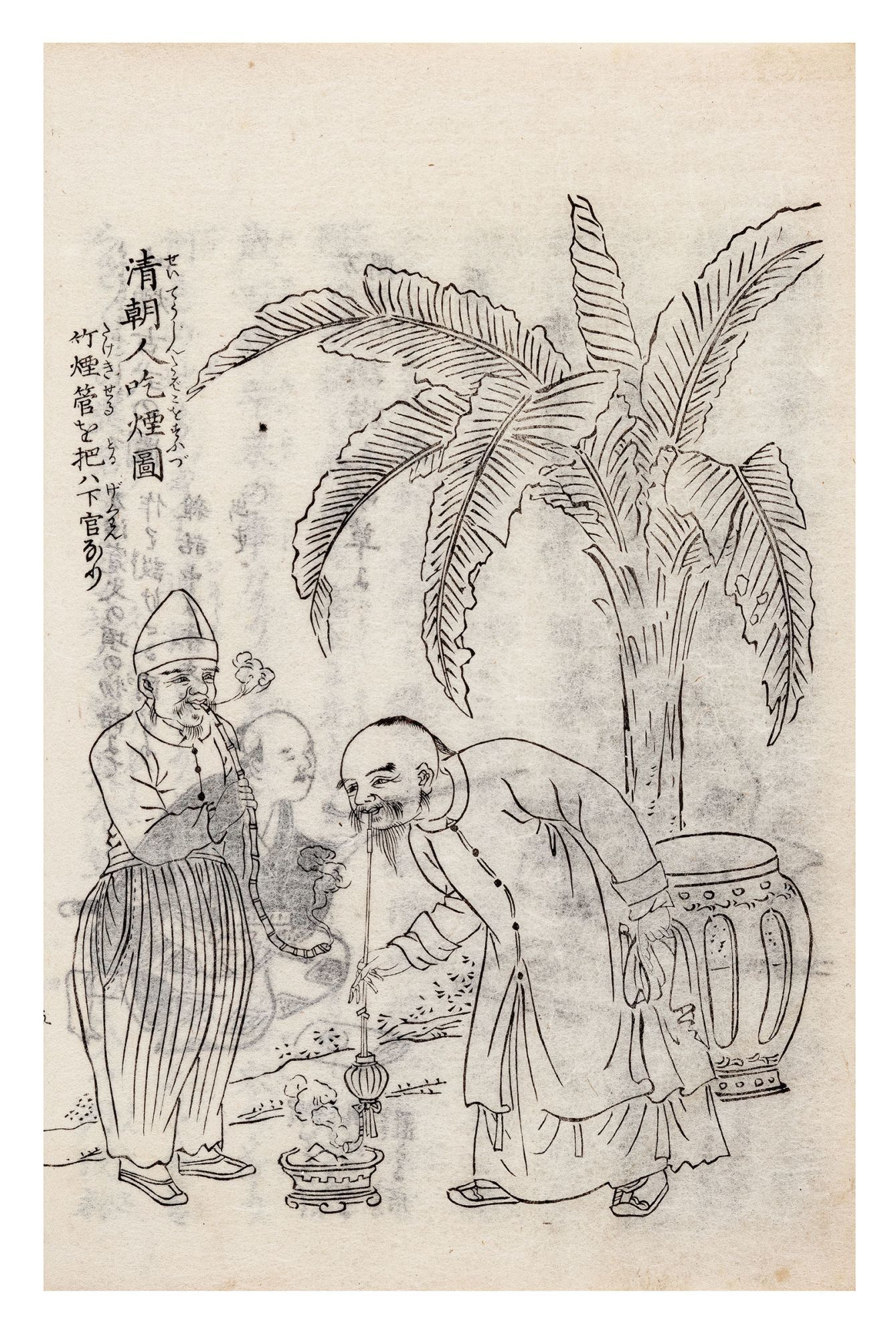
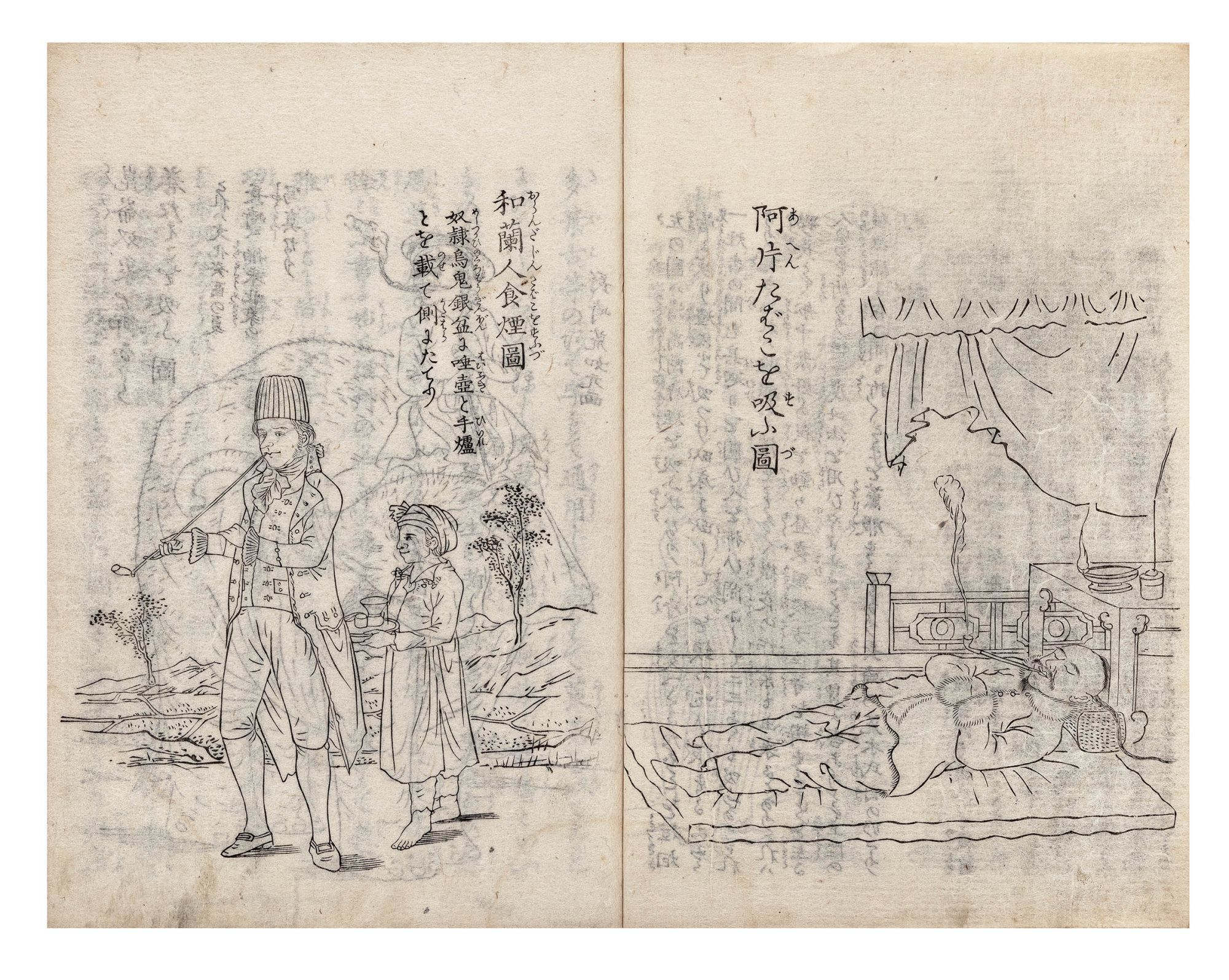
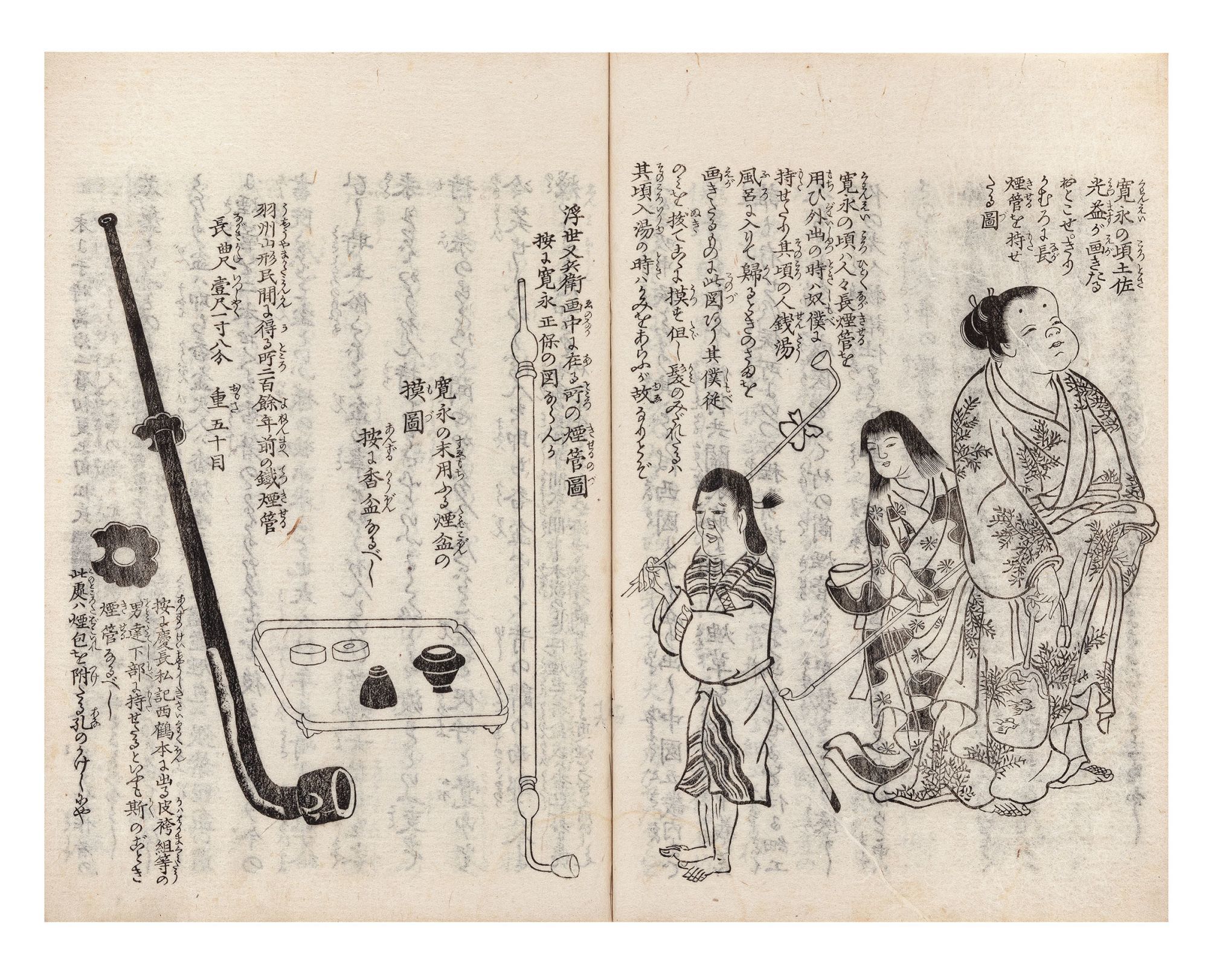
Many woodcut illus. (several full-page). 37 folded leaves. 8vo, orig. semi-stiff wrappers, orig. block-printed title label on upper cover, new stitching. [Japan]: Preface dated 1815.
First edition. Tobacco first arrived in Japan about 1570, and by 1820 nearly the entire population of Tokyo were tobacco smokers. “The tobacco merchant Seichutei Shukushin captured the popular fascination with tobacco and investigated its history in his book The Wakeful Weed (Mesamashigusa), published in 1815. Though purporting to be a popular rendition of a scholarly work transcribed ‘for the benefit of women and children,’ Seichutei drew upon a broad range of sources including evidence from visual and material culture, folklore, etymology, and popular literature. This approach makes Seichutei’s text more than a collection of tobacco lore. He offered a meditation on historical methods useful to exploring the medieval past, locate Japan’s place in world history, and gauge the development of his country’s distinct culture of smoking.”–Eric C. Rath, “An Herb for Reflecting on Hazy Memories: On the Origins of Smoking in Japan,” University of Michigan online, “The Early Modern ‘Medieval.’ Reconstructing Japanese Pasts,” 2011.
The present work is based on the Enroku (1809) by Gentaku Ōtsuki 大槻玄澤 (1757-1827), which was written in Chinese with Japanese reading marks, making it difficult to read. Seichutei Shukushin, a student of Ōtsuki, wrote the present work in Japanese for the general public. It discusses the medical benefits of smoking tobacco (and using the smoke as an enema) and depicts various smoking devices including several interesting types of pipes, a man smoking a pipe atop an elephant (this elephant came to Nagasaki in 1813), a Western man smoking, and an Asian man reclining and smoking, etc.
Fine copy, preserved in a chitsu.
First edition. Tobacco first arrived in Japan about 1570, and by 1820 nearly the entire population of Tokyo were tobacco smokers. “The tobacco merchant Seichutei Shukushin captured the popular fascination with tobacco and investigated its history in his book The Wakeful Weed (Mesamashigusa), published in 1815. Though purporting to be a popular rendition of a scholarly work transcribed ‘for the benefit of women and children,’ Seichutei drew upon a broad range of sources including evidence from visual and material culture, folklore, etymology, and popular literature. This approach makes Seichutei’s text more than a collection of tobacco lore. He offered a meditation on historical methods useful to exploring the medieval past, locate Japan’s place in world history, and gauge the development of his country’s distinct culture of smoking.”–Eric C. Rath, “An Herb for Reflecting on Hazy Memories: On the Origins of Smoking in Japan,” University of Michigan online, “The Early Modern ‘Medieval.’ Reconstructing Japanese Pasts,” 2011.
The present work is based on the Enroku (1809) by Gentaku Ōtsuki 大槻玄澤 (1757-1827), which was written in Chinese with Japanese reading marks, making it difficult to read. Seichutei Shukushin, a student of Ōtsuki, wrote the present work in Japanese for the general public. It discusses the medical benefits of smoking tobacco (and using the smoke as an enema) and depicts various smoking devices including several interesting types of pipes, a man smoking a pipe atop an elephant (this elephant came to Nagasaki in 1813), a Western man smoking, and an Asian man reclining and smoking, etc.
Fine copy, preserved in a chitsu.
Details
Title
Mesamashigusa 目さまし草 [The Wakeful Weed]
Author
SEICHUTEI SHUKUSHIN 淸中亭叔親
Condition
Unknown