

Some implications of the genetical concept of race in terms of spatial analysis in Cold Spring Harbor Symposia on Quantitative Biology, Vol. XV, pp 259-314
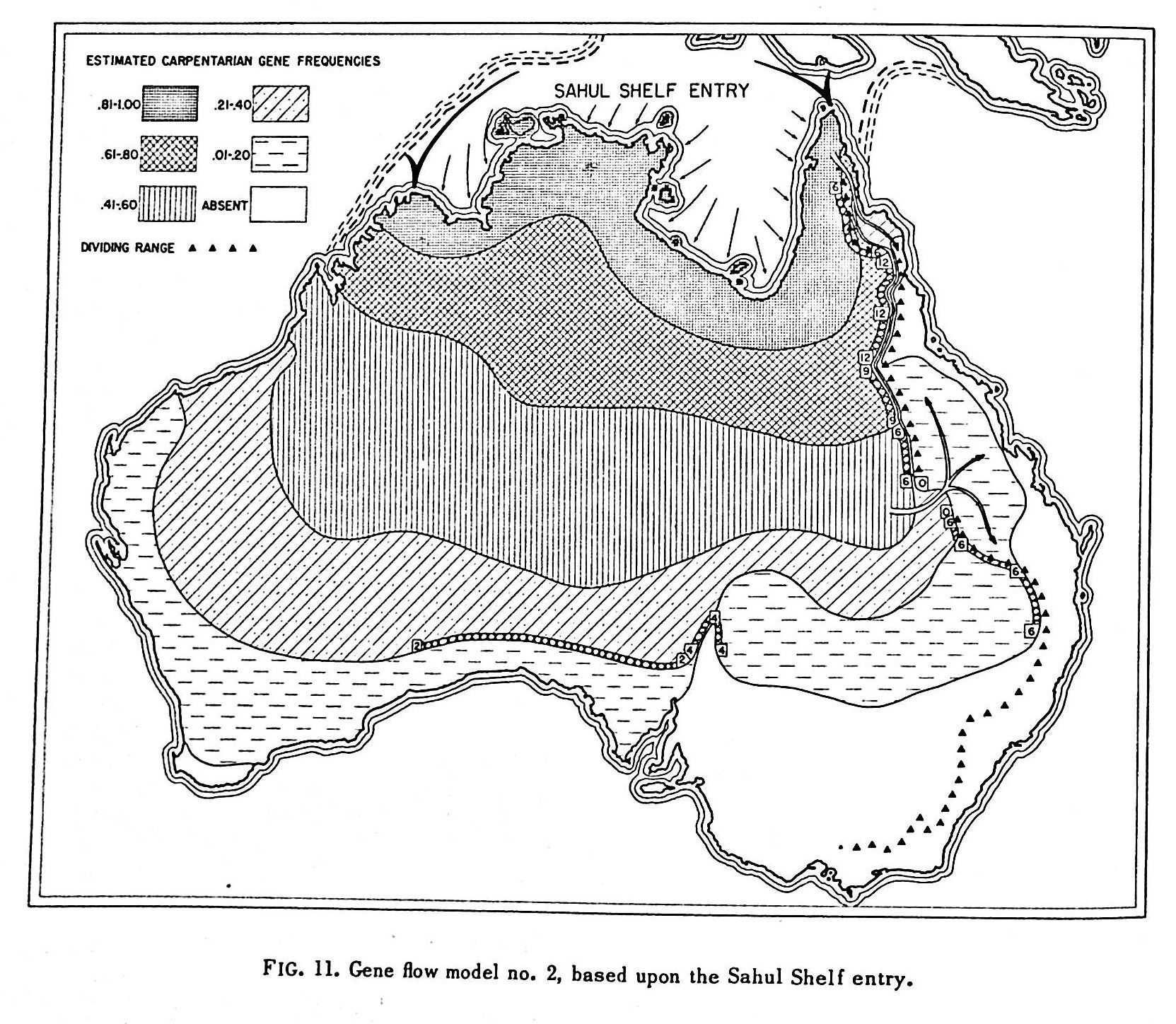
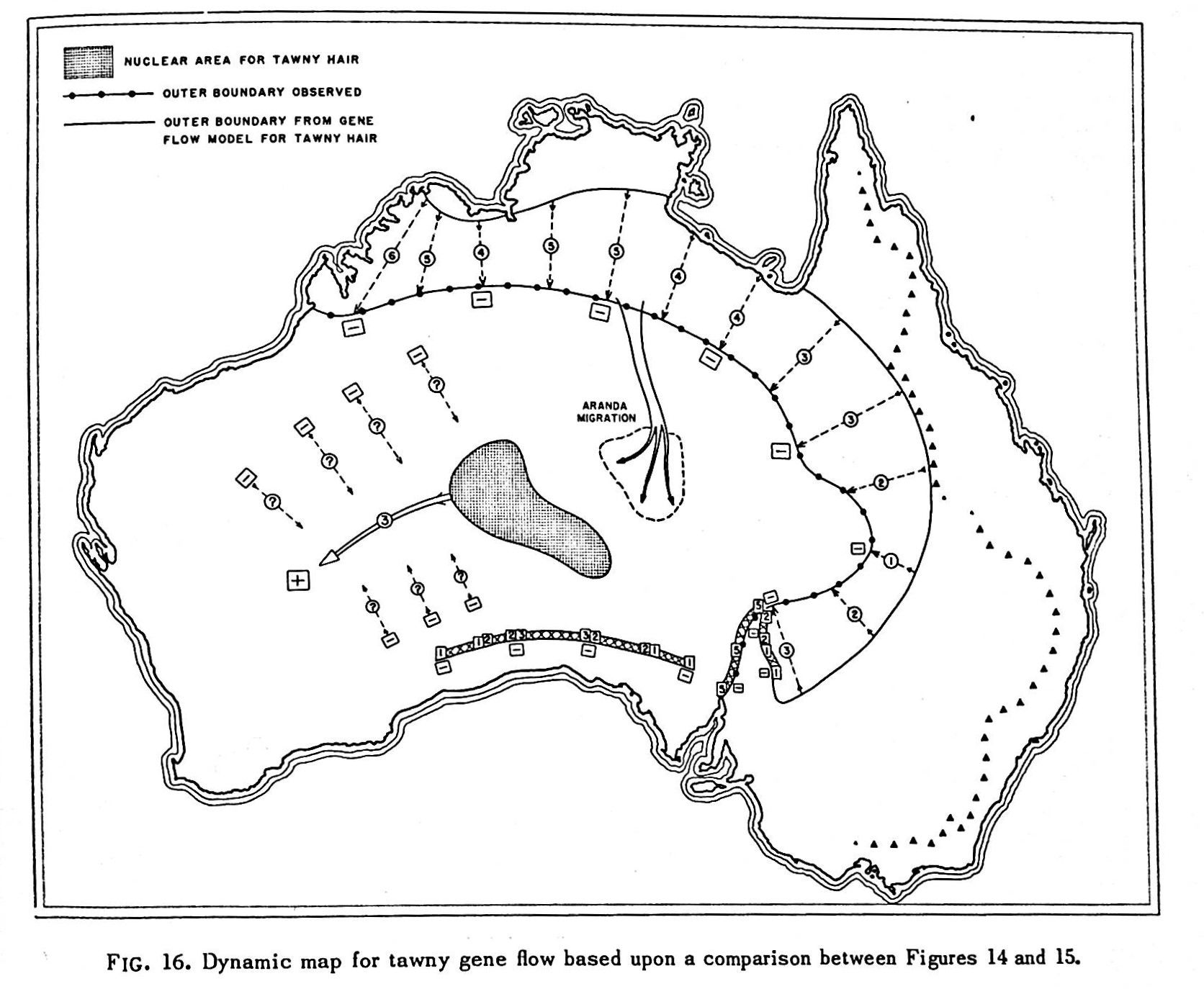
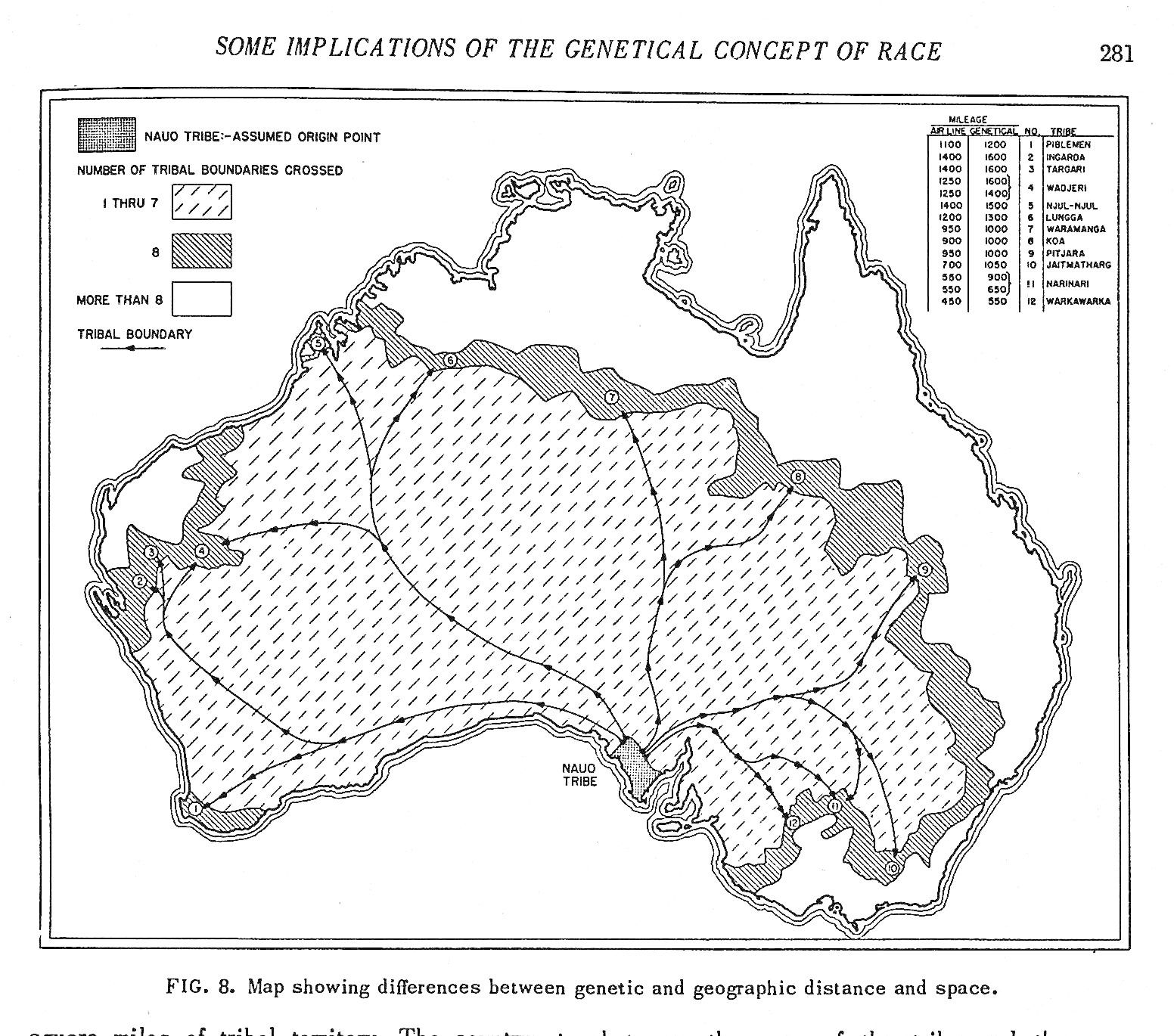
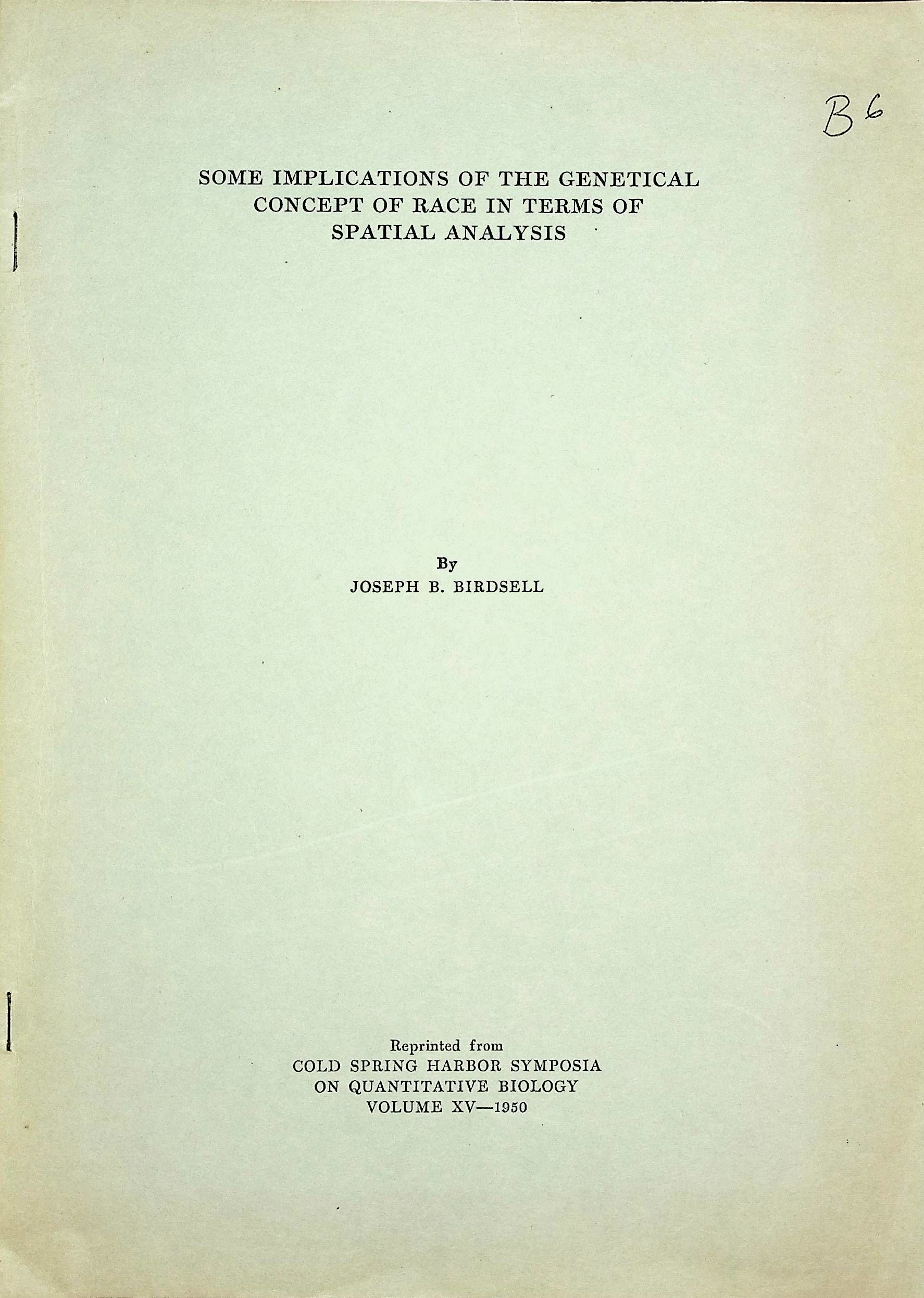
- printed paper wraps
- Cold Spring Harbor, NY: Cold Spring Harbor Laboratory, 1950
Cold Spring Harbor, NY: Cold Spring Harbor Laboratory, 1950. First edition.
1950 POPULATION GENETICS STUDY BASED ON BLOOD GROUPS AND "RACE" BEFORE DISCOVERY OF DNA.
7 3/4 x 10 3/4 inches offprint in stapled printed gray wrappers, 56 pp, 16 figures. Light browning to covers, "B6" inscribed top of cover. From the library of Stephen Jay Gould, with his catalog number: "B", surname, and "6" the filing number.
JOSEPH BENJAMIN BIRDSELL (1908-1994) of Harvard University and UCLA was an anthropologist who studied Aboriginal Australians. After meeting Australian anthropologist Norman Tindale, of the South Australian Museum and University of Adelaide, in 1936 when Tindale visited the US, Birdsell made his first field study in Australia in 1938. Tindale would study the genealogies, while Birdsell undertook the measuring, and with government support the pair travelled across south-east Australia, parts of Queensland, Western Australia, and Tasmania, and returned periodically to study microevolutionary processes. Together with Tindale, in field-work over 1938–39 in the Cairns rainforest, he concluded that the Indigenous "pygmy" peoples there, which they collectively called Barrineans, belonged to a group that were genetically distinct from the majority of Australian Aboriginal peoples, perhaps related to the Aboriginal Tasmanians. He taught anthropology at UCLA from 1948 until his retirement in 1974, continuing his research, and writing many articles and a widely used textbook on human evolution. He had a productive 50-year collaboration with Tindale. Early scholars had tended to view the peopling of Australia as the result of three separate waves of immigration, with distinct human types. Birdsell took a biological approach and did extensive work on anthropometrics to buttress his conjecture. This trihybrid model was resurrected and espoused by Birdsell, and became a standard part of Australian history down from the 1940s. The mid-twentieth century Australian fieldwork of Joseph B. Birdsell illustrates, perhaps uniquely, the transition from typological structuring in physical anthropology before World War II to human biology's increasing interest in the geographical or clinal patterning of genes and commitment to notions of drift and selection. It also shows that some morphological inquiries lingered into the postwar period, as did an attachment to theories of racial migration and hybridization. Birdsell's intensive and long-term fieldwork among Aboriginal Australians eventually led him to criticize the settler colonialism and white racism that had made possible his expeditions and data collection.
Details
Title
Some implications of the genetical concept of race in terms of spatial analysis in Cold Spring Harbor Symposia on Quantitative Biology, Vol. XV, pp 259-314
Author
Birdsell, Joseph B.
Binding
printed paper wraps
Condition
Unknown
Publisher
Cold Spring Harbor Laboratory: Cold Spring Harbor, NY
Date
1950
Edition
First edition