

1906 Atlanta Massacre; in Le Petit Journal
- Paris: Le Petit Journal, 1906
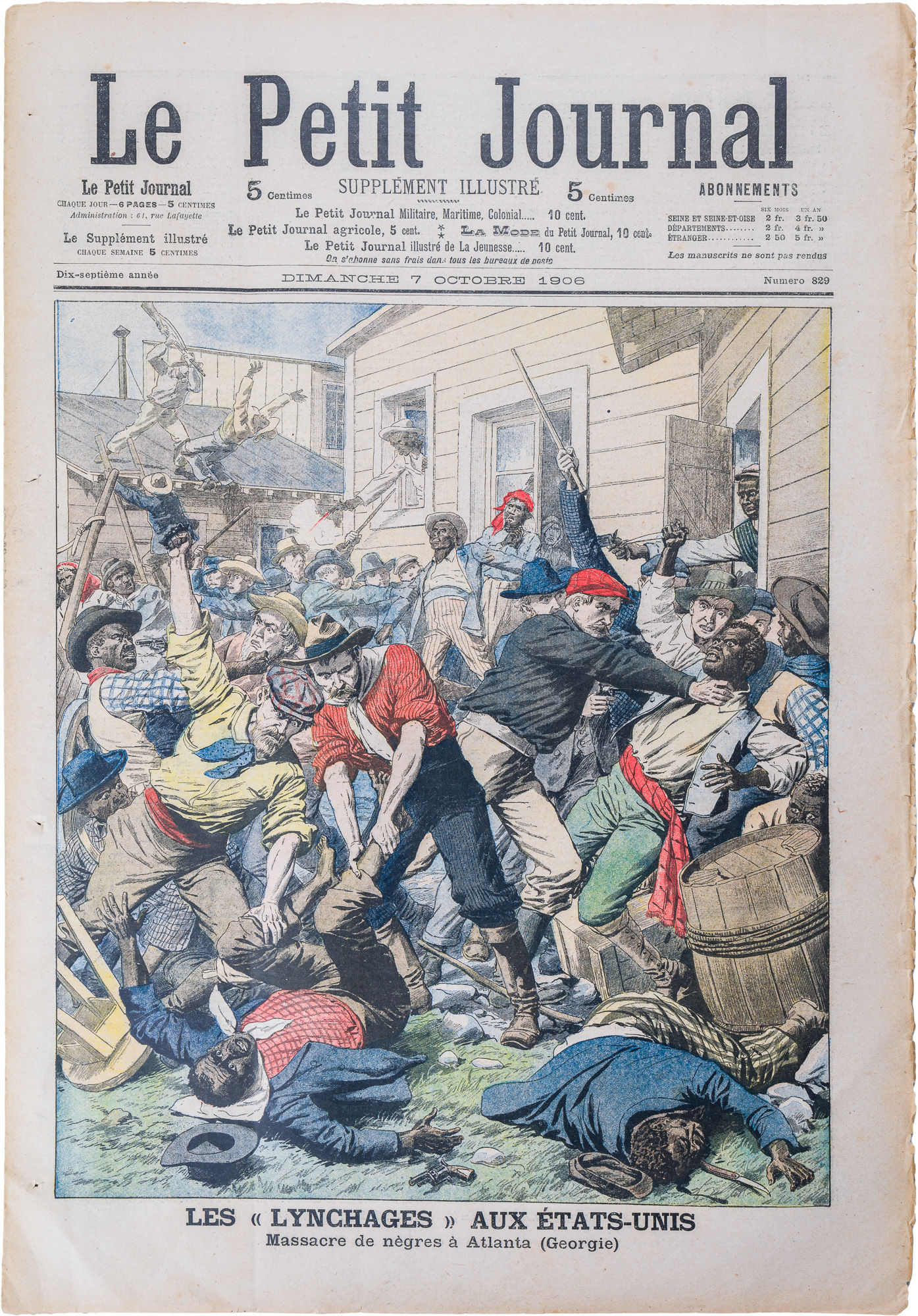
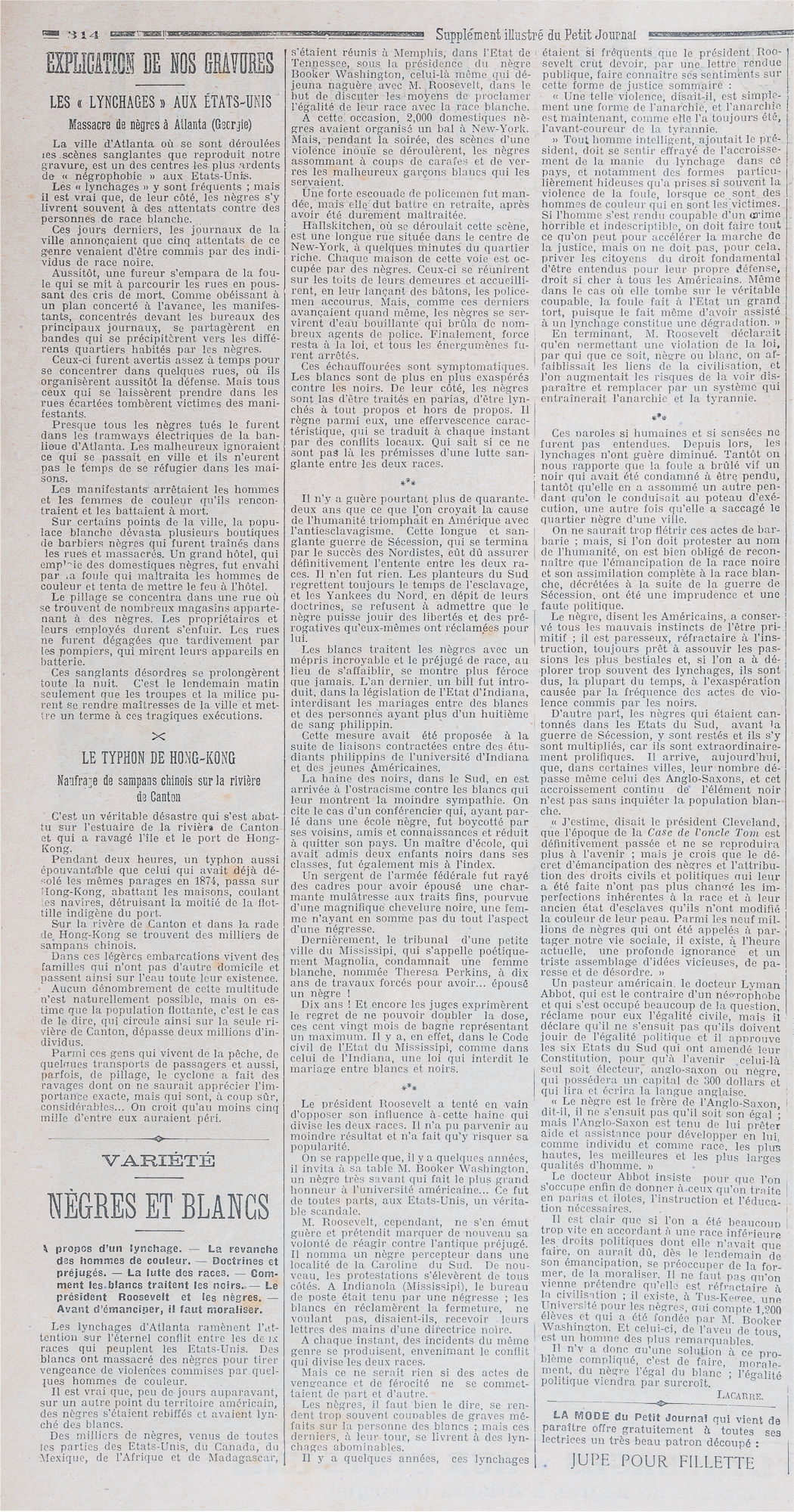
Paris: Le Petit Journal, 1906. First Edition. 1st Continental appearance (?), covered earlier in the U.S. and U.K. Original sheets (4), as issued. Very good. The massacre took place from September 22–24, upwards of 100 Black residents of Atlanta were murdered in an event that was, in the immediacy, misrepresented regionally, downplayed nationally and then ignored locally for 100 years. The details can be easily researched, with numerous scholarly works published in the past 20 years. We’d say this illustration, and its report, would add to any African American archive that includes the event. The Atlanta Race Massacre of 1906 was a devastating episode of racial violence that erupted between September 22-26, when white mobs, inflamed by sensationalized and fabricated newspaper reports of Black men assaulting white women, descended upon Atlanta's Black communities. The violence was situated within a heated gubernatorial campaign where both candidates, M. Hoke Smith and Clark Howell, editors of competing newspapers, explicitly campaigned on platforms to disenfranchise Black voters and stoked racial tensions through inflammatory journalism. What began at Five Points in downtown Atlanta quickly spread as mobs killed at least 25 African Americans (with unofficial estimates ranging from 25-100), destroyed countless Black-owned businesses and homes, while police officers and some militia members either participated in or did nothing to stop the violence. The massacre reflected growing white resentment toward Atlanta's expanding Black population and their increasing economic success in what was considered the capital of the New South.
The 1906 Atlanta massacre carried profound significance for 20th century history and the trajectory of civil rights activism. As historian Clifford Kuhn notes, the violence "discredited for many Black leaders the accommodationist strategy of Booker T. Washington among the leadership of Black America, and gave new legitimacy to the more aggressive tactics for achieving racial justice epitomized by W.E.B. Du Bois,” who wrote a poem titled "A Litany of Atlanta" in response to the violence. The event directly influenced the founding of the NAACP in 1909 and contributed to a shift toward more activist approaches to civil rights. Despite its historical importance, the massacre was "forgotten or minimized for decades in the white community and ignored in official histories of the city" (New Georgia Encyclopedia, 2022). It wasn't until 2006, on its 100th anniversary, that the event was publicly commemorated, and only in 2007 did it become part of Georgia's public school curriculum, demonstrating how this critical historical event was effectively brushed under the rug for a century.
The 1906 Atlanta massacre carried profound significance for 20th century history and the trajectory of civil rights activism. As historian Clifford Kuhn notes, the violence "discredited for many Black leaders the accommodationist strategy of Booker T. Washington among the leadership of Black America, and gave new legitimacy to the more aggressive tactics for achieving racial justice epitomized by W.E.B. Du Bois,” who wrote a poem titled "A Litany of Atlanta" in response to the violence. The event directly influenced the founding of the NAACP in 1909 and contributed to a shift toward more activist approaches to civil rights. Despite its historical importance, the massacre was "forgotten or minimized for decades in the white community and ignored in official histories of the city" (New Georgia Encyclopedia, 2022). It wasn't until 2006, on its 100th anniversary, that the event was publicly commemorated, and only in 2007 did it become part of Georgia's public school curriculum, demonstrating how this critical historical event was effectively brushed under the rug for a century.
Details
Title
1906 Atlanta Massacre; in Le Petit Journal
Author
[African Americana]
Condition
Unknown
Publisher
Le Petit Journal: Paris
Date
1906
Edition
First Edition