

Ornate calligraphic manuscript - Vor nicht gar langer ....
- Late eighteenth century (laid paper), colored blue/green, textured paper wrappers. The stitching of the binding is a multi- colo
- ca 1820
ca 1820. Late eighteenth century (laid paper), colored blue/green, textured paper wrappers. The stitching of the binding is a multi- colored thread strand.. Near fine; colors are bright and crisp, as is the decoration.. Three folio sheets of watermarked, laid paper (continental). Folded in half, nested, and bound (stitched, landscape format) into plain blue/green laid paper wrappers. The endpapers are milled paper of a later period that are original to the binding. The folded sheets make 6 leaves that are the manuscript (recto only). The leaf size is appx. 213 x 333 mm.
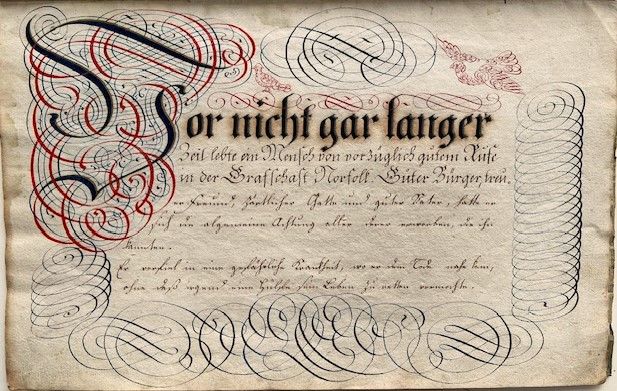
An extraordinary manuscript attributed to C F Egelmann (1781-1860) PA school teacher and provincial engraver containing elaborate calligraphic filligree embellishments and ornaments executed in red, green, and blue with gold highlights. Written in German Gothic script the text is a fable of two children. It is set in the "Grafschaft" (county) of Norfolk in the UK. The father of children becomes ill and close to death, decides to present them, a boy and a girl, an inheritance impressing upon them their responsibilities to themselves and god for it all could be gone in a moment of neglect. Typical of such stories among the PA Germans there was always a practical, direct conclusion. The subject offers an eerie echo of a tragedy that befell the Herbach family children in 1820 in York County. The manuscript is most likely a product during his years teaching in Chester or Wernersville (where he had been engaged to teach German) near Reading. Egelmann's manuscript is modelled - in format and style - on continental German calligraphic sample manuals of an earlier generation. Raised in a family of privilege and education, both parents coming from titled families, he certainly would have been familiar with these elaborate writing manuals that circulated as advertisments for skilled scribes. The family originated in Holland where his grandfather had been sent as an ambassador for the English (the family had established itself in England during the Middle Ages; at that point the name was Eagleman). As a young man his father had been private secretary to the chamberlain of King George III in the Duchy of Linneburg. It was during his term of office there that Carl was born in 1781. His mother was Belgian and came from Flanders. At 17, Carl was engaged as secretary by the Chamberlain of England and shortly afterwards was made private secretary. All the time he was in the employ of the Chamberlain, Baron Dinklaga, he lived with the family of the baron at his residence, Schulenburg near Batburgen. During this time his father, and sister died, his mother having died when he was quite young. In 1802, together with an English relative, he emigrated to America. Given this background it is no wonder that the setting for the fable offered here was the UK. Though employed as a teacher by the Quakers in Chester and then moving to Wernersville, Egelmann began a career as an engraver and provincial publisher. He is best known for his book, Deutsche & Englische Vorschriften, first issued in 1821. That book contains clear duplicates of the design and ornament motifs of swirls and birds utilized in the manuscript offered here. See Arndt #2522; Yoder, Pennsylvania German Broadside.
An extraordinary manuscript attributed to C F Egelmann (1781-1860) PA school teacher and provincial engraver containing elaborate calligraphic filligree embellishments and ornaments executed in red, green, and blue with gold highlights. Written in German Gothic script the text is a fable of two children. It is set in the "Grafschaft" (county) of Norfolk in the UK. The father of children becomes ill and close to death, decides to present them, a boy and a girl, an inheritance impressing upon them their responsibilities to themselves and god for it all could be gone in a moment of neglect. Typical of such stories among the PA Germans there was always a practical, direct conclusion. The subject offers an eerie echo of a tragedy that befell the Herbach family children in 1820 in York County. The manuscript is most likely a product during his years teaching in Chester or Wernersville (where he had been engaged to teach German) near Reading. Egelmann's manuscript is modelled - in format and style - on continental German calligraphic sample manuals of an earlier generation. Raised in a family of privilege and education, both parents coming from titled families, he certainly would have been familiar with these elaborate writing manuals that circulated as advertisments for skilled scribes. The family originated in Holland where his grandfather had been sent as an ambassador for the English (the family had established itself in England during the Middle Ages; at that point the name was Eagleman). As a young man his father had been private secretary to the chamberlain of King George III in the Duchy of Linneburg. It was during his term of office there that Carl was born in 1781. His mother was Belgian and came from Flanders. At 17, Carl was engaged as secretary by the Chamberlain of England and shortly afterwards was made private secretary. All the time he was in the employ of the Chamberlain, Baron Dinklaga, he lived with the family of the baron at his residence, Schulenburg near Batburgen. During this time his father, and sister died, his mother having died when he was quite young. In 1802, together with an English relative, he emigrated to America. Given this background it is no wonder that the setting for the fable offered here was the UK. Though employed as a teacher by the Quakers in Chester and then moving to Wernersville, Egelmann began a career as an engraver and provincial publisher. He is best known for his book, Deutsche & Englische Vorschriften, first issued in 1821. That book contains clear duplicates of the design and ornament motifs of swirls and birds utilized in the manuscript offered here. See Arndt #2522; Yoder, Pennsylvania German Broadside.
Details
Title
Ornate calligraphic manuscript - Vor nicht gar langer ....
Author
[Egelmann, Carl F] - MANUSCRIPT FABLE
Binding
Late eighteenth century (laid paper), colored blue/green, textured paper wrappers. The stitching of the binding is a multi- colo
Condition
Near Fine
Date
ca 1820