

Manuscript on paper, entitled “Gunkyōroku” 軍鏡錄 [“The Recorded Military Mirror”]
Numerous brush & ink illus. (some heightened in red, blue, brown, yellow, & gray ink) in text. 20 parts in 7 vols. Ca. 522 folding leaves. 8vo (242 x 170 mm.), orig. wrappers, new stitching (a bit loose). [Japan]: 1847.
A very rare and richly illustrated manuscript on military doctrine and practice, compiled during the early or mid-Edo period. Only one or two complete copies appear to be available in Japanese libraries, and none in North America. It has never been published.
A Preface signed by Sawai Munekiyo discusses the duties of civil and military officials: “to serve the peace of one’s country and the good of its people, that is the substance of civil officials. To serve so that it does not become threatened and act so that it does not fall into disorder, that is the substance of military officials.” From the wording, it sounds as if this passage was written in peacetime, when the task of military officials was to maintain the status quo, an important factor during the relatively peaceful Tokugawa period.
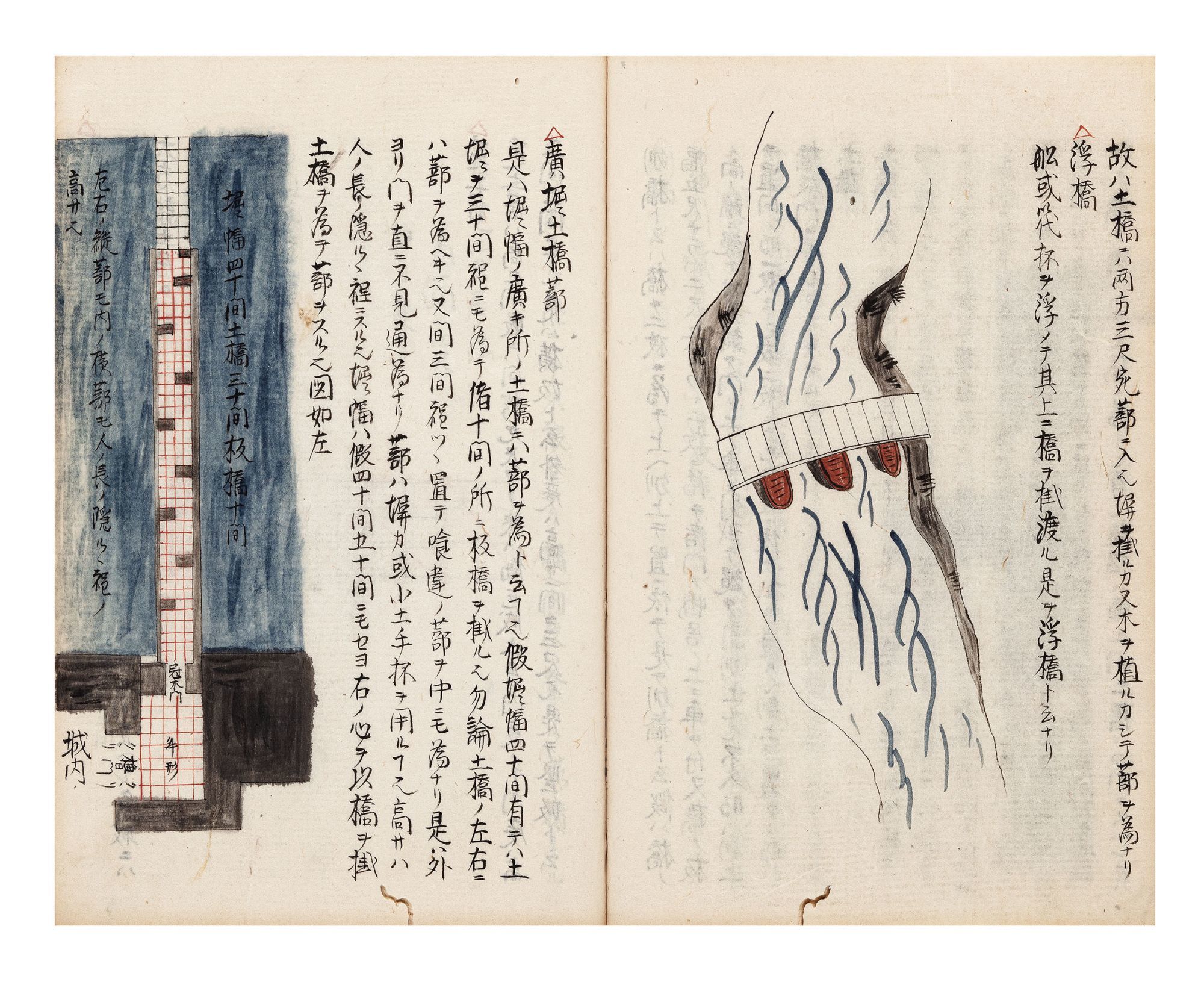
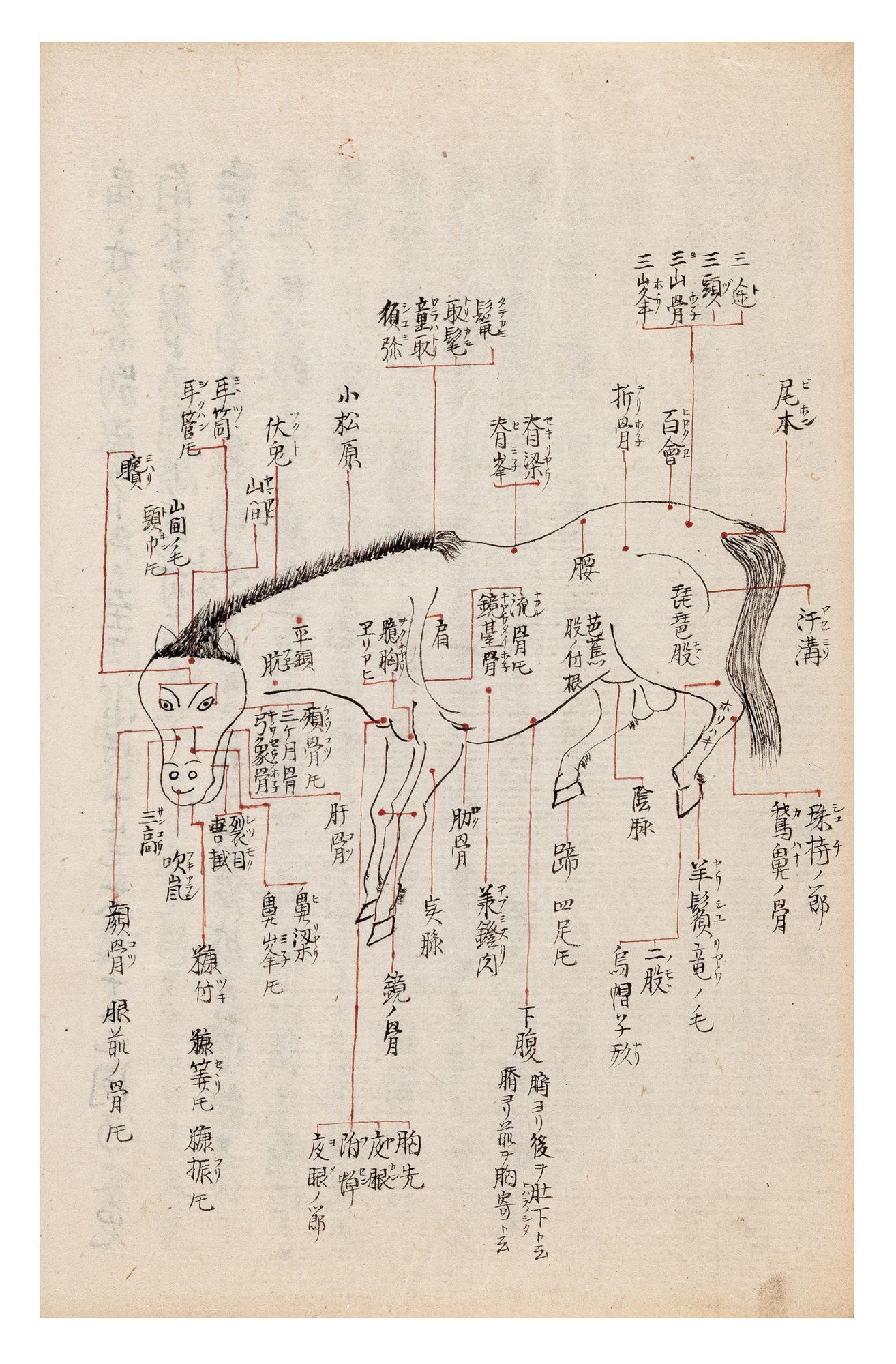
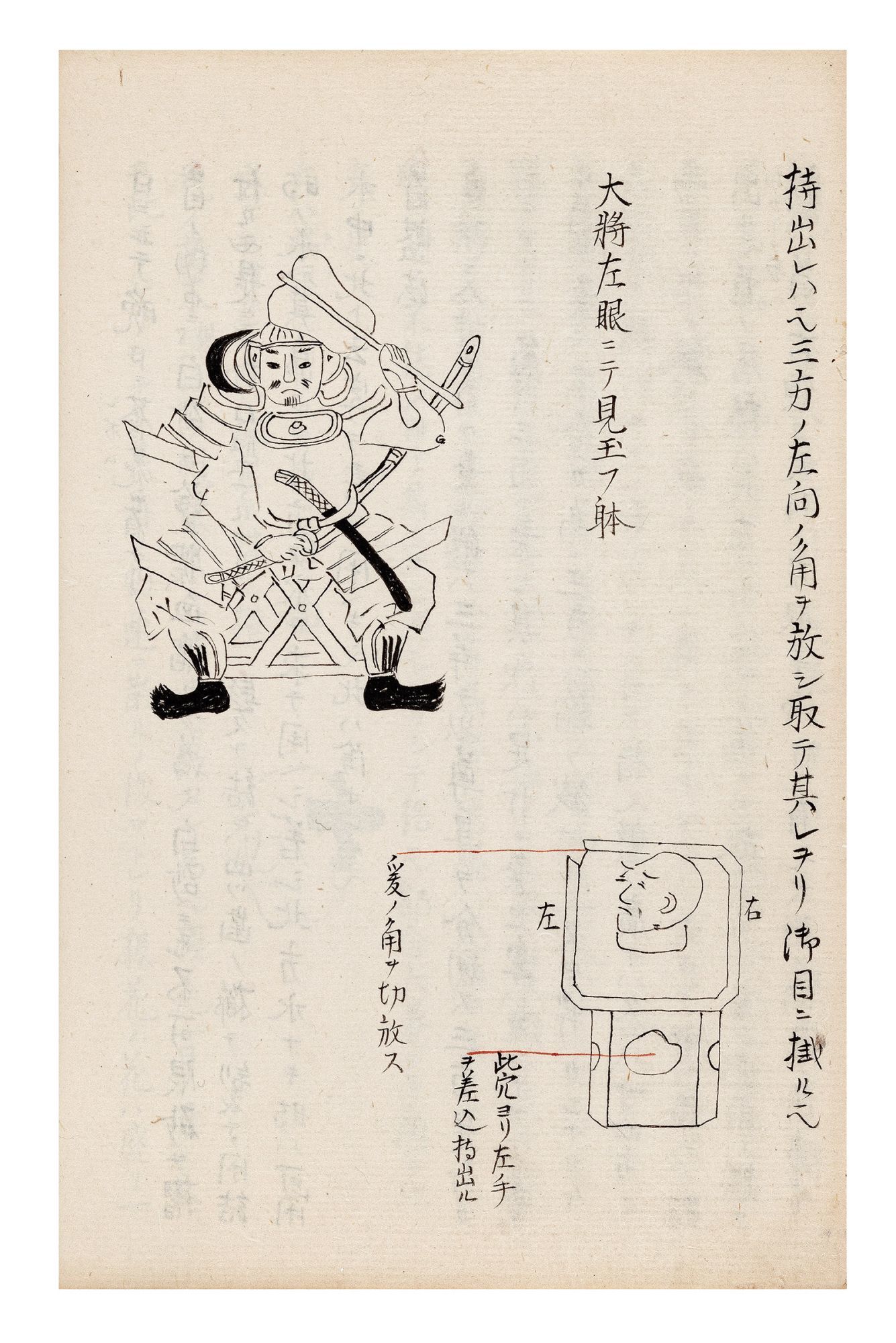
Our manuscript is extremely detailed and discusses “the use of troops,” distinguishing infantry, cavalry, artillery, etc. The section is illustrated, including a variety of helmets, undergarments, body armor, saddles, stirrups, and foot gear. A horse is presented with its different anatomical parts clearly marked, along with illustrations of protective armor for the horse. The text then continues with a discussion of the virtues that generals should possess: humanity, righteousness, ritual, wisdom, trustworthiness, and bravery. Following this are discussions about military campaigns and strategies. There are sections on camps and their hygiene (with a rather fascinating discussion of toilets), the order within sending-off processions, special travelling boxes designed to carry heads of captured enemy generals, the construction of pontoon and permanent bridges, elevated observation posts, fences, traps, styles of moats, etc. (all illustrated).
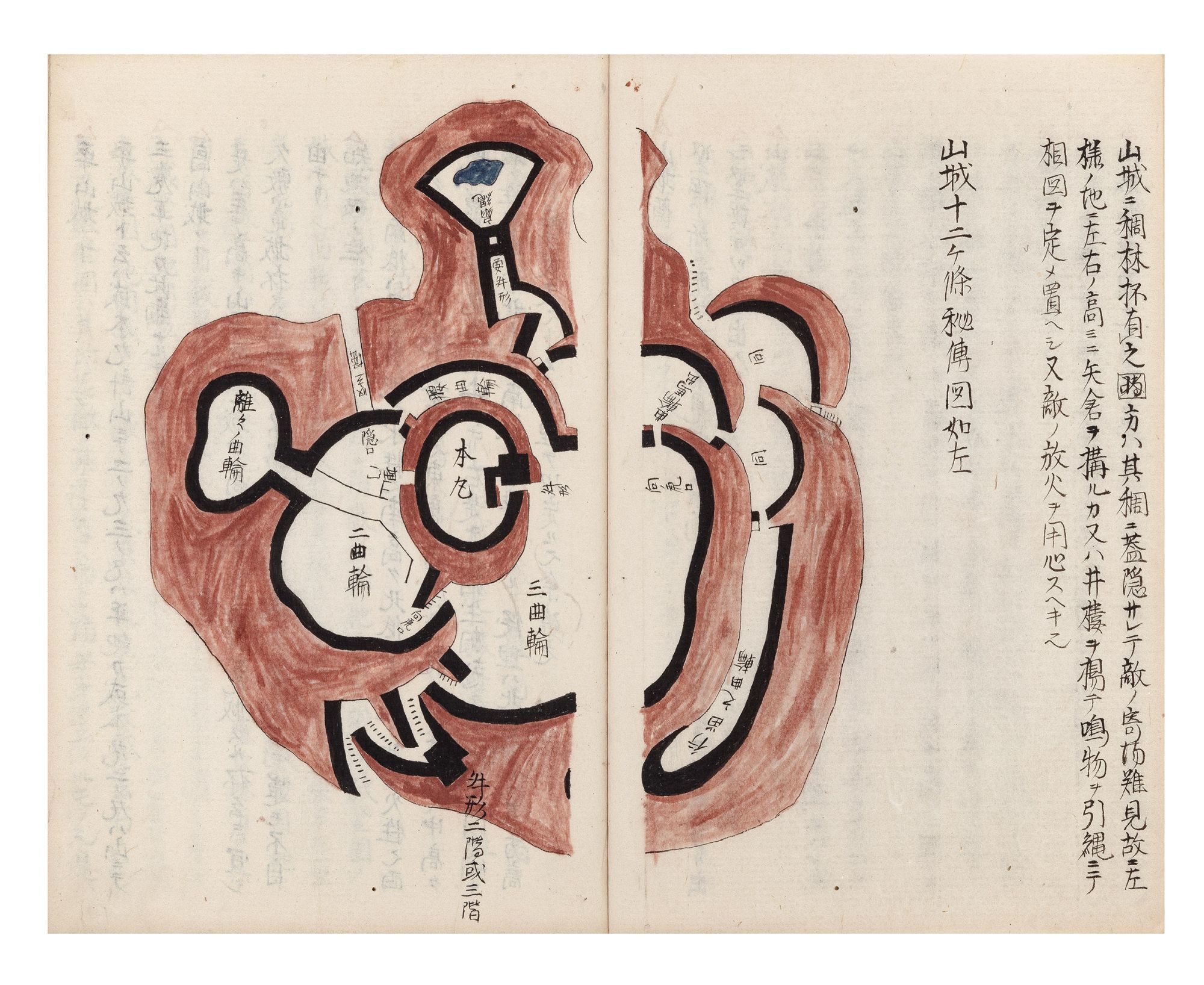
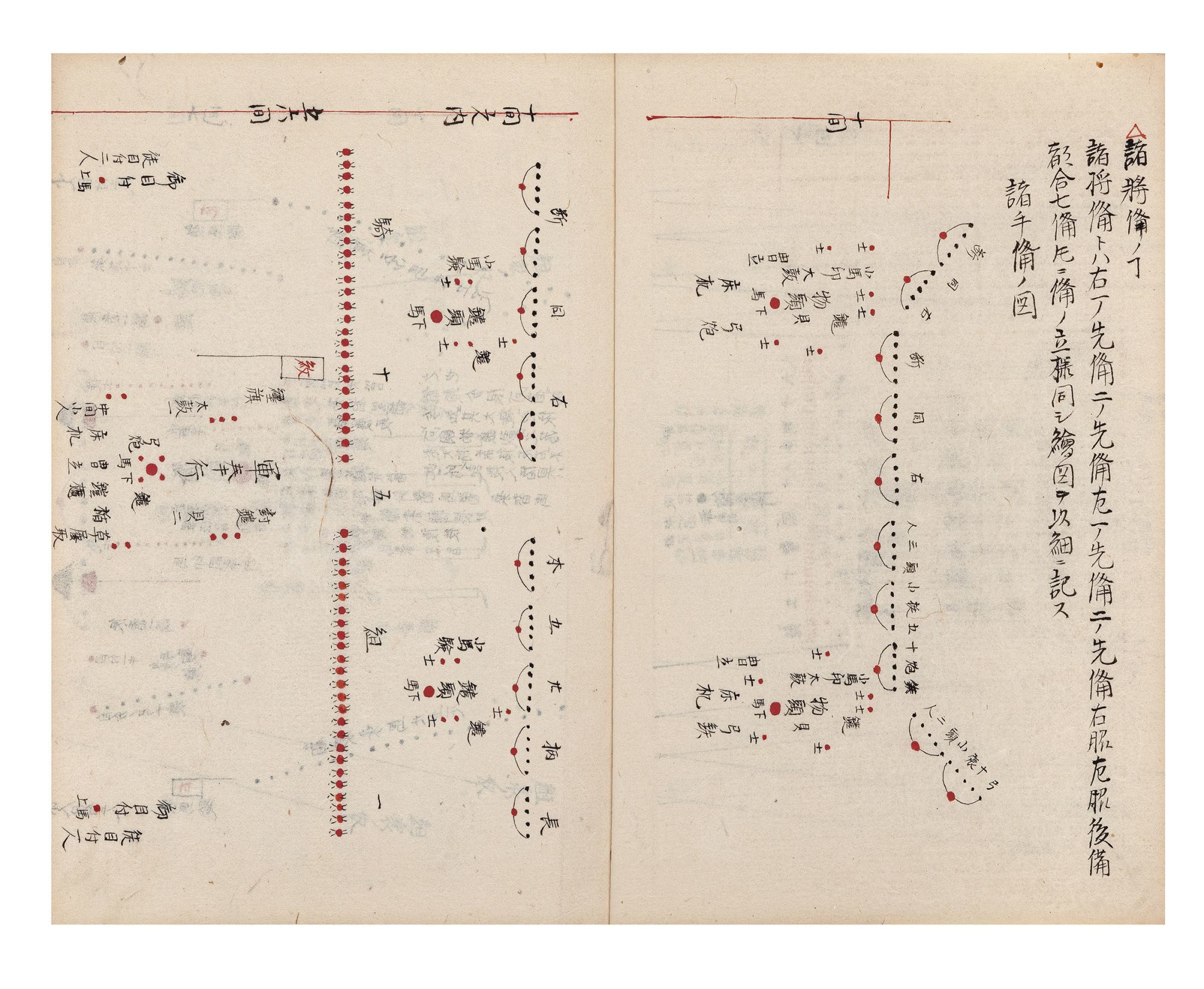
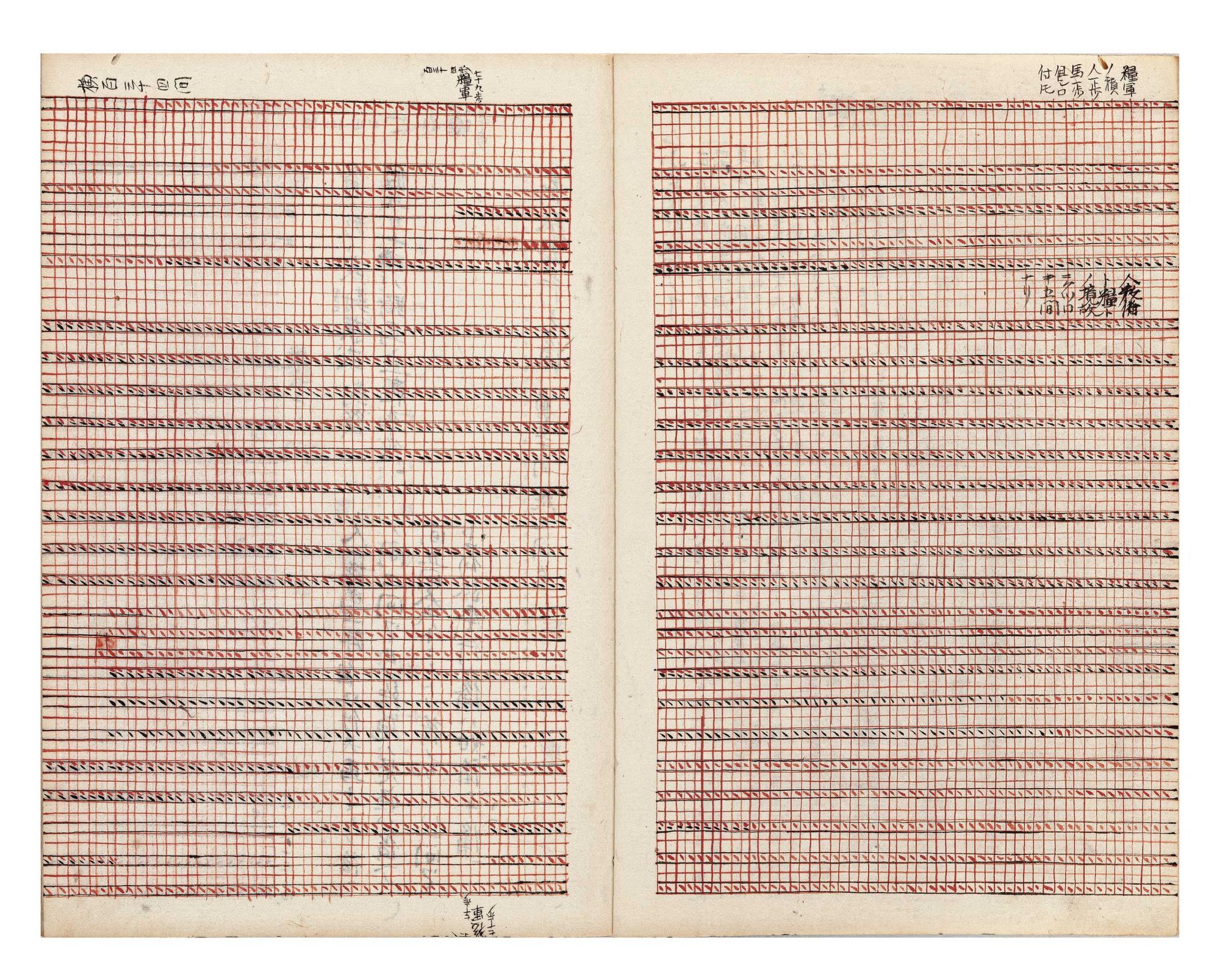
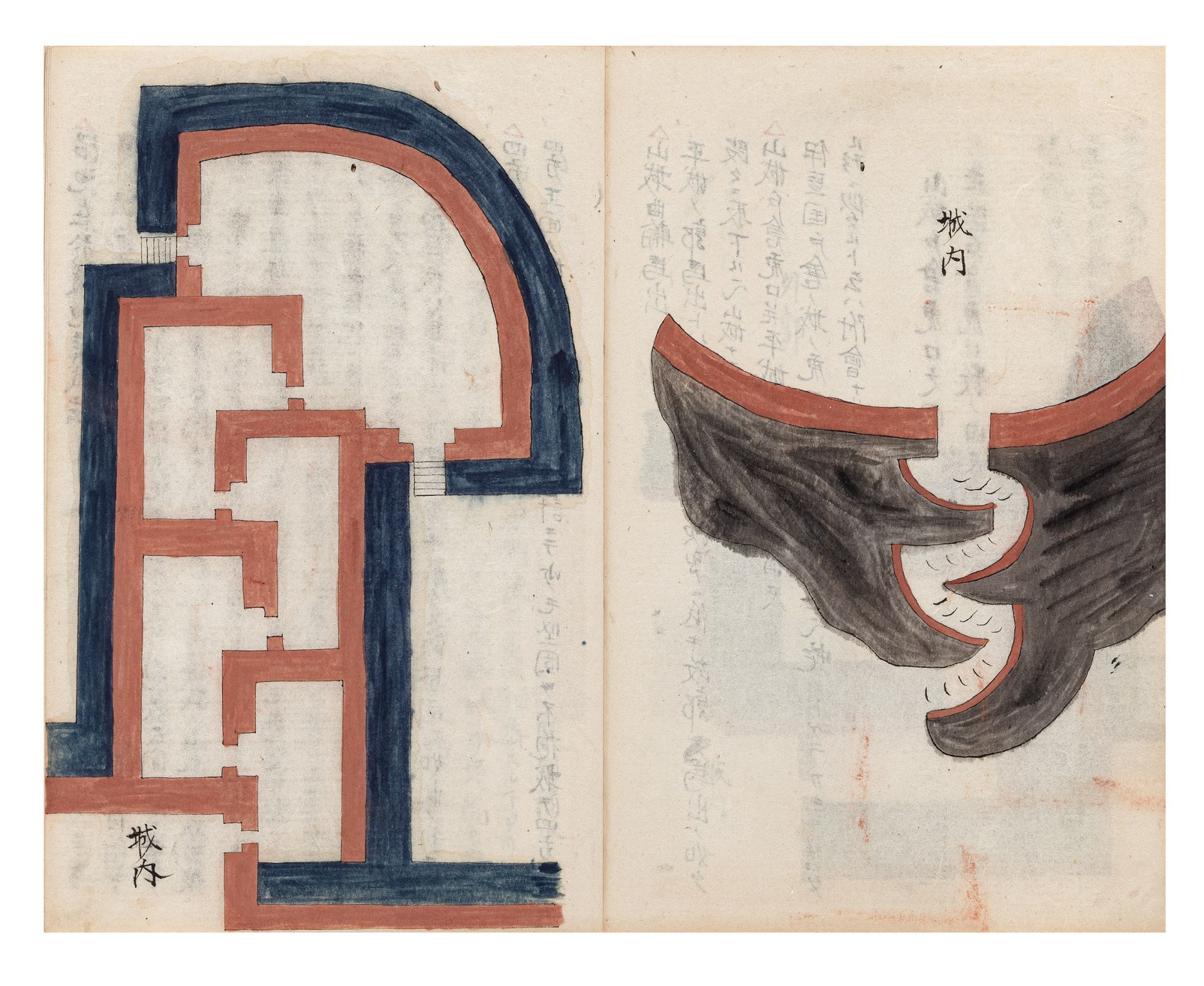
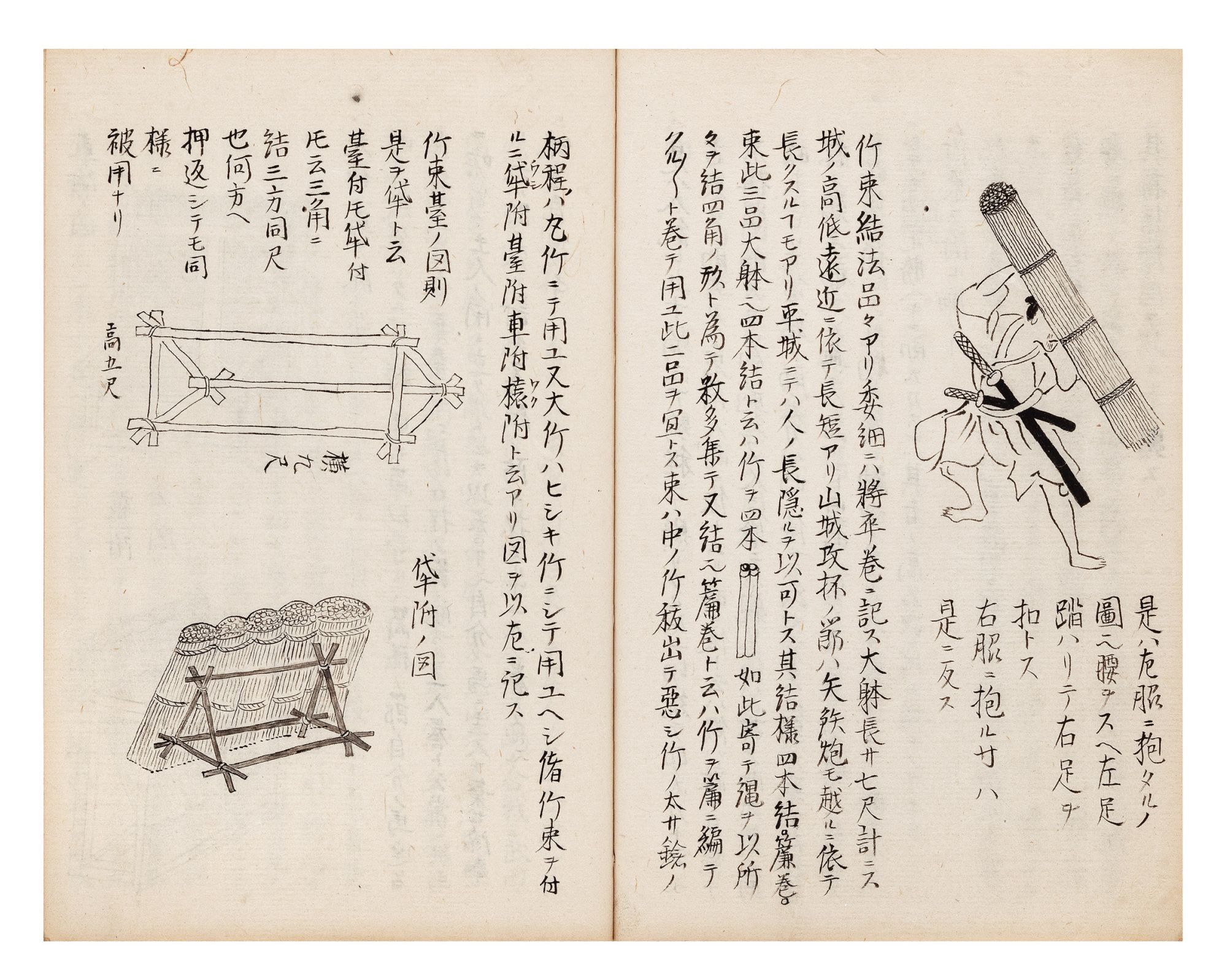
Other topics covered in our manuscript include encampments, portable shields made of densely packed reeds, the construction of fortresses (numerous illustrations with many kinds of complex maze-like fortresses and fortifications, with measurements), auspicious meals to be eaten before battle, formations of troops before and during a battle, signaling by flags, military tools that “assist soldiers” (drums to send signals, bells, bugles, conch shells to be blown, flags, fans, knots, gloves, whips, boots, saddles and stirrups, elaborate backpacks with quivers for arrows), and military discipline. A separate, brief section discusses discipline on military ships. Naval warfare has its own section, with an account of different armored ships, as does nighttime fighting. Devices to help one breathe under water are shown. Astrology (determining inauspicious and auspicious days) is likewise covered in a section.
The manuscript begins with an oath (meisho 盟書), signed in 1710, followed by the undated Preface. The last volume carries a colophon by the copyist, Senbu Dōjin 宣夫道人, dated 1847. The first volume contains a very useful “Grand Index” to all 20 parts of our manuscript.
Fine set. Unimportant, mostly marginal worming.
A very rare and richly illustrated manuscript on military doctrine and practice, compiled during the early or mid-Edo period. Only one or two complete copies appear to be available in Japanese libraries, and none in North America. It has never been published.
A Preface signed by Sawai Munekiyo discusses the duties of civil and military officials: “to serve the peace of one’s country and the good of its people, that is the substance of civil officials. To serve so that it does not become threatened and act so that it does not fall into disorder, that is the substance of military officials.” From the wording, it sounds as if this passage was written in peacetime, when the task of military officials was to maintain the status quo, an important factor during the relatively peaceful Tokugawa period.
Our manuscript is extremely detailed and discusses “the use of troops,” distinguishing infantry, cavalry, artillery, etc. The section is illustrated, including a variety of helmets, undergarments, body armor, saddles, stirrups, and foot gear. A horse is presented with its different anatomical parts clearly marked, along with illustrations of protective armor for the horse. The text then continues with a discussion of the virtues that generals should possess: humanity, righteousness, ritual, wisdom, trustworthiness, and bravery. Following this are discussions about military campaigns and strategies. There are sections on camps and their hygiene (with a rather fascinating discussion of toilets), the order within sending-off processions, special travelling boxes designed to carry heads of captured enemy generals, the construction of pontoon and permanent bridges, elevated observation posts, fences, traps, styles of moats, etc. (all illustrated).
Other topics covered in our manuscript include encampments, portable shields made of densely packed reeds, the construction of fortresses (numerous illustrations with many kinds of complex maze-like fortresses and fortifications, with measurements), auspicious meals to be eaten before battle, formations of troops before and during a battle, signaling by flags, military tools that “assist soldiers” (drums to send signals, bells, bugles, conch shells to be blown, flags, fans, knots, gloves, whips, boots, saddles and stirrups, elaborate backpacks with quivers for arrows), and military discipline. A separate, brief section discusses discipline on military ships. Naval warfare has its own section, with an account of different armored ships, as does nighttime fighting. Devices to help one breathe under water are shown. Astrology (determining inauspicious and auspicious days) is likewise covered in a section.
The manuscript begins with an oath (meisho 盟書), signed in 1710, followed by the undated Preface. The last volume carries a colophon by the copyist, Senbu Dōjin 宣夫道人, dated 1847. The first volume contains a very useful “Grand Index” to all 20 parts of our manuscript.
Fine set. Unimportant, mostly marginal worming.
Details
Title
Manuscript on paper, entitled “Gunkyōroku” 軍鏡錄 [“The Recorded Military Mirror”]
Author
SAWAI, Munekiyo 澤井宗清, author of Preface
Condition
Unknown