

Manuscript on paper, entitled “Saigyō hōshi kashū” 西行法師家集 [“The Personal Collection of the Buddhist Priest Saigyō”] (ascribed title)
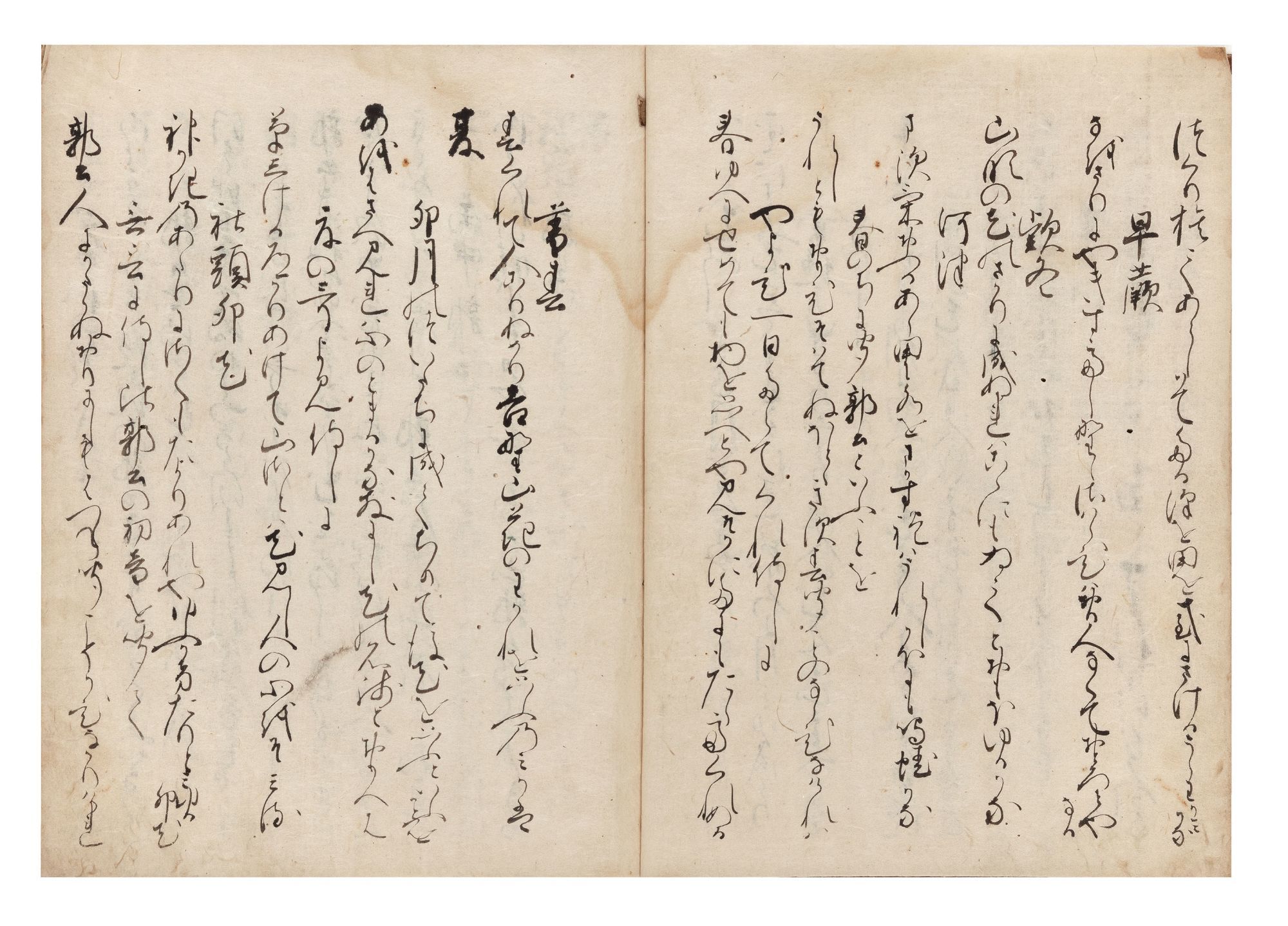
46 folding leaves. Large 8vo, orig. wrappers, new stitching. [Japan]: [early Edo period].
A collection of poetry by “one of the most influential figures of the Japanese court poetry tradition” (Burton Watson, trans., Saigyō: Poems of a Mountain Home [Columbia: 1991], p. 2). These poems were written at a time of social unrest and political change, when the imperial system of rule that had characterized the Heian period was superseded by the rule of warrior shoguns in Kamakura. This atmosphere is said to have influenced Saigyō’s poetry.
We believe that our book is an edition, possibly abridged, of Sankashū 山家集, the “Mountain Home Collection,” also known as Saigyō hōshi kashū, another title seen on many books and manuscripts. “The poems are arranged by topic, beginning with sections devoted to the four seasons, followed by a group of love poems, and ending with a section entitled ‘Miscellaneous’ that has apparently been added to at a later date and represents a catchall for poems that do not fit easily into other categories...The Sankashū appears to contain the bulk of Saigyō’s poems written up to about 1180” (Watson, pp. 13-14).
“Saigyō started out in life under the name Satō Norikiyo, the son of a well-to-do warrior family that was a branch of the eminent Fujiwara clan. He was born in 1118 in Kyoto, the capital of Heian period Japan, where his father held a military post. As a young man he received training in the martial arts and became a retainer to the Tokudaiji family, another branch of the Fujiwara clan” (Watson, p. 2). In 1140, Saigyō quit this life to become a Buddhist monk. He assumed the name Saigyō, “Western Journey,” probably as a reference to the journey to the Western Paradise of Amida Buddha, where believers would be reborn and where they could more easily attain enlightenment than in this world. Saigyō lived as a recluse for much of the time but also travelled extensively around Japan. He died in 1190.
The colophon mentions the year 1348, possibly the date of the manuscript from which our book was copied.
Fine copy, but with thumbing, light dampstaining, and some worming. Preserved in a chitsu.
❧ William R. LaFleur, Awesome Nightfall: The Life, Times, and Poetry of Saigō (Wisdom Publications: 2003)–“Japan’s foremost ‘Buddhist’ poet.”.
A collection of poetry by “one of the most influential figures of the Japanese court poetry tradition” (Burton Watson, trans., Saigyō: Poems of a Mountain Home [Columbia: 1991], p. 2). These poems were written at a time of social unrest and political change, when the imperial system of rule that had characterized the Heian period was superseded by the rule of warrior shoguns in Kamakura. This atmosphere is said to have influenced Saigyō’s poetry.
We believe that our book is an edition, possibly abridged, of Sankashū 山家集, the “Mountain Home Collection,” also known as Saigyō hōshi kashū, another title seen on many books and manuscripts. “The poems are arranged by topic, beginning with sections devoted to the four seasons, followed by a group of love poems, and ending with a section entitled ‘Miscellaneous’ that has apparently been added to at a later date and represents a catchall for poems that do not fit easily into other categories...The Sankashū appears to contain the bulk of Saigyō’s poems written up to about 1180” (Watson, pp. 13-14).
“Saigyō started out in life under the name Satō Norikiyo, the son of a well-to-do warrior family that was a branch of the eminent Fujiwara clan. He was born in 1118 in Kyoto, the capital of Heian period Japan, where his father held a military post. As a young man he received training in the martial arts and became a retainer to the Tokudaiji family, another branch of the Fujiwara clan” (Watson, p. 2). In 1140, Saigyō quit this life to become a Buddhist monk. He assumed the name Saigyō, “Western Journey,” probably as a reference to the journey to the Western Paradise of Amida Buddha, where believers would be reborn and where they could more easily attain enlightenment than in this world. Saigyō lived as a recluse for much of the time but also travelled extensively around Japan. He died in 1190.
The colophon mentions the year 1348, possibly the date of the manuscript from which our book was copied.
Fine copy, but with thumbing, light dampstaining, and some worming. Preserved in a chitsu.
❧ William R. LaFleur, Awesome Nightfall: The Life, Times, and Poetry of Saigō (Wisdom Publications: 2003)–“Japan’s foremost ‘Buddhist’ poet.”.
Details
Title
Manuscript on paper, entitled “Saigyō hōshi kashū” 西行法師家集 [“The Personal Collection of the Buddhist Priest Saigyō”] (ascribed title)
Author
SAIGYŌ 西行
Condition
Unknown