

Da Tang Xi yu ji 大唐西域記 (J.: Daitō saiiki ki) [The Great Tang Record of the Western Regions]
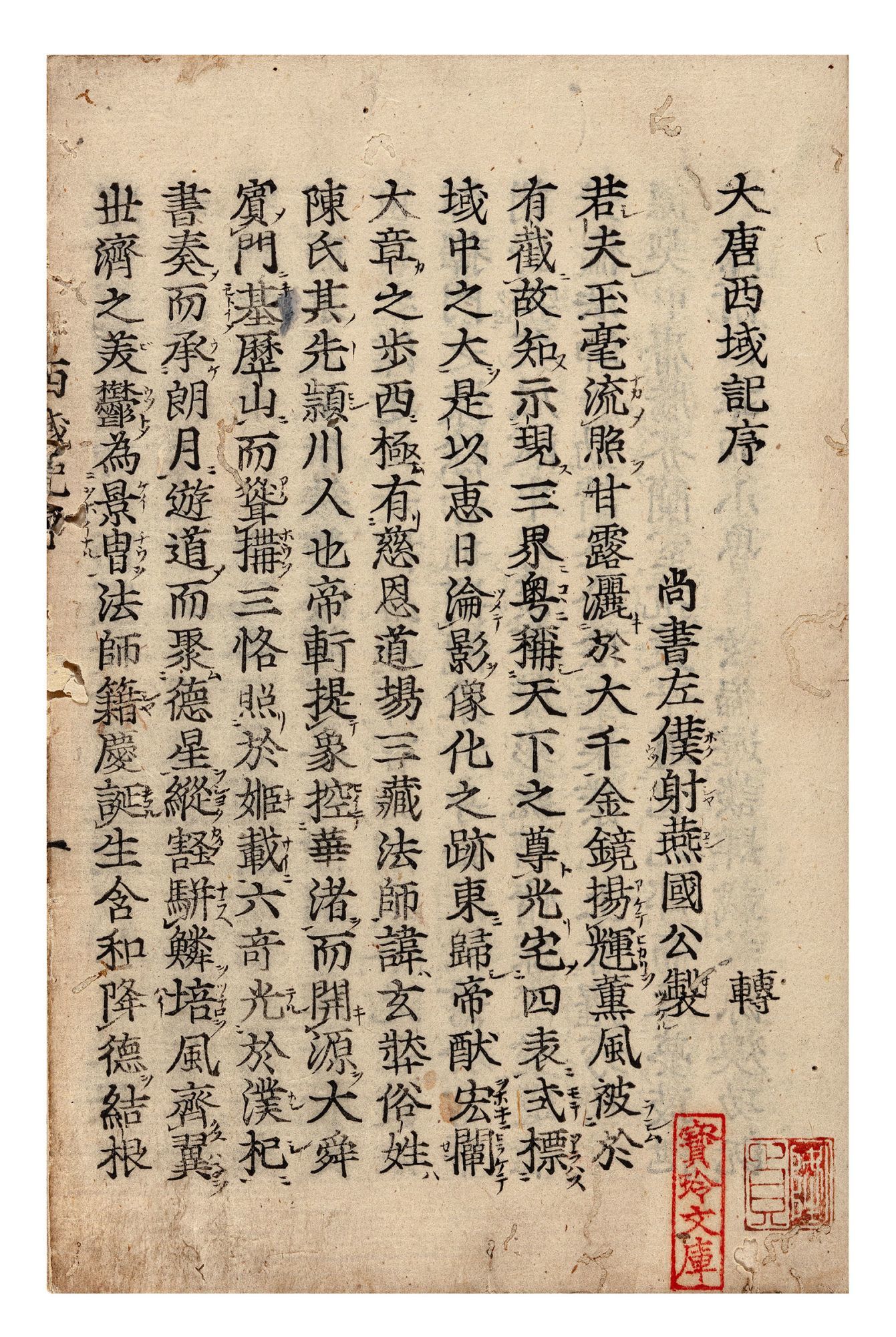
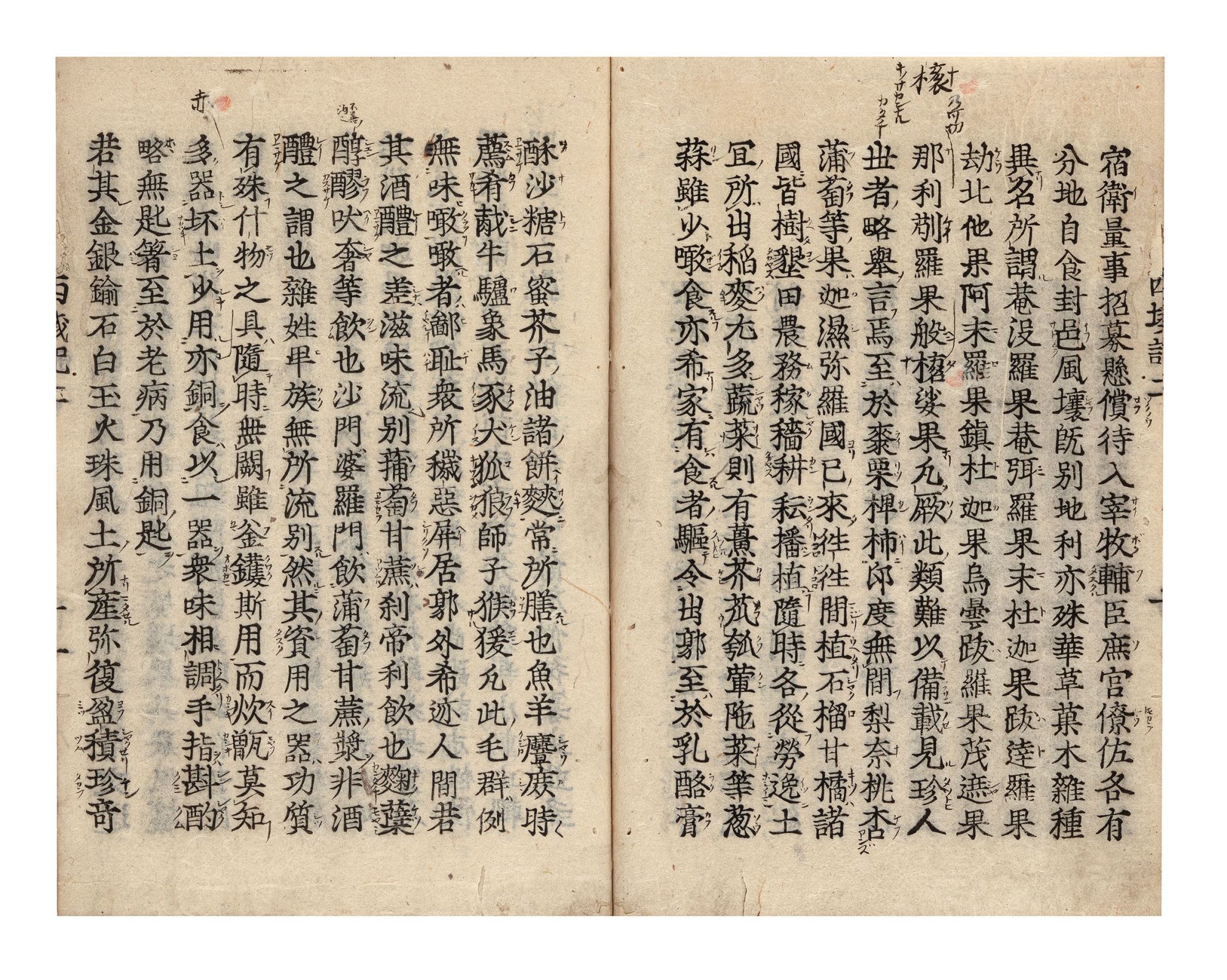
Movable type printing. Ten columns per page, 20 characters per column. 52; 42; 42; 49; 50; 57 folding leaves. 12 parts in six vols. 8vo (284 x 190 mm.), orig. semi-stiff wrappers (rubbed), new stitching. [Japan]: [early 17th century].
An extremely rare early Japanese movable type edition of one of the most important sources on Sino-Indian cross-cultural exchange in the first millennium CE. Xuanzang (596-664), its author, “set off on his unauthorized journey to India at age 24 in 627 and returned 18 years later in 645. In all he is reckoned to have covered 25,146 km and brought back more than 650 Buddhist texts” (Endymion Wilkinson, Chinese History: A New Manual, enlarged 6th ed., Vol. 2, p. 1396). His deeds, travelogue, and Buddhist translations made him one of the most famous figures in Buddhism in China and neighboring countries. Our book is a very fine example of early Japanese movable type printing that was formerly in one of the most important Japanese book collections of the 20th century, formed by Frank Hawley.
“Why was Xuanzang such a hallowed figure in East Asian Buddhism? He spent almost seventeen years, from 629 to 645, on a pilgrimage to India to visit Buddhism’s sacred sites, to learn its truths from Indian masters, and to seek its authentic texts. He endured the hardship of twice crossing the deserts and mountains of Central Asia, bringing back from India a total of six hundred and fifty-seven Buddhist texts, as well as sacred images and the Buddha’s relics. Upon returning to Chang’an, the Tang capital, he dedicated the rest of his life to translating the scriptures he had collected. His translation of the monumental Yogacara texts became the doctrinal foundation of the Faxiang 法相 sect, which was later to be a major school of Nara Buddhism in Japan” (Dorothy C. Wong, “The Making of a Saint: Images of Xuanzang in East Asia,” Early Medieval China 8 [2002], p. 44).
“The most noteworthy aspects of [Xuanzang’s] account are the general discussions of India presented in fascicle two...and the details of the Chinese monk’s interaction with the Indian ruler Harṣvardhana that appear in fascicle five...the Chinese monk explains the geography and climate, the measurement system, and the concept of time in India. Xuanzang then provides a glimpse of urban life and architecture and narrates in detail the existing caste system, the educational requirements for the Brahmins, the teaching of Buddhist doctrines, legal and economic practices, social and cultural norms, and the eating habits of the natives, and lists the natural and manufactured products of India. After this overview of India, Xuanzang proceeds to give a detailed account of the kingdoms and towns he visited in India, including, in fascicle five, the city of Kanauj, the capital of King Harṣavardhana’s empire.” Xuanzang’s meeting with Harṣavardhana “resulted in the establishment of diplomatic relations between Kanauj and the Tang court. The contribution of the Chinese pilgrim to the initiation of official exchanges is fully acknowledged by the official scribes of the Tang dynasty” (Tansen Sen, “The Travel Records of Chinese Pilgrims Faxian, Xuanzang, and Yijing: Sources for Cross-Cultural Encounters Between Ancient China and Ancient India,” Education about Asia 11.3 [2006], pp. 29-30).
Xuanzang furthermore recorded other dialogues with Indian individuals. “Such dialogues between Xuanzang and Indians make the account of his travels unique and significant for the study of cross-cultural perspectives. It not only offers the views on India and the Indian society of the Chinese pilgrim, it also provides rare glimpses into the Indian perception and knowledge of China, seldom available in contemporary Indian sources. Xuanzang’s account is also exceptional because of his meticulous records of Buddhist sites such as Bamiyan and Nalanda. These notices have already aided the work of modern archeologists and historians of medieval South Asia” (Sen, 30).
Our book is an early Japanese example of kokatsujiban 古活字版, which denotes movable type books from before the mid-17th century. The beginning of movable type printing in this period can be traced to Hideyoshi’s invasion of Korea, where movable type was widely used. Books printed with the technology, as well as the type itself, were brought back to Japan and used there. Buddhist temples participated in this otherwise secularly oriented activity: “a number of temples, some of which already had a history of blockprinting, experimented with movable type to print mostly Buddhist works in the late sixteenth and early seventeenth centuries” (Peter Kornicki, The Book in Japan: A Cultural History from the Beginnings to the Nineteenth Century [Hawaii: 2001], p. 131). Our book likely was published in one of these temples in this period.
Our book was previously in the collection of Frank Hawley (1906-61), carrying his seal hōrei bunko 寶玲文庫. Hawley was an important book collector and an “outstanding scholar who greatly contributed to Japanese studies.” He “possessed an uncanny knowledge of books and books about books.” Toward the end of his life, Hawley’s finances declined, and he was compelled to sell off most of his collection (R.H. van Gulik, “In Memoriam. Frank Hawley (1906-1961),” Monumenta Nipponica 16.3-4 [1960/61]: pp. 214-16).
Very good copy, with some worming, preserved in a new chitsu.
❧ Not in Kawase, Sorimachi, NIJL, or WorldCat.
An extremely rare early Japanese movable type edition of one of the most important sources on Sino-Indian cross-cultural exchange in the first millennium CE. Xuanzang (596-664), its author, “set off on his unauthorized journey to India at age 24 in 627 and returned 18 years later in 645. In all he is reckoned to have covered 25,146 km and brought back more than 650 Buddhist texts” (Endymion Wilkinson, Chinese History: A New Manual, enlarged 6th ed., Vol. 2, p. 1396). His deeds, travelogue, and Buddhist translations made him one of the most famous figures in Buddhism in China and neighboring countries. Our book is a very fine example of early Japanese movable type printing that was formerly in one of the most important Japanese book collections of the 20th century, formed by Frank Hawley.
“Why was Xuanzang such a hallowed figure in East Asian Buddhism? He spent almost seventeen years, from 629 to 645, on a pilgrimage to India to visit Buddhism’s sacred sites, to learn its truths from Indian masters, and to seek its authentic texts. He endured the hardship of twice crossing the deserts and mountains of Central Asia, bringing back from India a total of six hundred and fifty-seven Buddhist texts, as well as sacred images and the Buddha’s relics. Upon returning to Chang’an, the Tang capital, he dedicated the rest of his life to translating the scriptures he had collected. His translation of the monumental Yogacara texts became the doctrinal foundation of the Faxiang 法相 sect, which was later to be a major school of Nara Buddhism in Japan” (Dorothy C. Wong, “The Making of a Saint: Images of Xuanzang in East Asia,” Early Medieval China 8 [2002], p. 44).
“The most noteworthy aspects of [Xuanzang’s] account are the general discussions of India presented in fascicle two...and the details of the Chinese monk’s interaction with the Indian ruler Harṣvardhana that appear in fascicle five...the Chinese monk explains the geography and climate, the measurement system, and the concept of time in India. Xuanzang then provides a glimpse of urban life and architecture and narrates in detail the existing caste system, the educational requirements for the Brahmins, the teaching of Buddhist doctrines, legal and economic practices, social and cultural norms, and the eating habits of the natives, and lists the natural and manufactured products of India. After this overview of India, Xuanzang proceeds to give a detailed account of the kingdoms and towns he visited in India, including, in fascicle five, the city of Kanauj, the capital of King Harṣavardhana’s empire.” Xuanzang’s meeting with Harṣavardhana “resulted in the establishment of diplomatic relations between Kanauj and the Tang court. The contribution of the Chinese pilgrim to the initiation of official exchanges is fully acknowledged by the official scribes of the Tang dynasty” (Tansen Sen, “The Travel Records of Chinese Pilgrims Faxian, Xuanzang, and Yijing: Sources for Cross-Cultural Encounters Between Ancient China and Ancient India,” Education about Asia 11.3 [2006], pp. 29-30).
Xuanzang furthermore recorded other dialogues with Indian individuals. “Such dialogues between Xuanzang and Indians make the account of his travels unique and significant for the study of cross-cultural perspectives. It not only offers the views on India and the Indian society of the Chinese pilgrim, it also provides rare glimpses into the Indian perception and knowledge of China, seldom available in contemporary Indian sources. Xuanzang’s account is also exceptional because of his meticulous records of Buddhist sites such as Bamiyan and Nalanda. These notices have already aided the work of modern archeologists and historians of medieval South Asia” (Sen, 30).
Our book is an early Japanese example of kokatsujiban 古活字版, which denotes movable type books from before the mid-17th century. The beginning of movable type printing in this period can be traced to Hideyoshi’s invasion of Korea, where movable type was widely used. Books printed with the technology, as well as the type itself, were brought back to Japan and used there. Buddhist temples participated in this otherwise secularly oriented activity: “a number of temples, some of which already had a history of blockprinting, experimented with movable type to print mostly Buddhist works in the late sixteenth and early seventeenth centuries” (Peter Kornicki, The Book in Japan: A Cultural History from the Beginnings to the Nineteenth Century [Hawaii: 2001], p. 131). Our book likely was published in one of these temples in this period.
Our book was previously in the collection of Frank Hawley (1906-61), carrying his seal hōrei bunko 寶玲文庫. Hawley was an important book collector and an “outstanding scholar who greatly contributed to Japanese studies.” He “possessed an uncanny knowledge of books and books about books.” Toward the end of his life, Hawley’s finances declined, and he was compelled to sell off most of his collection (R.H. van Gulik, “In Memoriam. Frank Hawley (1906-1961),” Monumenta Nipponica 16.3-4 [1960/61]: pp. 214-16).
Very good copy, with some worming, preserved in a new chitsu.
❧ Not in Kawase, Sorimachi, NIJL, or WorldCat.
Details
Title
Da Tang Xi yu ji 大唐西域記 (J.: Daitō saiiki ki) [The Great Tang Record of the Western Regions]
Author
XUANZANG 玄奘
Condition
Unknown