

[Autograph letter, signed, by a young mother on domestic life in the aftermath of the California Gold Rush.]
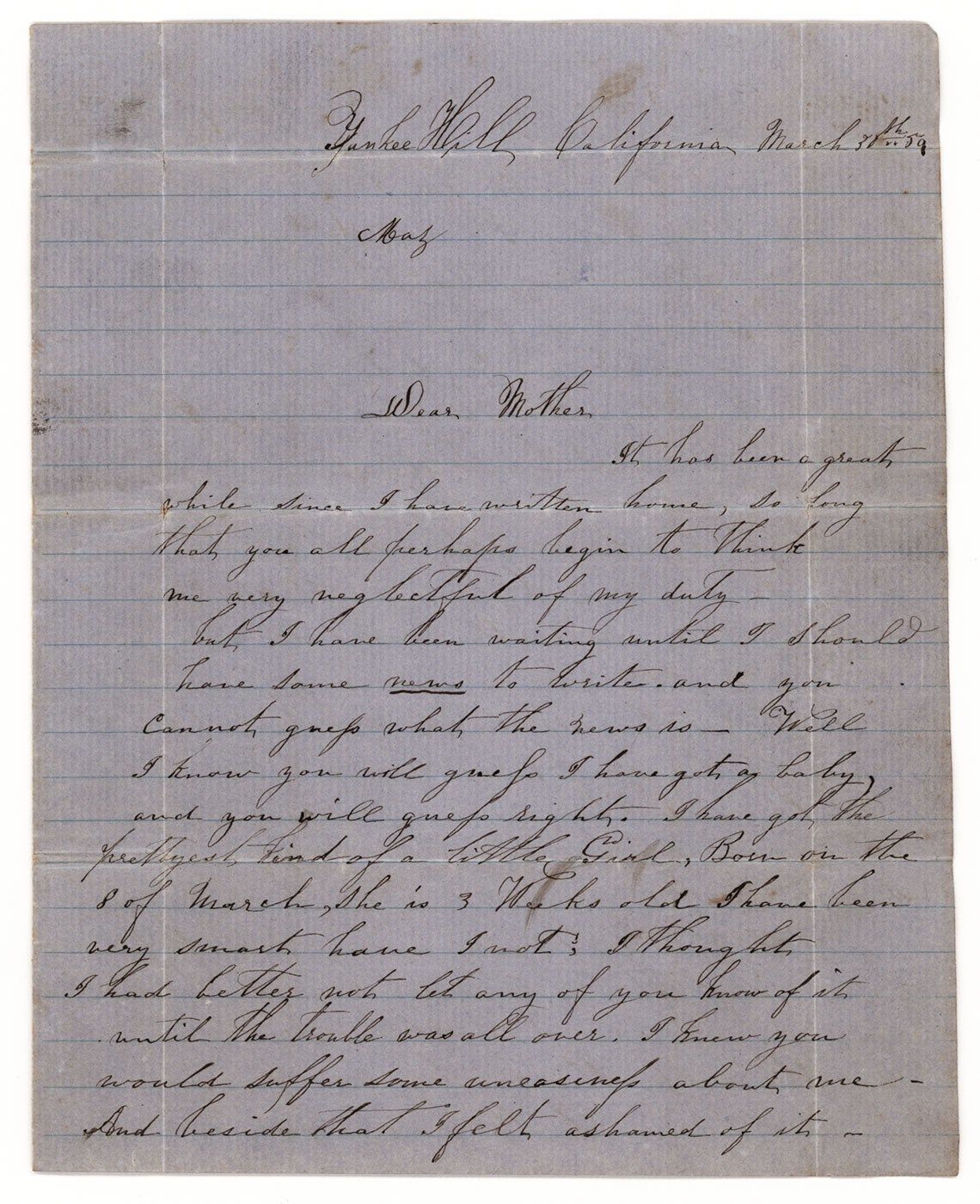
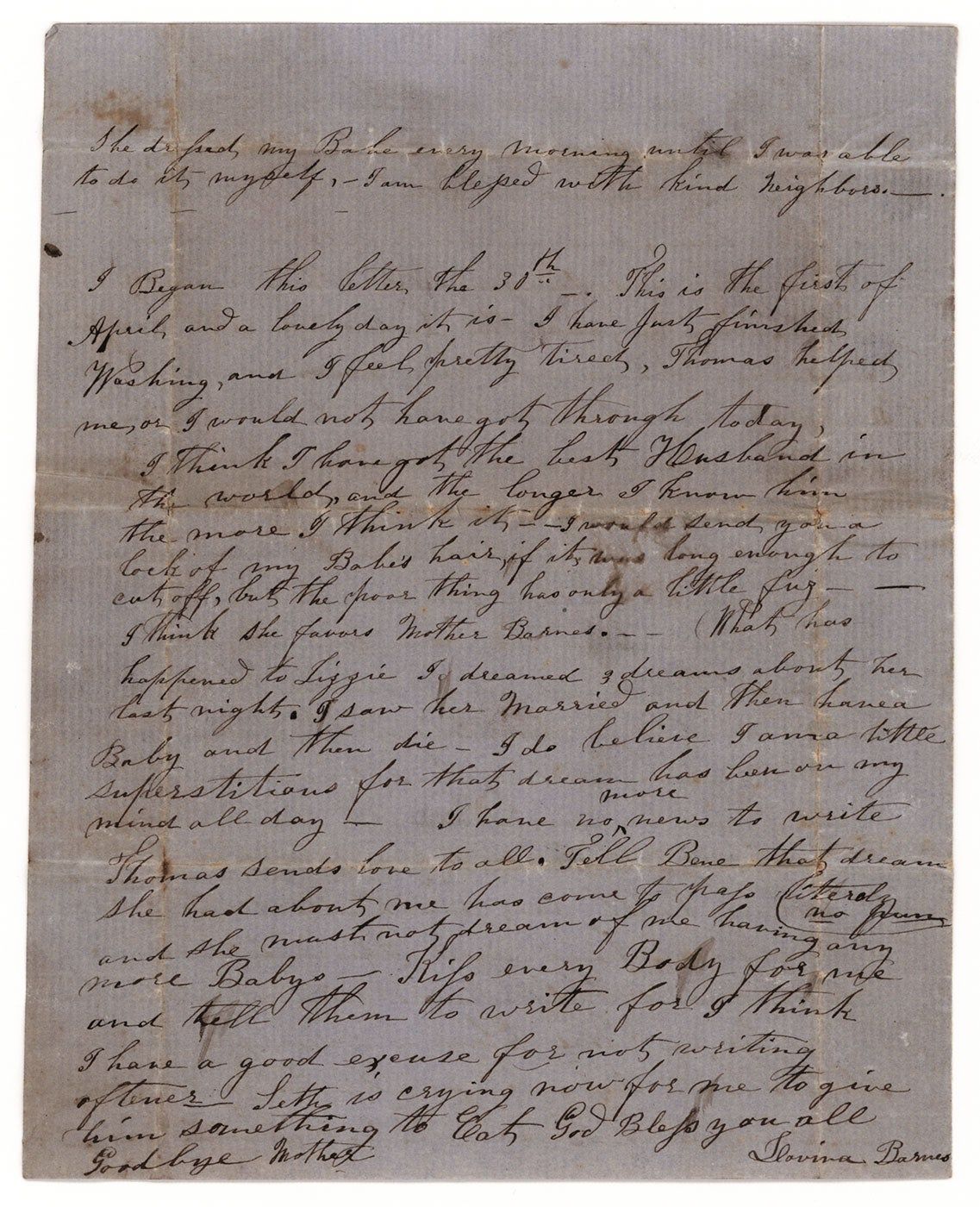
- Yankee Hill, California, 30 March–1 April 1859
An evocative letter documenting domestic and dream life in a small California gold-mining town by a woman who ventured from Kentucky to California with her miner husband.
Born in Livingston, Kentucky, Lovina Terry Padon Barnes (1833–1916) married Thomas Bartholomew Barnes Jr. (1830–1905) in 1853, and sometime before 1859 they moved to Yankee Hill, Butte County, California. Lovina died in Solano, California in 1916.
This letter is addressed to Barnes’s mother Mary Terry (1801–1861) back home in Kentucky. Apologizing for her long silence, Barnes writes that she has been waiting to send a letter until she has some news—“And you cannot guess what the news is”:
Well I know you will guess I have got a baby, and you will guess right. I have got the prettiest kind of a little girl, born on the 8 of March, she is 3 weeks old. I have been very smart have I not; I thought I had better not let any of you know of it until the trouble was all over. I knew you would suffer some uneasiness about me—and beside that I felt ashamed of it. My health was not good for some time previous to the birth of my babe. But I had the easiest time with her I have ever had. Mrs. Glover & Mrs. Stearns officiated, I have more faith in them, than I have in the Doctors.
Barnes informs her mother that she and her new baby Lizzie—named after two of her aunts—are both in good health (she has not needed “a single dose of medicine”), and that Lizzie “is as fat as a possum.” Although her first child, Seth, did not know what to make of Lizzie at first, he is now very fond of his new sister and “kisses her so much.” Barnes writes that her husband Thomas has built a cradle for the baby, but notes that she is “nearly set…crazy” when both children cry at the same time. She offers an evocative portrait her family’s life in Yankee Hill:
Both children are asleep. Thomas is at work on his claim. It is snowing very hard. It has snowed every day this week. There has been more snow here this winter than usual. The Fruit trees are in full bloom. It is the general impression that the weather will kill all the fruit. Mr. Glover has covered a great many of his trees with cloth, but I think it almost useless to try to save them. Times are pretty dull here now. The weather is so disagreeable there is very little work going on, and the ladies are all confined in doors. I have not been from home since New Year’s Day, I begin to want to go visiting, how nice it would be if I could take my children and go spend the day with you next week, but I must wait I fear a great many weeks before I can do that…Mr. Smith and lady left Yankee Hill quite recently for the States as they then thought, but I have heard they had concluded to remain in California a while longer, and had bought a ranch near Stockton [San Joaquin County, California]…Mrs Glover is a dear good woman. She has been a sister to me—she has no children and she seems to think a great deal of mine. She dressed my babe every morning until I was able to do it myself. I am blessed with kind neighbors.
Concluding the letter on April 1st, Barnes writes that she has just finished the washing, with help from Thomas, who is “the best husband in the world, and the longer I know him the more I think it.” After noting that she would send a lock of Lizzie’s hair if she had anything more than fuzz, Barnes recounts: “I dreamed 3 dreams about [Lizzie] last night. I saw her married and then have a Baby and then die—I do believe I am a little superstitious for that dream has been on my mind all day.” Not only that, Barnes asks her mother tell a mutual acquaintance “that dream she had about me has come to pass…and she must not dream of me having any more Babys.”
Yankee Hill (formerly known as Rich Gulch and Spanishtown) was settled in 1850, around the time that lode mining began in the area. When Chilean and Spanish miners arrived later that decade, the area was renamed Spanishtown. With the subsequent arrival of New Englanders it became Yankee Hill. It is estimated that the district produced more than 100,000 ounces of gold. At its peak, the town had a hotel, a saloon and winery, and a general store. Its post office operated from 1858 to 1951.
An unusual letter on life as a young mother in a California gold mining town.
REFERENCES: Durham, David L. California’s Geographic Names: A Gazetteer of Historic and Modern Names of the State (Clovis, California: Word Dancer Press, 1998), p. 338; “Lovina B Terry Padon” at Family Search online; “Yankee Hill District” at Western Mining History online.
Details
Title
[Autograph letter, signed, by a young mother on domestic life in the aftermath of the California Gold Rush.]
Author
Barnes, Lovina
Condition
Unknown
Publisher
Yankee Hill, California, 30 March–1 April 1859