

Hesione Tragedie Mise En Musique ... Representée par l'Academie Royalle de Musique Le Vingt-uniéme jour de Decembre 1700. [Short score]
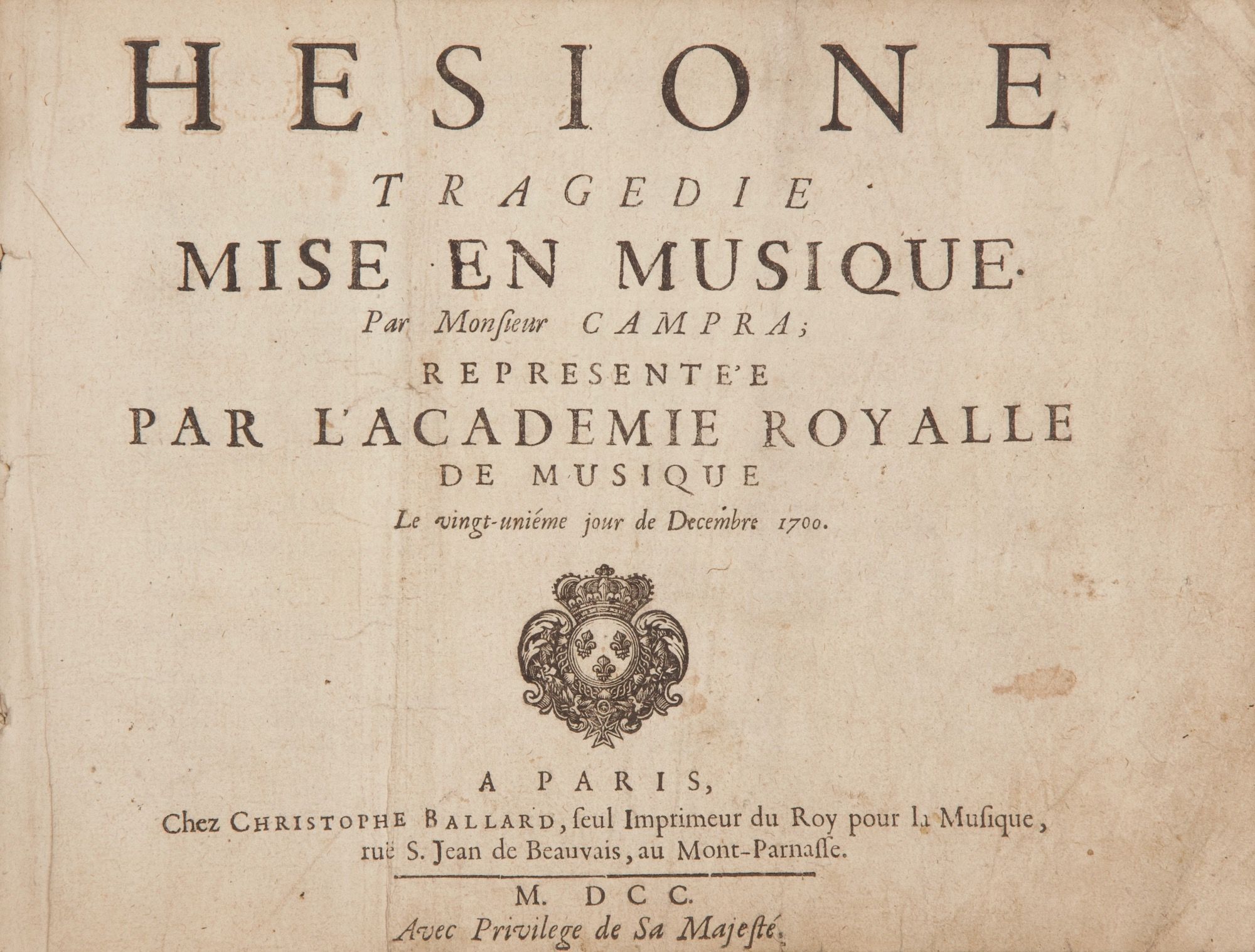
- Paris: Chez Christophe Ballard, seul Imprimeur du Roy pour la Musique, ruë S. Jean de Beauvais, au Mont-Parnasse ... Avec Privilege de, 1700
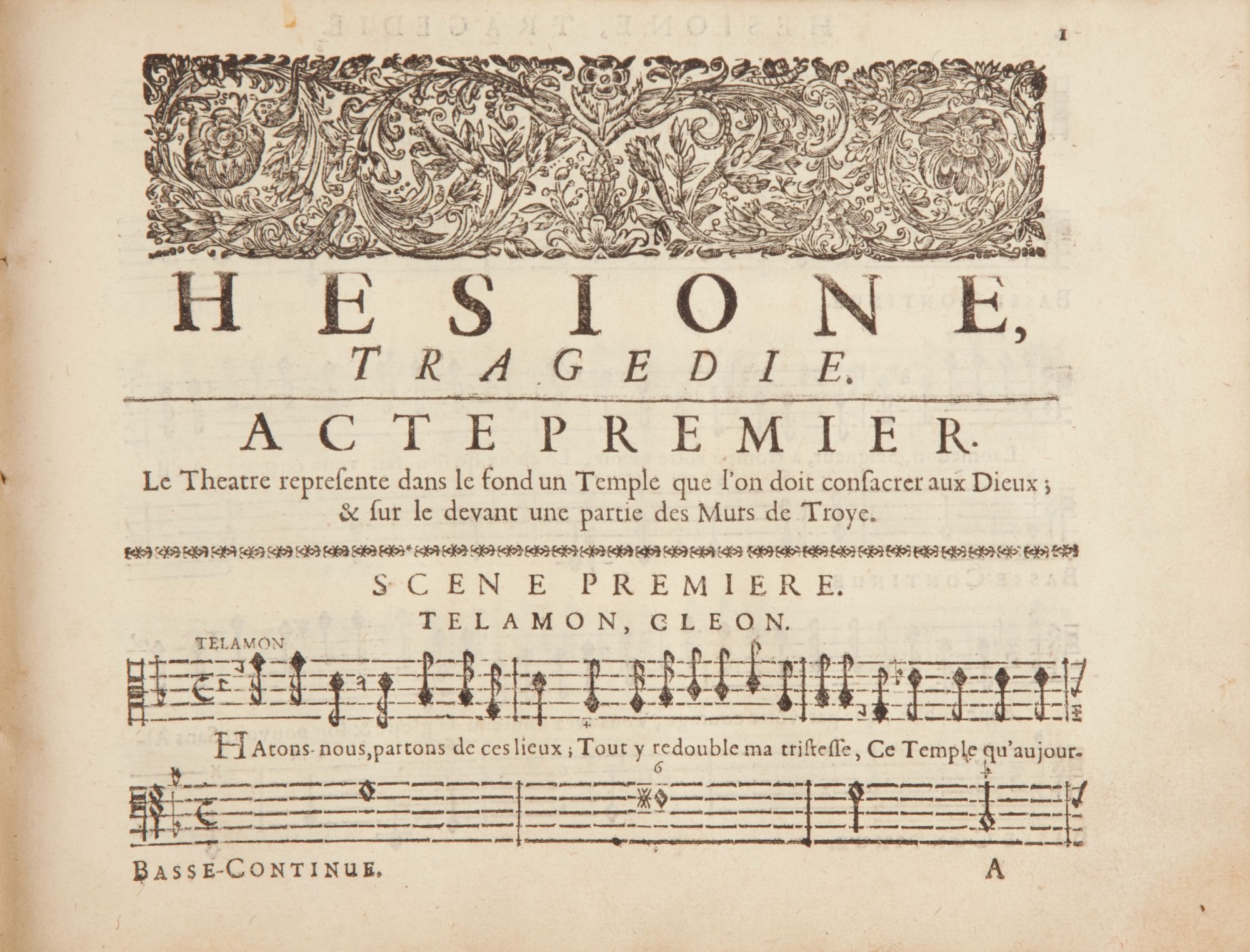
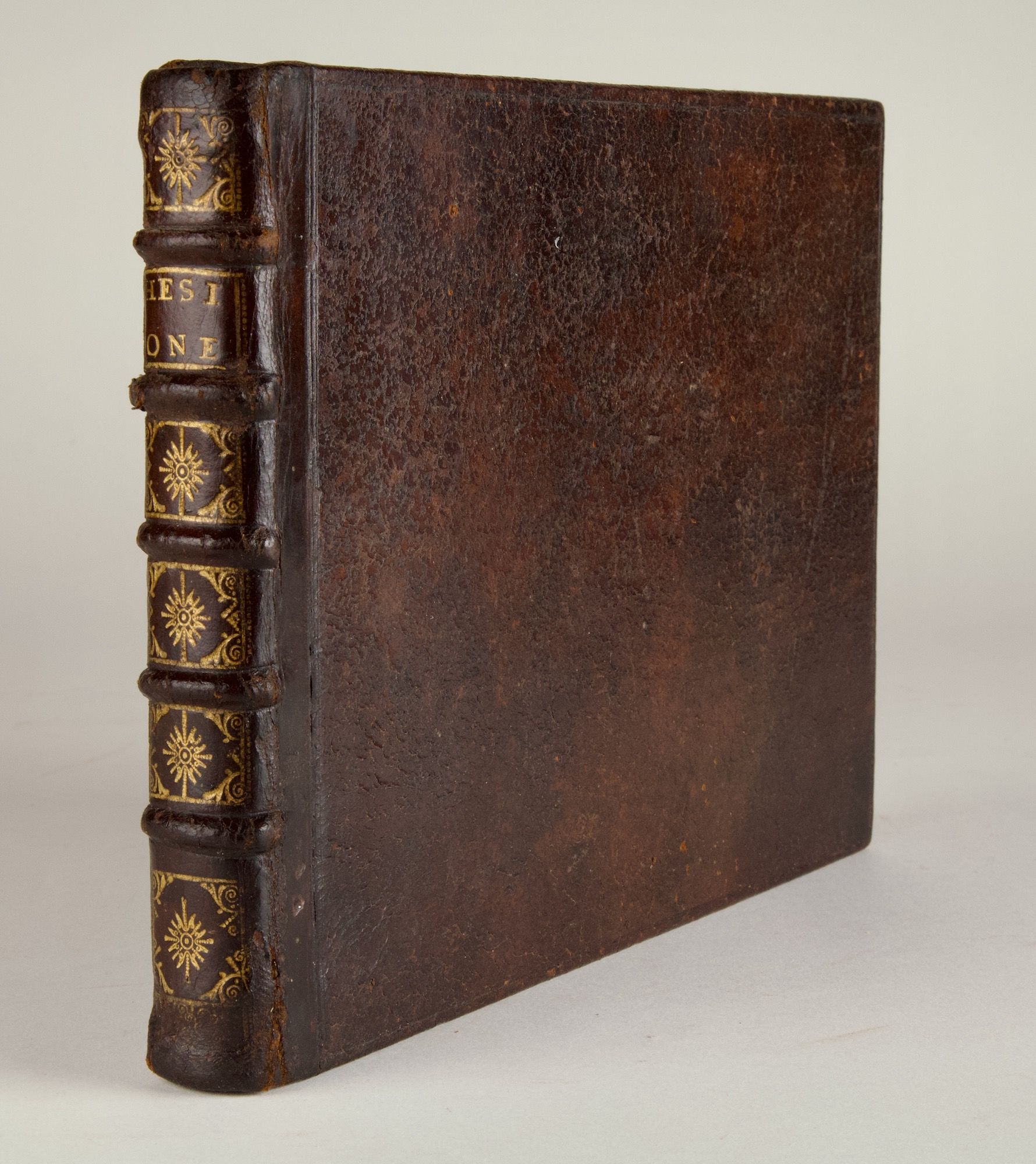
Paris: Chez Christophe Ballard, seul Imprimeur du Roy pour la Musique, ruë S. Jean de Beauvais, au Mont-Parnasse ... Avec Privilege de Sa Majesté, 1700. Large oblong octavo. Contemporary full dark brown calf with raised bands on spine in decorative compartments gilt, title label gilt to spine. 1f. (recto title, verso blank), 1f. (recto "Airs a chanter," verso "Memoire des Oeuvres de Monsieur Campra"), [iii] ("Tables"), [i] ("Symphonies"), lviii, 259, [i] (privilege) pp.
With royal woodcut device to title, decorative woodcut headpieces to head of each act, and occasional large historiated woodcut initials.
Binding worn and with small cracks, spine restored. Slightly worn, soiled, and stained, primarily at margins; small stab holes throughout; some dampstaining; title worn and soiled, a bit more heavily at margins and edges, with minor tears to blank inner margin around stab holes; small hole to "Airs a chanter," not affecting text; worming to lower inner margins of first ca. 45 pages; blank lower outer corner of final leaf with early paper restoration; occasional minor defects. First Edition. Lesure p. 96. BUC p. 158. RISM C730.
Hesione, in a prologue and five acts to a libretto by Antoine Danchet based on the Greek myth of Hesione and Laomedon, was first performed in Paris in the Salle du Palais-Royal on 21 December 1700 with great success.
Campra "was a leading figure in French theatrical and sacred music in the early 18th century. ... [He] was the most catholic of the generation of composers that flourished between Lully's death (1687) and Rameau's début as an opera composer (1733). It is no longer possible to sustain the argument that Campra and his contemporaries were mere 'imitators of Lully'. With his delicate sense of orchestral colour, the kaleidoscopic brilliance with which he used the dance, his gift for melody and his sensitivity to the expressive possibilities of harmony, Campra greatly expanded the musical vocabulary of Lully. Through his opéras-ballets he introduced a degree of verisimilitude to the French lyric stage. On his limited scale and at his best, he was a poet who, like the painter Antoine Watteau, created a world half real, half fantasy. His awareness of the primary role of the musician in opera was not shared by most contemporaneous French aestheticians, but it enabled him to turn to the Prince of Conti after the first performances of Rameau's Hippolyte et Aricie in 1733 and prophesy: 'There is enough music in this opera for ten operas; this man will eclipse us all'." James R. Anthony in Grove Music Online.
With royal woodcut device to title, decorative woodcut headpieces to head of each act, and occasional large historiated woodcut initials.
Binding worn and with small cracks, spine restored. Slightly worn, soiled, and stained, primarily at margins; small stab holes throughout; some dampstaining; title worn and soiled, a bit more heavily at margins and edges, with minor tears to blank inner margin around stab holes; small hole to "Airs a chanter," not affecting text; worming to lower inner margins of first ca. 45 pages; blank lower outer corner of final leaf with early paper restoration; occasional minor defects. First Edition. Lesure p. 96. BUC p. 158. RISM C730.
Hesione, in a prologue and five acts to a libretto by Antoine Danchet based on the Greek myth of Hesione and Laomedon, was first performed in Paris in the Salle du Palais-Royal on 21 December 1700 with great success.
Campra "was a leading figure in French theatrical and sacred music in the early 18th century. ... [He] was the most catholic of the generation of composers that flourished between Lully's death (1687) and Rameau's début as an opera composer (1733). It is no longer possible to sustain the argument that Campra and his contemporaries were mere 'imitators of Lully'. With his delicate sense of orchestral colour, the kaleidoscopic brilliance with which he used the dance, his gift for melody and his sensitivity to the expressive possibilities of harmony, Campra greatly expanded the musical vocabulary of Lully. Through his opéras-ballets he introduced a degree of verisimilitude to the French lyric stage. On his limited scale and at his best, he was a poet who, like the painter Antoine Watteau, created a world half real, half fantasy. His awareness of the primary role of the musician in opera was not shared by most contemporaneous French aestheticians, but it enabled him to turn to the Prince of Conti after the first performances of Rameau's Hippolyte et Aricie in 1733 and prophesy: 'There is enough music in this opera for ten operas; this man will eclipse us all'." James R. Anthony in Grove Music Online.
Details
Title
Hesione Tragedie Mise En Musique ... Representée par l'Academie Royalle de Musique Le Vingt-uniéme jour de Decembre 1700. [Short score]
Author
CAMPRA, Andre 1660-1744
Condition
Unknown
Publisher
Chez Christophe Ballard, seul Imprimeur du Roy pour la Musique, ruë S. Jean de Beauvais, au Mont-Parnasse ... Avec Privilege de: Paris
Date
1700