

Blues. A Magazine of New Rhythms. Vol. I, no. 1., February 1929
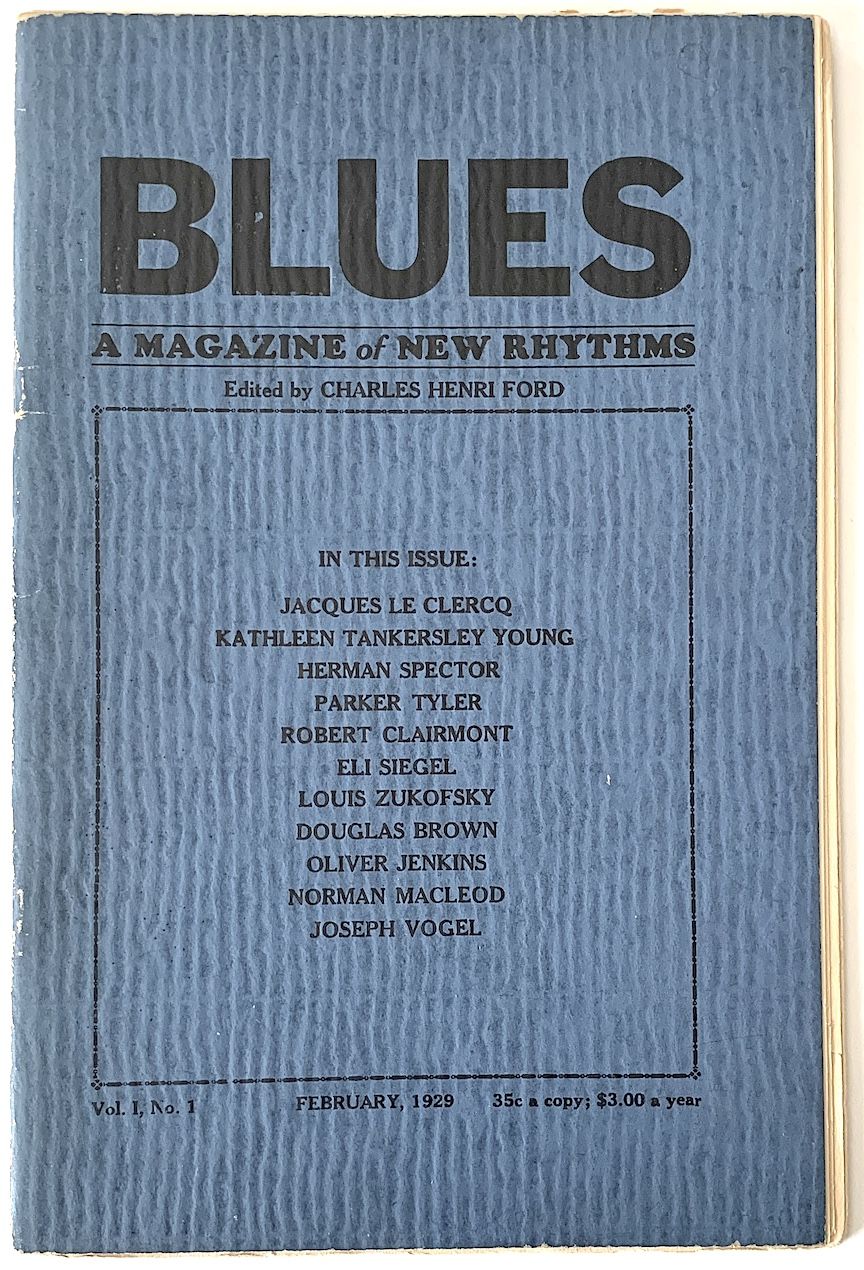
- Columbus, MS , 1929
Columbus, MS, 1929. First edition. 28 pp. Stapled wrappers. Light wear to the spine and extremities, near fine. Partially unopened.
The first issue of Ford's legendary little magazine, published while Ford was working in the café at the Gilmer Hotel in Columbus, Mississippi, which his father was managing. Charles had dropped out of high school and had had a poem published in The New Yorker, and was eager to lead a literary life. Although the magazine lasted only nine issues over two years, the twenty-one year old Ford was the first to publish Paul Bowles, Edouard Roditi, Harold Rosenberg, Kenneth Rexroth, and James T. Farrell. Ford and co-editor Parker Tyler later said, "No doubt, some perfectly worthless stuff got in: it was not, at first, our intention to publish blueribbon literature. The general tendency in taste was certainly toward the significant in legitimate new literary modes. But the important thing to be considered is the fate which must befall any attempt at cultural renovation (we prefer the word to revolution), for each attempt has the partially secret but wholly venomous antipathy of the lords of cultural destiny."
Ford subsequently moved to Paris and was a key figure bridging European surrealism and American modernism. Although his later journal View has overshadowed Blues, Gertrude Stein wrote of it, "Of all the little magazines which as Gertrude Stein loves to quote, have died to make verse free, perhaps the youngest and freshest was the Blues. Its editor Charles Henri Ford has come to Paris and he is young and fresh as his Blues and also honest which also is a pleasure. Gertrude Stein thinks that he and Robert Coates alone among the young men have an individual sense of words."
Reference: Gertrude Stein, The Autobiography of Alice B. Toklas, p.296. Charles Henri Ford and Parker Tyler, "What Happens to a Radical Literary Magazine." The Sewanee Review (January 1931), p.64.
The first issue of Ford's legendary little magazine, published while Ford was working in the café at the Gilmer Hotel in Columbus, Mississippi, which his father was managing. Charles had dropped out of high school and had had a poem published in The New Yorker, and was eager to lead a literary life. Although the magazine lasted only nine issues over two years, the twenty-one year old Ford was the first to publish Paul Bowles, Edouard Roditi, Harold Rosenberg, Kenneth Rexroth, and James T. Farrell. Ford and co-editor Parker Tyler later said, "No doubt, some perfectly worthless stuff got in: it was not, at first, our intention to publish blueribbon literature. The general tendency in taste was certainly toward the significant in legitimate new literary modes. But the important thing to be considered is the fate which must befall any attempt at cultural renovation (we prefer the word to revolution), for each attempt has the partially secret but wholly venomous antipathy of the lords of cultural destiny."
Ford subsequently moved to Paris and was a key figure bridging European surrealism and American modernism. Although his later journal View has overshadowed Blues, Gertrude Stein wrote of it, "Of all the little magazines which as Gertrude Stein loves to quote, have died to make verse free, perhaps the youngest and freshest was the Blues. Its editor Charles Henri Ford has come to Paris and he is young and fresh as his Blues and also honest which also is a pleasure. Gertrude Stein thinks that he and Robert Coates alone among the young men have an individual sense of words."
Reference: Gertrude Stein, The Autobiography of Alice B. Toklas, p.296. Charles Henri Ford and Parker Tyler, "What Happens to a Radical Literary Magazine." The Sewanee Review (January 1931), p.64.
Details
Title
Blues. A Magazine of New Rhythms. Vol. I, no. 1., February 1929
Author
Ford, Charles Henri, ed
Condition
Unknown
Publisher
Columbus, MS
Date
1929
Edition
First edition