

PENELOPE'S WEB
- blue cloth-covered boards, cover design of painted on the front cover, cloth clamshell box, title on paper spine label
- East Hampton, NY: Barry McCallion, 2024
East Hampton, NY: Barry McCallion, 2024. blue cloth-covered boards, cover design of painted on the front cover, cloth clamshell box, title on paper spine label. McCallion, Barry. large 4to (10 1/4 x 13 inches). blue cloth-covered boards, cover design of painted on the front cover, cloth clamshell box, title on paper spine label. thirteen hinged pages, unpaginated, but each is a full-page spread, with one page colophon at rear. Unique foldout Artist Book by Barry McCallion. Fine in fine clamshell box.
Penelope's Web - the making of an artist's book
Barry McCallion
"Penelope's Web is a work of weaving on many levels. The background story is familiar enough: twenty years have passed since the fall of Troy, but Odysseus has not returned to Ithaca. Convinced that he is dead, unruly suitors descend on his estate, make free with the wine, mistreat the servants, and reduce the farm flocks to barbeque. When the suitors insist that Penelope choose one of them to marry, she delays by weaving a shroud by day and undoing the work by night.
The story of Penelope's attempt to deceive the suitors occurs three times - at the beginning, in the middle, and at the end of the poem. The story is told by three different characters. First by Antinous, one of the suitors, who is outraged and indignant over Penelope's "duplicity." Next, Penelope confides in the shabby wanderer (Odysseus in disguise) who has arrived at her door. Lastly, the ghost of Amphimedon, one of the slain suitors, upon reaching Hades, tells the story of Penelope's ruse to Agamemnon.
Although the versions are widely spaced throughout the poem, each 'telling' mirrors the one before it and whole sentences are repeated. Antinous, Penelope, and Amphimedon may have different perspectives: one criticizes, one confides, and one laments, but they rely on the same narrative framework and use the same expressions. Homer, subtly turning from one narrator to another, is weaving and unweaving Narrative itself, using multiple voices and different perspectives to pull us back and forth through narrative time.
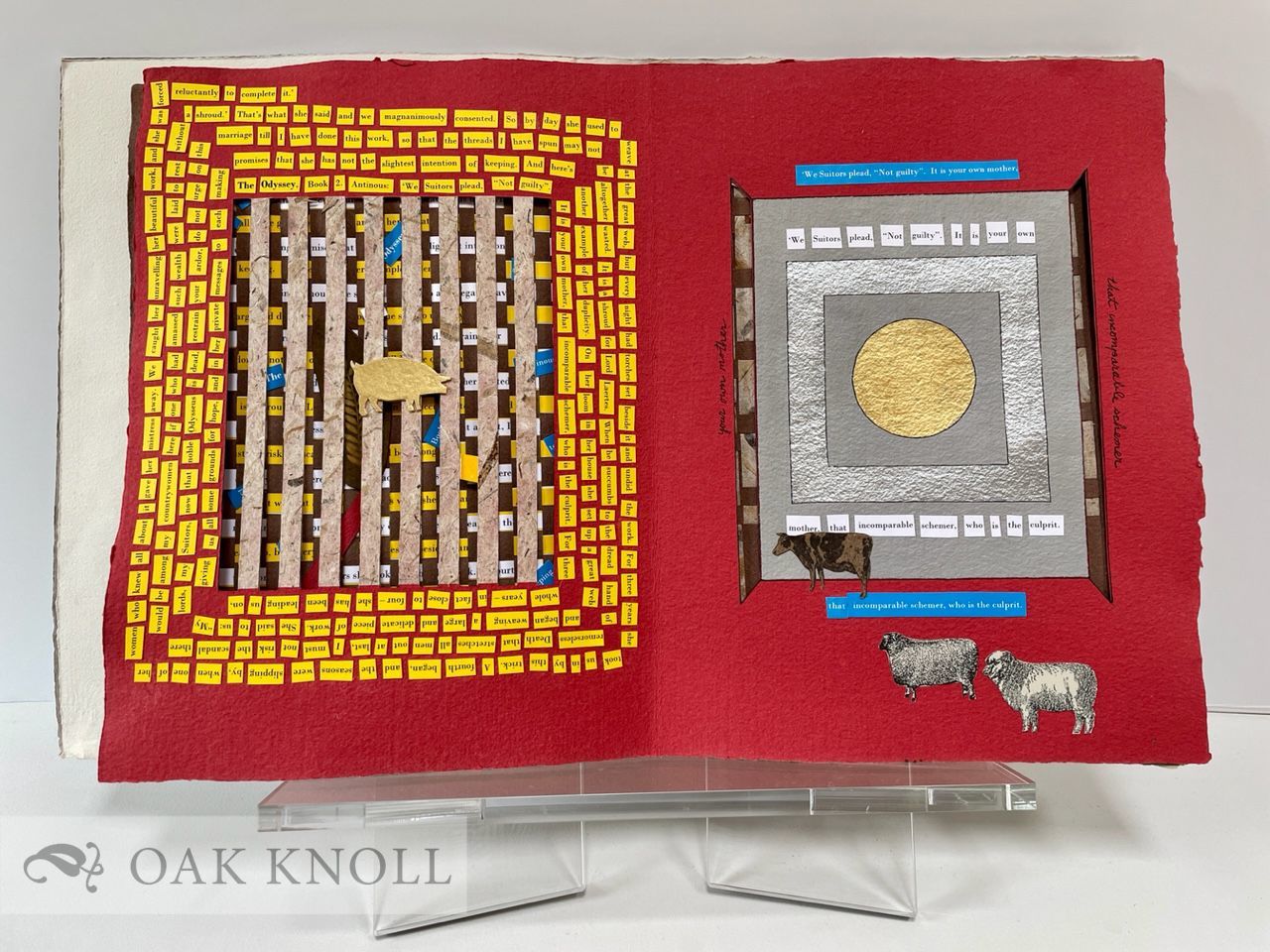
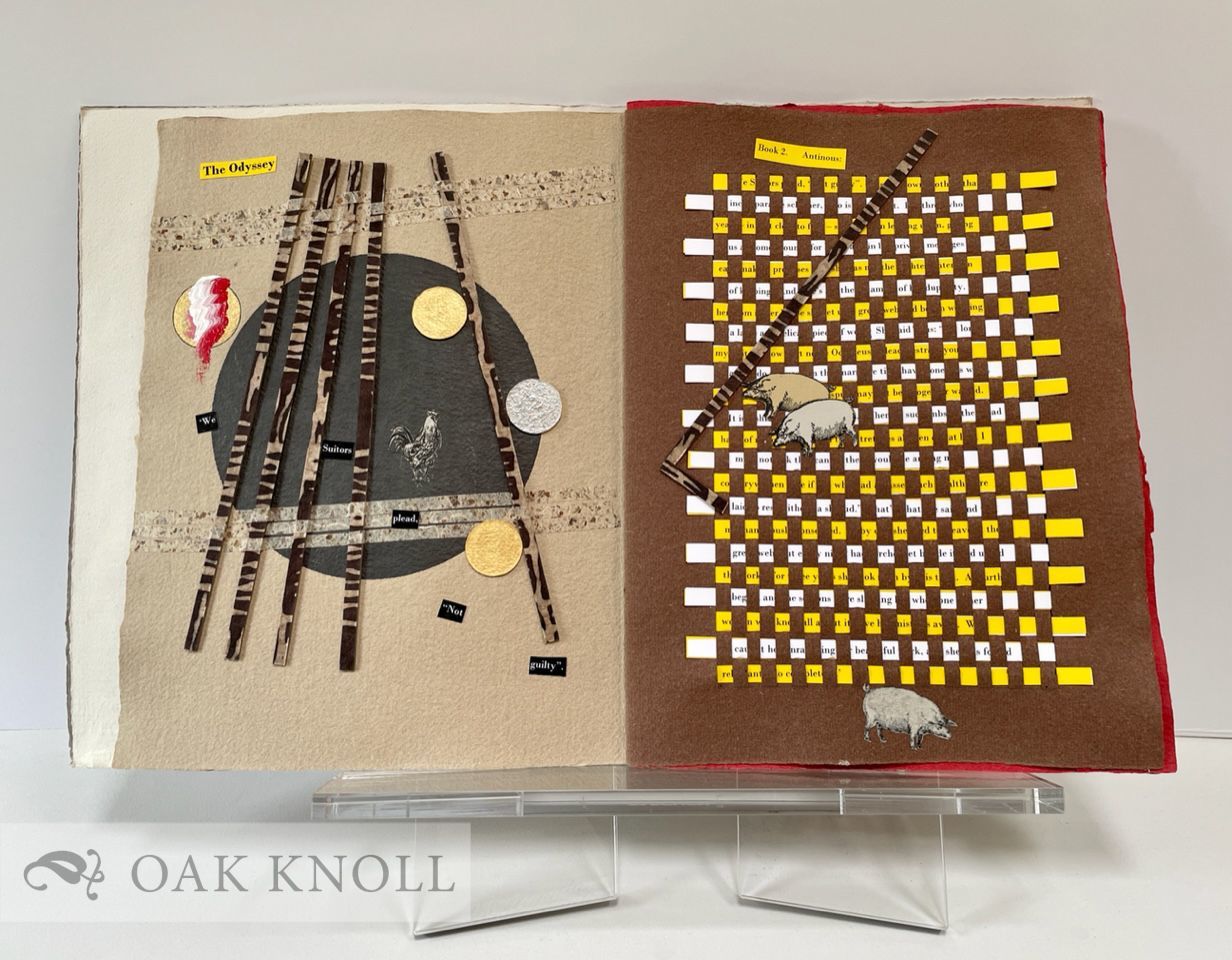
I began the book by printing each of the speeches, first in black, then in drop-out type, on several colors of card stock. These printed texts were intended for collage and paper weaving. For the book's pages I chose sheets of heavy beige, brown, and red St. Armand paper. Where appropriate, I treated pages as looms by incising parallel lines, after which I cut the texts into long strips then wove the strips through the incised lines. Other pages were collaged with images and designs made from India ink drawings, metallic inks, acrylic paint, and rubber stamps of farm animals. Sometimes the printed word was legible, often (as in the woven pages) I reduced the text to an abstraction, and it became a pattern.
I assigned each narrator twelve pages and began the sections with a handwritten copy of the speaker's speech. Antinous, the first to be heard, is a living suitor and, as such, has his mind on the worldly benefits of marrying Penelope. I collaged his pages using the objects of his desire: gold and silver coins, outlines of a female form, and the cutout rubber-stamp forms of farm animals. I wanted the viewer to feel his ambition, his sense of urgency, so I cut through some of the pages, supplying the viewer with a rear-view of what has gone before and a preview of what is to come.
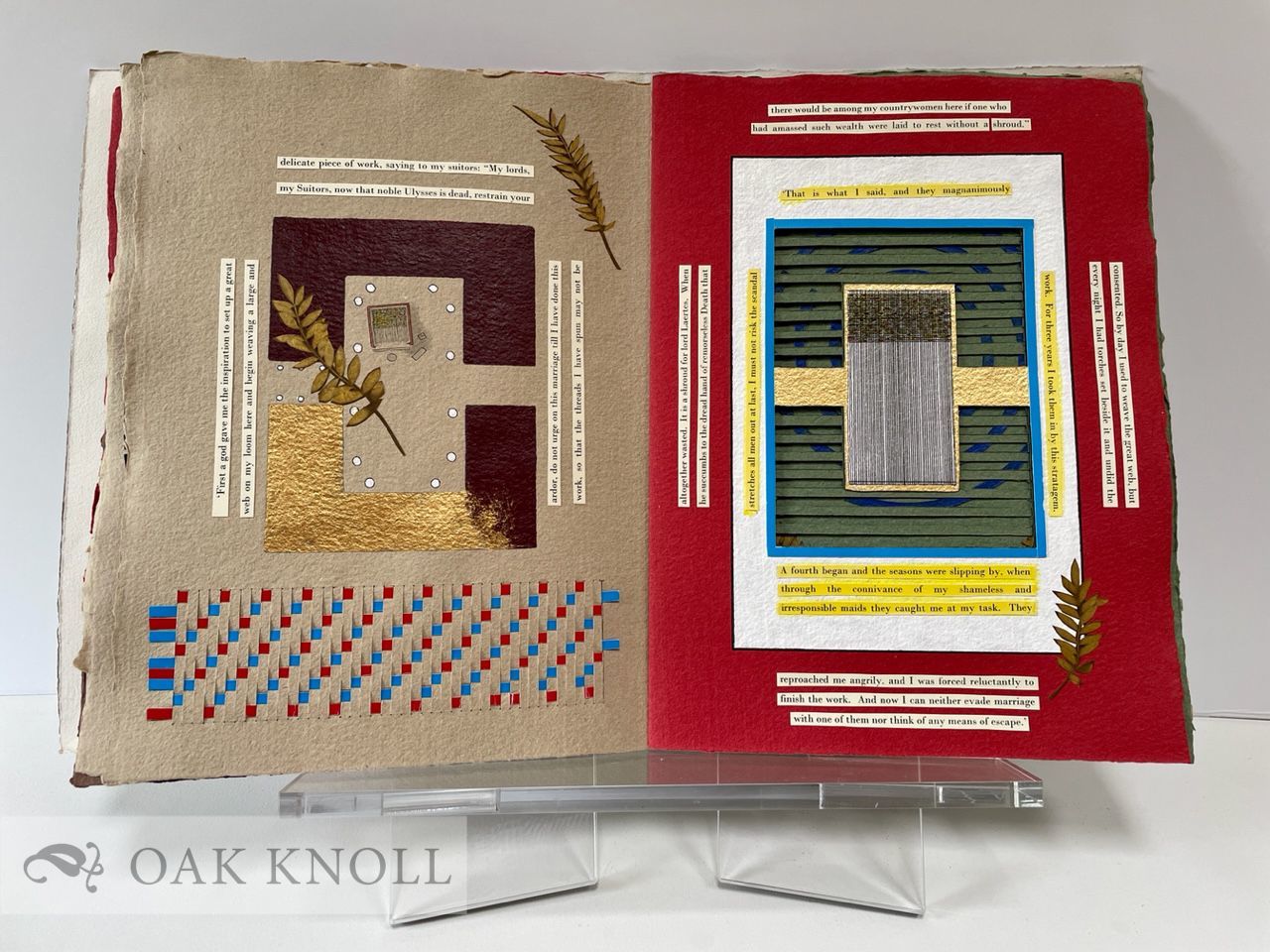
Penelope's twelve pages are quite different. While Antinous and the others go on with their riotous living, Penelope is trapped, a strong woman weakened by circumstance. Odysseus, her long-absent husband, is presumed dead and custom expects a widow to marry. Besieged by suitors, watching the estate's resources plundered, Penelope tells us her plan: "First a god gave me the inspiration to set up a great web on my loom... So, by day I used to weave the great web, but every night I had torches set beside it and undid the work." Her deception succeeds for three years, but eventually, a maid betrays her to the suitors and her ruse is discovered.
Penelope presents a character in contrasts: she is beautiful and noble while her circumstances are degraded. I designed many of Penelope's pages in glittering color, but opposed the colors with a motif of interlocking rectangles and other images suggesting confinement and constraint. When I cut through Penelope's pages, the openings reveal a network of bars and blank walls. Each new 'view' opens onto further obstructions. I wove some text strips into a dense web, and separated others into individual words arranged along a tight, dizzying spiral. Her situation seems hopeless; she has no one to tell her misfortunes but the shabby old wanderer who, in chapter 19, asks merely for a place to rest. In despair, she ends her tale with the words: "And now I can neither evade marriage with one of them nor think of any means of escape."
The theme of escape and confinement plays out in subsequent chapters as Odysseus shuts the palace doors, trapping the suitors inside the great hall. As they flee for their lives, the suitors form a great wheel of moving and falling bodies, a form I employed several times throughout the book.
Amphimedon, our third speaker, is killed by Odysseus, arrives in Hades, and tells his story to Agamemnon. He accuses Penelope of concocting an elaborate plan to "bring about our downfall and our death." Agamemnon is an interesting choice of listener, having returned from the war in Troy years before, only to be the victim of a plot by his own wife.
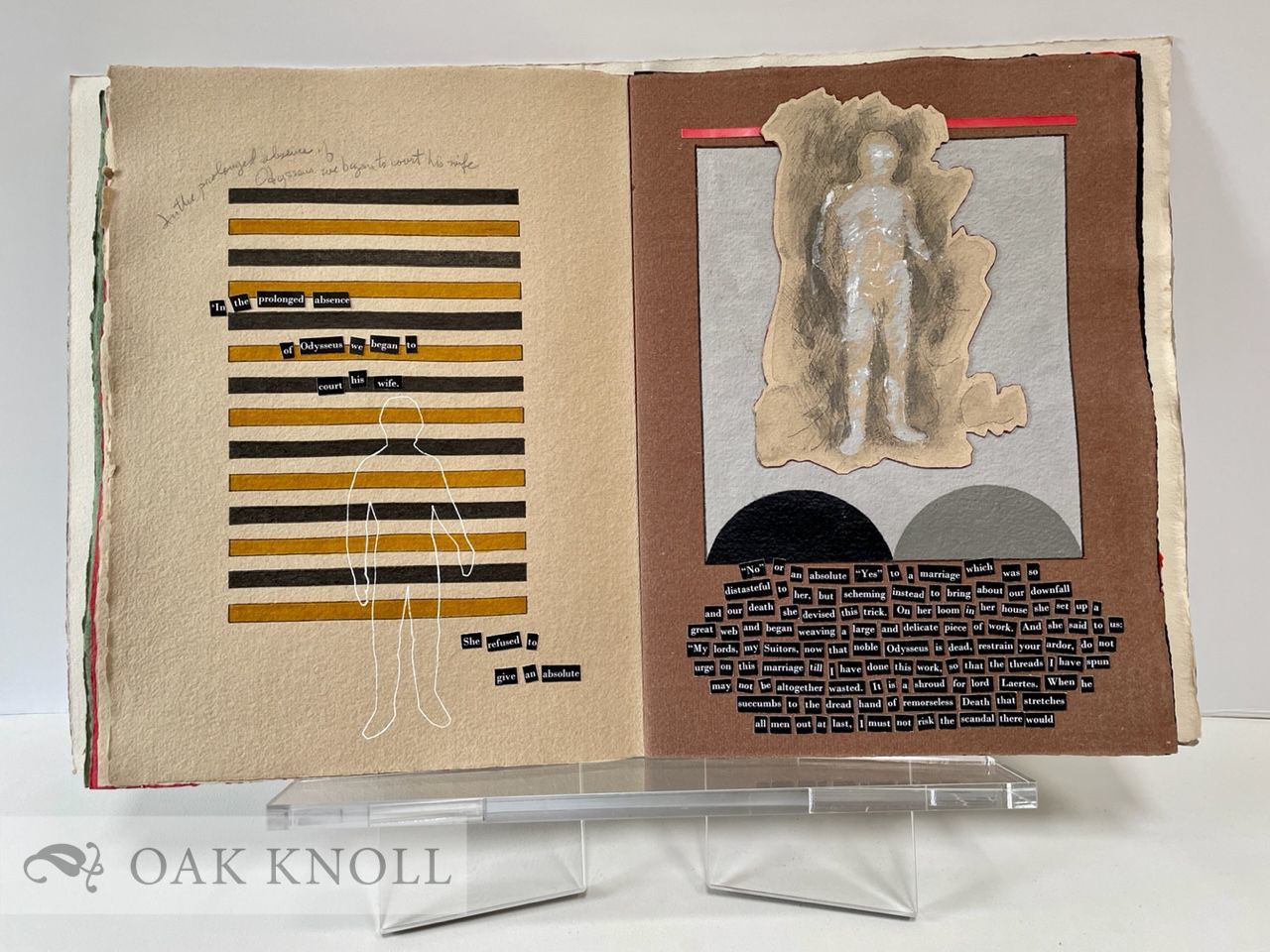
For Amphimedon's pages I conjured the dim, shadowed world of Hades. I removed the red paper used for the Antinous and Penelope sections and substituted a sheet of heavy, black paper. I further dulled the beige and brown pages with areas of gray acrylic paint, and stark black and white type. I drew outlines of a male figure that resembles the chalk outline at crime scenes. Hollowed-out and insubstantial, the splayed figure of Amphimedon tumbles through space. All is underworld: bleak, unregulated and untethered. Words form lines and swirl around the souls of the dead. Twisting and turning on the page, they take a meandering, somewhat aimless journey of their own.
I have made 'woven' books before. Lines of interwoven type hold a particular fascination for me; I experience a certain 'thinklessness' and meditative immersion in repetition. The Odyssey has always appealed and finding Penelope's story repeated in essentially the same language by different people asked interesting questions, which making Penelope's Web helped me address. Then, too, there is the sense that an episode or action, told and retold from different points of view, is very modern. Or is it? We know it as the Rashomon effect: the presentation of multiple, contradictory viewpoints / the fragility of Certainty, and its replacement by a world guided (or misguided) by ambiguity and indeterminacy.
Did you hear that?
What sounds like a new perspective in modern literature may just be a three thousand year old echo."
From the artist's website: "Barry McCallion was born in the Bronx, New York and received degrees from Columbia University (English Literature) and Claremont Graduate University (Sculpture).
His natural inclination to travel has been officially sponsored by the DAAD artist in residence program to Berlin, the Cite des Arts Atelier in Paris and most recently, by the Visual Arts Board of the New Zealand and Australian Arts Councils. The artist currently lives and works on the east end of Long Island, New York.
Penelope's Web - the making of an artist's book
Barry McCallion
"Penelope's Web is a work of weaving on many levels. The background story is familiar enough: twenty years have passed since the fall of Troy, but Odysseus has not returned to Ithaca. Convinced that he is dead, unruly suitors descend on his estate, make free with the wine, mistreat the servants, and reduce the farm flocks to barbeque. When the suitors insist that Penelope choose one of them to marry, she delays by weaving a shroud by day and undoing the work by night.
The story of Penelope's attempt to deceive the suitors occurs three times - at the beginning, in the middle, and at the end of the poem. The story is told by three different characters. First by Antinous, one of the suitors, who is outraged and indignant over Penelope's "duplicity." Next, Penelope confides in the shabby wanderer (Odysseus in disguise) who has arrived at her door. Lastly, the ghost of Amphimedon, one of the slain suitors, upon reaching Hades, tells the story of Penelope's ruse to Agamemnon.
Although the versions are widely spaced throughout the poem, each 'telling' mirrors the one before it and whole sentences are repeated. Antinous, Penelope, and Amphimedon may have different perspectives: one criticizes, one confides, and one laments, but they rely on the same narrative framework and use the same expressions. Homer, subtly turning from one narrator to another, is weaving and unweaving Narrative itself, using multiple voices and different perspectives to pull us back and forth through narrative time.
I began the book by printing each of the speeches, first in black, then in drop-out type, on several colors of card stock. These printed texts were intended for collage and paper weaving. For the book's pages I chose sheets of heavy beige, brown, and red St. Armand paper. Where appropriate, I treated pages as looms by incising parallel lines, after which I cut the texts into long strips then wove the strips through the incised lines. Other pages were collaged with images and designs made from India ink drawings, metallic inks, acrylic paint, and rubber stamps of farm animals. Sometimes the printed word was legible, often (as in the woven pages) I reduced the text to an abstraction, and it became a pattern.
I assigned each narrator twelve pages and began the sections with a handwritten copy of the speaker's speech. Antinous, the first to be heard, is a living suitor and, as such, has his mind on the worldly benefits of marrying Penelope. I collaged his pages using the objects of his desire: gold and silver coins, outlines of a female form, and the cutout rubber-stamp forms of farm animals. I wanted the viewer to feel his ambition, his sense of urgency, so I cut through some of the pages, supplying the viewer with a rear-view of what has gone before and a preview of what is to come.
Penelope's twelve pages are quite different. While Antinous and the others go on with their riotous living, Penelope is trapped, a strong woman weakened by circumstance. Odysseus, her long-absent husband, is presumed dead and custom expects a widow to marry. Besieged by suitors, watching the estate's resources plundered, Penelope tells us her plan: "First a god gave me the inspiration to set up a great web on my loom... So, by day I used to weave the great web, but every night I had torches set beside it and undid the work." Her deception succeeds for three years, but eventually, a maid betrays her to the suitors and her ruse is discovered.
Penelope presents a character in contrasts: she is beautiful and noble while her circumstances are degraded. I designed many of Penelope's pages in glittering color, but opposed the colors with a motif of interlocking rectangles and other images suggesting confinement and constraint. When I cut through Penelope's pages, the openings reveal a network of bars and blank walls. Each new 'view' opens onto further obstructions. I wove some text strips into a dense web, and separated others into individual words arranged along a tight, dizzying spiral. Her situation seems hopeless; she has no one to tell her misfortunes but the shabby old wanderer who, in chapter 19, asks merely for a place to rest. In despair, she ends her tale with the words: "And now I can neither evade marriage with one of them nor think of any means of escape."
The theme of escape and confinement plays out in subsequent chapters as Odysseus shuts the palace doors, trapping the suitors inside the great hall. As they flee for their lives, the suitors form a great wheel of moving and falling bodies, a form I employed several times throughout the book.
Amphimedon, our third speaker, is killed by Odysseus, arrives in Hades, and tells his story to Agamemnon. He accuses Penelope of concocting an elaborate plan to "bring about our downfall and our death." Agamemnon is an interesting choice of listener, having returned from the war in Troy years before, only to be the victim of a plot by his own wife.
For Amphimedon's pages I conjured the dim, shadowed world of Hades. I removed the red paper used for the Antinous and Penelope sections and substituted a sheet of heavy, black paper. I further dulled the beige and brown pages with areas of gray acrylic paint, and stark black and white type. I drew outlines of a male figure that resembles the chalk outline at crime scenes. Hollowed-out and insubstantial, the splayed figure of Amphimedon tumbles through space. All is underworld: bleak, unregulated and untethered. Words form lines and swirl around the souls of the dead. Twisting and turning on the page, they take a meandering, somewhat aimless journey of their own.
I have made 'woven' books before. Lines of interwoven type hold a particular fascination for me; I experience a certain 'thinklessness' and meditative immersion in repetition. The Odyssey has always appealed and finding Penelope's story repeated in essentially the same language by different people asked interesting questions, which making Penelope's Web helped me address. Then, too, there is the sense that an episode or action, told and retold from different points of view, is very modern. Or is it? We know it as the Rashomon effect: the presentation of multiple, contradictory viewpoints / the fragility of Certainty, and its replacement by a world guided (or misguided) by ambiguity and indeterminacy.
Did you hear that?
What sounds like a new perspective in modern literature may just be a three thousand year old echo."
From the artist's website: "Barry McCallion was born in the Bronx, New York and received degrees from Columbia University (English Literature) and Claremont Graduate University (Sculpture).
His natural inclination to travel has been officially sponsored by the DAAD artist in residence program to Berlin, the Cite des Arts Atelier in Paris and most recently, by the Visual Arts Board of the New Zealand and Australian Arts Councils. The artist currently lives and works on the east end of Long Island, New York.
Details
Title
PENELOPE'S WEB
Binding
blue cloth-covered boards, cover design of painted on the front cover, cloth clamshell box, title on paper spine label
Condition
Unknown
Publisher
Barry McCallion: East Hampton, NY
Date
2024