

Manuscript on paper, entitled “Kōbei nichiroku” 航米日錄 [“Daily Record of the Voyage to America”]
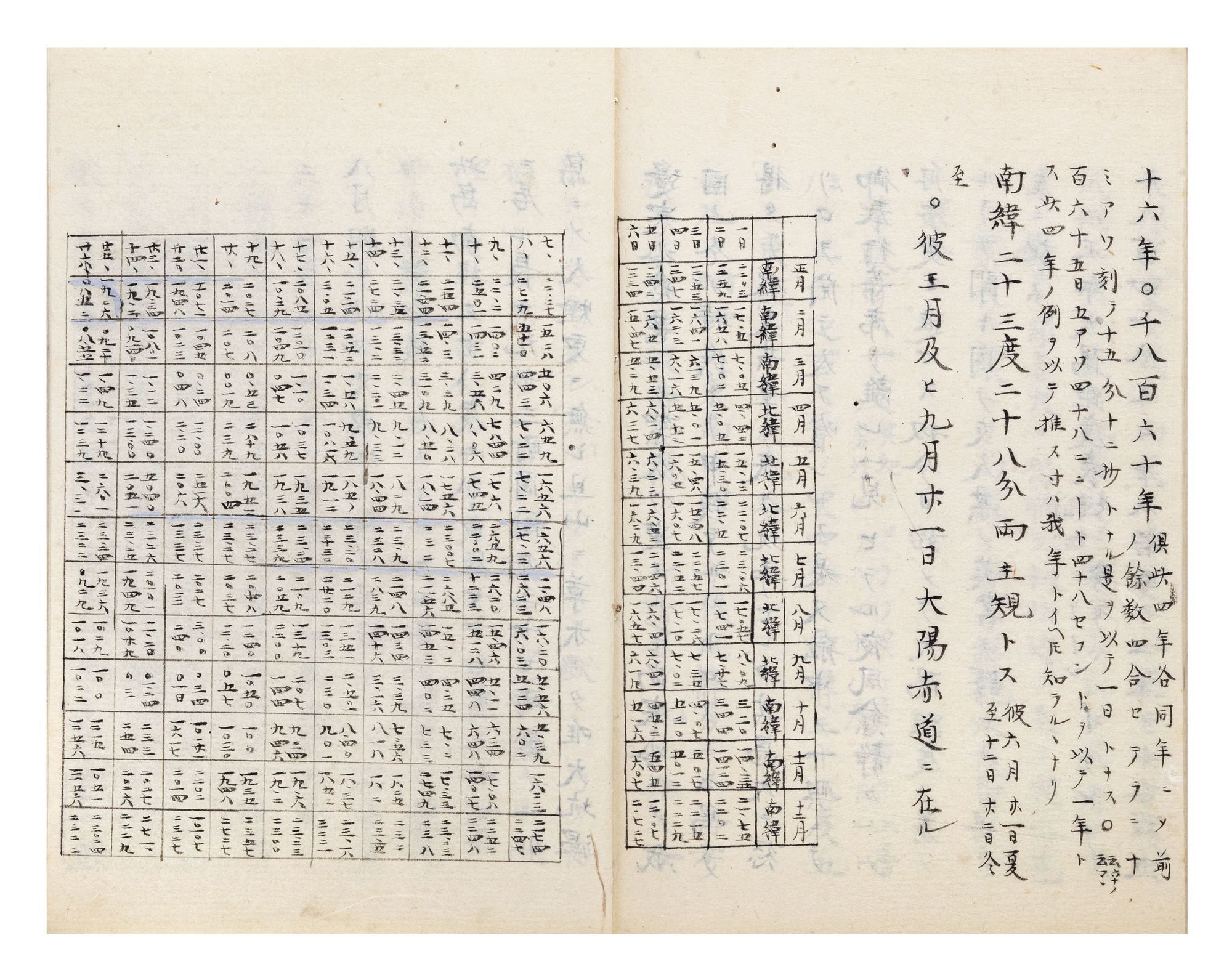
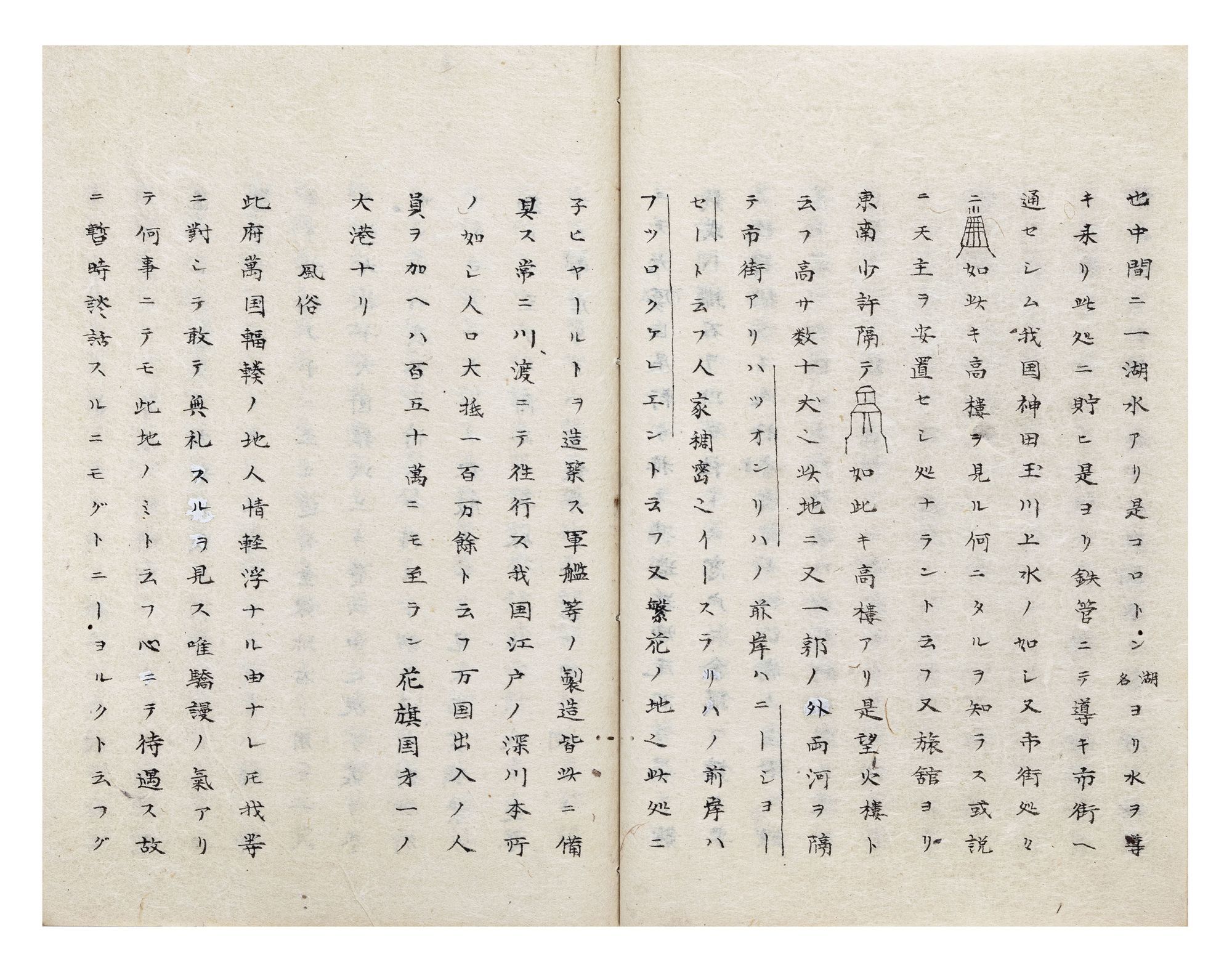
Several small illus. & one double-page chart. Seven vols. 8vo (235 x 165 mm.), orig. wrappers, old stitching. [Japan]: before 1868.
A manuscript copy of this famous travelogue of the first Japanese embassy to the United States in 1860. This important text remained unpublished until 1913.
The Japanese mission was “tasked to present to President Buchanan a letter from the shogun and to exchange instruments of ratification for the US-Japan Treaty of Amity and Commerce concluded in 1858. When the Japanese completed their official duty, they visited three East Coast cities — Baltimore, Philadelphia, and New York — at the invitation of municipal authorities. At the capital and other localities, the Japanese men received welcome in the forms of parades, receptions, dance balls, and tours of factories and navy yards...It was Japan’s first official visit to a Western nation and opportunity to observe its social and economic systems. The United States viewed the mission as a steppingstone for increased commerce and a chance to promote a stronger relationship with Japan against covetous European powers” (Ikuko Asaka, “Guerilla Women and Men in Silk Dresses: Diplomacy and Orientalism during the 1860 Japanese Mission,” The Journal of the Civil War Era 13.4 [2023]: pp. 444-45).
The journal is an invaluable source for Japanese impressions of the Western world at the end of the Edo period, but it also documents inter-Asian interactions. Notably, during a stop-over in Hawaii, Tamamushi encountered a Chinese pharmacist, with whom he conversed by means of “brush-talk” — writing notes in classical Chinese. The pair discussed the recent Arrow War between Great Britain and China, and both lamented the behavior of the Western powers (Michael Facius, “From Kangaku to Shingaku: On the Growing Significance of Contemporary China for Sinitic Scholarship in Nineteenth-Century Japan,” in Sino-Japanese Reflections, ed. by Joshua A. Fogel & Matthew Fraleigh, pp. 274-75).
Tamamushi Sadayū (1823-69), studied in Edo. In 1857 he travelled to Ezo, the non-Japanese part of Hokkaido, later authoring a book about his journey. During the Boshin War, which ended bakufu rule in Japan, Tamamushi worked to establish and maintain the Northern Alliance that resisted the restoration of imperial rule. “Sendai retainer Tamamushi Sadayū (1823–1869) rejected race and human exploitation as hierarchies of ‘civilization,’ separated morality from ‘Westernization,’ and perceived the intra-hierarchical compassion he believed he saw in America as the key to Japan’s future political stability. Tamamushi’s ideas and transnational experiences manifested themselves in his activity as a military commander for the Northern Alliance in the Boshin War (1868–1869)” (Natalia Doan, “The 1860 Japanese Embassy and the Opening of American Civilization,” Oxford, PhD Thesis, 2019).
The chitsu containing our volumes has a note pasted on it stating that it was “formerly in the collection of the Makino family, feudal lords of the Tango-Tanabe Domain” 丹後國田辺藩主牧野家舊藏, which ought to date our manuscript to before the Meiji restoration of 1868.
Fine set, some minor worming, partially mended.
A manuscript copy of this famous travelogue of the first Japanese embassy to the United States in 1860. This important text remained unpublished until 1913.
The Japanese mission was “tasked to present to President Buchanan a letter from the shogun and to exchange instruments of ratification for the US-Japan Treaty of Amity and Commerce concluded in 1858. When the Japanese completed their official duty, they visited three East Coast cities — Baltimore, Philadelphia, and New York — at the invitation of municipal authorities. At the capital and other localities, the Japanese men received welcome in the forms of parades, receptions, dance balls, and tours of factories and navy yards...It was Japan’s first official visit to a Western nation and opportunity to observe its social and economic systems. The United States viewed the mission as a steppingstone for increased commerce and a chance to promote a stronger relationship with Japan against covetous European powers” (Ikuko Asaka, “Guerilla Women and Men in Silk Dresses: Diplomacy and Orientalism during the 1860 Japanese Mission,” The Journal of the Civil War Era 13.4 [2023]: pp. 444-45).
The journal is an invaluable source for Japanese impressions of the Western world at the end of the Edo period, but it also documents inter-Asian interactions. Notably, during a stop-over in Hawaii, Tamamushi encountered a Chinese pharmacist, with whom he conversed by means of “brush-talk” — writing notes in classical Chinese. The pair discussed the recent Arrow War between Great Britain and China, and both lamented the behavior of the Western powers (Michael Facius, “From Kangaku to Shingaku: On the Growing Significance of Contemporary China for Sinitic Scholarship in Nineteenth-Century Japan,” in Sino-Japanese Reflections, ed. by Joshua A. Fogel & Matthew Fraleigh, pp. 274-75).
Tamamushi Sadayū (1823-69), studied in Edo. In 1857 he travelled to Ezo, the non-Japanese part of Hokkaido, later authoring a book about his journey. During the Boshin War, which ended bakufu rule in Japan, Tamamushi worked to establish and maintain the Northern Alliance that resisted the restoration of imperial rule. “Sendai retainer Tamamushi Sadayū (1823–1869) rejected race and human exploitation as hierarchies of ‘civilization,’ separated morality from ‘Westernization,’ and perceived the intra-hierarchical compassion he believed he saw in America as the key to Japan’s future political stability. Tamamushi’s ideas and transnational experiences manifested themselves in his activity as a military commander for the Northern Alliance in the Boshin War (1868–1869)” (Natalia Doan, “The 1860 Japanese Embassy and the Opening of American Civilization,” Oxford, PhD Thesis, 2019).
The chitsu containing our volumes has a note pasted on it stating that it was “formerly in the collection of the Makino family, feudal lords of the Tango-Tanabe Domain” 丹後國田辺藩主牧野家舊藏, which ought to date our manuscript to before the Meiji restoration of 1868.
Fine set, some minor worming, partially mended.
Details
Title
Manuscript on paper, entitled “Kōbei nichiroku” 航米日錄 [“Daily Record of the Voyage to America”]
Author
TAMAMUSHI, Sadayū 玉虫左太夫
Condition
Unknown