

Kaigan hōjutsu biyō 海岸砲術備要 [Compendium on Coastal Artillery] (title from beginning of text) [or] Kaigan biyō [Coastal Compendium] (from title-page)
Many fine woodcuts throughout. Four parts & appendices in five vols. 8vo, orig. semi-stiff wrappers (a little frayed), old stitching, orig. title slips on covers. Tokyo: Yamasakiya Seishichi 山崎屋清七 et al., 1852.
First printed edition of this artillery manual from the bakumatsu period. In the early 19th century, Japan came under increased pressure from Western nations that wanted access to Japanese ports. “The Shogunate government issued the Order to Drive Away Foreign Ships in 1825 and commanded that foreign ships appearing along the coast of Japan be fired upon, so the domains along the coast began building gun batteries and installing cannons. This is when the gun batteries and emplacements were built at Odaiba in Edo Bay and at Uraga, Nakaminato, Tahara, Maiko, Dannoura, Uwajima, Kagoshima, and elsewhere. Dutch coastal artillery books were referred to when building these gun batteries” (NDL, Japan-Netherlands Exchange in the Edo Period, online). Our book was published in this historical context.
The book had already been translated by Motoki Masahide (1767-1822), who had left it unpublished at his death (manuscript copies exist). Nunokawa Tsūboku 布川通璞, who edited Motoki’s translation and brought it to print, in his Preface referenced the order that the domains build coastal defenses as one justification for publication. Motoki had studied not only Dutch but also French, Russian, and English. He published an English-language primer in 1811 and an English-Japanese dictionary in 1814.
The Dutch original from which the book was translated was titled Het Nieuwe Licht Der Bosschieterye (1699) and was written by Gerrit van der Tollen (fl. 1721-23), who worked for the Dutch East India Company.
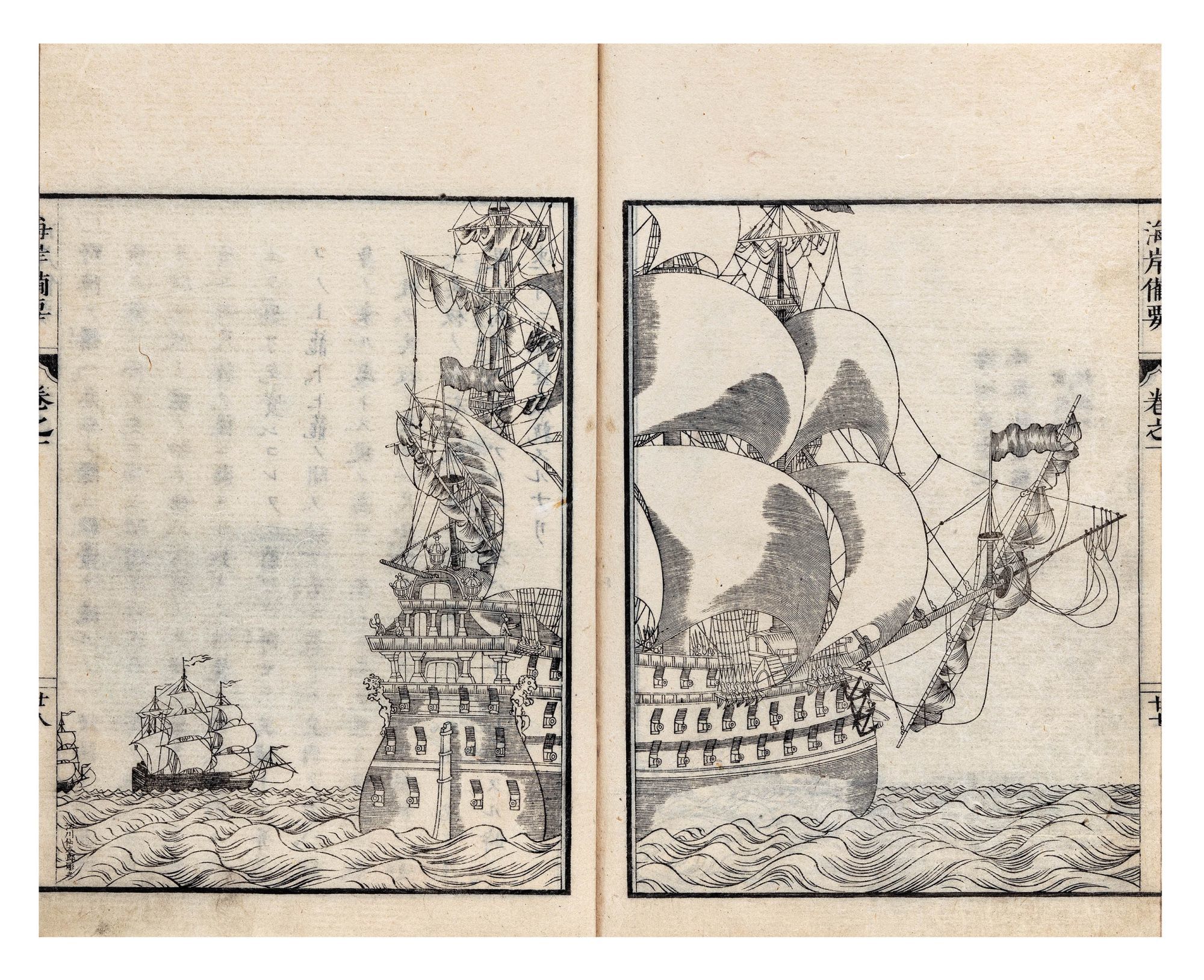
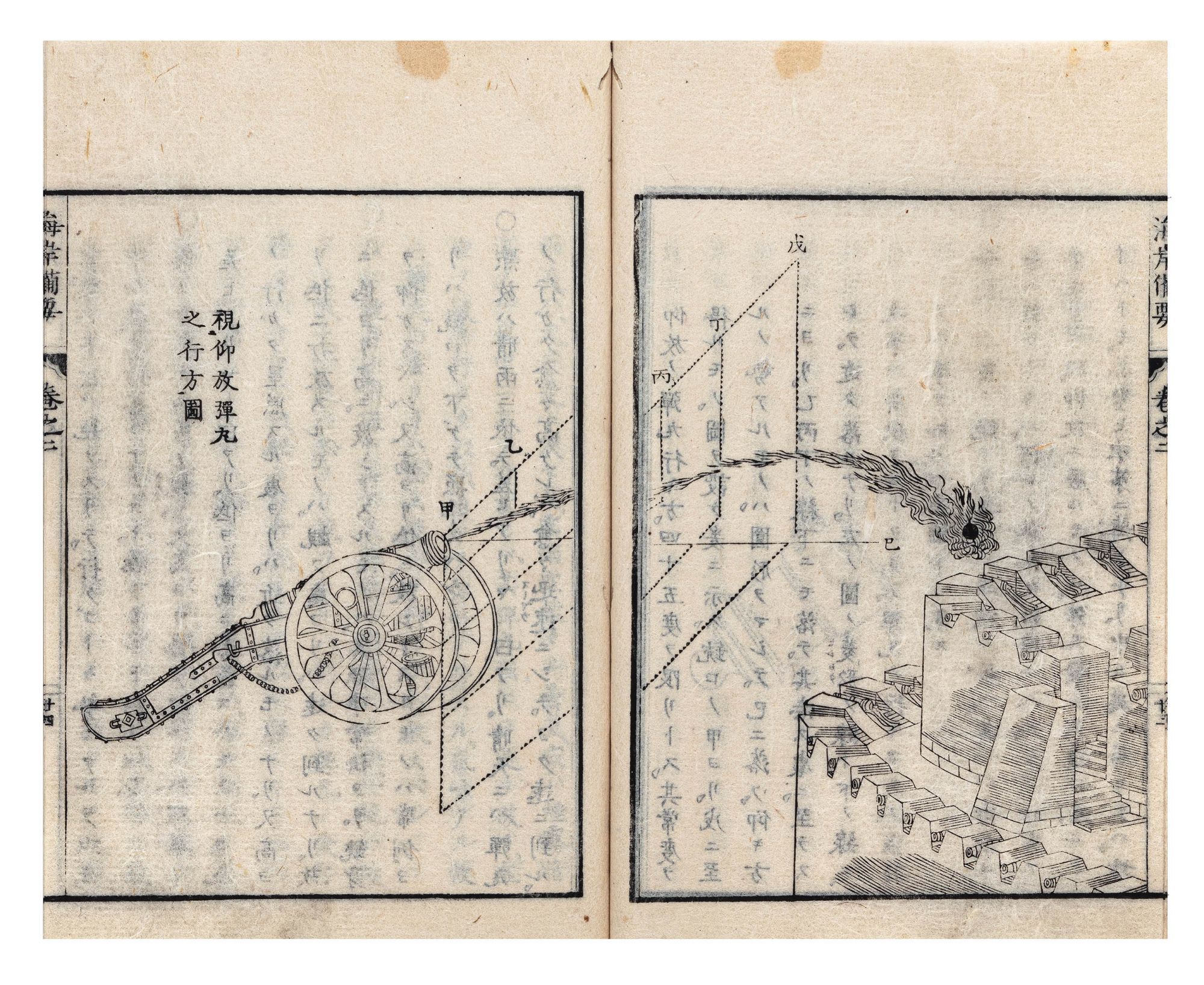
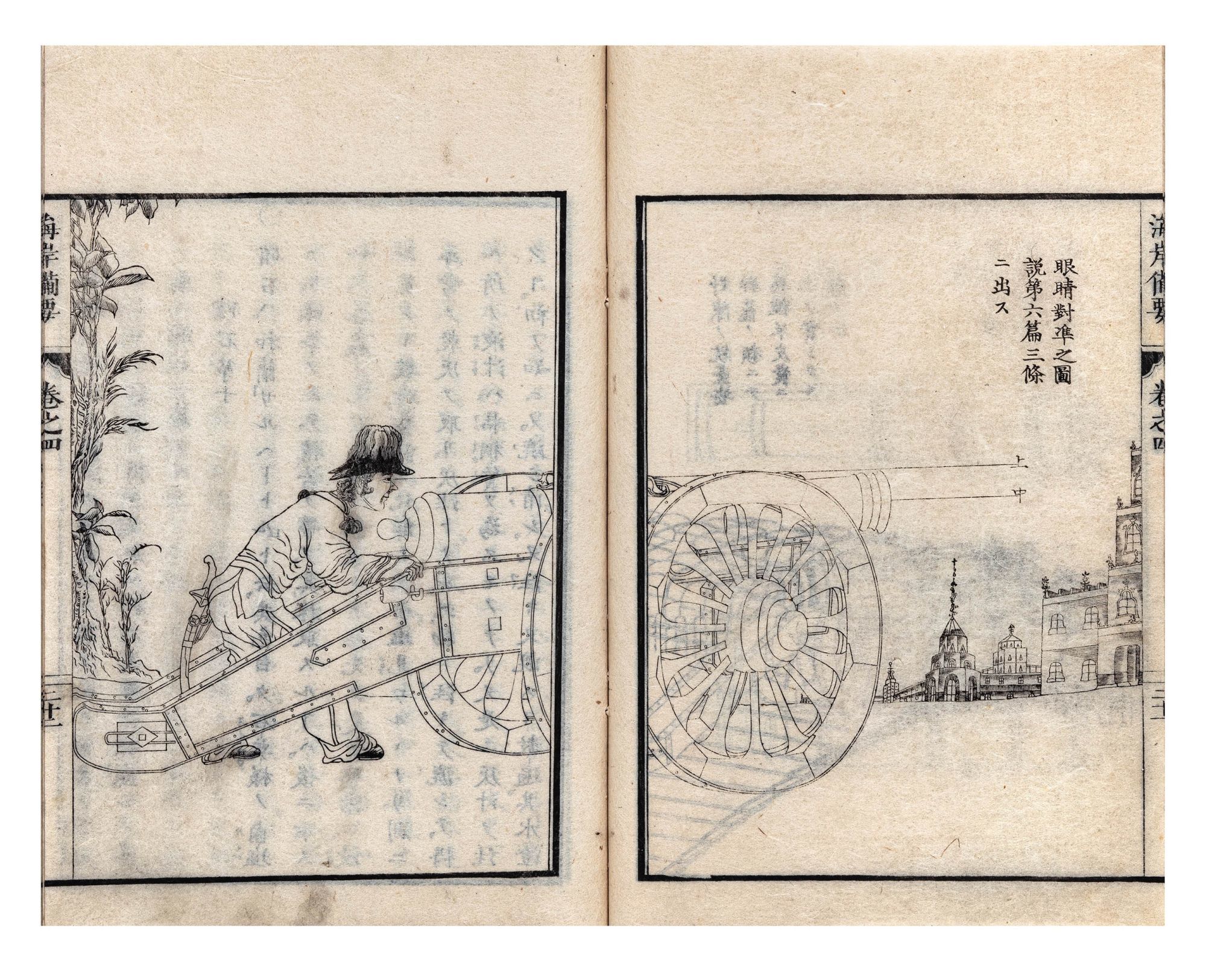
Our book is richly illustrated with a series of fine single- and double-page woodcuts of many kinds of cannons and mortars, cannonballs, and Western warships, along with diagrams of problems in ballistics. Sections include illustrations and explanations of the structure and dimensions of cannons, the measurement of gunpowder, and lists of Dutch terms translated into Japanese. Some sections are written in a question-and-answer format (“Which countries produce cannons? Is there a difference in the making of light and heavy cannonballs?”). The book begins with a history of artillery, a topic that is treated further in the appendices, which were not written by Motoki. The appendices treat the history of artillery both in Europe and in China.
Note that Google Books presents the copy at the Bavarian State Library as being published in 1825, but the digitized title page says Kaei mizunoene, which corresponds to 1852 and is the same date as seen in our book.
Very fine set.
❧ Motoki: Christopher Joby, The Dutch Language in Japan (1600-1900) (Leiden & Boston: 2021), pp. 74, 121, 186, 191, 196-97, 276, 285, & 320.
First printed edition of this artillery manual from the bakumatsu period. In the early 19th century, Japan came under increased pressure from Western nations that wanted access to Japanese ports. “The Shogunate government issued the Order to Drive Away Foreign Ships in 1825 and commanded that foreign ships appearing along the coast of Japan be fired upon, so the domains along the coast began building gun batteries and installing cannons. This is when the gun batteries and emplacements were built at Odaiba in Edo Bay and at Uraga, Nakaminato, Tahara, Maiko, Dannoura, Uwajima, Kagoshima, and elsewhere. Dutch coastal artillery books were referred to when building these gun batteries” (NDL, Japan-Netherlands Exchange in the Edo Period, online). Our book was published in this historical context.
The book had already been translated by Motoki Masahide (1767-1822), who had left it unpublished at his death (manuscript copies exist). Nunokawa Tsūboku 布川通璞, who edited Motoki’s translation and brought it to print, in his Preface referenced the order that the domains build coastal defenses as one justification for publication. Motoki had studied not only Dutch but also French, Russian, and English. He published an English-language primer in 1811 and an English-Japanese dictionary in 1814.
The Dutch original from which the book was translated was titled Het Nieuwe Licht Der Bosschieterye (1699) and was written by Gerrit van der Tollen (fl. 1721-23), who worked for the Dutch East India Company.
Our book is richly illustrated with a series of fine single- and double-page woodcuts of many kinds of cannons and mortars, cannonballs, and Western warships, along with diagrams of problems in ballistics. Sections include illustrations and explanations of the structure and dimensions of cannons, the measurement of gunpowder, and lists of Dutch terms translated into Japanese. Some sections are written in a question-and-answer format (“Which countries produce cannons? Is there a difference in the making of light and heavy cannonballs?”). The book begins with a history of artillery, a topic that is treated further in the appendices, which were not written by Motoki. The appendices treat the history of artillery both in Europe and in China.
Note that Google Books presents the copy at the Bavarian State Library as being published in 1825, but the digitized title page says Kaei mizunoene, which corresponds to 1852 and is the same date as seen in our book.
Very fine set.
❧ Motoki: Christopher Joby, The Dutch Language in Japan (1600-1900) (Leiden & Boston: 2021), pp. 74, 121, 186, 191, 196-97, 276, 285, & 320.
Details
Title
Kaigan hōjutsu biyō 海岸砲術備要 [Compendium on Coastal Artillery] (title from beginning of text) [or] Kaigan biyō [Coastal Compendium] (from title-page)
Author
TOLLEN (not TORREN), Gerrit van der, author & MOTOKI Masahide (or Shōei or Shōzaemon) 本木正栄, trans
Condition
Unknown