

Chong juan Shang shu ti zhu da quan 重鐫尚書體註大全 [Great & Complete Compendium of Substantive Comments to the “Venerated Documents,” Carved Anew] (title from title page) [or] Shu jing ji zhu 書經集註 [Collected Commentaries on the “Document Classic”] (title from beginning of text)
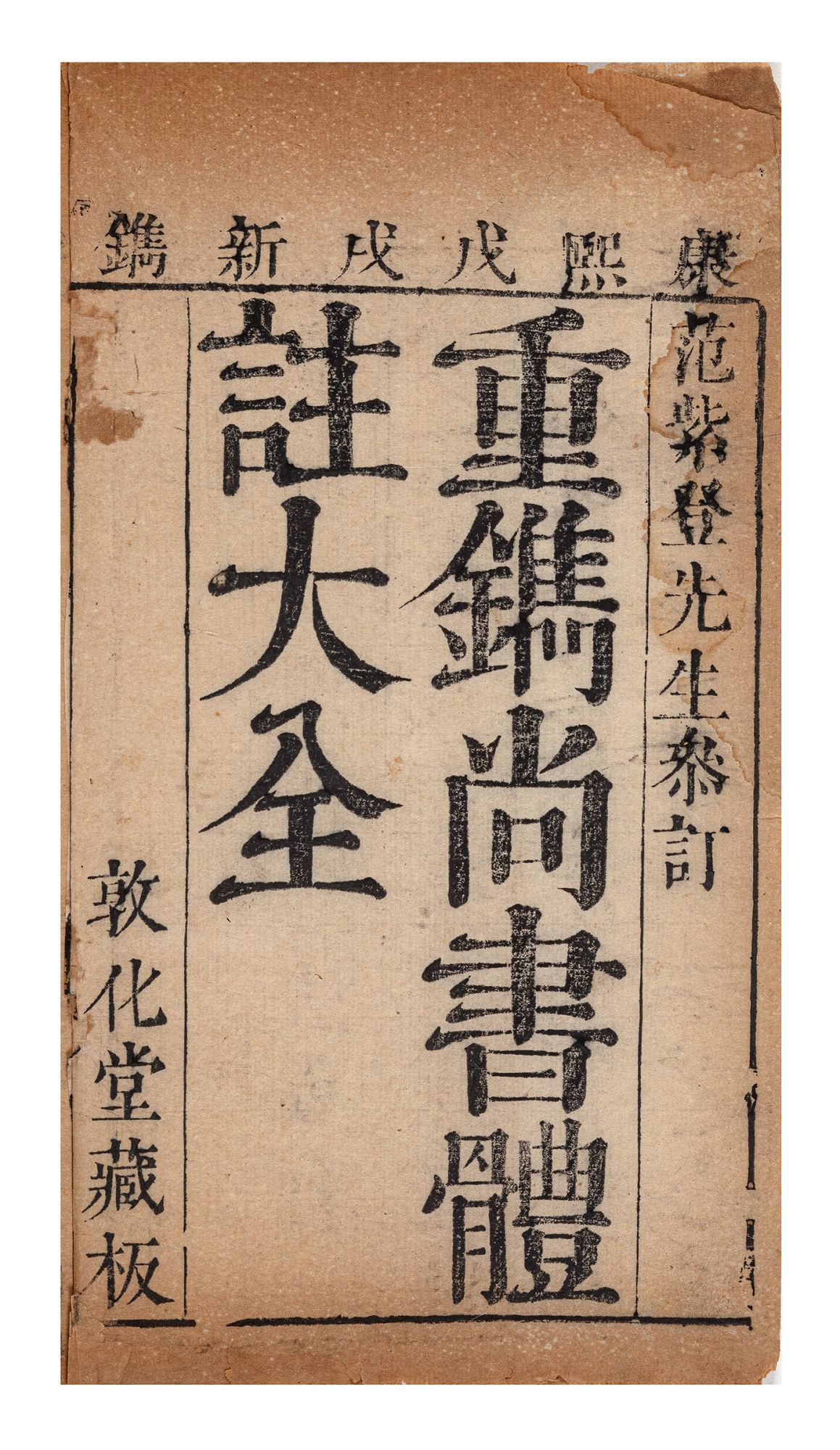
Nine full-page & one double-page woodcut illus. and one vignette. Four vols. 8vo, orig. wrappers, old stitching. [China]: Dun hua tang 敦化堂, 1718.
A commercial edition of the Confucian Document Classic, probably intended for candidates for the civil service examinations.
The Document Classic, or Venerated Documents, “was recognized during the Han dynasty as one of the ‘Five Classics’ and has served for more than two-thousand years as the foundation of Chinese political philosophy. The text contains the earliest writings in China’s traditional literature, with some chapters dating nearly a thousand years before its recognition as a classic” (Edward L. Shaughnessy in Michael Loewe, ed., Early Chinese Texts: A Bibliographical Guide, p. 376). As a Confucian classic, our book was studied extensively by elite males, and familiarity with it was expected by candidates sitting for the civil service examinations.
On its own, the Document Classic was difficult to understand for readers in imperial China, who nevertheless invested it with great importance and meaning. Commentaries on the text thus accrued. In the 12th century, the great Neo-Confucian synthesist Zhu Xi (1130-1200) entrusted one of his disciples—Cai Shen—to produce an edition combining the available commentaries. “Chu Hsi [Zhu Xi] moved freely between the Four Books and Five Classics, treating them holistically as the basis for the thought-world of the classical age. Chu’s efforts culminated with Ts’ai Shen [Cai Shen] 蔡沈 (1167-1230), his student, who used the ‘human and mind of the Tao’ passage for a holistic interpretation of all the chapters in the Documents, a view that became required in the Ming examination curriculum” (Benjamin A. Elman, A Cultural History of Civil Examinations, p. 436). Thus our book became very influential in the Ming period and into the early Qing.
Each page of our book is divided into two panels, a common format in Ming and early Qing commercial publishing. The lower panel contains the text of the Document Classic along with Cai’s commentary. The upper panel contains additional commentaries assembled by one Zhu Yun, about whom we find no further information. Zhu is also the author of the book’s list of “Editorial Principles.” Fan Zideng, who is said to have proofread the text, wrote the Preface. Like Cai, Fan stressed the unity of the mind of the ancient sage rulers, which was accessible through the reading of the Document Classic with Cai’s assembled commentary.
Our book, in which an earlier reader has made notes, is a good example of commercially produced didactic books. In addition to the Classic itself, it contains supplementary material for students of the text, consisting of mnemonics for memorizing the geographical divisions of ancient China.
Very good set; somewhat browned and frayed and with some dampstaining. Thumbing and tears to a few leaves with some loss of text. Preserved in the original hantao.
A commercial edition of the Confucian Document Classic, probably intended for candidates for the civil service examinations.
The Document Classic, or Venerated Documents, “was recognized during the Han dynasty as one of the ‘Five Classics’ and has served for more than two-thousand years as the foundation of Chinese political philosophy. The text contains the earliest writings in China’s traditional literature, with some chapters dating nearly a thousand years before its recognition as a classic” (Edward L. Shaughnessy in Michael Loewe, ed., Early Chinese Texts: A Bibliographical Guide, p. 376). As a Confucian classic, our book was studied extensively by elite males, and familiarity with it was expected by candidates sitting for the civil service examinations.
On its own, the Document Classic was difficult to understand for readers in imperial China, who nevertheless invested it with great importance and meaning. Commentaries on the text thus accrued. In the 12th century, the great Neo-Confucian synthesist Zhu Xi (1130-1200) entrusted one of his disciples—Cai Shen—to produce an edition combining the available commentaries. “Chu Hsi [Zhu Xi] moved freely between the Four Books and Five Classics, treating them holistically as the basis for the thought-world of the classical age. Chu’s efforts culminated with Ts’ai Shen [Cai Shen] 蔡沈 (1167-1230), his student, who used the ‘human and mind of the Tao’ passage for a holistic interpretation of all the chapters in the Documents, a view that became required in the Ming examination curriculum” (Benjamin A. Elman, A Cultural History of Civil Examinations, p. 436). Thus our book became very influential in the Ming period and into the early Qing.
Each page of our book is divided into two panels, a common format in Ming and early Qing commercial publishing. The lower panel contains the text of the Document Classic along with Cai’s commentary. The upper panel contains additional commentaries assembled by one Zhu Yun, about whom we find no further information. Zhu is also the author of the book’s list of “Editorial Principles.” Fan Zideng, who is said to have proofread the text, wrote the Preface. Like Cai, Fan stressed the unity of the mind of the ancient sage rulers, which was accessible through the reading of the Document Classic with Cai’s assembled commentary.
Our book, in which an earlier reader has made notes, is a good example of commercially produced didactic books. In addition to the Classic itself, it contains supplementary material for students of the text, consisting of mnemonics for memorizing the geographical divisions of ancient China.
Very good set; somewhat browned and frayed and with some dampstaining. Thumbing and tears to a few leaves with some loss of text. Preserved in the original hantao.
Details
Title
Chong juan Shang shu ti zhu da quan 重鐫尚書體註大全 [Great & Complete Compendium of Substantive Comments to the “Venerated Documents,” Carved Anew] (title from title page) [or] Shu jing ji zhu 書經集註 [Collected Commentaries on the “Document Classic”] (title from beginning of text)
Author
CAI, Shen 蔡沈, ZHU, Yunlong 朱雲龍, & FAN Zideng 范紫登
Condition
Unknown