

Four Papers Related to Anti-Slavery
- SIGNED
- Baltimore, 1839
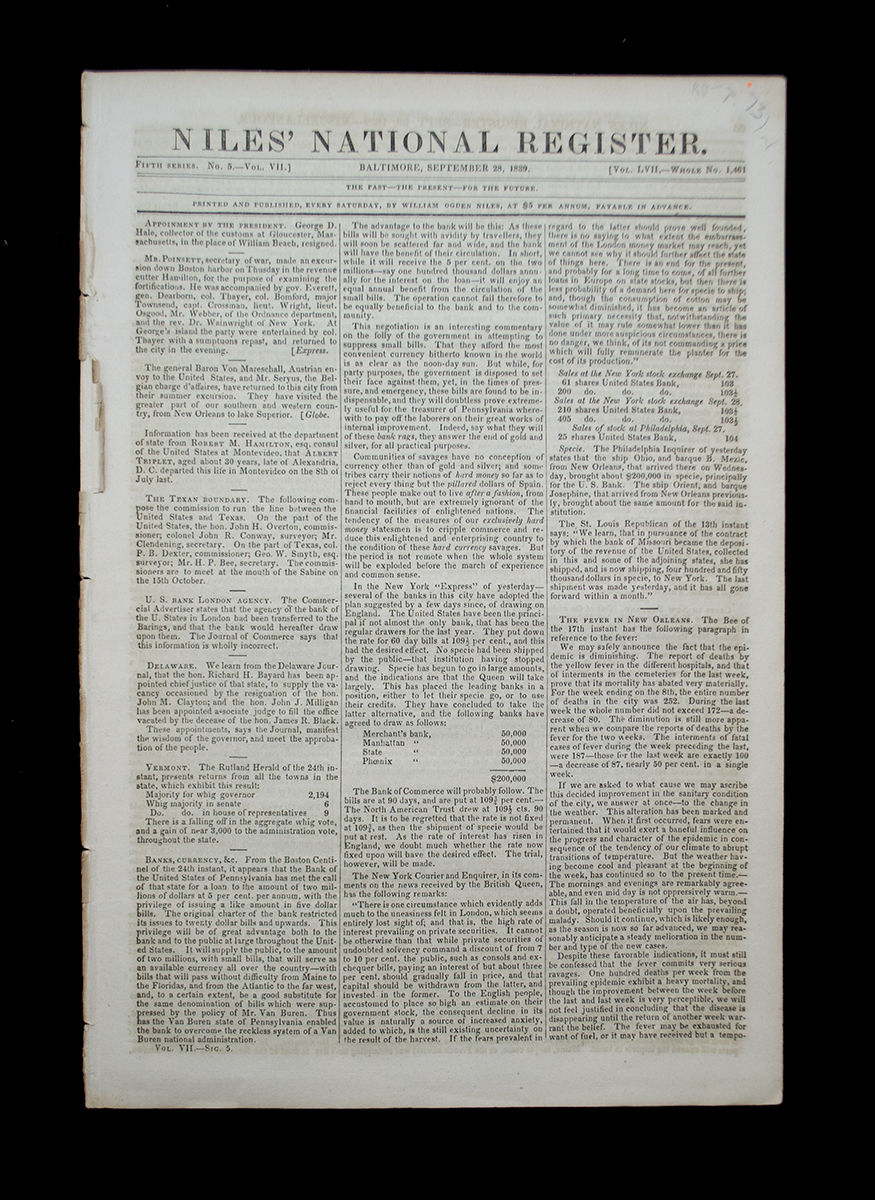
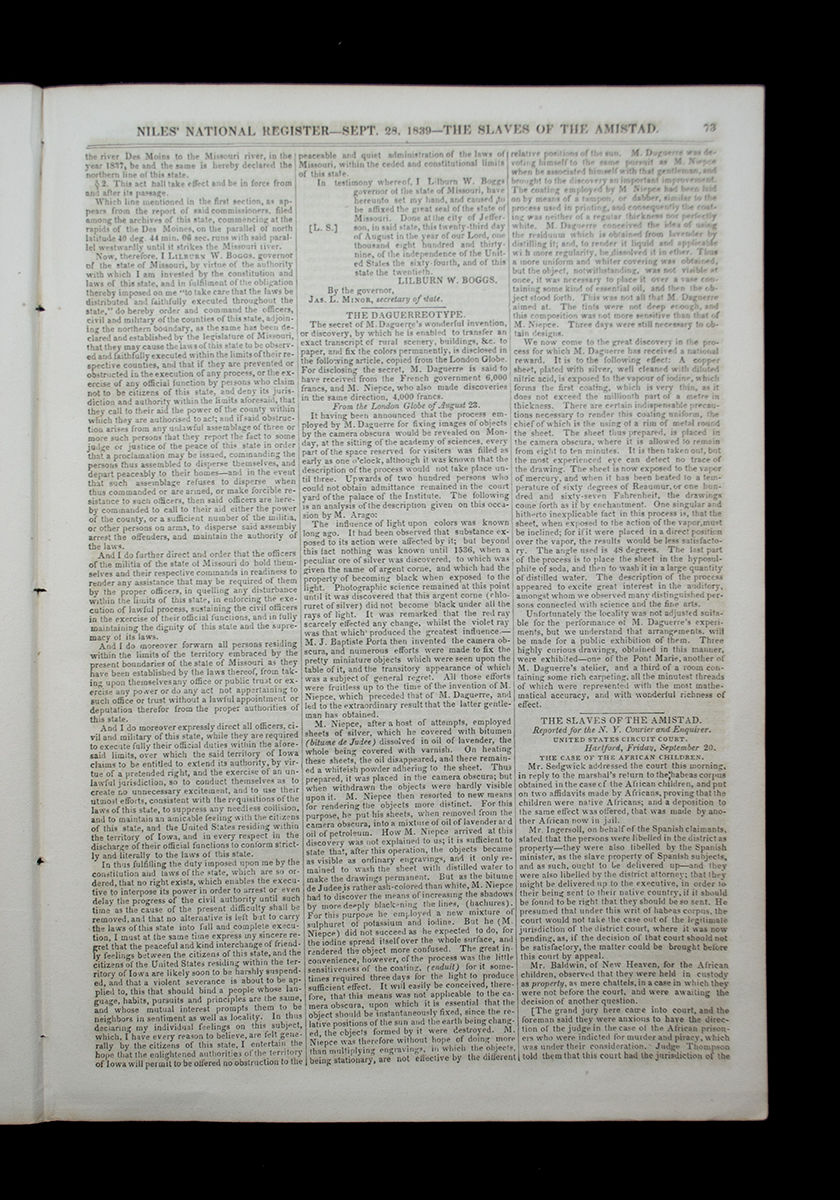
Baltimore, 1839. ANTI-SLAVERY. The Slaves of the Amistad [The Amistad Affair] [within] Niles' National Register. Baltimore: William Ogden Niles, Saturday, September 28, 1839.
An early account of the legal proceedings in the Amistad affair, (which led way to the Supreme Court case United States v. Schooner Amistad; 1841), printed within Niles' National Register published by William Ogden Niles, Fifth series No. 5-Vol. VII. Vol. LVII- Whole No. 1, 461. Published on Saturday, September 28, 1839. Quarto (12 1/8 x 8 3/4 inches; 307 x 213 mm). 16 pp. (Pages 65-80).
Additionally, directly preceding this is an article on the birth of photography. The article is entitled "The Daguerreotype" and is announcing the invention of the daguerreotype, which was discovered by M. Daguerre in France in 1839. This new process of photography made it simpler that previous processes, enabling photography to be more accessible to a broader group of people.
Self-bound and hand-sewn with stab holes present on inner margin. Very good.
The Supreme court case that came about because of the Amistad affair is considered the most important court case involving slavery prior to the Dred Scott case.
[Together with]:
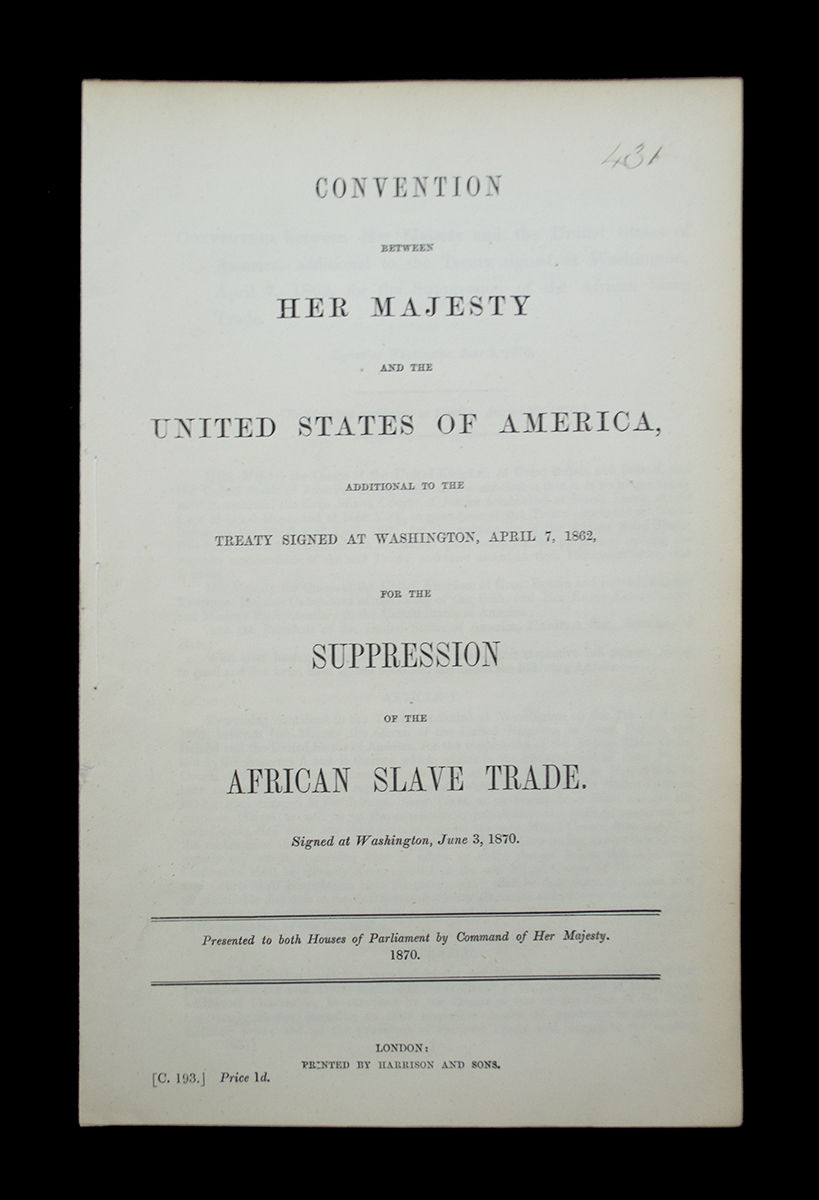
Convention between Her Majesty and the United States of America. Additional to the Treaty Signed at Washington, April 7 1862, for the Suppression of the African Slave Trade. Signed at Washington, June 3, 1870. Presented to both Houses of Parliament by Command of Her Majesty. London: Harrison and Sons, [1870.] Quarto (12 1/2 x 8 inches; 317 x 202 mm). [2], 4. [2] pp.
Self-bound and hand-sewn with stab holes present on inner margin. Previous owner's old ink numbers on the upper corner of each leaf. Still very good.
"Signed in Washington April 7, 1862. The treaty, negotiated by Lord Lyons and Secretary of State Seward, sets forth conditions under which either nation may search any merchant vessels of the other which may 'be suspected of being engaged in the African Slave Trade, or of having been fitted out for that purpose.' 'All negroes who are found on board [such ships were] immediately set at liberty.'" (NYPL)
[And]:
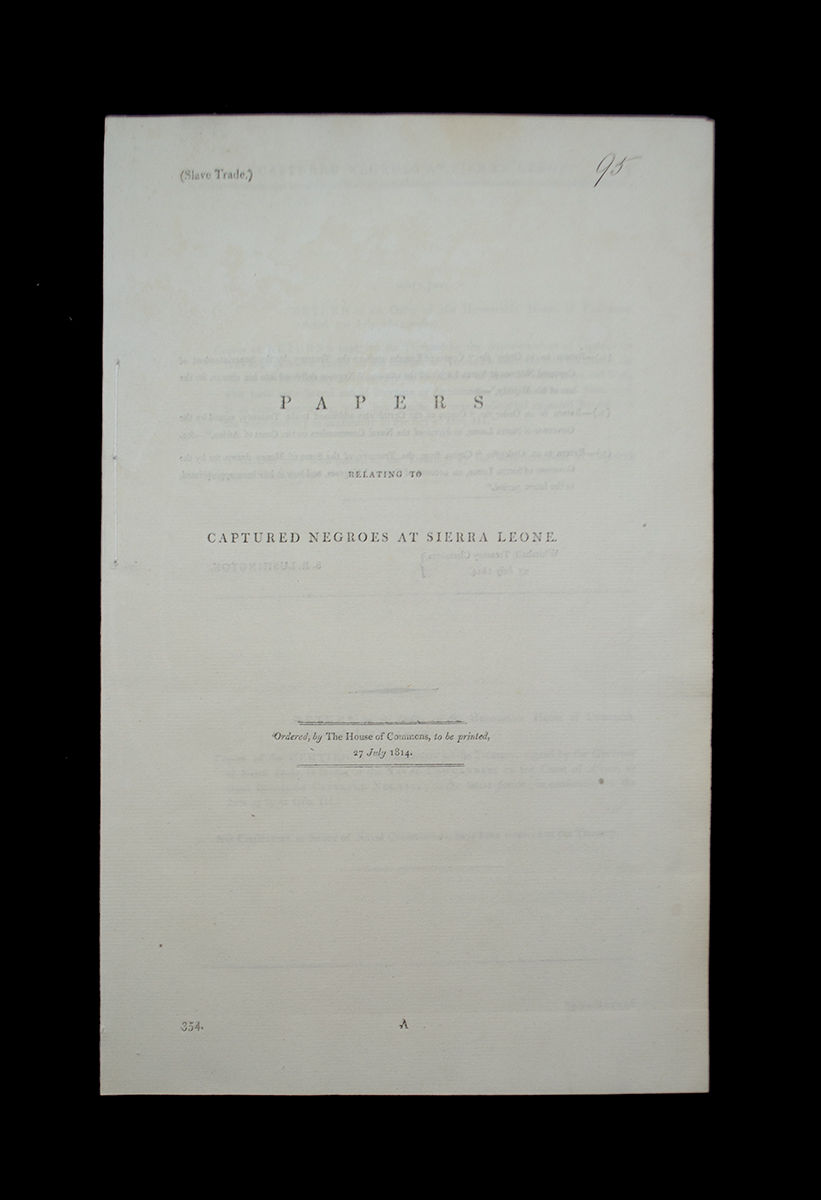
Papers Relating to Captured Negroes at Sierra Leone. Ordered, by The House of Commons, to be printed, 27 July 1814. Quarto (12 1/2 x 8 inches; 317 x 202 mm). 5, [3] pp. Self-bound and hand-sewn with stab holes present on inner margin. Previous owner's old ink numbers on the upper corner of each leaf. Very good.
[And]:
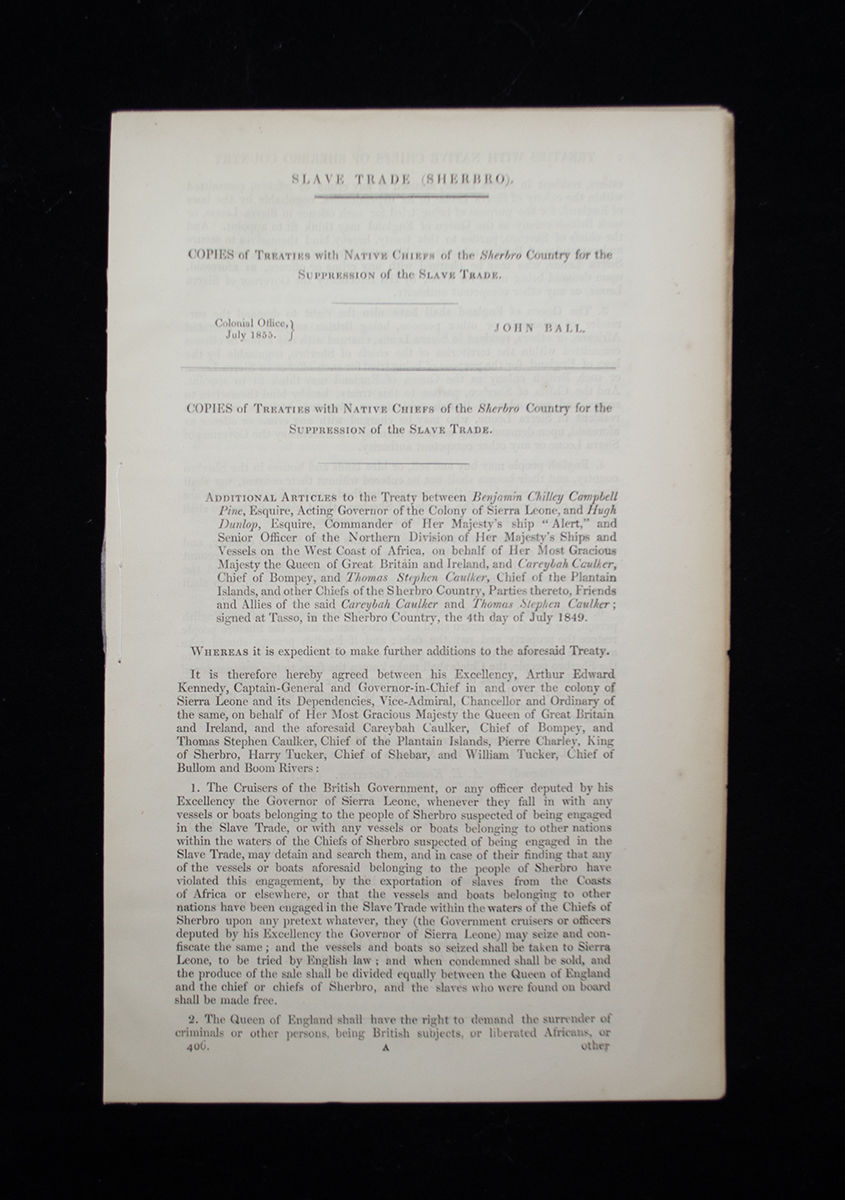
BALL, John. Slave Trade (Sherbro). Copies of Treaties with Native Chiefs of the Sherbro Country for the Suppression of the Slave Trade. Colonial Office, July 1855. Quarto (12 1/2 x 8 inches; 317 x 202 mm). 6 pp.
Self-bound and hand-sewn with stab holes present on inner margin. Very good.
"In 1787, British philanthropists founded the 'Province of Freedom' which later became Freetown, a British crown colony and the principal base for the suppression of the slave trade. By 1792, 1200 freed slaves from Nova Scotia joined the original settlers, the Maroons. Another group of slaves rebelled in Jamaica and travelled to Freetown in 1800. Through the efforts of men such as William Wilberforce, Thomas Clarkson and Granville Sharpe, Lord Mansfield formed an administration in 1806, which was instrumental in the British Empire's abolition of the Trans-Atlantic slave trade (1807). The British established a naval base in Freetown to patrol against illegal slave ships. A fine of £100 was established for every slave found on a British ship. In 1808 Sierra Leone officially became a crown colony with the land possessions of Sierra Leone Company (formerly known as St George's Bay Company) transferred to the crown. The colony was dedicated to demonstrating the principles of Christianity, "civilisation" and commerce. In 1833 British Parliament passed the Emancipation Act, and in 1833 slavery was finally abolished. It wasn't until 1865; the United States passed the 13th amendment abolishing slavery. By 1855, over 50,000 freed slaves has been settled in Freetown." (Visit Siera Leon dot org)
"The history of Sierra Leone is one of departures and arrivals. Between 1581 and 1867, European slave traders carried away an estimated 389,000 Africans from the regions in and around what now constitutes the country of Sierra Leone. In the late eighteenth century, as Britain began contemplating the legal abolition of the slave trade, Sierra Leone became the destination for a reverse migration of enslaved Africans and their descendants who sought to return from the Americas. Between 1787 and 1800 more than two thousand formerly enslaved men, women, and children sailed from Britain, Nova Scotia, and Jamaica to populate a nascent colony financed by British abolitionists and like-minded businessmen." (Anderson, Richard)
"In February of 1839, Portuguese slave hunters abducted a large group of Africans from Sierra Leone and shipped them to Havana, Cuba, a center for the slave trade. This abduction violated all of the treaties then in existence. Two Spanish plantation owners, Pedro Montes and Jose Ruiz, purchased 53 Africans and put them aboard the Cuban schooner Amistad to ship them to a Caribbean plantation. On July 1, 1839, the Africans seized the ship, killed the captain and the cook, and ordered Montes and Ruiz to sail to Africa. Montes and Ruiz actually steered the ship north; and on August 24, 1839, the Amistad was seized off Long Island, NY, by the U.S. brig Washington. The schooner, its cargo, and all on board were taken to New London, CT. The plantation owners were freed and the Africans were imprisoned on charges of murder. Although the murder charges were dismissed, the Africans continued to be held in confinement and the case went to trial in the Federal District Court in Connecticut. The district court ruled that the case fell within Federal jurisdiction and that the claims to the Africans as property were not legitimate because they were illegally held as slaves. The U.S. District Attorney filed an appeal to the Supreme Court... In the trial before the Supreme Court, the Africans were represented by former U.S. President, and descendant of American revolutionaries, John Quincy Adams... For 8 ½ hours, the 73-year-old Adams passionately and eloquently defended the Africans' right to freedom on both legal and moral grounds, referring to treaties prohibiting the slave trade and to the Declaration of Independence. The Supreme Court decided in favor of the Africans, stating that they were free individuals. Kidnapped and transported illegally, they had never been slaves. Senior Justice Joseph Story wrote and read the decision: "...it was the ultimate right of all human beings in extreme cases to resist oppression, and to apply force against ruinous injustice." The opinion asserted the Africans' right to resist "unlawful" slavery. The Court ordered the immediate release of the Amistad Africans. Thirty five of the survivors were returned to their homeland." (The National Archives).
HBS 69176.
$2,250.
An early account of the legal proceedings in the Amistad affair, (which led way to the Supreme Court case United States v. Schooner Amistad; 1841), printed within Niles' National Register published by William Ogden Niles, Fifth series No. 5-Vol. VII. Vol. LVII- Whole No. 1, 461. Published on Saturday, September 28, 1839. Quarto (12 1/8 x 8 3/4 inches; 307 x 213 mm). 16 pp. (Pages 65-80).
Additionally, directly preceding this is an article on the birth of photography. The article is entitled "The Daguerreotype" and is announcing the invention of the daguerreotype, which was discovered by M. Daguerre in France in 1839. This new process of photography made it simpler that previous processes, enabling photography to be more accessible to a broader group of people.
Self-bound and hand-sewn with stab holes present on inner margin. Very good.
The Supreme court case that came about because of the Amistad affair is considered the most important court case involving slavery prior to the Dred Scott case.
[Together with]:
Convention between Her Majesty and the United States of America. Additional to the Treaty Signed at Washington, April 7 1862, for the Suppression of the African Slave Trade. Signed at Washington, June 3, 1870. Presented to both Houses of Parliament by Command of Her Majesty. London: Harrison and Sons, [1870.] Quarto (12 1/2 x 8 inches; 317 x 202 mm). [2], 4. [2] pp.
Self-bound and hand-sewn with stab holes present on inner margin. Previous owner's old ink numbers on the upper corner of each leaf. Still very good.
"Signed in Washington April 7, 1862. The treaty, negotiated by Lord Lyons and Secretary of State Seward, sets forth conditions under which either nation may search any merchant vessels of the other which may 'be suspected of being engaged in the African Slave Trade, or of having been fitted out for that purpose.' 'All negroes who are found on board [such ships were] immediately set at liberty.'" (NYPL)
[And]:
Papers Relating to Captured Negroes at Sierra Leone. Ordered, by The House of Commons, to be printed, 27 July 1814. Quarto (12 1/2 x 8 inches; 317 x 202 mm). 5, [3] pp. Self-bound and hand-sewn with stab holes present on inner margin. Previous owner's old ink numbers on the upper corner of each leaf. Very good.
[And]:
BALL, John. Slave Trade (Sherbro). Copies of Treaties with Native Chiefs of the Sherbro Country for the Suppression of the Slave Trade. Colonial Office, July 1855. Quarto (12 1/2 x 8 inches; 317 x 202 mm). 6 pp.
Self-bound and hand-sewn with stab holes present on inner margin. Very good.
"In 1787, British philanthropists founded the 'Province of Freedom' which later became Freetown, a British crown colony and the principal base for the suppression of the slave trade. By 1792, 1200 freed slaves from Nova Scotia joined the original settlers, the Maroons. Another group of slaves rebelled in Jamaica and travelled to Freetown in 1800. Through the efforts of men such as William Wilberforce, Thomas Clarkson and Granville Sharpe, Lord Mansfield formed an administration in 1806, which was instrumental in the British Empire's abolition of the Trans-Atlantic slave trade (1807). The British established a naval base in Freetown to patrol against illegal slave ships. A fine of £100 was established for every slave found on a British ship. In 1808 Sierra Leone officially became a crown colony with the land possessions of Sierra Leone Company (formerly known as St George's Bay Company) transferred to the crown. The colony was dedicated to demonstrating the principles of Christianity, "civilisation" and commerce. In 1833 British Parliament passed the Emancipation Act, and in 1833 slavery was finally abolished. It wasn't until 1865; the United States passed the 13th amendment abolishing slavery. By 1855, over 50,000 freed slaves has been settled in Freetown." (Visit Siera Leon dot org)
"The history of Sierra Leone is one of departures and arrivals. Between 1581 and 1867, European slave traders carried away an estimated 389,000 Africans from the regions in and around what now constitutes the country of Sierra Leone. In the late eighteenth century, as Britain began contemplating the legal abolition of the slave trade, Sierra Leone became the destination for a reverse migration of enslaved Africans and their descendants who sought to return from the Americas. Between 1787 and 1800 more than two thousand formerly enslaved men, women, and children sailed from Britain, Nova Scotia, and Jamaica to populate a nascent colony financed by British abolitionists and like-minded businessmen." (Anderson, Richard)
"In February of 1839, Portuguese slave hunters abducted a large group of Africans from Sierra Leone and shipped them to Havana, Cuba, a center for the slave trade. This abduction violated all of the treaties then in existence. Two Spanish plantation owners, Pedro Montes and Jose Ruiz, purchased 53 Africans and put them aboard the Cuban schooner Amistad to ship them to a Caribbean plantation. On July 1, 1839, the Africans seized the ship, killed the captain and the cook, and ordered Montes and Ruiz to sail to Africa. Montes and Ruiz actually steered the ship north; and on August 24, 1839, the Amistad was seized off Long Island, NY, by the U.S. brig Washington. The schooner, its cargo, and all on board were taken to New London, CT. The plantation owners were freed and the Africans were imprisoned on charges of murder. Although the murder charges were dismissed, the Africans continued to be held in confinement and the case went to trial in the Federal District Court in Connecticut. The district court ruled that the case fell within Federal jurisdiction and that the claims to the Africans as property were not legitimate because they were illegally held as slaves. The U.S. District Attorney filed an appeal to the Supreme Court... In the trial before the Supreme Court, the Africans were represented by former U.S. President, and descendant of American revolutionaries, John Quincy Adams... For 8 ½ hours, the 73-year-old Adams passionately and eloquently defended the Africans' right to freedom on both legal and moral grounds, referring to treaties prohibiting the slave trade and to the Declaration of Independence. The Supreme Court decided in favor of the Africans, stating that they were free individuals. Kidnapped and transported illegally, they had never been slaves. Senior Justice Joseph Story wrote and read the decision: "...it was the ultimate right of all human beings in extreme cases to resist oppression, and to apply force against ruinous injustice." The opinion asserted the Africans' right to resist "unlawful" slavery. The Court ordered the immediate release of the Amistad Africans. Thirty five of the survivors were returned to their homeland." (The National Archives).
HBS 69176.
$2,250.
Details
Title
Four Papers Related to Anti-Slavery
Author
ANTI-SLAVERY
Condition
Unknown
Publisher
Baltimore
Date
1839