

Public Opinion
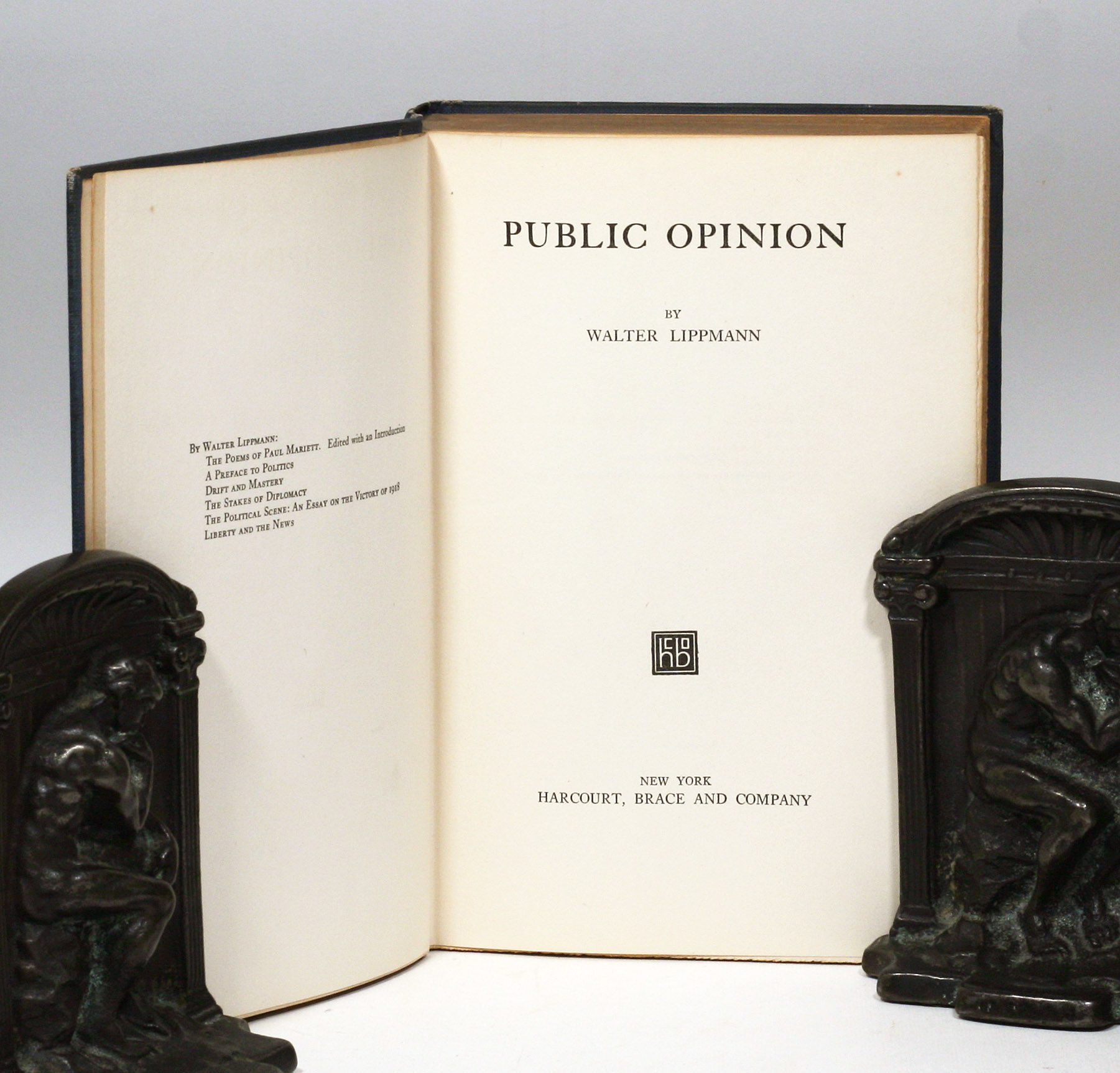
- SIGNED Original Cloth
- New York: Harcourt, Brace and Company, 1922
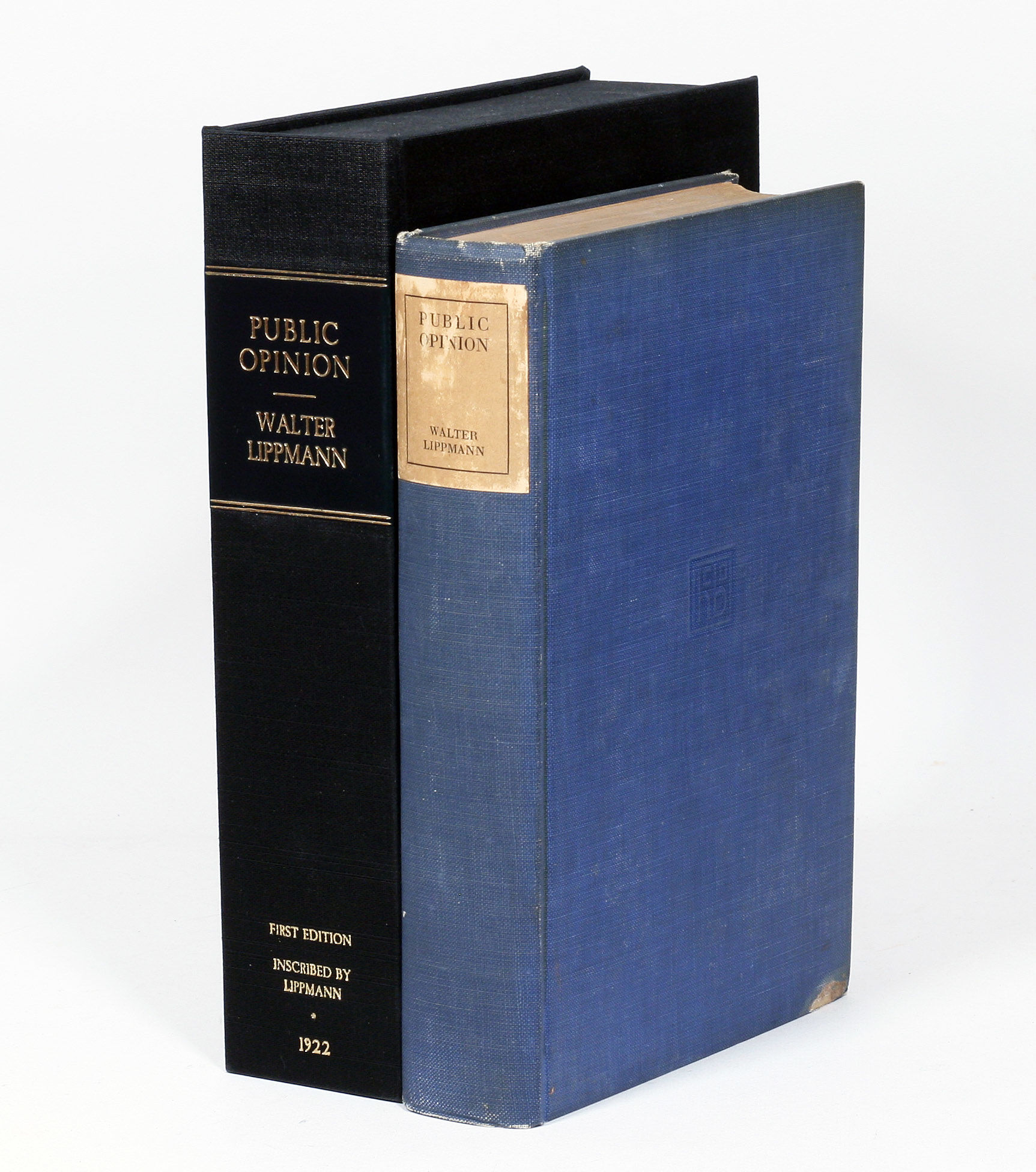
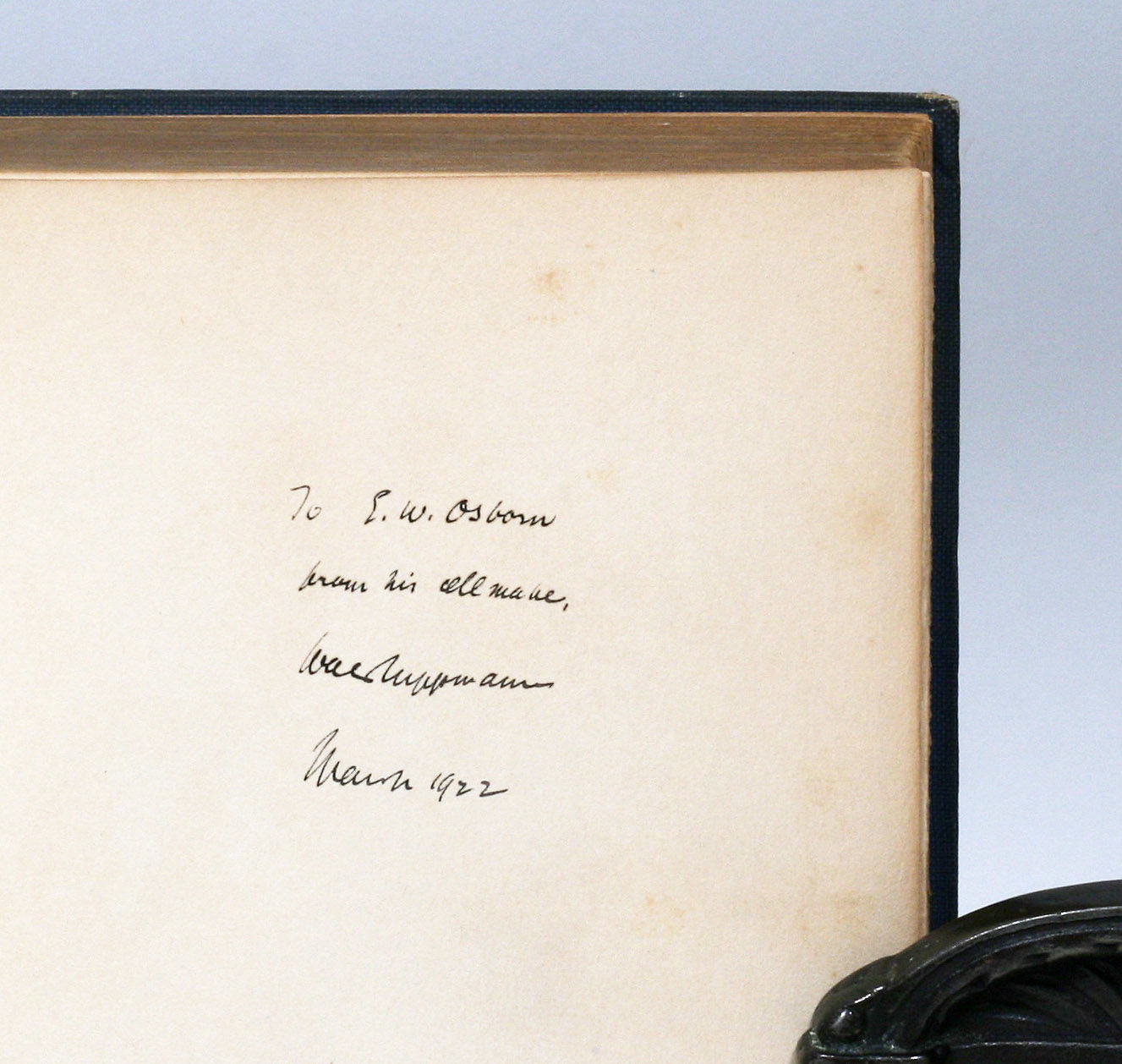
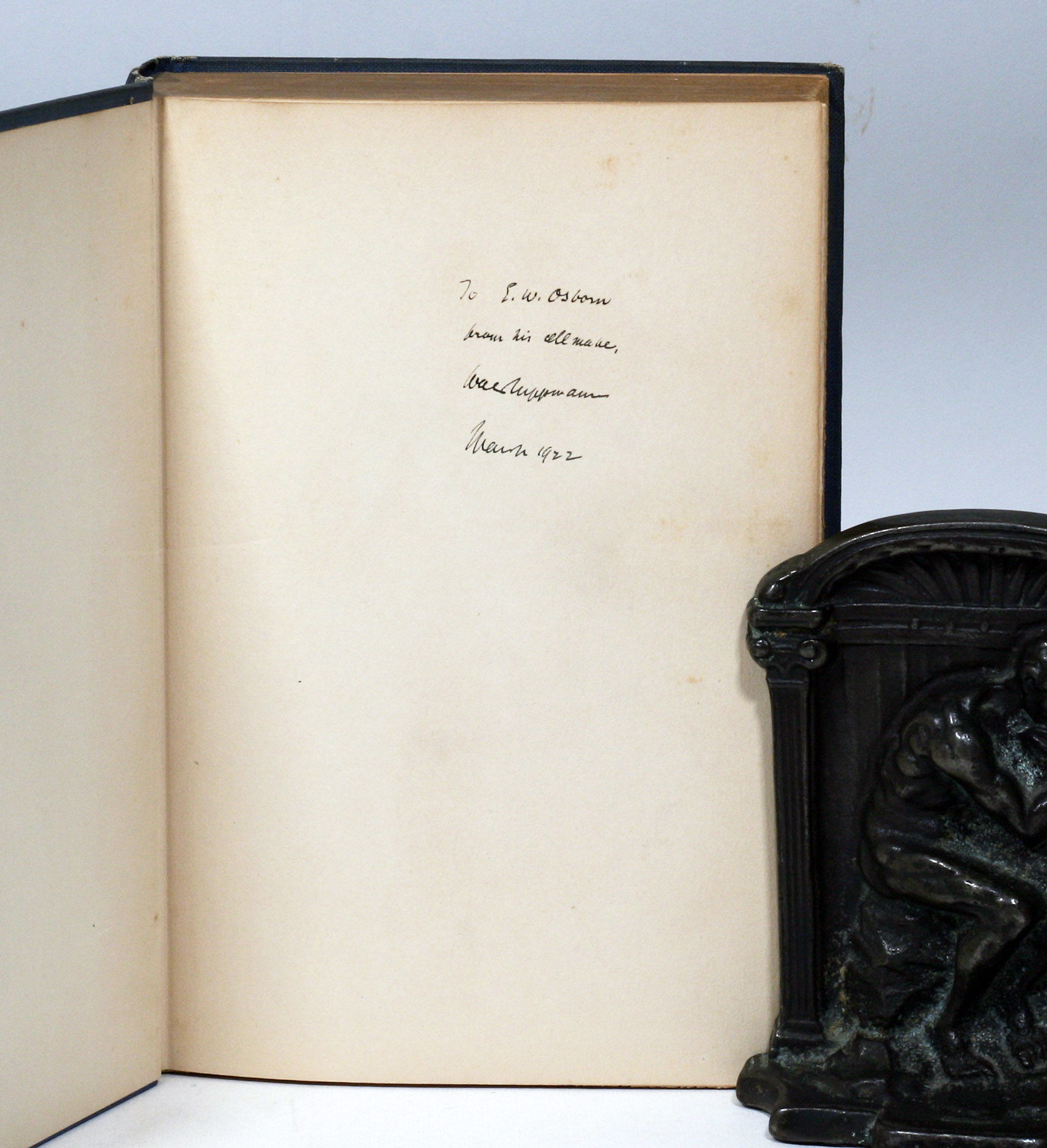
New York: Harcourt, Brace and Company, 1922. First Edition. Original Cloth. Very Good. RARE SIGNED FIRST EDITION OF WALTER LIPPMANN'S PRESCIENT TEXT EXAMINING THE INTERPLAY BETWEEN MEDIA, PUBLIC OPINION, AND DEMOCRACY. Signed and inscribed by Lippmann: "To E.W. Osborn / from his cell mate [?] / Walt Lippmann / March 1922." Everything old is new again. "For when there's panic in the air, with one crisis tripping over the heels of another, actual dangers mixed with imaginary scares, there is no chance at all for the constructive use of reasons, and any order soon seems preferable to any disorder." These words, written by Walter Lippmann in 1922 in Public Opinion, are as true today as they were over 100 years ago.
Walter Lippmann (1889-1974), the father of modern journalism, won a Pulitzer Prize in 1958 and 1962, and a Presidential Medal of Freedom from President Johnson in 1964. He was also one of the the founding editors of the New Republic and the author of The New York Herald Tribune's nationally syndicated column "Today and Tomorrow" from 1931 to 1967 in which he shared his insights and analysis on domestic and international affairs. Lippmann was a political philosopher and President Wilson drew upon his ideas for, among other things, the post-World War I settlement plan (Fourteen Points). Lippmann was a confidante of every president from Teddy Roosevelt to Richard Nixon and a significant voice in global geopolitics. In April 1961 Soviet leader Nikita Khrushchev, dealing with a crisis in Berlin, asked Lippmann to delay a planned interview in Russia. When Lippmann said no, Khrushchev rearranged his plans to accommodate an interview with Lippmann (Harsch). The articles that resulted won Lippmann his second Pulitzer Prize.
We have his preeminent text Public Opinion on offer. This work, about the media's role in shaping public opinion, is widely considered to be "the founding book of modern journalism" (Carey, 20). In this text, Lippmann exposed how the media shapes public perception and how that perception impacts society. His incisive analysis is increasingly relevant 100 years later and his work continues to be cited and built upon by those seeking to understand the complexities of modern public life.
Lippmann was an intellectual and believed that journalism was vitally important as both a profession and an instrument of democracy. Public Opinion was prescient and foundational in media studies. In this text he coined the modern psychological meaning of the term "stereotype," which he defined as "cognitive shortcuts" used to navigate the complexities of the world. He also introduced the concept of "manufacture of consent," arguing that the media could shape public perception through framing and selective presentation of facts. Though this idea is commonly understood in today's media environment where commercialization and partisanship often upstage journalistic integrity, it was novel 100 years ago. He called this subjective, simplified version of reality the "pseudo-environment." Lippmann worried that these "pictures in our heads" led to opinions based on distorted or incomplete information, resulting in polarization and misinformation.
In Public Opinion Lippmann shared his concerns about the fate of democracy, believing that society's complexity made it difficult for average citizens to fully understand and engage with public issues. He also shared his suspicion that some news stories were dominated by the emotions and hopes of the journalist rather than by the facts. To address these concerns, he advocated for expert analysis and interpretation to guide public opinion as well as elevated journalistic standards and professionalism. His analyses in this book provide context and lessons for political discourse and policy-making. While his ideas were ground-breaking and controversial in 1922, Lippmann's concerns about the media are indisputable. The modern media market is more competitive, more fragmented, and more profit-driven than that of Lippmann's day.
As a life-long journalist Lippmann made many friends in the industry. While working at The New York World in the early 1920s, he met E. William Osborn, a drama critic and long-time editor. This copy that we have on offer is inscribed to Osborn, a member of the editorial staff of The New York World for 42 years.
It's been 50 years since Walter Lippmann died, yet journalists today continue to grapple with many of the questions that defined Lippmann's life and career: How should news be created? What is the role of the media in shaping public opinion? How does one balance reporting and commentary? How do stereotypes affect public perception? What are the limitations of individual understanding in a complex world?
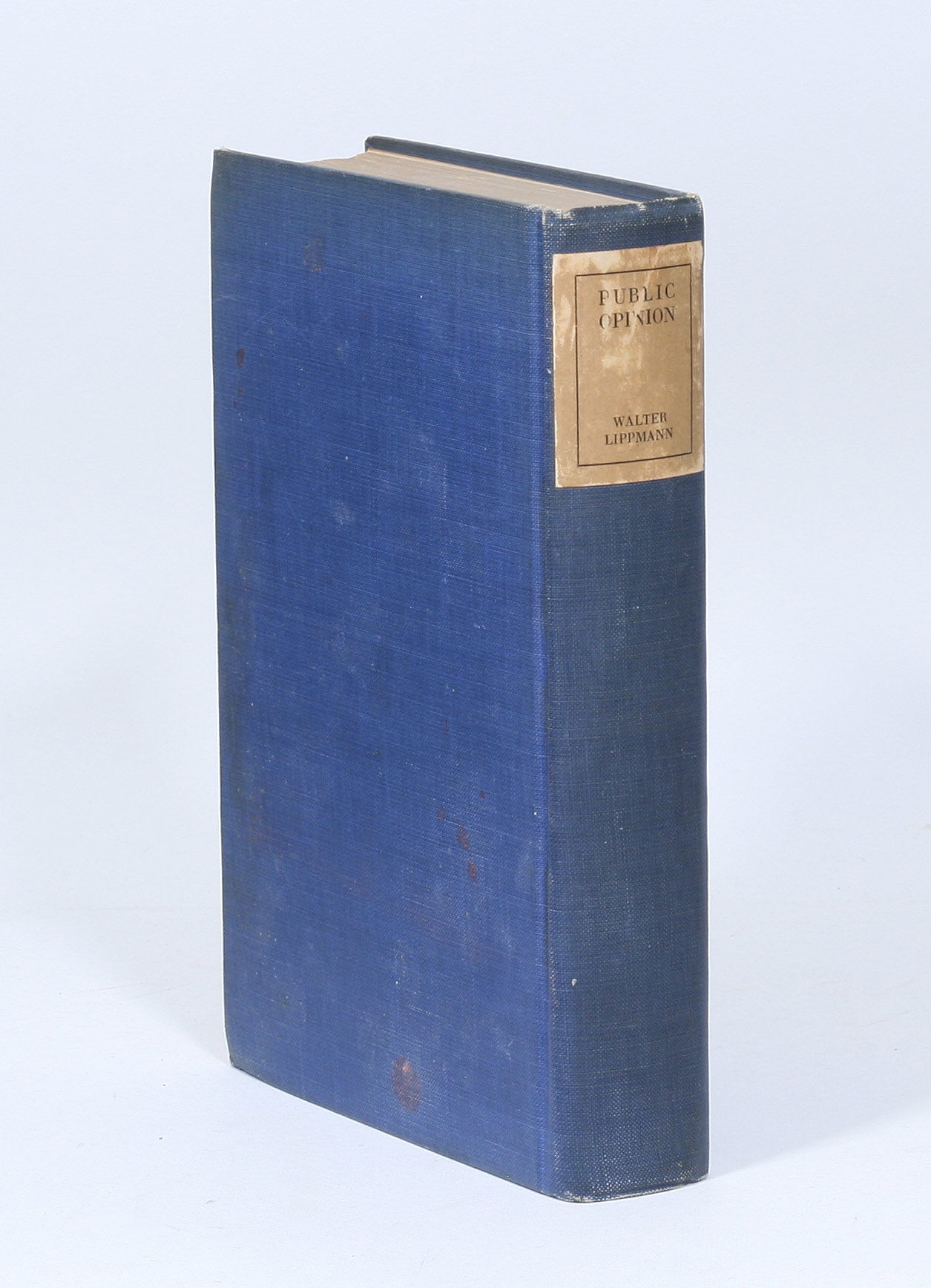
New York: Harcourt, Brace and Company, 1922. Octavo, original cloth with paper spine label; custom box. Without the exceedingly rare dust jacket (we've never seen an example of the jacket). Some wear to cloth, with fraying at bottom corner of front panel, mild rubbing to spine label. A few early notations in text (underlinings and marginal lines), likely by Osborn. Notably, without any library stamps (a common problem with this book). A very good copy, exceptionally rare signed.
References:
James W. Carey, "The Press and the Public Discourse." The Center Magazine. March 1987.
Marquis W. Childs and James Reston, eds. Walter Lippmann and His Times. New York: Harcourt, Brace, 1959.
Christopher Daly. Covering America: A Narrative History of a Nation's Journalism. University of Massachusetts Press, 2012.
Joseph C. Harsch. "Lippmann: statesman at a typewriter." The Christian Science Monitor, September 8, 1980.
Nancy Snow. Information War: American Propaganda, Free Speech and Opinion Control Since 9/11. Canada: Seven Stories, 2003.
Ronald Steel. "Lippmann, Walter." American National Biography, February 2000.
Details
Title
Public Opinion
Author
LIPPMANN, WALTER
Binding
Original Cloth
Condition
Very Good
Publisher
Harcourt, Brace and Company: New York
Date
1922
Edition
First Edition