

[Obituary Notice of] Miss Caroline Lucretia Herschel, Astronomische Nachrichten, No. 629
![[Obituary Notice of] Miss Caroline Lucretia Hersch](https://d3525k1ryd2155.cloudfront.net/h/216/109/1614109216.0.x.jpg)
- Astronomische Nachrichten, 1848
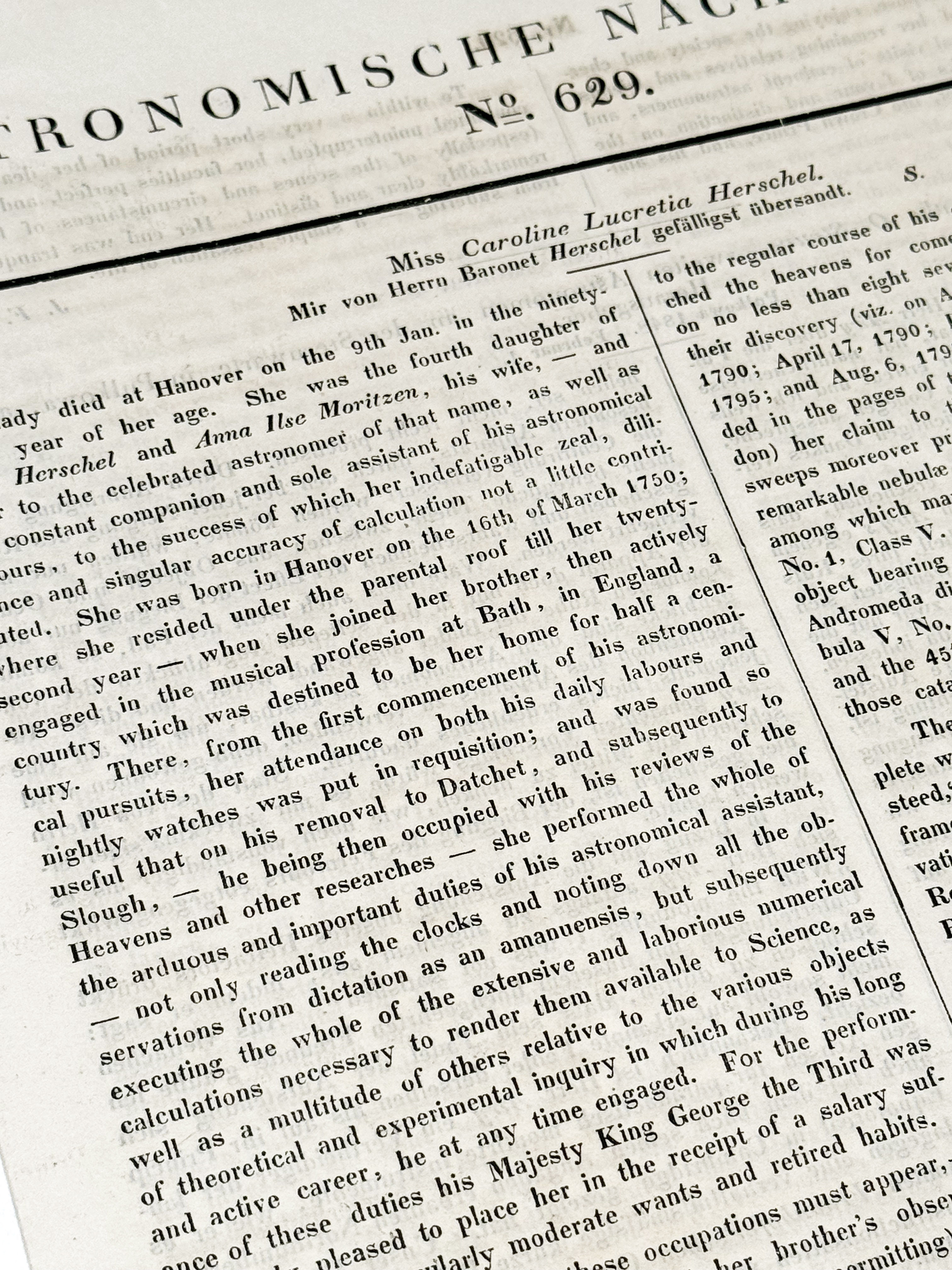
Astronomische Nachrichten, 1848. first edition. Fine. SIGNIFICANT TRIBUTE TO THE WORLD'S FIRST PROFESSIONAL FEMALE ASTRONOMER. Standing at just 4 feet 3 inches tall, under a 40-foot telescope, Caroline Herschel's small size belies her immense scientific accomplishments. Though she disliked any praise that diminished her older brother William's achievements, she was a giant in the field of astronomy in the late 18th and early 19th centuries. Her accomplishments enabled generations of women to develop their careers in the sciences, a field once exclusively reserved for men. The incredible life of Caroline Herschel was memorialized in this obituary which we have on offer, published in this pristine copy of Astronomische Nachrichten.
Astronomische Nachrichten, also known as Astronomical Notes, is the oldest continuously published astronomy journal. Founded in 1821 by German astronomer H.C. Schumacher under the patronage of King Christian VIII of Denmark, it quickly became the world's leading professional astronomy publication. Astronomische Nachrichten has published more than 300 volumes documenting and celebrating the progress of astronomy research over the last 200 years.
Stunted by typhus as a child, Caroline was not considered a suitable candidate for marriage. Through the age of 22, she lived in the home where she was born, acting as a servant to her own family. In 1772, an invitation from her brother William to join him in Bath, England, changed the course of her life and the course of astronomy. Like her brother, she was captivated by the night sky. In 1774 as William was building his own telescope to observe the stars, he recognized Caroline's aptitude for mathematical calculations. Together they surveyed the skies, William entrusting Caroline with planning each night's observation schedule.
After William discovered Uranus in 1782 and was appointed to be the personal astronomer to King George III, Caroline began to gain more recognition as an astronomer in her own right. Today, scientists acknowledge that her contributions were vital to William's success. As written in this obituary, written by her nephew, John Herschel:
"There, from the first commencement of his astronomical pursuits, her attendance on both his daily labours and nightly watches was put in requisition; and was found so useful, that...she performed the whole of the arduous and important duties of his astronomical assistant, not only reading the clocks and noting down all the observations from dictation...but subsequently executing the whole of the extensive and laborious numerical calculations necessary to render them available to science...For the performance of these duties his Majesty King George the Third was graciously pleased to place her in the receipt of a salary sufficient for her singularly moderate wants and retired habits."
Caroline received an annual salary of fifty pounds from King George III, making her the first woman in science to receive compensation for her academic work and research (Lubbock, 172). In addition to assisting William, Caroline continued to perform and document the extensive calculations that accompanied their research. They were a remarkable team that swept the visible sky with their telescopes, discovering 2400 nebulae (Hoskin).
Caroline also made her own observations at the telescope, finding her first celestial object in 1783. Her most significant contributions to astronomy were the discoveries of eight comets, including the periodic comet 35P/Herschel-Rigollet, named after her. The first woman to discover a comet, she held the record for most comets discovered by a woman until the 1980s (Olson and Pasachoff, 80). She also observed many nebulae and star clusters, cataloging and identifying numerous astronomical objects.
Caroline presented new findings to the Royal Astronomical Society, including revisions to John Flamsteed's British Catalogue, the most influential star catalog of that time. In the span of twenty months, Caroline identified and submitted a list of many mistakes in the British Catalogue as well as a list of 560 stars that had been omitted in Flamsteed's original publication. Her updates were published by the Royal Society in 1798 and members of the academy noted that her contributions were "unparalleled in either magnitude or importance" (Hoskins).
Following William's death in 1822, Caroline mapped out and published the exact placement of their discoveries including Uranus and 2,500 clusters, comets, and nebulae. This work, along with her earlier publications, earned her an honorary membership to the Royal Astronomical Society (1835), and in 1838 she became the first female member of the Royal Irish Academy. For her achievements in the field of astronomy, she was awarded the King of Prussia's Gold Medal of Science in 1846. She died two years later, at the age of ninety-seven, well-received in society and highly recognized for her talents. It is a tribute to her accomplishments that her obituary was featured in Astronomische Nachrichten, the leading professional astronomy journal of her time.
The complete obituary:
Astronomische Nachrichten No. 629
Miss Caroline Lucretia Herschel
Mir von Herrn Baronet Herschel gefälligst übersandt. S
This lady died at Hanover on the 9th of Jan in the ninety-eighth year of her age. She was the fourth daughter of Isaac Herschel and Anna Ilse Moritzen, his wife, - and sister to the celebrated astronomer of that name, as well as the constant companion and sole assistant of his astronomical labours, to the success of which her indefatigable zeal, diligence, and singular accuracy of calculation not a little contributed. She was born in Hanover on the 16th of March 1750; where she resided under the parental roof till her twenty second year - when she joined her brother, then actively engaged in the musical profession in Bath, in England, a country which was destined to be her home for half a century. There, from the first commencement of his astronomical pursuits, her attendance on both his daily labours and nightly watches was put in requisition; and was found so useful that on his removal to Datchet, and subsequently to Slough, - he being then occupied with his reviews of the heavens and other researches - she performed the whole of the arduous and important duties of his astronomical assistant , - not only reading the clocks and noting down all the observations from dictation as an amanuensis, but subsequently executing the whole of the extensive and laborious numerical calculations necessary to render them available to Science, as well as a multitude of others relative to the various objects of theoretical and experimental inquiry in which during his long and active career he at any time engaged. For the performance of these duties his Majesty King George the Third was graciously pleased to place her in the receipt of a salary sufficient for her singularly moderate wants and retired habits.
Arduous, however, as these occupations must appear, - especially when it is considered that her brother's observations were always carried on (circumstances permitting) till day break, without regard to season, and indeed chiefly in the winter, - they proved insufficient to exhaust her activity. In their intervals she found time both for actual astronomical observations of her own and for the execution of more than one work of great extent and utility.
The observations here alluded to were made with a small Newtonian sweeper constructed for her by her brother; with which, whenever his occasional absence or any interruption to the regular course of his observations permitted, she searched the heavens for comets, - and that so effectively as on no less than eight several occasions to be rewarded by their discovery (viz . on Aug. 1, 1786 ; Dec. 21, 1788 ; Jan. 9, 1790 ; April 17, 1790 ; Dec. 15, 1791 ; Oct. 7, 1793 ; Nov. 7, 1795 ; and Aug. 6, 1797). On five of these occasions (recorded in the pages of the "Philosophical Transactions" of London) her claim to the first discovery is admitted. These sweeps moreover proved productive of the detection of several remarkable nebulæ and clusters of stars previously unobserved: among which may be specially mentioned the superb Nebula, No. 1, Class V. of Sir William Herschel's catalogues - an object bearing much resemblance to the celebrated nebula in Andromeda discovered by Simon Inarius - as also the Nebula V. No. 18 ; the 12th and 27th clusters of Class VII .; and the 45th, 65th, 72nd, 77th, and 78th, of Class VIII.; of those catalogues.
The astronomical works which she found leisure to complete were: 1st . "A Catalogue of 561 Stars observed by Flamsteed, "but which, having escaped the notice of those who framed the "British Catalogue" from that astronomer's observations, are not therein inserted: 2nd. "A General Index of Reference to every Observation of every Star inserted in the British Catalogue. "These works were published together in one volume by the Royal Society; and to their utility in subsequent researches Mr. Baily, in his "Life of Flamsteed, " pp. 388, 390, bears ample testimony. She further completed the reduction and arrangement as a "Zone Catalogue" of all the nebulæ and clusters of stars observed by her brother in his sweeps a work for which she was honoured with the Gold Medal of the Astronomical Society of London, in 1828, - which Society also conferred on her the unusual distinction of electing her an honorary member.
On her brother's death, in 1822, she returned to Hanover; which she never again quitted, - passing the last twenty-six years of her life in repose, enjoying the society and cherished by the regard of her remaining relatives and friends, gratified by the occasional visits of eminent astronomers, and honoured with many marks of favour and distinction on the part of the King of Hanover, the Crown Prince, and his amiable and illustrious consort. To within a very short period of her death her health continued uninterrupted, her faculties perfect, and her memory (especially of the scenes and circumstances of former days) remarkably clear and distinct. Her end was tranquil and free from suffering - a simple cessation of life.
J.F.W.H.
IN: Astronomische Nachrichten, No. 629, pp. 65-67. The entire issue No. 629 in one large folio sheet uncut, folded to produce four leaves (eight pages, but paginated in columns to produce four page numbers per leaf). Each leaf approximately 23x28 cm. A remarkable survival in fine condition.
References:
Michael Hoskin. "Herschel, Caroline Lucretia (1750-1848), astronomer." Oxford Dictionary of National Biography. September 22, 2005.
Constance Lubbock. The Herschel Chronicle: The Life Story of Sir William Herschel and His Sister Caroline Herschel. Cambridge: Cambridge University Press, 1933.
Roberta J. M. Olson and Jay M. Pasachoff. "The Comets of Caroline Herschel (1750-1848): Sleuth of the Skies at Slough", Culture and Cosmos, 2012.
Details
Title
[Obituary Notice of] Miss Caroline Lucretia Herschel, Astronomische Nachrichten, No. 629
Author
HERSCHEL, CAROLINE LUCRETIA
Condition
Fine
Publisher
Astronomische Nachrichten
Date
1848
Edition
first edition